Battery Management System (BMS) Analog Front End Market Insights
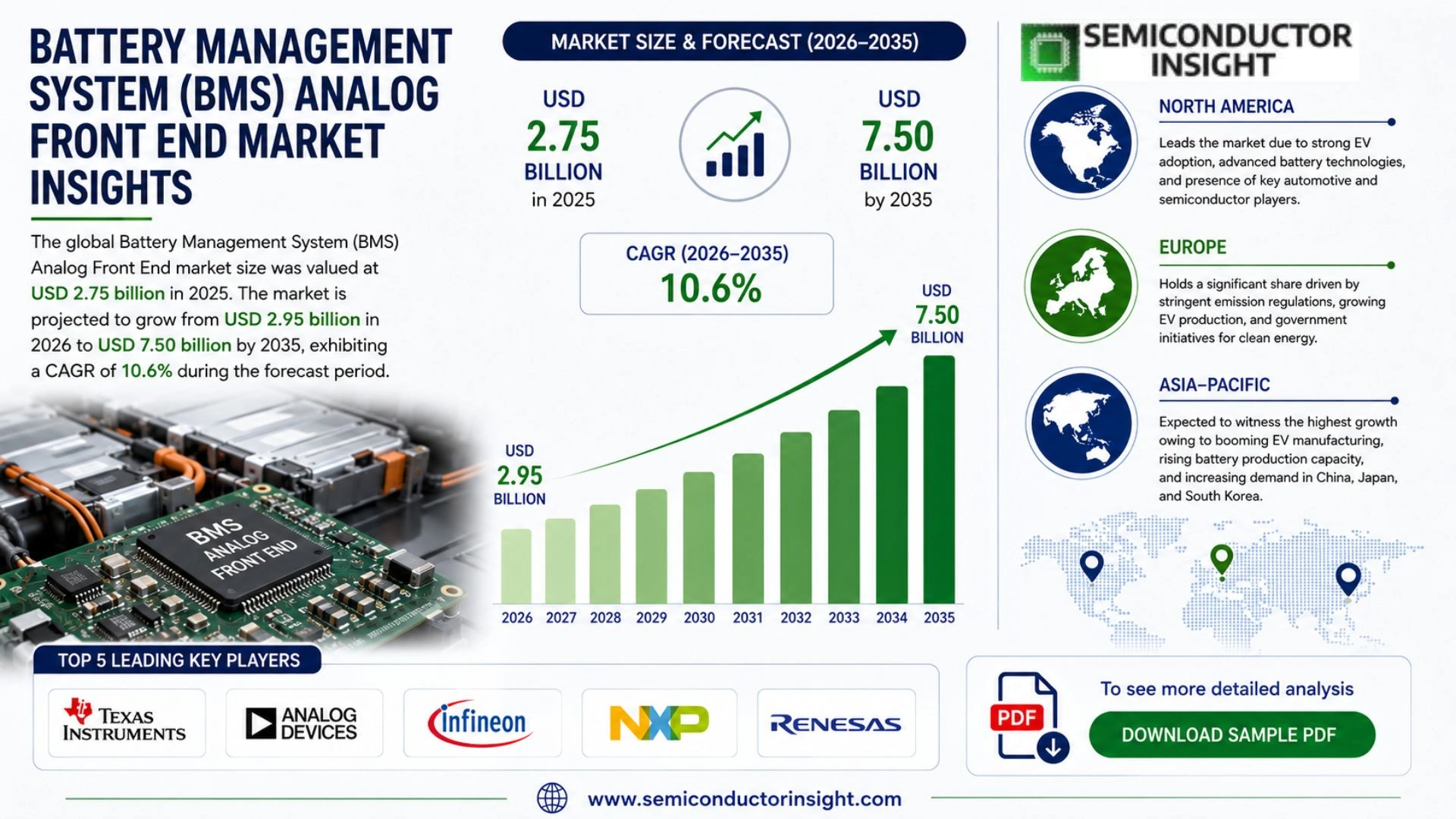
Battery Management System (BMS) Analog Front End Market size was valued at USD 2.75 billion in 2025. The market is projected to grow from USD 2.95 billion in 2026 to USD 7.50 billion by 2035, exhibiting a CAGR of 10.6% during the forecast period.
Battery Management System (BMS) Analog Front End components are specialized integrated circuits designed to monitor critical battery parameters including cell voltages, currents, and temperatures with high precision. These devices serve as the essential interface between the battery cells and the digital processing units within BMS architectures, enabling accurate data acquisition, cell balancing, and protection functions necessary for safe and efficient battery operation.
The market is experiencing robust growth due to several factors, including the rapid adoption of electric vehicles worldwide, expanding renewable energy storage deployments, and increasing demand for advanced battery technologies across consumer electronics and industrial applications. Furthermore, stringent safety regulations and the push toward higher voltage battery systems are driving innovation in AFE solutions. Key players continue to invest in enhanced integration and performance features. For instance, advancements in multi-cell monitoring capabilities and improved isolation technologies are supporting more reliable operation in demanding automotive and energy storage environments. Texas Instruments, Analog Devices, Infineon Technologies, and NXP Semiconductors are among the leading companies operating in the market with comprehensive portfolios of BMS Analog Front End solutions.
MARKET DRIVERS
Rising Electric Vehicle Adoption Fuels Demand for Precision Monitoring
Battery Management System (BMS) Analog Front End Market is experiencing robust growth driven by the accelerating global transition to electric vehicles. AFEs serve as the critical interface for high-accuracy voltage, current, and temperature measurements in multi-cell battery packs, enabling optimal performance and safety in high-voltage architectures such as 800V systems. Leading semiconductor providers continue to advance multi-channel AFE solutions with improved precision and faster sampling rates to support longer range and faster charging requirements.
Expansion in Renewable Energy Storage Applications
Growth in grid-scale and residential energy storage systems further propels demand for reliable BMS Analog Front End components. These systems require robust monitoring across diverse battery chemistries and operating conditions to ensure longevity and efficiency. Integration of advanced AFE ICs supports precise state-of-charge and state-of-health estimation, critical for second-life battery applications and virtual power plant integration.
➤ Advancements in AFE technology, including higher integration and functional safety compliance, are enabling more compact and cost-effective BMS designs across automotive and industrial segments.
Overall, the combination of electrification trends and semiconductor innovations positions the BMS Analog Front End segment for sustained expansion through the coming decade.
MARKET CHALLENGES
Integration Complexity and Functional Safety Requirements
Developing BMS Analog Front End solutions that meet stringent automotive-grade reliability standards, including AEC-Q100 qualification and ISO 26262 functional safety, presents significant engineering hurdles. Ensuring accurate measurements across wide temperature ranges and high common-mode voltages while maintaining low power consumption remains technically demanding.
Supply Chain Vulnerabilities for Advanced Semiconductors
Dependence on specialized analog processes and global semiconductor supply dynamics can lead to potential shortages or increased lead times for high-performance AFE ICs.
Thermal Management and High-Voltage Handling
Managing heat dissipation and providing robust isolation in compact, high-energy-density battery packs continues to challenge AFE designers, particularly for fast-charging applications.
MARKET RESTRAINTS
High Development Costs and System Complexity
Battery Management System (BMS) Analog Front End Market faces restraints from elevated costs associated with designing, qualifying, and producing advanced AFE solutions that incorporate precision analog circuitry, isolation, and communication interfaces. These factors contribute to higher bill-of-materials expenses, particularly for smaller volume or specialized applications. Additionally, the need for extensive validation across varying battery chemistries and pack configurations increases time-to-market and engineering investment requirements for both chip suppliers and system integrators.
MARKET OPPORTUNITIES
Emerging Technologies and Wireless BMS Architectures
Significant opportunities exist in the development of wireless Battery Management System solutions that reduce wiring harness complexity through integrated wireless communication alongside traditional AFE functionality. This trend supports modular battery pack designs and simplifies manufacturing for next-generation EVs and energy storage systems.Expansion into emerging markets, advancements in solid-state batteries, and growing demand for AI-enhanced predictive diagnostics further open avenues for differentiated AFE offerings with embedded intelligence and improved accuracy.
Trends
Rising Adoption of Electric Vehicles and Renewable Energy Storage
Battery Management System (BMS) Analog Front End components are specialized integrated circuits designed to monitor critical battery parameters including cell voltages, currents, and temperatures with high precision. These devices serve as the essential interface between the battery cells and the digital processing units within BMS architectures, enabling accurate data acquisition, cell balancing, and protection functions necessary for safe and efficient battery operation. Battery Management System (BMS) Analog Front End Market is experiencing robust growth driven by the rapid adoption of electric vehicles worldwide and expanding renewable energy storage deployments.
Other Trends
Advancements in Multi-Cell Monitoring and Isolation Technologies
Advancements in multi-cell monitoring capabilities and improved isolation technologies are supporting more reliable operation in demanding automotive and energy storage environments. Stringent safety regulations and the push toward higher voltage battery systems are driving innovation in AFE solutions for Battery Management System (BMS) Analog Front End Market. These developments enable better performance across complex battery packs used in modern applications.
Enhanced Integration in Consumer Electronics and Industrial Applications
Key players continue to invest in enhanced integration and performance features withBattery Management System (BMS) Analog Front End Market. Companies such as Texas Instruments, Analog Devices, Infineon Technologies, and NXP Semiconductors maintain comprehensive portfolios of BMS Analog Front End solutions. This focus supports increasing demand for advanced battery technologies across consumer electronics and industrial applications, where precise monitoring ensures optimal battery life and operational safety. The trend toward greater functional integration helps system designers achieve more compact and efficient BMS designs while maintaining high accuracy in parameter measurement.
COMPETITIVE LANDSCAPE
Key Industry Players
Battery Management System (BMS) Analog Front End Market
Battery Management System (BMS) Analog Front End Market is dominated by leading semiconductor companies with strong expertise in precision analog ICs and power management solutions. Texas Instruments stands out as a market leader, offering a comprehensive portfolio of BMS AFE solutions that deliver high-accuracy cell voltage monitoring, current sensing, and temperature measurement essential for high-voltage battery packs in electric vehicles and energy storage systems. The competitive landscape features a mix of established analog giants and specialized players, with innovation focused on higher channel counts, improved isolation, and integration to support evolving battery architectures.
Other significant players include Analog Devices, Infineon Technologies, and NXP Semiconductors, which maintain robust positions through advanced multi-cell monitoring capabilities and automotive-grade certifications. These companies continue to invest in next-generation AFE technologies to address demands for enhanced safety, efficiency, and scalability across EV, renewable energy, and industrial applications. The market structure remains concentrated among a few key innovators capable of meeting stringent regulatory and performance requirements.
List of Key Battery Management System (BMS) Analog Front End Companies Profiled
- Texas Instruments
- Analog Devices
- Infineon Technologies
- NXP Semiconductors
- Renesas Electronics
- STMicroelectronics
- Maxim Integrated (Analog Devices)
- ON Semiconductor
- Rohm Semiconductor
- Monolithic Power Systems
- ams-OSRAM
- Allegro MicroSystems
- Sensata Technologies
- Eberspächer
- LG Energy Solution (affiliated solutions)
Segment Analysis:
| Segment Category | Sub-Segments | Key Insights |
| By Type |
|
Multi-Cell AFEs stand out as the leading segment due to their ability to simultaneously monitor numerous battery cells with exceptional precision. These solutions excel in delivering synchronized voltage and temperature data across complex battery packs, which is essential for maintaining balance and preventing thermal issues. Their robust design supports advanced cell balancing techniques that enhance overall system longevity and reliability. Industry preference for these devices stems from their seamless integration with digital controllers, enabling real-time decision-making in dynamic operating environments. |
| By Application |
|
Electric Vehicles represent the dominant application area as manufacturers prioritize safety and performance in high-power traction battery systems. AFEs in this space deliver precise monitoring that supports rapid acceleration demands while ensuring protection against overvoltage conditions. They facilitate sophisticated thermal management strategies critical for sustained highway performance and fast-charging cycles. The emphasis on functional safety compliance further drives adoption of advanced AFE solutions tailored for automotive-grade reliability and extended operational life. |
| By End User |
|
Automotive OEMs lead this segment through their stringent requirements for integrated safety architectures in next-generation electric platforms. These end users demand AFEs that offer superior isolation and diagnostic capabilities to meet rigorous certification standards. Their focus on system-level optimization encourages close collaboration with semiconductor suppliers for customized monitoring solutions. This partnership approach results in AFEs that seamlessly embed within broader vehicle control ecosystems, enhancing both performance and user confidence in battery-powered transportation. |
| By Battery Chemistry |
|
Lithium-Ion Focused AFEs dominate due to their optimized circuitry for the unique voltage curves and impedance characteristics of prevailing lithium-based cells. These solutions provide highly accurate state-of-charge estimations that support efficient energy utilization across varying load conditions. Their adaptability to different cell formats enables manufacturers to deploy standardized platforms across multiple product lines. Enhanced protection features specifically tuned for lithium-ion sensitivities contribute to safer operation and reduced warranty claims in end applications. |
| By Integration Level |
|
Highly Integrated SoC solutions are preferred for their compact footprint and reduced system complexity in space-constrained designs. These AFEs consolidate multiple monitoring functions onto a single chip, minimizing interconnects and potential failure points while lowering overall power consumption. The integration enhances signal integrity and simplifies software development for BMS engineers. This approach accelerates time-to-market for battery system developers seeking competitive advantages through streamlined architectures and improved electromagnetic compatibility. |
Regional Analysis: Battery Management System (BMS) Analog Front End Market
Asia-Pacific
The region excels in developing advanced analog front-end technologies featuring higher resolution ADCs, faster communication protocols, and integrated diagnostics. Research institutions and companies invest heavily in miniaturization and functional safety enhancements, keeping Asia-Pacific at the forefront of BMS AFE evolution for next-generation battery systems.
Supportive industrial policies and incentives for electrification bolster adoption of premium BMS Analog Front End components. This regulatory push encourages manufacturers to incorporate sophisticated AFE solutions that enhance battery longevity and safety, solidifying the region’s leadership in sustainable energy technologies.
Deep vertical integration allows rapid iteration and cost-effective scaling of BMS analog front end technologies. Proximity between chip designers, cell manufacturers, and system integrators reduces development cycles and enables tailored AFE solutions that address specific regional performance and environmental challenges.
North America
North America demonstrates robust growth Battery Management System (BMS) Analog Front End Market fueled by expanding electric vehicle production and grid-scale energy storage initiatives. The United States and Canada emphasize technological differentiation through high-safety AFE designs tailored for demanding automotive and industrial applications. Strong focus on domestic semiconductor capabilities and strategic investments in battery innovation drive demand for advanced analog front-end circuits offering superior fault detection and real-time monitoring. Collaborations between automakers and tech suppliers accelerate integration of intelligent BMS solutions, while emphasis on supply chain resilience encourages localized development of reliable AFE components. The region’s stringent regulatory standards for battery safety further propel adoption of premium analog front-end technologies that ensure compliance and performance excellence.
Europe
Europe maintains a sophisticated position Battery Management System (BMS) Analog Front End Market, characterized by rigorous safety standards and sustainability goals. Countries such as Germany, France, and the UK prioritize AFE solutions that support circular economy principles and extended battery life cycles. European manufacturers excel in developing precise analog front-end systems optimized for high-voltage architectures in premium electric vehicles and renewable energy storage. Collaborative research programs across the continent foster innovation in low-power, high-accuracy BMS components. Regulatory frameworks mandating enhanced battery transparency and traceability create sustained opportunities for advanced analog front-end integration, positioning Europe as a key player focused on quality, reliability, and environmental responsibility in BMS technologies.
South America
South America is emerging as a promising region withBattery Management System (BMS) Analog Front End Market, supported by growing interest in electric mobility and natural resource advantages for battery materials. Brazil and other nations are investing in local assembly and charging infrastructure, gradually increasing demand for cost-effective yet reliable BMS analog front-end solutions. The region focuses on adapting global AFE technologies to tropical climate challenges and developing applications in mining equipment electrification. While still developing its manufacturing base, strategic partnerships with international suppliers help introduce modern analog front-end capabilities tailored to regional energy storage needs and entry-level electric vehicle segments, laying foundations for future expansion.
Middle East & Africa
The Middle East and Africa region shows accelerating potential Battery Management System (BMS) Analog Front End Market driven by renewable energy diversification and smart grid projects. Gulf countries are incorporating BMS analog front-end technologies into large-scale solar and energy storage systems to enhance efficiency and reliability under extreme conditions. Africa’s emerging markets explore AFE-enabled solutions for off-grid and mini-grid applications, supporting rural electrification efforts. Though infrastructure development varies, rising awareness of battery management best practices encourages adoption of robust analog front-end components. The region’s focus on sustainable development creates niche opportunities for specialized BMS AFE implementations suited to harsh environments and decentralized power systems.
Report Scope
This market research report provides a comprehensive analysis of the Battery Management System (BMS) Analog Front End Market , covering the forecast period 2026–2034. It offers detailed insights into market dynamics, technological advancements, competitive landscape, and key trends shaping the industry.
Key focus areas of the report include:
- Market Overview: The report begins with an overview outlining its current market scenario, key growth indicators, and industry transformation drivers. It discusses macroeconomic factors, demand–supply balance, regulatory landscape, and the strategic role of semiconductors in powering advancements across industries such as automotive, telecommunications, consumer electronics, and industrial automation.
- Market Size & Forecast: Historical data and future projections for revenue, unit shipments, and market value across major regions and segments.
- Segmentation Analysis: Detailed breakdown by product type, technology, application, and end-user industry to identify high-growth segments and investment opportunities.
- Regional Insights: Insights into market performance across North America, Europe, Asia-Pacific, Latin America, and the Middle East & Africa, including country-level analysis where relevant.
- Competitive Landscape: Profiles of leading market participants, including their product offerings, R&D focus, manufacturing capacity, pricing strategies, and recent developments such as mergers, acquisitions, and partnerships.
- Technology Trends & Innovation: Assessment of emerging technologies, integration of AI/IoT, semiconductor design trends, fabrication techniques, and evolving industry standards.
- Market Drivers & Restraints: Evaluation of factors driving market growth along with challenges, supply chain constraints, regulatory issues, and market-entry barriers.
- Stakeholder Insights: Insights for component suppliers, OEMs, system integrators, investors, and policymakers regarding the evolving ecosystem and strategic opportunities.
Primary and secondary research methods are employed, including interviews with industry experts, data from verified sources, and real-time market intelligence to ensure the accuracy and reliability of the insights presented.
FREQUENTLY ASKED QUESTIONS:
What is the current market size of Battery Management System (BMS) Analog Front End Market?
-> Battery Management System (BMS) Analog Front End Market was valued at USD 2.75 billion in 2025 and is expected to reach USD 7.50 billion by 2035.
Which key companies operate Battery Management System (BMS) Analog Front End Market?
-> Key players include Texas Instruments, Analog Devices, Infineon Technologies, and NXP Semiconductors, among others.
What are the key growth drivers?
-> Key growth drivers include rapid adoption of electric vehicles worldwide, expanding renewable energy storage deployments, and increasing demand for advanced battery technologies.
Which region dominates the market?
-> Asia-Pacific is the fastest-growing region, while Europe remains a dominant market.
What are the emerging trends?
-> Emerging trends include advancements in multi-cell monitoring capabilities and improved isolation technologies.

Get Sample Report PDF for Exclusive Insights
Report Sample Includes
- Table of Contents
- List of Tables & Figures
- Charts, Research Methodology, and more...
 Download Sample Report PDF