Backside Power Delivery Network (BSPDN) Market Insights
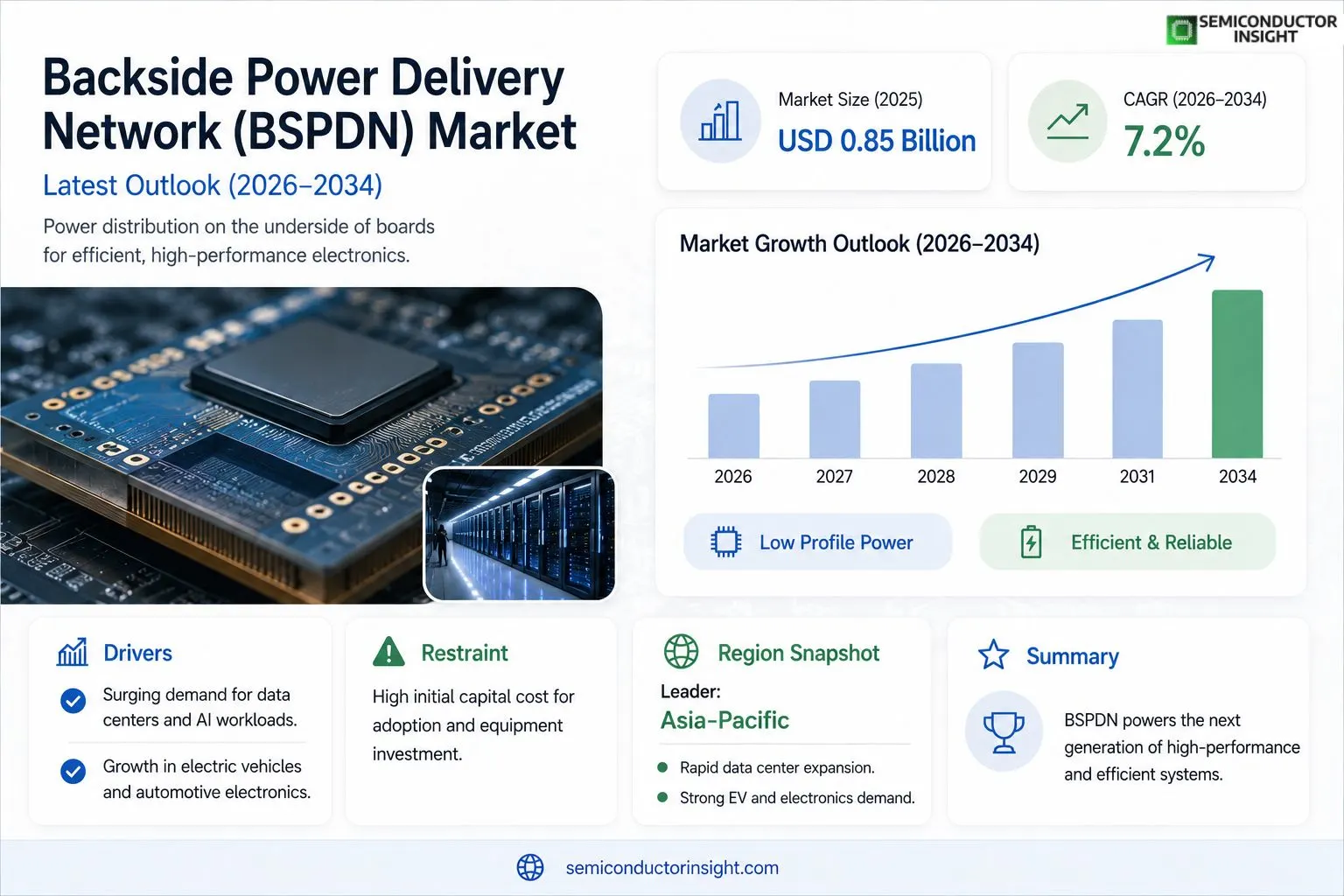
Global Backside Power Delivery Network (BSPDN) market size was valued at USD 0.85 billion in 2025. The market is projected to grow from USD 0.92 billion in 2026 to USD 1.58 billion by 2034, exhibiting a CAGR of 7.2% during the forecast period.
Backside Power Delivery Networks are integrated power distribution architectures located on the underside of printed circuit boards or semiconductor packages, providing efficient voltage regulation and reduced electromagnetic interference for high‑performance computing, automotive electronics and artificial‑intelligence workloads.The market is accelerating because system‑level designers seek lower‑profile power solutions, while the rise of heterogeneous integration and advanced packaging drives demand for backside delivery schemes. Furthermore, expanding data‑center capacity and electric‑vehicle electrification create strong tailwinds. Key players such as TSMC, Intel Corporation, Qualcomm Technologies, Texas Instruments and Samsung Electronics are investing heavily in R&D and strategic partnerships to broaden their BSPDN portfolios.
MARKET DRIVERS
Growing Demand for High‑Performance Computing
Backside Power Delivery Network (BSPDN) Market is being propelled by the rapid adoption of high‑performance CPUs and GPUs in data centers and AI accelerators. These devices require efficient power distribution with minimal impedance, and BSPDN offers a superior solution compared to traditional front‑side routing.
Miniaturization of Mobile and Edge Devices
Mobile smartphones and edge IoT modules are shrinking in size while demanding higher power density. BSPDN enables designers to free up front‑side space for antennas and sensors, directly supporting the form‑factor trends observed in the latest flagship devices.
➤ “Manufacturers achieving 15% lower power loss with BSPDN report faster time‑to‑market for next‑gen wearables.”
Regulatory pressure for energy‑efficient electronics also drives adoption, as BSPDN architectures align with emerging standards for lower power consumption and reduced thermal footprints.
MARKET CHALLENGES
Complexity of Design Integration
Integrating BSPDN into existing PCB workflows requires specialized EDA tools and expertise. Many design houses face a steep learning curve, which can increase development timelines and cost.
Other Challenges
Supply Chain Constraints
The limited availability of high‑frequency laminates and specialized vias can delay production, especially when demand spikes for advanced AI hardware.
MARKET RESTRAINTS
Higher Initial Capital Expenditure
Adopting BSPDN often requires re‑tooling of assembly lines and investment in new testing equipment, which can be a deterrent for small‑to‑mid sized manufacturers.Additionally, the need for precise impedance control raises the cost of material qualification, limiting rapid entry for newcomers.
MARKET OPPORTUNITIES
Expansion into Automotive Electronics
Electric and autonomous vehicles are increasingly reliant on high‑power electronics for sensors, LIDAR, and infotainment. BSPDN offers a pathway to meet the stringent reliability and power‑efficiency standards required in automotive applications.Furthermore, the emergence of 3D‑stacked ICs creates new design spaces where backside power delivery can dramatically improve inter‑die communication speed and reduce overall board thickness.
Backside Power Delivery Network (BSPDN) Market Trends
Integration with Advanced Packaging
The industry is witnessing a rapid shift toward heterogeneous integration, where multiple functional blocks are assembled within a single package. This architectural change positions backside power delivery networks as a natural complement because they reside beneath the active dies, delivering regulated voltage with minimal parasitic inductance. System designers increasingly prefer low‑profile solutions that free up board space for higher I/O density, enabling finer scaling of compute modules. As semiconductor manufacturers adopt fan‑out wafer‑level packaging and chip‑on‑wafer technologies, the need for robust backside power rails grows, driving investment in novel materials and design automation tools that improve thermal performance while maintaining signal integrity.
Other Trends
Automotive Electrification
The electrification of vehicles creates a demanding power environment where compact, high‑efficiency delivery is essential. Modern electric powertrains rely on multiple voltage domains for motor control, battery management, and auxiliary systems. By moving the power distribution network to the backside of the package, automotive engineers can reduce the overall footprint of power modules, lower electromagnetic interference, and meet stringent automotive reliability standards. Recent collaborations between semiconductor firms and OEMs focus on integrating backside power solutions with silicon‑carbide devices, further enhancing efficiency under high‑temperature operating conditions common in automotive applications.
Data‑Center Power Efficiency
Data‑center operators are under pressure to cut energy consumption while scaling compute density. Backside power delivery networks help achieve this goal by shortening the power path and decreasing voltage drop across the board, which translates into lower loss and reduced cooling requirements. Vendors are embedding these networks within high‑performance compute modules that serve AI accelerators and dense server blades. The trend is reinforced by the push toward composable infrastructure, where modular power blocks must be interchangeable and space‑efficient. As a result, design cycles now incorporate backside power considerations early, ensuring that power delivery aligns with the aggressive latency and throughput targets of next‑generation data‑center workloads.
COMPETITIVE LANDSCAPEKey Industry Players
Backside Power Delivery Network (BSPDN) Market Competitive Overview
Backside Power Delivery Network (BSPDN) Market is currently led by a handful of semiconductor Foundries and integrated device manufacturers that have integrated BSPDN capabilities into their advanced packaging roadmaps. TSMC, as the world’s largest contract chipmaker, leverages its 3‑nm and 2‑nm process nodes to embed backside voltage regulation structures, positioning it as the primary driver of volume adoption in data‑center and high‑performance computing segments. Intel complements this leadership through its EMIB and Foveros technologies, offering tightly coupled BSPDN solutions that reduce form‑factor and improve power integrity for next‑generation CPUs. Samsung Electronics, with its X‑CUBE and advanced package‑on‑package (PoP) offerings, targets mobile‑AI and automotive workloads, while Qualcomm Technologies integrates BSPDN into its Snapdragon platforms to meet the power‑density demands of 5G‑enabled edge devices. Texas Instruments, a specialist in power management ICs, supplies reference designs and discrete components that enable system‑level engineers to implement efficient backside power rails. Collectively, these incumbents command the majority of R&D spend and define the architecture standards that shape the market’s growth trajectory toward the projected $1.58 billion by 2034.Beyond the dominant tier, a diverse set of niche and emerging players enriches the BSPDN ecosystem by supplying complementary technologies and application‑specific solutions. AMD incorporates backside power delivery in its EPYC and Radeon lines to optimize thermal envelopes for high‑density servers, while Broadcom focuses on networking ASICs that exploit BSPDN to lower electromagnetic interference. NXP Semiconductors and STMicroelectronics deliver automotive‑grade BSPDN modules that meet stringent reliability criteria for electric‑vehicle power‑train control. Analog Devices and Infineon Technologies provide precision voltage‑regulation blocks and silicon‑based inductors that are essential for fine‑tuned backside distribution. Micron Technology’s memory‑centric packages benefit from BSPDN to maintain signal integrity at high speeds. ON Semiconductor and Renesas Electronics contribute mixed‑signal components that integrate seamlessly with backside power planes, and MediaTek expands its portfolio for consumer electronics by adopting BSPDN in its AI‑focused system‑on‑chips. These specialized contributors collectively broaden the market’s addressable applications, fostering competitive differentiation and supporting the overall CAGR of 7.2 % through 2034.
List of Key Backside Power Delivery Network Companies Profiled
- TSMC
- Intel Corporation
- Qualcomm Technologies
- Texas Instruments
- Samsung Electronics
- AMD
- Broadcom
- NXP Semiconductors
- STMicroelectronics
- Analog Devices
- Infineon Technologies
- Micron Technology
- ON Semiconductor
- Renesas Electronics
- MediaTek
Segment Analysis:
| Segment Category | Sub-Segments | Key Insights |
| By Type |
|
Passive BSPDN is emerging as the preferred choice for early‑stage adoption because:
|
| By Application |
|
High‑Performance Computing drives the most compelling demand for BSPDN solutions because:
|
| By End User |
|
Data Center Operators favor BSPDN technologies because:
|
| By Technology |
|
Integrated Voltage Regulators are gaining prominence as the leading technology within BSPDN because:
|
| By Integration Approach |
|
System‑in‑Package (SiP) emerges as the dominant integration approach for BSPDN because:
|
Regional Analysis: North America
United States
The data center sector is a primary driver of BSPDN adoption in the United States, with investments in infrastructure continuously increasing to support growing computational workloads.
HPC environments demand exceptional power delivery capabilities to maximize the performance of processors and accelerators.
The rise of edge computing necessitates localized and efficient power solutions to support distributed computing resources.
The intensive power demands of AI and machine learning workloads are driving innovation in BSPDN technologies to improve efficiency.
Europe
The European BSPDN Market is characterized by a strong emphasis on energy efficiency and sustainability. Stringent environmental regulations and a growing focus on green computing are influencing the adoption of advanced power delivery solutions. While adoption rates might be slightly slower compared to the US, the European market presents significant long-term growth potential. Key drivers include the development of high-performance computing clusters for research and industrial applications, and the expansion of data center infrastructure across the continent. Several European countries are proactively investing in research and development related to power electronics and thermal management, fostering innovation within the BSPDN sector. Furthermore, the increasing adoption of renewable energy sources is creating a demand for more efficient and reliable power delivery systems to integrate these sources into data centers and computing facilities. The focus is on optimizing power utilization and minimizing environmental impact, making the European market a key area for the development of sustainable BSPDN solutions.
Asia-Pacific
Asia-Pacific is emerging as the fastest-growing region for the BSPDN Market, driven by rapid industrialization, increasing digital adoption, and substantial investments in data center infrastructure. Countries like China, Japan, and South Korea are leading this growth, with significant demand from the telecommunications, manufacturing, and technology sectors. The region’s strong focus on 5G deployment and the expansion of cloud services are fueling the need for robust and efficient power delivery solutions. Furthermore, the growing adoption of AI and machine learning in Asia-Pacific is creating significant demand for high-performance computing infrastructure, further boosting the BSPDN market. The market is characterized by a diverse range of players, from local manufacturers to multinational technology companies, all competing to provide innovative BSPDN solutions. Government initiatives promoting digital transformation and smart city development are also contributing to the growth of the region’s BSPDN market.
South America
South America represents a developing market for the BSPDN Market, with increasing investments in data centers to support the growth of e-commerce, cloud computing, and digital services. While the market is still relatively nascent compared to North America and Asia-Pacific, it presents significant growth opportunities in the long term. The increasing adoption of cloud services and the expansion of telecommunications infrastructure are driving the demand for efficient power delivery solutions. However, challenges such as limited infrastructure investment and regulatory complexities may hinder the market’s growth. The focus is on providing cost-effective and reliable BSPDN solutions to address the evolving power needs of the region’s expanding digital economy. Further development of local expertise and technology will be crucial for the sustained growth of the BSPDN market in South America.
Middle East & Africa
The Middle East & Africa presents a promising, yet evolving, market for Backside Power Delivery Networks. Rapid urbanization, increasing internet penetration, and significant investments in data centers and telecommunications infrastructure are fueling the demand for sophisticated power delivery solutions. The region’s focus on smart city initiatives and the development of advanced technologies like 5G are creating a significant need for efficient and reliable power systems to support these advancements. While the market is relatively smaller compared to other regions, substantial growth potential exists, particularly in countries like Saudi Arabia, UAE, and South Africa. Challenges include infrastructure limitations and regulatory inconsistencies, but the long-term prospects remain positive, driven by strong economic growth and increasing digital transformation.
Report Scope
This market research report provides a comprehensive analysis of the Backside Power Delivery Network (BSPDN) Market , covering the forecast period 2026–2034. It offers detailed insights into market dynamics, technological advancements, competitive landscape, and key trends shaping the industry.
Key focus areas of the report include:
- Market Overview: ✅ The report begins with an overview outlining its current market scenario, key growth indicators, and industry transformation drivers. It discusses macroeconomic factors, demand–supply balance, regulatory landscape, and the strategic role of semiconductors in powering advancements across industries such as automotive, telecommunications, consumer electronics, and industrial automation.
- ✅ Market Size & Forecast: Historical data and future projections for revenue, unit shipments, and market value across major regions and segments.
- ✅ Segmentation Analysis: Detailed breakdown by product type, technology, application, and end-user industry to identify high-growth segments and investment opportunities.
- ✅ Regional Insights: Insights into market performance across North America, Europe, Asia-Pacific, Latin America, and the Middle East & Africa, including country-level analysis where relevant.
- ✅ Competitive Landscape: Profiles of leading market participants, including their product offerings, R&D focus, manufacturing capacity, pricing strategies, and recent developments such as mergers, acquisitions, and partnerships.
- ✅ Technology Trends & Innovation: Assessment of emerging technologies, integration of AI/IoT, semiconductor design trends, fabrication techniques, and evolving industry standards.
- ✅ Market Drivers & Restraints: Evaluation of factors driving market growth along with challenges, supply chain constraints, regulatory issues, and market-entry barriers.
- ✅ Stakeholder Insights: Insights for component suppliers, OEMs, system integrators, investors, and policymakers regarding the evolving ecosystem and strategic opportunities.
FREQUENTLY ASKED QUESTIONS:
What is the current market size of Backside Power Delivery Network (BSPDN) Market?
-> Backside Power Delivery Network (BSPDN) Market was valued at USD 0.85 billion in 2025 and is expected to reach USD 1.58 billion by 2034, with a CAGR of 7.2% during the forecast period.
Which key companies operate in Backside Power Delivery Network (BSPDN) Market?
-> Key players include TSMC, Intel Corporation, Qualcomm Technologies, Texas Instruments, and Samsung Electronics.
What are the key growth drivers?
-> Key growth drivers include system‑level designers seeking lower‑profile power solutions, heterogeneous integration, advanced packaging, expanding data‑center capacity, and electric‑vehicle electrification.
Which region dominates the market?
-> The market is globally balanced, with significant growth observed across North America, Europe, and Asia‑Pacific, driven by data‑center expansion and automotive electrification trends.
What are the emerging trends?
-> Emerging trends include heterogeneous integration, advanced packaging technologies, AI/ML workload support, and power solutions tailored for electric‑vehicle platforms.
Get Sample Report PDF for Exclusive Insights
Report Sample Includes
- Table of Contents
- List of Tables & Figures
- Charts, Research Methodology, and more...
 Download Sample Report PDF