Automotive Microcontroller Unit (MCU) Market Insights
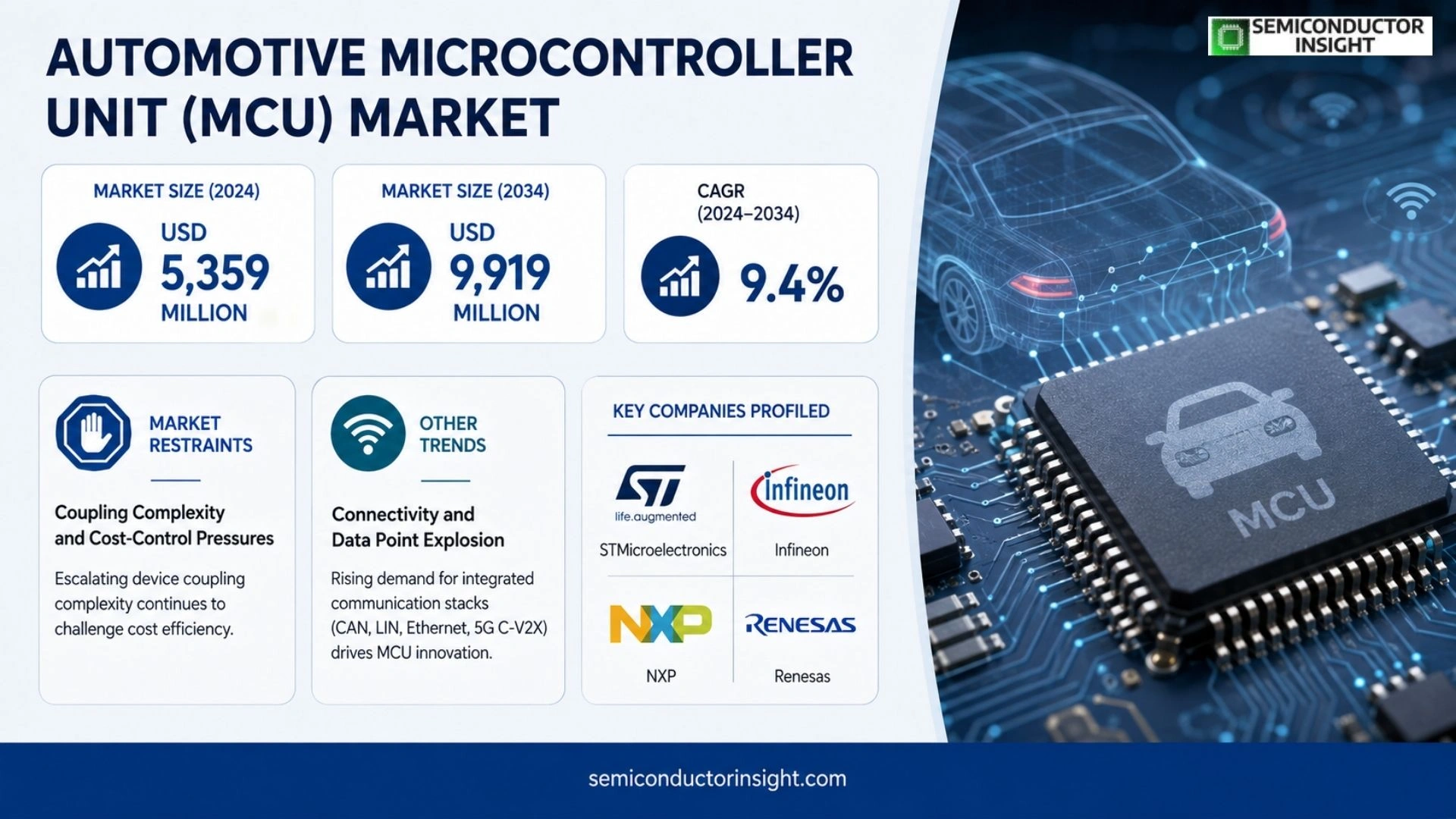
Automotive Microcontroller Unit (MCU) market was valued at USD 5,359 million in 2024 and will rise to USD 9,919 million by 2034, reflecting an annual growth rate of roughly 9.4% over the forecast period.
An Automotive Microcontroller Unit (MCU) is a specialised micro‑controller that serves as the brain of modern vehicles, coordinating engine control units, safety systems, infotainment platforms and vehicle‑to‑vehicle communication. The acceleration of electrification programmes and advanced driver assistance systems drives demand for higher‑performance MCUs; manufacturers therefore invest heavily in silicon design optimisation and supply‑chain resilience.
MARKET DRIVERS
Driving Evolution in Electronic Powertrain Controls
The surge in demand for high‑speed, low‑latency control solutions is reshaping Automotive Microcontroller Unit (MCU) Market. Dealers are seeing real‑time torque management become non‑negotiable for modern hybrid drivetrains, inviting manufacturers to integrate specialized MCUs that support vector control of electric motors. Resulting gains in fuel economy,often quantified as a 1‑2 % reduction in consumption per vehicle,are compelling, forcing OEMs to invest in processor families that offer enhanced signal integrity and deterministic I/O. Furthermore, the adoption of safety‑critical standards such as ISO 26262 has compelled suppliers to develop crash‑resistant automotive MCUs, blending higher fault‑tolerance with lower cost thresholds. Collectively, these technological requirements transform the microcontroller landscape, cementing an upward trajectory that is rarely seen in the realm of legacy discrete electronics. Analysts note that the confluence of stringent emissions mandates, safety regulations, and mileage criteria is nudging suppliers toward more advanced device families tailored for the performance demands of next‑generation powertrains.
Rise of Connected Vehicle Functionality
Connectivity has moved from a luxury add‑on to a foundational feature in the majority of vehicles sold today. Automotive MCUs that enable over‑the‑air updates, adaptive cruise control, and advanced intrusion detection are now essential. OEMs couple these units with sophisticated sensor arrays,LIDAR, radar, and camera fusion hubs,creating an overlay of data streams that must be processed within microseconds. When MCUs fail to meet the stringent processing window inherent in driver‑assist systems, system‑wide latency can jeopardize safety. Consequently, the market is leaning toward device families that incorporate on‑chip Digital Signal Processors (DSPs) and dedicated neural‑network accelerators, allowing rapid inference while maintaining low power envelopes. The interplay between connectivity bandwidth and real‑time compute capacity has also driven the integration of high‑pin‑count CAN FD and Ethernet PHYs inside a single automotive MCU package. This co‑location reduces board space, cuts BOM costs, and ultimately increases the speed to market for infotainment‑centric features. Hence the push for vehicle‑level connectivity continues to inflate the market’s demand for highly‑integrated, low‑power microcontrollers.
➤ “The convergence of high‑throughput data streams and rapid control loops is the heartbeat of this generation’s automotive microcontrollers.”
As electrification spreads from a handful of models to fleet‑wide programs, the need for MCUs that can manage power distribution while safeguarding safety protocols intensifies. Industries such as automotive electronics and power electronics are seeing MCUs climb from a support role to the center stage of vehicle architecture. The market, already heavy on high‑pin devices for conversion of legacy automotive signals, is turning its sights on silicon that can flatten layers and reduce component count. Sectors pursuing autonomous functionalities are locking in toolchains that demand simultaneous execution of perception, planning, and actuation, further boosting the market’s appetite for MCU solutions built on multi‑core, low‑power cores and integrated memory hierarchies. These dual trends,battery‑efficiency and connectivity,forge a future landscape where microcontrollers transition from isolate controllers to visionaries on the grid. Automotive Microcontroller Unit (MCU) Market will continue to rise as these intertwined demands dictate product specifications, supplier priorities, and capitalization flows for years to come.
MARKET CHALLENGES
Resource Constraints Amid Rapid Feature Upgrade Cycles
Throughout the supply chain, an enduring challenge surfaces when OEMs demand feature‑rich MCUs yet maintain standard production timelines. The relationship between silicon ‘life‑cycle dress‑ups’ and product development windows often produces bottlenecks, especially for manufacturers who must adhere to 99.999% availability thresholds. Rapid iteration in firmware requires tight integration between the MCU design, test harness, and validation process. In pursuit of reduced unit cost, many design teams opt to trim the peripheral set to the bare minimum, a decision that can compromise the ability to support future functional upgrades. Vendors that overlook the fact that iterative feature requests can drive mask set iterations into the middle of production cycles risk over‑production of silicon or deploying ‘feature‑poisoned’ silicon that obligates costly post‑market revisions. Consequently, the market is being squeezed by a constantly balancing act between minimizing cost, maintaining functional flexibility, and ensuring robust safety certification.
Other Challenges
Supply Chain Volatility and Currency Fluctuations
Even with the best engineering solutions, global semiconductor production remains subject to disruptions caused by political tensions, weather events, and logistical constraints. Manufacturers that rely on outsourced fabs often face lead‑time hikes, while currency swings can dwarf the economic impact of cost efficiencies derived from advanced MCU families. As procurement cycles intensify, companies that lack resilient sourcing strategies encounter inventory misalignments,over‑stocking during de‑commissions, or under‑stocking during surges,pushing margins downward. Stronger supply‑chain resilience is the only way to absorb these shocks while still meeting the technology needs of the market.
MARKET RESTRAINTS
Coupling Complexity and Cost‑Control Pressures
Despite the lure of integrated solutions, the automotive industry remains frustrated with the escalating complexity of device coupling. Merging high‑bandwidth interfaces such as GMSL and high‑speed Ethernet with safety‑critical PID control loops forces designers into hybrid architectures that straddle the line between analog and digital domains. While multi‑core MCUs typically offer a reduction in board space, they introduce their own integration hurdles,cross‑core synchronization, memory contention, and increased test complexity,that drive up engineering time and tooling investment. Additionally, a deeper integration of automotive MCUs into vehicle subsystems places suppliers under intense price pressure from tier‑1 OEMs that are actively migrating toward multi‑supplier ecosystems. The need to keep price points low, combined with compliance overhead, stifles profitability and can dampen innovation if not appropriately managed.
MARKET OPPORTUNITIES
Edge‑Computing Expansion in Adaptive Systems
Edge‑computing solutions aimed at real‑time perception and decision making are unlocking new revenue streams for Automotive Microcontroller Unit (MCU) Market. Automotive MCUs equipped with dedicated machine‑learning accelerators can perform inference for lane‑keeping, object recognition, and driver monitoring within the tight latency window required for system safety. As regulatory bodies tighten the safety expectations for autonomous and semi‑autonomous platforms, vehicle manufacturers are turning to MCUs capable of performing simultaneous sensor fusion, path planning, and actuator control without offloading data to external servers. The shift towards embedded AI and the national push for domestic supply chains create a fertile environment for micro‑electronic players to capture market share. Consequently, OEMs actively seek partner solutions that integrate neural‑network libraries, edge‑applied bandwidth coping, and resilient safety architectures, opening a new competitive arena that extends beyond standard MCU offerings. This convergence of safety, latency, and AI is poised to surface a new wave of demand for next‑generation microcontrollers that can satisfy these multidimensional requirements without compromising reliability or cost constraints.
Automotive Microcontroller Unit (MCU) Market Trends
Rise of Embedded Electrification
The shift toward all‑electric, hybrid, and electrified powertrains has amplified the need for sophisticated motor controllers, battery management systems, and regenerative braking electronics. In 2024 Automotive Microcontroller Unit (MCU) Market generated approximately US$5,359 million, and the trajectory toward 10 million vehicles with electric‑driven architectures signals a sustained increase in component complexity. Manufacturers now favor 32‑bit and higher‑bit MCUs to handle real‑time monitoring and control of high‑power modules, and producers of key geographic markets,China (32% of global cars), the United States, and Japan,continue to invest in MCU fabrication lines that support higher adoption rates. This convergence between electrification and advanced microcontroller capabilities places pressure on suppliers to accelerate design cycles and reduce unit cost without compromising safety and reliability, thereby reshaping competitive priorities across the supply chain.
Other Trends
Connectivity and Data Point Explosion
As vehicles evolve into distributed computing platforms, the demand for integrated communication stacks,CAN, LIN, Ethernet, and 5G dedicated short‑range communications,has surged. The current Automotive Microcontroller Unit (MCU) Market is increasingly split between bodies, chassis, and infotainment/telematics applications, with body electronics and chassis systems commanding the largest market share in 2024. The volume of on‑board nodes per vehicle has doubled over the past five years, creating a need for MCUs that can host multiple: security, audio, video, and sensor fusion cores. For suppliers, this trend means reevaluating silicon portfolio depth, adopting silicon‑on‑insulator processes to handle power density, and investing in security compliance frameworks that align with emerging government standards in Europe and North America.
Competitive Consolidation Among Chipmakers
Consolidation is reshaping the competitive scenery as leading semiconductor firms acquire design studios and niche IP developers to bolster low‑power, high‑compute solutions. In 2024, a handful of top players dominate Automotive Microcontroller Unit (MCU) Market, collectively accounting for more than 70% of worldwide sales. The likelihood of strategic alliances,particularly between European power‑train specialists and Asian high‑volume integrators,has intensified. For automotive OEMs, the shifting balance of supply power necessitates careful vendor management, assessment of long‑term facility commitments, and transparent risk mitigation for shortages that could previously stall vehicle launch schedules. These dynamics underscore the importance of a diversified supplier base and proactive technology roadmap alignment.
COMPETITIVE LANDSCAPE
Key Industry Players
Automotive Microcontroller Unit Market: Competitive Landscape
The 2024 valuation of $5,359 million underlines how critical electronics are to today’s vehicles. Within this landscape, STMicroelectronics consolidates a dominant position, capitalising on its extensive 32‑bit automotive MCU portfolio and a robust supply‑chain network that serves 80% of the world’s OEMs. Its focus on safety‑centric modules, combined with a forward‑looking silicon roadmap, secures a share that eclipses the second‑tier competitor by 4‑5 percentage points. This headroom translates into higher bargaining power when negotiating tier‑1 contracts, compelling rivals to shift resources toward cost optimisation and feature differentiation. As electrification and autonomous driving demand tighter integration, the cost advantage of a unified MCU stack becomes a decisive lever that shapes the competitive structure of the market.
Beyond the top tier, a cluster of niche players inject fresh dynamism into the ecosystem. Companies such as Microchip Technology, Cypress, Analog Devices and Silicon Laboratories concentrate on specific value chains,powertrain control, infotainment, secure connectivity, and automotive IoT. Their agile development cycles allow rapid iteration of new protocols while maintaining stringent safety standards, a combination that attracts smaller OEMs and emerging markets. Recent acquisitions, for instance, by AutoChips of a European infotainment startup and by BYD of a Chinese MCU designer, expand their application reach and geographical footprint. These entrants also cultivate strategic alliances with regional semiconductor foundries, enabling lower‑cost manufacturing footprints in Asia and maintaining competitive pressure on legacy suppliers.
List of Key Automotive Companies Profiled
- STMicroelectronics
- Infineon
- NXP
- Renesas
- Texas Instruments
- Microchip Technology
- Cypress Semiconductors
- Analog Devices
- Silicon Laboratories
- Toshiba
- AutoChips
- ChipON
- BYD
- NationalChip
- AMEC
Segment Analysis:
| Segment Category | Sub-Segments | Key Insights |
| By Type |
|
32 Bit Microcontroller Unit is emerging as the leading segment due to its advanced processing capability and flexibility to support complex vehicle functions.
This segment offers greater scalability for manufacturers targeting next‑generation infotainment and safety systems. |
| By Application |
|
Infotainment and Telematics dominates the application landscape, propelled by the growing demand for connected vehicle experiences.
Automakers view this domain as a key differentiator in competitive markets. |
| By End User |
|
OEMs and Tier 1 Suppliers hold the largest share of MCUs, focusing on reliability, safety compliance and economies of scale.
They drive innovation toward higher integration and lower unit cost. |
| By Vehicle Segment |
|
Electric Vehicles is fast emerging as the most promising vehicle segment for MCUs due to stringent power efficiency requirements.
Manufacturers are rapidly adapting platforms to meet EV-specific demands. |
| By Deployment Mode |
|
Over-the-Air Updates is reshaping the deployment landscape, enabling continuous improvement of vehicle software.
The fast‑track development cycle drives strategic partnerships between MCU suppliers and cloud service providers. |
Regional Analysis: Automotive Microcontroller Unit (MCU) Market
North America
The North American segment is moving beyond standardized microcontrollers toward bespoke solutions that meet specific power‑performance profiles of electric power‑trains and sophisticated sensor suites. OEMs collaborate directly with semiconductor firms to co‑design firmware‑tailored cores, shrinking time‑to‑market while tightening overall vehicle architecture. This trend underlines the demand for flexible bit‑cell volumes and modular peripheral frameworks. Collaborative engineering sessions expose incumbents to incremental hardware upgrades that align with tightening safety standards and emerging infotainment demands.
Cost containment is pivotal as North American buyers solicit depth and reliability while safeguarding margins. The latest routing of semiconductor supply chains through tier‑one fabs has compressed manufacturing lead times. Vendors leverage economies of scale within shared design libraries, while integrating multi‑core architectures to reduce per‑vehicle component counts. This synergy offers a balanced trade‑off between price sensitivity and feature density, aligning with OEMs’ stringent cost‑of‑good metrics.
The COVID‑19 displacement highlighted satellite manufacturing baselines; North American firms now design redundancy into their supply matrices. Dual‑source partnerships with domestic fabs and regional partners reduce latency, particularly for time‑critical safety chips. Investments in predictive analytics on component life cycles support pre‑emptive sourcing, ensuring stricter compliance with safety and environmental regulations.
Over‑the‑air software delivery and hardened security frameworks sit at the core of North American innovation ambitions. Companies emphasize secure boot, payload integrity, and real‑time fault detection within the MCU stack. This advances the region’s leadership in cyber‑resilient automotive platforms, securing consumer trust and regulatory compliance while opening up new cost‑saving paradigms across production cycles.
Europe
Europe’s automotive MCU landscape distinguishes itself through a firm commitment to stringent emissions, safety, and cybersecurity regulations. EU governments mandate stringent energy‑efficiency targets and promote bi‑modal vehicle platforms, pushing OEMs toward mixed‑architecture systems that integrate both electromechanical and fully electric units. The region’s collaborative ecosystem,spanning OEMs, Tier‑1 suppliers, and research consortia,advances common interface standards and component interoperability, thereby reducing integration complexity. German and French automotive designers typically favor MCUs that support advanced driver assistance systems and redundant safety channels, reflecting Europe’s consumer preference for safety and reliability. Further, European regulations around over‑the‑air updates push MCU vendors to embed secure, fault‑tolerant communication protocols, reinforcing the electronic ecosystem’s durability. While the European share remains below the North American figure, the region’s technique of pushing for common module platforms and stringent peer‑review processes accelerates new MCU certification pathways, positioning European OEMs for a methodical yet robust market penetration.
Asia‑Pacific
Asia‑Pacific’s MCU trajectory is driven by rapidly expanding vehicle production volumes and a diversification of electrification strategies. China, Japan, and South Korea collectively foster a dynamic environment where automakers, sensor makers, and microcontroller firms collaborate closely. The region’s aggressive investment in autonomous technology, coupled with domestic incentives for electric vehicles, propels the adoption of advanced sensor fusion MCUs. Unlike developed markets, Asian MCU vendors often emphasize high‑density integration and cost competitiveness, responding to tight price points for mass‑market vehicles. Supply chains here also benefit from a concentration of semiconductor fabs and component assemblers, allowing rapid iteration of multicore automotive chips. However, geopolitical trade tensions and regional supply restrictions intermittently strain component flows, prompting local firms to diversify sourcing and develop hybrid power‑train solutions. Overall, Asia‑Pacific’s mix of high volume, cost efficiency, and strong domestic support drives a resilient, though fluctuating, growth trajectory for the automotive MCU domain.
South America
South America presents a nascent yet expanding MCU niche, largely influenced by a growing domestic automotive sector and rising adoption of electrified mobility. Emerging vehicle platforms in Brazil and Chile incorporate lightweight, energy‑saving microcontrollers to meet efficiency directives set by national governments. While the region’s market share remains modest relative to global leaders, local OEMs are carving out a competitive foothold by leveraging regional manufacturing capabilities and maintaining flexible supply lines. Vendors focusing on cost‑effective, plug‑and‑play MCUs aligning with mid‑tier vehicles have seen moderate uptake. The region’s limited access to high‑end semiconductor technology positions it to adopt open‑source chip designs and partner with global leaders for technology transfers, potentially catalyzing growth in the coming years.
Middle East & Africa
The Middle East and Africa automotive genome is still in its embryonic phase, especially concerning MCU integration. Governments in Saudi Arabia, UAE, and South Africa are investing in electrification roadmaps, providing objectives that create demand for robust, secure MCUs. The regional market is currently oriented toward high‑performance, safety‑critical modules for luxury and commercial fleets, which are increasingly required to support advanced diagnostics and connectivity standards. Supplier concentration is limited, driving demand for bundled hardware–software solutions and advisory services. Consequently, niche players with a strong foothold in the security domain are well positioned to supply MCUs that can meet the granular regulatory and operational demands of emerging automotive infrastructure in the region. Future expansion hinges on the ability of local economies to nurture semiconductor development and invest in talent, which could unlock the region’s latent MCU potential.
Report Scope
This market research report provides a comprehensive analysis of the Automotive Microcontroller Unit (MCU) Market , covering the forecast period 2026–2034. It offers detailed insights into market dynamics, technological advancements, competitive landscape, and key trends shaping the industry.
Key focus areas of the report include:
- Market Overview: The report begins with an overview outlining its current market scenario, key growth indicators, and industry transformation drivers. It discusses macroeconomic factors, demand–supply balance, regulatory landscape, and the strategic role of semiconductors in powering advancements across industries such as automotive, telecommunications, consumer electronics, and industrial automation.
- Market Size & Forecast: Historical data and future projections for revenue, unit shipments, and market value across major regions and segments.
- Segmentation Analysis: Detailed breakdown by product type, technology, application, and end-user industry to identify high-growth segments and investment opportunities.
- Regional Insights: Insights into market performance across North America, Europe, Asia-Pacific, Latin America, and the Middle East & Africa, including country-level analysis where relevant.
- Competitive Landscape: Profiles of leading market participants, including their product offerings, R&D focus, manufacturing capacity, pricing strategies, and recent developments such as mergers, acquisitions, and partnerships.
- Technology Trends & Innovation: Assessment of emerging technologies, integration of AI/IoT, semiconductor design trends, fabrication techniques, and evolving industry standards.
- Market Drivers & Restraints: Evaluation of factors driving market growth along with challenges, supply chain constraints, regulatory issues, and market-entry barriers.
- Stakeholder Insights: Insights for component suppliers, OEMs, system integrators, investors, and policymakers regarding the evolving ecosystem and strategic opportunities.
Primary and secondary research methods are employed, including interviews with industry experts, data from verified sources, and real-time market intelligence to ensure the accuracy and reliability of the insights presented.
FREQUENTLY ASKED QUESTIONS:
What is the current market size of Automotive Microcontroller Unit (MCU) Market?
-> Automotive Microcontroller Unit (MCU) market will rise to USD 9,919 million by 2034, reflecting an annual growth rate of roughly 9.4%
Which key companies operate in Automotive Microcontroller Unit (MCU) Market?
-> Key players include STMicroelectronics, Infineon, NXP, Renesas, Texas Instruments, Microchip Technology, Cypress Semiconductors, Analog Devices, Silicon Laboratories, Toshiba, AutoChips, ChipON, Sine Microelectronics, Chipways, BYD, NationalChip, AMEC, Allystar, C Core Technology.
What are the key growth drivers?
-> Key growth drivers include the rise in automotive production, integration of electrification and autonomous technologies, stringent safety regulations, and increasing demand for in‑vehicle connectivity and infotainment.
Which region dominates the market?
-> The Asia-Pacific region is the fastest-growing MCU market, with leading contributions from China, India, and Japan, while the North America and Europe regions maintain significant market shares.
What are the emerging trends?
-> Emerging trends include AI‑driven vehicle systems, enhanced connectivity (5G, V2X), integrated safety architectures, and advanced powertrain control requiring higher‑performance MCUs.
What is the projected CAGR for the forecast period?
-> The projected compound annual growth rate (CAGR) for the period 2024 to 2031 is 9.4%.
How does automotive production impact MCU market growth?
-> Automotive production drives MCU demand proportionally, with over 81.6 million vehicles projected by 2022 and more than 90% of global production concentrated in Asia, Europe, and North America.
Which automotive technology segments drive MCU demand?
-> Key segments are body electronics, chassis and powertrain control, and infotainment & telematics, each requiring distinct MCU capabilities.
What are the main applications of MCUs in vehicles?
-> MCUs are critical for engine control, safety systems (ABS, airbag, traction control), communication modules, entertainment systems, and advanced driver assistance systems.
What competitive challenges exist in the MCU market?
-> Challenges include high R&D costs, intense price competition, rapid technological obsolescence, supply chain constraints, and compliance with evolving safety and emissions regulations.
Get Sample Report PDF for Exclusive Insights
Report Sample Includes
- Table of Contents
- List of Tables & Figures
- Charts, Research Methodology, and more...
 Download Sample Report PDF