Automotive Isolated Interface Chips Market Insights
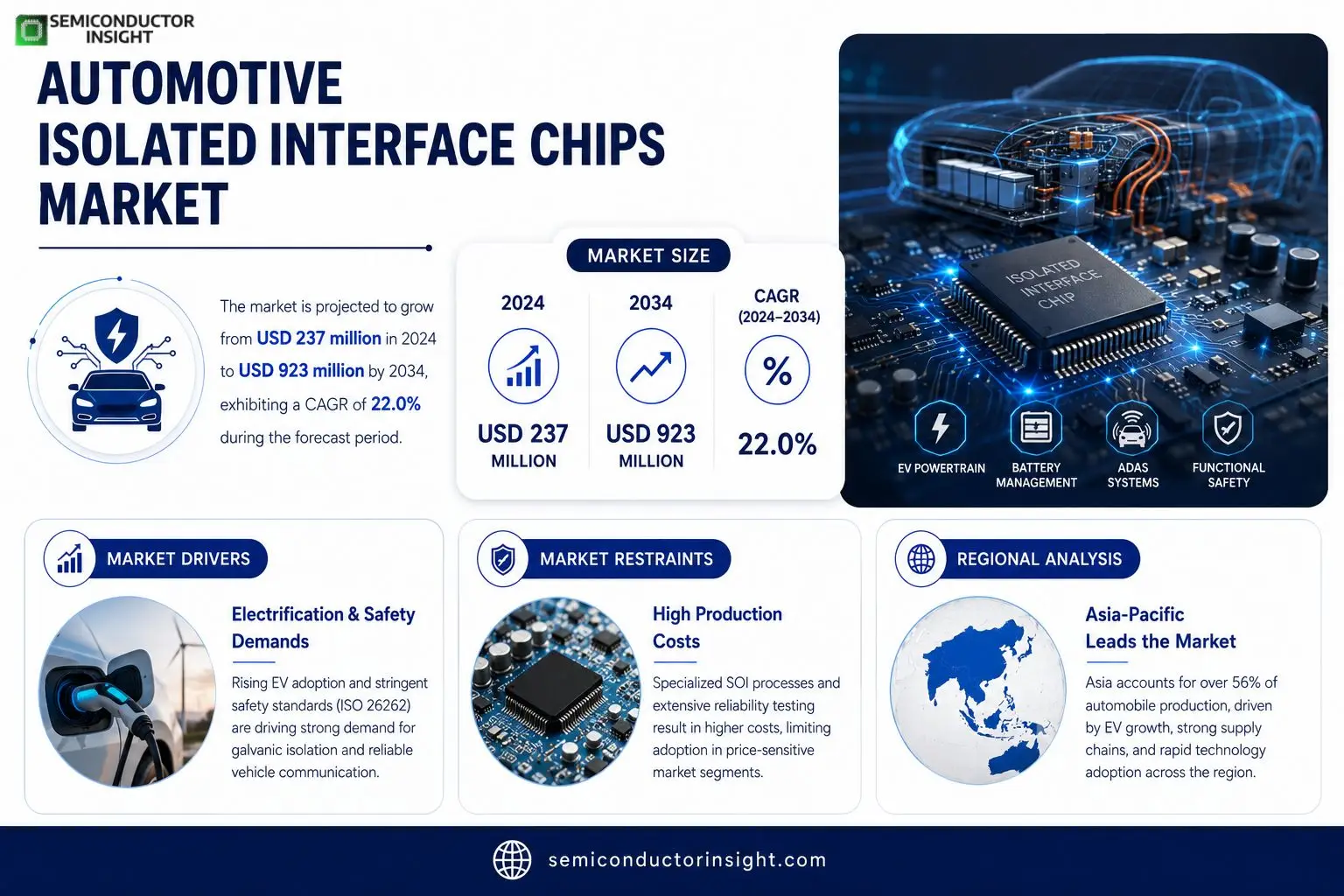
Automotive Isolated Interface Chips market size was valued at USD 237 million in 2024. The market is projected to grow from USD 237 million in 2024 to USD 923 million by 2034, exhibiting a CAGR of 22.0 % during the forecast period.
Automotive isolated interface chips integrate isolation barriers with communication standards such as CAN, RS‑485 and I²C, delivering galvanic separation while preserving signal integrity across vehicle networks. Because modern vehicles depend on numerous electronic control units, these chips safeguard high‑voltage domainsparticularly electric‑drive and battery‑management systemsfrom transient spikes, enabling reliable data exchange that complies with stringent automotive safety requirements.
MARKET DRIVERS
Electrification and Safety Demands
The shift toward electric powertrains has forced OEMs to isolate high‑voltage domains from low‑voltage control electronics. Automotive Isolated Interface Chips Market suppliers that can guarantee galvanic isolation while maintaining signal fidelity are seeing orders surge, especially in Europe where EV registrations have climbed above 20% of total sales.
Regulatory Momentum and Functional Safety Standards
Stringent safety regulations such as ISO 26262 have made functional safety a non‑negotiable criterion for new vehicle programs. Chip manufacturers that embed fail‑safe mechanisms and meet ASIL‑B/ASIL‑C requirements are being preferred by Tier‑1 suppliers, creating a clear purchasing preference.
➤ “Isolation solutions that combine low power loss with high EMI robustness are becoming the decisive factor in contract awards for next‑generation EV platforms.”
This dynamic compels system architects to allocate larger budget portions to isolated interface components, thereby expanding the overall addressable market for these chips.
MARKET CHALLENGES
Design Complexity and Integration Costs
Integrating isolated interfaces into compact automotive ECUs demands meticulous board layout and additional testing phases, inflating development cycles. Small‑volume niche models often struggle to justify the upfront expense, limiting adoption outside mainstream platforms.
Other Challenges
Supply Chain Volatility
semiconductor shortages have tightened lead times for critical components like isolation barriers, compelling manufacturers to hold higher safety stock and eroding margin flexibility.
MARKET RESTRAINTS
High Production Costs
Achieving the required isolation voltage (>5 kV) typically involves specialized silicon‑on‑insulator (SOI) processes that command a premium. The cost differential between standard mixed‑signal chips and isolated variants can exceed 40%, prompting cost‑sensitive OEMs to postpone upgrades.Moreover, the need for extensive reliability testing under automotive temperature extremes adds further expense, compressing the price advantage of newer designs.Consequently, price‑sensitive market segments, especially emerging economies, exhibit slower uptake despite the technical merits of isolated solutions.
MARKET OPPORTUNITIES
Emerging ADAS and Autonomous Platforms
Advanced driver‑assistance systems (ADAS) and autonomous driving stacks rely on high‑speed sensor data that must cross safety domains without corruption. Isolated interface chips that support gigabit‑per‑second links while preserving isolation margins open a lucrative niche.Strategic partnerships between chip makers and autonomous‑software vendors are already materialising, aiming to co‑develop reference designs that accelerate time‑to‑market for Level‑3 and Level‑4 capabilities.
Automotive Isolated Interface Chips Market Trends
Rising Adoption of Isolated CAN and RS‑485 in EV Powertrains
The automotive sector’s transition toward electric propulsion has placed unprecedented pressure on communication reliability within high‑voltage environments. Isolated CAN and RS‑485 transceivers, which provide galvanic separation between power and signal domains, have become indispensable for battery‑management systems, motor‑control units, and charging infrastructure. In 2024 the market for isolated interface chips stood at roughly $237 million; forecasts indicate a climb to about $923 million by 2034. This acceleration mirrors the surge in electric‑vehicle (EV) registrations, which now exceed 81 million units worldwide and are heavily concentrated in Asia (56 % of production), Europe (20 %), and North America (16 %). Manufacturers such as Texas Instruments and Infineon are expanding dedicated EV product lines, reflecting the need for rugged, high‑speed, fault‑tolerant links that can survive the harsh electromagnetic conditions of modern powertrains.
Other Trends
Shift Toward Integrated I2C Isolation in ADAS Modules
Advanced driver‑assistance systems (ADAS) rely on dense sensor networks that exchange data at millisecond intervals. Traditional I2C buses, while cost‑effective, are vulnerable to ground‑potential differences when interfaced with high‑voltage safety‑critical components. Recent product introductions embed isolation directly within the I2C transceiver, reducing board‑level component count and simplifying thermal management. This integration is especially appealing to OEMs targeting mass‑market passenger cars, where cost constraints intersect with stringent safety standards. Early adopters report a 10‑15 % reduction in overall module depth, enabling more compact sensor housings and smoother packaging designs.
Geographic Concentration Drives Competitive Landscape
Asia’s dominance in vehicle manufacturing translates into a disproportionate share of demand for isolated interface chips. China alone accounts for roughly one‑third of automobile output, prompting local semiconductor firms such as Shanghai Chipanalog and Guangzhou Zhiyuan to prioritize high‑voltage isolation technologies. Meanwhile, European players benefit from stricter functional‑safety regulations, encouraging the deployment of redundant isolated communication paths in commercial‑vehicle platforms. North America, although smaller in unit volume, exhibits higher average spend per chip due to the prevalence of premium EV models and autonomous‑driving pilots. This regional split forces vendors to tailor their R&D investment: Asia‑focused firms accelerate volume‑driven cost reductions, whereas European and North‑American operations concentrate on reliability engineering and certification support.
COMPETITIVE LANDSCAPE
Key Industry Players
Competitive dynamics in the automotive isolated interface chips segment
Texas Instruments remains the dominant force in the automotive isolated interface chips arena, leveraging a comprehensive portfolio that spans isolated CAN, RS‑485 and I2C transceivers. Its extensive design‑for‑automotive (DfA) framework, coupled with a worldwide sales network, secures deep relationships with Tier‑1 OEMs and emerging EV manufacturers. The market structure reflects a tiered pattern: a handful of large, diversified semiconductor firms dominate revenue, while a growing cohort of specialist firms address niche safety‑critical applications and region‑specific standards.Beyond the market leader, several firms carve out strategic positions through technology depth or geographic focus. Analog Devices and Infineon Technologies provide high‑voltage isolation solutions that meet stringent ISO 26262 requirements, appealing to premium‑segment vehicle platforms. NXP and Renesas exploit their broad automotive microcontroller ecosystems to bundle isolated interfaces with system‑on‑chip offerings. Smaller but agile players such as NVE, 2Pai Semiconductor, Silicon Internet of Things Technology, Shanghai Chipanalog Microelectronics, NOVOSENSE, Guangzhou Zhiyuan Electronics and UOTEK differentiate by targeting specific chassis or body‑control modules, often partnering with regional manufacturers to accelerate time‑to‑market.
List of Key Automotive Isolated Interface Chips Companies Profiled
- Texas Instruments
- Analog Devices
- Infineon Technologies AG
- NXP Semiconductors
- Renesas Electronics
- NVE Corporation
- 2Pai Semiconductor
- Silicon Internet of Things Technology
- Shanghai Chipanalog Microelectronics
- NOVOSENSE
- Guangzhou Zhiyuan Electronics
- UOTEK
- Microchip Technology
- STMicroelectronics
- ON Semiconductor
Segment Analysis:
| Segment Category | Sub-Segments | Key Insights |
| By Type |
|
Leading Segment The isolated CAN transceiver consistently emerges as the preferred choice for safety‑critical networks. – Engineers value its robustness against voltage spikes and electromagnetic interference. – The technology aligns with automotive standards for functional safety. – Its integration simplicity accelerates system‑level design cycles. |
| By Application |
|
Leading Segment In commercial vehicle platforms, isolated interface chips are pivotal for heavy‑duty communication. – They enable reliable data exchange between powertrain modules and telematics. – Manufacturers appreciate the reduction of grounding issues in harsh environments. – The flexibility to support multiple bus standards strengthens platform modularity. |
| By End User |
|
Leading Segment OEMs drive the strategic adoption of isolated chips to meet stringent safety regulations. – They prioritize components that simplify validation across vehicle platforms. – Tier‑1 suppliers focus on scalable modules that enable rapid integration. – Aftermarket players value retrofit compatibility and long‑term reliability. |
| By [Segment Category 3]] |
|
Leading Segment The powertrain control unit segment showcases strong demand for isolation due to high voltage swings. – Designers seek chips that safeguard low‑voltage sensors from engine transients. – Robust isolation facilitates tighter integration of electric drive components. – The functional safety narrative reinforces its prominence. |
| By [Segment Category 4]] |
|
Leading Segment Safety‑critical functions dominate the qualitative discussion around isolated chips. – Engineers emphasize deterministic behavior under fault conditions. – The ability to meet functional safety standards drives component selection. – Integration with battery management ensures longevity and protects vehicle electrification initiatives. |
Regional Analysis: Automotive Isolated Interface Chips Market
North America
The region’s strong research base, anchored by several university‑industry consortia, fuels a pipeline of next‑generation silicon that promises lower capacitance and higher breakdown voltageattributes that align with the rising prevalence of high‑voltage architectures in electric drivetrains. This technical progress, coupled with an established supply chain that can scale from prototype runs to mass production, gives North American firms a competitive edge in meeting volume demands for next‑gen vehicles.
From a strategic standpoint, the concentration of key automotive design centers in Detroit, Silicon Valley, and Toronto creates a feedback loop: design teams identify interface shortcomings, chip makers respond with targeted fabs upgrades, and the cycle repeats. Such proximity shortens time‑to‑market for innovative isolation solutions and reinforces the region’s status as a trendsetter for supply chains.
Vehicle manufacturers are integrating isolated interface chips into power‑train control units and battery‑management systems to guard against cross‑talk and voltage spikes. The push for higher voltage platforms has compelled designers to replace legacy components with devices that offer tighter isolation margins, ensuring functional safety while supporting higher power densities.
Recent disruptions have underscored the importance of diversified fab locations. Suppliers are spreading wafer production across the Midwest and Southern United States, reducing reliance on any single facility and allowing OEMs to keep production lines running even when a single site encounters a bottleneck.
Updated safety standards such as ISO 26262 and emerging functional‑safety directives are explicitly referencing isolation performance. Compliance audits now examine isolation leakage and breakdown thresholds, prompting manufacturers to seek components that can demonstrably meet these tightened thresholds.
Strategic alliances between chipmakers and leading automakers have accelerated prototype validation. Joint development programs focus on co‑designing package‑in‑package solutions that embed isolation layers directly within system‑on‑chip architectures, shortening integration timelines.
Europe
European automakers are reconfiguring their power‑electronics architectures to align with the bloc’s stringent emissions legislation. The move toward higher‑voltage electric drivetrains has amplified the need for isolated interface chips that can operate reliably across broader temperature swings typical of European climates. Manufacturers are also leveraging the region’s dense network of research institutes to pilot silicon‑on‑insulator technologies that promise reduced parasitic capacitance, a critical factor for fast‑switching converters. In parallel, supply‑chain initiatives emphasize local fab capacity to satisfy “Made‑in‑EU” requirements, thereby mitigating import‑related lead‑time risks.
Asia‑Pacific
The Asia‑Pacific market is distinguished by a rapid rollout of next‑generation electric vehicles, especially in China, Japan, and South Korea. OEMs in this region are experimenting with isolated interface chips that can handle the high‑voltage spikes associated with fast‑charging infrastructure. Meanwhile, a burgeoning ecosystem of semiconductor startups is introducing innovative die‑stacking techniques that embed isolation directly beneath power‑gate transistors, enabling slimmer module footprints. Policy incentives aimed at expanding EV adoption have spurred investments in dedicated fab lines, although capacity constraints remain a focal point for industry planners.
South America
In South America, market growth is being driven by a gradual shift from conventional internal‑combustion platforms to hybrid powertrains. This transition creates a niche for isolated interface chips that can bridge low‑voltage sensor networks with higher‑voltage control units without compromising safety. Local automotive assemblers are forging partnerships with North American suppliers to import proven isolation solutions, while simultaneously cultivating regional design capabilities to customize specifications for regional climate conditions and road‑grade variability.
Middle East & Africa
The Middle East & Africa region is witnessing nascent demand for isolated interface chips as luxury vehicle imports rise and regional manufacturers begin limited EV production. Harsh desert temperatures and dust exposure demand chips with robust encapsulation and enhanced thermal tolerance. Governments are launching pilot programs to develop domestic semiconductor capabilities, encouraging joint ventures that blend foreign expertise with local manufacturing. These initiatives aim to reduce dependence on distant suppliers and create a resilient supply base for future automotive electrification projects.
Report Scope
This market research report provides a comprehensive analysis of the Automotive Isolated Interface Chips Market , covering the forecast period 2026–2034. It offers detailed insights into market dynamics, technological advancements, competitive landscape, and key trends shaping the industry.
Key focus areas of the report include:
- Market Overview: The report begins with an overview outlining its current market scenario, key growth indicators, and industry transformation drivers. It discusses macroeconomic factors, demand–supply balance, regulatory landscape, and the strategic role of semiconductors in powering advancements across industries such as automotive, telecommunications, consumer electronics, and industrial automation.
- Market Size & Forecast: Historical data and future projections for revenue, unit shipments, and market value across major regions and segments.
- Segmentation Analysis: Detailed breakdown by product type, technology, application, and end-user industry to identify high-growth segments and investment opportunities.
- Regional Insights: Insights into market performance across North America, Europe, Asia-Pacific, Latin America, and the Middle East & Africa, including country-level analysis where relevant.
- Competitive Landscape: Profiles of leading market participants, including their product offerings, R&D focus, manufacturing capacity, pricing strategies, and recent developments such as mergers, acquisitions, and partnerships.
- Technology Trends & Innovation: Assessment of emerging technologies, integration of AI/IoT, semiconductor design trends, fabrication techniques, and evolving industry standards.
- Market Drivers & Restraints: Evaluation of factors driving market growth along with challenges, supply chain constraints, regulatory issues, and market-entry barriers.
- Stakeholder Insights: Insights for component suppliers, OEMs, system integrators, investors, and policymakers regarding the evolving ecosystem and strategic opportunities.
Primary and secondary research methods are employed, including interviews with industry experts, data from verified sources, and real-time market intelligence to ensure the accuracy and reliability of the insights presented.
FREQUENTLY ASKED QUESTIONS:
What is the current market size of Automotive Isolated Interface Chips Market?
-> Automotive Isolated Interface Chips Market was valued at USD 237 million in 2024 and is expected to reach USD 923 million by 2034, growing at a CAGR of 22.0% during the forecast period.
Which key companies operate in Automotive Isolated Interface Chips Market?
-> Key players include ADI, Texas Instruments, Infineon Technologies AG, NXP Semiconductors, Shanghai Chipanalog Microelectronics, NOVOSENSE, Renesas, NVE, 2Pai Semiconductor, Silicon Internet of Things Technology, Guangzhou Zhiyuan Electronics, UOTEK.
What are the key growth drivers?
-> Key growth drivers include rapid increase in vehicle production, especially in Asia, heightened demand for reliable communication interfaces (isolated CAN, RS‑485, I2C) in safety‑critical automotive systems, and the broader shift toward electric and autonomous vehicles that require robust isolation technology.
Which region dominates the market?
-> Asia dominates the market, accounting for over 56% of automobile production and driving the majority of demand for isolated interface chips, followed by Europe and North America.
What are the emerging trends?
-> Emerging trends include integration of isolated CAN, RS‑485 and I2C transceivers into single‑chip solutions, increasing adoption of isolated interfaces in electric vehicle powertrains, and the development of higher‑speed, low‑power isolated communication standards to support advanced driver‑assistance systems (ADAS).
Get Sample Report PDF for Exclusive Insights
Report Sample Includes
- Table of Contents
- List of Tables & Figures
- Charts, Research Methodology, and more...
 Download Sample Report PDF