SEMICONDUCTOR INSIGHT
MARKET RESEARCH REPORT

Automotive-grade SiC MOSFET Discrete Market

2026 to 2034
MARKET INTELLIGENCE
ACROSS KEY REGIONS
2026 EDITION
POWER ELECTRONICS Semiconductor Market Research

Automotive-grade SiC MOSFET Discrete Market

Size, Share & Industry Analysis, 2026–2034

◷
UPDATED 30 October 2026
▤
REPORT LENGTH Detailed Report
▣
REPORT CODE 7eff396c1f7e
▯
FORMATS PDF

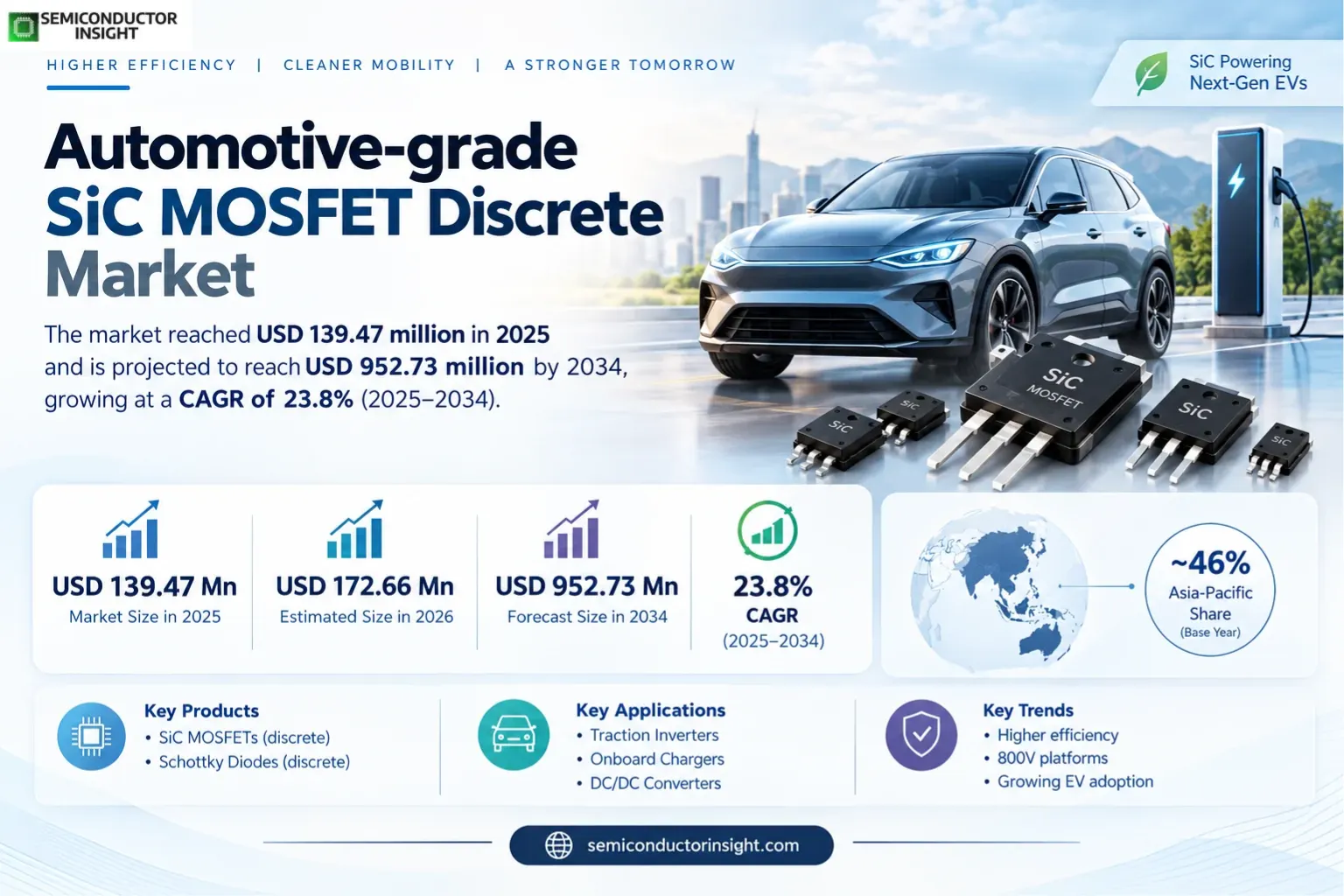
Automotive-grade SiC MOSFET discrete market was valued at USD 139.47 million in 2025 and is projected to reach USD 952.73 million by 2034, expanding at a CAGR of 23.8% through the 2025–2034 modeling period. The 2026 estimate is USD 172.66 million, and Asia-Pacific is the largest regional market with an estimated ~46% share in the base year.

Get the sample PDF with study scope, segmentation and methodology details.

Key Statistics

2025 Market Size
USD 139.47 million
2034 Projected Size
USD 952.73 million
CAGR (2025–2034)
23.8%
Largest Market in 2025
Asia-Pacific (~46%)

Key Takeaways

  • Market trajectory: Global automotive-qualified discrete silicon-carbide MOSFET revenue reached USD 139.47 million in 2025 and is forecast to attain USD 952.73 million in 2034, equivalent to a 23.8% compound annual growth rate; the 2026 estimate is USD 172.66 million.
  • Voltage leadership: The 1200V device category is the leading type at an estimated ~44% of 2025 sales, supported by traction-inverter requirements and design preferences for high blocking-voltage margin.
  • Vehicle application: Main traction inverters represent an estimated ~60% of market value, ahead of onboard charging and high-voltage DC/DC conversion, because their semiconductor content is closely tied to drivetrain output.
  • Regional concentration: Asia-Pacific accounts for an estimated ~46% of 2025 revenue, reflecting the concentration of vehicle assembly, power-electronics engineering and semiconductor supply relationships in China, Japan and South Korea.
  • Qualification matters: Automotive device procurement involves AEC-Q101 qualification, thermal cycling, gate-drive robustness and traceable manufacturing control; a general-purpose industrial SiC part does not automatically qualify for vehicle production.
  • Supplier positioning: Device manufacturers compete through substrate access, trench-cell design, packaging thermal resistance and multiyear automotive supply commitments; systems suppliers are not equivalent to merchant discrete MOSFET vendors.

Automotive-grade SiC MOSFET Discrete Market Overview

Automotive-grade SiC MOSFET discrete market was valued at USD 139.47 million in 2025 and is projected to reach USD 952.73 million by 2034, expanding at a CAGR of 23.8% through the 2025–2034 modeling period. The 2026 estimate is USD 172.66 million, and Asia-Pacific is the largest regional market with an estimated ~46% share in the base year.

Base year: 2025 · Estimate: 2026 · Forecast: 2034 · CAGR period: 2025–2034 · Monetary unit: USD million

Automotive-grade discrete silicon-carbide metal-oxide-semiconductor field-effect transistors are high-voltage switches supplied as individual dies or packaged discrete components for electric and hybrid-electric vehicle power conversion. Their material properties support high breakdown fields, rapid switching and operation at elevated junction temperatures. Buyers evaluate the transistor alongside its package, gate driver, cooling interface and protection scheme, because a favourable data-sheet resistance figure alone does not guarantee an efficient or reliable vehicle converter. Device qualification and the supplier’s ability to sustain consistent wafer lots are central to procurement decisions.

The revenue perimeter comprises merchant automotive-qualified SiC MOSFET discretes used in traction inverters, onboard battery chargers and vehicle DC/DC converters. It includes qualifying bare die sold as discrete switching components and individually packaged transistors, but excludes complete power modules, assembled traction-inverter systems, finished cars, silicon-carbide substrates, epitaxial wafers and stand-alone SiC diodes. This distinction prevents an integrated inverter sale or a substrate transaction from being counted as a discrete transistor sale. Suppliers active in both modules and devices are assessed only for the qualifying device category.

The market is shaped by the transition from silicon insulated-gate bipolar transistors and silicon MOSFETs toward SiC devices in designs where power density, high-voltage operation and reduced cooling demand justify higher component costs. A traction inverter must repeatedly switch substantial battery current under varying motor load, while an onboard charger faces different switching-frequency, magnetics and packaging constraints. Silicon carbide can be advantageous in each circuit, but the financial case differs by vehicle price segment, electrical architecture and expected annual production volume.

Automotive adoption involves lengthy validation that separates this niche from ordinary industrial power switching. AEC-Q101 is an important component-level reliability framework, yet automakers and tier-one suppliers also require production-part approval, process-change notification, traceability and application-specific electrical stress testing. Temperature cycling, humidity exposure, short-circuit survivability and gate-oxide stability can influence which qualified part ultimately enters a platform bill of materials. As a result, commercial share tends to follow platform awards and production ramp schedules rather than short-term catalogue availability.

The 2025 model assigns an estimated ~44% of type revenue to 1200V devices, followed by 750V, 650V and 900V classes, reflecting different battery voltages and converter functions. The dominant application is main-inverter switching at ~60% of base-year revenue, while charging and auxiliary high-voltage conversion form separate demand pools. The regional allocation is led by Asia-Pacific at ~46%, followed by North America and Europe, with smaller developing markets contributing to later vehicle-electrification demand. These proportions describe a calibrated market model, not a supplier-by-supplier audit.

Device makers are improving switching figures of merit while changing package geometry to reduce parasitic inductance and improve heat extraction. Top-side cooling, Kelvin-source connections and lower gate charge can reduce losses, but the practical result depends on printed-circuit layout and the chosen control topology. A supplier offering both 750V and 1200V automotive lines can address different vehicle subsystems, although design substitution requires fresh qualification. The commercial opportunity therefore combines higher silicon-carbide content per electric vehicle with the gradual widening of approved component families.

Segment Analysis: By Type

The type segmentation follows four publisher voltage classes: 650V, 750V, 900V and 1200V SiC MOSFET Discrete. The 1200V class leads at an estimated ~44% share in 2025 because traction equipment often requires additional voltage headroom during switching transients, whereas 750V parts serve a broad range of onboard charging and DC/DC applications. These shares are mutually exclusive allocations of device revenue, not counts of products listed in distributor catalogues.

Voltage class Engineering use Commercial position
1200V SiC MOSFET Discrete High-voltage blocking margin for demanding traction inverter designs and power conversion under wide battery operating conditions. Largest modeled class at ~44% of 2025 type revenue; packaging, thermal management and ruggedness requirements determine how much value a qualified part can command.
750V SiC MOSFET Discrete High-efficiency vehicle charging, auxiliary power conversion and selected drive architectures with tighter semiconductor voltage budgets. Estimated ~31% of type revenue; suppliers have expanded automotive-qualified product families and top-cooled packaging for demanding converter layouts.
650V SiC MOSFET Discrete Lower-voltage conversion stages and selected charger topologies that prioritize switching frequency and reduced passive-component size. Estimated ~17% of type revenue; competition includes advanced silicon alternatives where cost and thermal design permit similar vehicle-level performance.
900V SiC MOSFET Discrete Intermediate voltage designs balancing margin, switching loss and component cost across vehicle power electronics. Estimated ~8% of type revenue; the class occupies a narrower qualification niche between widely adopted 750V and 1200V families.

1200V devices: traction qualification and switching margin

The 1200V class serves the most demanding portion of automotive discrete MOSFET demand because the electrical design must tolerate bus-voltage excursions, parasitic inductance and transient overvoltage without compromising reliability. A device with ample blocking margin may still lose a bid if its short-circuit behaviour, gate stability or thermal resistance is unsuitable for the inverter architecture. Buyers consequently assess switching energy, conduction loss and fault response together, rather than treating voltage rating as a stand-alone indicator of value.

Higher-power platforms can place multiple discrete switches in parallel or migrate to integrated modules, so a manufacturer’s device portfolio does not translate directly into merchant discrete revenue. The modeled ~44% share refers to transistors sold within the defined discrete boundary, not the complete SiC content of an electric drivetrain. Suppliers that offer matched devices, reference gate-drive guidance and stable automotive production lots are better positioned to win long-lived traction programs where requalification costs discourage rapid component substitution.

750V devices: charging and auxiliary conversion

The 750V segment has become strategically important as vehicle power designers seek faster switching and smaller magnetic components without sacrificing system efficiency. Onboard chargers, high-voltage DC/DC converters and auxiliary systems operate with different load profiles from traction inverters, making the optimum resistance and capacitance trade-off application dependent. Infineon’s 2025 CoolSiC generation demonstrates how suppliers combine low on-resistance with new package options and enhanced gate-drive tolerance for this class.

Estimated base-year revenue share of ~31% reflects a substantial commercial addressable market but does not imply that every automotive charger uses SiC at the same voltage. Silicon superjunction devices, GaN transistors and other SiC ratings remain alternatives according to bus architecture, power rating and cooling. Automotive qualification is the dividing line between a technically compatible industrial product and a component that can be specified for series vehicle production.

650V and 900V: differentiated converter niches

The 650V class competes on fast switching and converter compactness in designs with lower required blocking voltage, while 900V parts provide an intermediate option where engineers want more transient headroom than common 750V offerings. The modeled shares are ~17% and ~8%, respectively, and their commercial trajectories need not track the headline market uniformly. A device supplier can expand unit shipments yet lose revenue share if average selling prices decline faster than automotive design wins accumulate.

Product selection within these classes is influenced by packaging inductance, board footprint, qualified junction-temperature range and the ease of sourcing compatible gate drivers. The strongest opportunities are specific vehicle subsystems rather than a generic replacement of all silicon transistors. Validation of switching loss under realistic operating temperature is particularly important because nominal room-temperature specifications can overstate the performance advantage available in a production converter.

Segment Analysis: By Application

Application demand is divided into Main Inverter (Electric Traction), OBC and DC/DC Converter for EV/HEV. Main-inverter components lead with an estimated ~60% share of 2025 revenue, reflecting the switching duty and high power levels of propulsion electronics. OBC contributes an estimated ~25%, while vehicle DC/DC conversion accounts for ~15%; the categories are defined by end-use circuit to avoid counting the same component in multiple applications.

Application Demand characteristics
Main Inverter (Electric Traction) Traction converters must control motor current across acceleration, regenerative braking and thermal transients; their high switching power makes semiconductor efficiency, ruggedness and package cooling economically significant. The segment leads at an estimated ~60% of base-year device revenue, with demand tied to production programs rather than only vehicle registrations.
OBC Onboard chargers convert external alternating-current input into regulated battery charging power, often using power-factor correction and isolated conversion stages. Estimated ~25% revenue share reflects SiC adoption where switching frequency, conversion efficiency and charger size justify premium qualified devices, with component selection shaped by regional charging standards and vehicle platform cost targets.
DC/DC Converter for EV/HEV Vehicle DC/DC converters bridge high-voltage traction batteries and lower-voltage electrical networks or auxiliary loads. Estimated ~15% of market value arises from architectures that benefit from higher switching speed and compact magnetics, although silicon MOSFETs remain competitive in lower-power rails and some functions are integrated into multifunction power modules.

Application boundaries matter because an automotive supplier may describe a family as suitable for traction, charging and DC/DC use without revealing actual shipments by circuit. The allocation assigns each merchant device to the final application for which it was sold, not to every possible use case printed on its product page. Inverter procurement is often governed by the automaker’s platform timing, whereas charger component awards can be influenced by independent power-electronics suppliers and differences in regional electrical infrastructure.

Future revenue growth depends on the mix of vehicle architectures as much as on the number of vehicles sold. Higher battery voltages can change the preferred MOSFET class and device count, while integrated power assemblies can shift sales from discrete packages to module revenue outside this market. The application forecast therefore reflects the value of qualified individual switches, preserving a clean boundary even when device technology improves at the same time as complete vehicle systems.
Automotive-grade SiC MOSFET Discrete Market Size, Share & Industry Analysis, 2026–2034

Regional Analysis

Asia-Pacific is the leading 2025 market with an estimated ~46% share and a modeled ~25.1% CAGR, followed by North America at ~26% and Europe at ~20%. South America and Middle East & Africa account for smaller modeled shares of ~5% and ~3%, respectively. Geographic allocations follow where qualified discrete components are used in vehicle manufacturing and related converter supply chains, rather than where a wafer happens to be fabricated.

Where does automotive-qualified discrete SiC MOSFET demand concentrate?

Automotive power-device purchasing crosses borders because vehicle platforms, power-electronics tier-one suppliers and wafer fabs rarely occupy the same country. China combines high electric-vehicle assembly volumes with a large electronics supply base; Japan and South Korea contribute automotive semiconductor engineering and component procurement. Europe has established vehicle manufacturers and SiC research capacity, while North America draws demand from vehicle electrification, charging-related conversion and regional supply-chain qualification programs.

The regional model applies different annual growth assumptions to each territory while reconciling the weighted market value with the global forecast. A high regional growth rate does not establish a precise future market share, because starting values, local production and vehicle content change together. Published vehicle sales and fab announcements provide context for demand direction but are not substituted for semiconductor revenue figures.

Region Position Growth outlook Demand profile What decides supplier selection
Asia-Pacific Largest, ~46% share ~25.1% CAGR China-led electric-vehicle production and Japan/Korea semiconductor programs Automotive qualification, local delivery and cost-effective high-voltage devices
North America Second, ~26% share ~20.8% CAGR Vehicle electrification and established semiconductor design teams Long-term supply assurance, reliability data and packaging traceability
Europe Third, ~20% share ~23.5% CAGR Premium electric platforms and high-efficiency inverter engineering AEC-Q101 records, OEM approval and low-loss switching behaviour
South America Emerging, ~5% share ~25.0% CAGR Electrified vehicle imports and localized power-electronics assembly Price-sensitive qualification and service continuity
Middle East & Africa Emerging, ~3% share ~26.0% CAGR Fleet electrification and imported EV component ecosystems Thermal ruggedness and distributor-led support

Asia-Pacific Largest market · ~46% share

Why does Asia-Pacific lead the automotive discrete SiC market?

Asia-Pacific represents an estimated ~46% of 2025 revenue and carries a modeled ~25.1% CAGR. China provides the largest concentration of electric-vehicle production and vehicle electronics purchasing, while Japanese and Korean suppliers contribute wafer processing, packaging and long-established automaker relationships. Demand is shaped by traction-inverter qualification, the pace of platform redesign and local sourcing expectations rather than by one semiconductor factory’s output. Suppliers must reconcile aggressive vehicle cost targets with automotive test coverage and stable production yields.

Market position~46% of 2025 revenue
Growth outlook~25.1% CAGR through 2034
Demand profileTraction inverter and high-voltage charging components
Market access gateLocal OEM approval and multiyear supply stability
Country Position in region What drives demand
China Leading vehicle production base China’s electric-vehicle industry creates substantial demand for high-voltage switching components through domestic automakers, tier-one converter manufacturers and semiconductor suppliers. Local procurement can favour rapid engineering response and competitive package pricing, but qualification requirements remain demanding. The presence of domestic SiC companies expands choice without proving that all locally fabricated devices meet every global automotive program specification.
Japan and South Korea Technology and qualification hubs Japan contributes automotive electronics design and established SiC device manufacturing, while South Korea combines vehicle assembly with a broad semiconductor ecosystem. Customers prioritize reproducible gate behaviour, low-loss packages and documentation across long production cycles. These markets support both local discrete sales and cross-border sourcing for vehicle programs assembled elsewhere in Asia.
Market instances

  • Vehicle platform localization Chinese electric-vehicle manufacturers increasingly coordinate traction power electronics with local component development, creating opportunities for qualified SiC MOSFET packages that meet price and delivery targets. The commercial significance lies in the ability to scale accepted designs into multiple vehicle variants; it does not mean every domestically advertised power semiconductor is shipped in automotive production.
  • Japanese automotive device engineering Japanese device producers maintain strong capabilities in trench MOSFET structures, thermal packages and quality documentation. Their competitive position is reinforced by the importance of long service life and predictable electrical characteristics in propulsion systems. As battery architectures diversify, suppliers can offer differentiated voltage classes without automatically capturing all inverter module revenue.
In the full report: country-level manufacturer demand, type and application revenue, automotive qualification pipelines, supplier sourcing routes and detailed annual forecasts for China, Japan, South Korea, India and other Asian markets.

North America Second largest · ~26% share

How do North American vehicle programs influence SiC discrete sourcing?

North America accounts for an estimated ~26% of 2025 market value, with modeled ~20.8% annual growth. Demand originates from electric-vehicle engineering, onboard charging design and the qualification of high-voltage components for regional production programs. Automotive purchasing decisions may be made in the United States while wafer fabrication or packaging occurs abroad, so geographic consumption cannot be inferred from a supplier’s plant address. Reliability validation and assured component availability are particularly important when a vehicle platform is expected to remain in production for years.

Market position~26% modeled share
Growth outlook~20.8% CAGR through 2034
Demand profileAutomotive converter and powertrain engineering
Market access gateSupplier traceability and local technical support
Country Position in region What drives demand
United States Design and platform decision center US automakers and power-electronics engineering groups evaluate SiC transistors for high-voltage drive systems and charging conversion. Device selection is linked to battery architecture, thermal-management constraints and total vehicle cost. Domestic semiconductor investment can improve supply options, although the location of wafer processing does not alone establish the origin or value of merchant automotive discrete sales.
Canada and Mexico Integrated automotive supply chain Canadian vehicle engineering and Mexican assembly operations participate in North American automotive supply chains where electronic subassemblies may cross borders before installation. Growth in electric and hybrid production can increase qualified semiconductor requirements, but purchasing typically follows a common platform bill of materials. Distributor support, testing records and continuity of approved package variants influence market access.
Market instances

  • Qualification-driven design cycles A North American traction inverter supplier may test multiple MOSFET options for switching loss, short-circuit endurance and thermal cycling before finalizing a platform. The resulting device award can extend across several vehicle model years, making application engineering and stable manufacturing controls commercially valuable. Catalogue availability without documented automotive qualification does not establish a production design win.
  • Regional powertrain integration Powertrain designers seek efficient high-voltage conversion as electric-vehicle architectures evolve, but the preferred component can be a discrete switch or an integrated power module. This choice changes the addressable revenue for the market even when total SiC adoption rises. Procurement therefore depends on mechanical integration, serviceability and converter power density as well as transistor price.
In the full report: US, Canada and Mexico consumption estimates, automotive platform qualification timing, supplier contract structure, voltage-class demand and application-specific converter adoption scenarios.

Europe Third largest · ~20% share

What underpins European demand for qualified SiC MOSFET discretes?

Europe holds an estimated ~20% base-year share and a modeled ~23.5% CAGR, supported by vehicle efficiency targets, power-electronics design expertise and established semiconductor suppliers. Germany, France and Italy are important automotive engineering markets, while other countries participate through specialist component and converter manufacturing. The key commercial distinction is between semiconductor components purchased for European vehicle programs and full module or inverter assemblies, which fall outside the discrete device revenue boundary.

Market position~20% modeled share
Growth outlook~23.5% CAGR through 2034
Demand profilePremium EV platforms and high-efficiency power conversion
Market access gateQualification depth and documented reliability
Country Position in region What drives demand
Germany Automotive engineering anchor German automakers and tier-one suppliers place emphasis on drivetrain efficiency, validated failure modes and supplier quality processes. SiC discrete MOSFETs are evaluated within converter assemblies where switching losses and cooling demand affect the final mechanical design. The country’s automotive and semiconductor capabilities support qualification activity, but complete inverter sales should not be mistaken for transistor revenue.
France, Italy and wider Europe Specialized device and systems network European semiconductor and automotive groups contribute SiC materials expertise, packaging development and vehicle power electronics integration. STMicroelectronics is a notable device manufacturer, while systems-oriented firms may procure rather than sell discrete components. The market opportunity depends on qualified device awards and production volume, not the total turnover of broad electronics businesses.
Market instances

  • Efficiency-led inverter design European engineering programs increasingly assess high-voltage switching efficiency alongside thermal-system mass and vehicle driving range. A lower-loss MOSFET can support smaller cooling hardware, but its benefit must survive validation at realistic junction temperatures and transient operating conditions. This creates a premium for predictable device performance rather than a simple contest over headline voltage rating.
  • Supplier manufacturing commitments European device producers and vehicle customers often plan semiconductor supply over multiple product generations because process changes require documentation and renewed approval. Contracts may encompass dies, packaged discretes or modules, each with different market accounting. The presence of a multi-year SiC agreement therefore signals demand context but cannot be assigned entirely to the automotive discrete category.
In the full report: European country revenue models, automaker qualification requirements, manufacturing footprint analysis, traction and charging component mix, and competing package technologies.

South America Developing market · ~5% share

Where can South American automotive SiC demand emerge?

South America contributes an estimated ~5% of 2025 revenue and a modeled ~25.0% CAGR from a smaller starting base. Electric-vehicle imports, local automotive assembly and the expansion of high-voltage service capability create openings for qualified semiconductor components. Most design decisions are linked to global vehicle platforms, so local demand may be embedded in imported converter assemblies rather than direct device purchasing. Currency volatility and cost sensitivity can slow the adoption of premium transistor packages despite technical benefits.

Market position~5% modeled share
Growth outlook~25.0% CAGR through 2034
Demand profileImported EV platforms and selective local integration
Market access gatePrice, service infrastructure and qualified imports
Country Position in region What drives demand
Brazil Largest regional automotive economy Brazil has a diversified vehicle manufacturing base and growing interest in electrified mobility, but silicon-carbide device procurement is closely linked to global powertrain designs. Local component opportunities may arise through charging electronics and specialized assembly. Semiconductor demand should be separated from the retail value of imported electric vehicles and the capital spending associated with charging infrastructure.
Argentina and neighbouring markets Early-stage component demand Other South American markets rely heavily on imported vehicle electronics and specialized distribution networks. Their SiC discrete purchases can gradually grow as more high-voltage vehicle platforms enter service, although volumes remain modest compared with established manufacturing hubs. Suppliers must provide documentation, replacement availability and application assistance for service-intensive operating environments.
Market instances

  • Electrified fleet deployment Urban bus, delivery and fleet electrification can create concentrated demand for high-efficiency traction systems, particularly where vehicle duty cycles are intensive. Such projects may use SiC technology in complete imported inverters, leaving limited local merchant discrete sales. The opportunity becomes more direct when local integrators qualify component-level replacements or develop regional converter assemblies.
  • Automotive electronics distribution Distributors serving South American industrial and automotive customers can introduce AEC-Q101-qualified SiC transistors for maintenance and engineering programs. However, a listed part is not equivalent to a production award in a vehicle model. Local market development depends on technical support, customs lead times and access to approved package variants rather than headline component performance alone.
In the full report: Brazil, Argentina and neighbouring-country demand forecasts, importer and distributor structures, automotive converter localization and voltage-class purchasing assumptions.

Middle East & Africa Early-stage · ~3% share

What is the role of Middle East and African demand?

Middle East & Africa represents an estimated ~3% share in 2025 and a modeled ~26.0% CAGR, with growth arising from a limited installed base of electrified vehicles and emerging service networks. Most qualified devices reach the region within imported cars, chargers or converter assemblies. High ambient temperatures and fleet duty cycles can raise interest in efficient power electronics, but semiconductor component demand must be distinguished from the total investment in charging stations and electric mobility programs.

Market position~3% modeled share
Growth outlook~26.0% CAGR through 2034
Demand profileVehicle imports and early power-electronics programs
Market access gateHeat tolerance, qualified distribution and service support
Country Position in region What drives demand
United Arab Emirates and Saudi Arabia Fleet and infrastructure adoption Gulf markets are steadily investing in electric mobility and charging availability, creating potential demand for durable high-voltage vehicle electronics. Most semiconductor content is currently specified upstream by international vehicle manufacturers. Component-level opportunities are concentrated in engineering, service and specialist conversion projects where suppliers can document automotive qualification and thermal performance.
South Africa and North Africa Developing vehicle electronics base South Africa and parts of North Africa have automotive assembly and component supply activities that may support electrified vehicle programs over time. SiC transistor adoption will depend on platform choices, imported component costs and access to trained converter engineers. The region’s market value remains small, and broad EV policy commitments should not be interpreted as confirmed discrete semiconductor purchase orders.
Market instances

  • Thermal operating conditions Hot-climate vehicle applications place demanding requirements on cooling, junction-temperature margin and package reliability. Silicon-carbide technology offers potential efficiency benefits, but automotive designers must validate the full converter under expected operating conditions. This favours suppliers with detailed thermal data and robust device qualification rather than those offering only nominal room-temperature switching specifications.
  • Imported vehicle supply chains Electrified vehicles sold across the Gulf and African markets frequently contain power-electronics assemblies manufactured in other regions. Their semiconductor content supports demand allocation to the final vehicle market, but does not establish a local SiC fabrication industry. As service and assembly capabilities expand, qualified discrete components may become more visible in regional purchasing channels.
In the full report: Gulf, North African and sub-Saharan demand segmentation, vehicle-import context, high-temperature converter requirements and local distributor qualification.

Key Automotive-grade SiC MOSFET Discrete Manufacturers and Competitive Landscape

The competitive landscape includes established SiC device makers with automotive-qualified product families and specialist suppliers that target high-voltage discrete packaging. STMicroelectronics, Infineon, onsemi, ROHM, Navitas through GeneSiC and Microchip are relevant device competitors, although their companywide revenue and broader module portfolios cannot be treated as merchant automotive discrete sales. Differentiation depends on wafer quality, package inductance, junction-temperature reliability and long-term program support.

Automotive component qualification is a stronger competitive barrier than the number of catalogue part numbers. Customers review AEC-Q101 records, process stability, traceability and application-specific fault behaviour before accepting a device into a propulsion or charging design. Once the platform is approved, a supplier benefits from high switching costs, but must maintain the approved manufacturing process and notify customers about material changes. This favours producers able to combine semiconductor design, manufacturing controls and field application engineering.

STMicroelectronics and Infineon have broad SiC technology programs that encompass different voltage classes, package designs and automotive customer relationships. onsemi participates in electric-vehicle traction ecosystems, while ROHM offers automotive trench SiC MOSFETs and supporting technical documentation. Navitas markets GeneSiC devices with automotive reliability claims, and Microchip provides qualified power-device options. Their presence in the ecosystem is established by product and collaboration announcements, but market shares are modeled independently rather than inferred from total semiconductor segment revenue.

Some names listed in the wider publisher universe occupy different commercial roles. Semikron Danfoss and Vincotech are particularly associated with power modules and integrated conversion assemblies, while Bosch may act as both semiconductor producer and captive automotive system participant. A manufacturer supplying an inverter assembly is not automatically a merchant seller of individual MOSFET discretes. Similarly, an equipment supplier or substrate specialist may influence device availability without booking revenue inside the defined transistor boundary.

Technology competition increasingly moves beyond on-resistance at room temperature. Buyers examine reverse-recovery behaviour, dynamic resistance, gate-oxide stress, avalanche performance and package thermal impedance at relevant automotive duty cycles. Suppliers with Kelvin-source connections and optimized top-side cooling can help system designers reduce switching overshoot, yet the converter’s board layout remains decisive. Price competition is therefore moderated by qualification evidence and total-system engineering value, particularly for traction programs that require years of stable supply.

Tier structure

Tier Companies Basis of competition
Established automotive device makers Infineon Technologies; STMicroelectronics; onsemi; ROHM; Microchip Technology Broad semiconductor development and reliability resources, qualified SiC device portfolios and direct engagement with automakers or tier-one suppliers. Competitive advantage is determined by stable production, documented automotive process controls and packages compatible with demanding vehicle converter layouts.
Focused device alternatives Navitas Semiconductor (GeneSiC); Wolfspeed; Toshiba; Alpha & Omega Semiconductor; Nexperia Specialist or expanding SiC switching portfolios, with product positioning varying by qualification, voltage rating and packaging. The group offers alternative sourcing and application engineering, but individual automotive approvals and actual merchant discrete shipments must be evaluated part by part.
Modules, systems and adjacent ecosystem Semikron Danfoss; Vincotech; Bosch; Mitsubishi Electric; BYD Semiconductor Organizations with substantial integration, module, vehicle-system or captive roles. Their technology influences adoption and procurement, but the entire revenue of assembled power modules, inverters or vehicles is excluded from the standalone automotive MOSFET discrete market.

Key companies profiled

  • STMicroelectronics
  • Infineon Technologies
  • Wolfspeed
  • ROHM
  • onsemi
  • BYD Semiconductor
  • Microchip Technology
  • Mitsubishi Electric
  • Semikron Danfoss
  • Navitas Semiconductor (GeneSiC)
  • Toshiba
  • Bosch
  • Alpha & Omega Semiconductor
  • Nexperia

Automotive-grade SiC MOSFET Discrete Production and Qualification Analysis

Manufacturing economics combine SiC substrate quality, epitaxial uniformity, transistor fabrication, back-end packaging and automotive qualification. A device can be electrically promising yet commercially constrained by defect density, wafer yield or the cost of maintaining multiple qualified manufacturing routes. The shift toward larger SiC wafers and improved trench processes may lower unit cost over time, but transition risks can temporarily raise qualification and capital requirements.

The manufacturing sequence starts with high-quality silicon-carbide substrates and epitaxial layers before lithography, implantation, annealing, gate formation, metallization and wafer-level testing. SiC’s material properties enable high-voltage performance but create processing challenges that differ from mature silicon MOSFET lines. Substrate defects and process variation can affect blocking voltage and device reliability, so automotive customers demand statistical evidence that manufacturing conditions remain stable from lot to lot. Yield improvement matters as much as nominal transistor performance for the long-term cost curve.

Packaging is a separate source of differentiation. Surface-mount designs with improved thermal paths, low-inductance connections and appropriate creepage distances can support compact converters, while conventional leaded packages may remain attractive where serviceability and established assembly processes matter. Top-side-cooled variants move heat toward a dedicated cooling surface and may reduce printed-circuit thermal loading. These benefits must be tested in the complete vehicle converter because a package’s nominal thermal specification cannot describe every board or cold-plate configuration.

Automotive quality processes extend beyond component datasheets to supplier audits, production-part approvals, change-control procedures and failure-analysis response. Qualification of a new fabrication line or package may take substantial engineering effort even when the silicon-carbide cell design is unchanged. Vehicle platform programs often require multiyear delivery continuity and traceable manufacturing history, which can favour suppliers with redundant capacity and disciplined documentation. These factors also slow sudden changes in market share after a competitor announces a technically superior device.

Capacity announcements for 200mm SiC materials or broader power-semiconductor fabs are relevant indicators of potential future supply, but they do not represent confirmed automotive discrete transistor revenue. Manufacturing expansions may serve industrial inverters, modules, charging equipment and other products alongside vehicle MOSFETs. Market interpretation therefore separates factory investment, substrate output and qualified component sales, with the last category forming the financial perimeter used here.

Infineon’s automotive 750V generation offers nominal 4, 7, 16, 25 and 60 milliohm package options in a 2025 product family, illustrating why device selection requires more than a voltage-class label. Its public technology description discusses a 4.5V typical gate threshold at 25 degrees Celsius, negative static gate-drive tolerance of minus 7V and transient tolerance of minus 11V. These figures are part-specific engineering parameters rather than assumptions about marketwide average selling prices or device shipment shares.

Automotive-qualified 1200V surface-mount products announced by Nexperia in 2025 include 30, 40 and 60 milliohm versions in a D2PAK-7 package. Those options demonstrate the trade-off between die area, on-state conduction loss and cooling design; a 30 milliohm switch may suit a different power level than a 60 milliohm device. Product families rated at 650V, 750V, 900V and 1200V should therefore be compared at matched current, temperature and switching conditions before procurement.

A published ROHM automotive device example carries a 750V drain-source rating, 22A nominal current specification, 65 milliohm typical on-resistance, a 175 degree Celsius maximum junction temperature and a 15V gate-drive reference. The product uses a 7-pin surface-mount form factor and meets AEC-Q101. These specifications show how package geometry and qualification coexist with electrical limits, but they do not justify applying a single device’s current rating or price to the entire global discrete market.

Product-level comparisons also distinguish 2024, 2025 and 2026 launch vintages from the modeled 2025 base year. The publisher’s original monetary anchors refer to 2023 and 2030, whereas this report presents 2025, 2026 and 2034 as the required market window. Automotive engineering evidence includes 650V, 750V, 900V and 1200V devices, plus 4, 7, 16, 25, 30, 40 and 60 milliohm catalogue options. None of these product specifications is treated as a direct observation of the global market value.

Automotive-grade SiC MOSFET Discrete Market Dynamics: Drivers, Restraints and Opportunities

Revenue expansion is supported by increasing electric-vehicle powertrain content, high-voltage architecture transitions, more efficient onboard conversion and wider availability of automotive-qualified discrete packages. Countervailing pressures include expensive SiC processing, qualification lead times and alternative power-switching technologies. The modeled contributions below reconcile to the headline CAGR and express relative growth influence rather than directly observed percentage-point causation.

MARKET DRIVERS

Drivers Impact Analysis*

Market Drivers Impact Rank CAGR Contribution (%) 2025–2027 2028–2030 2031–2034
Traction inverter electrification and platform awards High +7.10% High High High
High-voltage battery and powertrain architecture shifts High +6.20% Medium High High
Automotive-qualified package and device improvements Medium-High +5.10% High High Medium
Onboard charging and auxiliary conversion redesigns Medium +4.30% High Medium Medium
Others (supplier localization and design diversification) Low-Medium +4.00% Medium Medium High

Traction inverter component content

Electric drivetrains create a high-value switching application in which semiconductor conduction loss, switching loss and cooling requirements interact. SiC MOSFET discretes can improve the engineering trade-off in selected powertrain designs, especially where high-voltage operation and demanding duty cycles justify the device premium. The strongest revenue effect follows approved vehicle platform ramps rather than announcement counts. Suppliers that sustain repeatable automotive quality across successive model years can capture growing component value even as individual device prices decline.

Battery voltage and conversion architecture

Changes in traction battery voltage influence required MOSFET blocking ratings, insulation design and the acceptable switching transient margin. A 1200V device may suit demanding propulsion stages, while 750V alternatives can be attractive for charging and auxiliary converters. The opportunity is not simply a migration to the highest available rating: excessive voltage headroom can worsen resistance or cost for a given package. Engineering teams optimize the complete converter, so voltage-class demand depends on actual platform architecture.

Qualified device and package innovation

Automotive product development has broadened the available combinations of SiC cell structures, package thermal paths and gate-drive characteristics. Lower switching charge and reduced parasitic inductance can help improve conversion efficiency without necessarily increasing transistor die area. Reliability evidence remains critical because rapid switching can expose weaknesses in layout, insulation or protection circuitry. Manufacturers that provide clear application notes, fault data and long-term quality support can translate technical advances into approved production parts.

Onboard chargers and DC/DC integration

Vehicle onboard chargers and high-voltage DC/DC converters benefit from power density and reduced passive-component size when switching frequencies increase. Silicon carbide is one option among advanced silicon and GaN devices, with the preferred solution depending on voltage, cost and isolation requirements. As automakers consolidate power-electronics functions, component selection becomes more closely linked to integrated thermal design. Qualified discrete MOSFET suppliers can win new sockets where individual switches remain preferable to complete modules.

Others: supply resilience and sourcing choices

Automakers increasingly assess geographic manufacturing concentration and continuity of supply when qualifying power semiconductors. A second source can reduce disruption risk, but electrical and mechanical differences mean substitution is rarely instantaneous. More suppliers offering comparable automotive-qualified devices can expand adoption by lowering procurement risk and enabling competitive pricing. The market effect is distributed across platform redesigns, service inventories and emerging regional assembly programs rather than a single announced factory.

MARKET RESTRAINTS

Restraints Impact Analysis*

Market Restraints Impact Rank CAGR Contribution (%) 2025–2027 2028–2030 2031–2034
Substrate defects and fabrication cost High -1.30% High Medium Medium
Automotive qualification and process-change delays Medium -1.00% High High Medium
Others (silicon and module-level substitution) Low -0.60% Medium Medium Low
*CAGR contribution shows the percentage points each factor adds to or removes from the forecast CAGR for 2025–2034; driver contributions less restraint contributions equal the market CAGR. Period columns rate the strength of each factor in that window.

SiC wafer cost and defect sensitivity

Silicon carbide fabrication remains more demanding than mature silicon processing, particularly where substrate defects, epitaxial variation and complex gate structures affect yield. High wafer and packaging costs can make a SiC discrete less attractive in cost-sensitive vehicle programs even when the efficiency gain is technically measurable. Producers must improve manufacturing consistency while meeting automotive reliability standards, and investments in larger wafer formats can introduce new process-control challenges before cost benefits are realized.

Qualification cycle and field reliability

Automotive purchasing processes require validation across electrical, thermal and environmental stresses before a component enters series production. Changes to the semiconductor process, package or assembly site may trigger additional customer approval work. This can delay adoption of improved devices and limit the speed at which market share changes. Suppliers must maintain traceability, application engineering and failure-analysis capability, which adds cost but also protects established production awards from abrupt displacement.

Others: competing device and integration options

Advanced silicon switches remain competitive in certain lower-voltage converters, while GaN may offer advantages in selected high-frequency charging stages. At the same time, power modules can absorb functions that might otherwise use individual discrete packages. These alternatives do not eliminate SiC demand, but they change the proportion of system semiconductor spending that falls inside the merchant automotive discrete market. Forecast sensitivity is therefore greatest where OEMs alter the boundary between individual devices and integrated assemblies.

MARKET OPPORTUNITIES

Platform-specific device families

Suppliers can improve commercial acceptance by tailoring voltage rating, package footprint and gate characteristics to a defined vehicle platform rather than offering only broad industrial product lines. A qualified family that covers both propulsion and auxiliary conversion may reduce engineering effort for the customer, provided each part meets the relevant stress profile. The opportunity is especially attractive when a manufacturer can preserve process consistency while offering different resistance and thermal options.

Thermal and low-inductance packaging

Compact vehicle converters create demand for packages that manage heat and switching overshoot without excessive mechanical complexity. Kelvin-source pins, top-side cooling and optimized interconnects can offer system-level advantages when paired with appropriate board layout. Suppliers able to document those benefits at realistic operating temperatures can compete on converter performance rather than unit transistor price. The potential is limited by the time required to validate a new package within an automotive assembly process.

Regional supply-chain qualification

Automakers and tier-one suppliers may seek more diversified SiC component sourcing as electric powertrains become strategically important. Additional qualified production sites can reduce continuity risk and support local engineering collaboration, but process changes require rigorous verification. Producers with transparent traceability and consistent electrical specifications across manufacturing routes are well positioned to enter dual-source programs. The resulting market opportunity arises from approved merchant device sales rather than the headline value of factory construction.

Automotive-grade SiC MOSFET Discrete Supply Chain Analysis

The value chain connects silicon-carbide crystal growth and epitaxy to power-device fabrication, package assembly, automotive validation and vehicle converter integration. Economic value is not evenly distributed: high-quality substrates and reliable transistor processes require significant capital and process expertise, while downstream platform qualification can determine whether a technically sound component is sold in volume. A device shipment is counted at the qualified discrete stage, not again when the vehicle or inverter is sold.

MaterialsSiC substrates, epitaxial layers, specialized implantation and high-temperature processing inputs
Device fabricationMOSFET cell patterning, gate formation, metallization, wafer probing and reliability screening
Packaging and qualityDiscrete assembly, thermal characterization, AEC-Q101 qualification and traceability
Vehicle integrationTraction inverter, onboard charger and high-voltage DC/DC converter production programs

Upstream materials. Substrate quality influences defect density, usable die yield and ultimately the cost of a qualified MOSFET. Epitaxial uniformity and crystal defects can affect blocking characteristics, so device makers often maintain close technical relationships with material suppliers. Vertical integration can improve process control, but it does not change the market boundary: a bare substrate sale is upstream revenue and is excluded from the automotive discrete transistor total. Materials investment should therefore be read as a supply indicator rather than an immediate device sales figure.

Semiconductor processing. Fabrication requires high-temperature implantation and annealing, precise gate structures and careful passivation to maintain device reliability. Production testing must identify parts that could fail under vehicle voltage and temperature stresses, while process-control data help customers assess lot consistency. Larger wafers may offer cost advantages once yield and tool utilization mature, but new lines can initially require additional qualification. A stable automotive MOSFET process is consequently an engineering asset as well as a manufacturing capacity resource.

Packaging and distribution. After wafer test, discrete dies are assembled into packages chosen for thermal resistance, inductance, creepage and assembly compatibility. Automotive distribution requires approved part numbers, traceable lots and change notifications that differ from ordinary catalogue selling. Top-side-cooled packages can reduce thermal bottlenecks in some designs, but they may require revised mechanical interfaces. Component suppliers and distributors that support qualification documentation are better placed to convert engineering samples into durable production demand.

Downstream converters. Automotive tier-one suppliers and vehicle manufacturers determine final component requirements through converter architecture, cost targets and field reliability expectations. Traction inverters, onboard chargers and DC/DC converters may be assembled in different countries from the MOSFET fabrication site. The discrete component can also be incorporated into a module, after which its value must not be counted a second time as an independent transistor sale. Platform procurement therefore governs both market timing and revenue attribution.

Recent Developments in Automotive-grade SiC MOSFET Discrete Devices

  • 6 May 2025 Launched
    Nexperia introduced automotive-qualified 1200V SiC MOSFETs in D2PAK-7 surface-mount packages with 30, 40 and 60 milliohm resistance options. The AEC-Q101-qualified devices target onboard chargers, traction inverters and vehicle DC/DC conversion. Their commercial significance is the expansion of qualified discrete alternatives in a voltage class where package thermal stability and automated board assembly influence design decisions. Source
  • 29 April 2025 Launched
    Infineon introduced CoolSiC MOSFET 750V Generation 2 for automotive and industrial conversion, including a top-side-cooled Q-DPAK option and a range of on-resistance values. The company highlighted AEC-Q101 compliance for automotive parts and applications in onboard charging and DC/DC systems. The announcement shows how lower losses and package thermal design are being developed together rather than treated as separate component attributes. Source
  • 5 May 2025 Announced
    Navitas Semiconductor described GeneSiC AEC-Plus automotive SiC MOSFET technology, emphasizing reliability qualification and high-voltage device packaging. The product direction is relevant to vehicle powertrain and charging converters where suppliers must provide evidence beyond industrial electrical ratings. It adds a specialist device alternative to a field otherwise populated by diversified power semiconductor manufacturers and encourages competition on documented ruggedness. Source
  • 24 July 2025 Announced
    onsemi and Schaeffler expanded collaboration around EliteSiC-based electrified powertrain technology for a plug-in hybrid platform. The program indicates customer interest in SiC switching for demanding vehicle propulsion electronics. The reported platform context encompasses broader power electronics, so it supports the demand outlook without establishing that the entire design-win value belongs to merchant discrete MOSFET revenue. Source
  • 24 September 2024 Introduced
    STMicroelectronics presented its fourth-generation SiC MOSFET technology for electric-vehicle powertrain applications, highlighting advances in switching performance and efficiency. The technology development is relevant to the qualification pipeline for high-voltage vehicle conversion, although different products may ultimately be supplied as bare dies, discretes or integrated assemblies. Commercial impact depends on subsequent platform adoption and the specific sales format. Source
  • 4 December 2025 Launched
    onsemi announced new top-cooling packaging technology for high-efficiency power applications, including EliteSiC MOSFET options. Improved heat extraction can support more compact vehicle converters when the package is matched to an appropriate cooling interface. The development illustrates how thermal packaging can become a design-selection criterion independently of nominal transistor blocking voltage or room-temperature resistance. Source

REPORT SCOPE & SEGMENTATION

Attribute Details
Study Period 2021–2034
Base Year 2025
Estimated Year 2026
Forecast Period 2026–2034
Historical Period 2021–2024
Market Size 2025 USD 139.47 million
Market Size 2026 USD 172.66 million
Market Size 2034 USD 952.73 million
Growth Rate CAGR of 23.8% from 2025–2034
Unit Value in USD Million; semiconductor devices sold as discrete parts
Segmentation By Type, By Application, and By Region
By Type 650V SiC MOSFET Discrete · 750V SiC MOSFET Discrete · 900V SiC MOSFET Discrete · 1200V SiC MOSFET Discrete
By Application Main Inverter (Electric Traction) · OBC · DC/DC Converter for EV/HEV
By Region Regional demand allocated by automotive device consumption and converter integration, with country detail in the full study
North AmericaUnited States, Canada, Mexico
EuropeGermany, France, Italy, United Kingdom, Spain, rest of Europe
Asia-PacificChina, Japan, South Korea, India, Southeast Asia, rest of Asia-Pacific
South AmericaBrazil, Argentina, rest of South America
Middle East & AfricaSaudi Arabia, United Arab Emirates, South Africa, rest of Middle East & Africa
Key Companies Profiled STMicroelectronics, Infineon Technologies, Wolfspeed, ROHM, onsemi, BYD Semiconductor, Microchip Technology, Mitsubishi Electric, Semikron Danfoss, Navitas Semiconductor (GeneSiC), Toshiba, Bosch, Alpha & Omega Semiconductor, Nexperia
Customization Scope Country-level demand splits, automotive qualification pipeline mapping, voltage-class package benchmarking and application-specific discrete device supplier assessment may be customized for purchasing organizations.

Frequently Asked Questions

How large is the automotive-grade SiC MOSFET discrete market?

The market reached USD 139.47 million in the 2025 base year and is projected to reach USD 952.73 million in 2034, equivalent to a 23.8% annual growth rate over the modeling interval. The scope is limited to qualifying individual automotive SiC MOSFET dies and packaged discretes. Complete inverter assemblies, power modules and raw SiC substrates are separate product categories and are not included in these totals.

Which region accounts for the highest device demand?

Asia-Pacific leads the base-year allocation with an estimated ~46% of market value, supported by the scale of electric-vehicle production and power-electronics sourcing in China, Japan and South Korea. North America follows at ~26% and Europe at ~20%. The geographic model allocates demand by final automotive converter use, rather than assigning all revenue to the country where semiconductor wafers were processed.

What voltage class dominates automotive discrete SiC MOSFET sales?

The 1200V category holds an estimated ~44% of 2025 type revenue because many demanding propulsion designs require additional voltage margin. The 750V class represents an estimated ~31% and is important in charging and auxiliary conversion. The smaller 650V and 900V classes address different electrical requirements, so the ranking is not a judgment that one rating is technically preferable for every vehicle platform.

Which vehicle application is the largest?

Main traction inverters account for an estimated ~60% of 2025 automotive discrete device revenue. Onboard charging represents ~25%, while DC/DC conversion for electric and hybrid vehicles contributes ~15%. These categories refer to the final converter function, not all possible applications advertised for a part. Component selection depends on the architecture, current demand, thermal system and whether the OEM purchases individual switches or integrated modules.

Why do automotive customers require separate qualification?

AEC-Q101 testing provides an important reliability foundation, but series vehicle production also requires process traceability, documented change control and system-level electrical validation. A MOSFET can pass a general industrial performance test yet be unsuitable for a specific automotive converter’s transient conditions. Qualification cycles can therefore influence supplier choice and commercial launch timing as strongly as on-resistance or switching-speed specifications.

How do SiC MOSFET discretes differ from power modules?

A discrete MOSFET is an individual transistor die or packaged device, whereas a power module integrates multiple semiconductor chips and associated interconnects in one assembly. Both can use the same underlying SiC transistor technology, but they are distinct commercial products. This market measures merchant discrete sales and excludes module revenue, avoiding double-counting when a qualified transistor is incorporated into a larger automotive power assembly.

What makes top-side-cooled packages commercially relevant?

Top-side cooling can create a shorter thermal path from the semiconductor package to the converter cooling structure and may relieve heat flow through the printed-circuit board. It can also change mechanical design, insulation requirements and assembly procedures. The benefit depends on the complete application, so automotive buyers compare thermal resistance, parasitic inductance, switching loss and reliability rather than choosing a package solely because it advertises an advanced cooling configuration.

Are automotive device market shares independently audited?

The regional, voltage and application shares presented here are calibrated market allocations supported by engineering and demand indicators, not audited vendor shipment disclosures. The estimates reconcile to the global monetary trajectory and distinguish merchant discretes from adjacent device and system categories. Supplier announcements and EV production trends are used to explain demand drivers, but they do not independently establish each manufacturer’s revenue in this narrowly defined product market.

What constrains the cost reduction of automotive SiC transistors?

High-quality SiC substrates, epitaxial process control, complex fabrication steps and automotive reliability screening create a demanding manufacturing cost structure. Larger wafers and better yields may improve economics, but transferring a process can require customer requalification. In cost-sensitive vehicle applications, advanced silicon alternatives or integrated module designs may limit the price premium available to merchant SiC discretes even when they offer electrical efficiency benefits.

Which suppliers are relevant to the automotive discrete segment?

Infineon, STMicroelectronics, onsemi, ROHM, Navitas GeneSiC and Microchip are among the relevant power-device manufacturers, with qualification and voltage coverage varying by part family. Nexperia has also introduced automotive-qualified 1200V packages. Companies focused on complete modules or vehicle systems remain important ecosystem participants but should not be assigned full company revenue to discrete transistor sales without product-level evidence.

Research Sources & Evidence Base

View research sources used for this overview
  1. Infineon automotive technology newsroom. CoolSiC 750V G2 automotive MOSFET announcement, 29 April 2025; device performance and AEC-Q101 qualification
  2. Infineon Technologies. Automotive 750V package expansion, 10 December 2025; package availability and conversion use cases
  3. Infineon Technologies. Automotive CoolSiC 750V Generation 1, 27 February 2024; earlier qualified discrete family
  4. Navitas Semiconductor. GeneSiC AEC-Plus automotive reliability, 5 May 2025; specialist high-voltage device positioning
  5. onsemi. Schaeffler electrified powertrain collaboration, 24 July 2025; adjacent traction demand context
  6. Navitas Semiconductor. Automotive GeneSiC device technology, 22 April 2025; qualified technology and packaging direction
  7. onsemi. Power semiconductor top-cooling packaging, 4 December 2025; thermal design innovation
  8. Toshiba Electronic Devices. 650V discrete MOSFET packaging, 20 May 2025; adjacent industrial technology context
  9. STMicroelectronics. Fourth-generation SiC MOSFET technology, 24 September 2024; automotive traction device development
  10. STMicroelectronics. ST and ZF SiC device supply agreement, vehicle power electronics procurement context; not all module value is discrete revenue
  11. STMicroelectronics. Geely SiC technology collaboration, 4 June 2024; automotive platform engineering
  12. Microchip Technology. Delta Electronics power technology collaboration, 17 July 2025; broader power device ecosystem
  13. Microchip Technology. AEC-Q101 SiC product generation, automotive qualification and voltage family coverage
  14. International Energy Agency. Global EV Outlook 2026 summary, electric vehicle adoption as demand context
  15. International Energy Agency. Global electric car market trends, geographic vehicle sales evidence, not device revenue
  16. SEMI. 300mm fab equipment outlook, 13 October 2026; adjacent semiconductor investment context
  17. Nexperia. Automotive 1200V SiC discrete launch, 6 May 2025; qualified D2PAK-7 component options
Automotive-grade SiC MOSFET Discrete Market Size, Share & Industry Analysis, 2026–2034

Get Sample Report PDF for Exclusive Insights

Report Sample Includes

  • Table of Contents
  • List of Tables & Figures
  • Charts, Research Methodology, and more...

PDF Icon Download Sample Report PDF

Download Sample Report

Table of Content

Table of Contents
1 Research Methodology and Statistical Scope
1.1 Market Definition and Statistical Scope of Automotive-grade SiC MOSFET Discrete
1.2 Key Market Segments
1.2.1 Automotive-grade SiC MOSFET Discrete Segment by Type
1.2.2 Automotive-grade SiC MOSFET Discrete Segment by Application
1.3 Methodology & Sources of Information
1.3.1 Research Methodology
1.3.2 Research Process
1.3.3 Market Breakdown and Data Triangulation
1.3.4 Base Year
1.3.5 Report Assumptions & Caveats
2 Automotive-grade SiC MOSFET Discrete Market Overview
2.1 Global Market Overview
2.1.1 Global Automotive-grade SiC MOSFET Discrete Market Size (M USD) Estimates and Forecasts (2026-2034)
2.1.2 Global Automotive-grade SiC MOSFET Discrete Sales Estimates and Forecasts (2026-2034)
2.2 Market Segment Executive Summary
2.3 Global Market Size by Region
3 Automotive-grade SiC MOSFET Discrete Market Competitive Landscape
3.1 Global Automotive-grade SiC MOSFET Discrete Sales by Manufacturers (2019-2025)
3.2 Global Automotive-grade SiC MOSFET Discrete Revenue Market Share by Manufacturers (2019-2025)
3.3 Automotive-grade SiC MOSFET Discrete Market Share by Company Type (Tier 1, Tier 2, and Tier 3)
3.4 Global Automotive-grade SiC MOSFET Discrete Average Price by Manufacturers (2019-2025)
3.5 Manufacturers Automotive-grade SiC MOSFET Discrete Sales Sites, Area Served, Product Type
3.6 Automotive-grade SiC MOSFET Discrete Market Competitive Situation and Trends
3.6.1 Automotive-grade SiC MOSFET Discrete Market Concentration Rate
3.6.2 Global 5 and 10 Largest Automotive-grade SiC MOSFET Discrete Players Market Share by Revenue
3.6.3 Mergers & Acquisitions, Expansion
4 Automotive-grade SiC MOSFET Discrete Industry Chain Analysis
4.1 Automotive-grade SiC MOSFET Discrete Industry Chain Analysis
4.2 Market Overview of Key Raw Materials
4.3 Midstream Market Analysis
4.4 Downstream Customer Analysis
5 The Development and Dynamics of Automotive-grade SiC MOSFET Discrete Market
5.1 Key Development Trends
5.2 Driving Factors
5.3 Market Challenges
5.4 Market Restraints
5.5 Industry News
5.5.1 New Product Developments
5.5.2 Mergers & Acquisitions
5.5.3 Expansions
5.5.4 Collaboration/Supply Contracts
5.6 Industry Policies
6 Automotive-grade SiC MOSFET Discrete Market Segmentation by Type
6.1 Evaluation Matrix of Segment Market Development Potential (Type)
6.2 Global Automotive-grade SiC MOSFET Discrete Sales Market Share by Type (2019-2025)
6.3 Global Automotive-grade SiC MOSFET Discrete Market Size Market Share by Type (2019-2025)
6.4 Global Automotive-grade SiC MOSFET Discrete Price by Type (2019-2025)
7 Automotive-grade SiC MOSFET Discrete Market Segmentation by Application
7.1 Evaluation Matrix of Segment Market Development Potential (Application)
7.2 Global Automotive-grade SiC MOSFET Discrete Market Sales by Application (2019-2025)
7.3 Global Automotive-grade SiC MOSFET Discrete Market Size (M USD) by Application (2019-2025)
7.4 Global Automotive-grade SiC MOSFET Discrete Sales Growth Rate by Application (2019-2025)
8 Automotive-grade SiC MOSFET Discrete Market Segmentation by Region
8.1 Global Automotive-grade SiC MOSFET Discrete Sales by Region
8.1.1 Global Automotive-grade SiC MOSFET Discrete Sales by Region
8.1.2 Global Automotive-grade SiC MOSFET Discrete Sales Market Share by Region
8.2 North America
8.2.1 North America Automotive-grade SiC MOSFET Discrete Sales by Country
8.2.2 U.S.
8.2.3 Canada
8.2.4 Mexico
8.3 Europe
8.3.1 Europe Automotive-grade SiC MOSFET Discrete Sales by Country
8.3.2 Germany
8.3.3 France
8.3.4 U.K.
8.3.5 Italy
8.3.6 Russia
8.4 Asia Pacific
8.4.1 Asia Pacific Automotive-grade SiC MOSFET Discrete Sales by Region
8.4.2 China
8.4.3 Japan
8.4.4 South Korea
8.4.5 India
8.4.6 Southeast Asia
8.5 South America
8.5.1 South America Automotive-grade SiC MOSFET Discrete Sales by Country
8.5.2 Brazil
8.5.3 Argentina
8.5.4 Columbia
8.6 Middle East and Africa
8.6.1 Middle East and Africa Automotive-grade SiC MOSFET Discrete Sales by Region
8.6.2 Saudi Arabia
8.6.3 UAE
8.6.4 Egypt
8.6.5 Nigeria
8.6.6 South Africa
9 Key Companies Profile
9.1 STMicroelectronics
9.1.1 STMicroelectronics Automotive-grade SiC MOSFET Discrete Basic Information
9.1.2 STMicroelectronics Automotive-grade SiC MOSFET Discrete Product Overview
9.1.3 STMicroelectronics Automotive-grade SiC MOSFET Discrete Product Market Performance
9.1.4 STMicroelectronics Business Overview
9.1.5 STMicroelectronics Automotive-grade SiC MOSFET Discrete SWOT Analysis
9.1.6 STMicroelectronics Recent Developments
9.2 Infineon
9.2.1 Infineon Automotive-grade SiC MOSFET Discrete Basic Information
9.2.2 Infineon Automotive-grade SiC MOSFET Discrete Product Overview
9.2.3 Infineon Automotive-grade SiC MOSFET Discrete Product Market Performance
9.2.4 Infineon Business Overview
9.2.5 Infineon Automotive-grade SiC MOSFET Discrete SWOT Analysis
9.2.6 Infineon Recent Developments
9.3 Wolfspeed
9.3.1 Wolfspeed Automotive-grade SiC MOSFET Discrete Basic Information
9.3.2 Wolfspeed Automotive-grade SiC MOSFET Discrete Product Overview
9.3.3 Wolfspeed Automotive-grade SiC MOSFET Discrete Product Market Performance
9.3.4 Wolfspeed Automotive-grade SiC MOSFET Discrete SWOT Analysis
9.3.5 Wolfspeed Business Overview
9.3.6 Wolfspeed Recent Developments
9.4 Rohm
9.4.1 Rohm Automotive-grade SiC MOSFET Discrete Basic Information
9.4.2 Rohm Automotive-grade SiC MOSFET Discrete Product Overview
9.4.3 Rohm Automotive-grade SiC MOSFET Discrete Product Market Performance
9.4.4 Rohm Business Overview
9.4.5 Rohm Recent Developments
9.5 onsemi
9.5.1 onsemi Automotive-grade SiC MOSFET Discrete Basic Information
9.5.2 onsemi Automotive-grade SiC MOSFET Discrete Product Overview
9.5.3 onsemi Automotive-grade SiC MOSFET Discrete Product Market Performance
9.5.4 onsemi Business Overview
9.5.5 onsemi Recent Developments
9.6 BYD Semiconductor
9.6.1 BYD Semiconductor Automotive-grade SiC MOSFET Discrete Basic Information
9.6.2 BYD Semiconductor Automotive-grade SiC MOSFET Discrete Product Overview
9.6.3 BYD Semiconductor Automotive-grade SiC MOSFET Discrete Product Market Performance
9.6.4 BYD Semiconductor Business Overview
9.6.5 BYD Semiconductor Recent Developments
9.7 Microchip (Microsemi)
9.7.1 Microchip (Microsemi) Automotive-grade SiC MOSFET Discrete Basic Information
9.7.2 Microchip (Microsemi) Automotive-grade SiC MOSFET Discrete Product Overview
9.7.3 Microchip (Microsemi) Automotive-grade SiC MOSFET Discrete Product Market Performance
9.7.4 Microchip (Microsemi) Business Overview
9.7.5 Microchip (Microsemi) Recent Developments
9.8 Mitsubishi Electric (Vincotech)
9.8.1 Mitsubishi Electric (Vincotech) Automotive-grade SiC MOSFET Discrete Basic Information
9.8.2 Mitsubishi Electric (Vincotech) Automotive-grade SiC MOSFET Discrete Product Overview
9.8.3 Mitsubishi Electric (Vincotech) Automotive-grade SiC MOSFET Discrete Product Market Performance
9.8.4 Mitsubishi Electric (Vincotech) Business Overview
9.8.5 Mitsubishi Electric (Vincotech) Recent Developments
9.9 Semikron Danfoss
9.9.1 Semikron Danfoss Automotive-grade SiC MOSFET Discrete Basic Information
9.9.2 Semikron Danfoss Automotive-grade SiC MOSFET Discrete Product Overview
9.9.3 Semikron Danfoss Automotive-grade SiC MOSFET Discrete Product Market Performance
9.9.4 Semikron Danfoss Business Overview
9.9.5 Semikron Danfoss Recent Developments
9.10 Navitas (GeneSiC)
9.10.1 Navitas (GeneSiC) Automotive-grade SiC MOSFET Discrete Basic Information
9.10.2 Navitas (GeneSiC) Automotive-grade SiC MOSFET Discrete Product Overview
9.10.3 Navitas (GeneSiC) Automotive-grade SiC MOSFET Discrete Product Market Performance
9.10.4 Navitas (GeneSiC) Business Overview
9.10.5 Navitas (GeneSiC) Recent Developments
9.11 Toshiba
9.11.1 Toshiba Automotive-grade SiC MOSFET Discrete Basic Information
9.11.2 Toshiba Automotive-grade SiC MOSFET Discrete Product Overview
9.11.3 Toshiba Automotive-grade SiC MOSFET Discrete Product Market Performance
9.11.4 Toshiba Business Overview
9.11.5 Toshiba Recent Developments
9.12 San’an Optoelectronics
9.12.1 San’an Optoelectronics Automotive-grade SiC MOSFET Discrete Basic Information
9.12.2 San’an Optoelectronics Automotive-grade SiC MOSFET Discrete Product Overview
9.12.3 San’an Optoelectronics Automotive-grade SiC MOSFET Discrete Product Market Performance
9.12.4 San’an Optoelectronics Business Overview
9.12.5 San’an Optoelectronics Recent Developments
9.13 CETC 55
9.13.1 CETC 55 Automotive-grade SiC MOSFET Discrete Basic Information
9.13.2 CETC 55 Automotive-grade SiC MOSFET Discrete Product Overview
9.13.3 CETC 55 Automotive-grade SiC MOSFET Discrete Product Market Performance
9.13.4 CETC 55 Business Overview
9.13.5 CETC 55 Recent Developments
9.14 BASiC Semiconductor
9.14.1 BASiC Semiconductor Automotive-grade SiC MOSFET Discrete Basic Information
9.14.2 BASiC Semiconductor Automotive-grade SiC MOSFET Discrete Product Overview
9.14.3 BASiC Semiconductor Automotive-grade SiC MOSFET Discrete Product Market Performance
9.14.4 BASiC Semiconductor Business Overview
9.14.5 BASiC Semiconductor Recent Developments
9.15 Bosch
9.15.1 Bosch Automotive-grade SiC MOSFET Discrete Basic Information
9.15.2 Bosch Automotive-grade SiC MOSFET Discrete Product Overview
9.15.3 Bosch Automotive-grade SiC MOSFET Discrete Product Market Performance
9.15.4 Bosch Business Overview
9.15.5 Bosch Recent Developments
9.16 Zhuzhou CRRC Times Electric
9.16.1 Zhuzhou CRRC Times Electric Automotive-grade SiC MOSFET Discrete Basic Information
9.16.2 Zhuzhou CRRC Times Electric Automotive-grade SiC MOSFET Discrete Product Overview
9.16.3 Zhuzhou CRRC Times Electric Automotive-grade SiC MOSFET Discrete Product Market Performance
9.16.4 Zhuzhou CRRC Times Electric Business Overview
9.16.5 Zhuzhou CRRC Times Electric Recent Developments
9.17 Guangdong AccoPower Semiconductor
9.17.1 Guangdong AccoPower Semiconductor Automotive-grade SiC MOSFET Discrete Basic Information
9.17.2 Guangdong AccoPower Semiconductor Automotive-grade SiC MOSFET Discrete Product Overview
9.17.3 Guangdong AccoPower Semiconductor Automotive-grade SiC MOSFET Discrete Product Market Performance
9.17.4 Guangdong AccoPower Semiconductor Business Overview
9.17.5 Guangdong AccoPower Semiconductor Recent Developments
9.18 Alpha and Omega Semiconductor
9.18.1 Alpha and Omega Semiconductor Automotive-grade SiC MOSFET Discrete Basic Information
9.18.2 Alpha and Omega Semiconductor Automotive-grade SiC MOSFET Discrete Product Overview
9.18.3 Alpha and Omega Semiconductor Automotive-grade SiC MOSFET Discrete Product Market Performance
9.18.4 Alpha and Omega Semiconductor Business Overview
9.18.5 Alpha and Omega Semiconductor Recent Developments
10 Automotive-grade SiC MOSFET Discrete Market Forecast by Region
10.1 Global Automotive-grade SiC MOSFET Discrete Market Size Forecast
10.2 Global Automotive-grade SiC MOSFET Discrete Market Forecast by Region
10.2.1 North America Market Size Forecast by Country
10.2.2 Europe Automotive-grade SiC MOSFET Discrete Market Size Forecast by Country
10.2.3 Asia Pacific Automotive-grade SiC MOSFET Discrete Market Size Forecast by Region
10.2.4 South America Automotive-grade SiC MOSFET Discrete Market Size Forecast by Country
10.2.5 Middle East and Africa Forecasted Consumption of Automotive-grade SiC MOSFET Discrete by Country
11 Forecast Market by Type and by Application (2025-2030)
11.1 Global Automotive-grade SiC MOSFET Discrete Market Forecast by Type (2025-2030)
11.1.1 Global Forecasted Sales of Automotive-grade SiC MOSFET Discrete by Type (2025-2030)
11.1.2 Global Automotive-grade SiC MOSFET Discrete Market Size Forecast by Type (2025-2030)
11.1.3 Global Forecasted Price of Automotive-grade SiC MOSFET Discrete by Type (2025-2030)
11.2 Global Automotive-grade SiC MOSFET Discrete Market Forecast by Application (2025-2030)
11.2.1 Global Automotive-grade SiC MOSFET Discrete Sales (K Units) Forecast by Application
11.2.2 Global Automotive-grade SiC MOSFET Discrete Market Size (M USD) Forecast by Application (2025-2030)
12 Conclusion and Key FindingsList of Tables
Table 1. Introduction of the Type
Table 2. Introduction of the Application
Table 3. Market Size (M USD) Segment Executive Summary
Table 4. Automotive-grade SiC MOSFET Discrete Market Size Comparison by Region (M USD)
Table 5. Global Automotive-grade SiC MOSFET Discrete Sales (K Units) by Manufacturers (2019-2025)
Table 6. Global Automotive-grade SiC MOSFET Discrete Sales Market Share by Manufacturers (2019-2025)
Table 7. Global Automotive-grade SiC MOSFET Discrete Revenue (M USD) by Manufacturers (2019-2025)
Table 8. Global Automotive-grade SiC MOSFET Discrete Revenue Share by Manufacturers (2019-2025)
Table 9. Company Type (Tier 1, Tier 2, and Tier 3) & (based on the Revenue in Automotive-grade SiC MOSFET Discrete as of 2022)
Table 10. Global Market Automotive-grade SiC MOSFET Discrete Average Price (USD/Unit) of Key Manufacturers (2019-2025)
Table 11. Manufacturers Automotive-grade SiC MOSFET Discrete Sales Sites and Area Served
Table 12. Manufacturers Automotive-grade SiC MOSFET Discrete Product Type
Table 13. Global Automotive-grade SiC MOSFET Discrete Manufacturers Market Concentration Ratio (CR5 and HHI)
Table 14. Mergers & Acquisitions, Expansion Plans
Table 15. Industry Chain Map of Automotive-grade SiC MOSFET Discrete
Table 16. Market Overview of Key Raw Materials
Table 17. Midstream Market Analysis
Table 18. Downstream Customer Analysis
Table 19. Key Development Trends
Table 20. Driving Factors
Table 21. Automotive-grade SiC MOSFET Discrete Market Challenges
Table 22. Global Automotive-grade SiC MOSFET Discrete Sales by Type (K Units)
Table 23. Global Automotive-grade SiC MOSFET Discrete Market Size by Type (M USD)
Table 24. Global Automotive-grade SiC MOSFET Discrete Sales (K Units) by Type (2019-2025)
Table 25. Global Automotive-grade SiC MOSFET Discrete Sales Market Share by Type (2019-2025)
Table 26. Global Automotive-grade SiC MOSFET Discrete Market Size (M USD) by Type (2019-2025)
Table 27. Global Automotive-grade SiC MOSFET Discrete Market Size Share by Type (2019-2025)
Table 28. Global Automotive-grade SiC MOSFET Discrete Price (USD/Unit) by Type (2019-2025)
Table 29. Global Automotive-grade SiC MOSFET Discrete Sales (K Units) by Application
Table 30. Global Automotive-grade SiC MOSFET Discrete Market Size by Application
Table 31. Global Automotive-grade SiC MOSFET Discrete Sales by Application (2019-2025) & (K Units)
Table 32. Global Automotive-grade SiC MOSFET Discrete Sales Market Share by Application (2019-2025)
Table 33. Global Automotive-grade SiC MOSFET Discrete Sales by Application (2019-2025) & (M USD)
Table 34. Global Automotive-grade SiC MOSFET Discrete Market Share by Application (2019-2025)
Table 35. Global Automotive-grade SiC MOSFET Discrete Sales Growth Rate by Application (2019-2025)
Table 36. Global Automotive-grade SiC MOSFET Discrete Sales by Region (2019-2025) & (K Units)
Table 37. Global Automotive-grade SiC MOSFET Discrete Sales Market Share by Region (2019-2025)
Table 38. North America Automotive-grade SiC MOSFET Discrete Sales by Country (2019-2025) & (K Units)
Table 39. Europe Automotive-grade SiC MOSFET Discrete Sales by Country (2019-2025) & (K Units)
Table 40. Asia Pacific Automotive-grade SiC MOSFET Discrete Sales by Region (2019-2025) & (K Units)
Table 41. South America Automotive-grade SiC MOSFET Discrete Sales by Country (2019-2025) & (K Units)
Table 42. Middle East and Africa Automotive-grade SiC MOSFET Discrete Sales by Region (2019-2025) & (K Units)
Table 43. STMicroelectronics Automotive-grade SiC MOSFET Discrete Basic Information
Table 44. STMicroelectronics Automotive-grade SiC MOSFET Discrete Product Overview
Table 45. STMicroelectronics Automotive-grade SiC MOSFET Discrete Sales (K Units), Revenue (M USD), Price (USD/Unit) and Gross Margin (2019-2025)
Table 46. STMicroelectronics Business Overview
Table 47. STMicroelectronics Automotive-grade SiC MOSFET Discrete SWOT Analysis
Table 48. STMicroelectronics Recent Developments
Table 49. Infineon Automotive-grade SiC MOSFET Discrete Basic Information
Table 50. Infineon Automotive-grade SiC MOSFET Discrete Product Overview
Table 51. Infineon Automotive-grade SiC MOSFET Discrete Sales (K Units), Revenue (M USD), Price (USD/Unit) and Gross Margin (2019-2025)
Table 52. Infineon Business Overview
Table 53. Infineon Automotive-grade SiC MOSFET Discrete SWOT Analysis
Table 54. Infineon Recent Developments
Table 55. Wolfspeed Automotive-grade SiC MOSFET Discrete Basic Information
Table 56. Wolfspeed Automotive-grade SiC MOSFET Discrete Product Overview
Table 57. Wolfspeed Automotive-grade SiC MOSFET Discrete Sales (K Units), Revenue (M USD), Price (USD/Unit) and Gross Margin (2019-2025)
Table 58. Wolfspeed Automotive-grade SiC MOSFET Discrete SWOT Analysis
Table 59. Wolfspeed Business Overview
Table 60. Wolfspeed Recent Developments
Table 61. Rohm Automotive-grade SiC MOSFET Discrete Basic Information
Table 62. Rohm Automotive-grade SiC MOSFET Discrete Product Overview
Table 63. Rohm Automotive-grade SiC MOSFET Discrete Sales (K Units), Revenue (M USD), Price (USD/Unit) and Gross Margin (2019-2025)
Table 64. Rohm Business Overview
Table 65. Rohm Recent Developments
Table 66. onsemi Automotive-grade SiC MOSFET Discrete Basic Information
Table 67. onsemi Automotive-grade SiC MOSFET Discrete Product Overview
Table 68. onsemi Automotive-grade SiC MOSFET Discrete Sales (K Units), Revenue (M USD), Price (USD/Unit) and Gross Margin (2019-2025)
Table 69. onsemi Business Overview
Table 70. onsemi Recent Developments
Table 71. BYD Semiconductor Automotive-grade SiC MOSFET Discrete Basic Information
Table 72. BYD Semiconductor Automotive-grade SiC MOSFET Discrete Product Overview
Table 73. BYD Semiconductor Automotive-grade SiC MOSFET Discrete Sales (K Units), Revenue (M USD), Price (USD/Unit) and Gross Margin (2019-2025)
Table 74. BYD Semiconductor Business Overview
Table 75. BYD Semiconductor Recent Developments
Table 76. Microchip (Microsemi) Automotive-grade SiC MOSFET Discrete Basic Information
Table 77. Microchip (Microsemi) Automotive-grade SiC MOSFET Discrete Product Overview
Table 78. Microchip (Microsemi) Automotive-grade SiC MOSFET Discrete Sales (K Units), Revenue (M USD), Price (USD/Unit) and Gross Margin (2019-2025)
Table 79. Microchip (Microsemi) Business Overview
Table 80. Microchip (Microsemi) Recent Developments
Table 81. Mitsubishi Electric (Vincotech) Automotive-grade SiC MOSFET Discrete Basic Information
Table 82. Mitsubishi Electric (Vincotech) Automotive-grade SiC MOSFET Discrete Product Overview
Table 83. Mitsubishi Electric (Vincotech) Automotive-grade SiC MOSFET Discrete Sales (K Units), Revenue (M USD), Price (USD/Unit) and Gross Margin (2019-2025)
Table 84. Mitsubishi Electric (Vincotech) Business Overview
Table 85. Mitsubishi Electric (Vincotech) Recent Developments
Table 86. Semikron Danfoss Automotive-grade SiC MOSFET Discrete Basic Information
Table 87. Semikron Danfoss Automotive-grade SiC MOSFET Discrete Product Overview
Table 88. Semikron Danfoss Automotive-grade SiC MOSFET Discrete Sales (K Units), Revenue (M USD), Price (USD/Unit) and Gross Margin (2019-2025)
Table 89. Semikron Danfoss Business Overview
Table 90. Semikron Danfoss Recent Developments
Table 91. Navitas (GeneSiC) Automotive-grade SiC MOSFET Discrete Basic Information
Table 92. Navitas (GeneSiC) Automotive-grade SiC MOSFET Discrete Product Overview
Table 93. Navitas (GeneSiC) Automotive-grade SiC MOSFET Discrete Sales (K Units), Revenue (M USD), Price (USD/Unit) and Gross Margin (2019-2025)
Table 94. Navitas (GeneSiC) Business Overview
Table 95. Navitas (GeneSiC) Recent Developments
Table 96. Toshiba Automotive-grade SiC MOSFET Discrete Basic Information
Table 97. Toshiba Automotive-grade SiC MOSFET Discrete Product Overview
Table 98. Toshiba Automotive-grade SiC MOSFET Discrete Sales (K Units), Revenue (M USD), Price (USD/Unit) and Gross Margin (2019-2025)
Table 99. Toshiba Business Overview
Table 100. Toshiba Recent Developments
Table 101. San’an Optoelectronics Automotive-grade SiC MOSFET Discrete Basic Information
Table 102. San’an Optoelectronics Automotive-grade SiC MOSFET Discrete Product Overview
Table 103. San’an Optoelectronics Automotive-grade SiC MOSFET Discrete Sales (K Units), Revenue (M USD), Price (USD/Unit) and Gross Margin (2019-2025)
Table 104. San’an Optoelectronics Business Overview
Table 105. San’an Optoelectronics Recent Developments
Table 106. CETC 55 Automotive-grade SiC MOSFET Discrete Basic Information
Table 107. CETC 55 Automotive-grade SiC MOSFET Discrete Product Overview
Table 108. CETC 55 Automotive-grade SiC MOSFET Discrete Sales (K Units), Revenue (M USD), Price (USD/Unit) and Gross Margin (2019-2025)
Table 109. CETC 55 Business Overview
Table 110. CETC 55 Recent Developments
Table 111. BASiC Semiconductor Automotive-grade SiC MOSFET Discrete Basic Information
Table 112. BASiC Semiconductor Automotive-grade SiC MOSFET Discrete Product Overview
Table 113. BASiC Semiconductor Automotive-grade SiC MOSFET Discrete Sales (K Units), Revenue (M USD), Price (USD/Unit) and Gross Margin (2019-2025)
Table 114. BASiC Semiconductor Business Overview
Table 115. BASiC Semiconductor Recent Developments
Table 116. Bosch Automotive-grade SiC MOSFET Discrete Basic Information
Table 117. Bosch Automotive-grade SiC MOSFET Discrete Product Overview
Table 118. Bosch Automotive-grade SiC MOSFET Discrete Sales (K Units), Revenue (M USD), Price (USD/Unit) and Gross Margin (2019-2025)
Table 119. Bosch Business Overview
Table 120. Bosch Recent Developments
Table 121. Zhuzhou CRRC Times Electric Automotive-grade SiC MOSFET Discrete Basic Information
Table 122. Zhuzhou CRRC Times Electric Automotive-grade SiC MOSFET Discrete Product Overview
Table 123. Zhuzhou CRRC Times Electric Automotive-grade SiC MOSFET Discrete Sales (K Units), Revenue (M USD), Price (USD/Unit) and Gross Margin (2019-2025)
Table 124. Zhuzhou CRRC Times Electric Business Overview
Table 125. Zhuzhou CRRC Times Electric Recent Developments
Table 126. Guangdong AccoPower Semiconductor Automotive-grade SiC MOSFET Discrete Basic Information
Table 127. Guangdong AccoPower Semiconductor Automotive-grade SiC MOSFET Discrete Product Overview
Table 128. Guangdong AccoPower Semiconductor Automotive-grade SiC MOSFET Discrete Sales (K Units), Revenue (M USD), Price (USD/Unit) and Gross Margin (2019-2025)
Table 129. Guangdong AccoPower Semiconductor Business Overview
Table 130. Guangdong AccoPower Semiconductor Recent Developments
Table 131. Alpha and Omega Semiconductor Automotive-grade SiC MOSFET Discrete Basic Information
Table 132. Alpha and Omega Semiconductor Automotive-grade SiC MOSFET Discrete Product Overview
Table 133. Alpha and Omega Semiconductor Automotive-grade SiC MOSFET Discrete Sales (K Units), Revenue (M USD), Price (USD/Unit) and Gross Margin (2019-2025)
Table 134. Alpha and Omega Semiconductor Business Overview
Table 135. Alpha and Omega Semiconductor Recent Developments
Table 136. Global Automotive-grade SiC MOSFET Discrete Sales Forecast by Region (2025-2030) & (K Units)
Table 137. Global Automotive-grade SiC MOSFET Discrete Market Size Forecast by Region (2025-2030) & (M USD)
Table 138. North America Automotive-grade SiC MOSFET Discrete Sales Forecast by Country (2025-2030) & (K Units)
Table 139. North America Automotive-grade SiC MOSFET Discrete Market Size Forecast by Country (2025-2030) & (M USD)
Table 140. Europe Automotive-grade SiC MOSFET Discrete Sales Forecast by Country (2025-2030) & (K Units)
Table 141. Europe Automotive-grade SiC MOSFET Discrete Market Size Forecast by Country (2025-2030) & (M USD)
Table 142. Asia Pacific Automotive-grade SiC MOSFET Discrete Sales Forecast by Region (2025-2030) & (K Units)
Table 143. Asia Pacific Automotive-grade SiC MOSFET Discrete Market Size Forecast by Region (2025-2030) & (M USD)
Table 144. South America Automotive-grade SiC MOSFET Discrete Sales Forecast by Country (2025-2030) & (K Units)
Table 145. South America Automotive-grade SiC MOSFET Discrete Market Size Forecast by Country (2025-2030) & (M USD)
Table 146. Middle East and Africa Automotive-grade SiC MOSFET Discrete Consumption Forecast by Country (2025-2030) & (Units)
Table 147. Middle East and Africa Automotive-grade SiC MOSFET Discrete Market Size Forecast by Country (2025-2030) & (M USD)
Table 148. Global Automotive-grade SiC MOSFET Discrete Sales Forecast by Type (2025-2030) & (K Units)
Table 149. Global Automotive-grade SiC MOSFET Discrete Market Size Forecast by Type (2025-2030) & (M USD)
Table 150. Global Automotive-grade SiC MOSFET Discrete Price Forecast by Type (2025-2030) & (USD/Unit)
Table 151. Global Automotive-grade SiC MOSFET Discrete Sales (K Units) Forecast by Application (2025-2030)
Table 152. Global Automotive-grade SiC MOSFET Discrete Market Size Forecast by Application (2025-2030) & (M USD)
List of Figures
Figure 1. Product Picture of Automotive-grade SiC MOSFET Discrete
Figure 2. Data Triangulation
Figure 3. Key Caveats
Figure 4. Global Automotive-grade SiC MOSFET Discrete Market Size (M USD), 2026-2034
Figure 5. Global Automotive-grade SiC MOSFET Discrete Market Size (M USD) (2026-2034)
Figure 6. Global Automotive-grade SiC MOSFET Discrete Sales (K Units) & (2026-2034)
Figure 7. Evaluation Matrix of Segment Market Development Potential (Type)
Figure 8. Evaluation Matrix of Segment Market Development Potential (Application)
Figure 9. Evaluation Matrix of Regional Market Development Potential
Figure 10. Automotive-grade SiC MOSFET Discrete Market Size by Country (M USD)
Figure 11. Automotive-grade SiC MOSFET Discrete Sales Share by Manufacturers in 2023
Figure 12. Global Automotive-grade SiC MOSFET Discrete Revenue Share by Manufacturers in 2023
Figure 13. Automotive-grade SiC MOSFET Discrete Market Share by Company Type (Tier 1, Tier 2 and Tier 3): 2023
Figure 14. Global Market Automotive-grade SiC MOSFET Discrete Average Price (USD/Unit) of Key Manufacturers in 2023
Figure 15. The Global 5 and 10 Largest Players: Market Share by Automotive-grade SiC MOSFET Discrete Revenue in 2023
Figure 16. Evaluation Matrix of Segment Market Development Potential (Type)
Figure 17. Global Automotive-grade SiC MOSFET Discrete Market Share by Type
Figure 18. Sales Market Share of Automotive-grade SiC MOSFET Discrete by Type (2019-2025)
Figure 19. Sales Market Share of Automotive-grade SiC MOSFET Discrete by Type in 2023
Figure 20. Market Size Share of Automotive-grade SiC MOSFET Discrete by Type (2019-2025)
Figure 21. Market Size Market Share of Automotive-grade SiC MOSFET Discrete by Type in 2023
Figure 22. Evaluation Matrix of Segment Market Development Potential (Application)
Figure 23. Global Automotive-grade SiC MOSFET Discrete Market Share by Application
Figure 24. Global Automotive-grade SiC MOSFET Discrete Sales Market Share by Application (2019-2025)
Figure 25. Global Automotive-grade SiC MOSFET Discrete Sales Market Share by Application in 2023
Figure 26. Global Automotive-grade SiC MOSFET Discrete Market Share by Application (2019-2025)
Figure 27. Global Automotive-grade SiC MOSFET Discrete Market Share by Application in 2023
Figure 28. Global Automotive-grade SiC MOSFET Discrete Sales Growth Rate by Application (2019-2025)
Figure 29. Global Automotive-grade SiC MOSFET Discrete Sales Market Share by Region (2019-2025)
Figure 30. North America Automotive-grade SiC MOSFET Discrete Sales and Growth Rate (2019-2025) & (K Units)
Figure 31. North America Automotive-grade SiC MOSFET Discrete Sales Market Share by Country in 2023
Figure 32. U.S. Automotive-grade SiC MOSFET Discrete Sales and Growth Rate (2019-2025) & (K Units)
Figure 33. Canada Automotive-grade SiC MOSFET Discrete Sales (K Units) and Growth Rate (2019-2025)
Figure 34. Mexico Automotive-grade SiC MOSFET Discrete Sales (Units) and Growth Rate (2019-2025)
Figure 35. Europe Automotive-grade SiC MOSFET Discrete Sales and Growth Rate (2019-2025) & (K Units)
Figure 36. Europe Automotive-grade SiC MOSFET Discrete Sales Market Share by Country in 2023
Figure 37. Germany Automotive-grade SiC MOSFET Discrete Sales and Growth Rate (2019-2025) & (K Units)
Figure 38. France Automotive-grade SiC MOSFET Discrete Sales and Growth Rate (2019-2025) & (K Units)
Figure 39. U.K. Automotive-grade SiC MOSFET Discrete Sales and Growth Rate (2019-2025) & (K Units)
Figure 40. Italy Automotive-grade SiC MOSFET Discrete Sales and Growth Rate (2019-2025) & (K Units)
Figure 41. Russia Automotive-grade SiC MOSFET Discrete Sales and Growth Rate (2019-2025) & (K Units)
Figure 42. Asia Pacific Automotive-grade SiC MOSFET Discrete Sales and Growth Rate (K Units)
Figure 43. Asia Pacific Automotive-grade SiC MOSFET Discrete Sales Market Share by Region in 2023
Figure 44. China Automotive-grade SiC MOSFET Discrete Sales and Growth Rate (2019-2025) & (K Units)
Figure 45. Japan Automotive-grade SiC MOSFET Discrete Sales and Growth Rate (2019-2025) & (K Units)
Figure 46. South Korea Automotive-grade SiC MOSFET Discrete Sales and Growth Rate (2019-2025) & (K Units)
Figure 47. India Automotive-grade SiC MOSFET Discrete Sales and Growth Rate (2019-2025) & (K Units)
Figure 48. Southeast Asia Automotive-grade SiC MOSFET Discrete Sales and Growth Rate (2019-2025) & (K Units)
Figure 49. South America Automotive-grade SiC MOSFET Discrete Sales and Growth Rate (K Units)
Figure 50. South America Automotive-grade SiC MOSFET Discrete Sales Market Share by Country in 2023
Figure 51. Brazil Automotive-grade SiC MOSFET Discrete Sales and Growth Rate (2019-2025) & (K Units)
Figure 52. Argentina Automotive-grade SiC MOSFET Discrete Sales and Growth Rate (2019-2025) & (K Units)
Figure 53. Columbia Automotive-grade SiC MOSFET Discrete Sales and Growth Rate (2019-2025) & (K Units)
Figure 54. Middle East and Africa Automotive-grade SiC MOSFET Discrete Sales and Growth Rate (K Units)
Figure 55. Middle East and Africa Automotive-grade SiC MOSFET Discrete Sales Market Share by Region in 2023
Figure 56. Saudi Arabia Automotive-grade SiC MOSFET Discrete Sales and Growth Rate (2019-2025) & (K Units)
Figure 57. UAE Automotive-grade SiC MOSFET Discrete Sales and Growth Rate (2019-2025) & (K Units)
Figure 58. Egypt Automotive-grade SiC MOSFET Discrete Sales and Growth Rate (2019-2025) & (K Units)
Figure 59. Nigeria Automotive-grade SiC MOSFET Discrete Sales and Growth Rate (2019-2025) & (K Units)
Figure 60. South Africa Automotive-grade SiC MOSFET Discrete Sales and Growth Rate (2019-2025) & (K Units)
Figure 61. Global Automotive-grade SiC MOSFET Discrete Sales Forecast by Volume (2026-2034) & (K Units)
Figure 62. Global Automotive-grade SiC MOSFET Discrete Market Size Forecast by Value (2026-2034) & (M USD)
Figure 63. Global Automotive-grade SiC MOSFET Discrete Sales Market Share Forecast by Type (2025-2030)
Figure 64. Global Automotive-grade SiC MOSFET Discrete Market Share Forecast by Type (2025-2030)
Figure 65. Global Automotive-grade SiC MOSFET Discrete Sales Forecast by Application (2025-2030)
Figure 66. Global Automotive-grade SiC MOSFET Discrete Market Share Forecast by Application (2025-2030)