Automotive-grade SiC Devices (Discrete) Market Overview
This report studies the Automotive-grade SiC Devices (Discrete), key segments cover SiC MOSFET discrete, SiC Schottky Barrier Diodes discrete, SiC FETs, SiC JFETs etc., used in EV Main Inverter (Electric Traction), OBC and DC/DC.
This report provides a deep insight into the global Automotive-grade SiC Devices (Discrete) market covering all its essential aspects. This ranges from a macro overview of the market to micro details of the market size, competitive landscape, development trend, niche market, key market drivers and challenges, SWOT analysis, value chain analysis, etc.
The analysis helps the reader to shape the competition within the industries and strategies for the competitive environment to enhance the potential profit. Furthermore, it provides a simple framework for evaluating and accessing the position of the business organization. The report structure also focuses on the competitive landscape of the Global Automotive-grade SiC Devices (Discrete) Market, this report introduces in detail the market share, market performance, product situation, operation situation, etc. of the main players, which helps the readers in the industry to identify the main competitors and deeply understand the competition pattern of the market.
In a word, this report is a must-read for industry players, investors, researchers, consultants, business strategists, and all those who have any kind of stake or are planning to foray into the Automotive-grade SiC Devices (Discrete) market in any manner.
Automotive-grade SiC Devices (Discrete) Market Analysis:
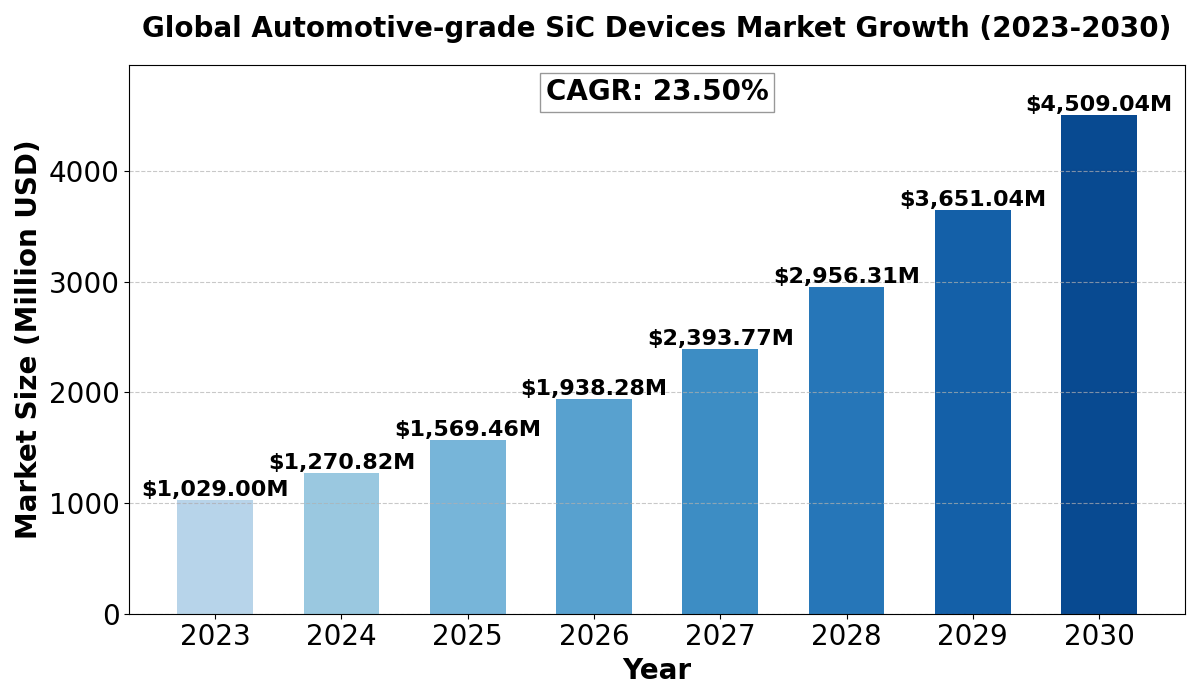
The global Automotive-grade SiC Devices (Discrete) Market size was estimated at USD 1029 million in 2023 and is projected to reach USD 4509.04 million by 2030, exhibiting a CAGR of 23.50% during the forecast period.
North America Automotive-grade SiC Devices (Discrete) market size was USD 268.13 million in 2023, at a CAGR of 20.14% during the forecast period of 2025 through 2030.
Automotive-grade SiC Devices (Discrete) Key Market Trends :
- Rising Adoption of SiC in EV Powertrains – The demand for SiC-based devices in electric vehicles (EVs) is growing due to their higher efficiency and lower energy losses compared to silicon-based components.
- Advancements in SiC Manufacturing – Innovations in SiC wafer technology, such as 8-inch wafer production, are improving cost efficiency and scalability.
- Increasing Government Support for EVs – Global regulations and incentives promoting electric mobility are driving the need for high-performance SiC components.
- Expansion of Charging Infrastructure – The growth of fast-charging stations requires efficient SiC-based power electronics to enhance charging speed and reliability.
- Strategic Partnerships & Mergers – Leading semiconductor manufacturers are forming collaborations and acquisitions to strengthen their SiC capabilities and market position.
Automotive-grade SiC Devices (Discrete) Market Regional Analysis :
-
North America:
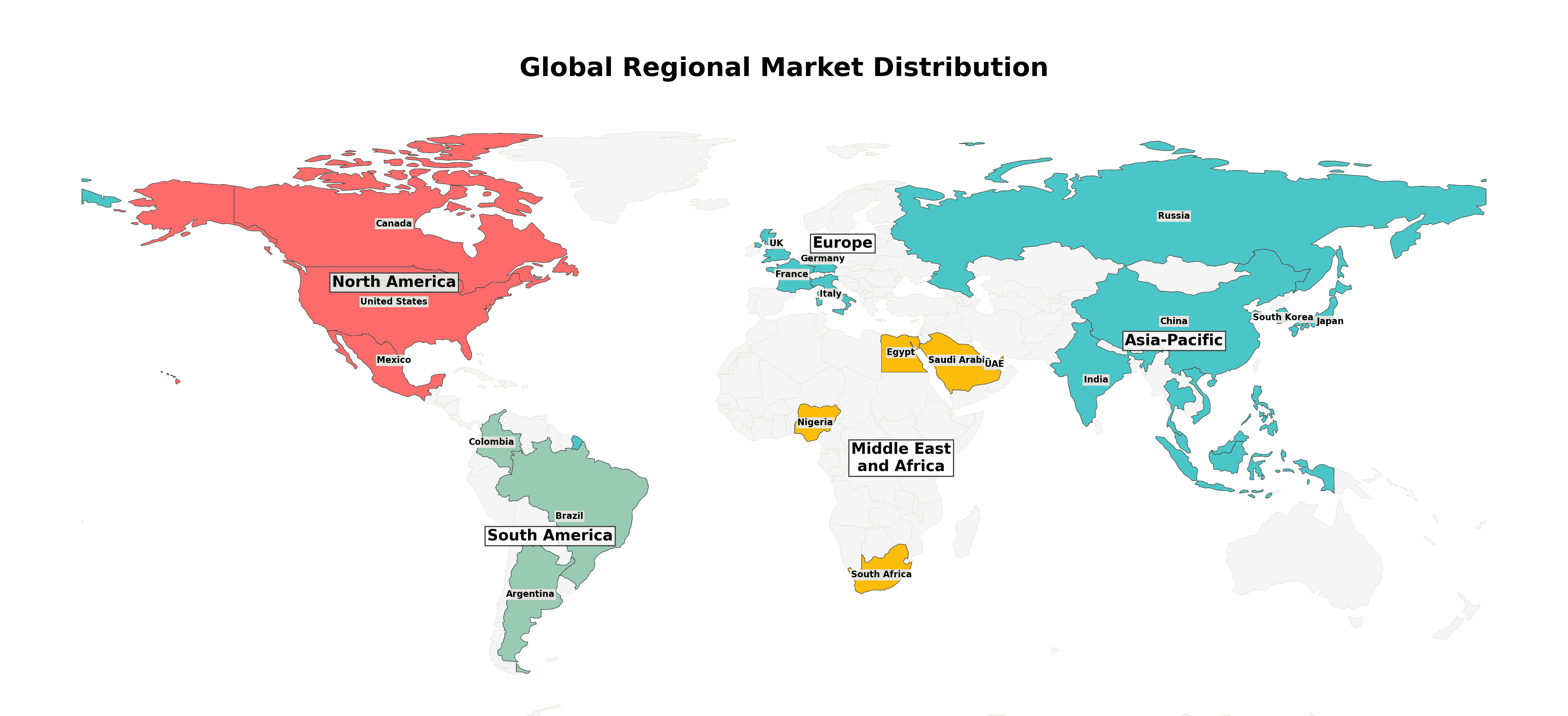
Strong demand driven by EVs, 5G infrastructure, and renewable energy, with the U.S. leading the market.
-
Europe:
Growth fueled by automotive electrification, renewable energy, and strong regulatory support, with Germany as a key player.
-
Asia-Pacific:
Dominates the market due to large-scale manufacturing in China and Japan, with growing demand from EVs, 5G, and semiconductors.
-
South America:
Emerging market, driven by renewable energy and EV adoption, with Brazil leading growth.
-
Middle East & Africa:
Gradual growth, mainly due to investments in renewable energy and EV infrastructure, with Saudi Arabia and UAE as key contributors.
Automotive-grade SiC Devices (Discrete) Market Segmentation :
The research report includes specific segments by region (country), manufacturers, Type, and Application. Market segmentation creates subsets of a market based on product type, end-user or application, Geographic, and other factors. By understanding the market segments, the decision-maker can leverage this targeting in the product, sales, and marketing strategies. Market segments can power your product development cycles by informing how you create product offerings for different segments.
Key Company
- STMicroelectronics
- Infineon
- Wolfspeed
- Rohm
- onsemi
- BYD Semiconductor
- Microchip (Microsemi)
- Mitsubishi Electric (Vincotech)
- Semikron Danfoss
- Fuji Electric
- Navitas (GeneSiC)
- Toshiba
- Qorvo (UnitedSiC)
- San’an Optoelectronics
- Littelfuse (IXYS)
- CETC 55
- WeEn Semiconductors
- BASiC Semiconductor
- SemiQ
- Diodes Incorporated
- SanRex
- Alpha & Omega Semiconductor
- Bosch
- KEC Corporation
- PANJIT Group
- Nexperia
- Vishay Intertechnology
- Zhuzhou CRRC Times Electric
- China Resources Microelectronics Limited
- StarPower
- Yangzhou Yangjie Electronic Technology
- Guangdong AccoPower Semiconductor
- Changzhou Galaxy Century Microelectronics
- Hangzhou Silan Microelectronics
- Cissoid
- SK powertech
- InventChip Technology
- Hebei Sinopack Electronic Technology
- Oriental Semiconductor
- Jilin Sino-Microelectronics
- PN Junction Semiconductor (Hangzhou)
Market Segmentation (by Type)
- SiC MOSFET Discrete
- SiC Diode Discrete (SiC SBD)
Market Segmentation (By Voltage Range)
- Up to 600V
- 601–1200V
- 1201–1700V
- Above 1700V
Market Segmentation (By Power Rating)
- Low Power
- Medium Power
- High Power
Market Segmentation (By Vehicle Type)
- Battery Electric Vehicles (BEVs)
- Plug-in Hybrid Electric Vehicles (PHEVs)
- Hybrid Electric Vehicles (HEVs)
- Fuel Cell Electric Vehicles (FCEVs)
Market Segmentation (by Application)
- Main Inverter (Electric Traction)
- OBC
- DC/DC Converter for EV/HEV
Market Segmentation (By End User)
- OEMs
- Tier-1 Suppliers
- Aftermarket
Market Drivers
- Growing EV and HEV Market – The transition toward electric mobility is significantly increasing the adoption of SiC devices in inverters, OBCs, and DC/DC converters.
- Superior Performance of SiC Devices – SiC MOSFETs and diodes offer lower power loss, higher efficiency, and improved thermal management, making them ideal for automotive applications.
- Rising Investments in Semiconductor R&D – Companies are heavily investing in SiC research to improve production processes and enhance device performance.
Market Restraints
- High Production Costs – The manufacturing of SiC wafers is more expensive than traditional silicon-based counterparts, impacting affordability.
- Complex Fabrication Process – Producing high-quality SiC components requires advanced technology and expertise, posing challenges for new entrants.
- Limited SiC Wafer Supply – A shortage of SiC wafers could lead to supply chain disruptions and affect market growth.
Market Opportunities
- Expansion of SiC Manufacturing Facilities – Increasing investments in SiC wafer production will help meet growing demand and reduce costs.
- Development of High-Power Applications – SiC devices are being explored for applications beyond EVs, including renewable energy systems and industrial automation.
- Integration with AI and Smart Power Systems – The use of AI-driven power management solutions enhances the efficiency of SiC-based electronic systems.
Market Challenges
- Competition from Traditional Silicon-Based Devices – While SiC is gaining traction, silicon-based alternatives remain a strong competitor due to lower costs.
- Quality Control Issues in SiC Manufacturing – Ensuring defect-free SiC wafers and devices remains a challenge for manufacturers.
- Supply Chain Constraints – A limited number of suppliers for high-quality SiC wafers could create bottlenecks in production.
Automotive-grade SiC Devices (Discrete) Market News :
SemiQ’s Third-Generation 1200V SiC MOSFETs
-
Date: February 2025
-
Overview: SemiQ introduced its third-generation 1200V SiC MOSFETs, known as QSiC. These devices offer enhanced efficiency with a reduced die size and are automotive-qualified to the AEC-Q101 standard.
Bosch’s $1.9 Billion Investment in U.S. SiC Semiconductor Production
-
Date: December 2024
-
Overview: Bosch announced a $1.9 billion investment to transform its Roseville, California facility for SiC semiconductor production. The U.S. Commerce Department has preliminarily agreed to provide up to $225 million in subsidies for this project, aiming to commence SiC chip production by 2026.
Nexperia and KOSTAL’s Partnership on Automotive-Grade SiC Devices
-
Date: November 2024
-
Overview: Nexperia and KOSTAL formed a strategic partnership to advance automotive-grade wide-bandgap devices, focusing initially on SiC MOSFETs in QDPAK packaging for onboard chargers.
Nexperia’s Automotive-Qualified 650V SiC Schottky Diodes
-
Date: June 2024
-
Overview: Nexperia’s 650V, 10A SiC Schottky diode achieved automotive qualification and is available in real-two-pin (R2P) DPAK (TO-252-2) packaging, making it suitable for electric vehicle applications.
Key Benefits of This Market Research:
- Industry drivers, restraints, and opportunities covered in the study
- Neutral perspective on the market performance
- Recent industry trends and developments
- Competitive landscape & strategies of key players
- Potential & niche segments and regions exhibiting promising growth covered
- Historical, current, and projected market size, in terms of value
- In-depth analysis of the Automotive-grade SiC Devices (Discrete) Market
- Overview of the regional outlook of the Automotive-grade SiC Devices (Discrete) Market:
Key Reasons to Buy this Report:
- Access to date statistics compiled by our researchers. These provide you with historical and forecast data, which is analyzed to tell you why your market is set to change
- This enables you to anticipate market changes to remain ahead of your competitors
- You will be able to copy data from the Excel spreadsheet straight into your marketing plans, business presentations, or other strategic documents
- The concise analysis, clear graph, and table format will enable you to pinpoint the information you require quickly
- Provision of market value (USD Billion) data for each segment and sub-segment
- Indicates the region and segment that is expected to witness the fastest growth as well as to dominate the market
- Analysis by geography highlighting the consumption of the product/service in the region as well as indicating the factors that are affecting the market within each region
- Provides insight into the market through Value Chain
- Market dynamics scenario, along with growth opportunities of the market in the years to come
- 6-month post-sales analyst support
Customization of the Report
In case of any queries or customization requirements, please connect with our sales team, who will ensure that your requirements are met.
FAQs
Q: What are the key driving factors and opportunities in the Automotive-grade SiC Devices (Discrete) Market?
A: The rising demand for EVs, advancements in SiC technology, and growing investments in semiconductor manufacturing are major drivers. Opportunities exist in expanding SiC wafer production and high-power applications.
Q: Which region is projected to have the largest market share?
A: Asia-Pacific dominates the market due to high EV production in China, Japan, and South Korea, along with strong government support for semiconductor growth.
Q: Who are the top players in the global Automotive-grade SiC Devices (Discrete) Market?
A: Leading companies include STMicroelectronics, Infineon, Wolfspeed, Rohm, onsemi, Mitsubishi Electric, and BYD Semiconductor.
Q: What are the latest technological advancements in the industry?
A: Innovations include 8-inch SiC wafer production, high-voltage SiC MOSFETs, and AI-integrated power management solutions for enhanced efficiency.
Q: What is the current size of the global Automotive-grade SiC Devices (Discrete) Market?
A: The market was valued at USD 1029 million in 2023 and is projected to reach USD 4509.04 million by 2030, growing at a CAGR of 23.50%.

Get Sample Report PDF for Exclusive Insights
Report Sample Includes
- Table of Contents
- List of Tables & Figures
- Charts, Research Methodology, and more...
 Download Sample Report PDF