Automotive Grade NAND (AEC-Q100) Market Insights
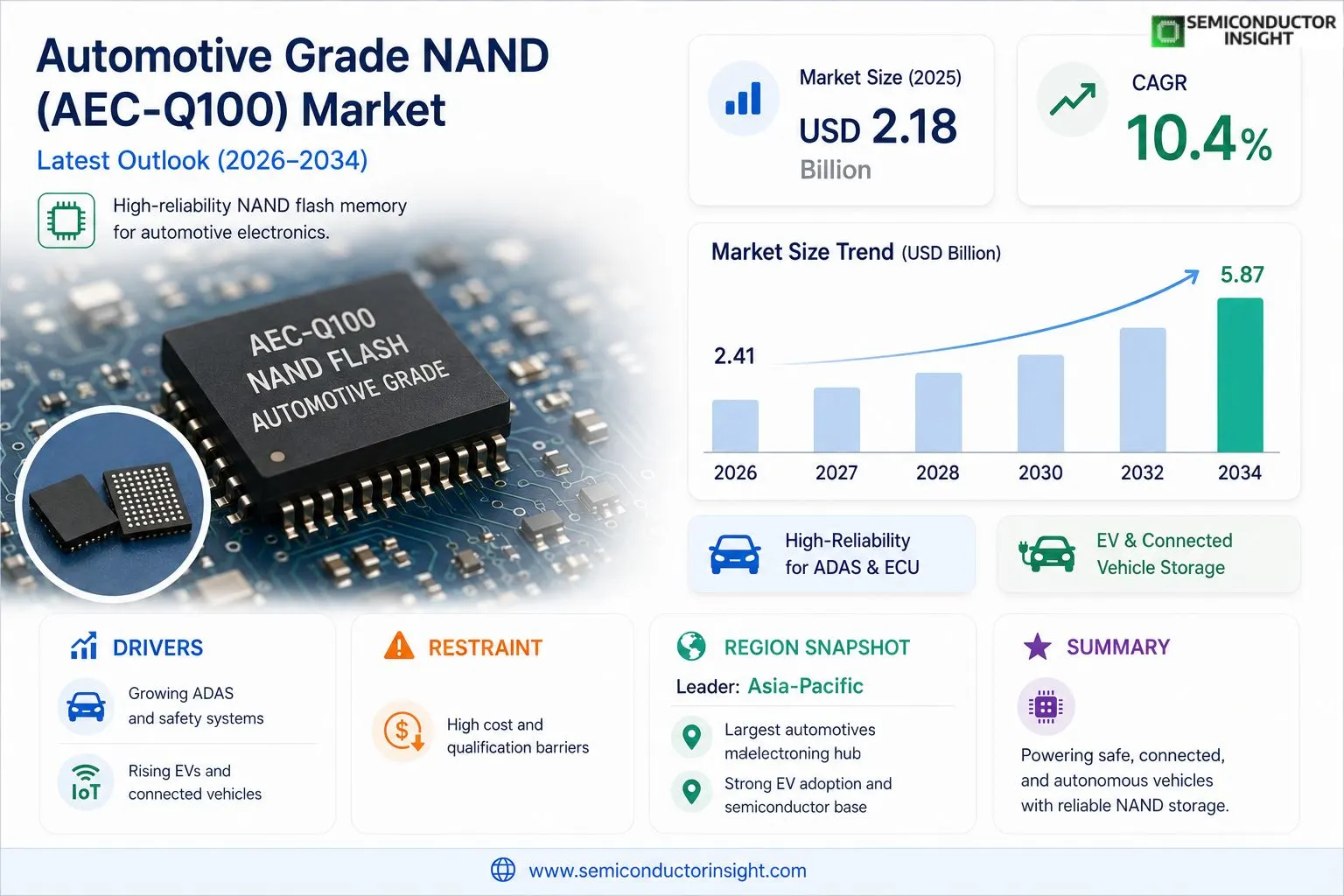
Global Automotive Grade NAND (AEC-Q100) market size was valued at USD 2.18 billion in 2025. The market is projected to grow from USD 2.41 billion in 2026 to USD 5.87 billion by 2034, exhibiting a CAGR of 10.4% during the forecast period.
Automotive Grade NAND flash memory certified to AEC-Q100 standards represents a specialized class of non-volatile storage components engineered to meet the rigorous reliability, temperature, and endurance requirements of modern automotive electronics. These components are qualified to withstand extended operating temperatures ranging from -40°C to +125°C and are designed for deployment in safety-critical systems including advanced driver-assistance systems (ADAS), infotainment units, instrument clusters, telematics control units, and electronic control units (ECUs). The AEC-Q100 qualification encompasses SLC, MLC, and 3D NAND architectures, each offering varying levels of endurance and data retention suited to different automotive applications.
The market is witnessing robust expansion driven by the accelerating adoption of connected and autonomous vehicle technologies, the growing complexity of in-vehicle software systems, and increasingly stringent functional safety mandates under ISO 26262. Furthermore, Global push toward electric vehicles (EVs) , with EV sales surpassing 14 million units in 2023 , has substantially elevated the demand for high-reliability embedded storage. Key industry participants including Micron Technology, Inc., Samsung Semiconductor, Kioxia Corporation, Western Digital Corporation, and Winbond Electronics Corporation continue to expand their automotive-grade NAND portfolios to address these evolving system requirements.
MARKET DRIVERS
Rising Demand for Advanced Driver Assistance Systems (ADAS) and In-Vehicle Infotainment
Automotive Grade NAND (AEC-Q100) Market is experiencing robust growth driven by the accelerating adoption of Advanced Driver Assistance Systems (ADAS) across passenger and commercial vehicles. Modern ADAS platforms require high-capacity, thermally resilient flash storage to manage sensor fusion data, real-time processing logs, and over-the-air (OTA) software updates. AEC-Q100-qualified NAND flash memory, designed to endure extreme automotive operating temperatures ranging from -40°C to +125°C, has become an indispensable component in these safety-critical applications. As regulatory frameworks in North America, Europe, and Asia-Pacific increasingly mandate ADAS features such as automatic emergency braking and lane-keep assist, original equipment manufacturers (OEMs) are scaling up procurement of automotive-grade storage solutions.
Proliferation of Connected and Electric Vehicles Expanding Storage Requirements
Global transition toward electric vehicles (EVs) and connected vehicle architectures is a significant catalyst for Automotive Grade NAND (AEC-Q100) Market. EV platforms rely heavily on embedded NAND flash for battery management system (BMS) firmware, telematics control unit (TCU) storage, and digital instrument cluster data retention. Connected vehicles generate substantial volumes of operational data that must be stored reliably on-board before transmission to cloud infrastructure, necessitating higher-density, AEC-Q100-certified NAND solutions. Leading automotive semiconductor suppliers including Micron Technology, Kioxia, and Western Digital have expanded their AEC-Q100-qualified NAND portfolios specifically to address the evolving storage density requirements of electrified and connected vehicle platforms.
➤ The integration of 3D NAND technology into AEC-Q100-qualified components is enabling automotive designers to achieve greater storage capacities within compact form factors, directly supporting the miniaturization trends observed across next-generation vehicle electronic control unit (ECU) designs.
The increasing deployment of digital cockpit solutions, which consolidate navigation, entertainment, and vehicle settings into unified computing platforms, further amplifies demand within Automotive Grade NAND (AEC-Q100) Market. These high-performance cockpit systems require fast-read NAND flash capable of handling simultaneous data streams without compromising functional safety requirements outlined in ISO 26262 standards. As vehicle software complexity continues to grow, the role of reliable, automotive-certified non-volatile memory storage becomes increasingly central to overall vehicle architecture design strategies.
MARKET CHALLENGES
Stringent Qualification and Certification Processes Increasing Time-to-Market Pressures
One of the most significant challenges confronting Automotive Grade NAND (AEC-Q100) Market is the extensive qualification process required before components can be deployed in production vehicles. AEC-Q100 certification demands rigorous reliability testing across multiple stress conditions, including temperature cycling, humidity bias testing, and electrostatic discharge (ESD) resistance validation. These qualification cycles can extend development timelines considerably, creating bottlenecks for automotive OEMs and Tier-1 suppliers seeking to rapidly integrate the latest NAND flash generations into new vehicle programs. The gap between consumer-grade NAND availability and automotive-grade qualification approval remains a persistent friction point across the supply chain.
Other Challenges
Supply Chain Concentration and Geopolitical Risk
Automotive Grade NAND (AEC-Q100) Market faces meaningful supply chain vulnerability due to the concentration of advanced NAND flash manufacturing capacity among a limited number of suppliers, predominantly headquartered in Asia. Geopolitical tensions, trade restrictions, and export control regulations have introduced uncertainty into long-term procurement strategies for automotive OEMs. The semiconductor supply disruptions experienced in recent years have highlighted the risks of over-reliance on single-region sourcing, prompting automotive manufacturers to reassess inventory management and dual-sourcing strategies for AEC-Q100-qualified NAND components.
Data Integrity and Endurance Limitations Under Automotive Workloads
Automotive applications impose significantly more demanding write endurance and data retention requirements compared to consumer electronics use cases. Continuous write cycles associated with event data recorders (EDR), ADAS logging systems, and telematics units accelerate NAND cell wear, presenting endurance management challenges that require sophisticated firmware-level solutions such as wear leveling and error correction code (ECC) algorithms. Balancing storage density, endurance, and cost within the strict reliability envelope defined by AEC-Q100 standards remains a persistent technical challenge for NAND flash manufacturers serving the automotive sector.
MARKET RESTRAINTS
Higher Cost Premium of AEC-Q100 Certified Components Relative to Commercial Alternatives
A primary restraint affecting Automotive Grade NAND (AEC-Q100) Market is the substantial cost premium associated with automotive-grade certified memory components compared to their industrial or consumer-grade counterparts. The extensive qualification testing, stricter manufacturing process controls, extended product lifecycle support commitments, and lower production volumes characteristic of the automotive segment collectively contribute to elevated per-unit pricing. For cost-sensitive vehicle segments, this price differential creates procurement pressure on Tier-1 and Tier-2 suppliers, occasionally incentivizing the use of lower-specification components in non-safety-critical applications, which can introduce longer-term reliability risks.
Technological Transition Risks Associated with Evolving NAND Flash Architectures
The rapid evolution of NAND flash architectures , from planar NAND to multi-layer 3D NAND configurations with increasing layer counts , introduces transition risks within Automotive Grade NAND (AEC-Q100) Market. Each architectural generation requires requalification under AEC-Q100 protocols, creating continuity challenges for automotive programs with extended production lifecycles that often span seven to ten years or more. The automotive industry’s requirement for long-term component availability conflicts with the semiconductor industry’s accelerated product refresh cycles, compelling NAND suppliers to maintain legacy product lines at considerable operational cost. This structural tension restrains the pace at which next-generation NAND technologies are adopted within automotive applications relative to consumer markets.
MARKET OPPORTUNITIES
Expansion of Autonomous Vehicle Development Programs Driving High-Density NAND Demand
The ongoing development of autonomous and semi-autonomous vehicle platforms presents a substantial growth opportunity for Automotive Grade NAND (AEC-Q100) Market. Autonomous driving systems generate and process exceptional volumes of data from LiDAR, radar, and camera sensor arrays, requiring high-capacity, high-speed AEC-Q100-qualified NAND flash storage capable of meeting both functional safety and performance benchmarks simultaneously. As SAE Level 2+ and Level 3 autonomous features transition from prototype stages toward series production, the demand for validated automotive-grade NAND storage solutions is expected to scale meaningfully, creating long-term procurement opportunities for certified component suppliers.
OTA Software Update Infrastructure Creating New Storage Architecture Requirements
The widespread adoption of over-the-air (OTA) software update capabilities across modern vehicle platforms is creating new architectural opportunities within Automotive Grade NAND (AEC-Q100) Market. OTA functionality requires dedicated, high-endurance NAND flash partitions capable of safely storing and staging firmware images during update processes without compromising system stability or vehicle operability. Automotive OEMs and software-defined vehicle platform developers are specifying higher-capacity AEC-Q100 NAND solutions to accommodate growing software stack sizes, dual-bank update architectures, and rollback recovery storage. This trend is expected to drive incremental NAND content growth per vehicle across all major market segments through the coming years.
Emerging Markets and Regional Automotive Production Growth Supporting Demand Diversification
Expanding automotive production in emerging markets across Southeast Asia, India, and South America offers meaningful geographic diversification opportunities for Automotive Grade NAND (AEC-Q100) Market. As these regions accelerate domestic vehicle manufacturing capabilities and adopt increasingly sophisticated vehicle electronic architectures, local Tier-1 supplier ecosystems are beginning to specify automotive-grade components that comply with internationally recognized reliability standards including AEC-Q100. The gradual alignment of emerging market vehicle platforms with global safety and connectivity standards is expected to broaden the addressable market for AEC-Q100-certified NAND flash memory beyond its traditional concentration in North American, European, and established Asia-Pacific automotive production hubs.
Automotive Grade NAND (AEC-Q100) Market Trends
Rising Demand for High-Reliability Storage in Autonomous and Connected Vehicles
Automotive Grade NAND (AEC-Q100) Market is experiencing strong momentum as the automotive industry undergoes a fundamental shift toward connected, autonomous, and electrified transportation. Automotive-grade NAND flash memory certified under AEC-Q100 standards is increasingly becoming indispensable in modern vehicle architectures. These components are engineered to endure extended operating temperatures ranging from -40°C to +125°C, making them essential for deployment in safety-critical applications such as advanced driver-assistance systems (ADAS), instrument clusters, telematics control units, and electronic control units (ECUs). As vehicle software complexity grows and over-the-air (OTA) update capabilities become standard, the demand for reliable, high-endurance non-volatile storage continues to intensify across global automotive OEMs and Tier-1 suppliers.
Other Trends
Electric Vehicle Proliferation Driving Embedded Storage Requirements
Global acceleration of electric vehicle adoption is serving as a significant catalyst for Automotive Grade NAND (AEC-Q100) Market. With EV sales surpassing 14 million units in 2023, automakers are integrating increasingly sophisticated battery management systems, powertrain controllers, and digital cockpit platforms , all of which require certified, high-reliability embedded storage solutions. AEC-Q100 qualified NAND components, including SLC, MLC, and 3D NAND architectures, are being adopted at scale to support these data-intensive EV systems, each architecture offering distinct trade-offs in endurance, data retention, and thermal performance suited to specific automotive use cases.
Functional Safety Mandates Elevating Qualification Standards
Increasingly stringent functional safety requirements under ISO 26262 are reshaping procurement and design practices within the automotive electronics supply chain. Original equipment manufacturers and system integrators are mandating AEC-Q100 qualification as a baseline requirement for all flash memory components deployed in safety-relevant systems. This regulatory and standards-driven trend is compelling semiconductor suppliers , including Micron Technology, Samsung Semiconductor, Kioxia Corporation, Western Digital Corporation, and Winbond Electronics Corporation , to expand and rigorously validate their automotive-grade NAND portfolios to maintain design-win competitiveness.
Expanding ADAS and Infotainment Applications Broadening Market Scope
The proliferation of ADAS features and advanced infotainment systems across vehicle segments is broadening the addressable scope of Automotive Grade NAND (AEC-Q100) Market. As vehicles transition toward higher levels of driving automation, the volume and velocity of data that must be stored, processed, and retrieved in real time continues to increase significantly. Infotainment units, digital clusters, and domain controllers are now routinely requiring high-capacity, thermally robust NAND solutions. This trend is expected to sustain long-term demand for AEC-Q100 certified components as automotive electronics architectures grow more centralized and software-defined.
COMPETITIVE LANDSCAPE
Key Industry Players
Automotive Grade NAND (AEC-Q100) Market: Competitive Dynamics and Leading Manufacturers
Global Automotive Grade NAND (AEC-Q100) market is characterized by the dominant presence of a few large-scale semiconductor manufacturers who command significant market share through vertically integrated manufacturing capabilities, extensive AEC-Q100 certified product portfolios, and deep-rooted partnerships with Tier-1 automotive suppliers and OEMs. Micron Technology, Inc. leads as one of the foremost suppliers of automotive-grade NAND flash memory, offering a broad range of SLC, MLC, and 3D NAND solutions qualified under AEC-Q100 and compliant with ISO 26262 functional safety requirements. Samsung Semiconductor brings its advanced 3D V-NAND architecture to the automotive segment, leveraging economies of scale and process node leadership to deliver high-density, high-endurance storage solutions for ADAS, infotainment, and telematics applications. Kioxia Corporation, a dedicated NAND flash specialist, has strengthened its automotive-grade BiCS FLASH portfolio to address the growing complexity of embedded storage in next-generation vehicle architectures. Western Digital Corporation rounds out the top tier with its automotive-qualified 3D NAND offerings, targeting applications across electronic control units (ECUs) and instrument clusters in both conventional and electric vehicles.
Beyond the leading players, several specialized and regional semiconductor firms contribute meaningfully to the competitive fabric of Automotive Grade NAND (AEC-Q100) Market. Winbond Electronics Corporation has established a strong niche in SLC NAND flash for cost-sensitive and reliability-demanding automotive applications, while SK Hynix Inc. continues to expand its automotive-certified NAND lineup alongside its broader memory product ecosystem. Macronix International Co., Ltd. and Alliance Memory, Inc. serve automotive customers requiring legacy-compatible, long-lifecycle NAND solutions. Swissbit AG differentiates through its focus on industrial and automotive-grade managed NAND storage modules certified for extreme environmental conditions. Infineon Technologies AG, though primarily a logic and power semiconductor company, offers complementary embedded flash solutions relevant to automotive storage architectures. ISSI (Integrated Silicon Solution Inc.) and Greenliant Systems address specific segments of the market with AEC-Q100 compliant SLC NAND and eMMC products tailored for harsh automotive environments. As EV adoption accelerates globally and software-defined vehicle architectures demand ever-greater storage performance and reliability, competition in this market is expected to intensify, with players differentiating on endurance ratings, operating temperature ranges, functional safety certification levels, and long-term supply commitments.
List of Key Automotive Grade NAND (AEC-Q100) Companies Profiled
- Micron Technology, Inc.
- Samsung Semiconductor
- Kioxia Corporation
- Western Digital Corporation
- Winbond Electronics Corporation
- SK Hynix Inc.
- Macronix International Co., Ltd.
- Alliance Memory, Inc.
- Swissbit AG
- Infineon Technologies AG
- ISSI (Integrated Silicon Solution Inc.)
- Greenliant Systems
Segment Analysis:
| Segment Category | Sub-Segments | Key Insights |
| By Type |
|
SLC NAND continues to dominate as the leading segment within the automotive-grade NAND market, driven by its unmatched endurance, data retention, and reliability characteristics essential for safety-critical deployments.
|
| By Application |
|
Advanced Driver Assistance Systems (ADAS) represents the most dynamically expanding application segment, propelled by Global automotive industry’s accelerating transition toward semi-autonomous and fully autonomous driving platforms.
|
| By End User |
|
Original Equipment Manufacturers (OEMs) lead the end-user segment, commanding the largest share of automotive-grade NAND procurement through highly integrated supply chain relationships with both semiconductor vendors and Tier-1 system integrators.
|
| By Vehicle Type |
|
Battery Electric Vehicles (BEVs) have emerged as the most influential vehicle type driving incremental demand for automotive-grade NAND, reflecting both the volume growth of global EV adoption and the substantially elevated embedded storage requirements inherent to fully electric platforms.
|
| By Interface Standard |
|
eMMC (Embedded MultiMediaCard) currently holds the leading position among automotive NAND interface standards, offering a well-established, cost-effective managed NAND solution that simplifies integration across a broad range of infotainment, instrument cluster, and telematics applications.
|
Regional Analysis: Automotive Grade NAND (AEC-Q100) Market
Asia-Pacific
China’s position as the world’s largest electric vehicle market makes it a primary consumption hub for Automotive Grade NAND (AEC-Q100) solutions. Domestic automakers are rapidly integrating advanced driver-assistance systems and connected cockpit platforms, each requiring highly reliable NAND storage. Government mandates around intelligent transportation and new energy vehicles continue to accelerate design-in activity for AEC-Q100 qualified components across the automotive electronics value chain.
Japan and South Korea collectively anchor the supply side of Automotive Grade NAND (AEC-Q100) Market in Asia-Pacific. Precision engineering culture, rigorous quality management systems, and decades of automotive semiconductor expertise allow these nations to consistently deliver AEC-Q100 compliant NAND products meeting the most demanding vehicular reliability and temperature tolerance requirements. Their chipmakers are pivotal partners for global automotive OEMs seeking certified memory solutions.
India’s automotive semiconductor landscape is undergoing a structural transformation, supported by national policies promoting electronics manufacturing and automotive indigenization. As domestic automakers invest in connected and electrified vehicle platforms, demand for AEC-Q100 grade NAND flash memory is gaining traction. India’s growing engineering talent pool and expanding Tier-2 supplier ecosystem position it as a meaningful long-term contributor to regional Automotive Grade NAND adoption.
Taiwan plays a critical enabling role in Automotive Grade NAND (AEC-Q100) Market through its world-class semiconductor foundry services and IC design ecosystem. Taiwanese foundries support the production of automotive-qualified NAND flash components at advanced process nodes, while local fabless design houses contribute innovative controller and storage solutions. The island’s deep integration with global semiconductor supply chains makes it a strategic node for AEC-Q100 product development and qualification.
North America
North America represents a highly strategic region in Automotive Grade NAND (AEC-Q100) Market, underpinned by its robust automotive OEM base, particularly in the United States, and a thriving semiconductor design ecosystem. The United States is home to several key NAND flash controller and memory solution providers, as well as influential automotive technology companies pioneering autonomous driving and connected vehicle platforms. Regulatory frameworks emphasizing vehicle cybersecurity and over-the-air update capability are compelling automakers to specify AEC-Q100 qualified NAND memory for mission-critical applications. Additionally, the CHIPS Act and related federal investment initiatives are stimulating domestic semiconductor manufacturing, which is expected to progressively strengthen the North American supply chain for automotive-grade memory components. Canada and Mexico contribute through their respective roles in automotive manufacturing and supply chain logistics, reinforcing the region’s overall significance in global Automotive Grade NAND (AEC-Q100) market dynamics through the forecast period.
Europe
Europe occupies a prominent position in Automotive Grade NAND (AEC-Q100) Market, characterized by its stringent automotive engineering standards, strong legacy OEM presence, and ambitious vehicle electrification agenda. Germany, France, and Sweden are home to globally renowned automotive groups that consistently demand the highest grades of electronic component reliability, making AEC-Q100 certification a non-negotiable specification for NAND flash integration. European Union regulations around vehicle safety, data recording, and emission reduction are catalyzing deeper adoption of advanced automotive electronics, including sophisticated infotainment and ADAS architectures that rely on AEC-Q100 qualified NAND memory. The region also benefits from a sophisticated Tier-1 supplier network, including several major automotive semiconductor distributors and design engineering firms with deep expertise in functional safety standards. Europe’s commitment to software-defined vehicles further amplifies the strategic importance of reliable, high-endurance automotive-grade NAND solutions.
South America
South America presents a developing but progressively relevant landscape for Automotive Grade NAND (AEC-Q100) Market. Brazil serves as the region’s primary automotive hub, hosting assembly operations for several global OEM brands and a growing electronics localization drive. While the adoption of advanced driver-assistance systems and electric vehicles remains at an earlier stage compared to other regions, increasing consumer demand for connected infotainment features and telematics is beginning to drive interest in AEC-Q100 compliant memory solutions. Argentina and other regional markets contribute modestly to overall demand, largely through imported vehicle models that incorporate Automotive Grade NAND components at the OEM level. Infrastructure investments and trade agreements are gradually improving the region’s readiness to support more sophisticated automotive electronic content, suggesting steady market development for Automotive Grade NAND adoption through 2034.
Middle East & Africa
The Middle East and Africa region represents an nascent yet increasingly noteworthy segment of Automotive Grade NAND (AEC-Q100) Market. Gulf Cooperation Council nations, particularly the UAE and Saudi Arabia, are investing substantially in smart city initiatives and intelligent transportation infrastructure, which indirectly supports demand for automotive-grade electronic components including AEC-Q100 qualified NAND flash. The region’s extreme ambient temperature conditions make automotive-grade reliability certifications especially relevant, as standard commercial memory components are ill-suited for vehicular deployment in such environments. Africa’s automotive market, while still largely driven by imported used vehicles, is witnessing gradual modernization as newer vehicle models with embedded electronics gain market share. As regional economic development programs advance and domestic automotive assembly activities expand, the Middle East and Africa are expected to contribute incrementally to global Automotive Grade NAND (AEC-Q100) market growth over the forecast horizon.
Report Scope
This market research report provides a comprehensive analysis of the Automotive Grade NAND (AEC-Q100) Market , covering the forecast period 2026–2034. It offers detailed insights into market dynamics, technological advancements, competitive landscape, and key trends shaping the industry.
Key focus areas of the report include:
- Market Overview: The report begins with an overview outlining its current market scenario, key growth indicators, and industry transformation drivers. It discusses macroeconomic factors, demand–supply balance, regulatory landscape, and the strategic role of semiconductors in powering advancements across industries such as automotive, telecommunications, consumer electronics, and industrial automation.
- Market Size & Forecast: Historical data and future projections for revenue, unit shipments, and market value across major regions and segments.
- Segmentation Analysis: Detailed breakdown by product type, technology, application, and end-user industry to identify high-growth segments and investment opportunities.
- Regional Insights: Insights into market performance across North America, Europe, Asia-Pacific, Latin America, and the Middle East & Africa, including country-level analysis where relevant.
- Competitive Landscape: Profiles of leading market participants, including their product offerings, R&D focus, manufacturing capacity, pricing strategies, and recent developments such as mergers, acquisitions, and partnerships.
- Technology Trends & Innovation: Assessment of emerging technologies, integration of AI/IoT, semiconductor design trends, fabrication techniques, and evolving industry standards.
- Market Drivers & Restraints: Evaluation of factors driving market growth along with challenges, supply chain constraints, regulatory issues, and market-entry barriers.
- Stakeholder Insights: Insights for component suppliers, OEMs, system integrators, investors, and policymakers regarding the evolving ecosystem and strategic opportunities.
Primary and secondary research methods are employed, including interviews with industry experts, data from verified sources, and real-time market intelligence to ensure the accuracy and reliability of the insights presented.
FREQUENTLY ASKED QUESTIONS:
What is the current market size of Automotive Grade NAND (AEC-Q100) Market?
-> Automotive Grade NAND (AEC-Q100) Market was valued at USD 2.18 billion in 2025 and is expected to reach USD 5.87 billion by 2034, growing at a CAGR of 10.4% during the forecast period from 2026 to 2034.
Which key companies operate in Automotive Grade NAND (AEC-Q100) Market?
-> Key players include Micron Technology, Inc., Samsung Semiconductor, Kioxia Corporation, Western Digital Corporation, and Winbond Electronics Corporation, among others.
What are the key growth drivers?
-> Key growth drivers include accelerating adoption of connected and autonomous vehicle technologies, growing complexity of in-vehicle software systems, stringent functional safety mandates under ISO 26262, and Global push toward electric vehicles (EVs) , with EV sales surpassing 14 million units in 2023 , substantially elevating demand for high-reliability embedded storage.
Which region dominates the market?
-> Asia-Pacific is the fastest-growing region, driven by strong automotive manufacturing bases and semiconductor production capabilities, while North America and Europe remain significant markets due to advanced ADAS adoption and stringent automotive safety regulations.
What are the emerging trends?
-> Emerging trends include adoption of 3D NAND architectures, integration of SLC and MLC NAND in safety-critical automotive systems such as ADAS and telematics control units, expanded AEC-Q100 qualified portfolios, and increasing deployment in electronic control units (ECUs) and instrument clusters supporting next-generation connected and autonomous vehicles.

Get Sample Report PDF for Exclusive Insights
Report Sample Includes
- Table of Contents
- List of Tables & Figures
- Charts, Research Methodology, and more...
 Download Sample Report PDF