Audio Codec (DAC, ADC, Amplifier) Smartphone IC Market Insights
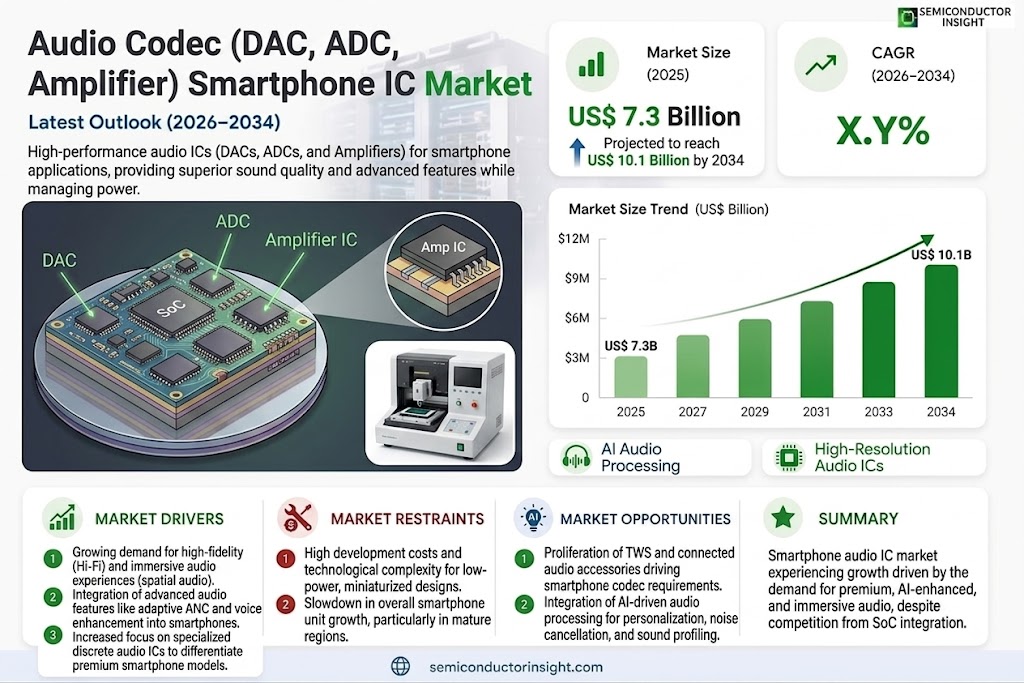
Global Audio Codec (DAC, ADC, Amplifier) Smartphone IC Market size was valued at USD 7.3 billion in 2025. The market is projected to grow from USD 7.55 billion in 2026 to USD 10.1 billion by 2034, exhibiting a CAGR of 3.5% during the forecast period.
Audio Codec (DAC, ADC, Amplifier) Smartphone ICs are specialized integrated circuits essential for high-quality audio processing in mobile devices. These components handle digital-to-analog conversion (DAC) for playback, analog-to-digital conversion (ADC) for recording, and amplification to deliver clear, powerful sound through speakers, headphones, and earpieces. They integrate advanced signal processing capabilities to support features such as noise cancellation, spatial audio, and high-resolution playback while maintaining low power consumption critical for battery-powered smartphones.
The market is experiencing steady growth due to several factors, including rising consumer demand for superior audio experiences in smartphones, increasing adoption of premium features like high-fidelity sound and active noise cancellation, and the proliferation of multimedia content consumption. Furthermore, advancements in 5G technology and streaming services are driving the need for more sophisticated audio ICs that can handle higher data rates and deliver immersive sound. Initiatives by key players in the market are also expected to fuel the market growth. Major semiconductor companies continue to innovate in low-power, high-performance solutions tailored for flagship and mid-range devices, enhancing overall user experience in communication, entertainment, and gaming applications.
MARKET DRIVERS
Rising Demand for High-Quality Audio in Smartphones
Audio Codec (DAC, ADC, Amplifier) Smartphone IC Market is propelled by the increasing consumer expectation for superior audio experiences in mobile devices. Smartphones now serve as primary hubs for media consumption, gaming, and communication, driving the integration of advanced audio ICs that support high-resolution formats and immersive sound. Manufacturers continue to enhance audio capabilities to differentiate flagship models, incorporating features like noise cancellation and spatial audio.
Expansion of Wireless Audio and Streaming Services
Growth in wireless earbuds, headphones, and streaming platforms has significantly boosted demand for efficient audio codecs and amplifiers optimized for low latency and power efficiency. The shift away from traditional headphone jacks has accelerated the need for integrated DAC and ADC solutions in USB-C and Bluetooth ecosystems. This trend aligns with broader adoption of high-quality audio formats across consumer electronics.
➤ Smartphone shipments remain robust, with audio IC content per device rising due to multi-speaker setups and advanced processing requirements.
Advancements in Class-D amplifiers and AI-enhanced signal processing further support market expansion by delivering better efficiency and sound quality in compact form factors typical of modern smartphones.
MARKET CHALLENGES
Itense Competition and Integration Pressures
Audio Codec (DAC, ADC, Amplifier) Smartphone IC Market faces challenges from increasing integration of audio functions directly into mobile SoCs by major chipset providers. This trend pressures discrete IC suppliers to innovate rapidly while managing pricing dynamics in a highly competitive landscape dominated by a few key players.
Other Challenges
Power Consumption Management
Balancing high audio performance with stringent battery life requirements in slim smartphone designs remains a persistent technical hurdle for codec and amplifier ICs.
Supply Chain and Cost Sensitivity
Fluctuations in semiconductor supply and the need to maintain competitive pricing for high-volume smartphone applications create ongoing margin pressures for specialized audio IC manufacturers.
MARKET RESTRAINTS
High Development Costs and Technological Complexity
Developing advanced Audio Codec (DAC, ADC, Amplifier) solutions for smartphones involves substantial R&D investment to meet requirements for low power, high fidelity, and miniaturization. Smaller players face barriers in keeping pace with rapid technological evolution and stringent certification standards demanded by leading device manufacturers. The market also contends with potential slowdowns in overall smartphone unit growth in mature regions, which can moderate demand expansion for premium audio IC content despite per-device increases.
MARKET OPPORTUNITIES
Emergence of AI and Immersive Audio Technologies
Audio Codec (DAC, ADC, Amplifier) Smartphone IC Market presents strong opportunities through the integration of AI-driven audio processing for adaptive noise cancellation, voice enhancement, and personalized sound profiles. Growing interest in spatial and lossless audio formats creates avenues for higher-value IC solutions in premium and mid-range devices. Expansion into emerging markets with rising smartphone penetration, coupled with increasing demand for enhanced multimedia experiences, offers significant growth potential for optimized audio IC implementations.
Trends
Rising Demand for Superior Audio Processing in Smartphones
Audio Codec (DAC, ADC, Amplifier) Smartphone ICs remain essential components for delivering high-quality audio experiences in modern mobile devices. These specialized integrated circuits manage digital-to-analog conversion for audio playback, analog-to-digital conversion for recording, and signal amplification to ensure clear and powerful sound output through speakers, headphones, and earpieces. Manufacturers continue to prioritize integration of advanced signal processing that supports noise cancellation, spatial audio, and high-resolution playback while optimizing for low power consumption to preserve smartphone battery life.
Other Trends
Integration of Premium Audio Features Across Device Segments
Audio Codec (DAC, ADC, Amplifier) Smartphone IC Market is witnessing increased adoption of premium audio capabilities not only in flagship devices but also in mid-range smartphones. Consumer expectations for immersive sound in entertainment, communication, and gaming applications are pushing semiconductor companies to develop versatile solutions that enhance overall user experience. This trend aligns with the proliferation of multimedia content consumption and the need for reliable audio performance in everyday device usage.
Advancements Driven by 5G Connectivity and Streaming Services
Expansion of 5G networks and growth in high-quality streaming platforms are accelerating the requirement for more sophisticated Audio Codec (DAC, ADC, Amplifier) Smartphone IC solutions capable of handling higher data rates and delivering richer audio output. Industry leaders are focusing on innovations in low-power, high-performance audio processing technologies that support active noise cancellation and spatial audio features. These developments enable smartphone makers to differentiate their products through superior sound quality while maintaining efficiency critical for portable devices. Ongoing efforts by major semiconductor firms to refine these integrated circuits continue to shape the evolution of mobile audio capabilities across global markets.
COMPETITIVE LANDSCAPE
Key Industry Player
Competitive Dynamics Audio Codec (DAC, ADC, Amplifier) Smartphone IC Market
Audio Codec (DAC, ADC, Amplifier) Smartphone IC Market is characterized by a concentrated competitive landscape dominated by specialized semiconductor firms with strong expertise in low-power, high-fidelity audio processing. Cirrus Logic stands out as a leading player, renowned for its advanced audio codecs widely adopted in premium smartphones for superior DAC performance, noise cancellation, and power efficiency. Qualcomm also commands significant influence through its integrated Snapdragon Sound platforms that combine audio IC functionalities with SoC solutions, enabling seamless support for high-resolution audio and immersive experiences across Android ecosystems.
Other notable participants include established analog giants and emerging specialists who focus on niche innovations such as high-performance amplifiers and spatial audio capabilities. Companies like Texas Instruments, Analog Devices, and Realtek Semiconductor contribute robust portfolios tailored for both flagship and mid-range devices, driving technological advancements in battery optimization and multimedia quality amid rising demand for premium audio features in 5G-enabled smartphones.
List of Key Audio Codec Smartphone IC Companies Profiled
- Cirrus Logic
- Qualcomm Technologies
- Texas Instruments
- Analog Devices, Inc.
- Realtek Semiconductor Corp.
- STMicroelectronics
- NXP Semiconductors
- MediaTek Inc.
- Infineon Technologies AG
- ON Semiconductor Corporation
- Dialog Semiconductor (Renesas)
- ESS Technology
- Asahi Kasei Microdevices (AKM)
- Maxim Integrated (Analog Devices)
- ROHM Co., Ltd.
Segment Analysis:
| Segment Category | Sub-Segments | Key Insights |
| By Type |
|
Integrated Audio Codecs represent the dominant approach in modern smartphone designs due to their ability to combine multiple audio functions into a single compact chip. This integration enables efficient signal processing while minimizing space requirements on densely packed smartphone motherboards. Manufacturers favor these solutions for delivering seamless playback, recording, and amplification capabilities that enhance overall audio fidelity.
|
| By Application |
|
Multimedia Playback emerges as the primary driver for audio codec innovation in smartphones, fueled by consumer preference for high-quality music streaming and video content. These ICs excel at converting digital signals into rich, detailed analog audio for speakers and headphones.
|
| By End User |
|
Flagship Smartphones lead adoption of cutting-edge Audio Codec solutions, prioritizing superior sound performance to justify premium positioning. These devices incorporate the most advanced DAC, ADC, and amplifier technologies available.
|
| By Audio Feature |
|
Active Noise Cancellation stands out as a transformative feature driving demand for specialized audio codec ICs in smartphones. These solutions intelligently filter ambient sounds to deliver clearer audio in challenging environments.
|
| By Integration Level |
|
SoC-Integrated Solutions are increasingly preferred for their ability to streamline smartphone architecture while optimizing audio performance. Embedding audio codec functions directly within the main processor reduces latency and component count.
|
Regional Analysis: Audio Codec (DAC, ADC, Amplifier) Smartphone IC Market
Asia-Pacific
Asia-Pacific dominates Audio Codec (DAC, ADC, Amplifier) Smartphone IC Market as the epicenter of global smartphone production and technological innovation. The region’s robust ecosystem, anchored by manufacturing powerhouses in China, South Korea, and Taiwan, fosters seamless integration of advanced audio components into next-generation devices. Local semiconductor giants collaborate closely with flagship smartphone brands to deliver superior sound quality, noise cancellation, and power-efficient amplification solutions that meet demanding consumer expectations for immersive audio experiences.Design houses in the region prioritize compact, high-performance audio codec solutions that enhance music playback, voice clarity during calls, and spatial audio features in premium handsets. The presence of specialized supply chains accelerates rapid prototyping and mass production of DAC, ADC, and amplifier ICs tailored for foldable phones, gaming smartphones, and AI-enhanced audio applications. Consumer preferences in key markets like India, Japan, and Southeast Asia drive continuous upgrades in audio fidelity and battery optimization, pushing manufacturers to innovate in low-power consumption technologies without compromising on clarity or volume output. Strategic partnerships between fabless designers and foundries enable the swift adoption of cutting-edge process nodes, resulting in smaller form factors and better thermal management for audio ICs. This dynamic environment positions Asia-Pacific as the primary innovation hub where audio codec technologies evolve in lockstep with smartphone trends toward richer multimedia capabilities and enhanced user experiences.
The concentrated smartphone assembly clusters in Asia-Pacific enable tight integration between audio codec suppliers and device makers. This proximity supports rapid iteration cycles for DAC and amplifier designs, ensuring new audio features reach the market faster than in other regions while maintaining strict quality standards for signal integrity and power efficiency.
Regional firms excel in developing specialized audio processing algorithms that complement hardware DAC, ADC, and amplifier ICs. Focus areas include adaptive sound enhancement for varied environments and seamless multi-channel support, keeping the Asia-Pacific at the forefront of audio technology evolution in smartphones.
Established semiconductor supply networks provide reliable access to materials and testing facilities essential for high-volume production of smartphone audio ICs. This resilience allows consistent delivery of advanced amplifier and codec solutions even amid global disruptions.
Diverse consumer bases across Asia-Pacific seek premium audio experiences in affordable and flagship devices alike. This broad demand spectrum encourages continuous refinement of audio codec technologies to balance performance, cost, and energy efficiency in smartphone applications.
North America
North America maintains a significant position Audio Codec (DAC, ADC, Amplifier) Smartphone IC Market through its emphasis on premium audio performance and software-hardware co-design. The region excels in developing sophisticated audio tuning solutions that optimize DAC and amplifier capabilities for high-end smartphones targeting audiophile consumers. Strong focus on immersive technologies such as spatial audio and advanced noise cancellation drives demand for high-fidelity ICs that deliver crystal-clear sound reproduction. Design teams collaborate with global brands to incorporate intelligent audio processing that adapts to user behavior and environment, enhancing overall multimedia experiences while prioritizing power management for extended battery life.
Europe
Europe contributes to Audio Codec (DAC, ADC, Amplifier) Smartphone IC Market with its rigorous standards for audio quality and sustainability. The region’s engineering expertise supports the creation of energy-efficient amplifier and codec solutions that meet strict environmental regulations without sacrificing performance. European consumers value natural sound reproduction and voice clarity, pushing manufacturers toward refined ADC technologies for superior call quality and media playback. Strategic research initiatives focus on integrating audio ICs with emerging connectivity standards, creating opportunities for differentiated smartphone audio features that appeal to privacy-conscious and quality-focused users across the continent.
South America
South America shows steady growth Audio Codec (DAC, ADC, Amplifier) Smartphone IC Market as smartphone penetration increases and consumers seek better entertainment experiences. Local market preferences favor affordable devices with reliable audio capabilities, encouraging the adoption of cost-effective yet capable DAC and amplifier solutions. Regional distributors work closely with global suppliers to customize audio features for tropical climates and diverse usage patterns, such as outdoor media consumption. Growing interest in gaming and social media applications drives demand for clearer voice amplification and basic noise reduction technologies tailored to mid-range smartphone segments prevalent in the region.
Middle East & Africa
The Middle East and Africa region demonstrates emerging potential Audio Codec (DAC, ADC, Amplifier) Smartphone IC Market fueled by rapid digital transformation and rising disposable incomes. Demand centers on durable audio solutions suitable for challenging environments, with emphasis on loud amplification and clear voice capture for communication in noisy settings. Smartphone brands adapt DAC and amplifier ICs to support multilingual voice processing and robust multimedia playback that aligns with cultural preferences for music and video content. Infrastructure development and increasing 5G adoption further stimulate interest in advanced audio codecs capable of delivering high-quality streaming experiences across diverse market segments.
Report Scope
This market research report provides a comprehensive analysis of the Audio Codec (DAC, ADC, Amplifier) Smartphone IC Market , covering the forecast period 2026–2034. It offers detailed insights into market dynamics, technological advancements, competitive landscape, and key trends shaping the industry.
Key focus areas of the report include:
- Market Overview: The report begins with an overview outlining its current market scenario, key growth indicators, and industry transformation drivers. It discusses macroeconomic factors, demand–supply balance, regulatory landscape, and the strategic role of semiconductors in powering advancements across industries such as automotive, telecommunications, consumer electronics, and industrial automation.
- Market Size & Forecast: Historical data and future projections for revenue, unit shipments, and market value across major regions and segments.
- Segmentation Analysis: Detailed breakdown by product type, technology, application, and end-user industry to identify high-growth segments and investment opportunities.
- Regional Insights: Insights into market performance across North America, Europe, Asia-Pacific, Latin America, and the Middle East & Africa, including country-level analysis where relevant.
- Competitive Landscape: Profiles of leading market participants, including their product offerings, R&D focus, manufacturing capacity, pricing strategies, and recent developments such as mergers, acquisitions, and partnerships.
- Technology Trends & Innovation: Assessment of emerging technologies, integration of AI/IoT, semiconductor design trends, fabrication techniques, and evolving industry standards.
- Market Drivers & Restraints: Evaluation of factors driving market growth along with challenges, supply chain constraints, regulatory issues, and market-entry barriers.
- Stakeholder Insights: Insights for component suppliers, OEMs, system integrators, investors, and policymakers regarding the evolving ecosystem and strategic opportunities.
Primary and secondary research methods are employed, including interviews with industry experts, data from verified sources, and real-time market intelligence to ensure the accuracy and reliability of the insights presented.
FREQUENTLY ASKED QUESTIONS:
What is the current market size of Audio Codec (DAC, ADC, Amplifier) Smartphone IC Market?
-> Audio Codec (DAC, ADC, Amplifier) Smartphone IC Market was valued at USD 7.3 billion in 2025 and is expected to reach USD 10.1 billion by 2034.
Which key companies operate Audio Codec (DAC, ADC, Amplifier) Smartphone IC Market?
-> Key players include Cirrus Logic, Qualcomm, Realtek Semiconductor, Analog Devices, STMicroelectronics, and Texas Instruments, among others.
What are the key growth drivers?
-> Key growth drivers include rising consumer demand for superior audio experiences, increasing adoption of high-fidelity sound and active noise cancellation, and proliferation of multimedia content consumption.
Which region dominates the market?
-> Asia-Pacific is the fastest-growing region, while North America remains a dominant market.
What are the emerging trends?
-> Emerging trends include advanced noise cancellation, spatial audio, low-power high-performance solutions, and integration with 5G streaming services.

Get Sample Report PDF for Exclusive Insights
Report Sample Includes
- Table of Contents
- List of Tables & Figures
- Charts, Research Methodology, and more...