AR Glasses Optical Engine & Display IC Market Insights
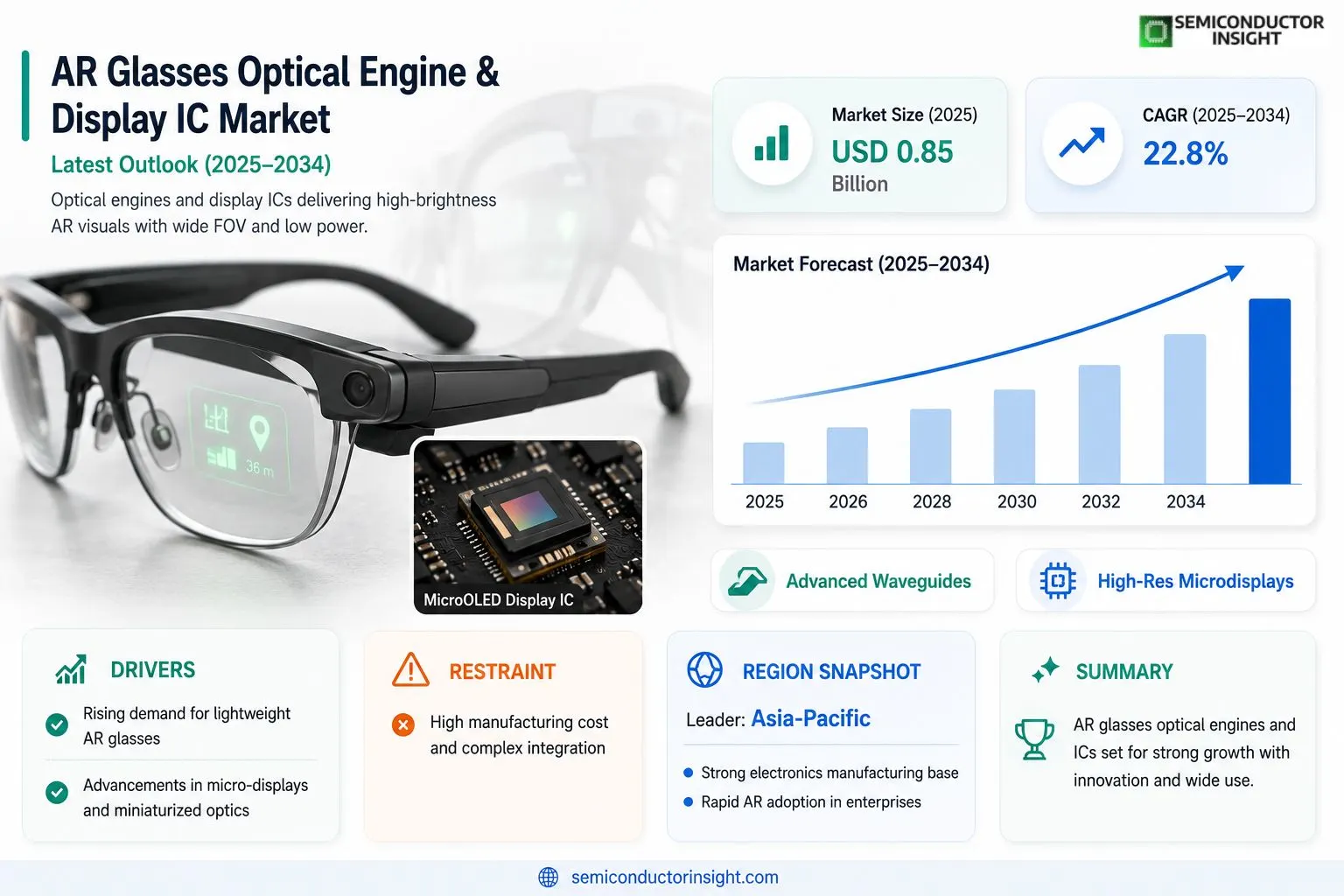
Global AR Glasses Optical Engine & Display IC market size was valued at USD 0.85 billion in 2025. The market is projected to grow from USD 0.92 billion in 2025 to USD 5.45 billion by 2034, exhibiting a CAGR of 22.8% during the forecast period.
AR Glasses Optical Engine and Display ICs are critical components that power the visual systems in augmented reality smart glasses. The optical engine integrates micro-displays, light sources, and projection optics such as waveguides, birdbath combiners, or freeform prisms to deliver high-brightness, wide field-of-view images overlaid on the real world. Display ICs manage signal processing, power efficiency, and image quality for technologies including MicroOLED, MicroLED, and LCOS.
The market is experiencing rapid growth due to several factors, including surging demand for lightweight and comfortable AR glasses in enterprise, industrial, and consumer applications. Advancements in miniaturized optics and high-resolution micro-displays are enabling better user experiences with improved brightness, reduced power consumption, and slimmer form factors. Furthermore, increasing investments by technology leaders in spatial computing and the integration of AI capabilities are accelerating adoption. Key players continue to innovate, with developments such as enhanced waveguide architectures and efficient display drivers supporting broader commercialization. Major contributors in this space offer comprehensive portfolios of optical modules and integrated circuits tailored for next-generation AR devices.
MARKET DRIVERS
Advancements in Waveguide Optics and Microdisplays
AR Glasses Optical Engine & Display IC Market is propelled by rapid innovations in waveguide technologies and high-performance microdisplays such as Micro-OLED and MicroLED. These components enable compact, lightweight optical engines that deliver high brightness, wide field of view, and seamless see-through experiences essential for consumer and enterprise AR glasses. Companies are achieving significant reductions in form factor while improving image quality, supporting broader adoption in industrial, healthcare, and daily-use applications.
Rising Enterprise and Consumer Demand for AR Solutions
Enterprise sectors continue to drive demand for advanced optical engines and display ICs as AR glasses enhance productivity through hands-free information overlay, remote collaboration, and real-time training. Consumer interest is accelerating with improving comfort and integration of AI capabilities, pushing manufacturers to develop more efficient display driver ICs optimized for low power and high resolution in slim profiles.
➤ Global AR glass market is experiencing explosive growth, with projections indicating strong double-digit CAGRs through 2030 fueled by optical technology maturation.
Integration of 5G and edge computing further complements these hardware advancements, allowing optical engines to offload processing while maintaining responsive AR overlays, creating a positive feedback loop for market expansion in AR Glasses Optical Engine & Display IC Market.
MARKET CHALLENGES
Technical Complexity in Optical Integration
Developing high-performance optical engines for AR glasses involves complex trade-offs between field of view, eyebox size, brightness, and form factor. Waveguide architectures and microdisplay integration demand precision manufacturing, often resulting in yield issues and extended development cycles for display ICs tailored to AR-specific requirements.
Other Challenges
Power Consumption and Thermal Management
Optical engines and associated display driver ICs in AR glasses must balance high brightness output with stringent battery life constraints for all-day wearability, with current solutions frequently facing thermal throttling during extended use.
Cost and Scalability Barriers
Advanced components like high-index waveguides and specialized ICs remain expensive to produce at volume, limiting accessibility for mass-market consumer AR glasses despite strong enterprise pull.
MARKET RESTRAINTS
High Manufacturing Costs and Supply Chain Limitations
Elevated production costs for precision optical engines, custom display ICs, and waveguide combiners continue to restrain broader commercialization in AR Glasses Optical Engine & Display IC Market. Specialized materials and low yields in microdisplay fabrication contribute to premium pricing that hampers widespread consumer adoption.
Performance Trade-offs in Compact Designs
Achieving sufficient brightness, wide field of view, and low power simultaneously within the constrained space of eyeglass frames poses ongoing technical hurdles. Challenges in etendue management, color uniformity, and prescription lens compatibility further slow the pace of market penetration for advanced AR optical solutions.
MARKET OPPORTUNITIES
Emerging Applications and Technological Convergence
Significant opportunities exist in healthcare, manufacturing, and defense sectors where next-generation optical engines and display ICs can deliver mission-critical AR capabilities. Continued convergence with AI processing and improved waveguide efficiency is expected to unlock new use cases and drive volume growth in AR Glasses Optical Engine & Display IC Market.
Innovation in Materials and Integration
Advances in microLED technology, high-refractive-index materials, and hybrid optical architectures present pathways for lighter, more efficient designs. Strategic partnerships between display IC suppliers, optics specialists, and device manufacturers are poised to accelerate commercialization and capture expanding market share through 2030 and beyond.
AR Glasses Optical Engine & Display IC Market Trends
Advancements in Miniaturized Optics and High-Resolution Micro-Displays
AR Glasses Optical Engine & Display IC Market is witnessing significant momentum driven by rapid technological progress in miniaturized optics and high-resolution micro-displays. Optical engines now integrate sophisticated components including waveguides, birdbath combiners, and freeform prisms alongside micro-displays and light sources to deliver seamless augmented reality overlays with enhanced brightness and wide field-of-view capabilities. Display ICs play a pivotal role in optimizing signal processing, power efficiency, and overall image quality across MicroOLED, MicroLED, and LCOS technologies.
Other Trends
Rising Demand for Lightweight and Comfortable Designs
Enterprise, industrial, and consumer sectors are increasingly seeking AR glasses that prioritize comfort without compromising performance. This shift is propelling innovation within AR Glasses Optical Engine & Display IC Market toward slimmer form factors and reduced weight through refined optical architectures and efficient driver circuits. Such improvements are essential for prolonged usage in real-world applications ranging from remote assistance to training simulations.
Integration with Spatial Computing and AI Capabilities
Technology leaders are heavily investing in the convergence of spatial computing and artificial intelligence, accelerating the evolution of optical engines and display ICs. These integrations enable more intuitive interactions and context-aware overlays, positioning AR Glasses Optical Engine & Display IC Market at the forefront of next-generation computing platforms. Enhanced waveguide designs and power-optimized display solutions are critical enablers for broader commercialization across professional and personal use cases.
Innovations in Waveguide Architectures and Display Drivers
Key industry participants continue to refine waveguide architectures and develop more efficient display drivers to support higher brightness levels while maintaining low power consumption. These advancements are fostering improved user experiences with better contrast, color accuracy, and overall visual fidelity in AR glasses. As the ecosystem matures, AR Glasses Optical Engine & Display IC Market benefits from collaborative efforts that address longstanding challenges in thermal management and optical alignment, paving the way for mainstream adoption in diverse verticals. The focus remains on delivering robust, scalable solutions that balance performance with manufacturability for sustained market expansion.
COMPETITIVE LANDSCAPEKey Industry Players
Fragmented yet rapidly consolidating market with specialized optical engine and display IC innovators driving AR glasses adoption
AR Glasses Optical Engine & Display IC Market is led by established semiconductor and optics specialists alongside innovative startups focused on micro-displays and waveguide technologies. Himax Technologies stands out as a dominant player through its advanced LCoS microdisplays and display driver ICs, partnering with manufacturers like AUO and Vuzix to deliver ultra-slim, high-brightness solutions optimized for power efficiency and outdoor visibility in next-generation AR devices.
Other significant players include waveguide pioneers such as Lumus and Vuzix, alongside microdisplay experts like MICROOLED, JBD, and Sony, who are advancing MicroOLED and MicroLED technologies. These companies are addressing critical challenges in form factor, brightness, and integration, supporting broader commercialization across enterprise, industrial, and consumer segments through strategic collaborations and continuous R&D investments.
List of Key AR Glasses Optical Engine & Display IC Companies Profiled
- Himax Technologies
- Lumus
- Vuzix Corporation
- MICROOLED
- JBD (Jade Bird Display)
- Sony Semiconductor Solutions
- Microsoft Corporation
- Seiko Epson Corporation
- DigiLens, Inc.
- LetinAR
- Dispelix
- Cellid
- MOJO Vision
- Kopin Corporation
- AUO Corporation
Segment Analysis:
| Segment Category | Sub-Segments | Key Insights |
| By Type |
|
Optical Engines represent the core visual delivery system integrating micro-displays with sophisticated projection optics to overlay digital information seamlessly onto the real world. These engines prioritize compact designs that maintain high brightness and wide field of view while minimizing weight for all-day wearability. Key advantages include superior light efficiency and reduced heat generation which enhance overall device comfort and battery performance. Manufacturers focus on advanced materials that deliver vibrant colors and sharp contrast even in challenging ambient lighting conditions. |
| By Application |
|
Industrial Maintenance stands out as a leading application due to its demand for hands-free access to complex schematics and real-time guidance overlays. Optical engines in this space deliver exceptional clarity for precise component identification under variable factory lighting. Display ICs optimize power usage during extended shifts while maintaining consistent image quality. This application drives innovation toward ruggedized components resistant to dust and vibration, enabling technicians to complete tasks faster with fewer errors through contextual visual assistance. |
| By End User |
|
Manufacturing Sector leads adoption by integrating AR glasses into production workflows for quality control and assembly support. The optical engines provide stable high-resolution overlays that align perfectly with physical equipment, while display ICs ensure low-latency performance critical for safety applications. End users benefit from enhanced worker training programs and remote expert collaboration, resulting in streamlined operations and knowledge transfer across shifts. This segment emphasizes durability and seamless integration with existing industrial systems. |
| By Display Technology |
|
MicroOLED emerges as a preferred technology for its excellent contrast ratios and power efficiency in compact form factors. Display ICs paired with MicroOLED enable rich color reproduction and deep blacks essential for realistic AR overlays. This technology supports the development of thinner optical engines without compromising visual fidelity. Innovations focus on increasing pixel density while managing thermal output, making it particularly suitable for consumer-oriented devices where aesthetics and comfort are paramount alongside performance. |
| By Optical Architecture |
|
Waveguide Combiners lead due to their ability to achieve wide field of view in slim profiles ideal for everyday wearable use. These architectures work in harmony with advanced display ICs to maintain image clarity across the entire viewing area. Key benefits include excellent see-through transparency and uniform brightness distribution. Ongoing refinements target reduced color dispersion and lighter weight materials, supporting broader market acceptance in both professional and personal applications where natural vision must remain unobstructed. |
Regional Analysis: AR Glasses Optical Engine & Display IC Market
Asia-Pacific
Asia-Pacific stands as the leading region in AR Glasses Optical Engine & Display IC Market, driven by its robust ecosystem of advanced electronics manufacturing and rapid adoption of augmented reality technologies. Countries across the region are witnessing accelerated innovation in optical engines and display integrated circuits tailored for lightweight, high-performance AR glasses. The presence of major technology firms and specialized component suppliers fosters seamless integration of micro-display solutions with efficient optical projection systems, enabling superior visual clarity and reduced power consumption essential for extended wearable use.Collaborative initiatives between industry players and research institutions further enhance capabilities in waveguide technology and micro-LED integration within display ICs. This dynamic environment supports the development of next-generation AR glasses optimized for enterprise, consumer, and industrial applications. Regional strengths in precision engineering and supply chain efficiency allow for faster prototyping and scaling of complex optical engine assemblies. As demand grows for immersive experiences in sectors like manufacturing, healthcare, and entertainment, Asia-Pacific continues to set the pace through strategic investments in R&D and talent development focused on AR-specific semiconductor and optical solutions.
The region benefits from concentrated innovation clusters where specialized teams advance optical engine miniaturization and display IC efficiency. Cross-border partnerships accelerate breakthroughs in free-space optics and holographic projection techniques specifically designed for AR glasses, creating a competitive edge in performance and form factor optimization.
Established semiconductor fabrication and precision optics manufacturing networks ensure reliable production of high-quality components. This integrated supply chain supports customization of display ICs for varying AR use cases while maintaining cost-effectiveness and quality standards demanded by global brands.
Strong momentum appears across enterprise training, remote assistance, and consumer entertainment verticals. Local market needs drive tailored optical engine designs that balance field of view, brightness, and comfort, positioning the region as a testbed for scalable AR glasses deployment.
Government initiatives promoting digital transformation and advanced manufacturing provide favorable conditions for sustained growth. Focus on technology self-reliance encourages domestic capabilities in critical AR Glasses Optical Engine & Display IC technologies, fostering long-term ecosystem resilience.
North America
North America demonstrates significant momentum in AR Glasses Optical Engine & Display IC Market through its emphasis on cutting-edge research and enterprise adoption. The region excels in software-hardware co-development, resulting in sophisticated display IC solutions that deliver enhanced computational imaging for AR applications. Major technology centers drive innovation in low-latency optical engines suited for professional environments such as design, engineering, and medical visualization. Strategic alliances between semiconductor designers and AR platform developers accelerate the refinement of waveguide and birdbath optical architectures. Consumer interest in premium AR experiences further stimulates demand for high-resolution display components with superior color accuracy and energy efficiency.
Europe
Europe maintains a strong position characterized by regulatory focus on data privacy and high manufacturing quality standards in AR Glasses Optical Engine & Display IC Market. Collaborative projects across the European Union support advancements in sustainable optical technologies and human-centric display designs. The region prioritizes integration of AR solutions in automotive, aerospace, and cultural heritage sectors, demanding robust optical engines capable of operating in diverse environmental conditions. Expertise in photonics and microelectronics contributes to refined display IC architectures that emphasize reliability and seamless user interaction. Growing emphasis on industrial metaverse applications continues to shape regional product development strategies.
South America
South America is emerging as a promising market for AR Glasses Optical Engine & Display IC Market with increasing interest in technology modernization across key industries. Local enterprises explore AR applications in agriculture, mining, and education, creating demand for durable optical engines adapted to challenging operational settings. Regional players focus on cost-effective adaptations of display IC technologies while building foundational partnerships with global suppliers. Infrastructure improvements and digital economy initiatives gradually enhance adoption rates. The market benefits from opportunities to customize AR solutions for unique geographical and sectoral requirements, supporting steady long-term expansion.
Middle East & Africa
The Middle East & Africa region shows growing engagement in AR Glasses Optical Engine & Display IC Market fueled by smart city initiatives and diversification efforts in energy and tourism sectors. Investments in advanced training and remote collaboration tools drive interest in reliable optical projection systems. Governments and private entities collaborate on technology transfer programs aimed at building local competencies in display electronics. The market evolves with attention to environmental resilience and power efficiency suitable for regional climates. Strategic focus on innovation hubs positions select markets to become important contributors to AR ecosystem development over the coming period.
Report Scope
This market research report provides a comprehensive analysis of the AR Glasses Optical Engine & Display IC Market , covering the forecast period 2026–2034. It offers detailed insights into market dynamics, technological advancements, competitive landscape, and key trends shaping the industry.
Key focus areas of the report include:
- Market Overview: The report begins with an overview outlining its current market scenario, key growth indicators, and industry transformation drivers. It discusses macroeconomic factors, demand–supply balance, regulatory landscape, and the strategic role of semiconductors in powering advancements across industries such as automotive, telecommunications, consumer electronics, and industrial automation.
- Market Size & Forecast: Historical data and future projections for revenue, unit shipments, and market value across major regions and segments.
- Segmentation Analysis: Detailed breakdown by product type, technology, application, and end-user industry to identify high-growth segments and investment opportunities.
- Regional Insights: Insights into market performance across North America, Europe, Asia-Pacific, Latin America, and the Middle East & Africa, including country-level analysis where relevant.
- Competitive Landscape: Profiles of leading market participants, including their product offerings, R&D focus, manufacturing capacity, pricing strategies, and recent developments such as mergers, acquisitions, and partnerships.
- Technology Trends & Innovation: Assessment of emerging technologies, integration of AI/IoT, semiconductor design trends, fabrication techniques, and evolving industry standards.
- Market Drivers & Restraints: Evaluation of factors driving market growth along with challenges, supply chain constraints, regulatory issues, and market-entry barriers.
- Stakeholder Insights: Insights for component suppliers, OEMs, system integrators, investors, and policymakers regarding the evolving ecosystem and strategic opportunities.
Primary and secondary research methods are employed, including interviews with industry experts, data from verified sources, and real-time market intelligence to ensure the accuracy and reliability of the insights presented.
FREQUENTLY ASKED QUESTIONS:
What is the current market size of AR Glasses Optical Engine & Display IC Market?
-> AR Glasses Optical Engine & Display IC Market was valued at USD 0.85 billion in 2025 and is expected to reach USD 5.45 billion by 2034.
Which key companies operate in AR Glasses Optical Engine & Display IC Market?
-> Key players include leading technology firms and specialized optics providers offering comprehensive portfolios of optical modules and integrated circuits.
What are the key growth drivers?
-> Key growth drivers include surging demand for lightweight and comfortable AR glasses in enterprise, industrial, and consumer applications, advancements in miniaturized optics and high-resolution micro-displays, and increasing investments in spatial computing and AI integration.
Which region dominates the market?
-> Asia-Pacific is the fastest-growing region due to strong manufacturing and technology adoption, while North America remains a dominant market with major innovation hubs.
What are the emerging trends?
-> Emerging trends include enhanced waveguide architectures, efficient display drivers for MicroOLED, MicroLED, and LCOS technologies, improved brightness with reduced power consumption, and slimmer form factors for next-generation AR devices.
Get Sample Report PDF for Exclusive Insights
Report Sample Includes
- Table of Contents
- List of Tables & Figures
- Charts, Research Methodology, and more...
 Download Sample Report PDF