AMHS (Automated Material Handling) for Fabs Market Insights
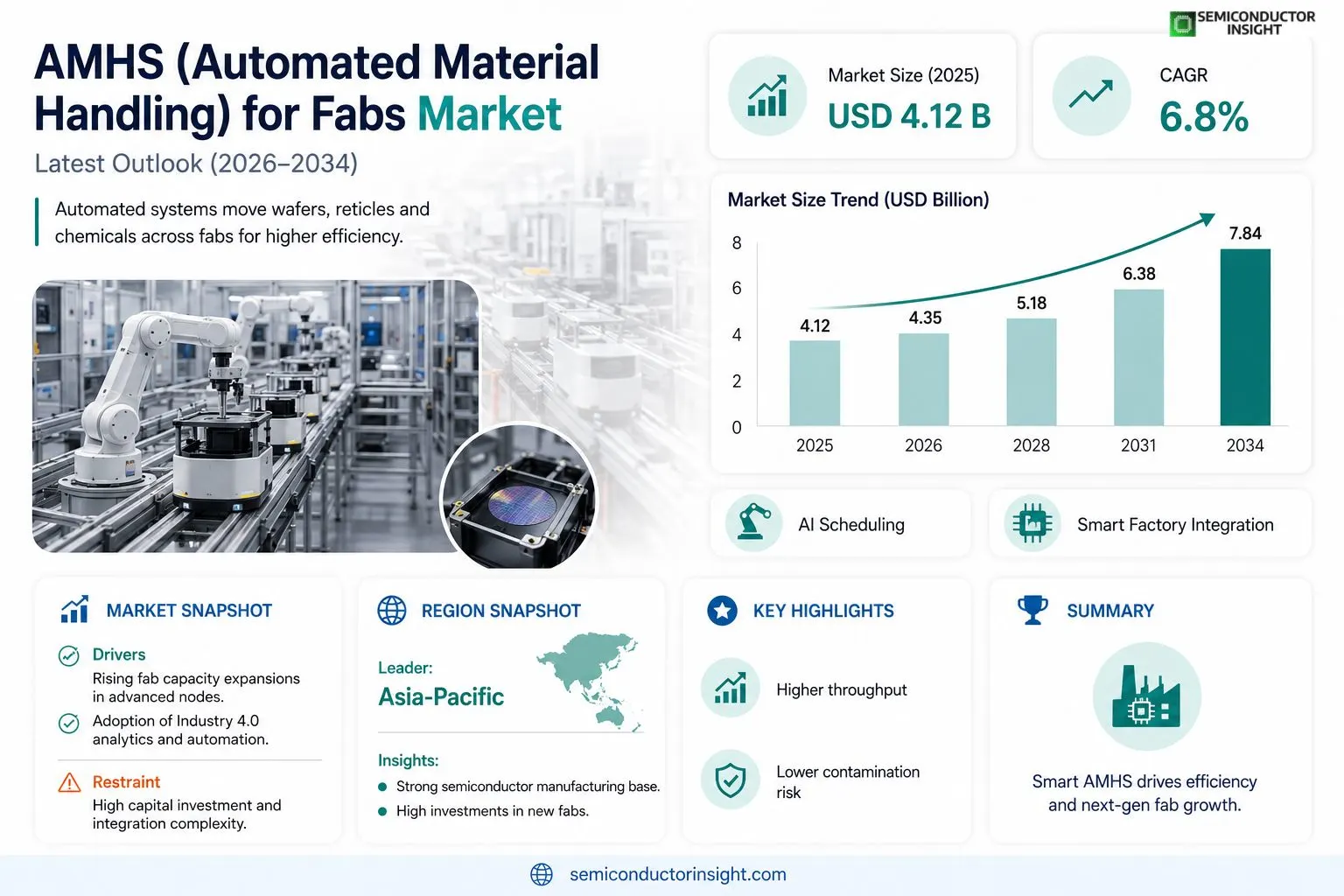
Global AMHS (Automated Material Handling) for Fabs market size was valued at USD 4.12 billion in 2025. The market is projected to grow from USD 4.35 billion in 2026 to USD 7.84 billion by 2034, exhibiting a CAGR of 6.8% during the forecast period.
AMHS systems integrate conveyors, robotic arms, automated guided vehicles (AGVs), and storage/retrieval units to transport wafers, reticles and chemicals within semiconductor fabrication plants. By minimizing manual handling, these solutions improve throughput, reduce contamination risk and enable tighter process control across clean‑room environments.
The market acceleration is driven by rising fab capacity expansions in advanced nodes, increasing adoption of Industry 4.0 analytics, and the need for higher yield consistency. Furthermore, leading suppliers such as Brooks Automation, Daifuku Co., Murata Machinery and Siemens are investing in AI‑enabled scheduling and modular designs to meet the growing demand.
MARKET DRIVERS
Increasing Production Throughput in Semiconductor Fabs
The push for higher wafer output is prompting fab operators to adopt AMHS (Automated Material Handling) for Fabs Market solutions that can move carriers faster and with greater precision. Modern AMHS platforms reduce cycle times, enabling manufacturers to meet tight production schedules without expanding physical floor space.
Rising Adoption of Industry‑4.0 Practices
Integration of IoT sensors, real‑time monitoring, and digital twins is becoming standard in advanced fabs. AMHS (Automated Material Handling) for Fabs Market vendors are embedding connectivity features that allow seamless data exchange with manufacturing execution systems, driving operational efficiency.
➤ Integration of real‑time data analytics with AMHS (Automated Material Handling) for Fabs Market accelerates decision making.
Overall, the convergence of higher throughput demands and smart‑factory initiatives creates a strong incentive for fab managers to modernize material handling infrastructure.
MARKET CHALLENGES
High Capital Expenditure for System Integration
Deploying comprehensive AMHS solutions often requires significant upfront investment in hardware, software, and site modification. For many mid‑size fabs, budgeting constraints can delay or limit the scope of adoption.
Other Challenges
Technical Compatibility
Existing legacy equipment may not readily interface with new AMHS control platforms, necessitating custom engineering work that adds both cost and schedule risk.
Change Management
Shifting operational practices to rely on automated handling demands extensive staff training and cultural adaptation, which can slow rollout timelines.
MARKET RESTRAINTS
Limited Skilled Workforce for AMHS Maintenance
The specialized nature of AMHS hardware and software means that qualified technicians are in short supply, particularly in regions with rapid fab expansion. This talent gap can increase downtime and maintenance costs.Additionally, the rapid evolution of automation technologies requires continuous up‑skilling, which many fabs struggle to provide within existing HR frameworks.Consequently, organizations may postpone large‑scale AMHS deployments until a reliable support ecosystem is established.
MARKET OPPORTUNITIES
Adoption of AI‑Driven Predictive Maintenance
Emerging AI algorithms can analyze sensor data from AMHS equipment to predict component wear before failures occur. Fab operators that implement these predictive models stand to reduce unplanned outages and extend asset life.Moreover, the growing availability of cloud‑based analytics platforms lowers the barrier for smaller fabs to leverage advanced diagnostics without large on‑premise infrastructure.These technological advances position AMHS (Automated Material Handling) for Fabs Market as a key enabler for the next generation of cost‑effective, high‑volume semiconductor manufacturing.
AMHS (Automated Material Handling) for Fabs Market Trends
AI‑Enabled Scheduling Drives Throughput
Suppliers are embedding artificial intelligence into the control layer of AMHS (Automated Material Handling) for Fabs Market solutions. By continuously analyzing real‑time equipment status, wafer queue lengths and clean‑room constraints, AI algorithms generate dynamic vehicle routes and conveyor speeds that adapt to fluctuating demand. This reduces idle time for automated guided vehicles, improves overall equipment effectiveness, and tightens yield consistency without increasing human intervention. Early adopters report up to a 12% lift in daily wafer throughput while maintaining contamination control standards.
Other Trends
Modular and Scalable System Architecture
Manufacturers such as Daifuku and Siemens are standardizing on modular hardware blocks that can be re‑configured as fab footprints evolve. The approach shortens installation cycles, enables phased capital expenditure, and supports rapid scaling when new lithography lines are commissioned. Modular designs also simplify maintenance, allowing individual modules to be serviced without shutting down the entire material flow, thereby preserving production continuity during upgrades.
Expansion Toward Advanced‑Node Capacity
The ongoing shift to sub‑10 nm nodes is prompting fabs to increase internal logistics capacity. Larger wafer volumes and tighter process windows require AMHS (Automated Material Handling) for Fabs Market platforms that can handle higher parcel densities and deliver parts with sub‑minute precision. Integration with Industry 4.0 analytics further enhances predictive maintenance, ensuring that critical transport assets remain operational throughout extended high‑volume runs. As a result, fabs are prioritizing systems that combine high speed, low vibration, and seamless data exchange with manufacturing execution systems.
COMPETITIVE LANDSCAPE
Key Industry Players
Automated Material Handling (AMHS) for Semiconductor Fabs
AMHS Market for semiconductor fabs is dominated by a small cohort of integrated equipment manufacturers that combine conveyor technology, robotic handling, and advanced software scheduling. Brooks Automation leads the segment with its comprehensive AMHS portfolio, leveraging AI‑enabled controllers and modular architectures to support high‑throughput 300 mm fabs. Daifuku Co. follows closely, offering a wide range of AGV‑based transport solutions that integrate seamlessly with clean‑room logistics. Murata Machinery and Siemens round out the top tier, each providing end‑to‑end systems that incorporate real‑time analytics, predictive maintenance, and scalable storage/retrieval units. Collectively, these firms shape market standards, drive technology roadmaps, and command the majority of the projected USD 7.84 billion market by 2034.
Beyond the primary quartet, several niche players contribute specialized capabilities that enhance fab automation. FANUC and Mitsubishi Electric supply high‑precision robotic arms tailored for wafer handling, while Honeywell Intelligrated focuses on smart conveyor systems with embedded IoT sensors. Toyota Industries and ABB deliver robust AGV platforms designed for heavy‑load transport. Dematic, Swisslog, and KION Group offer flexible warehouse automation that is increasingly repurposed for clean‑room environments. These companies, though smaller in market share, provide critical complementary technologies that enable fabs to achieve higher yield consistency and lower contamination risk.
List of Key AMHS Companies Profiled
- Brooks Automation
- Daifuku Co.
- Murata Machinery
- Siemens
- FANUC
- Mitsubishi Electric
- Honeywell Intelligrated
- Toyota Industries
- ABB
- Dematic
- Swisslog
- KION Group
Segment Analysis:
| Segment Category | Sub-Segments | Key Insights |
| By Type |
|
Robotic Arms are emerging as the leading segment because they offer:
|
| By Application |
|
Wafer Transport dominates due to:
|
| By End User |
|
Foundries are the leading end‑user segment because they:
|
| By Process Stage |
|
Front‑End is the dominant process‑stage segment due to:
|
| By Automation Level |
|
Advanced AI‑Driven Scheduling leads this category because it:
|
Regional Analysis: North America
United States
The primary drivers for AMHS adoption in the US fabs market include the relentless pursuit of technological advancement, the need for enhanced process control, and the growing complexity of semiconductor manufacturing.
Key trends shaping the AMHS landscape in the US include the increasing integration of AI/ML, the demand for modular and adaptable systems, and a growing focus on data analytics for optimizing material flow.
The US market is characterized by a mix of established players and innovative startups, all vying for a share of the growing AMHS market.
The future outlook for AMHS in the US fabs market remains exceptionally positive, with continued investment and innovation expected to fuel further growth.
Europe
Europe’s fabs market is witnessing a steady and evolving adoption of AMHS, influenced by stringent environmental regulations and a strong emphasis on energy efficiency in manufacturing processes. The region is particularly focused on advanced packaging and high-performance computing, creating demand for sophisticated automated material handling solutions. Key challenges include the high cost of implementation and the need for seamless integration with existing infrastructure. However, government initiatives supporting semiconductor manufacturing are expected to drive further investment in AMHS across European countries. The market is characterized by a strong presence of both global AMHS vendors and regional specialists catering to specific industry needs. The trend towards sustainable manufacturing is also influencing the development of energy-efficient and environmentally friendly AMHS solutions.
Asia-Pacific
Asia-Pacific is the largest and fastest-growing market for AMHS in the fabs industry, spearheaded by China, Japan, South Korea, and Taiwan. The region’s dominance in semiconductor manufacturing production necessitates significant investments in advanced automation to enhance efficiency and competitiveness. The demand for AMHS is particularly strong for advanced packaging and logic chip fabrication, where precision and throughput are paramount. The market is characterized by intense competition and a rapid pace of innovation, with a focus on developing cost-effective and highly integrated solutions. Government support and strategic initiatives aimed at bolstering domestic semiconductor capabilities are further accelerating the growth of AMHS Market in the region.
South America
South America represents a nascent but promising market for AMHS in the fabs sector. The region is witnessing a gradual increase in semiconductor manufacturing activity, driven by growing domestic demand and strategic investments in technology. The initial adoption of AMHS is focused on improving efficiency in existing fabs and supporting the development of new manufacturing facilities. Key challenges include limited investment capital and a shortage of skilled personnel. However, the long-term outlook for AMHS in South America is positive, with the potential for significant growth as the semiconductor industry continues to expand.
Middle East & Africa
The Middle East and Africa represent a relatively small but emerging market for AMHS within the fabs industry. The region’s growing focus on diversifying its economies and developing domestic manufacturing capabilities is driving initial investments in semiconductor fabrication and associated automation. The adoption of AMHS is expected to increase steadily as the industry matures and manufacturing volumes grow. Key factors influencing market development include access to skilled labor, availability of infrastructure, and government support for technology adoption. The long-term potential for AMHS in this region is significant, particularly with strategic investments in advanced manufacturing initiatives.
Report Scope
This market research report provides a comprehensive analysis of the AMHS (Automated Material Handling) for Fabs Market , covering the forecast period 2026–2034. It offers detailed insights into market dynamics, technological advancements, competitive landscape, and key trends shaping the industry.
Key focus areas of the report include:
- Market Overview: The report begins with an overview outlining its current market scenario, key growth indicators, and industry transformation drivers. It discusses macroeconomic factors, demand–supply balance, regulatory landscape, and the strategic role of semiconductors in powering advancements across industries such as automotive, telecommunications, consumer electronics, and industrial automation.
- Market Size & Forecast: Historical data and future projections for revenue, unit shipments, and market value across major regions and segments.
- Segmentation Analysis: Detailed breakdown by product type, technology, application, and end-user industry to identify high-growth segments and investment opportunities.
- Regional Insights: Insights into market performance across North America, Europe, Asia-Pacific, Latin America, and the Middle East & Africa, including country-level analysis where relevant.
- Competitive Landscape: Profiles of leading market participants, including their product offerings, R&D focus, manufacturing capacity, pricing strategies, and recent developments such as mergers, acquisitions, and partnerships.
- Technology Trends & Innovation: Assessment of emerging technologies, integration of AI/IoT, semiconductor design trends, fabrication techniques, and evolving industry standards.
- Market Drivers & Restraints: Evaluation of factors driving market growth along with challenges, supply chain constraints, regulatory issues, and market-entry barriers.
- Stakeholder Insights: Insights for component suppliers, OEMs, system integrators, investors, and policymakers regarding the evolving ecosystem and strategic opportunities.
Primary and secondary research methods are employed, including interviews with industry experts, data from verified sources, and real-time market intelligence to ensure the accuracy and reliability of the insights presented.
FREQUENTLY ASKED QUESTIONS:
What is the current market size of AMHS (Automated Material Handling) for Fabs Market?
-> AMHS (Automated Material Handling) for Fabs Market was valued at USD 4.12 billion in 2025 and is expected to reach USD 7.84 billion by 2034.
Which key companies operate in AMHS (Automated Material Handling) for Fabs Market?
-> Key players include Brooks Automation, Daifuku Co., Murata Machinery, and Siemens, among others.
What are the key growth drivers?
-> Key growth drivers include fab capacity expansions in advanced nodes, adoption of Industry 4.0 analytics, and the pursuit of higher yield consistency.
Which region dominates the market?
-> The reference does not specify a single dominant region; growth is driven by semiconductor fab expansions across major regions worldwide, with notable activity in Asia‑Pacific, North America and Europe.
What are the emerging trends?
-> Emerging trends include AI‑enabled scheduling, modular AMHS designs, and deeper integration of Industry 4.0 analytics.

Get Sample Report PDF for Exclusive Insights
Report Sample Includes
- Table of Contents
- List of Tables & Figures
- Charts, Research Methodology, and more...
 Download Sample Report PDF