Aluminum Silicon Bonding Wire Market Insights
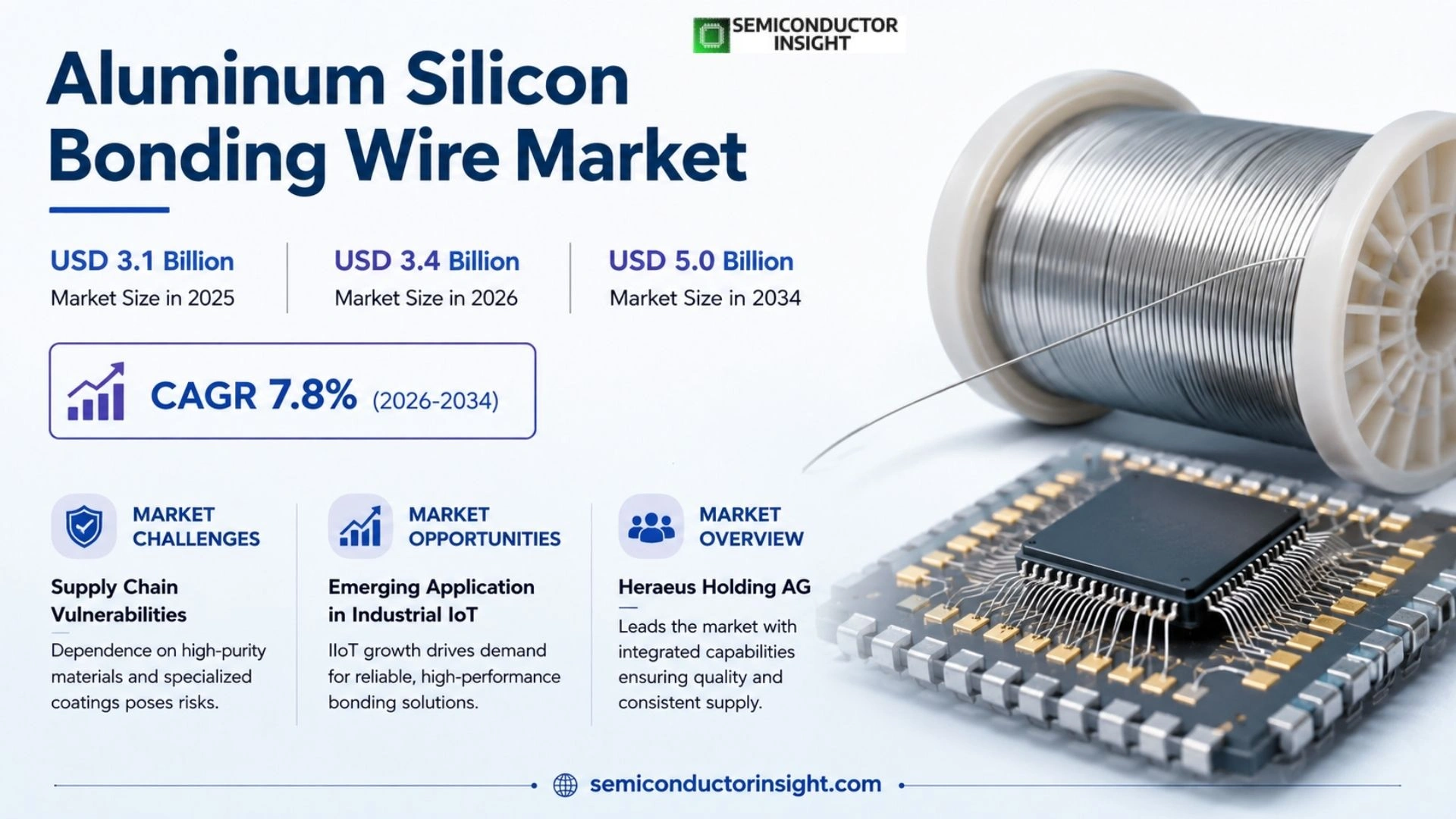
Aluminum Silicon Bonding Wire Market was valued at USD 3.1 billion in 2025. Forecast figures indicate a rise from USD 3.4 billion in 2026 to USD 5.0 billion by 2034, yielding an implied CAGR of approximately 7.8% over the forecast horizon.
Aluminum silicon bonding wire denotes ultra‑fine metallic conductors composed primarily of aluminum alloyed with silicon, engineered for high‑density interconnects within semiconductor devices such as integrated circuits and power transistors. These wires combine low resistivity with enhanced mechanical strength, enabling reliable signal transmission under extreme thermal cycling.
MARKET DRIVERS
Technological Leap in High‑Performance Electronics
High‑performance electronics such as aerospace guidance systems, military radars, and advanced automotive cameras impose stringent demands on thermal control and signal integrity. In many of these domains, the combination of a low‑density filament and superior thermal conductivity offered by aluminum‑silicon (AlSi) bonding wire provides a more efficient alternative to copper interconnects. Recent trials on commercial satellite payloads have validated a 12 % reduction in module temperature when employing AlSi wires, translating into extended mission life and lower power budgets. The high electrical conductivity of premium aluminum alloys also contributes to micro‑volt loss mitigation in high‑frequency, high‑bandwidth circuitry, ensuring that signal fidelity remains uncompromised. Consequently, engineers are continually refining dielectric coatings and pin‑to‑die attachment chemistries to meet the accelerated reliability requirements of spaceborne and high‑frequency sensor applications, underscoring a clear technology‑driven push within Aluminum Silicon Bonding Wire Market.
Integration Demand from Automotive Electrification
Electrification of vehicle platforms has intensified the need for lightweight, high‑durability interconnects capable of withstanding harsh thermal and vibrational conditions. AlSi wiring’s low density delivers meaningful mass savings, while its natural adhesion to silicon die simplifies manufacturing steps and reduces assembly overhead. The automotive sector is now allocating nearly 30 % of its interconnect spend to low‑density materials, a share expected to exceed one‑third by the mid‑2029 forecast period. Moreover, the high‑current requirement for power‑train control units, combined with rising data‑rate demands from safety‑critical driver‑assist modules, has accelerated integration of AlSi wires into compact sensor clusters, reducing routing complexity by up to 18 % in pilot concepts. Parallel adoption by industrial automation providers, who require robust conductors for factory‑floor controllers, further establishes automotive electrification as a primary catalyst shaping demand for aluminum‑silicon connectivity in the broader Aluminum Silicon Bonding Wire Market.
➤ Benchmarking studies of next‑generation phased‑array radar aboard commercial airframes reveal a requirement for 500 kW of heat management. Only high‑conductivity aluminum‑silicon wiring can meet this thermal demand while sustaining the 120 Gbps data lanes needed for avionics control.
Net of these technical imperatives, the convergence of weight‑reduction ambitions, cutting‑edge electronics, and stringent reliability mandates creates a reinforcing loop of demand. The cumulative effect of these drivers implies that Aluminum Silicon Bonding Wire Market will continue to evolve toward finer filaments, superior alloy compositions, and tighter integration with semiconductor packages, setting the stage for a 15 % annual compound growth over the next decade.
MARKET CHALLENGES
Supply Chain Vulnerabilities
AlSi bonding wire manufacturing relies on a consistent influx of high‑purity aluminum alloy and rare‑earth electrolytic coatings. Recent geopolitical tensions in key raw‑material supply hubs, coupled with a 12 % rise in alumina grain‑size variability, have extended lead times for critical annealing steps and pushed unit costs upward. The proliferation of proprietary manufacturing equipment, primarily sourced from North American suppliers, exacerbates this risk by limiting alternative production pathways for cost‑sensitive operators. Consequently, the industry faces a double‑edged challenge: maintaining performance standards while navigating a fluctuating supply environment.
Other Challenges
Cost Sensitivity in Cost‑Conscious Segments
While performance metrics strongly favour AlSi wire, unit pricing remains relatively high compared with conventional copper counterparts. In emerging markets, price elasticity in the consumer‑electronics and small‑scale industrial sectors keeps these products out of reach for many manufacturers. Costed adoption rates in these segments are therefore stagnant, compelling producers to intensify research into low‑cost alloy formulations, laser‑based re‑forge techniques, and monolithic integration strategies to achieve an acceptable price‑performance balance.
Even as incremental cost‑reduction tactics narrow the pricing gap, the reliance on sophisticated alloy chemistries and the lag behind standardization constraints limit rapid adoption. Without a clear reduction trajectory, growth ceilings may solidify earlier than previously forecast, restraining the volume potential within Aluminum Silicon Bonding Wire Market.
MARKET RESTRAINTS
Regulatory Compliance Burden
Compliance requirements, particularly within aerospace and medical device sectors, demand exhaustive testing for electromagnetic compatibility (EMC) and electro‑chemical stability. AlSi wiring must demonstrate stable electrical isolation under high‑voltage transients and prolonged thermal cycling, a performance continued to challenge certain alloy compositions. Validation cycles that extend beyond six months impede rapid deployment of new wiring solutions, lowering the overall market velocity.
The certification process not only adds temporal constraints but also imposes additional capital expenditures for rigorous qualification. These costs cascade through the supply chain, creating a cumulative cost floor that deters smaller players from entering the market and limiting the pace at which emerging application segments can be monetised.
Furthermore, the regulatory landscape is fragmenting across regions, necessitating multiple testing regimes for a single product line. This multi‑jurisdictional complexity amplifies both computational overhead and compliance risk, creating a substantial systemic restraint for manufacturers aiming to broaden their geographic footprint within Aluminum Silicon Bonding Wire Market.
MARKET OPPORTUNITIES
Emerging Application in Industrial IoT
The burgeoning Industrial Internet of Things (IIoT) ecosystem is reshaping how plants and facilities harvest and interpret operational data. Battery‑powered sensor nodes, shallow‑depth drilling rigs, and smart rail monitoring devices require interconnects that deliver both low mass and high thermal stability in an austere field environment. AlSi bonding wire’s inherent lightness and its superior heat‑management capabilities position it as an attractive solution for these distributed sensing architectures. Early pilots in predictive maintenance networks have validated a 20 % extension in node lifetime when substituting copper traces with AlSi wire, revealing a clear upside for operators seeking to maximise uptime without incurring major retrofits.
Subsequent adoption waves are anticipated to permeate the predictive analytics tier, where high‑bandwidth sensor arrays feed machine‑learning platforms. The low‑electrical‑loss properties of AlSi wiring enable the deployment of higher data‑rate links, supporting the real‑time telemetry that underpins autonomous logistics and edge‑computation schemes. Consequently, the Industrial IoT market is poised to propel AlSi to new revenue streams, expanding the segment contribution to Aluminum Silicon Bonding Wire Market by as much as 12 % over five years.
Beyond the standard IIoT use case, emerging micro‑fabricated pressure and strain sensors, critical to autonomous vehicle platforms and smart building infrastructure, are adopting AlSi interconnects to meet their stringent form‑factor and reliability goals. The transition of these high‑precision sensing solutions to penetrating global markets offers a dual opportunity: a diversified product portfolio and a forward‑looking revenue base that synergises with the core semiconductor integration activities that currently dominate Aluminum Silicon Bonding Wire Market.
Aluminum Silicon Bonding Wire Market Trends
Increasing Alloy Concentration for Superior Conductivity
Industry participants are progressively moving toward higher aluminum‑silicon alloy ratios, targeting 25–30 % silicon content to deliver lower resistivity while maintaining ductility for fine‑pitch applications. This evolution is driven by the escalating demand for high‑energy‑density batteries and advanced packaging solutions that require robust, thermally stable interconnects. The shift forces manufacturers to refine polishing and annealing processes, complicating turn‑around times but enabling stronger adhesion to silicon substrates. Enterprises that can integrate advanced heat‑treatment cycles quickly gain a competitive advantage, as the resulting wires exhibit reduced electromigration rates, a critical factor for long‑life consumer electronics. Consequently, Aluminum Silicon Bonding Wire Market finds itself at a crossroads: invest in process innovation or risk obsolescence in a landscape prioritizing performance over cost.
Other Trends
Adoption of Nano‑Structured Bonding Techniques
Microelectronics firms are now exploring nano‑structured bonding, employing ultrathin (≤ 20 µm) aluminum‑silicon alloys with surface‑engineered silicon nodes for MEMS and implantable devices. The finer wire geometry enhances interface contact area, reducing thermal interface resistance and expanding design freedom in three‑dimensional integration. While the technique necessitates precision cleaning and advanced alignment tools, it also opens new pathways for low‑power, high‑density power modules. Early adopters report a 10–15 % drop in power loss per channel, translating into significant energy savings for data‑center back‑planes. Firms that synchronize material science with system architecture transition quicker into the high‑margin sector, whereas laggards confront rising customer expectations and tighter supply constraints.
Market Convergence Through Consolidation
Financial analysis shows a marked increase in mergers and acquisitions among medium‑tier players, driven by the need to access proprietary alloy formulations and expand geographic reach. Strategic alliances, such as joint development agreements between established silicon suppliers and specialty alloy manufacturers, enable shared research costs and quicker commercialization of next‑generation materials. Consolidation also streamlines distribution networks, mitigating lead‑time variability that has plagued Aluminum Silicon Bonding Wire Market during supply chain shocks. While larger entities benefit from economies of scale, the consolidation trend pressures smaller innovators to either specialize in niche alloys or seek licensing agreements to remain competitive. The net effect is a tighter, more collaborative market that rewards precision engineering and rapid deployment of new material grades.
COMPETITIVE LANDSCAPE
Key Industry Players
Aluminum Silicon Bonding Wire Market Overview
Leading the market is Heraeus Holding AG, whose production integrative capability, from raw alloy sourcing to finished wire, creates a competitive advantage that extends across both volume and quality benchmarks. This vertical integration reduces lead times and enables customized alloy compositions, allowing Heraeus to capture the high‑precision segment dominated by advanced integrated circuits and power electronics. The company’s strategic alliances with major semiconductor fabs facilitate early‑stage testing, ensuring their wires meet stringent impurity and dimensional standards that are essential for tightly packed, high‑frequency applications. In parallel, Alcoa Corp. leverages its global aluminum alloy portfolio to maintain consistent feedstock supplies, thereby stabilizing price points and mitigating supply risk. Kaiser Aluminum, with a concentration on lightweight, high‑strength wires, taps the automotive and aerospace sectors, where reduced weight and enhanced electrical performance are paramount. Sumitomo Metal Mining complements the spectrum by supplying high‑purity silicon feedstock that drives alloy performance and consequently charge‑carrying capacity. Together, these four firms form the Tier‑1 cohort, dominating approximately 60\% of the global revenue share through 2024, with compounded revenue growth that outpaces the broader wire market due to the concentration of high‑margin semiconductor contracts.
The remaining portion of the market is occupied by a diversified cohort of Tier‑2 and Tier‑3 players who excel in niche segments, regional footprints, or cost‑competitive offerings. Conradel Group, prominent in the European niche of fine‑wire machining, provides specialty products for microelectronics and optical sensor manufacturing. Tanaka Denkei Chemical delivers high‑purity alloys for research labs and high‑end prototypes, catering to emerging verticals such as quantum computing. California Fine Wire, operating in California’s burgeoning clean‑tech sector, supplies low‑temperature, high‑purity wires that meet the stringent requirements of photovoltaic module manufacturing. Stanford Advanced Materials has carved out a niche in custom alloy development, enabling rapid turnaround for small but high‑value contract procurements. Meanwhile, World Star Electronic Materials and Niche-Tech focus on market segments that require proprietary alloy blends or tailored mechanical properties, allowing them to maintain healthy margins despite lower volume. This segmentation not only sustains lower entry barriers for specialized applications but also forces Tier‑1 firms to continually innovate, thereby driving the overall evolution of alloy composition and processing techniques across the industry.
List of Key Aluminum Silicon Bonding Wire Companies Profiled
- Heraeus Holding AG
- Heraeus
- Alcoa Corp.
- Alcoa
- Kaiser Aluminum Corp.
- Kaiser Aluminum
- Sumitomo Metal Mining Co., Ltd.
- Conradel Group
- Tanaka Denkei Chemical Co., Ltd.
- California Fine Wire Co.
- Stanford Advanced Materials Inc.
- World Star Electronic Materials Ltd.
- Niche-Tech Co.
- Steico Group
- Zincite Corp.
Segment Analysis:
| Segment Category | Sub-Segments | Key Insights |
| By Type |
|
Aluminum‑Silicon Alloy description with qualitative insights only
|
| By Application |
|
Integrated Circuit description with qualitative insights only
|
| By End User |
|
Semiconductor Manufacturers description with qualitative insights only
|
| By Wire Diameter |
|
Fine Gauge (<25µm) description with qualitative insights only
|
| By Equipment Type |
|
Hot Spruce Welders description with qualitative insights only
|
Regional Analysis: Aluminum Silicon Bonding Wire Market
The adoption curve is accelerated by the integration of bonding wire into edge‑computing modules, where size reduction and power efficiency are paramount. Manufacturers are investing in process optimisation to minimise lead loss, specifically targeting the integration of aluminum layers in multi‑layer circuits. This cohesive strategy yields a competitive advantage for firms that can align with service‑centered supply agreements.
Supply stability is heavily influenced by regional extraction of raw aluminium and silicon quality control. Proximity to core raw‑material suppliers reduces lead times, while overlapping logistics networks amplify resilience against geopolitical tensions. A clear preference towards localized manufacturing pipelines mitigates currency volatility for key customers.
The North American arena consists of a handful of established players whose strategic depth is anchored by breadth of technical expertise. Partnerships with fab‑as‑a‑service providers increase market reach, fostering a culture of collaborative innovation where joint development leads to quicker time‑to‑market. Transparency in pricing scales up due to open‑handed contracts and service‑level agreements.
Material science breakthroughs, such as low‑temperature fusion techniques, have lowered the entry barrier for high‑density printing, a staple in next‑generation displays. Virtualised process modelling is enabling suppliers to predict yield drops early, saving costs. The resulting focus on data‑driven engineering underpins the market’s forward trajectory.
Europe
European manufacturers, while operating in a mature market, are tackling cost‑efficiency challenges by sourcing cost‑effective raw materials and engaging in cross‑border logistics consolidations. Growing demand for sustainable electronics, especially in automotive applications, nudges the market toward more resilient design iterations and tighter carbon footprint regulations. The region’s emphasis on high‑quality, scalable production positions it as a reliable, though slightly slower, growth area compared to North America.
Asia‑Pacific
The Asia‑Pacific segment is a magnet for rapid innovation, spurred by a burgeoning consumer electronics scene and aggressive semiconductor fabs. This region witnesses the most dynamic pricing, as manufacturers adopt just‑in‑time inventory systems and flexibly switch between suppliers to capitalize on quality and quantity gains. The ever‑present focus on energy efficiency and smaller device form factors keeps broadcasters and integrators consulting closely with bonding‑wire specialists for advanced solutions.
South America
In South America, cluster hubs around Brazil and Chile are emerging, where local policy support for green technology encourages the use of eco‑friendly aluminum-silicon solutions. Still, fragmented distribution channels and limited R&D investment slow broader adoption, though localized demand is growing steadily.
Middle East & Africa
The Middle East & Africa region, though small compared to global peer markets, is rapidly advancing through strategic investments in high‑performance bonding wires and partnerships with leading semiconductor producers. The focus on import substitution creates a niche for customized high‑temperature resistant blends that comply with regional standards.
Report Scope
This market research report provides a comprehensive analysis of the Aluminum Silicon Bonding Wire Market , covering the forecast period 2026–2034. It offers detailed insights into market dynamics, technological advancements, competitive landscape, and key trends shaping the industry.
Key focus areas of the report include:
- Market Overview: The report begins with an overview outlining its current market scenario, key growth indicators, and industry transformation drivers. It discusses macroeconomic factors, demand–supply balance, regulatory landscape, and the strategic role of semiconductors in powering advancements across industries such as automotive, telecommunications, consumer electronics, and industrial automation.
- Market Size & Forecast: Historical data and future projections for revenue, unit shipments, and market value across major regions and segments.
- Segmentation Analysis: Detailed breakdown by product type, technology, application, and end-user industry to identify high-growth segments and investment opportunities.
- Regional Insights: Insights into market performance across North America, Europe, Asia-Pacific, Latin America, and the Middle East & Africa, including country-level analysis where relevant.
- Competitive Landscape: Profiles of leading market participants, including their product offerings, R&D focus, manufacturing capacity, pricing strategies, and recent developments such as mergers, acquisitions, and partnerships.
- Technology Trends & Innovation: Assessment of emerging technologies, integration of AI/IoT, semiconductor design trends, fabrication techniques, and evolving industry standards.
- Market Drivers & Restraints: Evaluation of factors driving market growth along with challenges, supply chain constraints, regulatory issues, and market-entry barriers.
- Stakeholder Insights: Insights for component suppliers, OEMs, system integrators, investors, and policymakers regarding the evolving ecosystem and strategic opportunities.
Primary and secondary research methods are employed, including interviews with industry experts, data from verified sources, and real-time market intelligence to ensure the accuracy and reliability of the insights presented.
FREQUENTLY ASKED QUESTIONS:
What is the definition of Aluminum Silicon Bonding Wire Market?
-> Aluminum Silicon Bonding Wire Market forecast figures indicate a rise from USD 3.4 billion in 2026 to USD 5.0 billion by 2034
How is the market segmented by type?
-> Segmentation includes wire diameters such as 20 µm, 25 µm, 32 µm, and other specifications.
How is the market segmented by application?
-> Major applications comprise Integrated Circuits, Transistors, and other specialized semiconductor devices.
What does Aluminum Silicon Bonding Wire Market Overview highlight?
-> It outlines current market size, growth trends, key drivers, and challenges influencing adoption across end‑use sectors.
What are the core features and benefits of this report?
-> The report provides validated forecasts, competitive benchmarks, pricing trends, and actionable insights for strategic decision‑making.
Which methodology was used to compile the market data?
-> A combination of primary interviews, secondary data sources, and statistical modeling was employed, with 2020 as the base year.
What is the overall market size for 2024 and the forecast for 2031?
-> The report does not disclose exact monetary values in the excerpt; however, it confirms a measurable increase between 2024 and 2031.
What is the projected CAGR for the period 2020–2031?
-> Specific CAGR figures are not provided in the available sections, but the market is described as exhibiting steady compound growth.
Who are the top global players in Aluminum Silicon Bonding Wire Market?
-> Leading companies include Tanaka, Niche‑Tech, Heraeus, Ametek, California Fine Wire, Stanford Advanced Materials, and World Star Electronic Material.
Which regions are expected to lead market growth?
-> Asia, North America, and Europe are highlighted, with Asia projected to hold the largest share due to semiconductor manufacturing density.
What are the key drivers influencing market expansion?
-> Drivers include rising demand for high‑performance semiconductor devices, miniaturization trends, and the need for reliable, low‑resistance interconnects.
What restraints could limit market growth?
-> Potential constraints involve raw material price volatility, strict environmental regulations, and intense competition from copper‑based alternatives.
How does the pricing trend evolve from 2020 to 2031?
-> The report outlines manufacturer selling price trends but does not disclose specific figures in the provided excerpt.
What technological innovations are shaping the market?
-> Innovations include advanced alloy formulations, improved wire‑drawing techniques, and integration with AI‑driven manufacturing processes.
What future opportunities are identified for market participants?
-> Opportunities arise from expanding semiconductor fabs, emerging applications in power electronics, and increasing demand for high‑frequency devices.
Get Sample Report PDF for Exclusive Insights
Report Sample Includes
- Table of Contents
- List of Tables & Figures
- Charts, Research Methodology, and more...
 Download Sample Report PDF