AI Chiplet Interposer (Silicon, Organic) Market Insights
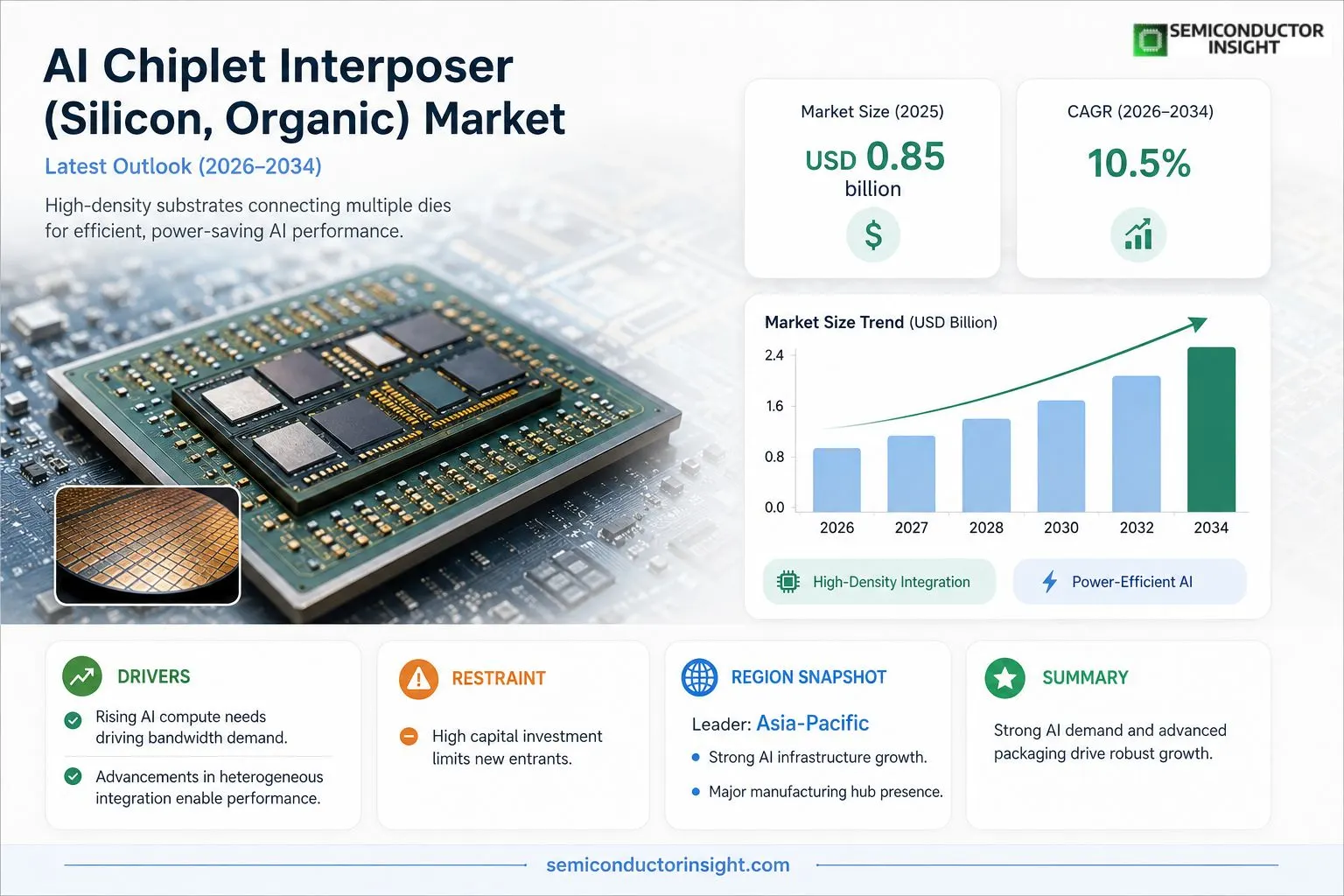
Global AI Chiplet Interposer (Silicon, Organic) Market size was valued at USD 0.85 billion in 2025. The market is projected to grow from USD 0.95 billion in 2026 to USD 2.10 billion by 2034, exhibiting a CAGR of 10.5% during the forecast period.
AI chiplet interposers are high‑density substrates,silicon or organic,that electrically connect multiple heterogeneous dies within a single package, enabling accelerated AI workloads while reducing power consumption and form factor.The market is experiencing rapid expansion because semiconductor manufacturers are intensifying investments in heterogeneous integration to meet soaring demand for edge‑AI and data‑center accelerators. However, challenges such as thermal management and supply‑chain constraints persist; nevertheless, continued advancements in micro‑bump technology and strategic collaborations,e.g., TSMC’s partnership with Intel on silicon interposers,are expected to sustain growth.
MARKET DRIVERS
Rising AI Compute Requirements
AI Chiplet Interposer (Silicon, Organic) Market is being propelled by exponential growth in AI model complexity, which demands higher bandwidth and lower latency interconnects. Data‑center operators are increasingly adopting chiplet architectures to sustain performance scaling while managing power envelopes.
Advancements in Heterogeneous Integration
Recent breakthroughs in silicon‑based and organic interposer technologies enable seamless integration of compute, memory, and networking die. This heterogeneity reduces time‑to‑market for AI accelerators and creates cost efficiencies that resonate across semiconductor manufacturers.
➤ “The ability to co‑package AI ASICs with high‑density memory via advanced interposers is the cornerstone of next‑generation AI workloads.”
Furthermore, the push for edge AI devices is driving demand for lightweight organic interposers, which offer flexibility and lower material costs. Manufacturers are therefore expanding R&D investments to capture emerging opportunities in both cloud and edge segments.
MARKET CHALLENGES
Complexity of Design and Validation
Designing and qualifying chiplet interposers involves intricate signal‑integrity analysis and thermal management, especially when mixing silicon and organic substrates. These technical hurdles can extend product development cycles and increase engineering expenditures.
Other Challenges
Supply‑Chain Constraints
Global shortages of high‑purity silicon and specialized organic polymers have intermittently limited production capacity, compelling OEMs to adopt multi‑sourcing strategies that add logistical overhead.
MARKET RESTRAINTS
High Capital Expenditure
AI Chiplet Interposer (Silicon, Organic) Market requires substantial upfront investment in precision lithography, advanced packaging lines, and verification equipment, which can deter smaller players from entering the space.Additionally, the steep learning curve associated with mastering both silicon and organic materials increases the risk profile for new entrants, potentially slowing broader market adoption.
Regulatory scrutiny around material safety, particularly for organic substrates, may impose additional compliance costs that further restrain rapid expansion.
MARKET OPPORTUNITIES
Customization for Edge AI
Emerging use cases such as autonomous vehicles and smart sensors create a niche for highly customized organic interposers that combine flexibility with robust electrical performance. Providers that can deliver low‑volume, high‑mix solutions stand to capture premium margins.The convergence of 5G and AI workloads is expected to drive demand for compact, high‑bandwidth interposer solutions in telecom equipment. Companies that align their product roadmaps with this convergence will unlock new revenue streams in AI Chiplet Interposer (Silicon, Organic) Market.Finally, collaborative ecosystems between fabless chip designers and interposer manufacturers are fostering co‑development models that reduce time‑to‑market and share risk, presenting a fertile ground for strategic partnerships.
AI Chiplet Interposer (Silicon, Organic) Market Trends
Accelerated Heterogeneous Integration
AI Chiplet Interposer (Silicon, Organic) Market is witnessing rapid expansion as semiconductor manufacturers intensify investments in heterogeneous integration. Growing demand for edge‑AI processors and high‑performance data‑center accelerators drives designers to adopt silicon and organic interposers that enable dense die‑to‑die connectivity while reducing overall footprint. Early adopters are leveraging the fine‑pitch routing capabilities of interposers to combine memory, logic, and specialized AI cores within a single package, thereby shortening time‑to‑market for next‑generation AI solutions. This trend is reinforced by industry collaborations that pool R&D resources, ensuring that emerging form‑factor requirements are met without compromising performance.
Other Trends
Thermal Management and Supply‑Chain Constraints
Thermal dissipation remains a critical challenge for AI Chiplet Interposer (Silicon, Organic) Market, especially as power densities increase in compact modules. Designers are exploring advanced heat‑spreader materials and optimized micro‑bump layouts to mitigate hotspots, while also investing in simulation tools that predict thermal gradients across heterogeneous stacks. Concurrently, global supply‑chain disruptions affect the availability of high‑purity silicon wafers and specialized organic substrates, prompting manufacturers to diversify sourcing strategies and develop regional fab partnerships. Resolving these intertwined issues is essential for sustaining the current growth momentum and for enabling reliable large‑scale production of AI‑optimized interposer solutions.
Advancements in Micro‑Bump Technology and Strategic Partnerships
Recent progress in micro‑bump technology has reduced interconnect pitch to sub‑20 µm levels, directly enhancing signal integrity and bandwidth for AI workloads. Strategic alliances, such as the partnership between TSMC and Intel, exemplify how shared expertise accelerates the deployment of next‑generation silicon interposers. These collaborations combine advanced lithography, proprietary bump‑forming processes, and co‑design frameworks that align AI chiplet architectures with market requirements. As a result, AI Chiplet Interposer (Silicon, Organic) Market is positioned to deliver increasingly efficient, high‑density solutions that meet the stringent performance and power targets of emerging AI applications.
COMPETITIVE LANDSCAPEKey Industry Players
AI Chiplet Interposer (Silicon & Organic) Market – Competitive Overview
AI chiplet interposer market is currently dominated by a small group of integrated circuit foundries and advanced packaging specialists that command the majority of high‑density silicon interposer capacity. TSMC leads with its 300 mm Si interposer platform, leveraging a strategic partnership with Intel to accelerate heterogeneous integration for data‑center AI accelerators. Intel’s own in‑house interposer design team complements this effort, while Samsung Electronics offers a parallel organic interposer line that targets edge‑AI devices requiring lower cost and thinner form factors. AMD, now incorporating Xilinx’s expertise, increasingly adopts silicon interposers to boost the performance of its CDNA GPU families, further consolidating the high‑end segment. These leaders benefit from deep R&D budgets, extensive micro‑bump capabilities, and secured supply chains, positioning them to capture the bulk of the projected $2.10 billion market by 2034.Beyond the marquee players, several niche but technically sophisticated firms contribute critical depth to the ecosystem. ASE Technology Holding and Amkor Technology provide multi‑die organic and silicon interposer services to fabless designers, emphasizing rapid time‑to‑market and custom stack‑up options. GlobalFoundries and STMicroelectronics focus on specialty interposer solutions for automotive and industrial AI workloads, where reliability and thermal management are paramount. Companies such as Qualcomm, Marvell, Broadcom, and Infineon are expanding their portfolio of heterogeneous integration offerings, often collaborating with packaging houses to embed AI chiplets within system‑in‑package (SiP) configurations. This diversified cohort ensures competitive pressure across pricing, innovation cadence, and application‑specific customization.
List of Key AI Chiplet Interposer (Silicon, Organic) Companies Profiled
- TSMC
- Intel
- Samsung Electronics
- AMD (including Xilinx)
- GlobalFoundries
- ASE Technology Holding
- Amkor Technology
- Qualcomm
- Marvell Technology Group
- Broadcom Inc.
- Infineon Technologies
- STMicroelectronics
- Renesas Electronics
- Micron Technology
- NXP Semiconductors
Segment Analysis:
| Segment Category | Sub-Segments | Key Insights |
| By Type |
|
Silicon Interposer is emerging as the dominant technology because it delivers superior electrical performance and thermal conductivity. – Enables very high‑density routing required for cutting‑edge AI accelerators. – Offers robust mechanical stability for demanding data‑center environments. – Attracts strong ecosystem support from leading foundries and design houses. |
| By Application |
|
Data‑Center AI Accelerators drive the most compelling demand for chiplet interposers. – Require ultra‑high bandwidth and low latency inter‑die communication. – Benefit from silicon interposers that can handle aggressive power and thermal budgets. – Push ecosystem partners to co‑develop advanced micro‑bump and under‑fill processes. |
| By End User |
|
Cloud Service Providers prioritize reliability, scalability, and energy efficiency in their AI workloads. – Favor silicon interposers that can sustain continuous high‑throughput operation. – View interposer technology as a strategic lever to differentiate next‑generation AI services. – Encourage long‑term collaboration with silicon foundries to secure supply‑chain resilience. |
| By Integration Strategy |
|
2.5D Stacking remains the pragmatic choice for most AI chiplet deployments. – Balances manufacturing complexity with performance gains. – Leverages mature silicon interposer processes while allowing flexible die mixing. – Aligns with current design‑for‑test methodologies across the ecosystem. |
| By Performance Tier |
|
High‑Performance AI segment drives the most sophisticated interposer engineering. – Demands extreme signal integrity and minimal power loss. – Encourages adoption of silicon interposers with fine‑pitch micro‑bump technology. – Shapes future roadmaps for thermal management solutions and advanced materials. |
Regional Analysis: North America
North America
The primary drivers in North America include increasing AI adoption across industries, the growing complexity of AI chip designs, and the need for improved signal integrity and bandwidth. Government initiatives supporting semiconductor manufacturing and AI research also contribute to market growth.
The North American market features a mix of established semiconductor companies and emerging players specializing in advanced packaging technologies. Intense competition exists among providers offering silicon and organic interposers for AI chiplets. Strategic partnerships and collaborations are becoming increasingly important for gaining a competitive edge.
Significant advancements are being made in both silicon and organic interposer technologies, focusing on higher density, improved thermal management, and enhanced signal performance. These innovations are crucial for supporting the escalating computational demands of AI workloads.
The future of AI Chiplet Interposer (Silicon, Organic) Market in North America will be shaped by the continued evolution of AI chiplet architectures and the demand for more powerful and energy-efficient computing solutions. Expect to see greater integration of advanced packaging technologies and a focus on sustainable manufacturing practices.
Europe
Europe represents a significant, yet evolving, market for AI Chiplet Interposers. While historically focused on traditional electronics, the region is witnessing a surge in AI investments, particularly in areas like automotive, industrial automation, and healthcare. The European Union’s initiatives to strengthen its semiconductor industry are fostering domestic innovation and reducing reliance on foreign suppliers. This support is expected to drive demand for advanced packaging technologies that enable the integration of complex AI chiplets. The focus on energy efficiency and sustainable manufacturing practices also influences the adoption of organic interposers, which offer potential advantages in terms of power consumption. However, fragmented markets and varying levels of technological advancement across different European countries present unique challenges and opportunities.
Asia-Pacific
Asia-Pacific is projected to become the largest and fastest-growing market for AI Chiplet Interposers. Countries like China, Japan, and South Korea are leading the charge in AI development and semiconductor manufacturing. China’s massive investments in AI infrastructure and its ambitious goals for technological self-sufficiency are driving substantial demand for advanced packaging solutions. South Korea, with its strong legacy in memory and logic chip manufacturing, is well-positioned to capitalize on the growing need for high-performance interconnect technologies. The region’s robust electronics manufacturing ecosystem and its proximity to key AI application markets further contribute to its dominance. Growth in Asia-Pacific is expected to be fueled by the increasing adoption of AI in various sectors, including telecommunications, consumer electronics, and industrial automation.
South America
South America presents a smaller but gradually expanding market for AI Chiplet Interposers. The region’s increasing adoption of AI in sectors like fintech, retail, and logistics is creating nascent demand for advanced packaging solutions. Brazil and Argentina are the largest economies in the region and are expected to be the primary drivers of market growth. However, limited technological infrastructure and a relatively small domestic semiconductor industry pose challenges. Investment in AI-related education and research is crucial for fostering innovation and supporting the growth of the market. The region’s focus on cost-effective solutions may favor certain organic interposer technologies.
Middle East & Africa
The Middle East and Africa represent a relatively underdeveloped market for AI Chiplet Interposers, but with significant potential for future growth. The region’s increasing investments in digital transformation, particularly in areas like smart cities, healthcare, and oil & gas, are driving demand for AI-powered solutions. Countries like Saudi Arabia and the United Arab Emirates are actively pursuing AI initiatives and are expected to be key growth markets. The region’s strategic location and its growing connectivity make it an attractive destination for semiconductor manufacturing and related industries. Addressing infrastructure challenges and fostering a skilled workforce are essential for unlocking the full potential of the market.
Report Scope
This market research report provides a comprehensive analysis of the AI Chiplet Interposer (Silicon, Organic) Market , covering the forecast period 2026–2034. It offers detailed insights into market dynamics, technological advancements, competitive landscape, and key trends shaping the industry.
Key focus areas of the report include:
- Market Overview: The report begins with an overview outlining its current market scenario, key growth indicators, and industry transformation drivers. It discusses macroeconomic factors, demand–supply balance, regulatory landscape, and the strategic role of semiconductors in powering advancements across industries such as automotive, telecommunications, consumer electronics, and industrial automation.
- Market Size & Forecast: Historical data and future projections for revenue, unit shipments, and market value across major regions and segments.
- Segmentation Analysis: Detailed breakdown by product type, technology, application, and end-user industry to identify high-growth segments and investment opportunities.
- Regional Insights: Insights into market performance across North America, Europe, Asia-Pacific, Latin America, and the Middle East & Africa, including country-level analysis where relevant.
- Competitive Landscape: Profiles of leading market participants, including their product offerings, R&D focus, manufacturing capacity, pricing strategies, and recent developments such as mergers, acquisitions, and partnerships.
- Technology Trends & Innovation: Assessment of emerging technologies, integration of AI/IoT, semiconductor design trends, fabrication techniques, and evolving industry standards.
- Market Drivers & Restraints: Evaluation of factors driving market growth along with challenges, supply chain constraints, regulatory issues, and market-entry barriers.
- Stakeholder Insights: Insights for component suppliers, OEMs, system integrators, investors, and policymakers regarding the evolving ecosystem and strategic opportunities.
Primary and secondary research methods are employed, including interviews with industry experts, data from verified sources, and real-time market intelligence to ensure the accuracy and reliability of the insights presented.
FREQUENTLY ASKED QUESTIONS:
What is the current market size of AI Chiplet Interposer (Silicon, Organic) Market?
-> AI Chiplet Interposer (Silicon, Organic) Market was valued at USD 0.85 billion in 2025 and is expected to reach USD 2.10 billion by 2034, reflecting a CAGR of 10.5% over the forecast period.
Which key companies operate in AI Chiplet Interposer (Silicon, Organic) Market?
-> Key players include TSMC and Intel, which have announced strategic collaborations on silicon interposers, alongside other major semiconductor manufacturers actively investing in heterogeneous integration.
What are the key growth drivers?
-> Key growth drivers include intensified investments in heterogeneous integration, rising demand for edge‑AI and data‑center accelerators, and advancements in micro‑bump technology that improve performance and power efficiency.
Which region dominates the market?
-> Asia‑Pacific shows strong activity due to the presence of leading silicon interposer manufacturers and high demand for AI‑enabled devices, while North America and Europe also contribute significantly to global adoption.
What are the emerging trends?
-> Emerging trends include advancements in micro‑bump technology, increased strategic partnerships such as the TSMC‑Intel collaboration, and broader adoption of silicon and organic interposers for power‑efficient AI workloads.
Get Sample Report PDF for Exclusive Insights
Report Sample Includes
- Table of Contents
- List of Tables & Figures
- Charts, Research Methodology, and more...
 Download Sample Report PDF