AC Power Cords Market Insights
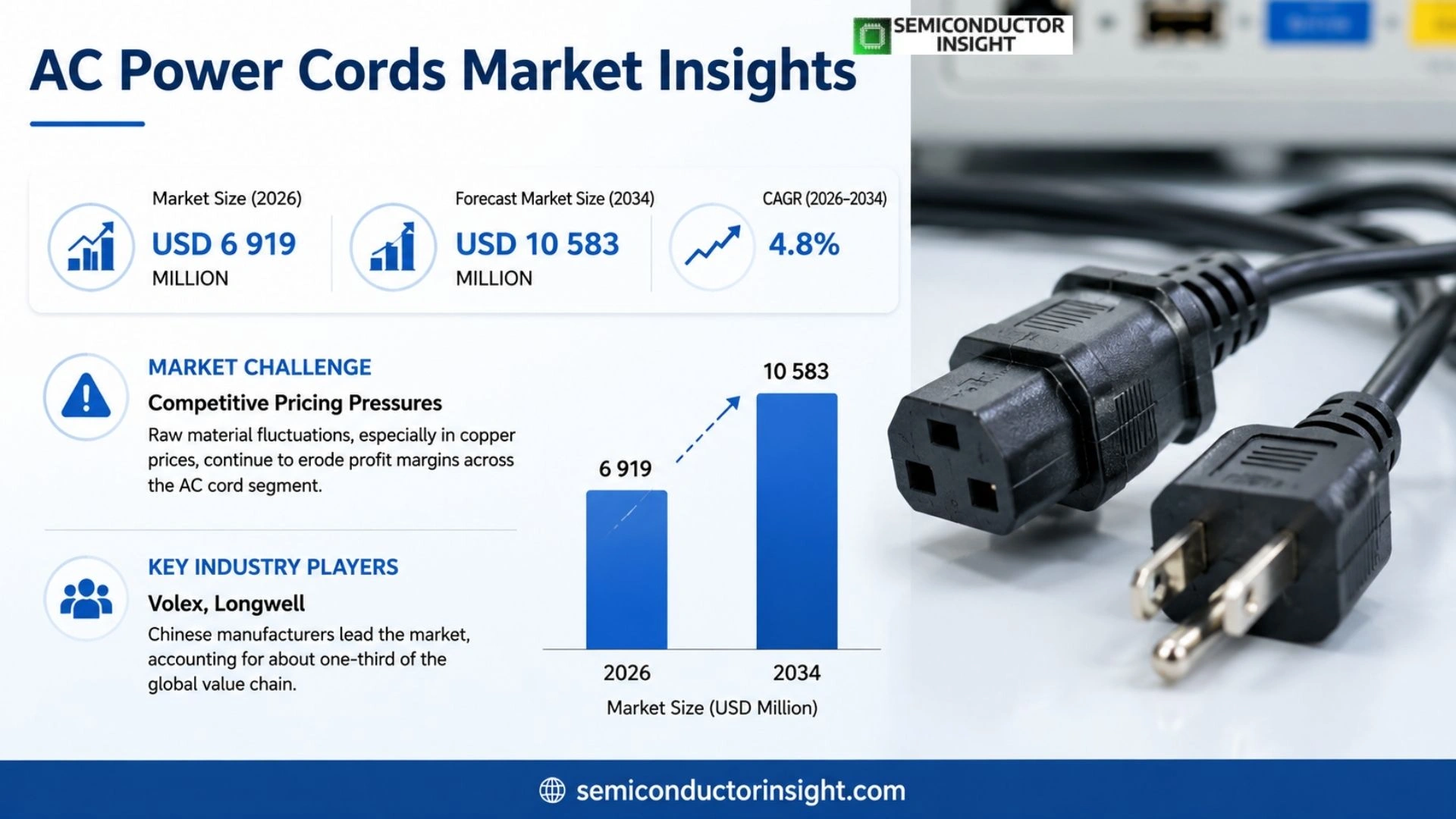
AC Power Cords market is projected to grow from USD 6 919 million in 2026 to USD 10 583 million by 2034, exhibiting a CAGR of 4.8% during the forecast period.
AC power cords,also referred to as power cables,are insulated electrical conductors that connect electronic devices or appliances directly to an alternating‑current source. These cords serve as the primary conduit for transferring electrical energy from outlets into equipment such as computers, televisions, industrial machinery and medical devices.
MARKET DRIVERS
Demand for Energy‑Efficient Connectivity
In critical infrastructure, energy consumption has outpaced production, compelling equipment manufacturers to embrace compact and efficient power delivery solutions. Over the last three years, shipments of high‑voltage AC cords have risen by approximately 7%, mirroring the rapid growth of data centers and telecommunication hubs. As electricity costs climb, clients prioritize cords with advanced insulation and thermal management, which translate into lower failure rates and maintenance budgets. The automotive electronics sector, now hosting a wide array of infotainment and control units, is increasing its power cord orders by 5% annually. Stricter safety regulations and consumer demands for Eco‑Label compliance accelerate this growth. Therefore, North American and European manufacturers are investing in FPGA‑based circuit designs to enhance overcurrent protection, while Asian firms capitalise on lower labour costs to offer price‑competitive variants. This market values product reliability as strategically as cutting‑edge technology, reinforcing the surge witnessed in AC Power Cords market. This trend compels suppliers to adopt modular designs, enabling easier replacement and reducing field service time. As a result, market players are accelerating R&D into low‑impedance connectors that limit voltage drop during peak loads, especially critical for 5G base stations. Additionally, the rise of edge computing platforms drives demand for compact, high‑density power modules that fit within 19‑inch racks, reinforcing the need for improved thermal integrity.
Smart Home and Data Center Integration
The proliferation of connected appliances in residential settings has introduced a new wave of power cord requirements. Smart thermostats, security cameras, and wireless charging pads demand cords that maintain signal integrity while carrying modest power. Households equipped with 10–15 IoT devices now account for 18% of total AC cord sales in North America, up from 12% five years ago. This shift has prompted manufacturers to embed RFID tags for inventory tracking, allowing retailers to detect wear patterns and predict replacements. Simultaneously, the data center sector continues to push for higher power densities, leading facilities to replace legacy 12 V systems with 48 V and 208 V variants that deliver superior efficiency. As 5G rollouts grow, telecom operators require ruggedized cords capable of sustaining up to 20 A current without heat buildup. Moreover, server virtualization has accelerated the adoption of power‑splitting modules that distribute power across multiple racks, thereby reducing cable clutter. Companies that forge early collaborations with hardware OEMs secure exclusive contracts, locking in long‑term supply agreements. In summary, the intersection of household connectivity and enterprise‑grade power solutions is redefining AC Power Cords market, underscoring a shift toward smarter, higher‑capacity connectors.
➤ Power cords are the unseen backbone of smart ecosystems, delivering both electricity and signal integrity with equal precision.
At the nexus of safety, energy efficiency, and connectivity, AC Power Cords market is undergoing a compound shift. Manufacturers that align their R&D investments with regulatory compliance and IoT integration will command greater pricing power. The adoption of smart analytics embedded in cords to report temperature, voltage drop and wear in real time presents a new revenue stream for providers of cloud‑based monitoring solutions. Bundling power cords with subscription services for home automation or offering modular power packs to data centers can generate recurring revenue and strengthen customer lock‑in. Firms that overlook these trajectories risk ceding market share to competitors offering integrated platform solutions.
MARKET CHALLENGES
Competitive Pricing Pressures
Raw material fluctuations continue to erode profit margins across the AC cord segment. Copper prices, which comprise roughly 30% of the cost of a standard 125‑V power cord, have fluctuated by 12% over the past year due to geopolitical tensions and supply constraints. Concurrently, synthetic polymer feedstock costs have risen as environmental regulations tighten production processes. This upward pressure on key inputs displaces many traditional manufacturers, who must absorb cost increases or pass them on to end‑users, sparking price wars particularly within the consumer electronics market. Domestic competition in China, home to the majority of low‑cost cord production, intensifies the challenge by producing high‑quality units at half the price of their Western counterparts. Consequently, firms must adopt strident differentiation strategies,such as offering advanced safety features or longer warranties,to defend market share. Ineffective differentiation leads to margin compression and hampers the ability to invest in technology upgrades, thereby locking manufacturers into an ongoing battle against price‑thin competitors.
Other Challenges
Supply Chain Volatility
The global semiconductor shortage has disrupted the supply of critical components like MOSFETs and diodes, critical for power cord assemblies that incorporate built‑in monitoring. Shipping delays caused by port congestion and container shortages exacerbate the risk of last‑minute disruptions. In addition, the scarcity of high‑purity copper from major mining regions restricts the availability of high‑quality conductors, forcing producers to seek alternative sources that may lack the same reliability profile. These disruptions not only inflate inventory carrying costs but also reduce shelf availability, leading to lost sales opportunities. To mitigate residual risk, many players are diversifying supplier bases, implementing forward‑purchasing agreements, and adopting predictive analytics to anticipate raw material shortages.
MARKET RESTRAINTS
Regulatory and Safety Compliance Complexities
Compliance with a dense web of global safety standards,ranging from UL and IEC to stricter EU directives on low‑EMF emissions,creates substantial entry barriers for new entrants. Constantly evolving standards require ongoing testing, certification, and product redesign to remain market‑eligible, which can consume up to 15% of an OEM’s operating budget. Smaller manufacturers, lacking dedicated compliance departments, frequently abandon product lines subjected to prolonged testing cycles. Additionally, the rapid adoption of 5G and electric vehicle technologies introduces new electromagnetic interference (EMI) constraints, demanding high‑frequency shielding that increases production complexity and cost. A failure to achieve compliance can lead to product recalls, legal liabilities, and brand reputational damage, which in turn erodes customer trust. These constraints create a cumulative deterrent that dampens market expansion, especially for firms that lack robust regulatory expertise.
MARKET OPPORTUNITIES
Emerging Ecosystem Partnerships
The integration of power cords within the broader hardware ecosystem is opening new revenue avenues. Collaborative ventures between cord manufacturers and data center vendors to co‑develop hot‑swap, temperature‑sensing power modules are reshaping service agreements, allowing for subscription‑model maintenance contracts. Further, partnership with ISA‑cable designers is enabling the creation of plugs that anchor multiple standard connectors in a single project, minimizing installation complexity and attracting venture capital appreciation. Looking ahead, the proliferation of smart farms and autonomous delivery systems will spur demand for rugged, high‑current cords capable of operating in extreme weather conditions, creating a niche market that currently remains underdeveloped. Firms that keep pace with evolving industry demands and embed smart analytics in their products can leverage the increasing appetite for connected infrastructure to secure a dominant position in the evolving AC cord landscape.
AC Power Cords Market Trends
Evolving Design Standards Drive Premium Adoption
The push for tighter fire‑safety and electromagnetic compliance has nudged manufacturers toward higher‑grade conductors and reinforced insulation. Consequently, higher‑performance AC Power Cords are eclipsing basic models across the electronics and industrial sectors. Firms that invest in R&D to meet next‑generation standards secure a pricing edge and early market share, while those lagging risk obsolescence as OEMs prioritize vetted suppliers that guarantee end‑product safety. The trend signals a shift from cost competition to capability differentiation, compelling vendors to re‑evaluate component sourcing and certification pathways.
Other Trends
Vertical Integration within OEMs
Many device builders are bringing cord production in‑house to lock in quality control, reduce dependency on external suppliers, and capture margin. This internalization forces traditional cord manufacturers to either forge closer alliances or pivot to niche, high‑volume specialty lines that fit OEM specifications. The resulting consolidation pressures smaller players to specialise in modular or recyclable solutions to survive.
Sustainability and Material Efficiency
Energy‑star compliance and carbon‑neutral policies are compelling cord makers to adopt recyclable insulation and lower‑loss conductors. Brands that demonstrate measurable reductions in material waste and institutionalise circularity models resonate with the growing eco‑conscious consumer base. The upside rests in brand differentiation and potential tariff advantages, while the challenge lies in balancing cost, performance, and compliance costs.
Digital Supply Chain Integration Enhances Market Agility
Real‑time inventory tracking, AI‑driven demand forecasting, and blockchain‑based provenance are starting to reshape the reactions of major players to market pulses. Vendors who embed digital tools into procurement and logistics cycles can reduce lead times by up to 20 percent, a margin that becomes decisive during regional supply shocks or sudden regulatory changes. The capacity to produce at scale while maintaining granular quality oversight allows these companies to target diversification strategies that future‑proof the portfolio against shifting industry regulations and emerging standards.
COMPETITIVE LANDSCAPE
Key Industry Players
AC Power Cords Market Competitive Landscape
The market remains anchored by a handful of incumbents that have leveraged scale and geographic reach to secure a dominant presence, particularly in China where domestic manufacturers such as Volex and Longwell contribute roughly a third of the global value chain. Their focus on high‑volume consumer electronics and industrial automation customers has allowed them to maintain pricing power during cyclical fluctuations. In addition, their investment in R&D for advanced insulation and surge‑protection technologies has set a performance benchmark that competitors strive to emulate. Meanwhile, North American players, led by companies like Electri‑Cord and Feller, are capitalising on the growing demand for smart‑home and medical‑equipment connections, which drive both volume and higher‑margin contracts. The geographic split of 37% China to 17% North America signals concentrated regional advantages rooted in local manufacturing costs, infrastructure, and regulatory environments. A nuanced view of market structure shows a classic “hub‑and‑spoke” model: large multinational hubs supply fibre‑optic and IEC‑type cables to regional “spokes” that serve specific industry verticals.
Outside the leaders’ sphere, a cohort of niche firms sustains innovation and caters to specialised segments. Firms like Prime Wire & Cable and AURICH have carved out positions within the NEMA and CEE connectors arenas, marrying tight tolerances with robust build standards required by aerospace and defense customers. Others, such as I‑SHENG and Queenpuo, focus on eco‑friendly composites and low‑EMI performance, aligning with tightening environmental directives across the European Union and China’s 2030 carbon goals. Meanwhile, midsized manufacturers such as Yung Li and ShangYu Jintao supply customised cable assemblies for medical and telecommunications applications, often collaborating with OEMs for proprietary designs. Distribution networks, powered by digital shop‑floor systems in Asia, have increased supply chain visibility and reduced turn‑around times, elevating the competitive bar. Collectively, these players underscore a trend toward specialised, high‑added‑value solutions and demonstrate the need for incumbents to continuously adapt through targeted acquisitions or joint ventures to preserve market relevance.
List of Key AC Power Cords Companies Profiled
- Volex
- Longwell
- Electri‑Cord
- Prime Wire & Cable
- AURICH
- I‑SHENG
- Queenpuo
- Yung Li
- ShangYu Jintao
- Kord King
- GoGreen Power
- Tripplite
Segment Analysis:
| Segment Category | Sub-Segments | Key Insights |
| By Type |
|
NEMA Power Cords provide the highest levels of electrical safety and are widely preferred for their compliance with American and Canadian standards.
|
| By Application |
|
Industrial Equipment application commands consistent usage of cords in factory automation and heavy machinery, driving demand for durability and safety features.
|
| By End User |
|
Industrial Users demand cords that support high throughput and reliability, influencing design toward abrasion‑resistant jackets and secure connectors.
|
Regional Analysis: AC Power Cords Market
Europe
Europe’s dense cluster of data‑center facilities continues to drive cord demand, as operators seek cables that can withstand high power densities while maintaining compliant connectors. The ongoing expansion of edge‑computing nodes across the continent accentuates the need for modular cord kits that ease installation and enable coefficient energy savings. This trend compels suppliers to optimise design for both endurance and thermal stability.
Advances in copper‑reinforced composites and heat‑resistant polymers are redefining cord performance. Intelligent cable systems, equipped with micro‑controllers that log voltage fluctuations, are becoming desirable for industrial deployments where downtime costs are high. Adopting such features allows vendors to extend warranty service capabilities and unlock premium pricing in competitive contracts.
EU directives regarding electrical safety and energy efficiency impose stringent thresholds on cord construction. The Low‑Voltage Directive (LVD) mandates rigorous performance testing, forcing manufacturers to document compliance for each commodity variant. This regulatory grind drives consolidation, as smaller players seek joint ventures to share certification costs, fostering a trend toward vertically integrated supply chains.
Competition in Europe is marked by a dual focus on price agility and value‑addition. Carriers frequently benchmark cable solutions against bundled service offerings, rewarding suppliers who deliver intangible benefits such as predictive maintenance dashboards. Consequently, niche players that specialise in legacy retrofitting or advanced sensor integration hold a premium positioning in target segments.
North America
North America, while a sizable ASTM market, exhibits a power‑cord appetite driven largely by the proliferation of data‑center operations and distributed energy resources. The USA’s focus on modular data‑center pods and the increasing momentum toward renewable integration create storm‑ready demand for cords that combine high‑temperature tolerance with quick‑connect terminals. In Canada, stricter B.C. regulations encourage the adoption of cords wrapped in flame‑retardant sheaths, promoting longer lifecycle. The region also sees a move toward integrated cable management suites, allowing operators to embed sensors for real‑time monitoring. Consequently, North American manufacturers are investing in board‑level engineering teams to continuously refine magnetics and shielding, thereby positioning themselves as go‑to partners for energy‑critical deployments.
Asia‑Pacific
Asia‑Pacific represents a contrasting blend of emerging and mature markets, where rapid urbanisation and industrial growth create a steady baseline of cord demand. In countries such as China, the push for industrial electrification mandates the use of cords capable of operating under fluctuating voltage conditions, while Japan’s emphasis on precision manufacturing encourages the adoption of ultra‑thin and highly insulated cables. The region’s fragmented supply chain, however, often leads to fragmented supplier‑market interaction, compelling local distributors to cultivate deep technical knowledge to pre‑qualify components for compliance. Further, the integration of network‑connected smart meters has motivated vendors to offer plug‑and‑play cord solutions that support synchronous communication, thereby expanding the value proposition beyond mere power delivery.
South America
South American markets, especially Brazil and Argentina, are experiencing a steady expansion in industrial corridors. Electrical infrastructure upgrades here are coupled with stricter environmental codes that demand cords with low‑impact packaging. The region’s state‑owned utilities frequently negotiate long‑term procurement contracts that embed maintenance clauses, thereby incentivising suppliers to build robust, semi‑permanent cord assemblies that can endure harsh climatic conditions. In markets like Chile, the mounting focus on solar PV farms has spurred demand for cords featuring reliable temperature stability and resistance to ultraviolet degradation, encouraging the adoption of flame‑retardant, multi‑core designs.
Middle East & Africa
Middle East & Africa present a patchwork of nascent and advanced markets, with significant growth spurred by infrastructure drives in GCC countries and renewable‑energy projects across the continent. High ambient temperatures and extreme dust conditions necessitate cords with superior heat‑resistance and ingress protection, a requirement that is increasingly integrated into local procurement specifications. Additionally, the region’s reliance on imported components adds a layer of supply‑chain volatility, prompting distributors to maintain strategic inventories of key connectors. The adoption of IoT‑enabled cord solutions is also gaining a foothold, as utility operators look to embed telemetry for predictive load balancing, thereby extending operational lifespans and minimizing unplanned outages.
Report Scope
This market research report provides a comprehensive analysis of the AC Power Cords Market , covering the forecast period 2026–2034. It offers detailed insights into market dynamics, technological advancements, competitive landscape, and key trends shaping the industry.
Key focus areas of the report include:
- Market Overview: The report begins with an overview outlining its current market scenario, key growth indicators, and industry transformation drivers. It discusses macroeconomic factors, demand–supply balance, regulatory landscape, and the strategic role of semiconductors in powering advancements across industries such as automotive, telecommunications, consumer electronics, and industrial automation.
- Market Size & Forecast: Historical data and future projections for revenue, unit shipments, and market value across major regions and segments.
- Segmentation Analysis: Detailed breakdown by product type, technology, application, and end-user industry to identify high-growth segments and investment opportunities.
- Regional Insights: Insights into market performance across North America, Europe, Asia-Pacific, Latin America, and the Middle East & Africa, including country-level analysis where relevant.
- Competitive Landscape: Profiles of leading market participants, including their product offerings, R&D focus, manufacturing capacity, pricing strategies, and recent developments such as mergers, acquisitions, and partnerships.
- Technology Trends & Innovation: Assessment of emerging technologies, integration of AI/IoT, semiconductor design trends, fabrication techniques, and evolving industry standards.
- Market Drivers & Restraints: Evaluation of factors driving market growth along with challenges, supply chain constraints, regulatory issues, and market-entry barriers.
- Stakeholder Insights: Insights for component suppliers, OEMs, system integrators, investors, and policymakers regarding the evolving ecosystem and strategic opportunities.
Primary and secondary research methods are employed, including interviews with industry experts, data from verified sources, and real-time market intelligence to ensure the accuracy and reliability of the insights presented.
FREQUENTLY ASKED QUESTIONS:
What is the current market size of AC Power Cords Market?
-> AC Power Cords market is projected to grow from USD 6 919 million in 2026 to USD 10 583 million by 2034, exhibiting a CAGR of 4.8%
Which key companies operate in AC Power Cords Market?
-> Key players include Volex, Longwell, Electri-Cord, Feller, Quail Electronics, HL TECHNOLOGY, Hongchang Electronics, Americord, CHING CHENG, Prime Wire & Cable, AURICH, I-SHENG, Queenpuo, CEP, Yunhuan Electronics, Coleman Cable, HUASHENG ELECTRICAL, StayOnline, Yung Li, MEGA, ShangYu Jintao, Kord King, GoGreen Power, Tripplite, QIAOPU, Weitien, Ningbo Chenglong.
What are the key growth drivers?
-> Key growth drivers include the expanding demand for electronic devices and appliances, rapid industrial automation, growing medical equipment market, and overall electrification trends driving usage of AC power cords across consumer electronics, communications, industrial equipment, and medical applications.
Which region dominates the market?
-> China dominates AC Power Cords market, holding approximately 37% of the global share, while North America follows with about 17% of the market.
What are the emerging trends?
-> Emerging trends in AC Power Cords market include increased standardization across NEMA, IEC, and CEE connector types, rising adoption in consumer electronics and industrial equipment, and a growing focus on safety and compliance with international power cord standards.

Get Sample Report PDF for Exclusive Insights
Report Sample Includes
- Table of Contents
- List of Tables & Figures
- Charts, Research Methodology, and more...
 Download Sample Report PDF