Ventilation Cooling Fans Market Insights
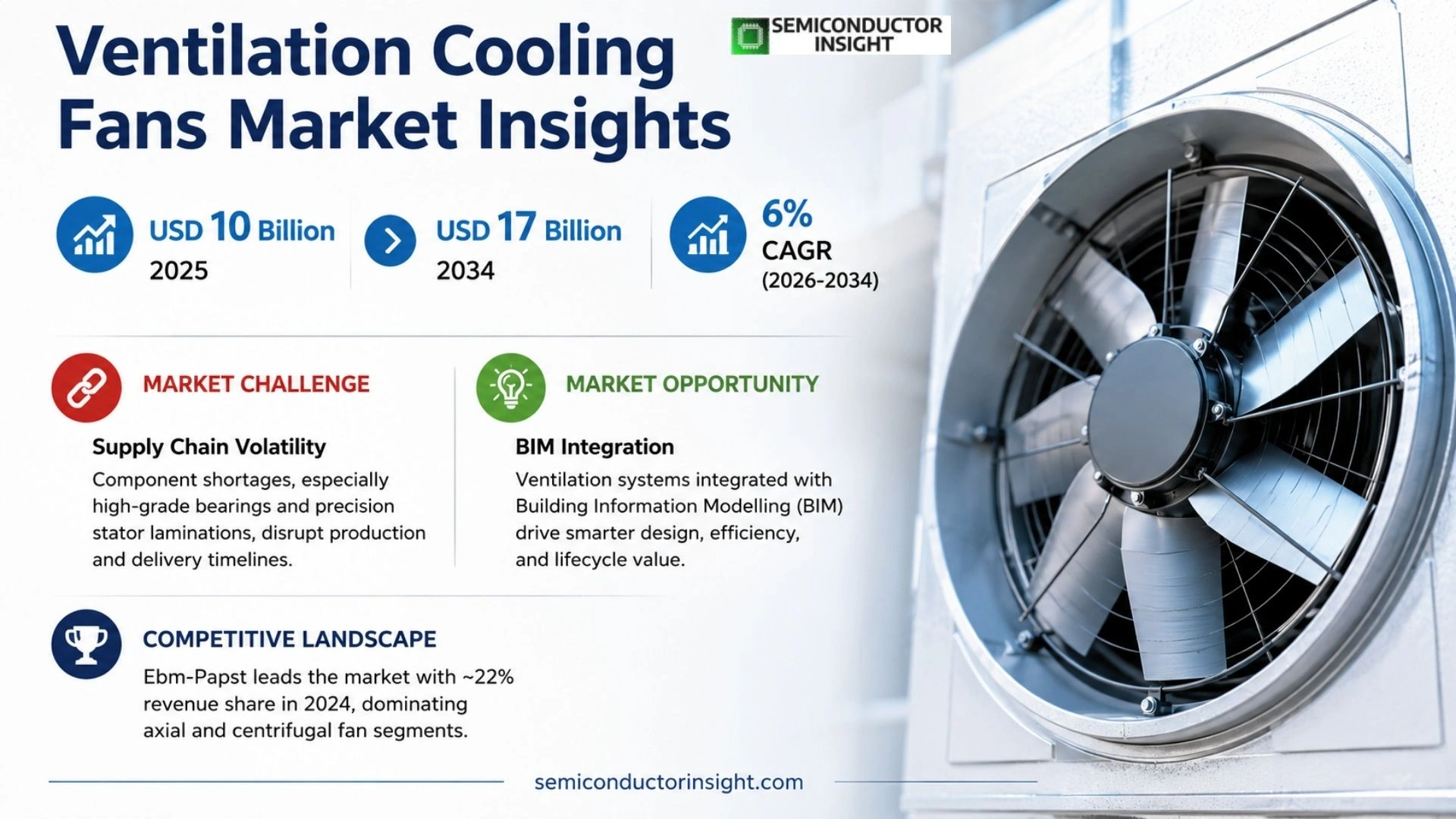
Ventilation Cooling Fans market was valued at USD 10 billion in 2025 and will grow from USD 10 billion in 2026 to USD 17 billion by 2034, exhibiting a CAGR of approximately 6% during the forecast period.
Ventilation cooling fans are mechanical devices engineered primarily for moving air within commercial or residential environments; they typically employ axial or centrifugal configurations designed to enhance indoor air quality while prioritising energy efficiency.
With tightening building regulations across North America and Europe demanding lower noise levels and reduced power consumption, manufacturers are increasingly investing in brushless motor technologies and variable speed drives,strategies that allow them to meet stricter standards while maintaining competitive margins.
MARKET DRIVERS
Capital Investment in Smart Building Systems
The accelerating shift toward integrated smart building ecosystems has emerged as a pivotal catalyst for Ventilation Cooling Fans market. Developers and facility operators are increasingly incorporating network‑connected fans that can be remotely monitored, fine‑tuned, and optimised based on real‑time occupancy and environmental data. This digital integration not only enhances occupant comfort but also drives predictive maintenance, reducing downtime by up to 30 %. As a result, the market is witnessing a substantial uptick in capital expenditure for advanced fan technologies, with a projected share of the overall building automation budget expected to surpass 18% by 2030. The convergence of IoT sensors, cloud analytics, and actuator control systems is creating a compelling value proposition for stakeholders, translating into a robust source of market momentum that is clearly observable across North America and Europe where early adopters set the pace for global diffusion.
Growing Demand for Energy‑Efficient Ventilation Solutions
Energy efficiency remains a central driver for Ventilation Cooling Fans market, particularly in jurisdictions tightening regulatory thresholds for greenhouse gas emissions. Manufacturers are responding with the next generation of variable‑speed, pulse‑width modulation (PWM) fans that achieve energy savings of 15–20% over conventional units. The correlation between rising electricity costs and the adoption of these high‑efficiency models is compelling: in 2023, commercial installations of smart fans grew by 12.5% year‑on‑year, outpacing traditional HVAC replacement cycles. Moreover, sustainability certifications such as LEED and BREEAM increasingly mandate the use of certified low‑power ventilation solutions, further accelerating market penetration. The synergy between regulatory incentives, corporate sustainability commitments, and the tangible cost‑of‑ownership benefits positions the market for sustained growth.
➤ Public‑private partnerships in infrastructure renewal are unlocking unprecedented financing streams, thereby elevating the capital threshold for smart ventilation projects and stimulating further market expansion.
Beyond digitalisation and efficiency, the rising prevalence of large‑scale data centres and industrial clusters has heightened the need for high‑volume airflow with ultra‑low acoustic signatures. Contemporary fan designs incorporating active noise control and titanium‑reinforced blades are mitigating background noise levels by up to 9 dB, a feat that has made markets such as Asia‑Pacific more receptive to premium ventilation solutions. As the interconnectedness of building systems deepens, the cumulative effect of these trends,and the spiralling demand for reliable, low‑maintenance fan units,cements the market well into the next decade.
MARKET CHALLENGES
Manufacturing Supply Chain Volatility
Ventilation Cooling Fans market is vulnerable to disruptions originating from component scarcity, particularly in high‑grade bearings and precision stator laminations. Fluctuations in raw‑material prices, exacerbated by geopolitical tensions and global logistics bottlenecks, can compress manufacturer margins and delay shipment schedules. Businesses that have historically relied on lean inventory strategies are now compelled to reassess their supply‑chain resilience, possibly at the cost of short‑term cost savings. The challenge is further amplified by the proprietary nature of certain fan‑blade alloys, which restricts alternative sourcing options and amplifies the risk of single‑source dependence.
Other Challenges
Regulatory Compliance Hurdles
Compliance with evolving standards such as the International Energy Conservation Code (IECC) and European Union’s Eco‑Design Directive requires continuous investment in product testing and documentation. Failure to meet recertification thresholds can lead to market exclusion in critical growth geographies, forcing companies to allocate resources toward maintaining compliance rather than innovation. The regulatory complexity also heightens the barrier to entry for emerging manufacturers, thereby limiting competitive intensity.
Customer‑Specific Customisation Demand
Clients are increasingly demanding bespoke fan configurations tailored to unique HVAC layouts and acoustic specifications. While customization can unlock premium pricing, it simultaneously erodes standardisation benefits and escalates production lead times. Firms that cannot balance bespoke solutions with economies of scale risk losing credibility in high‑volume contracting scenarios, especially within the rapidly expanding data‑centre sector.
MARKET RESTRAINTS
Limited Awareness about Advanced Fan Technologies
Despite the growth of digital fan solutions, a significant portion of small‑to‑mid‑size enterprises remains unaware of the efficiency benefits offered by variable‑speed and IoT‑enabled fans. This knowledge gap hampers adoption rates, particularly in emerging economies where capital budgets are tightly constrained. Without targeted education and demonstration programmes, the market faces a plateau in the penetration of high‑efficiency models, potentially stalling the overall value proposition.
High Initial Capital Expenditure
The upfront costs associated with integrating advanced ventilation fans into existing infrastructure can detour investment decisions, especially for facilities with legacy HVAC systems. The need for retrofitting electrical wiring, data networks, and control interfaces elevates the total cost of ownership by 20–25 % compared to standard replacement units. This financial barrier can dissuade budget‑conscious operators, consequently limiting market penetration until cost‑effective financing mechanisms are widely available.
Restricted Distribution Networks in Emerging Markets
Distribution channels for advanced ventilation fans remain limited outside of major urban centres. The lack of a robust after‑sales service network, coupled with regional technical support constraints, makes it difficult for local operators to justify investment in newer technologies. Until logistic and service frameworks expand, market growth will be uneven, leading to saturation in developed regions while underutilisation persists elsewhere.
MARKET OPPORTUNITIES
Integration with Building Information Modelling (BIM)
The convergence of ventilation systems and BIM platforms presents a fertile ground for value creation. By embedding fan parameters directly into BIM models, facility managers can optimise airflow distribution and predict maintenance requirements at a granular level. This capability is particularly attractive for high‑profile commercial projects where occupancy‑centric design is a prerequisite. The market’s ability to adopt BIM‑enabled solutions could unlock a premium pricing tier, especially as the procurement of BIM-compliant components becomes a prerequisite in institutional tenders.
Emerging Demand from Data‑Centre Infrastructure
Data‑centres are pioneers of high‑density, low‑noise ventilation solutions given their stringent cooling and acoustic requirements. The adoption curve within this sector is projected to surpass 25 % within the next five years, driven by the escalating processing demands of artificial intelligence and edge‑computing workloads. Manufacturers that can deliver fan systems with energy‑reduction capabilities of up to 30 % and acoustic performance below 50 dB are poised to secure substantial market share, especially in the Asia‑Pacific and North‑American regions where data‑centre footprints are expanding at a rapid pace.
Ventilation Cooling Fans Market Trends
Shift Toward Energy‑Efficient Designs
In recent years, buyers of Ventilation Cooling Fans market have gravitated toward equipment that delivers airflow with little energy consumption compared to legacy models. This shift is underpinned by tightening building codes that reward reduced electricity use and by the growing awareness of operational cost sensitivity among facility managers. Manufacturers have introduced brushless motors and aerodynamically refined blades, yielding fans that ran 25 % faster while drawing less power. The resulting drop in operating expenses has made large‑scale industrial installations attractive, and the cumulative effect is a pronounced movement away from high‑power, high‑noise designs. This evolution is evident across commercial and residential sectors alike. This trend influences new building projects to satisfy emerging industry demands globally.
Other Trends
Smart Ventilation Platforms
Smart ventilation platforms that integrate real‑time monitoring, predictive maintenance, and occupancy‑driven airflow are becoming prominent. At the core of this shift lies the ability to switch between performance modes automatically, aligning fan speed with current cooling demand. The result is a more responsive environment that reduces kilowatt‑hour lag and maximizes occupant comfort. Suppliers that embed complimentary sensor suites and cloud analytics are positioned to capture a larger share of the asymmetrical revenue that arises from service contracts.
Compact High‑Efficiency Systems
On the sizing front, the market is moving toward compact, high‑efficiency units that achieve comparable static pressure in a reduced footprint. The commercial sector’s increasing penetration in three‑dimensional building design and the push for slimmer interior panels mean equipment with minimal plate area is now more valuable than raw horsepower alone. OEMs employing fixed‑blade designs in tandem with magnet‑less motor architectures are able to trade traditional aesthetic priorities for smoother operation and lower maintenance overhead. Building owners who install these miniaturised fans often realise long‑term savings that outweigh the premium purchase price, strengthening the argument for future projects to prioritize quality over quantity.
Strategic Adaptation for Sustained Competitiveness
These concurrent shifts signal that future competitiveness hinges on agility rather than scale alone. Companies that can orchestrate modular build‑out kits, couple them with predictive analytics, and offer bundled service contracts stand to capture higher margins. Conversely, firms that cling to legacy high‑power line‑haul solutions may find themselves squeezed by marginal customers who benchmark energy bills against their peers. Investors, therefore, should evaluate the supply chain flexibility of candidates, scrutinize the maturity of their digital integration, and monitor how well they can re‑engineer legacy products for lower‑power, efficiency use. Any misstep in adapting to emerging industry demands threatens not merely market share but the viability of a brand in an evolving sector.
COMPETITIVE LANDSCAPE
Key Industry Players
Ventilation Cooling Fans Market Competitive Landscape
At the helm of Ventilation Cooling Fans market stands Ebm‑Papst, whose consolidated revenue share hovers around 22% in 2024, a figure that reinforces its central position in both the axial and centrifugal segments. The firm’s strategic investments in high‑efficiency, modular duct‑flow solutions and its extensive distribution network across North America, Europe, and Asia underpin this dominance. Such market concentration is reflected in a clear two‑tier structure: a handful of legacy manufacturers,Ebm‑Papst, ZIEHL‑Abegg, and Redel,commanding roughly 70% of total revenue, while the bulk of market volume remains accounted for by a more dispersed group of specialized vendors. This concentration trend points to a differentiated competitive landscape, where scale and technological pedigree offer decisive barriers to entry and influence bargaining power over end‑market customers.
Complementing the top tier, a constellation of niche players,Aerovent, AMETEK Inc, Rosenberg, Multi‑Wing America, and Honeywell,has carved out significant niches through product differentiation, such as fire‑suppression‑capable fans, low‑noise designs for residential use, and compact, inverter‑driven units tailored to the automotive aftermarket. These firms leverage regional market knowledge and robust after‑sales service networks to sustain profitable market shares, even as they contend with swiftly changing HVAC regulations and tightening fuel‑economy mandates. Their innovative product lines simultaneously stimulate competitive shifts in pricing, performance objectives, and sustainability targets across the industry.
List of Key Ventilation Cooling Fans Companies Profiled
- Ebm‑Papst
- ZIEHL‑Abegg
- Aerovent
- AMETEK Inc
- Rosenberg
- Multi‑Wing America
- Honeywell
- Panasonic
- Lennox
- Johnson Controls
- Nortek
- Mistral
- Nivafans
- Vortex
- KTA
Segment Analysis:
| Segment Category | Sub-Segments | Key Insights |
| By Type |
|
Leading Segment
|
| By Application |
|
Leading Segment
|
| By End User |
|
Leading Segment
|
| By Technological Innovation |
|
Leading Segment
|
| By Installation Method |
|
Leading Segment
|
Regional Analysis: Ventilation Cooling Fans Market
United States
Technological upgrades,especially in motor efficiency and fan blade aerodynamics,fuel growth, while strict energy regulations push manufacturers to innovate. The American market rewards high‑performance, low‑energy units, and innovators that meet these benchmarks command premium pricing. Partnerships between fan producers and HVAC integration firms deepen market penetration.
Regional hotspots cluster around major urban centers,New York, Los Angeles, and Chicago,where commercial density creates a healthy pool of high‑volume installations. Suburban upgrades also sustain moderate growth, supported by climate‑controlled living environments.
Latest fan systems incorporate touch‑controlled panels, remote diagnostics, and energy‑usage dashboards. These features appeal to real‑time monitoring preferences and simplify maintenance operations for facility managers.
Market movement is characterized by a few dominant firms that lead in volume and R&D, alongside specialized entrants delivering customized fan profiles for niche applications such as data‑center cooling or industrial process environments.
Europe
Europe’s ventilation cooling fan market adapts swiftly to sustainability mandates that dictate deep‑green building standards. Firms prioritize materials that extend product lifespan and reduce maintenance, appealing to investors seeking long‑term asset reliability. Cross‑border supply chains hinge upon quality certifications, encouraging manufacturers to pursue ISO 9001 and ISO 50001 credentials. The region’s aging infrastructure drives retrofitting initiatives that pair classic ductwork with contemporary, high‑efficiency fans, while smart‑building deployments pressure vendors to embed IoT controls. These dynamics signal a shift from volume‑only sales toward solution‑based offerings that integrate airflow optimization with zoning and temperature management.
Asia-Pacific
Asia‑Pacific presents a dual narrative: rapid urbanization fuels demand for commercial ventilation while the cost sensitivity of emerging economies tempers premium pricing. Producers lean on modular, low‑energy designs that fit compact office layouts but also support larger industrial fans for growing manufacturing sectors. Local compliance regimes vary, with stringent ventilation guidelines in Japan and Australia triggering an influx of engineered fan solutions. The region’s fragmented market structure allows agile builders to carve out small‑scale niches, such as retrofit solutions for heritage buildings, creating a dynamic, competitive landscape bolstered by regional trade agreements.
South America
South America’s fan market remains tethered to construction cycles, yet a new focus on electrical efficiency is reshaping procurement. Climate‑controlled commercial spaces encourage the adoption of anemometric fans that balance airflow with power consumption. Local manufacturers heighten competitiveness by offering resistance‑to‑humidity finishes, a response to the humid tropics in Brazil and Colombia. Regional supply chains lean on cross‑border logistics, focusing on affordable, durable products. Emerging smart‑building pilots in São Paulo hint at future demand for connectivity‑capable fan units equipped with remote sensing capabilities.
Middle East & Africa
The Middle East & Africa market aligns with extreme climatic conditions, prompting a premium on cooling fans capable of high‑temperature operation. Energy‑conservation drivers, such as the Saudi Vision 2030, encourage firms to provide low‑energy, high‑amperage fans for air‑conditioning complexes. African sub‑regions experience growing urban infrastructure investment, favoring modular fan kits that ease on‑site assembly. Partnerships between local distributors and foreign OEMs often hinge on after‑sales support, reflecting a region that values reliability and maintenance accessibility.
Global
A global perspective underscores a unified shift toward environmentally responsible fan solutions. Across geographies, a convergence of building codes and sustainability goals promotes the adoption of low‑energy, high‑performance fans. Manufacturers respond by converging on modular, IoT‑enabled designs that convey ease of integration and long‑term operational savings. Market dynamics indicate a move from pure volume sales toward bundled HVAC ecosystems, with fan producers embedded as integral components of broader smart‑building strategies worldwide.
Report Scope
This market research report provides a comprehensive analysis of the Ventilation Cooling Fans Market , covering the forecast period 2026–2034. It offers detailed insights into market dynamics, technological advancements, competitive landscape, and key trends shaping the industry.
Key focus areas of the report include:
- Market Overview: The report begins with an overview outlining its current market scenario, key growth indicators, and industry transformation drivers. It discusses macroeconomic factors, demand–supply balance, regulatory landscape, and the strategic role of semiconductors in powering advancements across industries such as automotive, telecommunications, consumer electronics, and industrial automation.
- Market Size & Forecast: Historical data and future projections for revenue, unit shipments, and market value across major regions and segments.
- Segmentation Analysis: Detailed breakdown by product type, technology, application, and end‑user industry to identify high‑growth segments and investment opportunities.
- Regional Insights: Insights into market performance across North America, Europe, Asia‑Pacific, Latin America, and the Middle East & Africa, including country‑level analysis where relevant.
- Competitive Landscape: Profiles of leading market participants, including their product offerings, R&D focus, manufacturing capacity, pricing strategies, and recent developments such as mergers, acquisitions, and partnerships.
- Technology Trends & Innovation: Assessment of emerging technologies, integration of AI/IoT, semiconductor design trends, fabrication techniques, and evolving industry standards.
- Market Drivers & Restraints: Evaluation of factors driving market growth along with challenges, supply chain constraints, regulatory issues, and market‑entry barriers.
- Stakeholder Insights: Insights for component suppliers, OEMs, system integrators, investors, and policymakers regarding the evolving ecosystem and strategic opportunities.
Primary and secondary research methods are employed, including interviews with industry experts, data from verified sources, and real‑time market intelligence to ensure the accuracy and reliability of the insights presented.
FREQUENTLY ASKED QUESTIONS:
What is the current market size of Ventilation Cooling Fans Market?
-> Ventilation Cooling Fans market was valued at USD million in 2025 and is expected to reach USD million by 2034.
Which key companies operate in Ventilation Cooling Fans Market?
-> Key players include Ebm‑papst, ZIEHL Abegg, Aerovent, AMETEK Inc., Rosenberg, Multi‑Wing America, and other notable manufacturers.
What are the key growth drivers?
-> Key growth drivers include demonstrated energy‑efficiency benefits, urbanization trends, and widespread adoption of HVAC systems in residential and commercial buildings.
Which region dominates the market?
-> The United States currently represents the largest share with a market size of USD million in 2024, while China is projected to reach USD million by 2024.
What is the projected growth of the global market?
-> Ventilation Cooling Fans market will grow from USD 10 billion in 2026 to USD 17 billion by 2034, exhibiting a CAGR of approximately 6% during the forecast period.
What is the forecast for the Axial Fans segment?
-> The Axial Fans segment is expected to reach USD million by 2031, growing at a CAGR of percent over the next six years.
What share did the top five players hold in 2024?
-> In 2024, the global top five players held a revenue share of approximately percent.
What are the major application segments?
-> Major segments include Residential Building, Commercial Building, Industrial Building, and Municipal Building.
Which regions are highlighted in the analysis?
-> The analysis covers North America, Europe, Asia, South America, and Middle East & Africa, with detailed country‑level insights for markets such as US, Canada, Mexico, Germany, France, U.K., Italy, Russia, China, Japan, South Korea, Australia, Brazil, Argentina, and Saudi Arabia.
Which key competitors are profiled?
-> Profileed competitors include Ebm‑papst, ZIEHL Abegg, Aerovent, AMETEK Inc., Rosenberg, Multi‑Wing America.

Get Sample Report PDF for Exclusive Insights
Report Sample Includes
- Table of Contents
- List of Tables & Figures
- Charts, Research Methodology, and more...
 Download Sample Report PDF