TEM Mode Coaxial Reramic Resonators Market Insights
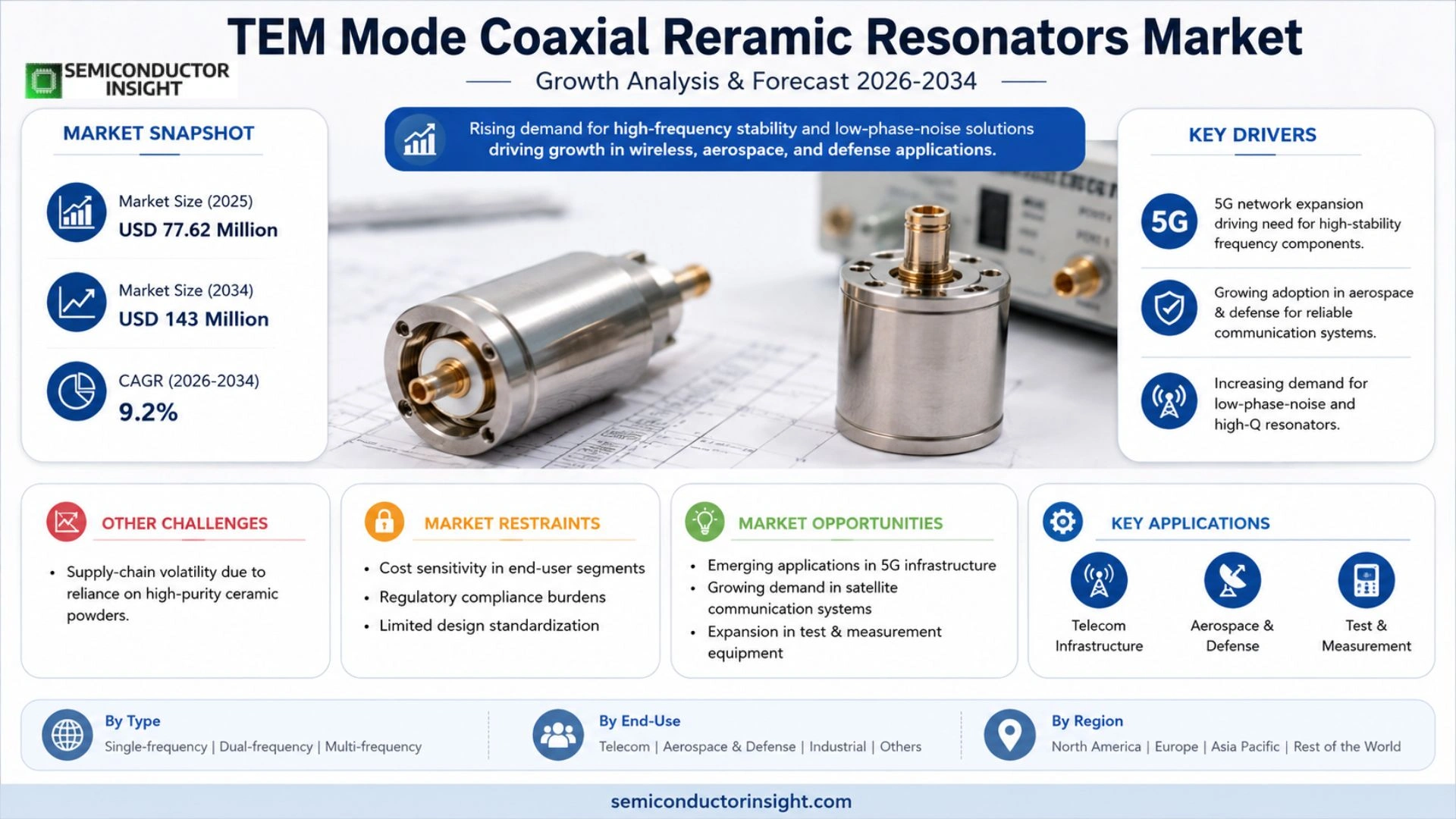
TEM Mode Coaxial Reramic Resonators market size was valued at USD 77.62 million in 2025 and is expected to reach USD 143 million by 2034, reflecting a CAGR of 9.2% over the forecast horizon.
TEM mode coaxial ceramic resonators are miniaturized, highly stable resonant components for RF and microwave circuits. Their core function is to provide high‑Q resonance at specified frequencies within limited space, enabling frequency selection, frequency reference, narrow‑band filtering, low insertion loss and temperature stability in filters, oscillators, duplexers, GPS receiver chains, wireless communication equipment and aerospace‑defense RF systems.
The market gains momentum because emerging 5G‑Advanced deployments, satellite communications and modern defence radar architectures demand ever smaller yet reliable RF building blocks. Recent collaborations,such as Knowles’ March 2024 agreement with a leading aerospace OEM for custom‑frequency resonators,demonstrate how manufacturers are securing supply chains.
MARKET DRIVERS
Rising Demand for High‑Frequency Stability
TEM Mode Coaxial Reramic Resonators Market is being pulled by telecom operators that require tighter frequency control for carrier aggregation. As network planners migrate toward denser spectrum allocations, resonators that deliver low phase noise become essential for maintaining link reliability. This need translates into higher procurement volumes from infrastructure vendors.
Advances in Ceramic Material Engineering
Recent breakthroughs in low‑loss ceramic compositions have lowered insertion loss while preserving temperature stability. Manufacturers that integrate these materials report a measurable improvement in Q‑factor, enabling designers to shrink module footprints without compromising performance. The engineering progress creates a virtuous loop: better products stimulate design adoption, which in turn funds further R&D.
➤ Industry observers note that the convergence of tighter spectral masks and refined ceramic processes is reshaping procurement strategies across the sector.
Beyond telecom, aerospace and defense programs are specifying resonators with stringent electromagnetic compatibility. The cross‑industry relevance cushions the market against cyclical downturns in any single segment, reinforcing overall demand momentum.
MARKET CHALLENGES
Manufacturing Tolerances
Producing coaxial resonators that meet exact TEM mode specifications requires sub‑micron dimensional control. Small deviations can shift resonant frequency, prompting costly re‑work or scrap. Companies that lack advanced metrology infrastructure face higher per‑unit costs, limiting their ability to compete on price.
Other Challenges
Supply‑Chain Volatility
The reliance on high‑purity ceramic powders ties the sector to a narrow supplier base. Disruptions in raw‑material logistics,whether due to geopolitical tensions or raw‑material shortages,create lead‑time spikes that cascade into delayed product launches.
MARKET RESTRAINTS
Cost Sensitivity in End‑User Segments
While performance gains are attractive, many customers operate under tight budget constraints. The premium associated with high‑Q ceramic resonators can deter adoption in cost‑focused projects, especially when alternative, lower‑cost technologies are deemed sufficient for less demanding applications.
Regulatory Compliance Burdens
Electromagnetic emission standards are tightening across regions. Resonator manufacturers must certify each product against multiple regulatory frameworks, a process that adds time and expense. Companies that cannot streamline compliance risk market entry delays.
Limited Design Standardization
The absence of universally accepted design guidelines for TEM mode coaxial resonators forces engineers to rely on in‑house expertise. This fragmentation hampers scalability and raises the barrier for new entrants seeking to develop compatible solutions.
MARKET OPPORTUNITIES
Emerging Applications in 5G Infrastructure
As operators densify their networks to support 5G, the requirement for resonators with ultra‑stable frequency characteristics intensifies. Deployments of massive MIMO arrays, which rely on precise phase alignment across many elements, present a sizable opportunity for suppliers that can deliver low‑phase‑noise components.
Integration with Photonic‑Hybrid Systems
Hybrid photonic‑RF architectures are emerging as a solution for high‑frequency signal distribution. Embedding TEM mode coaxial resonators within these platforms can improve overall system coherence, opening a niche market for resonators designed to interface directly with photonic modules.
Growth in Satellite Constellations
New low‑earth‑orbit satellite constellations demand compact, temperature‑stable resonators for on‑board transceivers. The scale of planned constellations translates into recurring orders, offering a steady revenue stream for manufacturers that can meet the strict space‑qualification criteria.
TEM Mode Coaxial Reranic Resonators Market Trends
Miniaturization and Performance Optimization
The push for smaller, more reliable RF front‑ends has elevated TEM Mode Coaxial Reranic Resonators Market relevance across telecom, aerospace, and defense sectors. By compressing the electromagnetic wavelength within a high‑dielectric ceramic body, manufacturers can deliver quarter‑wave or half‑wave resonators that occupy a fraction of the board area required by traditional LC networks while preserving high Q and low insertion loss. This architectural advantage translates into tighter filter skirts, superior frequency stability, and reduced thermal drift,attributes that are essential for narrowband filters, VCOs, and GPS receiver chains operating from VHF through C‑band. As network equipment migrates toward dense antenna arrays and compact base‑station modules, the demand for these resonators intensifies, compelling design teams to specify them as standard building blocks rather than niche components.
Other Trends
Supply Chain Consolidation and Material Mastery
Recent years have shown a clear movement toward vertically integrated operations, especially among firms that control ceramic formulation, powder processing, and precision sintering. Companies such as Knowles, Trans‑Tech, and emerging Chinese players like GOVA are leveraging in‑house dielectric research to guarantee batch‑to‑batch consistency, a critical factor for aerospace and high‑reliability customers. This integration curtails lead times for custom frequency development and enables quicker response to sudden spikes in demand from telecom roll‑outs. The competitive edge is shifting from simple price undercutting to the ability to offer differentiated dielectric platforms (low, medium, high permittivity) and rapid prototyping services, thereby reshaping procurement criteria toward technical flexibility and supply‑chain resilience.
Emerging Application Segments
Looking ahead, the rollout of 5G Advanced, satellite broadband constellations, and low‑altitude UAV communications is sharpening the need for high‑performance, compact resonators. These platforms operate at higher power densities and require stringent phase noise performance, which TEM mode coaxial ceramic resonators can satisfy without the bulk of metallic cavity filters. Defense radar upgrades and multi‑frequency GNSS receivers further accentuate the requirement for temperature‑stable components that survive harsh environments. For vendors, this translates into a strategic imperative to expand surface‑mount offerings, broaden frequency coverage, and reinforce long‑term reliability programs to lock in contracts with system integrators who prioritize lifecycle assurance over short‑term cost savings.
COMPETITIVE LANDSCAPE
Key Industry Players
TEM Mode Coaxial Reramic Resonators – Competitive Overview
The market is anchored by a handful of manufacturers that have built end‑to‑end capabilities in high‑dielectric ceramic formulation, precision coaxial machining, and stringent RF testing. Knowles Corporation, Trans‑Tech Co., and MCV Microwave dominate the upper tier, leveraging extensive in‑house material science programs to guarantee batch‑to‑batch frequency stability and low loss across VHF to C‑band applications. Their product portfolios cover both standard‑size resonators and custom‑frequency variants, allowing them to serve aerospace‑grade filter makers, defense RF subsystems, and high‑volume telecom equipment suppliers. The concentration of these capabilities in the United States and Europe creates a de‑facto supply chain hierarchy where downstream designers prioritize long‑term reliability and traceability, positioning the three firms as preferred sources for mission‑critical contracts.
Beyond the core tier, a diverse set of niche players is expanding the competitive set through specialized material platforms or regional cost advantages. Japan’s MARUWA Co., Ltd. focuses on ultra‑stable telecom filters, while France‑based Exxelia (T‑CERAM) supplies high‑permittivity substrates for microwave‑frequency modules. Chinese entrants such as GOVA Advanced Material Technology and SHENZHEN MOUNTAIN HIGHER TECHNOLOGY are integrating ceramic resonator production with dielectric‑filter and RF‑module assembly, thereby shortening customer development cycles. Smaller firms,including RLC Electronics, Anatech Electronics, Smiths Group, Mini‑Circuits, Token Electronics, INBEST Ceramic, and Wakoh Communication,target particular frequency bands or form‑factor niches, often offering lead‑free or leaded surface‑mount options that cater to compact board‑level designs. This widening of the supplier base introduces competitive pressure on price, customization speed, and the breadth of dielectric‑material choices.
List of Key TEM Mode Coaxial Reramic Resonators Companies Profiled
- Knowles Corporation
- Trans‑Tech Co., Ltd.
- MCV Microwave
- MARUWA Co., Ltd.
- Exxelia (T‑CERAM)
- RLC Electronics
- Anatech Electronics
- Smiths Group plc
- Mini‑Circuits
- GOVA Advanced Material Technology Co., Ltd.
- SHENZHEN MOUNTAIN HIGHER TECHNOLOGY CO., LTD
- Token Electronics Industry Co., Ltd.
- INBEST Ceramic Co., Ltd.
- Wakoh Communication Industrial Co., LTD
- T‑CERAM, s.r.o.
Segment Analysis:
| Segment Category | Sub-Segments | Key Insights |
| By Type |
|
Patch Type dominates due to its compact footprint and ease of surface‑mount integration.
|
| By Application |
|
Filters & Duplexers represent the most compelling use case.
|
| By End User |
|
RF Filter Makers drive demand through module‑level innovation.
|
| By Frequency Range |
|
L‑S‑C Bands attract the most attention.
|
| By Delivery Form |
|
Surface‑Mount Packages are favored for board‑level integration.
|
Regional Analysis: TEM Mode Coaxial Reramic Resonators Market
North America
The dominant OEMs in North America leverage legacy foundries to produce high‑precision coaxial structures, enabling them to meet strict tolerance requirements for defense and aerospace customers. Their long‑standing relationships with component distributors guarantee rapid access to niche ceramic substrates, reinforcing market leadership.
Federal grant programs and industry‑university consortia channel significant resources into ceramic‑resonator research. This pipeline fuels iterative design cycles, allowing firms to experiment with novel dielectric compositions while preserving cost discipline.
Standards bodies in the United States regularly update test protocols for high‑frequency components, compelling suppliers to adopt tighter quality‑control regimes. Compliance becomes a market differentiator, especially for customers in defense procurement.
Proximity of raw‑material producers and advanced machining hubs reduces lead times. Logistics firms specialized in low‑temperature transport further protect the integrity of temperature‑sensitive ceramic parts throughout distribution.
Europe
European manufacturers balance precision engineering heritage with an increasing focus on sustainability. Nations such as Germany and France channel aerospace‑grade resonator production through highly automated lines that minimize material waste. The region’s regulatory framework emphasizes environmental compliance, prompting firms to explore low‑loss ceramic formulations derived from recycled feedstock. Collaborative clusters across the Benelux area foster rapid knowledge exchange between university labs and niche suppliers, helping Europe retain a competitive edge in niche‑frequency applications for satellite communications.
Asia‑Pacific
Asia‑Pacific’s ascent is driven by a surge in consumer‑electronics demand that requires compact, high‑Q resonators. China’s expansive manufacturing base offers cost advantages, while Japan’s precision machining legacy supplies the high‑performance segment. Emerging markets such as South Korea and Taiwan invest heavily in wafer‑scale integration, blurring the line between traditional coaxial resonators and chip‑level solutions. The region’s ability to scale volume quickly, combined with government incentives for advanced material research, creates a fertile environment for both start‑ups and established players.
South America
South America remains a smaller, yet strategically important, node in the resonator supply chain. Brazil’s defense procurement programs provide a stable anchor for local producers, while Argentina’s academic institutions contribute incremental advances in ceramic sintering techniques. Market participants often rely on partnerships with North American firms to gain access to sophisticated testing facilities, a practice that elevates product credibility in regional telecommunications projects.
Middle East & Africa
In the Middle East & Africa, interest centers on resilient communications infrastructure for remote‑sensing and oil‑field telemetry. United Arab Emirates and Saudi Arabia have launched national research initiatives targeting microwave component reliability under extreme temperatures. African nations, though limited in manufacturing capacity, are positioning themselves as test‑bed markets for ruggedized resonators, leveraging their expansive geographies to validate performance across diverse climatic conditions.
Report Scope
This market research report provides a comprehensive analysis of the TEM Mode Coaxial Reramic Resonators Market , covering the forecast period 2026–2034. It offers detailed insights into market dynamics, technological advancements, competitive landscape, and key trends shaping the industry.
Key focus areas of the report include:
- Market Overview: The report begins with an overview outlining its current market scenario, key growth indicators, and industry transformation drivers. It discusses macroeconomic factors, demand–supply balance, regulatory landscape, and the strategic role of semiconductors in powering advancements across industries such as automotive, telecommunications, consumer electronics, and industrial automation.
- Market Size & Forecast: Historical data and future projections for revenue, unit shipments, and market value across major regions and segments.
- Segmentation Analysis: Detailed breakdown by product type, technology, application, and end-user industry to identify high-growth segments and investment opportunities.
- Regional Insights: Insights into market performance across North America, Europe, Asia-Pacific, Latin America, and the Middle East & Africa, including country-level analysis where relevant.
- Competitive Landscape: Profiles of leading market participants, including their product offerings, R&D focus, manufacturing capacity, pricing strategies, and recent developments such as mergers, acquisitions, and partnerships.
- Technology Trends & Innovation: Assessment of emerging technologies, integration of AI/IoT, semiconductor design trends, fabrication techniques, and evolving industry standards.
- Market Drivers & Restraints: Evaluation of factors driving market growth along with challenges, supply chain constraints, regulatory issues, and market-entry barriers.
- Stakeholder Insights: Insights for component suppliers, OEMs, system integrators, investors, and policymakers regarding the evolving ecosystem and strategic opportunities.
Primary and secondary research methods are employed, including interviews with industry experts, data from verified sources, and real-time market intelligence to ensure the accuracy and reliability of the insights presented.
FREQUENTLY ASKED QUESTIONS:
What is the current market size of TEM Mode Coaxial Reramic Resonators Market?
-> TEM Mode Coaxial Reramic Resonators market is expected to reach USD 143 million by 2034, reflecting a CAGR of 9.2% over the forecast horizon.
Which key companies operate in TEM Mode Coaxial Reramic Resonators Market?
-> Key players include Knowles Corporation, Trans‑Tech, MCV Microwave, MARUWA CO., LTD., Exxelia, RLC Electronics, Anatech Electronics, Smiths Group plc, Mini‑Circuits, among others.
What are the key growth drivers?
-> Key growth drivers include continuous demand for miniaturization, high Q‑factor performance, low insertion loss, temperature stability in RF and microwave systems, expansion of 5G‑Advanced and satellite communications, and increasing requirements for UAV and military radar applications.
Which region dominates the market?
-> Asia‑Pacific holds the largest share, driven by strong manufacturing capacity in China, Japan and South Korea, while North America remains a key market for high‑reliability aerospace and defense applications.
What are the emerging trends?
-> Emerging trends include integration of high‑permittivity ceramic platforms for broader frequency coverage, development of custom frequency‑tuned modules for 5G‑Advanced, multi‑frequency GNSS receivers, and the shift toward fully integrated RF modules that combine resonators with filtering functions.

Get Sample Report PDF for Exclusive Insights
Report Sample Includes
- Table of Contents
- List of Tables & Figures
- Charts, Research Methodology, and more...
 Download Sample Report PDF