RF Power MOSFET Market Insights
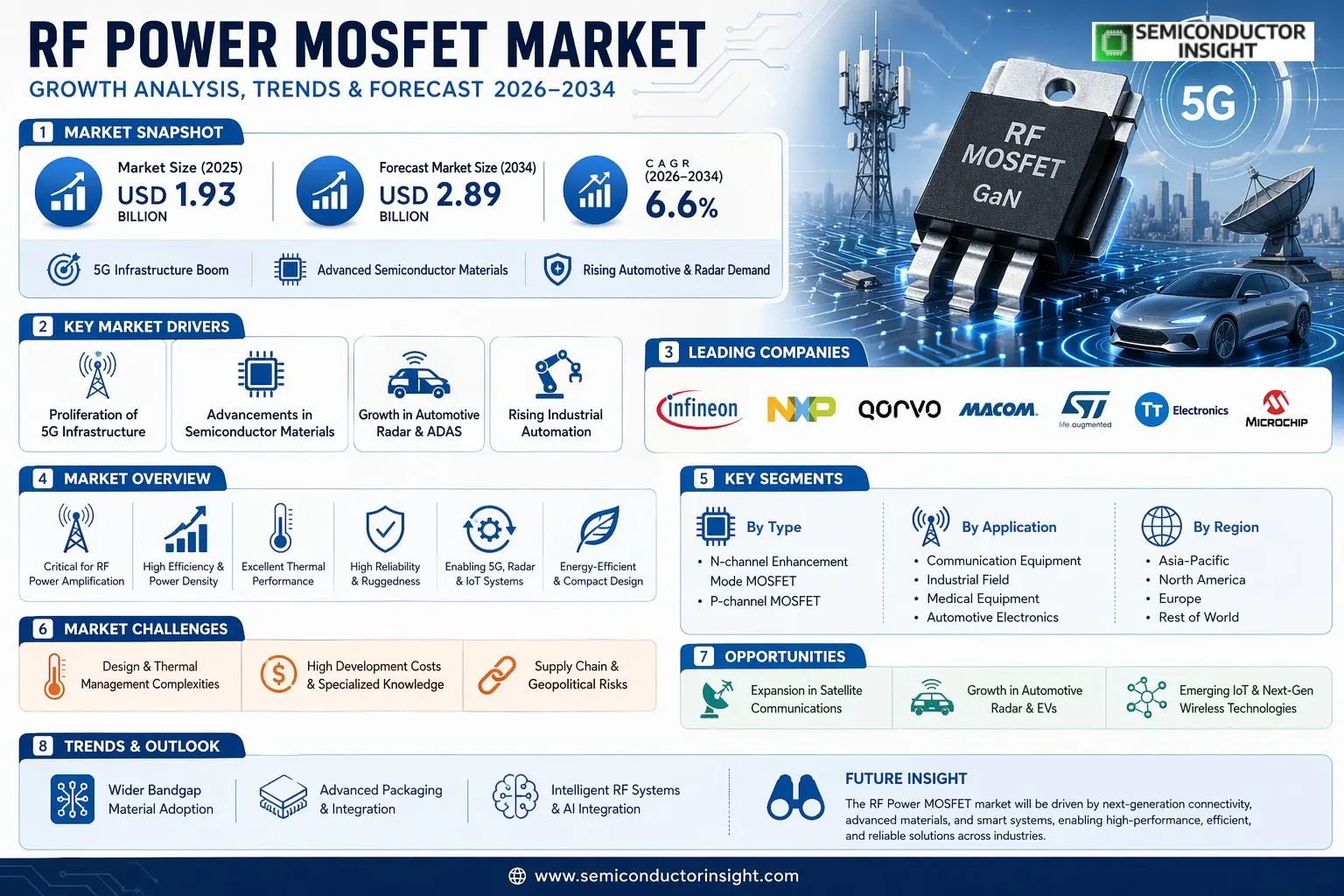
Global RF Power MOSFET market size was valued at USD 1.93 billion in 2025. The market is projected to grow from USD 2.06 billion in 2026 to USD 2.89 billion by 2034, exhibiting a CAGR of 6.6% during the forecast period.
RF Power MOSFETs are a specialized type of metal-oxide-semiconductor field-effect transistor engineered for high-frequency communication and radio frequency (RF) applications. These components are critical because they offer high operating frequency, superior power density, and excellent reliability, enabling efficient signal amplification and processing across numerous fields; they are indispensable high-power amplifier elements in modern communication systems like cellular base stations, radar, and broadcast transmitters.
The market is experiencing steady growth driven by several key factors, including Global rollout of 5G infrastructure, which demands higher frequency and power-efficient components, and the increasing adoption of advanced driver-assistance systems (ADAS) and vehicle connectivity in automotive electronics. Furthermore, ongoing advancements in semiconductor materials, such as silicon LDMOS and gallium nitride (GaN), are enhancing device performance and creating new opportunities. Initiatives by leading players also fuel innovation; for instance, companies like Infineon Technologies, NXP Semiconductors, and Qorvo continuously develop new product families to address evolving needs in aerospace, defense, and industrial applications.
MARKET DRIVERS
Proliferation of 5G Network Infrastructure
Global rollout of 5G technology is a paramount driver for RF Power MOSFET Market. These transistors are fundamental in 5G base stations, particularly for power amplifiers in the radio frequency front-end, due to their ability to handle high frequency and power levels efficiently. The transition to higher frequency bands, including millimeter-wave (mmWave), necessitates sophisticated RF Power MOSFET solutions that deliver greater linearity and power added efficiency (PAE) to maintain signal integrity and network performance. This sustained infrastructure investment is a core growth pillar for the market.
Advancements in Semiconductor Materials and Fabrication
Continuous innovation in wide-bandgap semiconductors, specifically Gallium Nitride (GaN) and Silicon Carbide (SiC), is revolutionizing RF Power MOSFET Market. GaN-on-SiC RF Power MOSFETs, in particular, offer superior attributes such as higher power density, better thermal conductivity, and higher breakdown voltage compared to traditional silicon-based LDMOS. This enables the design of smaller, more efficient, and more powerful RF amplifiers for defense radar, satellite communication, and commercial wireless systems.
➤ A typical LDMOS device may offer power densities around 1 W/mm, whereas modern GaN-based RF Power MOSFETs can achieve over 5 W/mm, drastically reducing the footprint and cooling requirements of power amplifier modules.
Complementing material advances, improved fabrication techniques and packaging technologies are enhancing device reliability and thermal management, further driving adoption in high-performance applications that demand ruggedness and longevity.
MARKET CHALLENGES
Design and Thermal Management Complexities
Designing circuits with advanced RF Power MOSFETs presents significant engineering challenges. Achieving optimal performance at high frequencies requires meticulous impedance matching, careful layout to minimize parasitic effects, and sophisticated modeling. Furthermore, the high power densities of modern devices generate substantial heat, mandating complex and often costly thermal management solutions, such as advanced heat sinks or active cooling, to ensure device reliability and prevent performance degradation over time.
Other Challenges
High Development Costs and Specialized Knowledge
The R&D costs associated with developing next-generation RF Power MOSFETs, especially on GaN and SiC platforms, are substantial. Furthermore, the design-in process requires highly specialized RF engineering expertise which can be scarce, potentially slowing down the pace of adoption and innovation for some manufacturers.
Supply Chain and Geopolitical Factors
RF Power MOSFET Market is sensitive to disruptions in the supply of critical raw materials, such as gallium and silicon carbide substrates, and advanced fabrication equipment. Trade restrictions and geopolitical tensions can introduce volatility and uncertainty for manufacturers, potentially constraining production capacity and leading to longer lead times for key components.
MARKET RESTRAINTS
High Cost of Advanced Wide-Bandgap Devices
The superior performance of GaN and SiC RF Power MOSFETs comes with a significantly higher cost compared to established silicon LDMOS technology. This cost premium includes expensive substrate materials, complex manufacturing processes, and specialized packaging. For cost-sensitive commercial applications, such as consumer electronics or certain wireless infrastructure segments, this can act as a major barrier to entry and slow the transition away from mature, lower-cost silicon-based solutions in the broader RF Power MOSFET Market.
Maturation of Key End-Markets and Economic Volatility
Certain traditional end-markets for RF Power MOSFETs, such as parts of the broadcast transmission sector, are experiencing slower growth or replacement cycles, limiting demand. Furthermore, capital expenditure cycles in telecommunications and industrial sectors are susceptible to broader macroeconomic volatility. Economic downturns or reduced investment in infrastructure projects can delay procurement decisions, directly impacting the market’s short-term revenue streams and growth projections for RF Power MOSFET suppliers.
MARKET OPPORTUNITIES
Expansion into Satellite and Aerospace Communications
The burgeoning market for low-earth orbit (LEO) satellite constellations for broadband internet presents a major growth opportunity for RF Power MOSFET Market. These satellite systems require thousands of power-efficient, high-frequency, and reliable transceivers, where advanced GaN RF Power MOSFETs are ideal. Similarly, modern military and aerospace platforms demand RF power solutions with superior performance in harsh environments, creating a stable, high-value segment for specialized device manufacturers.
Growth of Automotive Radar and Vehicle Electrification
The rapid advancement of autonomous driving and advanced driver-assistance systems (ADAS) is fueling demand for high-performance automotive radar. RF Power MOSFETs are critical components in these radar systems, operating at 77/79 GHz frequencies. The evolution towards electric vehicles (EVs) also creates demand for RF devices in various applications, including wireless charging and vehicle-to-everything (V2X) communication systems, representing a significant future avenue for market expansion beyond traditional sectors.
Emerging Wireless Connectivity Standards and IoT
Beyond 5G, the development of subsequent wireless standards and the exponential growth of the Internet of Things (IoT) will drive new requirements for RF power amplification. Next-generation Wi-Fi standards, private 5G networks for industrial IoT, and massive machine-type communications will demand a diverse range of RF Power MOSFET solutions optimized for different power levels, frequencies, and form factors, fostering innovation and niche market development for semiconductor companies.
RF Power MOSFET Market Trends
Expansion into High-Bandwidth Communication Systems
A primary trend is the integration of RF Power MOSFETs into next-generation communication equipment, including 5G and upcoming 6G infrastructure. The demand for higher data rates and network capacity drives continuous innovation in transistor design to achieve greater power density and efficiency at millimeter-wave frequencies. This critical component is essential for the power amplifier stages in base stations and small cells, where performance directly impacts network coverage and quality. Manufacturers are focusing on advanced semiconductor materials and packaging technologies to minimize signal loss and thermal resistance, enabling the compact, high-power modules required for dense urban deployments.
Other Trends
Material and Fabrication Advancements
Research into Silicon Carbide (SiC) and Gallium Nitride (GaN) technologies is influencing the broader RF Power MOSFET landscape. While silicon-based MOSFETs remain dominant for many applications, these wide-bandgap semiconductors offer superior properties for high-frequency, high-power operation. This competitive pressure is accelerating material science improvements in traditional silicon MOSFETs, particularly in enhancing electron mobility and breakdown voltage. The trend is leading to a more segmented market where device selection is increasingly application-specific, balancing performance requirements against cost considerations.
Vertical Integration and Strategic Partnerships
The competitive landscape is characterized by vertical integration strategies among leading manufacturers. Companies are consolidating expertise from design through packaging to offer complete RF power solutions, which improves performance reliability and supply chain control. Concurrently, strategic partnerships between RF Power MOSFET specialists and major telecom system integrators are becoming more common to co-develop application-specific products. This collaborative trend ensures that component evolution is tightly aligned with end-system requirements in key sectors such as automotive radar, industrial heating, and medical imaging equipment, fostering more stable, long-term growth pathways for the market.
COMPETITIVE LANDSCAPE
Key Industry Players
An Oligopolistic Market with Niche Specialization
Global RF Power MOSFET market is characterized by a consolidated structure dominated by a handful of established semiconductor giants. Infineon Technologies and NXP Semiconductors consistently rank among Global top players, leveraging their extensive portfolios, significant R&D investments, and strong supply chains to serve the broad communication equipment and automotive electronics segments. These market leaders benefit from economies of scale and deep customer relationships, which presents a high barrier to entry for new players. The competitive dynamic is significantly influenced by technological advancements aimed at achieving higher power density, improved efficiency, and broader frequency range to meet the demands of 5G, automotive radar, and industrial applications.
Beyond the leading multinational corporations, several specialized and niche players hold substantial positions. Companies like Qorvo, MACOM, and TT Electronics focus intensely on high-performance RF solutions for defense, aerospace, and critical communication infrastructure, areas where performance specifications often outweigh cost considerations. Similarly, players such as STMicroelectronics, Mitsubishi Electric, and Microchip Technology have carved out strong positions by integrating RF power MOSFETs into broader system-level solutions for industrial and automotive markets. This landscape results in a market where global scale and broad application support coexist with focused expertise in high-frequency, high-reliability niches.
List of Key RF Power MOSFET Companies Profiled
- Infineon Technologies
- NXP Semiconductors
- Qorvo, Inc.
- MACOM Technology Solutions
- STMicroelectronics
- TT Electronics
- Microchip Technology
- Mitsubishi Electric Corporation
- Nexperia
- onsemi
- Renesas Electronics Corporation
- Ericsson
- RFMW Ltd.
- Polyfet RF Devices
Segment Analysis:
| Segment Category | Sub-Segments | Key Insights |
| By Type |
|
N-channel Enhancement Mode MOSFET represents the dominant product segment due to its superior electrical characteristics for high-frequency amplification. This technology offers significantly higher electron mobility compared to its P-channel counterpart, which translates to faster switching speeds and better efficiency in RF power circuits. Its architecture is particularly advantageous for designing compact and high-power-density amplifiers required in modern communication systems. Furthermore, widespread manufacturing expertise and established design libraries for N-channel devices across leading semiconductor foundries solidify its market leadership and ease of integration for OEMs. |
| By Application |
|
Communication Equipment constitutes the primary application segment, serving as the backbone for the proliferation of wireless technologies. The relentless global rollout and upgrading of 5G infrastructure, along with sustained demand for 4G LTE networks, creates massive demand for high-performance RF power amplification in base stations and small cells. Additionally, the expansion of satellite communication systems and the Internet of Things (IoT) ecosystem further entrenches this segment’s dominance, as these technologies require reliable and efficient RF power components to ensure signal integrity and network coverage. |
| By End User |
|
Telecommunication Service Providers are the leading end-user segment, driving innovation and volume procurement. Their capital expenditure on next-generation network hardware is a primary market driver, compelling semiconductor suppliers to develop components that meet stringent requirements for power efficiency, linearity, and thermal management. The competitive landscape among these providers to offer superior network speed and coverage leads to continuous technology refresh cycles, creating a sustained and high-value demand pipeline for advanced RF Power MOSFETs from key manufacturers in the supply chain. |
| By Material Technology |
|
Silicon-based LDMOS technology currently holds a leading position, valued for its cost-effectiveness and proven reliability in high-volume applications, especially in sub-4 GHz frequency ranges common in cellular infrastructure. However, this segment is characterized by intense material competition, with GaN-based devices emerging as a formidable challenger for higher frequency and efficiency-critical applications. The market is thus transitioning, with silicon LDMOS maintaining its stronghold in legacy and cost-sensitive deployments while newer materials gain traction in cutting-edge systems demanding the ultimate in power density and bandwidth. |
| By Power Level |
|
High Power RF Power MOSFETs are the leading segment, directly fueled by the needs of macro and massive MIMO base stations for cellular networks. These applications require components capable of delivering substantial output power with high linearity to minimize signal distortion across wide bandwidths. The design and manufacturing complexity for high-power devices creates significant barriers to entry, consolidating the market among established players with deep expertise in thermal management and packaging. This segment’s growth is intrinsically linked to the densification of wireless networks and the expansion of coverage into new geographical areas. |
Regional Analysis: RF Power MOSFET Market
Asia-Pacific
Asia-Pacific’s unparalleled strength in semiconductor manufacturing is the bedrock of its leadership. Foundries and IDMs across the region drive advanced node development and specialized wafer production for RF Power devices, providing cost and scalability benefits that underpin the entire global market.
Aggressive national 5G rollout strategies, particularly in China, South Korea, and Japan, represent a primary demand driver. This deployment requires massive quantities of RF Power MOSFETs optimized for various frequency bands, positioning the region at the forefront of this critical application segment.
As the world’s factory for smartphones, tablets, and networking equipment, the region’s electronics OEMs generate sustained, high-volume demand. Their pursuit of improved power efficiency and compact designs in devices continues to push innovation in device integration withRF Power MOSFET Market.
Government-led policies and substantial private investments in new fab capacity and R&D for compound semiconductors (like GaN-on-Si) are accelerating. These initiatives aim to secure technological sovereignty and cater to the future needs of both communications and automotive radar sectors.
North America
North America remains a vital center for high-end innovation and design in Global RF Power MOSFET Market. The region’s influence stems from the concentration of leading fabless semiconductor companies, advanced R&D laboratories, and defense contractors pushing the boundaries of RF technology. Demand is heavily driven by next-generation telecommunications infrastructure, with major operators investing in extending 5G coverage and capacity, particularly in the mmWave spectrum requiring sophisticated RF Power components. Furthermore, substantial defense and aerospace spending, especially in the United States, supports the development and procurement of specialized RF Power MOSFETs for radar, electronic warfare, and secure communication systems, emphasizing performance and reliability over cost.
Europe
The European market is characterized by a strong emphasis on research, quality, and specialized industrial applications withRF Power MOSFET Market. Leading automotive manufacturers and tier-one suppliers in Germany, France, and Italy drive significant demand for components used in advanced automotive radar and in-vehicle communication systems, aligning with strict safety and emission standards. The region also hosts key telecommunications infrastructure firms involved in 5G deployment, though at a pace often tempered by regulatory landscapes. Collaborative R&D projects, often backed by EU funding, focus on next-generation materials and energy-efficient RF designs, solidifying Europe’s role in pioneering high-performance, niche applications rather than competing solely on high-volume consumer production.
South America
South America’s RF Power MOSFET Market is developing, currently driven by gradual infrastructure modernization efforts and a growing consumer base for telecommunications services. The primary demand originates from the expansion and upgrading of 4G LTE networks as a foundational step towards future 5G services, creating a steady market for medium-power RF components. Brazil and Mexico are focal points due to their relatively larger industrial bases and urban populations. While local semiconductor manufacturing is limited, the region represents an important import and consumption market. Growth is linked to telecom carrier investments and the increasing penetration of smartphones and digital services across its major economies.
Middle East & Africa
This region exhibits a bifurcated dynamic within Global RF Power MOSFET Market. Wealthy Gulf Cooperation Council (GCC) nations are engaged in ambitious digital transformation and smart city projects, investing in advanced telecommunications infrastructure, including early 5G deployments, which directly require modern RF Power solutions. In contrast, broader African markets are primarily focused on expanding basic connectivity and essential network coverage, driving demand for cost-effective RF components that support robust and reliable communication in diverse terrains. The region’s growth potential is significant but varies widely, tied to national economic development plans and investments in both modern telecom networks and related industrial applications like oil & gas infrastructure monitoring.
Report Scope
This market research report provides a comprehensive analysis of the RF Power MOSFET Market , covering the forecast period 2026–2034. It offers detailed insights into market dynamics, technological advancements, competitive landscape, and key trends shaping the industry.
Key focus areas of the report include:
- Market Overview: The report begins with an overview outlining its current market scenario, key growth indicators, and industry transformation drivers. It discusses macroeconomic factors, demand–supply balance, regulatory landscape, and the strategic role of semiconductors in powering advancements across industries such as automotive, telecommunications, consumer electronics, and industrial automation.
- Market Size & Forecast: Historical data and future projections for revenue, unit shipments, and market value across major regions and segments.
- Segmentation Analysis: Detailed breakdown by product type, technology, application, and end-user industry to identify high-growth segments and investment opportunities.
- Regional Insights: Insights into market performance across North America, Europe, Asia-Pacific, Latin America, and the Middle East & Africa, including country-level analysis where relevant.
- Competitive Landscape: Profiles of leading market participants, including their product offerings, R&D focus, manufacturing capacity, pricing strategies, and recent developments such as mergers, acquisitions, and partnerships.
- Technology Trends & Innovation: Assessment of emerging technologies, integration of AI/IoT, semiconductor design trends, fabrication techniques, and evolving industry standards.
- Market Drivers & Restraints: Evaluation of factors driving market growth along with challenges, supply chain constraints, regulatory issues, and market-entry barriers.
- Stakeholder Insights: Insights for component suppliers, OEMs, system integrators, investors, and policymakers regarding the evolving ecosystem and strategic opportunities.
Primary and secondary research methods are employed, including interviews with industry experts, data from verified sources, and real-time market intelligence to ensure the accuracy and reliability of the insights presented.
FREQUENTLY ASKED QUESTIONS:
What is the current market size of RF Power MOSFET Market?
-> Global RF Power MOSFET market was valued at USD 1933 million in 2025 and is projected to reach USD 2893 million by 2034, growing at a CAGR of 6.6% during the forecast period.
Which key companies operate RF Power MOSFET Market?
-> Key players include Infineon Technologies, NXP Semiconductors, Qorvo, MACOM, STMicroelectronics, TT Electronics, Microchip Technology, Ericsson, MITSUBISHI ELECTRIC, and Nexperia, among others.
What are the key applications of RF Power MOSFET?
-> RF Power MOSFETs are widely used in Communication Equipment, Industrial Field, Medical Equipment, and Automotive Electronics.
What are the key market segments by type?
-> The market is segmented by type, primarily into N-channel Enhancement Mode MOSFET and P-channel MOSFET.
Which regions are covered in the market analysis?
-> The report provides analysis for North America, Europe, Asia, South America, and the Middle East & Africa, including key country-level insights.

Get Sample Report PDF for Exclusive Insights
Report Sample Includes
- Table of Contents
- List of Tables & Figures
- Charts, Research Methodology, and more...
 Download Sample Report PDF