RF Dielectric Filter Market Insights
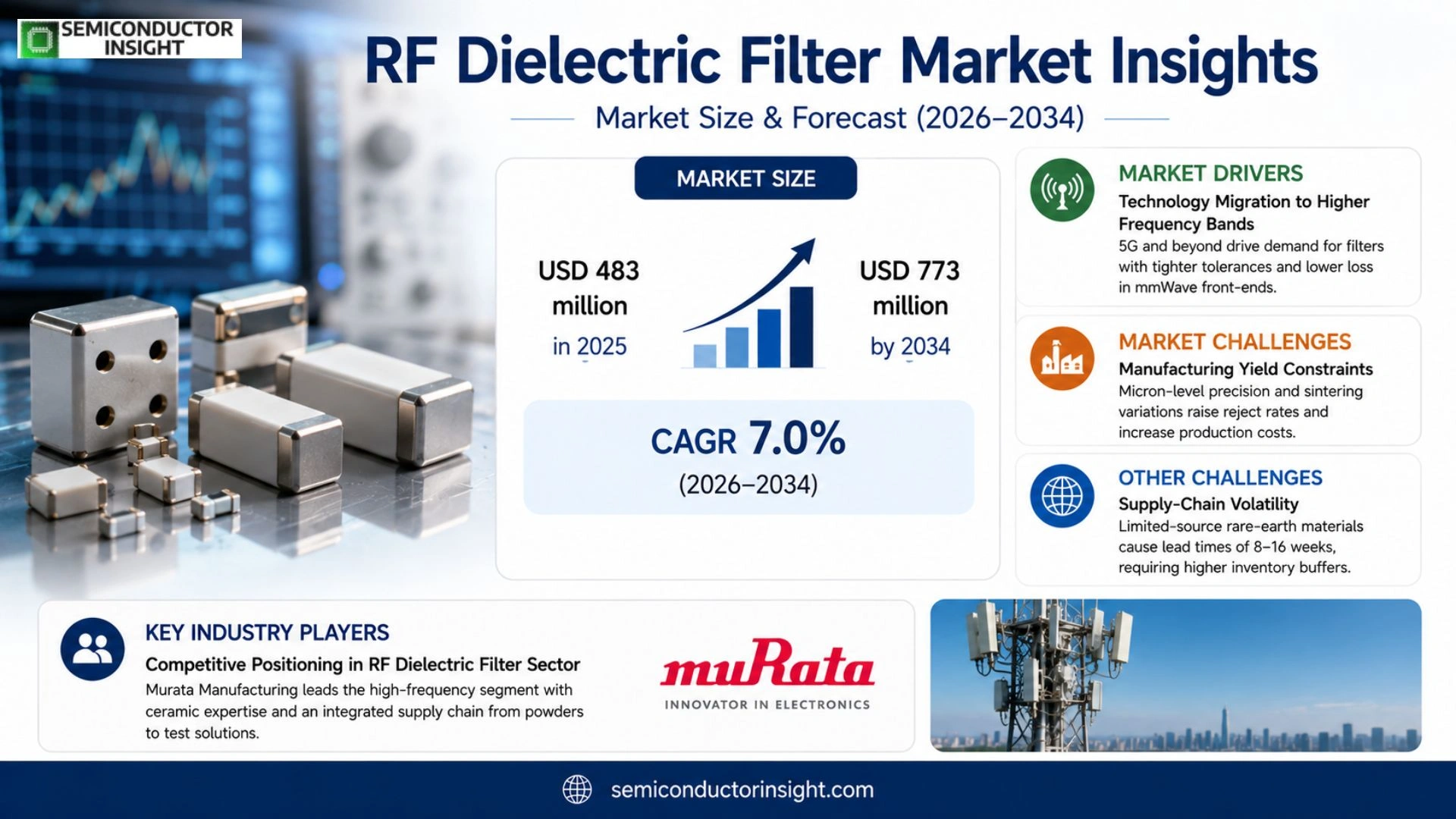
RF Dielectric Filter market was valued at USD 483 million in 2025 and grew to USD 773 million by 2034, reflecting a compound annual growth rate of 7.0% over the forecast horizon.
Radio‑frequency (RF) dielectric filters are passive components that exploit the resonance of high‑dielectric‑constant ceramic materials to achieve precise frequency selection. By suppressing spurious signals while preserving desired bands, these filters deliver small form‑factor, high‑Q performance and excellent thermal stability, making them indispensable in modern communication equipment such as base‑station modules, antennas and satellite transceivers.
The expansion of 5G roll‑outs and the surge in private‑network deployments across industrial, energy and transportation sectors have heightened demand for highly selective, stable filters. Manufacturers are pushing product evolution toward higher Q values, lower insertion loss and more compact architectures through advances in ceramic formulations and resonator design. Leading suppliers,including Murata, Caiqin Technology and Ube Electronics,are broadening portfolios with high‑power variants tailored for base‑station applications while exploring niche markets in emergency communications and aerospace.
MARKET DRIVERS
Technology Migration to Higher Frequency Bands
RF Dielectric Filter Market is being reshaped as cellular operators migrate to 5G and beyond, where higher frequencies demand filters with tighter tolerances and lower loss. Manufacturers that invest in ceramic and low‑loss dielectric materials gain a competitive edge because their products can meet the stringent insertion‑loss specifications of millimeter‑wave front‑ends.
Growth of Connected‑Device Ecosystem
IoT deployments, autonomous‑vehicle radar, and satellite‑based broadband are expanding the volume of RF paths that require compact, high‑Q filters. In 2023, worldwide shipments of dielectric filters surpassed 1.2 million units, reflecting the pressure on designers to replace legacy lumped‑element solutions with space‑efficient dielectric modules.
➤ “Designers prioritize dielectric filters that combine low profile with high selectivity, making them indispensable in densely packed RF boards.”
Regulatory environments that mandate tighter out‑of‑band emission limits also push OEMs toward filters capable of delivering steep roll‑off characteristics without sacrificing power handling. Companies that align their product roadmaps with these emission standards are positioning themselves for sustained uptake across multiple verticals.
MARKET CHALLENGES
Manufacturing Yield Constraints
Dielectric filter fabrication relies on precise material sintering and micron‑level dimensional control. Small deviations can drive up reject rates, inflating unit costs and limiting price‑sensitive applications such as low‑end consumer wearables.
Other Challenges
Supply‑Chain Volatility
The rare‑earth compounds used in certain high‑Q dielectrics are sourced from a limited number of geographic regions. Recent geopolitical tensions have introduced lead times that fluctuate between 8 and 16 weeks, compelling manufacturers to hold larger safety stocks or seek alternative chemistries.
MARKET RESTRAINTS
Cost Competitiveness Against Alternative Technologies
While dielectric filters excel in size and performance, their per‑unit cost still trails that of conventional SAW or bulk‑acoustic‑wave filters in mass‑produced handset segments. Budget‑conscious OEMs often default to the cheaper alternatives when system‑level performance margins allow.
Moreover, the adoption curve of new dielectric materials is slowed by the need for extensive reliability testing under extreme temperature and humidity cycles. Without clear evidence of long‑term durability, specifiers may hesitate to replace legacy parts.
MARKET OPPORTUNITIES
Emergence of Integrated RF Front‑Ends
System‑in‑package (SiP) architectures increasingly embed dielectric filters directly onto RF substrates, eliminating interconnect losses. This integration trend opens a niche for filter vendors that can co‑design with semiconductor foundries, delivering tailor‑made components that align with the SiP footprint.
The rise of private‑label satellite constellations, which operate in Ka‑band and higher, also creates a demand for filters that maintain high Q under intense radiation exposure. Early entrants that qualify their dielectric compounds for space‑grade reliability can capture a lucrative segment that commands premium pricing.
Finally, advances in additive‑manufacturing of ceramic materials promise to reduce tooling costs and enable rapid prototyping of custom filter geometries. Companies that master these 3‑D printing techniques will be able to respond to niche customer requests faster than traditional batch‑process suppliers.
RF Dielectric Filter Market Trends
5G Rollout Fuels Demand for High‑Q Dielectric Filters
The worldwide deployment of 5G infrastructure has pushed network operators to replace legacy front‑end components with devices that can handle tighter channel spacing and higher power density. RF dielectric filters, prized for their compact form factor and high quality factor, meet these requirements while keeping bill of materials modest. As base‑station sites proliferate in urban and industrial zones, manufacturers are scaling production to meet an estimated 91 million units shipped annually, a level that strains existing capacity of about 95 million units. The resulting margin pressure is tempered by a steady 25 % profitability envelope, reflecting the balance between price pressure at $5.8 per unit and the premium placed on filter stability in dense RF environments. This dynamic encourages suppliers to tighten tolerances and invest in precision machining, thereby reinforcing RF Dielectric Filter Market’s shift toward volume‑focused, performance‑oriented offerings.
Other Trends
Material Innovation and Miniaturization
Recent advances in ceramic chemistry have yielded dielectric compositions that combine a high dielectric constant with lower loss tangent, enabling resonators that are both smaller and more efficient. Suppliers are experimenting with mixed‑oxide powders and novel sintering cycles to push Q values upward while shrinking the resonant cavity. The engineering payoff is a filter that can be integrated directly onto RF modules, reducing board space and simplifying thermal management. For OEMs, this translates into lighter, more power‑efficient equipment,an appealing proposition for portable communication gear and edge‑computing nodes where space is at a premium.
Application Diversification Beyond Base Stations
While cellular base stations remain the dominant downstream buyer, RF Dielectric Filter Market is seeing meaningful traction in satellite communications, emergency response networks, and select defense platforms. These segments demand filters that tolerate high power bursts and maintain low insertion loss over extended temperature ranges. The push to embed dielectric filters in satellite payloads stems from the need to suppress spurious emissions without adding excessive weight. Similarly, emergency communication kits benefit from the filters’ robustness, ensuring reliable link integrity during crisis scenarios. This broadened application base mitigates reliance on a single ecosystem and creates new revenue streams for manufacturers willing to certify their products for aerospace and security standards.
COMPETITIVE LANDSCAPE
Key Industry Players
Competitive Positioning in RF Dielectric Filter Sector
Murata Manufacturing dominates the high‑frequency segment, leveraging its extensive ceramic‑substrate expertise and a vertically integrated supply chain that spans dielectric powders to final test equipment. The company’s ability to combine high‑Q resonators with compact form factors has secured long‑term contracts with major base‑station vendors, translating into a sizeable share of the $5.8‑average‑price market. Murata’s scale also cushions profit margins, allowing reinvestment in material science improvements that keep its product line ahead of the performance curve.
Beyond the leader, a constellation of specialized firms fuels diversification. Caiqin Technology and Ube Electronics focus on low‑loss ceramic formulations for medium‑power modules, while DSBJ and Partron cater to niche satellite‑communication applications where radiation tolerance is paramount. Emerging private‑network builders increasingly turn to Tongyu Communication and GOVA TECHNOLOGY for tailored filter kits that balance insertion loss with power handling. Taoglas and FINGU have built a reputation for rapid‑prototype services, attracting start‑ups seeking custom resonant structures. Smaller innovators such as TATFOOK, GLEAD, and MCV Technologies round out the ecosystem, each offering differentiated electrode‑material packages or precision‑machining capabilities that address specific customer pain points.
List of Key RF Dielectric Filter Companies Profiled
- Murata Manufacturing
- Caiqin Technology
- Ube Electronics
- DSBJ
- Partron
- Tongyu Communication
- GOVA TECHNOLOGY
- Taoglas
- FINGU
- TATFOOK
- GLEAD
- MCV Technologies
Segment Analysis:
| Segment Category | Sub-Segments | Key Insights |
| By Type |
|
Base Station Filters dominate the market because they are critical for the high‑performance demands of 5G and private network deployments. Their compact size, high Q factor and thermal stability make them indispensable in dense base‑station architectures.
|
| By Application |
|
Satellite Communications are emerging as a high‑growth niche, driven by the need for resilient connectivity in remote and aerospace environments. Dielectric filters provide the stability and low loss required for high‑power, space‑qualified transceivers.
|
| By End User |
|
Telecom Operators drive the core demand for RF dielectric filters, seeking reliability and performance across macro‑cell and small‑cell deployments. Their procurement strategies reflect long‑term network evolution plans.
|
| By Power Rating |
|
High Power filters are essential for base‑station amplifiers and satellite transceivers where thermal management and dielectric loss become critical concerns.
|
| By Dielectric Material |
|
Low Loss Ceramic is gaining prominence as manufacturers chase tighter insertion‑loss budgets and higher integration densities in modern RF front‑ends.
|
Regional Analysis: RF Dielectric Filter Market
North America
The United States has expanded its wafer‑fab capacity dedicated to dielectric substrates, allowing faster turn‑around for prototype runs. Canadian facilities focus on low‑volume, high‑mix production, catering to niche aerospace programmes that require bespoke filter geometries.
Harmonisation with FCC and ITU standards drives designers to adopt filters that meet stringent out‑of‑band emission limits, prompting vendors to certify products across multiple frequency bands in a single development cycle.
Telecommunications providers upgrading to millimetre‑wave backhaul are prioritising filters with ultra‑low dielectric loss, while the defense sector seeks radiation‑hard solutions for next‑generation radar platforms.
Recent semiconductor shortages have led firms to diversify raw‑material sources, establishing secondary contracts with Asian suppliers to safeguard continuity of high‑purity ceramic powders.
Europe
European manufacturers benefit from a tightly integrated standards framework that encourages early collaboration between filter makers and telecom equipment vendors. Nations such as Germany and France host research consortia that explore novel low‑temperature sintering techniques, aiming to reduce production costs while preserving high Q‑factor performance. The region’s strong emphasis on sustainability is prompting a shift toward recyclable substrate materials, which could reshape procurement criteria for operators seeking greener network upgrades. As 5G roll‑out matures, OEMs are increasingly looking for filters that can be slimmed without compromising thermal stability, a demand that European firms are well positioned to satisfy through precision engineering and small‑batch agility.
Asia‑Pacific
The Asia‑Pacific arena is characterised by rapid deployment of dense urban networks, driving a surge in demand for compact, high‑performance RF Dielectric Filters. Chinese and Korean players are investing heavily in automated deposition equipment, allowing them to scale volume while maintaining tight tolerance control. Moreover, the region’s burgeoning satellite constellations generate a parallel market for space‑qualified filters that can endure harsh thermal cycles. End‑user expectations for cost‑effective solutions are nudging manufacturers toward hybrid dielectric composites that balance performance with material expense, a trend likely to influence supplier negotiations across the supply chain.
South America
In South America, emerging mobile broadband initiatives are prompting telecom operators to upgrade legacy infrastructure with modern filtering solutions. While local production capacity remains modest, several firms are forming joint ventures with North American technology partners to acquire proprietary dielectric recipes. This collaboration model helps bridge the expertise gap and accelerates time‑to‑market for filters tailored to tropical climate conditions, where humidity‑induced dielectric variation is a critical design consideration.
Middle East & Africa
The Middle East & Africa region is witnessing incremental adoption of RF Dielectric Filters driven by defence modernization programs and expanding data‑center footprints. Sovereign wealth funds are allocating capital toward localised manufacturing initiatives, aiming to reduce reliance on imported components. Simultaneously, African telecom operators are beginning to tender for filters that support emerging 4G‑Advanced and early 5G services, creating a modest but growing niche for suppliers able to navigate complex import‑regulation environments.
Report Scope
This market research report provides a comprehensive analysis of the RF Dielectric Filter Market , covering the forecast period 2026–2034. It offers detailed insights into market dynamics, technological advancements, competitive landscape, and key trends shaping the industry.
Key focus areas of the report include:
- Market Overview: The report begins with an overview outlining its current market scenario, key growth indicators, and industry transformation drivers. It discusses macroeconomic factors, demand–supply balance, regulatory landscape, and the strategic role of semiconductors in powering advancements across industries such as automotive, telecommunications, consumer electronics, and industrial automation.
- Market Size & Forecast: Historical data and future projections for revenue, unit shipments, and market value across major regions and segments.
- Segmentation Analysis: Detailed breakdown by product type, technology, application, and end-user industry to identify high-growth segments and investment opportunities.
- Regional Insights: Insights into market performance across North America, Europe, Asia-Pacific, Latin America, and the Middle East & Africa, including country-level analysis where relevant.
- Competitive Landscape: Profiles of leading market participants, including their product offerings, R&D focus, manufacturing capacity, pricing strategies, and recent developments such as mergers, acquisitions, and partnerships.
- Technology Trends & Innovation: Assessment of emerging technologies, integration of AI/IoT, semiconductor design trends, fabrication techniques, and evolving industry standards.
- Market Drivers & Restraints: Evaluation of factors driving market growth along with challenges, supply chain constraints, regulatory issues, and market-entry barriers.
- Stakeholder Insights: Insights for component suppliers, OEMs, system integrators, investors, and policymakers regarding the evolving ecosystem and strategic opportunities.
Primary and secondary research methods are employed, including interviews with industry experts, data from verified sources, and real-time market intelligence to ensure the accuracy and reliability of the insights presented.
FREQUENTLY ASKED QUESTIONS:
What is the current market size of RF Dielectric Filter Market?
-> RF Dielectric Filter market grew to USD 773 million by 2034, reflecting a compound annual growth rate of 7.0% over the forecast horizon.
Which key companies operate in RF Dielectric Filter Market?
-> Key players include Murata, Caiqin Technology, Ube Electronics, DSBJ, Partron, Tongyu Communication, GOVA TECHNOLOGY, Taoglas, FINGU, TATFOOK, GLEAD, MCV Technologies.
What are the key growth drivers?
-> Key growth drivers include deployment of 5G networks, accelerated private‑network implementations in industrial, energy, and transportation sectors, and rising demand for high‑Q, low‑insertion‑loss RF dielectric filters.
Which region dominates the market?
-> No single region dominates; growth is globally distributed with significant contributions from Asia, Europe, and North America.
What are the emerging trends?
-> Emerging trends include optimisation for higher Q values, lower insertion loss, more compact structures, and expanding applications in satellite communications, emergency communications, and military specialised markets.
Get Sample Report PDF for Exclusive Insights
Report Sample Includes
- Table of Contents
- List of Tables & Figures
- Charts, Research Methodology, and more...