Pogo Pin Connectors Market Insights
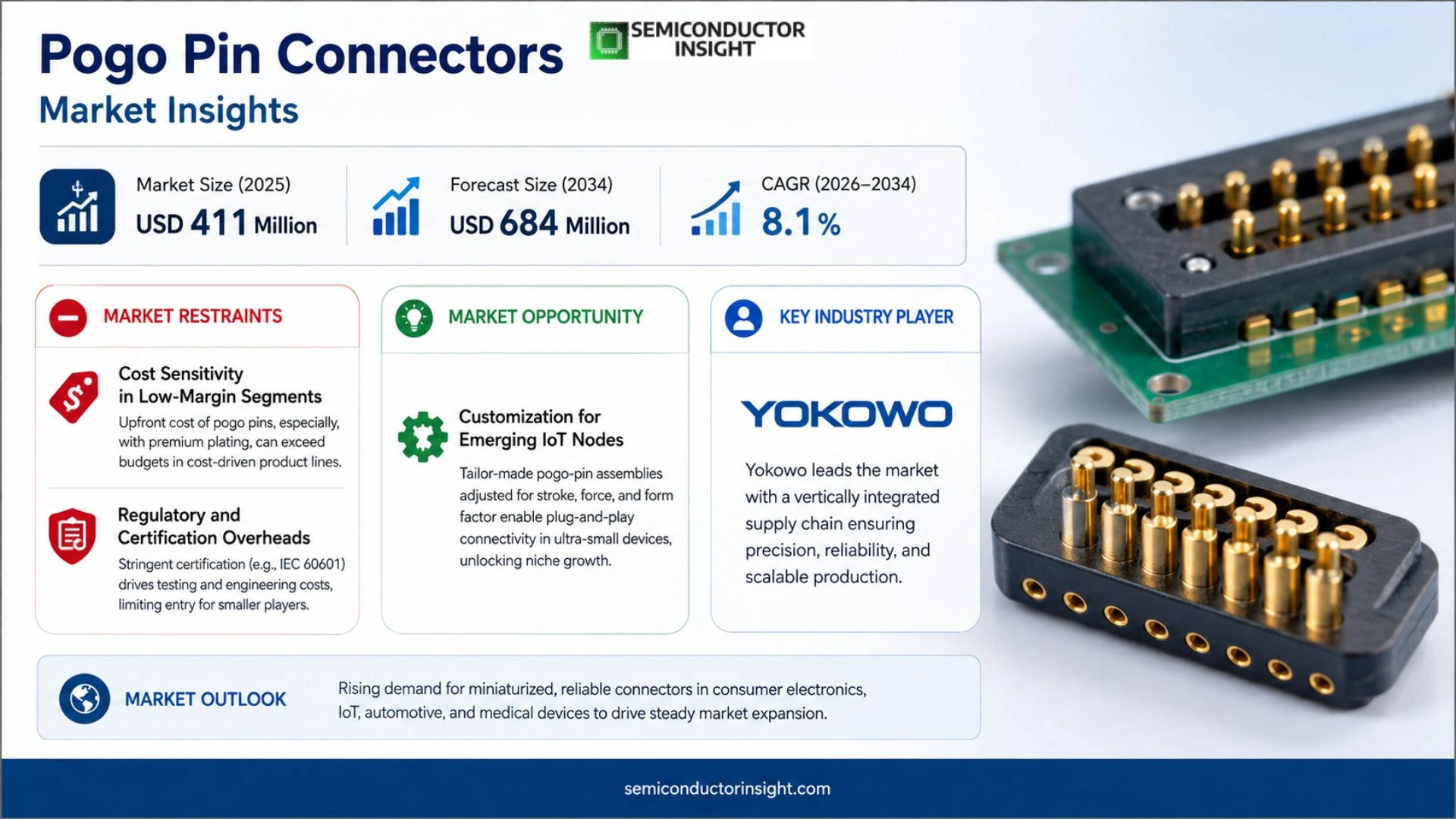
Pogo Pin Connectors market size was valued at USD 411 million in 2025 and is forecasted to reach USD 684 million by 2034, reflecting a CAGR of 8.1% over the period.
A Pogo Pin Connector is a high‑precision, spring‑based electronic connector comprising a plunger, a spring and a barrel that are joined by precision riveting; the internal spring force creates a stable electrical contact with a test point or mating component, making it common in smart wearables, telecommunications, automotive systems and medical devices for data transfer and charging.
Growth is fueled by the surge in ultra‑thin, lightweight consumer electronics that demand compact, waterproof interconnects, as well as rising requirements for high‑frequency probes in semiconductor testing and new‑energy vehicle radar systems; leading suppliers such as Yokowo, Mill‑Max and AVX are expanding their portfolios to address these applications.
MARKET DRIVERS
Increasing Adoption in Consumer Electronics
Pogo Pin Connectors Market is benefiting from a surge in compact device designs that demand reliable, high‑cycle mating interfaces. Manufacturers of smartphones, wearables, and portable medical devices are opting for spring‑loaded contacts because they enable thinner enclosures without sacrificing connection integrity. This shift reduces assembly steps and improves product durability, which directly translates into lower warranty costs for OEMs.
Growth of Automotive Connectivity
Vehicle electrification and the rollout of advanced driver‑assistance systems (ADAS) are compelling automotive suppliers to embed more electronic modules. Pogo pins provide the repeatable, low‑force engagement required for high‑frequency data exchange between sensors, control units, and infotainment modules. As electric‑vehicle production climbs, Pogo Pin Connectors Market experiences a measurable lift in demand for ruggedized solutions that can withstand vibration and temperature extremes.
➤ “Engineering teams cite spring‑loaded connectors as the decisive factor for meeting both size and reliability targets in next‑gen electronics.”
Beyond device‑level benefits, the broader supply chain is adapting to the pin’s modular nature, allowing faster time‑to‑market for iterative product versions. Companies that integrate pogo pins early in the design phase capture cost savings through reduced tooling changes and fewer field service incidents.
MARKET CHALLENGES
Material Compatibility Constraints
Although pogo pins excel in many applications, the selection of compatible plating materials remains a technical hurdle. Certain high‑frequency circuits require gold‑plated contacts to avoid corrosion, yet the cost premium can deter price‑sensitive manufacturers. When the material choice mismatches the operating environment, premature wear or signal loss may arise, forcing redesign cycles.
Other Challenges
Supply Chain Constraints
Global shortages of high‑purity copper and precision‑machined components have intermittently throttled production capacity. OEMs facing delayed deliveries often resort to alternative connector families, which undermines the momentum of Pogo Pin Connectors Market and introduces variability in product performance.
MARKET RESTRAINTS
Cost Sensitivity in Low‑Margin Segments
Segments such as entry‑level consumer gadgets operate on razor‑thin profit margins, making any incremental component cost a barrier to adoption. While pogo pins deliver long‑term reliability, their upfront price,especially for premium plating,can exceed the budget thresholds of cost‑driven product lines, prompting designers to select less expensive latch or soldered connections.
Regulatory and Certification Overheads
Electronic equipment destined for aerospace or medical markets must satisfy stringent certification regimes (e.g., IEC 60601 for medical devices). The validation process for spring‑loaded contacts adds engineering hours and testing expenses, which in turn restricts market entry for smaller players lacking extensive compliance resources.
MARKET OPPORTUNITIES
Customization for Emerging IoT Nodes
Internet‑of‑Things deployments are fragmenting into ultra‑small sensor nodes that require plug‑and‑play interfaces. Manufacturers that offer tailor‑made pogo‑pin assemblies,adjusted stroke length, contact force, and housing form,can capture niche contracts where off‑the‑shelf parts fail to meet dimensional tolerances. This bespoke approach promises incremental revenue streams without extensive capital outlays.
Integration with Advanced Manufacturing Techniques
Adopting additive manufacturing for pogo‑pin housings enables rapid prototyping and low‑volume production runs. Companies that align their design pipelines with 3‑D‑printed tooling stand to reduce lead times, thereby positioning themselves as preferred suppliers for fast‑track development programs in sectors such as robotics and wearable health monitors.
Pogo Pin Connectors Market Trends
Miniaturization and Waterproofing Demand in Wearables
The surge in ultra‑thin consumer devices has forced designers to prioritize connectors that occupy virtually no board real‑estate while still delivering reliable electrical paths. Spring‑loaded pins meet this requirement because their compact barrel and adjustable travel allow integration into the cramped chassis of true‑wireless earbuds, smart watches, and emerging AR/VR headsets. Moreover, the same mechanical structure can be sealed to IPX8 standards, a capability that traditional soldered contacts lack. This combination of size efficiency and water resistance has turned Pogo Pin Connectors Market into a strategic component for any product that markets itself on sleek form‑factors and ruggedness. Manufacturers that can guarantee low contact resistance under repeated compression cycles are seeing their tools specified as the default connectivity solution for the next generation of wearables.
Other Trends
Supply‑Chain Material Innovation
Upstream suppliers are shifting from conventional copper alloys toward beryllium copper and gold‑plated finishes to address two parallel pressures: higher electrical performance and stricter reliability specifications in automotive radar modules and semiconductor test rigs. The introduction of high‑performance insulating polymers has also reduced parasitic capacitance, enabling the pins to operate at frequencies required by modern radar and 5G subsystems. These material upgrades raise unit costs modestly but translate into gross margins that comfortably sit between 25 % and 40 %, reinforcing the attractiveness of investing in premium‑grade production lines within Pogo Pin Connectors Market.
High‑Frequency Hybrid Probes for 5G/6G Evolution
As mobile networks transition to millimeter‑wave bands, the need for connectors that can pass both DC power and RF signals without degrading signal integrity has become acute. Hybrid probes that embed a coaxial transmission line inside the pin’s barrel are emerging as the preferred architecture for 5G base‑station testing and early 6G prototypes. This trend not only opens a high‑margin niche for specialized manufacturers but also pushes downstream system designers to re‑evaluate board layouts, because a single hybrid pin can replace multiple discrete connectors. Companies that align their R&D pipelines with these RF‑compatible designs are positioning themselves to capture a sizable share of the incremental demand that the evolving communications ecosystem generates.
COMPETITIVE LANDSCAPE
Key Industry Players
Pogo Pin Connectors: Competitive Dynamics and Market Positioning
Yokowo dominates the upper tier of the global pogo‑pin market, leveraging a vertically integrated supply chain that spans raw‑material procurement, ultra‑precision machining, and automated riveting. Its extensive portfolio,covering surface‑mount, right‑angle, and high‑frequency hybrid probes,allows the company to serve both high‑volume consumer‑electronics OEMs and niche semiconductor‑testing firms. By investing in gold and palladium plating lines, Yokowo minimizes contact resistance, a decisive factor for next‑generation wearables and 5G/6G antenna modules. The firm’s pricing elasticity, anchored between USD 0.02 and USD 1.00 per pin, sustains a gross margin band of 25‑40 %, reinforcing its capacity to fund R&D aimed at sub‑micron travel‑distance designs. This combination of scale, material expertise, and profitability has forced smaller entrants to specialize rather than compete head‑to‑head, shaping a market where the top‑three players collectively capture roughly one‑third of total shipments.
Beyond the leaders, a cluster of highly specialized manufacturers occupies critical niches. Mill‑Max, for instance, concentrates on low‑inductance pins for aerospace testing, while Harwin excels in IPX8‑rated solutions for rugged medical devices. AVX and Qualmax focus on high‑current variants that address the power‑distribution demands of new‑energy vehicles. Companies such as FEINMETALL and C.C.P. Contact Probes provide bespoke spring‑coil geometries for semiconductor probe cards, and Shenzhen Top‑Link Technologies supplies cost‑effective units for mass‑market consumer gadgets. This fragmented segment thrives on agility: rapid design iterations, custom plating options, and localized support enable these firms to capture value in applications where performance nuances outweigh sheer volume.
List of Key Pogo Pin Connectors Companies Profiled
- Yokowo
- Mill-Max
- PRECI‑DIP
- Harwin
- AVX
- Qualmax
- Everett Charles Technologies
- Smiths Interconnect
- FEINMETALL
- C.C.P. Contact Probes
- Freewon
- Shenzhen Top‑Link Technologies
- CFE Corporation
- TE Connectivity
- Amphenol
Segment Analysis:
| Segment Category | Sub-Segments | Key Insights |
| By Type |
|
Surface Mount
Through‑Hole
|
| By Application |
|
Consumer Electronics
Semiconductor Testing
New Energy Vehicles
|
| By End User |
|
OEM Manufacturers
Electronic Design Houses
Test Equipment Providers
|
| By Material |
|
Gold‑Plated Brass
Beryllium Copper
|
| By Performance |
|
High‑Frequency Capability
IPX8 Waterproofing
|
Regional Analysis: Pogo Pin Connectors Market
North America
Silicon Valley and Austin host clusters where start‑ups experiment with ultra‑compact pogo assemblies, prompting larger OEMs to adopt modular designs that simplify integration across product families.
Near‑shore production in Mexico and Canada lowers lead times, allowing firms to respond swiftly to demand spikes while preserving the stringent quality standards expected by aerospace clients.
Growth in electric‑vehicle testing platforms and wearable health monitors expands the application base, compelling suppliers to offer a broader spectrum of pin counts and stroke lengths.
Stringent RoHS compliance and emerging safety certifications in the United States push manufacturers toward lead‑free alloys and enhanced traceability throughout the production flow.
Europe
European players leverage a well‑established standards framework that encourages interoperability among equipment across sectors such as rail transport and precision optics. The region’s emphasis on engineering excellence translates into a preference for high‑precision pogo pins with tight tolerance bands, supporting the rigorous testing regimes of automotive manufacturers seeking to meet EU emissions targets. Collaborative research programs funded by the European Union stimulate material innovations, notably nano‑coated contacts that promise longer service life under cyclic stress. Consequently, suppliers that can certify compliance with both IEC and ISO standards gain a competitive edge, especially in markets where cross‑border component sourcing remains prevalent.
Asia‑Pacific
The Asia‑Pacific landscape is defined by a rapid scaling of consumer electronics assembly lines, where cost efficiency and volume productivity dominate decision‑making. Manufacturers in China, South Korea, and Taiwan favor pogo pin solutions that balance performance with price, prompting a surge in standard‑grade offerings that still meet reliability benchmarks. Simultaneously, emerging smart‑home and IoT ecosystems in India and Southeast Asia create pockets of demand for compact, low‑profile connectors suitable for space‑constrained devices. The region’s flexible regulatory environment allows quicker adoption of novel alloy treatments, giving early adopters a foothold in fast‑moving market segments.
South America
In South America, the expansion of renewable‑energy projects and localized automotive assembly plants stimulates interest in robust testing fixtures equipped with durable pogo pins. Companies in Brazil and Mexico are increasingly integrating automated test equipment to reduce reliance on manual inspection, a shift that elevates the importance of connectors capable of withstanding high‑frequency actuation cycles. While price sensitivity remains high, purchasers are willing to invest in premium variants when they demonstrably reduce downtime and warranty claims, especially in equipment destined for harsh tropical environments.
Middle East & Africa
The Middle East & Africa region witnesses modest but steady adoption of pogo pin technology, chiefly driven by defense procurement and satellite communications initiatives. Nations such as the United Arab Emirates and Saudi Arabia prioritize high‑reliability connectors for aerospace and defense testing rigs, where failure is not an option. Meanwhile, burgeoning telecommunications infrastructure in Kenya and Nigeria creates niche opportunities for mid‑range connectors that support rapid deployment of base‑station equipment. Suppliers that can navigate local certification processes and provide on‑site technical support stand to capture market share in this diversified environment.
Report Scope
This market research report provides a comprehensive analysis of the Pogo Pin Connectors Market , covering the forecast period 2026–2034. It offers detailed insights into market dynamics, technological advancements, competitive landscape, and key trends shaping the industry.
Key focus areas of the report include:
- Market Overview: The report begins with an overview outlining its current market scenario, key growth indicators, and industry transformation drivers. It discusses macroeconomic factors, demand–supply balance, regulatory landscape, and the strategic role of semiconductors in powering advancements across industries such as automotive, telecommunications, consumer electronics, and industrial automation.
- Market Size & Forecast: Historical data and future projections for revenue, unit shipments, and market value across major regions and segments.
- Segmentation Analysis: Detailed breakdown by product type, technology, application, and end-user industry to identify high-growth segments and investment opportunities.
- Regional Insights: Insights into market performance across North America, Europe, Asia-Pacific, Latin America, and the Middle East & Africa, including country-level analysis where relevant.
- Competitive Landscape: Profiles of leading market participants, including their product offerings, R&D focus, manufacturing capacity, pricing strategies, and recent developments such as mergers, acquisitions, and partnerships.
- Technology Trends & Innovation: Assessment of emerging technologies, integration of AI/IoT, semiconductor design trends, fabrication techniques, and evolving industry standards.
- Market Drivers & Restraints: Evaluation of factors driving market growth along with challenges, supply chain constraints, regulatory issues, and market-entry barriers.
- Stakeholder Insights: Insights for component suppliers, OEMs, system integrators, investors, and policymakers regarding the evolving ecosystem and strategic opportunities.
Primary and secondary research methods are employed, including interviews with industry experts, data from verified sources, and real-time market intelligence to ensure the accuracy and reliability of the insights presented.
FREQUENTLY ASKED QUESTIONS:
What is the current market size of Pogo Pin Connectors Market?
-> Pogo Pin Connectors market is forecasted to reach USD 684 million by 2034, reflecting a CAGR of 8.1% over the period.
Which key companies operate in Pogo Pin Connectors Market?
-> Key players include Yokowo, Mill-Max, PRECI-DIP, Harwin, AVX, Qualmax, Everett Charles Technologies, Smiths Interconnect, FEINMETALL, C.C.P. Contact Probes, Freewon, Shenzhen Top-Link Technologies, CFE Coporation.
What are the key growth drivers?
-> Key growth drivers include ultra‑thin, lightweight and waterproof consumer electronics, high‑performance semiconductor testing probes, demand for vibration‑resistant high‑frequency probes in new‑energy vehicles, and the rollout of 5G/6G communication technologies.
Which region dominates the market?
-> Asia holds the largest market share, driven by strong demand in consumer electronics and automotive sectors, while Europe remains a significant market.
What are the emerging trends?
-> Emerging trends include high‑precision, high‑frequency hybrid probes, IPX8 waterproof designs, and integration of electrical and RF signals for 5G/6G applications.

Get Sample Report PDF for Exclusive Insights
Report Sample Includes
- Table of Contents
- List of Tables & Figures
- Charts, Research Methodology, and more...
 Download Sample Report PDF