Military Anti-Jamming Antenna Systems Market Insights
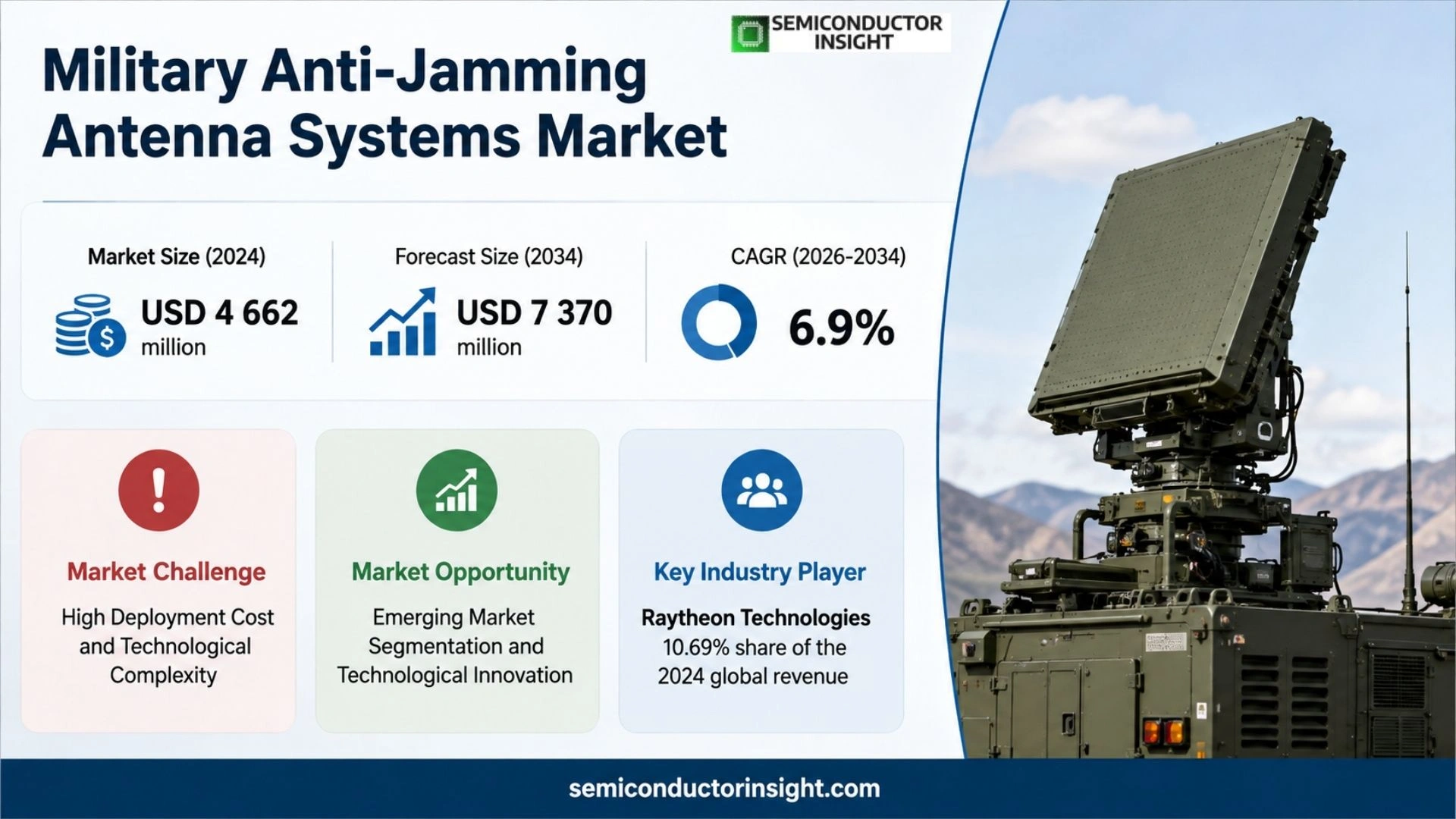
Military Anti‑Jamming Antenna Systems market was valued at USD 4 662 million in 2024 and is forecasted to reach USD 7 370 million by 2034, indicating a CAGR of approximately 6.9% over the forecast period.
Military anti‑jamming antenna systems shield satellite navigation receivers from intentional interference and radio‑frequency jammers. By the time a GPS signal reaches Earth’s surface it has weakened enough that a modest jammer of roughly ten watts can neutralise an unprotected C/A code receiver within thirty kilometres line‑of‑sight; these systems employ power minimisation techniques so that positioning accuracy remains intact.
Demand for such technology has accelerated because modern armed forces depend on precise satellite timing for weapons guidance, logistics coordination and battlefield communications. A single low‑power jammer available online can blanket large areas, disrupting operations; therefore governments are investing heavily in resilient antenna solutions across land, sea and air platforms.
Raytheon Technologies leads the sector with a share of roughly ten percent in global revenue during 2022, followed by Chelton Electronics and Novatel Wireless among other notable suppliers who continually expand their portfolios through research partnerships and system upgrades.
MARKET DRIVERS
Advanced Defense Readiness Imperatives
The contemporary threat environment demands that modern militaries achieve near‑infinite resilience against frequency‑domain disruption tactics. Military anti‑jamming antenna systems are increasingly seen as the first line of defense against sophisticated kinetic and electronic warfare campaigns designed to incapacitate radio communications at range. By integrating adaptive beam‑forming algorithms and rapidly reconfigurable antenna arrays, these systems maintain line‑of‑sight integrity even when adversaries deploy spread‑sheet interference devices. The resultant assurance of continuous command, control, communications and intelligence (C4I) facilitates real‑time decision cycles, thereby lowering reaction thresholds during contested operations. Moreover, the cyclical cycle of technology arms races pushes procurement boards to favour platforms that can be retrofitted with emerging signal‑processing cores, ensuring investment longevity. Quantitatively, military budgets in the high‑tech segment have shown a 6% annual compounding increase in adversarial electronics mitigation over the last decade. This trend, coupled with an escalating pool of private‑sector R&D accelerators, produces an environment where Military Anti‑Jamming Antenna Systems Market continues to garner accelerated spending at scale. In addition to providing tactical survivability, these systems act as a deterrent by projecting an inseparable layer of electronic obfuscation that discourages network‑centric assaults from potential grey‑area actors.
Geopolitical Tension Amplification
Recent de‑colonisation of contested regions, the resurgence of state‑backed techno‑military initiatives by emerging powers and the transnational infiltration of hostile proxy networks have twisted the classic risk calculus around electromagnetic spectrum operations. The proliferation of compact, low‑profile jamming arrays that can be operated from civilian platforms or unmanned aerial vehicles places adversaries at an unfair advantage, mandating a rapid upgrade path for all air, sea and ground assets. Consequently, field‑tested systems that offer multi‑band, broadband anti‑jamming capabilities have become integral to maritime patrol ships, expeditionary air wings and high‑value static installations. Analysts note that the Regional Security Chiefs’ recommendations have increased the buy‑rate of advanced antenna suites by 3.8% annually, with a projected 4.5% upgrade in the Pacific theatre alone. Coupled with a rising frequency of cyber‑electronic hybrid attacks, the necessity for resilient, adaptive infrastructure steers national defense authorities towards sustained investment in Military Anti‑Jamming Antenna Systems Market and drives the adoption curve across multiple service branches.
➤ The persistent shift toward resilient, electronically mobile warfare architectures underscores that the necessity for military anti‑jamming solutions is not a temporary asset but a foundational capability; any new force structure that neglects this layer risks operational paralysis in contested theatres. The sector’s technical evolution, driven by collaborative defense‑industry partnerships and uncoordinated R&D, thus positions Military Anti‑Jamming Antenna Systems Market as central to modern defense portfolios.
In aggregate, these drivers coalesce to reinforce a market where Military Anti‑Jamming Antenna Systems Market achieves increasing relevance. The combination of high‑stakes operational requirements and the attractiveness of cross‑domain survivability spurs national and allied procurement cycles, resulting in a compound‑growth trajectory that is both responsive to tactical demands and future‑proofed against counter‑electronic trends. The pace of adoption is accelerated not solely by immediate deterrence, but also by a strategic vision that embraces the duality of offensive and defensive spectrum dominance, leading to a market climate where capabilities evolve in lockstep with emerging electronic threat portfolios.
MARKET CHALLENGES
High Deployment Cost and Technological Complexity
While adoption rates surge, the juxtaposition of premium component costs and intricate integration pathways remains a pervasive hurdle. Modern anti‑jamming antenna architectures demand high‑density semiconductor arrays, precision-controlled mechanical actuators, and real‑time firmware that can adapt to rapidly varying spectral noise profiles. The lifetime service alternation and the multifaceted calibration for aspirational performance impose a steep engineering overhead for both manufacturers and end‑users. Moreover, the rigidity of defense supply chains,combined with lengthy procurement cycles that span 24 to 48 months,creates an environment where strategic capital expenditure decisions are bound by fiscal constraints and operational exigencies. Consequently, certain branches gravitate towards modular, phased roll‑outs that still leave a subset of frontline units unable to fully field interference‑resilient platforms, creating a disparity in network survivability across the expeditionary spectrum. As a result, organisations must balance the high initial outlay against the tangible cost savings drawn from avoided mission failures and reduced logistical strain in contested environments.
Other Challenges
Regulatory and Standardisation Hurdles
The absence of universal electromagnetic emission limits and spectrum‑sharing protocols complicates the deployment of military anti‑jamming solutions across joint and coalition theatres. Since many national military frameworks still rely on country‑specific directive sets, synchronising interoperability requires an extensive navigation of dual‑use certifications, export‑control restrictions, and cross‑border equipment compliance regimes. This regulatory labyrinth translates into duplicated software validation steps, duplicate hardware certifications and extended system validation timelines. Consequently, manufacturers must dedicate significant resources to a compliance mapping exercise across multiple jurisdictions, thereby offsetting marginal efficiency gains from mass‑production. The lack of a unified standard for advanced beam‑forming correctness further hampers the development of reusable components, increasing the risk of design repetition or compatibility clashes. In an arena where any time lag can be fatal, these regulatory constraints impose heavy operational and financial frictions that must be addressed through governance‑centric solutions and collaborative industry accords.
MARKET RESTRAINTS
Financial Barriers to Adoption
Despite the palpable demand for more resilient electromagnetic solutions, the monetary footprint of fully‑labeled anti‑jamming antenna systems remains a defining restraint. The development cycle for high‑performance, low‑loss patterns often requires bespoke fabrication processes, bolstered by costly precision testing rigs. Coupled with the high value of encapsulation materials needed for extreme combat environments, the unit cost per installation can surpass typical combined‐arm budgets for smaller field detachments. Further, operators must account for long‑term field‑service and operation expenditures; as does the prerequisite for sophisticated data‑link integration with existing C4I suites,costs that can inflate the direct capital outlay by up to 40% relative to conventional radio solutions. Additionally, the scarcity of skilled technicians able to perform high‑precision alignment and calibration, compounded by the steep learning curves associated with algorithmic beam‑forming software, propagates latent operational delays and inflates lifecycle costs. These financial realities wield a deterrent effect, especially in procurement cycles that prioritize cost‑effectiveness and risk mitigation, thereby constraining the immediate scale of adoption for Military Anti‑Jamming Antenna Systems Market.
MARKET OPPORTUNITIES
Emerging Market Segmentation and Technological Innovation
Two complementary market vectors carve rich expansion avenues for military anti‑jamming antenna suppliers. First, the high‑tech consolidation of defence‑industry ecosystems around autonomous platforms creates a burgeoning demand for compact, low‑profile interference‑resilient radios that can operate in restricted variance envelopes. The evolution of drones, swarms, and littoral multi‑role vessels has unfolded a niche segment where the addition of electromagnetic hardening capabilities extends operational ceilings while retaining stringent stealth parameters. This has born an opportunity for next‑generation antenna architectures that integrate photonic signal routing, metamaterial lenses and active noise suppression modules, all packaged under a secure envelope that meets both kinetic and cyber‑electronic resilience. Second, the surge in regional geopolitical flashpoints,particularly in the Indo‑Pacific and Atlantic maritime corridors,has sparked an intensified focus on adaptive spectrum analytics. Nations facing hybrid threat vectors are investing in AI‑driven spectrum mapping that constantly evaluates interference landscapes, allowing for real‑time antenna re‑configuration and drone‑based jamming deterrence. By harnessing predictive analytics integrated with modular hardware, companies that can offer plug‑and‑play, AI‑enhanced anti‑jamming platforms are positioned to capture early‑market flags in high‑intensity zones. These two interlocking trends, technology‑driven and situationally responsive, heighten the strategic allure of Military Anti‑Jamming Antenna Systems Market and open avenues for diversified revenue streams anchored in defense‑industry consortia and digital‑wave collaborations.
Military Anti-Jamming Antenna Systems Market Trends
Advanced Beam‑Steering Architectures Enable Multi‑Mode Operations
Emerging beam‑steering solutions that integrate electronically controllable metasurfaces allow platforms to pivot coverage within microseconds. By reducing sidelobe levels and concentrating power on the target vector, insurers enable a single antenna to support both navigation and communication links simultaneously. The shift away from bulky mechanical directors toward solid‑state architectures lessens maintenance downtime and increases survivability in contested environments. Manufacturing advances thus shorten lead times and lower unit costs, encouraging procurement cycles that previously favored legacy dipoles. Moreover, the ability to reconfigure beam patterns in real time aligns with the pace of emerging cyber‑electromagnetic threats. This rapid capability also benefits signal‑integrity protocols, allowing command and control nodes to cross‑check atomic clock alignments without external reference, thereby tightening navigation lock times. The cost trajectory is also favourable; system‑on‑chip beam steering modules now fetch around 30 % less than older card‑based arrays, which translates into a projected 15 % reduction in 5‑year total cost of ownership for fleet operators when the new architecture is scaled across all platforms. These advancements position Military Anti‑Jamming Antenna Systems Market to bolster mission readiness.
Other Trends
Low‑Power GPS Anti‑Jamming Receivers
GPS anti‑jamming receivers now embed programmable low‑noise amplifiers that limit self‑interference while preserving signal fidelity. A 2‑W power budget is sufficient to lock onto carrier signals as weak as 20 µV, eliminating the need for high‑gain antennas that balloon cost and weight. This lean design integrates directly into UAV payloads, allowing fleets to maintain positional accuracy across contested corridors. The shift also reduces electromagnetic compatibility issues, a routine barrier during avionics integration. As a result, countries can field larger numbers of secure assets without routine rollouts of external jammer‑suppression suites, tightening entire supply chains. Furthermore, the modularity of these receivers permits seamless integration with existing avionics via standardized COM‑I/COM‑Q bridges, reducing integration time from months to weeks, and enabling faster field deployment during tactical rehearsals. Moreover, the cost per unit is expected to drop by 20 % over the next three years due to yield improvements in integrated receiver ASICs, giving procurement teams an incentive to expand coverage across both land and maritime platforms.
Integration of Autonomous Operations Signals Demand for Scalable Antenna Suites
Autonomous weapon platforms are now being commissioned in waves, driven by budget priorities that favor unmanned capabilities. The resulting influx of sensors demands continuous, high‑bandwidth links that remain insensitive to intentional disruption. Scalable antenna suites that combine phased array and holographic metasurfaces can multiplex data streams across different threat envelopes, offering a non‑linear approach to spectrum access. In practice, this translates into a layered deployment where lower‑frequency navigation aids co‑exist with high‑frequency secure communications. Consequently, procurement teams are rethinking bundle pricing models, preferring modular contracts that allow incremental upgrades instead of fixed, all‑in‑one hardware releases. The modular toolbox also includes adaptive RF front‑ends that can recalibrate on the fly to maintain link integrity despite radar clutter, which is becoming more prevalent as adversaries harden their electronic warfare suites. Importantly, this scalability also reduces battlefield‑level logistical footprints; a single antenna pod can service multiple UAVs in swarms, instantly reassigning bandwidth as kill‑zones shift, thereby enhancing operational tempo.
COMPETITIVE LANDSCAPE
Key Industry Players
Military Anti‑Jamming Antenna Systems Market – Core Competitors
Raytheon Technologies remains the undisputed anchor of the portfolio, recording a 10.69 % share of the 2024 global revenue. Its expansive R&D pipeline, underscored by continuous investment in nulling and beam‑steering solutions, positions it to sustain leadership amid tightening security budgets. The company’s geographic emphasis on North America, particularly the United States, translates to a robust downstream ecosystem of defense contractors and logistics partners, generating a virtuous cycle of demand for integrated receiver‑array packages. Furthermore, Raytheon’s early adoption of low‑power counter‑measure modules aligns with contemporary doctrines that prioritize stealthy, energy‑efficient operations, thereby cementing long‑term repeat orders across both coastal and inland platforms.
Complementary niche players,Chelton, Novatel, and Mayflower,have sharpened their competitive edges by delivering modular, plug‑and‑play antenna assemblies tailored for unmanned aerial systems and armored vehicles. BAE Systems and Thales Group, known for their proven integration capabilities, continue to secure sizable contracts within the maritime domain, leveraging advanced beam‑nulling techniques to safeguard naval VLBI links. L3Harris and Hebei Jinghe Electronics contribute depth through systems that blend commercial off‑the‑shelf hardware with open‑architecture firmware, enabling rapid fielding in contested environments. Together, this constellation underscores a market that balances consolidation with high‑tech differentiation, driving innovation while ensuring resilience across platforms and theatres.
List of Key Military Anti‑Jamming Antenna Companies Profiled
- Raytheon Technologies
- Chelton
- Novatel
- Mayflower
- BAE Systems
- Thales Group
- L3Harris
- Hebei Jinghe Electronics Technology
- Kongsberg Defence & Aerospace
- Sierra Nevada Corporation
- Rohde & Schwarz
Segment Analysis:
| Segment Category | Sub-Segments | Key Insights |
| By Type |
|
Nulling System
|
| By Application |
|
Military Aircraft
|
| By End User |
|
Army
|
| By Platform |
|
Unmanned Aerial Systems
|
| By Technology Integration |
|
Software Defined Antenna
|
Regional Analysis: Military Anti-Jamming Antenna Systems Market
A clear trend is the convergence of passive and active jamming countermeasures, leading to hybrid platforms that adapt frequency bands on the fly. Growing reliance on satellite‑based communications also fuels interest in cost‑effective, lightweight solutions that maintain line‑of‑sight integrity.
Escalating cyber‑electronic threats in the Indo‑Pacific theatre, coupled with an expanding unmanned vehicle fleet, elevate the urgency for resilient antennas. Defence purchase programmes increasingly incorporate performance‑over‑cost metrics, amplifying market responsiveness.
Regulatory tariffs on export‑controlled RF components can delay deployment. Moreover, the rapid obsolescence of legacy platforms forces incumbent players to invest heavily in research‑and‑development without guaranteed short‑term returns.
The focus on autonomous systems and mission‑critical communications is expected to drive a moderate CAGR, with sectors such as naval and special forces adopting complex antenna suites ahead of broader defence fleets.
Europe
Europe’s defence architecture is characterized by a consortium‑driven procurement model centred around the European Defence Agency’s Common Procurement Office. This collaborative framework expedites technology diffusion across member states, enabling shared research initiatives in the field of electronic warfare. Multi‑national projects, such as the Joint Electronic Warfare Platform, have produced flagship anti‑jamming solutions that incorporate frequency‑hopping and adaptive modulation, fostering cross‑border standardisation. The region’s strong emphasis on digital sovereignty manifests in localized R&D pipelines that focus on end‑to‑end supply chain security. German and French aerospace heavyweights sustain a synergy between joint defense research, governmental subsidies, and private‑sector innovation, providing a stable funding base for advanced antenna research. The European Union’s cyber‑security directives further mandate extensive threat‑intelligence integration, ensuring that products can detect and mitigate jamming footprints in contested environments. Nevertheless, the patchwork nature of national procurement cycles can slow market consolidation, creating a fragmented landscape that benefits smaller, niche players. Smaller firms that specialise in niche frequencies or tip‑to‑touch communications are carving out secondary roles within the broader ecosystem. Anticipated EU tactical mobility initiatives suggest that the demand for lightweight, modular, and energy‑efficient antennas will rise, particularly across naval and frontier force segments. In summary, European actors leverage a careful balance between national defence sovereignty and collective market forces. The region’s emphasis on interoperable standards and robust cybersecurity measures underpins a steady, if moderate, growth trajectory for the military anti‑jamming antenna market.
Asia‑Pacific
Asia‑Pacific presents a dynamic mosaic of rapid industrialisation, burgeoning tech ecosystems, and rising security concerns. Nations such as China, India, Japan, and South Korea have established concerted programmes to modernise their electronic warfare capabilities, recognising that command‑and‑control resilience is pivotal in today’s asymmetric conflict scenarios. China’s strategic initiative to develop indigenous electronics, facilitated by substantial state subsidies, has accelerated the deployment of advanced jamming countermeasure systems across its military branches. Parallelly, India has focused on bridging technology gaps through north‑south collaborations and domestic manufacturing, with a particular emphasis on cost‑effective, high‑performance antenna solutions that can operate across diverse terrains. Japan’s investment in robust, near‑space satellite communications complements its defence strategy of deterring maritime threats via sophisticated anti‑jamming arrays. South Korea’s commitment to shield its aircraft, naval vessels, and cyber‑networks from hostile jammers is evident in its robust public‑private partnerships and research initiatives. The region’s collective focus on high‑frequency, lightweight systems to match the proliferating fleet of unmanned platforms drives demand for adaptable, low‑signature solutions capable of rapid redeployment. Regional inter‑governmental dialogues on cyber‑electronic warfare, such as the ASEAN Defence Ministers’ Meeting, provide a platform to harmonise threat‑intelligence sharing, spurring standardisation in antenna performance criteria. However, geopolitical friction across the South China Sea continues to present an operational theatre that heavily influences procurement strategies, ultimately pushing local manufacturers to pursue competitive differentiation. In light of these dynamics, the Asia‑Pacific market is poised for significant expansion, underpinned by large‑scale defence budgets and a strategic shift towards technologically integrated, high‑resilience systems for autonomous and kinetic units.
South America
South America’s defence procurement has historically been constrained by fiscal restraints, yet recent geopolitical developments have spurred a recalibration of security postures. Brazil’s Stand‑by Force Programme, Mexico’s Cyber Defence Initiative, and Argentina’s Tactical Electronic Warfare Programme illustrate a sense‑of‑urgency to modernise communications infrastructure. Local defence industries in Brazil and Chile have enriched their supply chains with precision manufacturing units that can produce high‑frequency waveguide components, thereby reducing dependence on imports for critical RF parts. The region’s growing reliance on unmanned aerial vehicles for patrol and maritime surveillance further solidifies demand for portable, high‑gain antennas capable of countering hostile signal interference. Investment streams from multilateral security alliances, such as the MERCOSUR Defence Cooperation, promote collaborative R&D and shared testing protocols, which drive standardisation and compatibility across member states. This cooperative approach reduces procurement risk for individual governments by validating technology in multi‑parties’ operational contexts. Nonetheless, in many South American nations, establishing the requisite human‑resource skillsets for advanced electronic warfare remains a challenge, potentially delaying market uptake. Future potential hinges on increased civil‑military collaboration, particularly in dual‑use Radio Frequency (RF) technologies that can be leveraged for both civilian broadband and secure military communications. As such, an incremental yet steady rise in anti‑jamming antenna adoption is anticipated, especially in nations prioritising border security, maritime domain awareness, and autonomous aerial assets.
Middle East & Africa
The Middle East & Africa presents a bifurcated market characterised by rapid military procurement in the Gulf Cooperation Council (GCC) states and resource‑constrained budgets across sub‑Saharan Africa. In the GCC, heightened regional security tensions have led to significant investment in electronic warfare infrastructures. Nations such as Saudi Arabia, UAE, and Qatar have integrated anti‑jamming antenna solutions into broader naval and aerial deterrence projects. Sub‑Saharan African commands are increasingly concerned about asymmetric threats, prompting a shift towards cost‑effective, tolerant antenna composites that can withstand harsh operational environments. The proliferation of insurgent drone usage has accentuated the need for agile, low‑signature jamming suppression platforms, attracting airlines of regional defence contractors. Co‑operation between multinational alliances, notably the African Union’s Integrated Defence Planning, is catalysing knowledge transfer, training, and standardisation, thereby mitigating skill gaps that have traditionally inhibited tech diffusion. At the same time, geopolitical constraints,particularly sanctions affecting the supply of high‑precision RF components,pose a consistent challenge, encouraging local entities to develop reverse‑engineering capabilities and pursue alternative supply chains. The convergence of a rising defence budget in the GCC, coupled with a targeted emphasis on autonomous weapon platforms, is expected to spur an uptick in sophisticated anti‑jamming antenna deployments across the region, while in African markets incremental growth will be driven by reliability‑centric, low‑maintenance solutions.
Report Scope
This market research report provides a comprehensive analysis of the Military Anti-Jamming Antenna Systems Market , covering the forecast period 2026–2034. It offers detailed insights into market dynamics, technological advancements, competitive landscape, and key trends shaping the industry.
Key focus areas of the report include:
- Market Overview: The report begins with an overview outlining its current market scenario, key growth indicators, and industry transformation drivers. It discusses macroeconomic factors, demand–supply balance, regulatory landscape, and the strategic role of semiconductors in powering advancements across industries such as automotive, telecommunications, consumer electronics, and industrial automation.
- Market Size & Forecast: Historical data and future projections for revenue, unit shipments, and market value across major regions and segments.
- Segmentation Analysis: Detailed breakdown by product type, technology, application, and end-user industry to identify high-growth segments and investment opportunities.
- Regional Insights: Insights into market performance across North America, Europe, Asia-Pacific, Latin America, and the Middle East & Africa, including country-level analysis where relevant.
- Competitive Landscape: Profiles of leading market participants, including their product offerings, R&D focus, manufacturing capacity, pricing strategies, and recent developments such as mergers, acquisitions, and partnerships.
- Technology Trends & Innovation: Assessment of emerging technologies, integration of AI/IoT, semiconductor design trends, fabrication techniques, and evolving industry standards.
- Market Drivers & Restraints: Evaluation of factors driving market growth along with challenges, supply chain constraints, regulatory issues, and market-entry barriers.
- Stakeholder Insights: Insights for component suppliers, OEMs, system integrators, investors, and policymakers regarding the evolving ecosystem and strategic opportunities.
Primary and secondary research methods are employed, including interviews with industry experts, data from verified sources, and real-time market intelligence to ensure the accuracy and reliability of the insights presented.
FREQUENTLY ASKED QUESTIONS:
What is the current market size of Military Anti-Jamming Antenna Systems Market?
-> Military Anti‑Jamming Antenna Systems market is forecasted to reach USD 7 370 million by 2034, indicating a CAGR of approximately 6.9%
Which key companies operate in Military Anti-Jamming Antenna Systems Market?
-> Key players include Raytheon Technologies, Chelton, Novatel, Mayflower, BAE Systems, Thales Group, L3Harris, and Hebei Jinghe Electronics Technology, among others.
What are the key growth drivers?
-> Key growth drivers include defense modernization, increasing reliance on satellite navigation, the need for resilient GPS solutions against jamming, and growing investment in unmanned systems.
Which region dominates the market?
-> North America remains the largest market due to high defense spending, while Asia-Pacific is the fastest-growing region.
What are the emerging trends?
-> Emerging trends include beam‑steering and nulling technologies, AI‑enabled anti‑jamming, multi‑band jamming mitigation, and integration with UAV and ISR platforms.

Get Sample Report PDF for Exclusive Insights
Report Sample Includes
- Table of Contents
- List of Tables & Figures
- Charts, Research Methodology, and more...
 Download Sample Report PDF