High Performance Dielectric Filter Market Insights
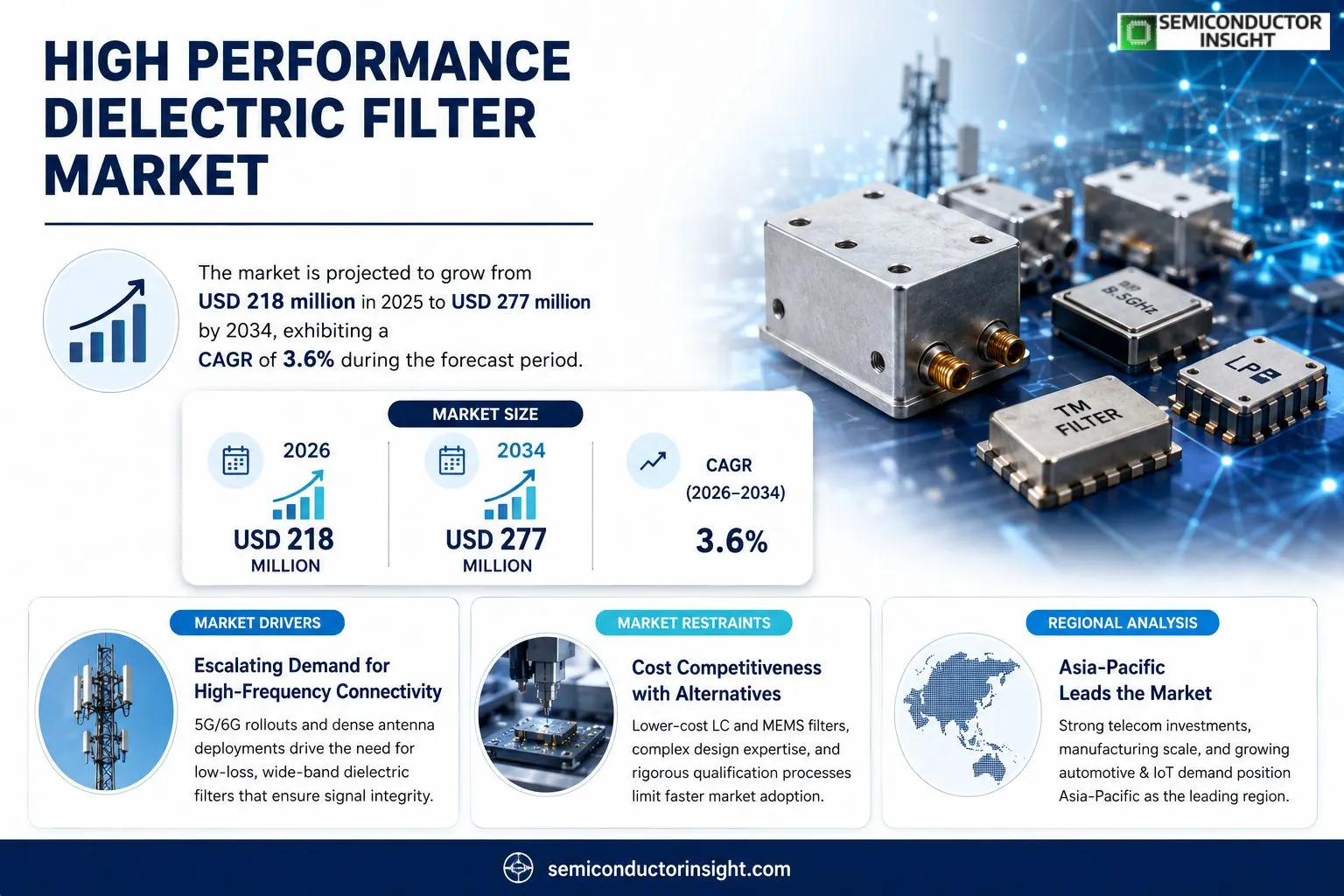
High Performance Dielectric Filter market was valued at USD 218 million in 2025 and is projected to reach USD 277 million by 2034, exhibiting a CAGR of 3.6% during the forecast period.
A high‑performance dielectric filter is fabricated from premium dielectric ceramics, ferrites or magnetic materials to isolate or pass signals within targeted frequency bands while maintaining low loss, high selectivity and broad bandwidth. In 2025 the industry produced approximately 11.958 million units at an average selling price of USD 20 per unit; annual capacity stands near 15 million units, delivering an estimated gross margin of about 22.5%. The upstream supplies dielectric ceramics and magnetic compounds, the midstream consists of filter manufacturers, and downstream users include macro‑base stations and small‑cell deployments.The expansion reflects ongoing upgrades of digital communication infrastructure, increasing throughput requirements for 5G and emerging 6G networks, and heightened reliability needs in automotive, aerospace and IoT applications. Manufacturers are responding with material innovations, multilayer architectures and integrated designs that improve frequency stability and temperature tolerance while pursuing cost reductions and miniaturisation.
MARKET DRIVERS
Escalating Demand for High‑Frequency Connectivity
The rollout of 5G and emerging 6G trials compels equipment makers to adopt components that sustain signal integrity at gigahertz ranges. High Performance Dielectric Filter Market participants are benefitting from telecom operators’ push for denser antenna arrays, where filter bandwidth and low insertion loss become decisive factors for network performance.
Miniaturization of RF Front‑Ends
Smart‑device manufacturers strive to shrink the footprint of RF front‑ends without compromising quality. Dielectric filters, thanks to their compact form factor and temperature‑stable dielectric constants, are being integrated into smartphones, wearables, and automotive radar modules, fueling a steady uptick in unit shipments.
➤ “The confluence of higher carrier frequencies and tighter form‑factor constraints is reshaping supplier priorities, placing dielectric filter technology at the forefront of next‑gen RF solutions.”
Regulatory pressure for spectrum efficiency adds another layer of urgency. Agencies worldwide are allocating more bands for public safety and IoT services, and filter manufacturers that can deliver steep roll‑off characteristics are securing long‑term contracts with network equipment providers.
MARKET CHALLENGES
Manufacturing Yield Consistency
Dielectric filter fabrication involves precise material deposition and sintering steps; slight variations can shift resonant frequencies, leading to costly re‑work. Vendors lacking robust process controls confront elevated scrap rates, eroding margins in a price‑sensitive segment.
Other Challenges
Supply‑Chain Vulnerabilities
The reliance on high‑purity ceramic powders and specialty substrates exposes the market to geopolitical fluctuations. Disruptions in raw‑material availability force buyers to maintain safety stocks, inflating inventory costs.
MARKET RESTRAINTS
Cost Competitiveness with Alternative Technologies
While dielectric filters excel in performance, competing solutions such as lumped‑element LC filters or microelectromechanical systems (MEMS) can be produced at lower unit costs for certain bandwidths. This price differential deters price‑sensitive OEMs from fully transitioning to dielectric architectures.Moreover, the design expertise required to tailor dielectric resonators to specific applications limits the pool of qualified engineers, slowing adoption cycles for niche markets.Finally, stringent qualification procedures for aerospace and defense projects impose additional testing overhead, extending time‑to‑market for new filter designs.
MARKET OPPORTUNITIES
Growth in Millimeter‑Wave Automotive Radar
Automakers are integrating 77 GHz radar modules to enable advanced driver‑assistance systems. Dielectric filters capable of handling millimeter‑wave frequencies with low loss are scarce, presenting a lucrative niche for firms that can certify automotive‑grade performance.Expanding IoT ecosystems, especially in industrial automation, require reliable filtering across crowded spectrum slices. High Performance Dielectric Filter Market players that develop modular, reconfigurable filter families stand to capture a share of this burgeoning demand.Finally, collaboration between semiconductor foundries and filter manufacturers to co‑package dielectric filters with RF front‑end modules promises to reduce board‑level complexity, opening a pathway for differentiated product offerings in both consumer and enterprise segments.
High Performance Dielectric Filter Market Trends
Infrastructure Upgrades and 5G/6G Demands
The rollout of next‑generation mobile networks is reshaping component requirements across the telecommunications ecosystem. As operators replace legacy macro and small base stations, High Performance Dielectric Filter Market is seeing a surge in demand for filters that can sustain higher throughput while maintaining low latency. This shift is not merely a capacity issue; it reflects the need for tighter signal isolation and broader bandwidth to support dense spectrum allocations. Manufacturers responding to these pressures are prioritizing frequency stability and temperature tolerance, thereby opening avenues for premium pricing and higher gross margins.
Other Trends
Materials Innovation and Miniaturization
Advances in dielectric ceramics, ferrites and magnetic composites are redefining filter performance envelopes. By engineering multilayer and multicavity architectures, suppliers achieve lower insertion loss and sharper roll‑off without expanding the physical footprint. The average selling price of US$20 per unit, coupled with a gross profit margin around 22 %, illustrates that cost efficiencies are being realized even as product complexity rises. This material‑centric evolution also aligns with broader industry pushes toward lightweight, space‑constrained designs in automotive and aerospace applications, where size, weight and power constraints dominate engineering decisions.
Regional Competition and Sustainable Production
Geographically, the market is fragmenting into clusters where local policy and supply‑chain considerations dictate competitive dynamics. In Asia, proximity to raw material sources and high‑volume manufacturing hubs drives aggressive pricing, while European firms leverage stricter environmental standards to differentiate through greener production processes. North American players, meanwhile, capitalize on strategic partnerships with macro‑base‑station vendors, securing long‑term contracts that buffer against price volatility. This regional mosaic forces all participants to balance cost leadership with innovation, prompting a wave of collaborative R&D initiatives aimed at reducing energy consumption during fabrication.
COMPETITIVE LANDSCAPEKey Industry Players
High Performance Dielectric Filter Market: Competitive Overview
Murata Manufacturing dominates the upper tier of the market, leveraging its deep portfolio of ceramic dielectric technologies and extensive R&D capabilities. The company’s ability to integrate multilayer constructions with tight tolerance controls allows it to capture a sizable share of macro‑base‑station contracts, where bandwidth and temperature stability are non‑negotiable. Murata’s scale also translates into a cost advantage that pressures smaller suppliers to specialize in niche frequency bands or customized packaging solutions. This tiered structurelarge, vertically integrated firms at the top, followed by focused mid‑size playerscreates clear segmentation in pricing, service depth, and geographic reach. Recent supply‑chain disruptions have prompted Murata to diversify sourcing of high‑purity ferrites, reinforcing its resilience against material volatility.Beyond the tier‑one incumbents, firms such as Johanson Technology, Taoglas, and Suzhou RF Top have carved out defensible positions by emphasizing rapid prototyping and flexible supply‑chain models. Emerging Chinese manufacturersincluding Guangdong Fenghua Advanced Technology Holding and Wuhan Fingu Electronic Technologyare expanding capacity to service the automotive and IoT segments, where volume sensitivity outweighs ultra‑high performance. European niche players like TATFOOK and DSBJ maintain relevance through specialized filters for aerospace applications, capitalising on rigorous certification pathways and long‑term service contracts. Strategic alliances with telecom equipment makers are increasingly common, enabling these companies to align product roadmaps with network rollout schedules across Asia and Europe.
List of Key High Performance Dielectric Filter Companies Profiled
- Murata Manufacturing
- Johanson Technology
- Taoglas
- Partron
- JIAKANG ELECTRONICS
- MCV Technologies
- Suzhou RF Top Electronic Communications
- Wuhan Fingu Electronic Technology
- Tongyu Communication
- Guangdong Fenghua Advanced Technology Holding
- TATFOOK
- Jiangsu Caiqin Technology
- Beijing BDStar Navigation
- DSBJ
Segment Analysis:
| Segment Category | Sub-Segments | Key Insights |
| By Type |
|
TM Mold dominates due to proven material stability; • manufacturers prioritize TM Mold for its consistent dielectric constant, reducing signal loss; • ongoing material innovation improves temperature tolerance, aligning with 5G/6G reliability demands; • design refinements enable thinner profiles, supporting miniaturization trends. |
| By Application |
|
Macro Base Station remains the primary driver; • high‑throughput and low‑latency requirements of 5G push for wide‑band, low‑loss filters; • scalability of macro installations amplifies demand for cost‑effective, high‑selectivity solutions; • manufacturers focus on integrating multilayer architectures to meet stringent performance specs. |
| By End User |
|
Telecom Operators prioritize filter reliability; • network upgrades to 5G/6G require filters with tight frequency stability across temperature ranges; • operators seek vendors that can guarantee long‑term supply continuity; • emphasis on low insertion loss supports higher data rates and reduced power consumption. |
| By Frequency Selectivity |
|
Bandpass Filter is the cornerstone of high‑performance deployments; • delivers precise channel isolation essential for dense spectrum reuse; • advances in dielectric material composition sharpen selectivity without increasing size; • integration with surface‑mount packaging aligns with compact antenna arrays. |
| By Structure Types |
|
Dielectric Waveguide Filter gains traction for high‑power scenarios; • superior power handling makes it suitable for macro base stations; • waveguide geometry provides inherent immunity to external interference; • ongoing manufacturing refinements reduce cost penalties compared with traditional metal waveguides. |
Regional Analysis: High Performance Dielectric Filter Market
North America
Industry clusters around Silicon Valley and the Boston corridor specialize in low‑loss dielectric materials, enabling filter designs that meet stringent insertion‑loss targets. Collaborative projects between semiconductor fabs and filter manufacturers have yielded hybrid architectures that blend traditional ceramic cores with emerging metamaterial layers, delivering performance levels unattainable a few years ago.
The presence of multiple substrate providers, coupled with a network of contract manufacturers that can scale from prototyping to volume runs, cushions the region against raw‑material shortages. Strategic stockpiles of high‑purity alumina and titanium dioxide further insulate production schedules.
FCC and MIL‑STD specifications drive continuous refinement of filter characteristics. Compliance testing facilities are heavily concentrated in the United States, allowing manufacturers to iterate designs rapidly while maintaining certification timelines.
Telecom infrastructure providers, aerospace prime contractors, and automotive OEMs pursuing V2X connectivity represent the most active buyers. Their procurement patterns favor suppliers that can co‑engineer solutions, reinforcing the collaborative ethos of the region.
Europe
European markets exhibit a balanced mix of mature telecom operators and a burgeoning automotive electrification agenda. Regulatory initiatives such as the EU’s spectrum harmonization plan compel network equipment providers to integrate higher‑performance filtering, while car manufacturers seek dielectric solutions capable of withstanding harsh thermal cycles in electric drivetrains. Germany and France host a dense network of specialist firms that marry precision machining with advanced ceramic sintering, positioning the continent as a hub for high‑frequency, compact filter modules. Cross‑border R&D consortia, supported by Horizon Europe funding, further accelerate material breakthroughs, though they often face longer certification cycles compared with North America.
Asia‑Pacific
The Asia‑Pacific region is distinguished by rapid adoption of 5G and a wave of domestic defense modernization programs. China, South Korea, and Japan invest heavily in indigenous semiconductor fabs, which in turn nurture local dielectric filter producers. While cost considerations dominate many procurement decisions, a growing premium segment in aerospace and satellite communications demands filters that combine low insertion loss with tight dimensional tolerances. The region’s expansive manufacturing base enables scale economies, yet supply‑chain transparency can be uneven, prompting multinational OEMs to establish dual‑source strategies to mitigate risk.
South America
In South America, market activity is driven primarily by telecom expansion in Brazil, Mexico, and Colombia. Operators are upgrading legacy networks to accommodate higher data rates, a shift that elevates the need for filters that can operate across broader frequency bands without compromising signal integrity. Defense spending remains modest, but regional initiatives to modernize radar capabilities create pockets of demand for ruggedized dielectric components. Local distributors often act as intermediaries, adding value through application engineering services that compensate for the limited presence of end‑to‑end filter manufacturers.
Middle East & Africa
The Middle East & Africa segment reflects divergent trajectories. Wealthier Gulf Cooperation Council nations are channeling investments into satellite ground stations and smart‑city infrastructure, both of which rely on high‑performance filters to manage crowded spectra. Conversely, many African markets prioritize basic mobile broadband rollout, where filter specifications are less demanding. Partnerships between OEMs and regional system integrators are emerging as a pragmatic approach, allowing the latter to leverage advanced filter technologies while navigating local procurement frameworks and import regulations.
Report Scope
This market research report provides a comprehensive analysis of the High Performance Dielectric Filter Market , covering the forecast period 2026–2034. It offers detailed insights into market dynamics, technological advancements, competitive landscape, and key trends shaping the industry.
Key focus areas of the report include:
- Market Overview: The report begins with an overview outlining its current market scenario, key growth indicators, and industry transformation drivers. It discusses macroeconomic factors, demand–supply balance, regulatory landscape, and the strategic role of semiconductors in powering advancements across industries such as automotive, telecommunications, consumer electronics, and industrial automation.
- Market Size & Forecast: Historical data and future projections for revenue, unit shipments, and market value across major regions and segments.
- Segmentation Analysis: Detailed breakdown by product type, technology, application, and end-user industry to identify high-growth segments and investment opportunities.
- Regional Insights: Insights into market performance across North America, Europe, Asia-Pacific, Latin America, and the Middle East & Africa, including country-level analysis where relevant.
- Competitive Landscape: Profiles of leading market participants, including their product offerings, R&D focus, manufacturing capacity, pricing strategies, and recent developments such as mergers, acquisitions, and partnerships.
- Technology Trends & Innovation: Assessment of emerging technologies, integration of AI/IoT, semiconductor design trends, fabrication techniques, and evolving industry standards.
- Market Drivers & Restraints: Evaluation of factors driving market growth along with challenges, supply chain constraints, regulatory issues, and market-entry barriers.
- Stakeholder Insights: Insights for component suppliers, OEMs, system integrators, investors, and policymakers regarding the evolving ecosystem and strategic opportunities.
Primary and secondary research methods are employed, including interviews with industry experts, data from verified sources, and real-time market intelligence to ensure the accuracy and reliability of the insights presented.
FREQUENTLY ASKED QUESTIONS:
What is the current market size of High Performance Dielectric Filter Market?
-> High Performance Dielectric Filter Market was valued at USD 218 million in 2025 and is expected to reach USD 277 million by 2034, at a CAGR of 3.6% during the forecast period.
Which key companies operate in High Performance Dielectric Filter Market?
-> Key players include Johanson Technology, Murata, Partron, JIAKANG ELECTRONICS, Taoglas, MCV Technologies, Suzhou Rf Top Electronic Communications, Wuhan Fingu Electronic Technology, Tongyu Communication, Guangdong Fenghua Advanced Technology Holding, TATFOOK, Jiangsu Caiqin Technology, Beijing BDStar Navigation, DSBJ.
What are the key growth drivers?
-> Key growth drivers include the upgrading of digital and communication infrastructure, demand for high throughput, low latency and high signal‑to‑noise ratio from 5G and future 6G networks, and strong requirements for reliability and wide‑bandwidth filtering from automotive, aerospace and IoT industries. Material innovation (dielectric ceramics, ferrites, magnetic materials), structural optimization (multilayer/multicavity, surface‑mount packaging) and miniaturization further accelerate market expansion.
Which region dominates the market?
-> Asia remains a dominant region, driven by extensive deployment of macro and small base stations, robust telecom investment, and strong adoption in automotive and aerospace sectors.
What are the emerging trends?
-> Emerging trends include increased focus on material‑based performance enhancement, integrated design approaches to combine filtering with other RF functions, cost‑reduction and eco‑friendly manufacturing processes, as well as the push toward smaller, high‑efficiency filter form factors for 5G/6G and IoT applications.
Get Sample Report PDF for Exclusive Insights
Report Sample Includes
- Table of Contents
- List of Tables & Figures
- Charts, Research Methodology, and more...
 Download Sample Report PDF