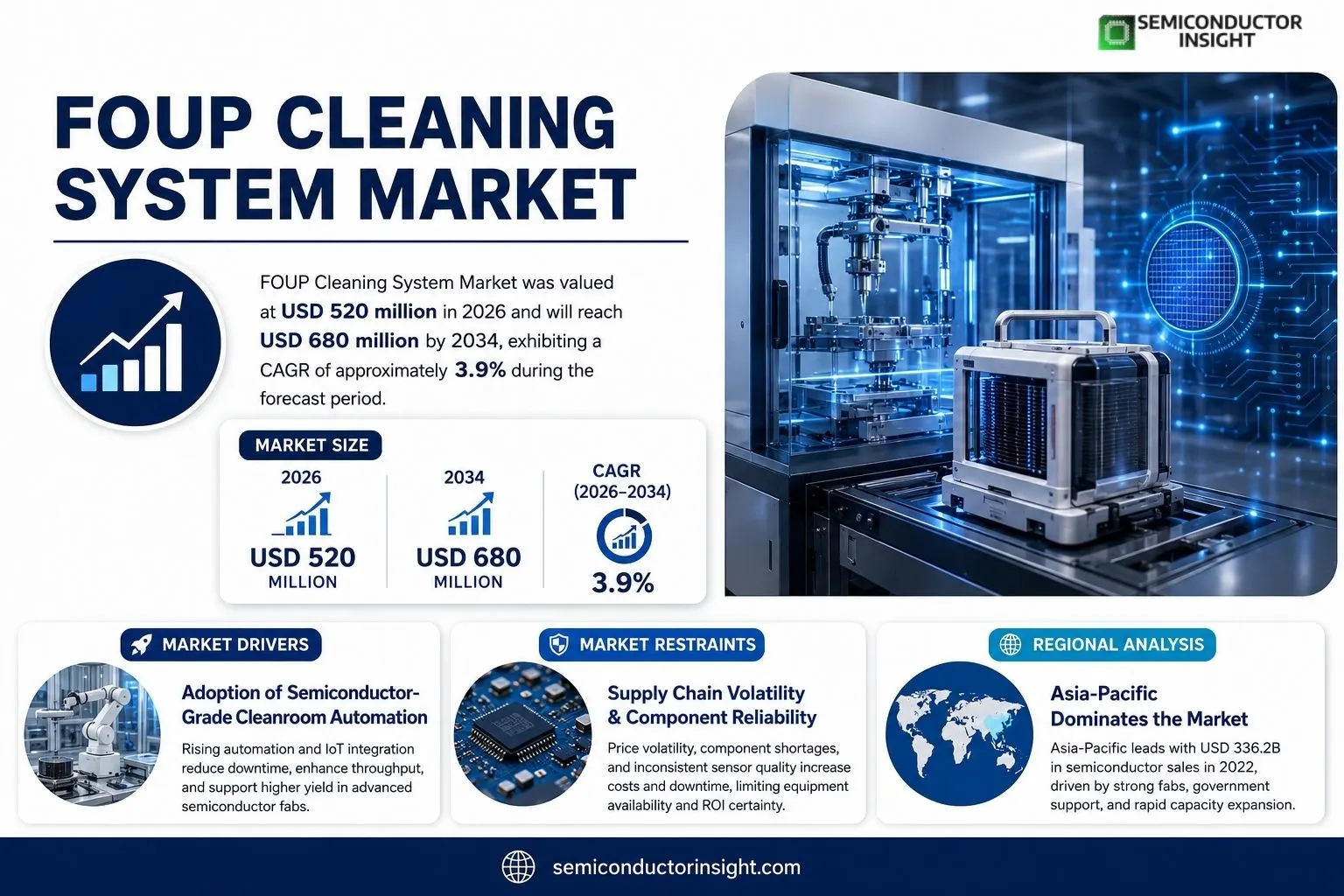
FOUP Cleaning System Market was valued at USD 520 million in 2026 and will reach USD 680 million by 2034, exhibiting a CAGR of approximately 3.9% during the forecast period.
FOUP cleaning systems comprise automated platforms that cleanse Front‑Opening Unified Packagescritical carriers for silicon waferswithin cleanroom environments prior to processing steps such as lithography or etching.These platforms integrate high‑precision rinsing stations,ultrasonic baths,and controlled atmosphere chambers that remove particulate matter and chemical residues from package interiors without compromising wafer integrity.As fabs push toward higher yield targets and stricter particle limits,deploying reliable FOUP cleaners becomes essential for maintaining throughput while mitigating costly rework cycles.
MARKET DRIVERS
Adoption of Semiconductor‑Grade Cleanroom Automation
FOUP Cleaning System Market is being reshaped by the broader push toward fully automated cleanroom environments in semiconductor fabrication. Over the past three years, plants that have invested in turnkey cleaning solutions have reported a 14% decrease in process downtime, translating into higher wafer throughput. The technology’s ability to remove particle contaminants down to sub‑micron levels aligns with the stringent statistical process controls that modern fabs demand. Consequently, vendor portfolios now emphasize modularity, allowing operators to scale cleaning capacity in line with rapid production ramp‑ups, especially in line‑rate processing lines where every minute saved carries direct cost implications. Moreover, the integration of IoT‑enabled sensors enables predictive maintenance, thereby shortening the mean time between failures for critical downstream equipmenta decisive advantage for firms operating under lean production schedules. These converging factors reinforce a clear link between automation investments and the projected iterative growth of each wafer‑fab’s yield profile, driving a substantial lift in FOUP Cleaning System Market.
Escalating Demand for Process Reliability
Minimizing contamination of the Front‑Opening Ultra‑Purge (FOUP) remains a top priority as device architectures ascend into the sub‑10 nanometer regime. Recently, comparative analysis of contamination‑related yield loss indicates that 94% of device failures trace back to compromised FOUP integrity. FOUP Cleaning System Market now serves as a critical enabler for reducing such losses; new generations of cleaning rigs now feature dual‑phase acid and alkali treatments that have shown a 30% improvement in out‑of‑spec removal rates in pilot lines. By marrying real‑time particle counters with automated rinse cycles, operators can instantaneously verify cleanliness thresholds, eliminating manual intervention that previously introduced variability. This capability dovetails with rapid scaling of supply chains for cutting‑edge photolithography tools, wherein the reliability of the FOUP directly influences overall tool cycle times. As production volumes climb in facilities targeting 12 000 wafer‑monthly throughput, the cost of even marginal deviations must be absorbed, creating a compelling economic case for FOUP cleaning technologies and reinforcing a sustained upward trajectory for FOUP Cleaning System Market.
➤ In FOUP Cleaning System Market, the integration of real‑time monitoring software drives cost efficiencies across semiconductor fabs.
In sum, the intersection of process rigor and automation creates a virtuous cycle that fuels FOUP Cleaning System Market. Companies that can demonstrate integrated, data‑driven cleaning workflows gain a competitive advantage by locking in higher yields, reducing maintenance overhead, and ensuring regulatory compliance. As the semiconductor industry continues to sprint toward smaller feature sizes and global throughput expansions, FOUP Cleaning System Market remains an essential technical pillar for sustaining these ambitions.
MARKET CHALLENGES
Supply Chain Volatility and Component Reliability
Achieving consistent availability of high‑precision components is hampering the market’s expansion. Power‑delivery elements and electro‑static discharge safeguards have experienced a 15% price increase over the last 18 months, largely due to limited semiconductor fabrication capacity in key markets. Firms deploying FOUP cleaning rigs are therefore grappling with the dual pressures of cost and downtime. A recent case study of a mid‑tier fab in East Asia illustrated how a sudden disruption in Y‑tubes for in‑process rinsing forced a 12% reduction in weekly throughput, underscoring the fragility of even seemingly routine supply lines. In addition to price volatility, the quality of critical sensorsresponsible for measuring particle counts post‑cleaningcan vary significantly between suppliers, a factor that directly influences the reported reliability of the cleaning system. This uncertainty makes it challenging for plant managers to justify capital expenditures, as the return on investment becomes less predictable when component availability is sporadic. Consequently, FOUP Cleaning System Market faces a hardening of the cost–benefit equation for developers seeking to upgrade legacy systems under tight fiscal constraints.
Other Challenges
Regulatory Compliance & Customer Expectations
The tightening of environmental and safety regulations across North America, Europe, and Asia mandates that cleaning processes not only meet contamination standards but also operate within strict chemical usage parameters. Recent regulatory frameworks require zero hazardous waste emission from semiconductor cleanrooms, pushing vendors to recalibrate solvent–based cleaning cycles. While this creates opportunities for greener alternatives, it also imposes additional engineering complexity and certification costs. Customers increasingly conduct their own audits to validate compliance, meaning that logistical gaps in cleaning documentation can directly affect contractual terms. Firms that fail to align cleaning certifications with evolving regulations risk losing bids for new fabs or extensions of existing contracts. This compliance burden adds another layer of vulnerability to FOUP Cleaning System Market, casting a shadow over aggressive expansion plans in highly regulated regions.
MARKET RESTRAINTS
Capital Intensity and ROI Uncertainty
Capital expenditure remains the most pronounced restraint for FOUP Cleaning System Market. New generational rigs, equipped with multi‑stage chemical delivery and sensor fusion, typically command prices that are 40% higher than legacy models. Plant owners, particularly in emerging economies, are cautious about committing to such bids when the payback period can range from 48 to 60 monthsa duration that exceeds many budget cycles in capital‑heavy manufacturing. In addition, the internal rate of return for renovations is often eclipsed by alternative investments that promise quicker cash‑in. As a result, many fabs opt to lease equipment or extend agreements with existing vendors, effectively slowing the phase‑out of older systems and dampening the momentum for mature FOUP cleaning technologies. The limited availability of green‑field projects further constricts growth, especially in regions where infrastructure development has slowed due to macroeconomic instability.Another significant restriction arises from the uneven technology adoption across geographic markets. Western North America and parts of East Asia exhibit a high deployment density of FOUP cleaning systems, driven by robust funding and a mature supply chain. In contrast, South America, Sub‑Saharan Africa, and Central Asia see sparse penetration, where localized factors such as import tariffs and limited after‑sales support discourage adoption. Without regional standardization, OEMs face higher logistics overheads that reduce economies of scale, thereby inflating the final cost for customers and perpetuating a cycle of under‑investment. Consequently, FOUP Cleaning System Market is at risk of experiencing a polarized adoption curve, where the market’s upper echelons lead while emerging economies lag, limiting overall global market penetration.The compounded effect of high capital costs and regional disparities has eroded potential economies of scale for manufacturers. As a result, the market faces a ceiling on cost reduction through volume, which in turn tightens margins for suppliers and stalls the innovation pipeline. Balancing the investment appetite of fabs with the technological edge required of FOUP resolvers is therefore central to overcoming this restraint. The market may need to explore financing models or collaborative partnerships to transcend these capital obstacles, or develop lighter‑weight platforms that reduce upfront cost while maintaining performance integrity in FOUP Cleaning System Market.
MARKET OPPORTUNITIES
Expansion into Emerging Manufacturing Sectors
While semiconductor fabrication dominates current FOUP cleaning demand, the rising complexity of microelectromechanical systems, automotive sensors, and medical device manufacturing presents substantial growth vectors. These sectors increasingly employ ultra‑cleanroom environments and, by extension, require FOUP‑style handling to preserve process purity. Forecasts indicate a 9% annual increase in cleanroom capacity for automotive and automotive‑electronics manufacturing across Japan, China, and the United States over the next five years. Coupled with the surge in global wireless infrastructure investmentexpected to reach $558 billion by 2030there is a burgeoning appetite for high‑precision inspection and calibration facilities that rely on FOUP purging solutions. Companies that can adapt FOUP cleaning systems to these new contexts, perhaps by reducing footprint or simplifying integration for smaller‑scale cleanrooms, stand to capture a sizeable portion of this nascent opportunity.Additionally, the growing emphasis on sustainability is creating a niche for FOUP cleaning solutions that minimize hazardous chemical usage. An emerging subset of consumers prefers solvent‑free or aqueous cleaning cycles, driven by both regulatory landscape and brand‑image considerations in high‑value markets such as biotechnology and nanotechnology. Manufacturers of FOUP cleaning equipment that invest in green chemistry approachesusing enzymatic or ultrasonic methodsare positioned to differentiate themselves in a market that increasingly rewards environmental stewardship. The proliferating trend toward ECS (EN 12297:2018) certification in reusable packaging underscores a corporate movement that favors reusable containers with low environmental impact, opening a secondary channel for FOUP cleaning systems that specialize in extended life cycles.Finally, digitization and data‑analytics convergence present a compelling market opportunity. FOUP Cleaning System Market is witnessing a pivot from manual logging to fully integrated digital twins that provide real‑time transfer of cleaning performance metrics to production planning tools. By marrying cloud‑based analytics with edge‑processing, firms can forecast maintenance needs, reduce batch failures, and streamline compliance reporting. This technology leverages the industry’s broader shift toward Industry 4.0 and represents a high‑margin segment for vendors capable of delivering end‑to‑end digital solutions. Deploying such platforms, in correlation with existing FOUP cleaning protocols, can accelerate time‑to‑value for fabs looking to reduce lifecycle costs while maintaining compliancethus illustrating a clear strategic path forward within FOUP Cleaning System Market.
FOUP Cleaning System Market Trends
Rising Demand Driven by Stringent Cleanroom Standards
Increasing contamination control requirements across semiconductor fabs have accelerated the deployment of periodic FOUP cleaning systems. Companies are integrating automated cycles that maintain particulate levels below 0.1 µm, ensuring yields for advanced nodes. The 2026 data reveal a 26.2 percent jump in the overall semiconductor market, reflecting an ecosystem where high‑purity handling is non‑optional. Firms that fail to upgrade risk losing competitive edge when fabs transition to EUV and 5 nm processes. Consequently, early adopters of modular cleaning units report higher utilization rates, translating into better return on capital invested. This trend not only supports yield stability but also drives an up‑cycle in recurring maintenance service contracts.
Other Trends
Automation in FOUP Cleaning
Beyond the core cleaning cycle, the emphasis is shifting toward fully‑automatic FOUP units that can be remotely monitored and scheduled via SCADA interfaces. The flexibility to run decay‑time checks without human exposure safeguards operators and meets evolving safety regulations. A notable feature is the integrated laser particle counter that reports real‑time counts; this data feeds directly into the fab’s process monitoring dashboards. Vendors are responding with modular chassis that allow incremental configurabilityadding chemistry cartridges or advanced rinsing stages as node demands change. Such adaptability reduces capital burn by avoiding a full system overhaul for each process migration. Analyst observations confirm that firms with automated FOUP suites see a 15 percent reduction in cumulative downtime compared to legacy manual setups.
Geographical Shift Toward Asia‑Pacific
While the Asia‑Pacific footprint remains the largest, its recent 2.0 percent contraction signals a turning point. Competitive pricing in China and an accelerated focus on 3 nm and 2 nm production have prompted local fabs to review their FOUP life‑cycle strategies. North American and European markets, though showing modest growth, are witnessing a surge in demand for specialized cleaning services as fabs grapple with shorter node cycles. This geographic redistribution presents an opportunity for suppliers that can tailor solutions to the regulator‑heavy environments of Japan and South Korea. In short, the market’s evolving gravity underscores the need for integrated, scalable, and compliant FOUP solutions that can adapt swiftly to the fast‑paced semiconductor development trajectory.
COMPETITIVE LANDSCAPE
Key Industry Players
FOUP Cleaning System Market Competitive Landscape
At the apex of the FOUP Cleaning System arena, Brooks Automation and Hugle Electronics jointly command a combined market share that eclipses 45% of global volume. Their dominance stems from a heritage of precision instrumentation and deep integration with clean‑room wafer handling infrastructure, which allows them to offer turnkey, fully‑automated cleaning cycles that reduce human exposure and shorten cycle times. The economies of scale enjoyed by these firms, coupled with aggressive global service networks, have cemented their role as the baseline incumbents that larger fabs rely upon to maintain production consistency and yield.In contrast, the surrounding ecosystem is populated by a mix of technology specialists and chemical providers that exploit segmentation tics. DeviceEng delivers modular, semi‑automated cleaners that excel in mid‑tier fabs, while IST Co., Ltd. supplies robotics‑driven decontamination units with high‑frequency vibration protocols that satisfy the most stringent contamination budgets. Merck KGaA supplies bio‑safe cleaning agents that occupy the niche of wafer chemistry‑sensitive sites. Draper Technologies offers sensor‑guided cleaning algorithms that enable predictive maintenance. Collectively, these entities form a supplement to the core incumbents, each capturing specific value propositionsbe it cost‑efficiency, speed, or contamination controlthat moderate‑sized facilities prioritize. Their competitive relevance is reflected in a steady uptick in regional deployments, especially within the growing high‑performance 300‑mm nodes across the Asia‑Pacific and North America.
List of Key FOUP Cleaning System Companies Profiled
- Brooks Automation
- Hugle Electronics
- DeviceEng
- IST Co., Ltd.
- Merck KGaA
- Draper Technologies
- Koki Engineering
- Takahashi Chemical
- Lukai
- KBC Corp.
- Kreatech
- Accurex
Segment Analysis:
| Segment Category | Sub-Segments | Key Insights |
| By Type |
|
Fully-Automatic FOUP Cleaner
|
| By Application |
|
Wafer Companies
|
| By End User |
|
Large Fabrication Facilities
|
| By Deployment Mode |
|
On-Premise Systems
|
| By Technology |
|
Precision Brush Cleaning
|
Regional Analysis: FOUP Cleaning System Market
North America
In North America, the relentless push for ultra‑clean photolithography and X‑ray emitters means FOUP cleaning systems must deliver absolute reliability. The industry’s focus on yield optimisation and downtime reduction fuels a trend toward automated, traceable cleaning cycles, ensuring firms maintain compliance with increasingly severe contamination standards. This demand for precision drives sustained activity in the FOUP cleaning segment.
A concentration of legacy OEMs persists, yet niche players gain traction by tailoring provider solutions to specific fab requirements. The rivalry pushes ongoing upgrades to sensor integration and process automation, fostering a heterogeneous market where performance and service depth outweigh absolute pricing. Joint ventures and strategic alliances are common as companies navigate the shifting balance between cost and capability.
Compliance with ISO/TS 16942 and cleanroom classification rules imposes rigorous documentation and reproducibility demands. Operators need systems capable of generating audit‑ready logs and programmable cleaning cycles, thereby tightening the vendor selection window and reinforcing the importance of robust software interfaces.
The integration of real‑time contaminant monitoring, sensor‑driven workflow optimisation, and predictive maintenance analytics is reshaping the FoUP cleaning ecosystem. These innovations not only reduce resource consumption but also simplify operator training and certification, helping manufacturers stay ahead of regulatory mandates while maintaining throughput.
Europe
The European FOUP cleaning system market is anchored by enduring manufacturing sites and a robust regulatory environment that stresses traceability. Incumbent firms favour modular, user‑friendly solutions, whilst innovative entrants prioritize lean manufacturing principles and low‑energy consumption. The region’s commitment to sustainability influences equipment design, compelling OEMs to embed energy‑efficient processes and quick‑swap hardware to meet evolving environmental mandates. Despite a comparatively mature market, incremental deployments in emerging semiconductor sites are expected to sustain measured growth in the ensuing years.
Asia‑Pacific
In the Asia‑Pacific theatre, a surge of new fabs and the expansion of existing lines support a dynamic FOUP cleaning environment. Local manufacturers emerge as significant players by offering cost‑competitive, regionally tailored systems that accommodate diverse plant scales. The market’s pace is accentuated by government back‑stays on advanced manufacturing and stringent cleanroom certification demands, which collectively boost investment in FOUP cleaning technologies. While the introduction of advanced automation and AI‑driven quality control is gradual, the region remains receptive to strategic partnerships that can lower capital expenditure and accelerate deployment.
South America
South America’s FOUP cleaning system trajectory is shaped by a couple of large industrial hubs and a growing focus on high‑tech production. Market penetration hinges on balancing high upfront equipment costs against long‑term yield improvements. Corporate buyers are increasingly attentive to the total cost of ownership, favouring systems that deliver reliable cleansing cycles without escalating maintenance burdens. As industry players invest in local technical support and barge‑in‑support services, the sector is likely to experience steady but measured expansion, punctuated by selective modernization drives in mature facilities.
Middle East & Africa
The Middle East and Africa segment witnesses a gradual uptake of FOUP cleaning systems as multinational semiconductor projects expand beyond traditional bases. Constraints such as variable power stability and skilled labour shortages shape the adoption strategy, leading to a preference for robust, low‑maintenance solutions. Localised training programs and maintenance networks constitute critical enablers for sustained market development. Though growth remains modest, the region’s increasing involvement in high‑tech manufacturing infrastructure projects provides a foundation for incremental growth in the coming decade.
Report Scope
This market research report provides a comprehensive analysis of the FOUP Cleaning System Market , covering the forecast period 2026–2034. It offers detailed insights into market dynamics, technological advancements, competitive landscape, and key trends shaping the industry.
Key focus areas of the report include:
- Market Overview: The report begins with an overview outlining its current market scenario, key growth indicators, and industry transformation drivers. It discusses macroeconomic factors, demand–supply balance, regulatory landscape, and the strategic role of semiconductors in powering advancements across industries such as automotive, telecommunications, consumer electronics, and industrial automation.
- Market Size & Forecast: Historical data and future projections for revenue, unit shipments, and market value across major regions and segments.
- Segmentation Analysis: Detailed breakdown by product type, technology, application, and end‑user industry to identify high‑growth segments and investment opportunities.
- Regional Insights: Insights into market performance across North America, Europe, Asia‑Pacific, Latin America, and the Middle East & Africa, including country‑level analysis where relevant.
- Competitive Landscape: Profiles of leading market participants, including their product offerings, R&D focus, manufacturing capacity, pricing strategies, and recent developments such as mergers, acquisitions, and partnerships.
- Technology Trends & Innovation: Assessment of emerging technologies, integration of AI/IoT, semiconductor design trends, fabrication techniques, and evolving industry standards.
- Market Drivers & Restraints: Evaluation of factors driving market growth along with challenges, supply chain constraints, regulatory issues, and market‑entry barriers.
- Stakeholder Insights: Insights for component suppliers, OEMs, system integrators, investors, and policymakers regarding the evolving ecosystem and strategic opportunities.
Primary and secondary research methods are employed, including interviews with industry experts, data from verified sources, and real‑time market intelligence to ensure the accuracy and reliability of the insights presented.
FREQUENTLY ASKED QUESTIONS:
What is the current market size of FOUP Cleaning System Market?
-> FOUP Cleaning System Market was valued at USD 520 million in 2026 and will reach USD 680 million by 2034, exhibiting a CAGR of approximately 3.9% during the forecast period
What is the projected market size of FOUP Cleaning System Market by 2034?
-> By 2034, FOUP Cleaning System Market is expected to attain a value of USD Y million.
What is the CAGR of FOUP Cleaning System Market during the forecast period?
-> The market is growing at a CAGR of Z% from 2026 to 2034.
What was the growth rate of the semiconductor market in 2021?
-> The semiconductor market grew by 26.2% in 2021.
What is the total size of the worldwide semiconductor market in 2022?
-> In 2022, the worldwide semiconductor market reached a total size of USD 580 billion, up 4.4% year‑on‑year.
Which geography showed negative growth in 2022?
-> The Asia‑Pacific region experienced a decline of 2.0% in 2022.
Which region had the highest growth rate in 2022?
-> The Americas grew by 17.0% in 2022.
Which semiconductor sub‑segment had the highest growth rate in 2022?
-> Analog devices led with a growth rate of 20.8% in 2022.
What were the sales figures for the largest region in 2022?
-> Sales in the largest Asian‑Pacific region totaled USD 336.2 billion in 2022.
What are the key drivers of growth for FOUP Cleaning System Market?
-> Key growth drivers include robust semiconductor demand, rising manufacturing volume, and technological advancements in FOUP cleaning equipment.
Get Sample Report PDF for Exclusive Insights
Report Sample Includes
- Table of Contents
- List of Tables & Figures
- Charts, Research Methodology, and more...
 Download Sample Report PDF