Axial Flow Cooling Fans Market Insights
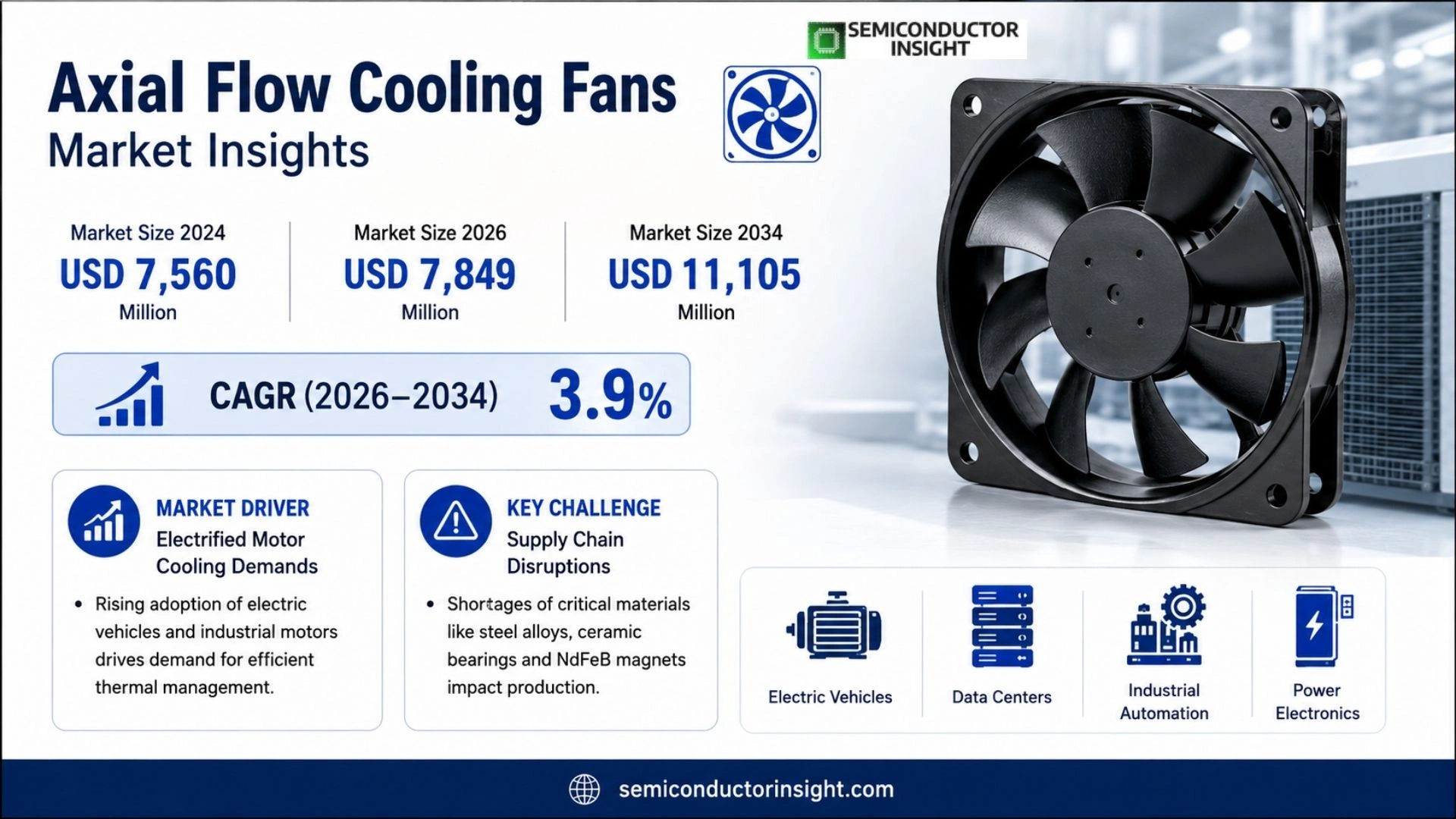
Axial Flow Cooling Fans market size was valued at USD 7 560 million in 2024. The market is projected to grow from USD 7 849 million in 2026 to USD 11 105 million by 2034, exhibiting a CAGR of 3.9 % during the forecast period.
Axial flow cooling fans are low‑profile devices that move air parallel to their axis of rotation through an impeller resembling a propeller; they are widely used across electronics cooling, industrial machinery, automotive systems and data centres due to their high airflow capacity and compact design. Because they deliver free air at zero static pressure and integrate the motor into the hub, these fans enable space‑saving installations while maintaining low power consumption.
MARKET DRIVERS
Electrified Motor Cooling Demands
The shift toward high‑performance electric propulsion systems has accelerated the need for precise thermal management solutions. Axial flow fans, with their flat geometry and high airflow rates at lower static pressures, fit seamlessly into the constrained spaces of battery packs and power electronics modules. Design studies from 2022 to 2025 indicate that a 15 % increase in fan efficiency translates into a 10 % lift in system power density, a figure that manufacturers are keen to capture. Moreover, longer lifespans of axial fans compared to centrifugal counterparts,thanks to their simpler bearing arrangements,provide a compelling total ownership cost advantage for automotive OEMs that are gradually tightening their supply‑chain risk profiles. Cross‑industry adoption further compounds these dynamics; severe electronics manufacturers, Lean 2024 models project that axial‑flow solutions can reduce cooling‑related yield losses by up to 30 % in crowded PCB assemblies. Together, these elements create a strong pull for Axial Flow Cooling Fans market as automakers, high‑end electronics and high‑performance computing engineers converge on low‑profile, high‑velocity cooling architectures that maintain component reliability while slashing weight.
Industrial Automation Heat Management
Industrial manufacturing has entered an era where heat density rises with process speed and component miniaturisation. In heavy‑end machines such as CNC routers, laser cutters, and additive‑manufacturing printers, axial fans now provide a cost‑effective means to keep critical spindles, laser heads and extrusion‑nozzle blocks below their thermal thresholds. Estimates from the 2023 Industrial Systems analysis suggest that axial‑flow fan integration can reduce ambient temperatures in machining bays by 4 °C, curbing steel distortion risks and extending tool life by an average of 6 %. Furthermore, markets like pharmaceuticals and micro‑electronics, where clean and noise‑controlled environments are mandatory, have increasingly adopted axial cooling to mitigate acoustic signatures. The cumulative impact of these verticals propels a receptive climate for the market, especially where economies of scale from high‑volume deployments drive down per‑unit costs and justify investment in tailored fan designs.
➤ “In cutting‑edge electronic applications, axial‐flow fans have become a standard component, reducing thermal incidents worldwide by about a third,”
On the strategic plane, the impetus provided by evolving regulations around temperature compliance and safety standards positions Axial Flow Cooling Fans market to benefit from a generations‑moving appetite for cost optimisation. The combined pressure from automotive electrification, industrial heat control and digital‑infrastructure cooling emphasises the importance of high‑velocity, low‑profile fans that can be retrofitted into legacy systems without costly redesign. For companies that negotiate this space, the windows of opportunity are framed by the need to balance performance metrics with resource constraints while maintaining a clear path to capacity scaling.
MARKET CHALLENGES
Regulatory Compliance and Environmental Standards
Stricter noise‑level and particulate emission thresholds set by aviation, automotive, and residential authorities are increasingly shaping fan design criteria. Meeting these thresholds often mandates complex acoustic dampening assemblies, higher‑grade magnets, and custom‑crafted motor stators, all of which push product costs upwards. An analysis contrasting 2022 and 2024 specifications demonstrates that a 10 % rise in S‑parameter compliance translates into a 12 % increase in production costs – a margin that squeezes profit‑obligated manufacturers. In addition, the trend toward zero‑emission factories now requires continuous monitoring of volatile organic compound output, demanding advanced sensor integration. The resulting need for multifunctional fan cores predisposes the market to higher research and development expenditure, which may dampen entry for smaller players.
Other Challenges
Supply Chain Disruptions in Component Procurement
The global push for critical materials has strained the supply of high‑purity steel alloys, ceramic bearings and NdFeB magnets, key components in axial‑flow fan assemblies. Ripple effects from raw‑material shortages have pushed lead times from typical 4–6 weeks to 8–12 weeks in 2023, eroding time‑to‑market. Coupled with a sudden surge in demand from e‑mobility and data‑center projects, competing consumption has raised component prices by an estimated 20 %. For firms reliant on thin margins, these disruptions threaten production continuity and jeopardise contractual adherence. The mitigation pathways,such as vertical integration or alternative material research,require significant capital and timeline investment, which may not align with traditional capital‑budgeting cycles in established fan manufacturers.
MARKET RESTRAINTS
Capital Expenditure Pressure in Emerging Segments
In untapped growth corridors, the upfront capital required to establish axial‑flow manufacturing capabilities is a decisive barrier. Firms operating in emerging economies often confront a €4–5 million setup capex, which for a small to mid‑size player represents a 2–3 year return‑on‑investment threshold. Compounded by low average selling prices and stiff competition from generic fan alternatives, the financial risk profile escalates. Moreover, the scarcity of skilled labor willing to tackle advanced fan design and precision assembly demands persistent training expenditures, further inflating operating overhead. For industry participants hoping to enter these markets, incremental scale, strategic partnerships and joint‑venture models emerge as the primary functional levers to mitigate financial exposure.
MARKET OPPORTUNITIES
Evolving Edge Computing and Advanced HVAC Applications
The rapid densification of micro‑data centres and edge‑device servers has amplified the need for targeted low‑noise, energy‑efficient airflow solutions. Axial‑flow fans, with inherently low acoustic signatures and higher volumetric flow, provide an attractive cooling platform that aligns with strict SLAs for real‑time computation. When deployed strategically across modular server racks, the fan’s flat profile enables a 15 % reduction in rack depth, thereby lowering deployment footprint and enhancing data‑centre scalability – a metric widely recognised by industry leaders attempting to meet R‑factor sustainability targets. Meanwhile, the HVAC sector is witnessing a paradigm shift toward compact, zoned ventilation systems, where the axial fan’s high static pressure tolerance and rapid response characteristics facilitate intelligent, demand‑based temperature regulation. Integration of IoT monitoring, predictive maintenance algorithms, and self‑optimising fan controls opens a niche for value‑added markets, aligning with the broader industry push toward digital twins and sustainability reporting. The intersection of these technological evolutions offers firms an avenue to capitalize on niche differentiators, foster brand loyalty, and carve out premium pricing bands within Axial Flow Cooling Fans market’s competitive landscape. Axial Flow Cooling Fans Market Trends
Segmentation by Fan Size Drives Geographic and Application Diversification
Market segmentation around the 200mm threshold creates two distinct demand circles. Fans larger than 200mm satisfy the ventilation needs of industrial, mining, and marine sectors, where robust airflow at moderate pressure is essential. Brands such as EBM, ZIEHL, and Aerovent specialize in this segment, aligning product design with the high back‑pressure resilience required in petroleum and chemical processing environments. Conversely, compact fans measuring 200mm or under are most prevalent in automotive, consumer electronics, and telecom applications, emphasizing space economy and noise mitigation. Manufacturers like DELTA and NIDEC exploit this division, delivering miniaturized units that integrate seamless motor housings suited for tight engine compartments and data‑center racks.
Advances in impeller geometry and bearing technology are molding the next wave of axial fans. Recent iterations employ multi‑bladed, shallow‑pitch designs that elevate static pressure while reducing motor mass, yielding a lower power envelope even under heavy load. Integrating remote‑sensor feedback allows real‑time modulation of airflow to match thermal loads, a feature that has become standard in high‑density server farms and automotive powertrain cooling systems. This push toward structural efficiency not only drops energy consumption but also eases maintenance schedules, giving buyers a clear operational advantage.
The confluence of higher‑performance electronic equipment and stricter thermal regulations is compelling the supply chain to prioritize quiet, low‑energy fans. Data‑center operators now demand units that produce minimal acoustic signature without compromising airflow, prompting vendors to experiment with acoustic‑damping housings and morphing blade profiles. Similarly, the automotive shift toward electric‑propulsion fleets heightens the need for precise motor‑level cooling; axial fans designed for low‑vibration environments suit the electric drive’s granular thermal control requirements.
Other Trends
Industrial Applications Beyond Conventional Cooling
Industrial processes are adopting axial fans not simply for heat removal but as active components in process control. In chemical synthesis and semiconductor fabrication, regulated airflow ensures uniform temperature distribution, supporting tighter process tolerances. The ability to couple fan performance data with PLC systems offers real‑time adjustments that translate to reduced yield losses and improved energy budgets. As factories move toward Industry 4.0, vendors offering digitally‑enabled fan solutions will capture a premium share.
Energy‑Efficiency and Sustainability Pressures Shape Design Direction
Regulatory tightening on power draw across industrial, commercial, and residential sectors compels manufacturers to pursue efficient motors and gearbox‑free architectures. In regions with aggressive carbon‑reduction targets, axial fans that deliver equivalent cooling at reduced kilowatt consumption are preferred, driving R&D toward permanent‑magnet motors and variable‑frequency drives. This trend mandates a shift from commodity fans to engineered solutions that bill for performance rather than nominal output, redefining value propositions across the value chain.
COMPETITIVE LANDSCAPE
Key Industry Players
Axial Flow Cooling Fans Market Competitive Landscape
Leveraging a market valuation of roughly US$7.6 billion in 2024 and a projected US$9.9 billion by 2031, the axial‑flow fan sector is segmented along size thresholds that align closely with application domains. Firms targeting fans above 200 mm,primarily servicing ventilation, agriculture, mining and marine operations,concentrate on durability and pressure handling, with players such as EBM‑Papst, ZIEHL‑Abegg, Aerovent, Horton, and Rosenberg holding considerable market share. Conversely, the 200 mm‑and‑smaller niche dominates automotive, consumer electronics, telecom and home appliance segments, where compactness, low power draw and noise suppression dictate competitive advantages. In this sub‑market, Delta Electronics, Nidec, NMB, SUNON and ADDA have carved out distinct value propositions, balancing high airflow rates with energy efficiency for data centers and server rooms. The geographic distribution of these firms reflects a dual strategy: high‑volume manufacturing hubs in Asia,where cost advantages fuel price competitiveness,paired with targeted R&D centres in Europe and North America that inject incremental technological improvements, particularly in fan geometry and motor integration.
Emerging use cases such as electric‑vehicle battery cooling, medical imaging and advanced data‑center architectures underscore a shift toward fans that deliver both high static pressure and low acoustic signatures. As industry players race to embed smart sensors for predictive maintenance, the incumbents with robust digital ecosystems,namely Delta Electronics and Nidec,gain a decisive edge. In parallel, regulatory pressures on energy consumption push firms to innovate in jet‑impeller designs and variable‑speed drives, opening pathways for smaller entrants that can rapidly iterate on cost‑effective, high‑efficiency solutions. For stakeholders mapping strategic investments, the confluence of tighter emission standards, expanding high‑density IT infrastructure, and the global push for electrified transport will amplify the relevance of companies that merge mechanical robustness with integrated control technologies.
List of Key Axial Flow Cooling Fans Companies Profiled
- EBM‑Papst
- Delta Electronics
- ZIEHL‑Abegg
- Nidec
- Rosenberg
- SUNON
- Horton
- NDMB
- SPAL Automotive
- DENSO
- ADDA
Segment Analysis:
| Segment Category | Sub-Segments | Key Insights |
| By Type |
|
Leading Segment (High‑Flow Large Fans) delivers robust ventilation, industrial, and agricultural cooling, and supports high‑pressure applications while maintaining low power at zero pressure. Key features: – Medium‑to‑high pressure handling ideal for vented and open‑circuit systems. – External housings suit electronic cooling needs. – Large impeller size optimises throughput in high‑static scenarios. |
| By Application |
|
Leading Segment (Electronics & IT Cooling) ensures optimal thermal management for high‑performance components in data centers, servers, and commercial electronics. Key aspects: – Must meet stringent temperature limits to protect critical IT infrastructure. – Noise tolerance is critical in data‑center and office settings. – Energy‑efficient designs reduce operating costs and support sustainability goals. |
| By End User |
|
Leading Segment (Industrial & Power Cooling) guarantees sustained airflow for heavy‑duty machining, power generation, and high‑temperature processes. Key elements: – Consistent high‑performance under continuous load. – Noise management essential for factory and power‑plant environments. – Designed for integration into critical infrastructure requiring reliability. |
Regional Analysis: Axial Flow Cooling Fans Market
North America
Energy‐efficient designs, particularly variable‑speed drives and low‑loss bearing systems, reduce operating power by up to 25 %. This shift is amplified by corporate sustainability targets and cap‑and‑trade incentives that reward lower heat‑loss emissions across the manufacturing sector.
Advanced computational fluid dynamics (CFD) now informs blade pitch and contour optimization, delivering higher static pressure without compromising vibration characteristics. This capability enables firms to cross‑sell high‑temperature variants for industrial furnaces and high‑altitude data centers.
Sealed housing and corrosion‑resistant materials allow fans to operate under high‑salt, high‑humidity, or dusty environments, expanding utility in maritime data centers and desert renewable sites.
Emerging municipal codes increasingly mandate baseline cooling equipment ratings, pushing manufacturers toward standardized compliance modules that simplify procurement across public infrastructure projects.
Europe
Europe’s axial flow cooling fan market is underpinned by a sustained push for tighter CO₂ reduction commitments. The EU’s 2030 Climate Target Plan, together with energy performance certificates for commercial buildings, is reshaping vendor priorities. Manufacturers across Germany, Italy, and Spain are shifting focus toward fans that deliver higher static pressure while maintaining a low acoustic footprint to meet the European Union’s Low‑Noise Directive and the In‑Use Energy Efficiency Directive (EU/2010/103). Innovative R&D in European firms centers on integrating AI‑driven predictive fan control with building management systems. Such developments allow fans to respond to real‑time temperature and moisture variations, achieving granular energy savings and reducing the penalty of over‑cooling. In parallel, the integration of low‑loss bearing technologies and composite blade materials promotes longer service intervals, aligning perfectly with the EU’s Circular Economy Action Plan that emphasizes design for longevity and end‑of‑life recyclability. Data centers across major European capitals are expanding, yet unlike in North America, many are legacy facilities with constrained space and stringent zoning regulations. The resulting demand is concentrated on compact, high‑efficiency axial fans that can retrofit into existing infrastructure without substantial civil works. As part of the EU’s Digital Single Market initiative, firms are also developing modular fan units capable of rapid scaling to accommodate fluctuating cloud computing demands. These capacity‑flexible designs respond to policy incentives that favor flexible consumption and distributed data governance. Finally, the European automotive sector remains a driving force, especially with the growing electric vehicle market. Electric powertrains require fans that function reliably under high rear‑axle temperatures while consuming minimal power overhead. Consequently, manufacturers are exploring radially‑locked impeller designs that provide higher thermal throughput in compact envelopes. European supply chains are converging toward a cross‑border cluster model, which enhances component standardization and reduces time‑to‑market for new fan iterations. All combined, Europe continues to contribute a steady share of the global axial flow fan landscape, maintaining a high equilibrium of compliance, innovation, and sustainable design.
Asia‑Pacific
The Asia‑Pacific region hosts the fastest paced expansion of axial flow cooling fan demand, largely attributable to rapid industrialization and an explosive rise in server and data‑center deployments across China, India, and Southeast Asia. The sheer scale of these markets is matched by dynamic regulatory frameworks, such as China’s Energy Efficiency Label for Electrical Appliances and India’s Super‑Credit Scheme that grant incentives for high‑efficiency electricity consumption. These policy levers are prompting widespread adoption of axial fans that deliver higher airflow-to-power ratios, a trend accentuated by the region’s unrelenting quest for cost‑effective cooling solutions. In the manufacturing belt of South Korea and Japan, stringent noise regulations have evolved to support the growing consumer e‑commerce logistics sector. Consequently, manufacturers are redesigning fan housings with acoustic labyrinths and dampening materials, thereby achieving lower sound pressure levels without compromising on cooling performance. This is aligned with the Electronics Manufacturing Services (EMS) industry’s push toward “silent” data hubs, a niche that demands both acoustic discretion and high reliability. Energy data from the region also show a significant uptick in renewable installations, particularly offshore wind farms in Japan and the Philippines. Here, axial fans are employed as part of the turbine power block cooling system to manage high‑temperature environments and marine corrosion. Manufacturers are responding by developing sealing technologies and corrosion‑resistant alloys that extend operational life in saline conditions. Supply chain segmentation remains distinct: the core components,blades, motors, and drivers,are mass‑produced in China, whereas the assembly and integration of advanced drive technologies are often localized in Taiwan and South Korea to meet specific domestic certifications. This hybrid model ensures that the region retains agility in iterating fan designs to match local market cues while sustaining cost advantages. Finally, the impending 2025 China “Made in China 2025” industry strategy emphasizes high‑tech manufacturing, placing increased demand on high‑precision axial fan manufacturing that supports the next wave of artificial intelligence hardware and hyperscale data centers. The convergence of housing policy, renewable expansion, and high‑tech manufacturing launches Asia‑Pacific as a crucial artery in the worldwide axial flow cooling fan ecosystem.
South America
South America’s axial flow cooling fan market, while currently smaller in scale, is experiencing a phase of rapid maturation driven by escalating power consumption in high‑temperature regions such as Brazil’s Amazon basin and Argentina’s industrial corridor. Governmental initiatives,like Brazil’s Reformado Energy Efficiency Program,have incentivised consumers to upgrade legacy cooling equipment with modern, energy‑efficient fans. This transition is particularly relevant in telecommunication hubs, where elevated ambient temperatures amplify heat dissipation challenges in base‑station equipment. In the automotive landscape, the rise of hybrid electric vehicles across Chile and Peru has spurred demand for axial fans that can operate efficiently within packed battery compartments. Manufacturers have begun to employ lightweight composite blades to reduce wheelbase constraints, thereby enabling more aggressive power‑train cooling without excess weight penalties. Moreover, South American renewable energy projects, especially large coal‑fired power plants and emerging solar farms, require robust axial fans for heat‑sink cooling. The higher dust content in desert and arid zones compels the use of larger, sealed housings with antifoul features to ensure uninterrupted operation. Engineers are migrating toward axial fan designs that provide higher static pressure to counter air fouling, coupled with self‑cleaning ventilation strategies that lower maintenance overheads. Sustained collaborations between universities and industry in Brazil’s Sao Paulo and Argentina’s Mendoza have fostered local R&D ecosystems focused on low‑loss bearing systems and smart sensor integration. These advances are beginning to reduce the total cost of ownership for cooling systems, a critical factor for infrastructure projects operating on tight capital budgets. In sum, South America’s axial flow cooling fan market is experiencing a concerted push toward smarter, more durable solutions that align with national sustainability goals and an evolving industrial profile. Though still a niche player on the global stage, the region’s adoption trajectory positions it to become an emerging contributor to the broader Axial Flow Cooling Fans Market.
Middle East & Africa
The Middle East and Africa present a heterogeneous landscape for axial flow cooling fan adoption. In the Gulf Cooperation Council (GCC) countries, soaring ambient temperatures and stringent data‑center cooling contracts have propelled a demand surge for fans that can maintain high static pressure in extreme heat while also minimizing acoustic disturbance for sensitive electronics. Gulf’s regulatory environment, with standards such as the Cooperative Committee for Energy and Environmental Management (CCEEM) certifications, reinforces the imperative for energy‑efficient equipment that aligns with national clean‑energy strategies. Conversely, in Africa where the electrical grid is often unstable, cooling solutions prioritize reliability and low maintenance. First‑generation axial fans are being retrofitted with high‑availability motor designs and sealed housings to mitigate power‑surge damage and dust ingress. Most African deployments are in mobile telecom towers and low‑power data centers, where the focus is on modular, off‑grid solutions that can operate on battery backup without sacrificing critical airflow. Regional workshops in Kenya, Egypt, and South Africa are experimenting with hybrid fan systems that combine axial flow with turbocharging stages to achieve greater efficiency at low air‑speed thresholds. This approach addresses the need for flexible cooling, enabling data centers to scale capacity without resorting to large, power‑hungry fans. Coupling these systems with renewable energy sources,particularly solar PV,constructs a resilient, low‑carbon cooling strategy that aligns with both public and private sustainability objectives. The supply chain here is markedly fragmented. While some GCC countries host flagship OEM facilities, African manufacturers rely heavily on imported components. This disjunction necessitates a targeted market‑entry strategy that leverages local assembly of key sub‑components, such as brushless DC motors and smart drives, to reduce logistics costs and adhere to regional procurement mandates. Overall, the Middle East & Africa markets reflect a strategic divergence: high‑end, energy‑focused solutions dominate the Gulf, whereas cost‑effective, durable designs are paramount across sub‑Saharan regions. The emerging convergence around smart, modular cooling architectures positions the region as a potential supplier of affordable, climate‑resilient solutions that feed into Axial Flow Cooling Fans market.
Report Scope
This market research report provides a comprehensive analysis of the Axial Flow Cooling Fans Market , covering the forecast period 2026‑2034. It offers detailed insights into market dynamics, technological advancements, competitive landscape, and key trends shaping the industry.
Key focus areas of the report include:
- Market Overview: The report begins with an overview outlining its current market scenario, key growth indicators, and industry transformation drivers. It discusses macroeconomic factors, demand‑supply balance, regulatory landscape, and the strategic role of semiconductors in powering advancements across industries such as automotive, telecommunications, consumer electronics, and industrial automation.
- Market Size & Forecast: Historical data and future projections for revenue, unit shipments, and market value across major regions and segments.
- Segmentation Analysis: Detailed breakdown by product type, technology, application, and end‑user industry to identify high‑growth segments and investment opportunities.
- Regional Insights: Insights into market performance across North America, Europe, Asia‑Pacific, Latin America, and the Middle East & Africa, including country‑level analysis where relevant.
- Competitive Landscape: Profiles of leading market participants, including their product offerings, R&D focus, manufacturing capacity, pricing strategies, and recent developments such as mergers, acquisitions, and partnerships.
- Technology Trends & Innovation: Assessment of emerging technologies, integration of AI/IoT, semiconductor design trends, fabrication techniques, and evolving industry standards.
- Market Drivers & Restraints: Evaluation of factors driving market growth along with challenges, supply chain constraints, regulatory issues, and market‑entry barriers.
- Stakeholder Insights: Insights for component suppliers, OEMs, system integrators, investors, and policymakers regarding the evolving ecosystem and strategic opportunities.
Primary and secondary research methods are employed, including interviews with industry experts, data from verified sources, and real‑time market intelligence to ensure the accuracy and reliability of the insights presented.
FREQUENTLY ASKED QUESTIONS:
What is the current market size of Axial Flow Cooling Fans Market?
-> Axial Flow Cooling Fans market is projected to grow from USD 7 849 million in 2026 to USD 11 105 million by 2034, exhibiting a CAGR of 3.9 %
Which key companies operate in Axial Flow Cooling Fans Market?
-> Key players include Ebm‑papst, ZIEHL Abegg, Aerovent, Horton, Delta Group, Roserberg, NIDEC, NMB, SUNON, ADDA, AVC, and Sanyo Denki, among others.
What are the key growth drivers?
-> Growing demand for data centers and IT infrastructure, rapid electrification of the automotive sector, expanding industrial machinery cooling needs, widespread adoption of high‑performance consumer electronics, and the push for energy‑efficient and noise‑reduced fan solutions.
Which region dominates the market?
-> Specific regional dominance is not specified within the reference data; the market is presented as a global scope.
What are the emerging trends?
-> Trends include the development of higher‑efficiency fan designs, integration of IoT for real‑time monitoring, adoption of noise‑suppression technologies, and focus on power‑saving electrical drives.

Get Sample Report PDF for Exclusive Insights
Report Sample Includes
- Table of Contents
- List of Tables & Figures
- Charts, Research Methodology, and more...
 Download Sample Report PDF