Absorption Film Capacitors Market Insights
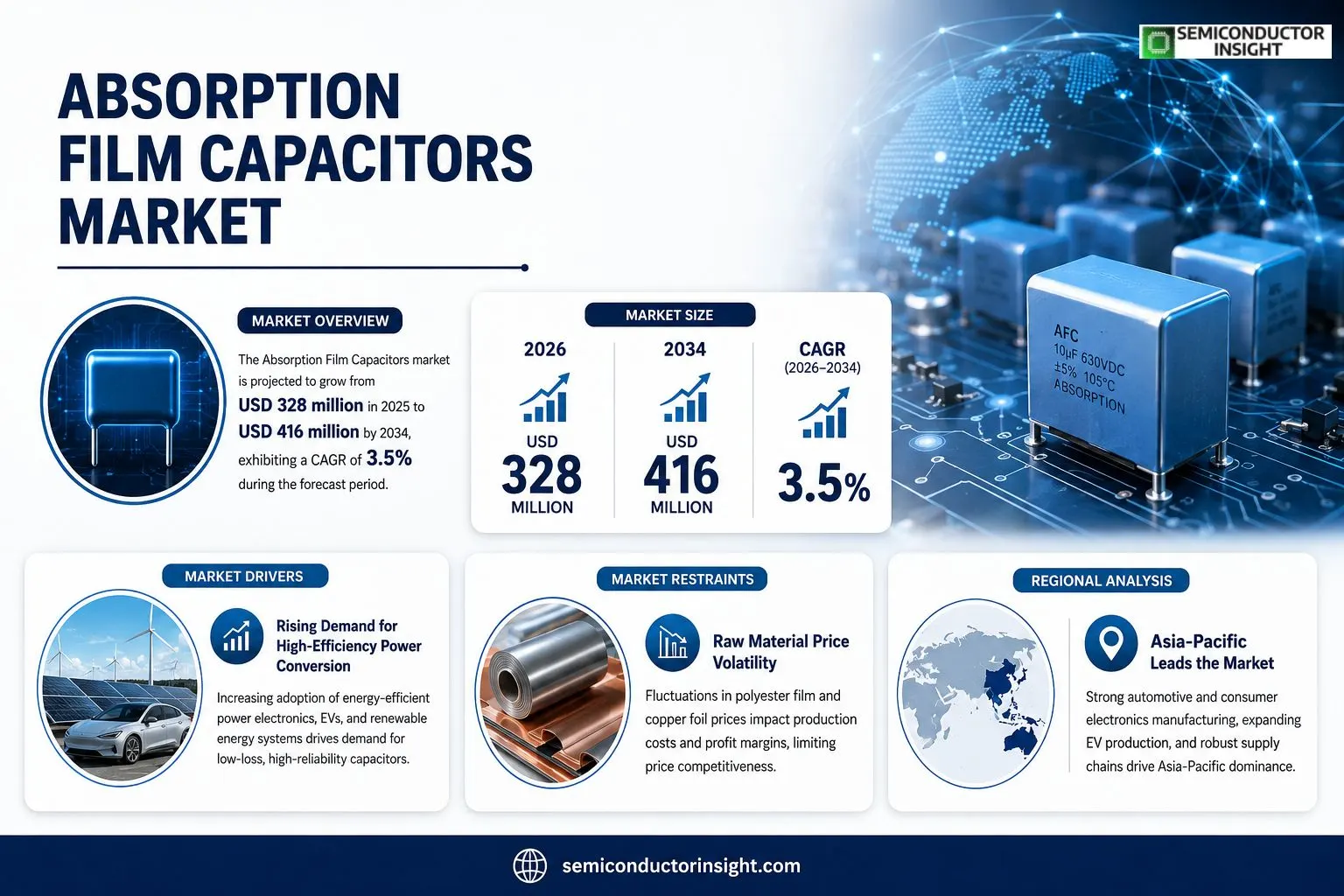
Absorption Film Capacitors market size was USD 328 million in 2025. Forecast indicates the market will rise to USD 416 million by 2034, delivering a CAGR of 3.5 % over the period.
Absorption film capacitorsalso called absorptive film capacitorsare a specialized class of film capacitors designed to absorb resonant energy and suppress harmonic noise in electronic circuits. In 2025 production reached 299 million units, each selling at an average price of USD 1.2. The industry’s annual production capacity stands at roughly 450 million units, supporting a gross profit margin near 20.1 %. These components combine traditional film‑capacitor performance with energy‑absorption capability and are widely deployed in power electronics, communication systems, automotive power‑train modules and aerospace equipment.The upward trajectory stems from expanding demand for high‑efficiency power conversion in new‑energy vehicles, renewable‑energy storage systems and advanced consumer electronics that require low‑loss, high‑voltage solutions. Material innovations have improved dielectric properties while packaging advances enhance heat dissipation and reliability across wide temperature ranges. Supply‑chain localization and cost‑control initiatives are reshaping competitive dynamics; leading manufacturers such as Panasonic, TDK, Vishay and AVX are extending capacity through vertical integration and customized product lines.
MARKET DRIVERS
Rising Demand for High‑Efficiency Power Conversion
Absorption Film Capacitors Market is benefiting from manufacturers’ push toward greener power conversion. Energy‑conserving designs in industrial drives and data‑center supplies require components that can handle ripple currents with low loss, and film capacitors deliver that performance without the leakage typical of electrolytic types. This efficiency imperative nudges OEMs to specify absorption film solutions, creating a steady uptick in volume.
Automotive Electrification and Safety Standards
Electrified powertrain architectures impose stringent safety and reliability criteria on passive parts. Because absorption film capacitors resist temperature drift and exhibit excellent surge handling, they are increasingly chosen for motor‑controller modules and traction‑inverter banks. The transition to hybrid and fully electric vehicles, therefore, translates into a tangible driver for market expansion.
➤ “Manufacturers cite longevity and thermal stability as decisive factors when qualifying components for automotive power modules.”
Beyond automotive, the surge in renewable‑energy installationsparticularly solar‑inverter farmsdemands capacitors that can survive harsh outdoor environments. The combination of durability and predictable aging curves positions absorption film devices as a preferred choice, reinforcing the upward trajectory of the market.
MARKET CHALLENGES
Raw‑Material Price Volatility
The cost of polyester film and high‑purity copper foils, core inputs for absorption capacitors, fluctuates with petrochemical cycles and trade tariffs. Sudden spikes compress margins for contract manufacturers, prompting some customers to postpone large‑scale procurements until price signals stabilize.
Other Challenges
Supply‑Chain Complexity
Component lead times have lengthened as semiconductor fabs and specialty film producers compete for limited capacity. End‑users face scheduling uncertainty, which can dampen the pace of new design launches that rely on absorption film technology.
MARKET RESTRAINTS
High Production Costs Relative to Competing Dielectrics
Absorption film capacitors typically involve multiple winding steps and tighter quality controls, driving unit costs above those of bulk‑type film or ceramic alternatives. Cost‑sensitive segment customersespecially in consumer electronicsopt for cheaper parts, limiting broader market penetration despite the technical merits of the product.
MARKET OPPORTUNITIES
Emergence of High‑Frequency Telecom Infrastructure
The rollout of 5G and forthcoming 6G networks calls for power‑distribution units that can operate at elevated switching frequencies. Absorption film capacitors, with their low equivalent series resistance and stable dielectric behavior, fit the bill for base‑station amplifiers and RF front‑end modules. This niche presents a growth avenue that could offset price pressures in other segments of Absorption Film Capacitors Market.
Absorption Film Capacitors Market Trends
Automotive Electrification and Energy‑Storage Demand
The surge in electric‑vehicle production and the expansion of stationary energy‑storage installations have created a pronounced need for components that combine high voltage tolerance with low loss. Absorption Film Capacitors, with their ability to damp resonant disturbances, are being specified more frequently in traction inverters and battery‑management systems. This shift is not merely a volume increase; it reflects a strategic move by OEMs to improve power‑quality metrics and extend the operational lifespan of high‑power electronics. Consequently, manufacturers are recalibrating their product mixes toward higher‑voltage, high‑capacity formats that meet the stricter reliability standards demanded by automotive and grid‑storage applications.
Other Trends
Supply‑Chain Localization
Geopolitical uncertainty and rising logistics costs have pushed leading suppliers to bring critical inputssuch as pulse‑width‑modulation films and specialty dielectricscloser to their assembly sites. This trend reduces lead‑time volatility and enables tighter control over material quality, which is essential for maintaining the 20.1% gross‑profit margin reported across the sector. Companies that have invested in regional production hubs are also better positioned to offer price‑competitive solutions, a decisive factor as end‑users in automotive and consumer‑electronics markets press for cost‑effective yet high‑performance components.
Material and Packaging Innovation
Advances in polymer science have yielded polypropylene and polyphenylene‑sulfide films with superior dielectric strength and lower dissipation factors. Parallel improvements in heat‑sink designs and compact packaging allow higher power density without sacrificing thermal stability. These technical gains address the industry’s long‑standing challenge of delivering reliable performance across a wide temperature envelope, thereby opening opportunities in aerospace where stringent environmental specifications prevail.
Competitive Consolidation and Vertical Integration
Strategic acquisitions and capacity expansions dominate the recent competitive landscape. Major players are acquiring niche manufacturers to secure access to proprietary electrode structures and to internalize key stages of the value chain, from raw‑material processing to final test. This consolidation yields economies of scale that support customized solutions for high‑volume automotive programs while preserving margins. The resulting market configuration favors firms that can blend scale with agility, a combination that will shape the trajectory of Absorption Film Capacitors Market over the next decade.
COMPETITIVE LANDSCAPE
Key Industry Players
Absorption Film Capacitors Market – Competitive Overview
Panasonic dominates the absorption‑film segment by leveraging its long‑standing expertise in power electronics and its vertically integrated supply chain, which spans from polymer film production to end‑product assembly. The firm’s capacity expansion in China and Southeast Asia has locked in a cost advantage, while its focus on high‑reliability modules for automotive and aerospace clients reinforces a premium pricing posture. This scale enables Panasonic to capture a sizable share of the $416 million market forecast for 2034, translating into robust gross margins that outpace newer entrants. The competitive architecture therefore revolves around a handful of multinational entities that command both technology patents and the bulk of production capacity, leaving limited room for fragmentation.Beyond the tier‑one group, a constellation of niche players is reshaping regional dynamics. Companies such as Nichicon, TDK and Vishay maintain strong footholds in North America and Europe by offering customized dielectric formulations that meet stringent automotive EN‑EL standards. Asian specialistsincluding Zhongxing, Shizuki Electric, WIMA GmbH, Yageo (Kemet), KYOCERA AVX and XIAMEN FARATRONICfocus on cost‑effective volume output, often securing supply‑chain contracts with consumer‑electronics OEMs. Emerging firms like TONGFENG ELECTRONICS, Guangdong Fengming Electronic Technology and Jianghai pursue aggressive capacity builds to cater to the new‑energy vehicle surge, while GUILIN POWER CAPACITOR and KNSCHA invest in advanced heat‑dissipation packaging to serve aerospace applications. This layered competitive set forces incumbents to prioritize innovation cycles and localized sourcing as decisive levers for market share growth.
List of Key Absorption Film Capacitors Companies Profiled
- Panasonic
- Nichicon Corporation
- TDK
- Vishay
- AVX Corporation
- Zhongxing
- Shizuki Electric
- WIMA GmbH
- Yageo (Kemet)
- KYOCERA AVX
- XIAMEN FARATRONIC
- TONGFENG ELECTRONICS
- Guangdong Fengming Electronic Technology
- Jianghai
- GUILIN POWER CAPACITOR
- KNSCHA
- EAGTOP
- SHENGYE ELECTRIC
- Guorui Technology
Segment Analysis:
| Segment Category | Sub-Segments | Key Insights |
| By Type |
|
AC Absorption Film Capacitors are favoured for their ability to handle alternating polarity and provide robust noise suppression; they are widely adopted in power conversion modules where harmonic mitigation is critical. • Their construction allows for efficient energy absorption during transient events, enhancing circuit reliability. • Manufacturers emphasize material purity and electrode design to improve dielectric stability under AC stress. |
| By Application |
|
Automotive drives innovation as vehicles demand high‑reliability components for power‑train control and infotainment; absorption film capacitors help dampen EMI from electric drive systems. • In consumer electronics, compact designs require capacitors that combine low loss with effective noise attenuation, supporting portable device performance. • Aerospace applications value the long lifespan and temperature resilience of these capacitors, ensuring mission‑critical stability under extreme conditions. |
| By End User |
|
Power Electronics rely on absorption film capacitors to mitigate voltage spikes and harmonic distortion in converters; this enhances overall system efficiency. • Communication infrastructure benefits from reduced signal interference, ensuring clearer data transmission in high‑frequency networks. • Renewable energy installations, such as solar inverters, adopt these capacitors to improve grid‑interface stability and protect against transient overloads. |
| By Voltage Rating |
|
Medium Voltage segments dominate design discussions because they balance performance and cost for most industrial applications; they enable effective energy absorption without excessive size. • High‑Voltage variants are critical for aerospace and high‑power grid equipment where extreme stress tolerance is mandatory. • Low‑Voltage products serve consumer‑grade devices, where compactness and low ESR are paramount. |
| By Dielectric Material |
|
Polypropylene Film is prized for its low dielectric loss and excellent thermal stability, making it a preferred choice for high‑frequency absorption tasks. • Polyester offers superior mechanical flexibility, supporting applications where form factor constraints exist. • Polyphenylene sulfide delivers high temperature resistance, aligning with aerospace and automotive power‑train demands. • PTFE provides exceptional chemical inertness, valuable in specialized industrial environments. |
Regional Analysis: Absorption Film Capacitors Market
Asia-Pacific
China’s fab capacity continues to dominate, yet capacity constraints are prompting diversified output across Vietnam and the Philippines. These emerging sites leverage automated line tooling that mirrors legacy processes, ensuring component consistency while reducing lead times for regional OEMs.
Recent disruptions highlighted the value of multi‑sourcing strategies. Companies are now mapping tier‑two suppliers in the region, creating buffer inventories of high‑spec film rolls to safeguard production continuity during logistics bottlenecks.
Environmental directives in Japan and South Korea increasingly require low‑emission manufacturing. Firms adopting water‑based coating technologies gain compliance headroom and differentiate their product portfolios in green‑focused segments.
The shift toward silicon‑carbide inverters for electric vehicles amplifies demand for capacitors that can tolerate high surge currents. Asian suppliers that can certify their film capacitors for these stress profiles capture a premium market niche.
North America
In North America, Absorption Film Capacitors Market is anchored by defense‑related applications and advanced industrial automation. Suppliers benefit from a robust IP framework that encourages incremental innovation in low‑dielectric‑loss technologies. However, the market faces upward pressure from stringent RoHS compliance, pushing manufacturers to adopt halogen‑free laminates. Clients increasingly evaluate component lifecycle support, prompting tier‑one distributors to bundle value‑added services such as parametric testing and extended warranty programs. The outcome is a competitive landscape where technical differentiation, rather than price alone, determines market share.
Europe
European players view Absorption Film Capacitors Market through the prism of energy‑efficiency mandates and the expansion of renewable‑energy infrastructures. The EU’s emphasis on grid stability fuels demand for capacitors that can sustain long‑duration voltage smoothing in wind‑farm converters. Concurrently, a fragmented supplier base has spurred consolidation, with several mid‑size firms merging to secure broader portfolio breadth. This consolidation enhances bargaining power with automotive OEMs seeking standardized components across multiple vehicle platforms, thereby streamlining procurement cycles.
South America
South America’s involvement in Absorption Film Capacitors Market is characterized by incremental growth tied to telecom upgrades and emerging renewable projects. Brazil’s investment in wind farms has opened niches for capacitors that operate reliably under high humidity and temperature swings. Local manufacturers, still scaling capacity, rely heavily on technology transfer agreements with Asian firms, allowing them to meet regional certification standards while keeping cost structures competitive. The region’s trajectory hinges on further infrastructure spending and the ability to internalize advanced film‑forming techniques.
Middle East & Africa
The Middle East & Africa region presents a differentiated picture, where oil‑rich economies are diversifying into high‑tech manufacturing zones. In the United Arab Emirates and Saudi Arabia, government‑backed industrial parks are attracting capacitor producers looking to serve aerospace and data‑center customers in the region. Environmental conditionsextreme heat and sand exposurenecessitate ruggedized film capacitors, prompting suppliers to develop enhanced encapsulation methods. While overall market size remains modest, the strategic intent to build localized supply chains suggests a gradual but meaningful expansion of Absorption Film Capacitors Market across the region.
Report Scope
This market research report provides a comprehensive analysis of the Absorption Film Capacitors Market , covering the forecast period 2026–2034. It offers detailed insights into market dynamics, technological advancements, competitive landscape, and key trends shaping the industry.
Key focus areas of the report include:
- Market Overview: The report begins with an overview outlining its current market scenario, key growth indicators, and industry transformation drivers. It discusses macroeconomic factors, demand–supply balance, regulatory landscape, and the strategic role of semiconductors in powering advancements across industries such as automotive, telecommunications, consumer electronics, and industrial automation.
- Market Size & Forecast: Historical data and future projections for revenue, unit shipments, and market value across major regions and segments.
- Segmentation Analysis: Detailed breakdown by product type, technology, application, and end-user industry to identify high-growth segments and investment opportunities.
- Regional Insights: Insights into market performance across North America, Europe, Asia-Pacific, Latin America, and the Middle East & Africa, including country-level analysis where relevant.
- Competitive Landscape: Profiles of leading market participants, including their product offerings, R&D focus, manufacturing capacity, pricing strategies, and recent developments such as mergers, acquisitions, and partnerships.
- Technology Trends & Innovation: Assessment of emerging technologies, integration of AI/IoT, semiconductor design trends, fabrication techniques, and evolving industry standards.
- Market Drivers & Restraints: Evaluation of factors driving market growth along with challenges, supply chain constraints, regulatory issues, and market-entry barriers.
- Stakeholder Insights: Insights for component suppliers, OEMs, system integrators, investors, and policymakers regarding the evolving ecosystem and strategic opportunities.
Primary and secondary research methods are employed, including interviews with industry experts, data from verified sources, and real-time market intelligence to ensure the accuracy and reliability of the insights presented.
FREQUENTLY ASKED QUESTIONS:
What is the current market size of Absorption Film Capacitors Market?
-> Absorption Film Capacitors Market was valued at USD 328 million in 2025 and is expected to reach USD 416 million by 2034, at a CAGR of 3.5% during the forecast period.
Which key companies operate in Absorption Film Capacitors Market?
-> Key players include Panasonic, Nichicon Corporation, TDK, Vishay, AVX Corporation, Zhongxing, Shizuki Electric, WIMA GmbH, Yageo (Kemet), KYOCERA AVX, XIAMEN FARATRONIC, TONGFENG ELECTRONICS, Guangdong Fengming Electronic Technology, Jianghai, GUILIN POWER CAPACITOR, KNSCHA, EAGTOP, SHENGYE ELECTRIC, Guorui Technology.
What are the key growth drivers?
-> Key growth drivers include stable demand from new energy, energy storage, consumer electronics, and automotive electronics for high‑capacity, high‑voltage, low‑loss capacitors; material advancements that improve dielectric properties; and increasing requirements for reliability, wide temperature range, and long lifespan.
Which region dominates the market?
-> Asia holds the largest market share, driven by strong automotive and consumer electronics manufacturing bases, while North America and Europe remain significant secondary markets.
What are the emerging trends?
-> Emerging trends feature improved dielectric materials, innovative packaging and heat‑dissipation technologies, accelerated localization of supply chains, cost‑control initiatives, and capacity expansion through vertical integration and customized solutions.
Get Sample Report PDF for Exclusive Insights
Report Sample Includes
- Table of Contents
- List of Tables & Figures
- Charts, Research Methodology, and more...
 Download Sample Report PDF