5G Small Cell SoC Market Insights
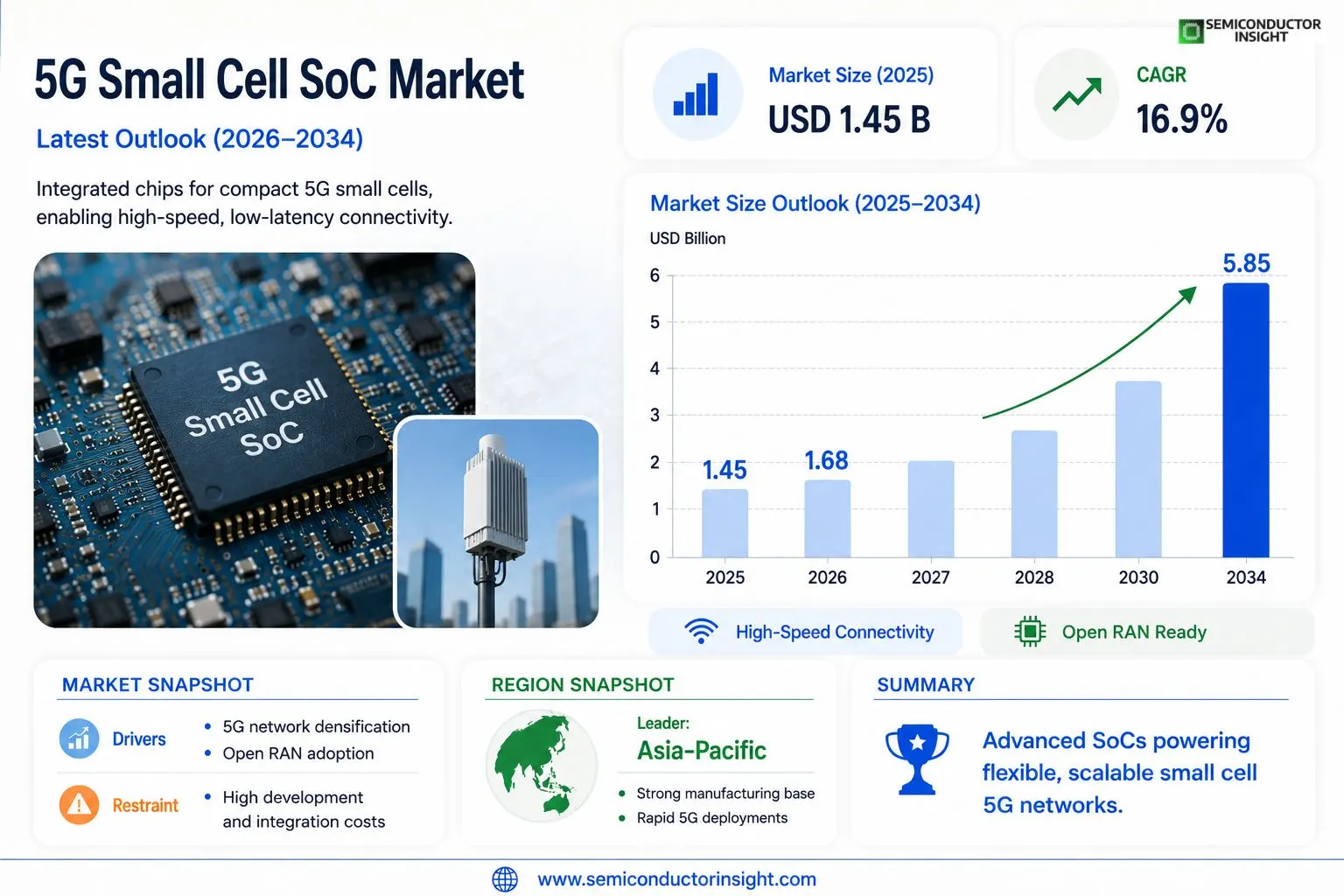
Global 5G Small Cell SoC market size was valued at USD 1.45 billion in 2025. The market is projected to grow from USD 1.68 billion in 2026 to USD 5.85 billion by 2034, exhibiting a CAGR of 16.9% during the forecast period.
5G Small Cell SoCs are highly integrated semiconductor solutions designed specifically for compact 5G radio units and base stations. These system-on-chips combine baseband processing, radio frequency capabilities, power management, and other essential functions onto a single die. They enable efficient deployment of small cells that enhance network capacity and coverage in dense urban environments, enterprises, and private networks while addressing challenges related to power consumption, size, and cost.
The market is experiencing robust growth due to several factors, including the accelerating global rollout of 5G infrastructure, surging demand for high-speed low-latency connectivity, and the proliferation of data-intensive applications such as IoT, smart cities, and edge computing. Furthermore, the shift toward Open RAN architectures is creating opportunities for specialized SoC solutions that support flexible and cost-effective deployments. However, complexities in integration and spectrum management present ongoing challenges for stakeholders. Initiatives by key players continue to drive innovation in this space. For instance, Picocom introduced the PC805, an industry-leading PHY SoC optimized for 5G NR/LTE small cell Open RAN radio units, facilitating lower power consumption and simplified implementations across enterprise and industrial use cases. Qualcomm Technologies, MediaTek, and Marvell are among the key players that operate in the market with comprehensive portfolios supporting advanced 5G small cell deployments.
MARKET DRIVERS
Rising Demand for Network Densification and High-Speed Connectivity
5G Small Cell SoC Market is propelled by the exponential growth in mobile data traffic and the need for enhanced network capacity in urban and indoor environments. As 5G adoption accelerates, operators deploy small cells to complement macro networks, requiring efficient, integrated System on Chip solutions that handle baseband processing, RF capabilities, and power management in compact form factors. [[1]](https://www.skyquestt.com/report/small-cell-5g-network-market) [[2]](https://www.fortunebusinessinsights.com/industry-reports/5g-small-cell-market-101600)
Advancements in Open RAN and AI Integration
Innovations in Open RAN architectures are driving demand for specialized SoCs optimized for 5G small cell radio units. Companies are developing low-power, highly integrated chips that support flexible deployments in enterprise, industrial, and private networks, incorporating AI for optimized performance and energy efficiency. [[3]](https://picocom.com/picocom-introduces-industrys-first-system-on-chip-for-5g-small-cell-open-ran-radio-units/) [[4]](https://www.fierce-network.com/wireless/edgeq-takes-ai-5g-small-cell)
➤ The integration of AI-enabled processing in small cell SoCs enables real-time network optimization and supports emerging use cases like Industrial IoT and smart cities.
Government initiatives and spectrum allocations further accelerate deployments, boosting the need for advanced 5G Small Cell SoCs that deliver low-latency, high-throughput connectivity while maintaining cost-effectiveness for mass adoption. [[2]](https://www.fortunebusinessinsights.com/industry-reports/5g-small-cell-market-101600)
MARKET CHALLENGES
Technical Integration and Performance Optimization
Developing SoCs for 5G small cells involves complex integration of multiple functions including baseband, RF front-end, and power management while meeting stringent thermal and size constraints for dense deployments.
Other Challenges
Backhaul and Infrastructure Limitations
Limited availability of high-capacity fiber backhaul in many regions constrains the performance of small cell SoC-powered deployments, requiring innovative solutions for wireless or alternative connectivity options.
Interference Management in Dense Environments
Coexistence with macro cells and other small cells creates interference challenges that SoC designs must address through advanced beamforming and signal processing capabilities.
MARKET RESTRAINTS
High Development and Deployment Costs
5G Small Cell SoC Market faces restraints from elevated costs associated with designing and manufacturing advanced semiconductor solutions tailored for small cell applications. High R&D expenses for integrating 5G NR capabilities, AI acceleration, and low-power features limit broader participation, particularly for smaller vendors. [[5]](https://greyb.com/blog/5g-chipset-market/) [[2]](https://www.fortunebusinessinsights.com/industry-reports/5g-small-cell-market-101600)
Regulatory hurdles, permitting complexities, and spectrum allocation delays in various markets further slow adoption and increase overall project timelines for small cell deployments utilizing these SoCs. [[6]](https://market.us/report/small-cell-5g-network-market/)
MARKET OPPORTUNITIES
Expansion in Private Networks and Enterprise Applications
Significant opportunities exist in private 5G networks for industrial, enterprise, and neutral host deployments, where specialized Small Cell SoCs enable cost-effective, customizable solutions with edge computing capabilities. [[3]](https://picocom.com/picocom-introduces-industrys-first-system-on-chip-for-5g-small-cell-open-ran-radio-units/)
The proliferation of IoT devices and smart city initiatives creates demand for low-power, AI-integrated SoCs that support massive connectivity and ultra-reliable low-latency communications in compact small cell form factors. [[1]](https://www.skyquestt.com/report/small-cell-5g-network-market)
5G Small Cell SoC Market Trends
Integration of Open RAN Architectures in 5G Small Cell SoC Solutions
5G Small Cell SoC Market is witnessing significant momentum from the industry shift toward Open RAN architectures. These system-on-chips serve as highly integrated semiconductor solutions tailored for compact 5G radio units and base stations. By combining baseband processing, radio frequency capabilities, power management, and essential functions onto a single die, 5G Small Cell SoC technologies enable more flexible and cost-effective network deployments across dense urban environments, enterprises, and private networks.
Other Trends
Focus on Power Efficiency and Compact Design
Power consumption, physical size, and overall cost remain critical considerations in small cell deployments. Leading 5G Small Cell SoC solutions address these challenges by delivering optimized performance that supports high-speed, low-latency connectivity required for data-intensive applications including IoT, smart cities, and edge computing. This integration helps network operators enhance capacity and coverage while maintaining operational efficiency.
Addressing Integration and Spectrum Management Challenges
Stakeholders in 5G Small Cell SoC Market continue to navigate complexities related to system integration and spectrum management. Ongoing innovation focuses on creating specialized SoC platforms that simplify implementation and support multi-standard operations, ensuring seamless performance in diverse deployment scenarios.
Key Player Innovations Shaping Market Evolution
Industry participants are actively advancing 5G Small Cell SoC technologies to meet growing demand. For instance, Picocom introduced the PC805, an industry-leading PHY SoC optimized for 5G NR/LTE small cell Open RAN radio units. This development facilitates lower power consumption and simplified implementations particularly suited for enterprise and industrial use cases. Major players including Qualcomm Technologies, MediaTek, and Marvell maintain comprehensive portfolios that support advanced 5G small cell deployments, contributing to accelerated global 5G infrastructure rollout and enhanced network capabilities.
COMPETITIVE LANDSCAPEKey Industry Players
5G Small Cell SoC Market Features Intense Competition Among Semiconductor Leaders Driving Open RAN Innovation
5G Small Cell SoC Market is led by established semiconductor giants such as Qualcomm Technologies, which maintains a dominant position through its comprehensive portfolio of integrated solutions optimized for small cell deployments. These highly integrated chips combine baseband processing, RF capabilities, and power management to support efficient, low-power operations in dense urban and enterprise environments. The market structure reflects a blend of broad-platform providers and specialized innovators, with increasing emphasis on Open RAN compatibility to enable flexible and cost-effective network densification.
Other significant players include MediaTek, Marvell Technology, and emerging specialists like Picocom, which focus on niche applications with optimized PHY SoCs for small cell Open RAN radio units. Additional contributors such as Samsung, Huawei, and Intel enhance the competitive dynamics by offering advanced silicon solutions that address power consumption, integration challenges, and support for data-intensive applications including IoT and edge computing.
List of Key 5G Small Cell SoC Companies Profiled
- Qualcomm Technologies
- MediaTek
- Marvell Technology
- Picocom
- Samsung Electronics
- Huawei Technologies (HiSilicon)
- Intel Corporation
- Analog Devices
- NXP Semiconductors
- Qorvo
- Infineon Technologies
- Octasic
- CommAgility
- Airspan Networks
- Parallel Wireless
Segment Analysis:
| Segment Category | Sub-Segments | Key Insights |
| By Type |
|
Multi-Function Integrated SoCs lead due to their ability to consolidate baseband, radio frequency, and power management functions on a single chip, resulting in compact designs ideal for space-constrained small cell deployments. These solutions deliver superior power efficiency and streamlined thermal management, enabling reliable performance in demanding environments. They also facilitate faster time-to-market for equipment manufacturers by reducing component complexity and integration challenges. This integration supports seamless handling of high-throughput data flows while maintaining low latency characteristics essential for advanced 5G use cases. |
| By Application |
|
Indoor Enterprise Coverage stands out as enterprises increasingly adopt small cells to create high-capacity, low-latency wireless environments within office buildings, campuses, and industrial facilities. These applications benefit from SoCs optimized for reliable signal penetration through walls and support for dense user concentrations. The solutions enable seamless integration with existing IT infrastructure and facilitate advanced applications such as real-time collaboration tools, IoT device orchestration, and immersive experiences. Their flexibility allows organizations to maintain consistent connectivity quality while scaling operations efficiently. |
| By End User |
|
Enterprises and Corporations represent a dynamic segment as organizations seek greater control over their wireless infrastructure to support digital transformation initiatives. These users prioritize SoCs that offer easy deployment, robust security features, and compatibility with private network architectures. The solutions empower businesses to deliver consistent high-performance connectivity tailored to specific operational requirements, enhancing productivity through reliable edge processing capabilities. They also support the convergence of IT and OT systems in modern enterprise settings. |
| By Architecture |
|
Open RAN Compatible architectures gain prominence by promoting interoperability and vendor flexibility in small cell deployments. These SoCs enable operators and enterprises to mix components from different suppliers, fostering innovation and cost optimization across the network ecosystem. They accelerate the adoption of software-defined approaches that enhance network programmability and remote management capabilities. This flexibility proves particularly valuable for rapidly evolving 5G environments where customization and future-proofing are critical considerations. |
| By Frequency Band |
|
Multi-Band Capable SoCs excel by supporting seamless operation across diverse spectrum allocations, allowing small cells to adapt to varying regulatory environments and deployment scenarios. These versatile chips deliver balanced performance characteristics that combine coverage reach with high capacity potential. They simplify network planning for operators by reducing the need for specialized hardware variants and enable smooth transitions between frequency bands based on real-time demand. This adaptability enhances overall network resilience and user experience consistency across different geographic and operational contexts. |
Regional Analysis: 5G Small Cell SoC Market
Asia-Pacific
Asia-Pacific stands as the leading region in 5G Small Cell SoC Market, driven by aggressive infrastructure deployment and technological leadership in key economies. Countries across the region are prioritizing network densification to support ultra-high data speeds and low latency applications essential for smart cities, industrial automation, and massive IoT ecosystems. The integration of advanced System on Chip solutions enables compact, power-efficient small cells that blend seamlessly into dense urban environments while delivering superior performance for edge computing tasks.Semiconductor innovation thrives here through close collaboration between chipset designers, telecom operators, and equipment manufacturers, accelerating the development of specialized SoCs optimized for 5G small cell requirements including beamforming, multi-band support, and AI-driven network optimization. Rapid urbanization creates sustained demand for enhanced mobile broadband and private networks in enterprise settings, where small cell SoCs play a critical role in delivering reliable connectivity without extensive macro infrastructure. Government initiatives focused on digital transformation further catalyze adoption, fostering an environment where next-generation wireless technologies integrate deeply with emerging applications like autonomous vehicles and immersive digital experiences. This dynamic ecosystem positions Asia-Pacific at the forefront of 5G Small Cell SoC innovation and commercialization through 2034.
North America demonstrates strong momentum in 5G Small Cell SoC Market through substantial private sector investments and a mature innovation landscape. Focus areas include enterprise deployments and urban coverage enhancement, where advanced SoC designs support high-capacity, low-power solutions tailored for demanding applications. Strategic partnerships between technology providers and network operators drive customization of small cell platforms, emphasizing security features and seamless integration with existing infrastructure for rapid rollout.
Europe advances steadily in 5G Small Cell SoC Market with emphasis on regulatory harmonization and sustainable technology development. Collaborative efforts across member states promote standardized approaches to network densification, where energy-efficient SoCs gain prominence for green deployment strategies. The region prioritizes applications in smart manufacturing and public safety, leveraging small cell solutions to create resilient, high-performance connectivity frameworks that align with broader digital economy objectives.
South America shows emerging potential in 5G Small Cell SoC Market as countries invest in bridging connectivity gaps in metropolitan areas. Growth centers on urban modernization projects where small cell SoCs facilitate cost-effective expansion of 5G services. Local operators explore partnerships with global technology firms to deploy solutions adapted to regional challenges, supporting economic diversification through improved digital infrastructure and enabling new business models in key vertical industries.
Middle East & Africa exhibits growing interest in 5G Small Cell SoC Market fueled by smart city visions and diversification initiatives. Strategic deployments target high-traffic zones and industrial hubs, utilizing compact SoC-powered small cells for efficient coverage. The region benefits from technology transfer and infrastructure partnerships that accelerate 5G readiness, creating opportunities for localized innovation in SoC applications suited to unique environmental and operational requirements.
North America
North America maintains a competitive position in 5G Small Cell SoC Market through its robust ecosystem of semiconductor innovation and telecom leadership. Enterprises and operators prioritize advanced SoC features that deliver exceptional signal processing capabilities and power optimization for dense deployments. The focus remains on integrating small cell technologies with edge AI and private networking solutions, supporting transformative use cases across healthcare, logistics, and entertainment sectors. Collaborative R&D efforts continue to refine SoC architectures for enhanced reliability and scalability in varied deployment scenarios.
Europe
Europe emphasizes balanced growth in 5G Small Cell SoC Market with strong attention to interoperability standards and environmental considerations. Regulatory support encourages widespread adoption of energy-conscious SoC designs that minimize operational footprints while maximizing performance. Cross-border initiatives facilitate knowledge sharing among technology providers, driving advancements tailored to smart infrastructure and sustainable urban development. The market benefits from a strategic approach that aligns small cell deployments with long-term connectivity goals across diverse economic landscapes.
South America
South America is progressively building capabilities within 5G Small Cell SoC Market as digital inclusion becomes a priority. Investments target key urban corridors where compact SoC solutions enable efficient network expansion without prohibitive costs. Emerging collaborations with international players help adapt technologies to local conditions, fostering gradual but meaningful progress in supporting broadband access and industrial applications. This positions the region for accelerated development as 5G ecosystems mature.
Middle East & Africa
The Middle East & Africa region is strategically positioning itself in 5G Small Cell SoC Market through ambitious national transformation programs. Focus areas include enhancing connectivity in commercial and tourism hubs using advanced small cell platforms powered by sophisticated SoCs. Knowledge partnerships and infrastructure projects drive the introduction of tailored solutions that address specific regional demands, supporting economic growth through reliable high-speed wireless networks and innovative service delivery models.
Report Scope
This market research report provides a comprehensive analysis of the 5G Small Cell SoC Market , covering the forecast period 2026–2034. It offers detailed insights into market dynamics, technological advancements, competitive landscape, and key trends shaping the industry.
Key focus areas of the report include:
- Market Overview: The report begins with an overview outlining its current market scenario, key growth indicators, and industry transformation drivers. It discusses macroeconomic factors, demand–supply balance, regulatory landscape, and the strategic role of semiconductors in powering advancements across industries such as automotive, telecommunications, consumer electronics, and industrial automation.
- Market Size & Forecast: Historical data and future projections for revenue, unit shipments, and market value across major regions and segments.
- Segmentation Analysis: Detailed breakdown by product type, technology, application, and end-user industry to identify high-growth segments and investment opportunities.
- Regional Insights: Insights into market performance across North America, Europe, Asia-Pacific, Latin America, and the Middle East & Africa, including country-level analysis where relevant.
- Competitive Landscape: Profiles of leading market participants, including their product offerings, R&D focus, manufacturing capacity, pricing strategies, and recent developments such as mergers, acquisitions, and partnerships.
- Technology Trends & Innovation: Assessment of emerging technologies, integration of AI/IoT, semiconductor design trends, fabrication techniques, and evolving industry standards.
- Market Drivers & Restraints: Evaluation of factors driving market growth along with challenges, supply chain constraints, regulatory issues, and market-entry barriers.
- Stakeholder Insights: Insights for component suppliers, OEMs, system integrators, investors, and policymakers regarding the evolving ecosystem and strategic opportunities.
Primary and secondary research methods are employed, including interviews with industry experts, data from verified sources, and real-time market intelligence to ensure the accuracy and reliability of the insights presented.
FREQUENTLY ASKED QUESTIONS:
What is the current market size of 5G Small Cell SoC Market?
-> 5G Small Cell SoC Market was valued at USD 1.45 billion in 2025 and is expected to reach USD 5.85 billion by 2034.
Which key companies operate in 5G Small Cell SoC Market?
-> Key players include Qualcomm Technologies, MediaTek, Marvell, and Picocom, among others.
What are the key growth drivers?
-> Key growth drivers include accelerating global rollout of 5G infrastructure, surging demand for high-speed low-latency connectivity, and the proliferation of data-intensive applications such as IoT, smart cities, and edge computing.
Which region dominates the market?
-> Asia-Pacific is the fastest-growing region with significant 5G deployments.
What are the emerging trends?
-> Emerging trends include shift toward Open RAN architectures, highly integrated low-power SoC designs, and specialized solutions for enterprise and industrial small cells.

Get Sample Report PDF for Exclusive Insights
Report Sample Includes
- Table of Contents
- List of Tables & Figures
- Charts, Research Methodology, and more...