5G Open RAN (O-RAN) Distributed Unit (DU) Chip Market Insights
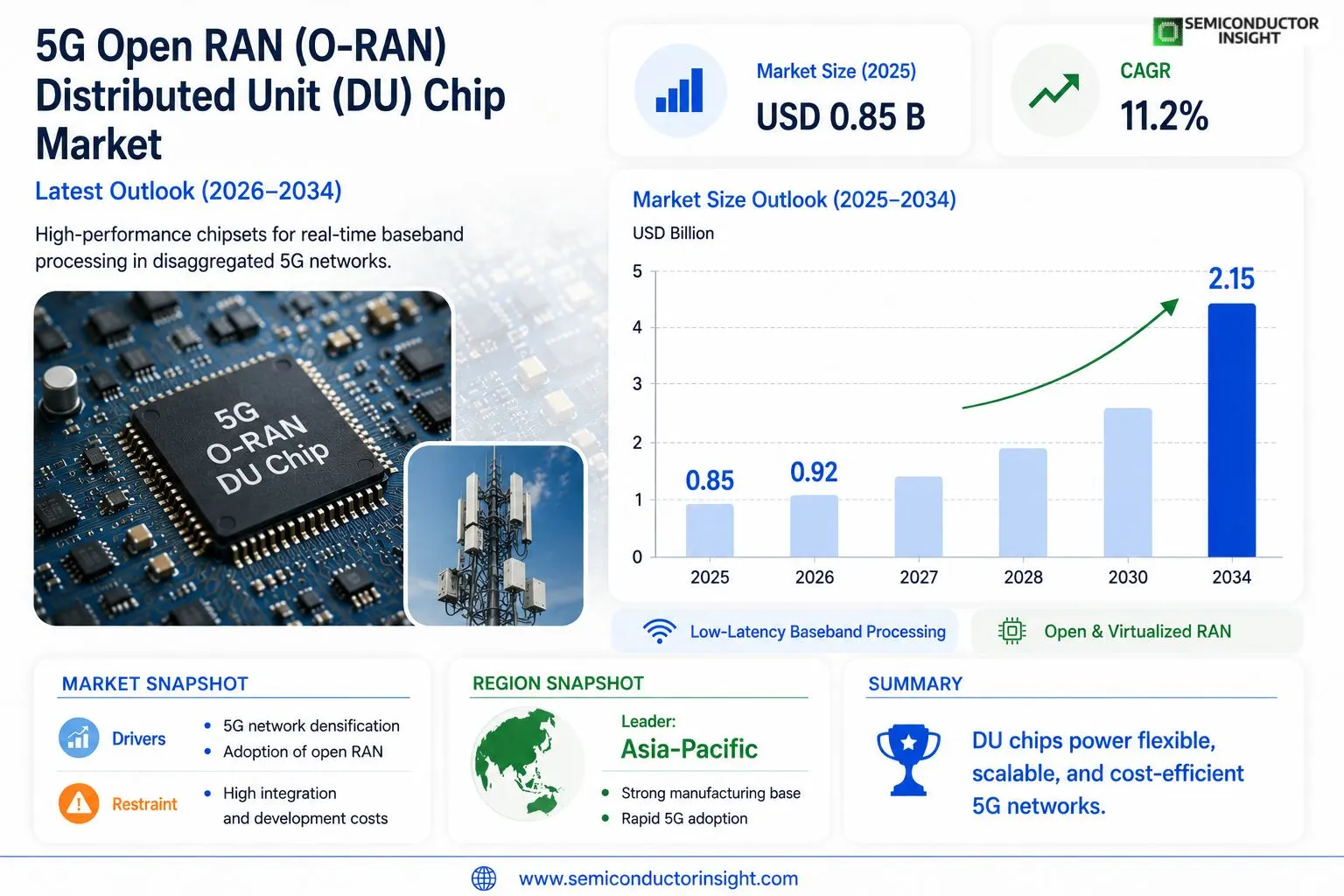
Global 5G Open RAN (O-RAN) Distributed Unit (DU) Chip Market size was valued at USD 0.85 billion in 2025. The market is projected to grow from USD 0.92 billion in 2026 to USD 2.15 billion by 2034, exhibiting a CAGR of 11.2% during the forecast period.
5G Open RAN (O-RAN) Distributed Unit (DU) chips are specialized semiconductors designed to handle real-time baseband processing, including MAC, RLC, and high-PHY layer functions within disaggregated Open RAN architectures. These chips enable the separation of radio units from baseband processing, supporting multi-vendor interoperability, cloud-native deployments, and scalable 5G network performance. Key technologies in these chips include hardware acceleration for low-latency operations, power-efficient processing, and compatibility with O-RAN Alliance standards for fronthaul interfaces.
The market is experiencing steady growth due to several factors, including Global push for 5G network densification, rising adoption of open and virtualized RAN solutions by telecom operators, and increasing demand for flexible, cost-effective infrastructure. Furthermore, advancements in semiconductor design for edge computing and AI-optimized network functions are contributing to market expansion. Initiatives by key players in the market are also expected to fuel the market growth. For instance, collaborations between chipset manufacturers and system integrators have accelerated the development of accelerator cards and processors tailored for DU workloads. Intel, Marvell, Qualcomm, and AMD are some of the key players that operate in the market with a wide range of portfolios.
MARKET DRIVERS
Rising Demand for Network Flexibility and Disaggregation
5G Open RAN (O-RAN) Distributed Unit (DU) Chip Market is propelled by telecom operators’ increasing need for flexible, scalable, and multi-vendor network architectures. As 5G deployments accelerate globally, the shift toward disaggregated RAN enables easier upgrades, optimizations, and integration of best-of-breed components, allowing operators to reduce vendor lock-in and accelerate innovation in baseband processing. [[1]](https://www.marketsandmarkets.com/Market-Reports/open-ran-market-153445936.html)
Global 5G Expansion and Cost Optimization
Extensive 5G network rollouts worldwide continue to drive demand for efficient DU solutions that support real-time baseband processing, low-latency operations, and resource allocation. Open RAN architectures, including advanced DU chips, help lower total cost of ownership through virtualization on COTS hardware and promote vendor diversification, with 5G commanding a dominant share of Open RAN investments. [[2]](https://www.mordorintelligence.com/industry-reports/open-ran-market)
➤ The 5G Open RAN DU chip ecosystem supports critical functions in data aggregation and processing, enabling operators to meet escalating demands for high-density urban coverage and enterprise applications.
Advancements in chipset technologies from vendors like Intel, Qualcomm, and others further enhance performance and energy efficiency in O-RAN compliant DUs, fostering broader adoption across public and private networks.
MARKET CHALLENGES
Interoperability and Integration Complexities
Achieving seamless interoperability between multi-vendor DU chips, software, and radio units remains a significant hurdle in 5G Open RAN (O-RAN) Distributed Unit (DU) Chip Market. Extensive testing and validation are required to ensure compliance with O-RAN specifications, which can extend deployment timelines and increase initial costs for operators. [[3]](https://www.intelmarketresearch.com/g-open-ran-distributed-unit-market-25117)
Other Challenges
Performance and Scalability Demands
Maintaining carrier-grade performance and real-time processing capabilities in virtualized environments poses ongoing technical challenges, with operators noting gaps compared to traditional proprietary systems that require continuous optimization of DU chip solutions.
Energy Efficiency and Power Consumption
High computational demands of 5G DU processing in dense deployments drive the need for more power-efficient chip designs, as energy costs and sustainability goals influence large-scale O-RAN implementations.
MARKET RESTRAINTS
Legacy Infrastructure and High Integration Costs
Substantial existing investments in proprietary RAN equipment create financial barriers to rapid migration toward 5G Open RAN (O-RAN) Distributed Unit (DU) Chip solutions. Operators often face amortization periods spanning several years, slowing the transition despite the long-term benefits of open architectures. [[1]](https://www.marketsandmarkets.com/Market-Reports/open-ran-market-153445936.html)
Additionally, the complexity and costs associated with integrating multi-vendor components, including rigorous interoperability testing for DU chips, restrain faster market expansion in brownfield deployments.
MARKET OPPORTUNITIES
Private Networks and Enterprise Adoption
5G Open RAN (O-RAN) Distributed Unit (DU) Chip Market presents strong growth potential in private 5G networks across manufacturing, logistics, and smart cities. These deployments benefit from the customization, low-latency performance, and vendor flexibility offered by advanced DU chip solutions. [[3]](https://www.intelmarketresearch.com/g-open-ran-distributed-unit-market-25117)
Cloud-native virtualization and AI-driven optimizations further expand opportunities, enabling scalable, efficient DU implementations that align with evolving 5G-Advanced requirements and support broader ecosystem innovation through O-RAN Alliance standards.
5G Open RAN (O-RAN) Distributed Unit (DU) Chip Market Trends
Rising Adoption of Open and Virtualized RAN Solutions
5G Open RAN (O-RAN) Distributed Unit (DU) Chip Market is witnessing significant momentum driven by the increasing preference for open and virtualized RAN architectures among telecom operators. These specialized chips play a critical role in handling real-time baseband processing tasks, including MAC, RLC, and high-PHY layer functions, enabling the disaggregation of network components. This separation supports enhanced multi-vendor interoperability and facilitates cloud-native deployments that improve overall 5G network scalability and performance.
Other Trends
5G Network Densification Initiatives
Global efforts toward 5G network densification continue to propel demand for advanced DU chips. Operators are expanding small cell deployments and enhancing coverage in urban and suburban areas, requiring efficient, power-optimized semiconductor solutions compatible with O-RAN Alliance standards. These chips deliver hardware acceleration for low-latency operations while maintaining compatibility with fronthaul interfaces essential for high-performance disaggregated networks.
Integration of Edge Computing and AI Capabilities
Advancements in semiconductor design are increasingly incorporating edge computing features and AI-optimized network functions within 5G Open RAN (O-RAN) Distributed Unit (DU) chips. This evolution allows for more intelligent resource allocation and dynamic performance adjustments, addressing the complex requirements of modern 5G applications. Manufacturers are focusing on power-efficient processing architectures that balance computational demands with energy consumption constraints in distributed network environments.
Strategic Collaborations Among Industry Leaders
Collaborations between chipset manufacturers and system integrators have accelerated innovation in 5G Open RAN (O-RAN) Distributed Unit (DU) Chip Market. Companies such as Intel, Marvell, Qualcomm, and AMD are developing specialized accelerator cards and processors tailored specifically for DU workloads. These partnerships are strengthening the ecosystem by promoting standardized interfaces and enabling faster deployment of flexible, cost-effective 5G infrastructure solutions that meet diverse operator requirements worldwide.
The convergence of these trends underscores the transformative potential of DU chips in building more open, efficient, and future-ready 5G networks. As operators prioritize interoperability and scalability, continued technological refinements in chip design are expected to sustain steady market evolution focused on performance optimization and operational flexibility.
COMPETITIVE LANDSCAPE
Key Industry Players
5G Open RAN (O-RAN) Distributed Unit (DU) Chip Market Competitive Landscape
5G Open RAN (O-RAN) Distributed Unit (DU) Chip Market is led by Intel, which maintains a dominant position through its extensive portfolio of Xeon processors and FlexRAN software solutions optimized for real-time baseband processing in disaggregated architectures. The market structure features a mix of established semiconductor giants offering general-purpose processors with hardware acceleration and specialized players developing inline accelerators tailored for low-latency O-RAN fronthaul and high-PHY functions, enabling multi-vendor interoperability and cloud-native deployments.
Other significant players include Marvell with its OCTEON platforms, Qualcomm providing dedicated accelerator solutions, and AMD advancing competitive CPU and acceleration options. Niche contributors such as EdgeQ, NXP Semiconductors, and emerging entrants further diversify the ecosystem, supporting power-efficient designs and AI-optimized network functions amid growing demand for scalable 5G infrastructure.
List of Key 5G Open RAN (O-RAN) Distributed Unit (DU) Chip Companies Profiled
- Intel Corporation
- Marvell Technology
- Qualcomm Technologies
- AMD (Advanced Micro Devices)
- NXP Semiconductors
- Broadcom Inc.
- EdgeQ
- Picocom
- MaxLinear
- Samsung Electronics
- NVIDIA Corporation
- ARM Holdings
- Fujitsu Limited
- NEC Corporation
- Mavenir
Segment Analysis:
| Segment Category | Sub-Segments | Key Insights |
| By Type |
|
Custom ASICs lead the market by delivering optimized real-time baseband processing capabilities essential for handling MAC, RLC, and high-PHY functions in disaggregated Open RAN environments.
|
| By Application |
|
Small Cell Deployments represent the leading application segment as operators focus on network densification to enhance coverage and capacity in urban and indoor environments.
|
| By End User |
|
Telecom Operators constitute the primary end user segment due to their extensive infrastructure investments and commitment to building flexible, future-proof 5G networks.
|
| By Technology |
|
AI-Optimized Processing emerges as the leading technology segment by incorporating intelligent algorithms directly into the chip architecture for dynamic resource allocation and predictive maintenance.
|
| By Deployment Model |
|
Edge-Centric Deployments stand out as the dominant deployment model by bringing DU processing closer to the radio units for minimized latency and improved reliability.
|
Regional Analysis: 5G Open RAN (O-RAN) Distributed Unit (DU) Chip Market
Asia-Pacific
Asia-Pacific stands as the leading region in 5G Open RAN (O-RAN) Distributed Unit (DU) Chip Market, driven by its robust semiconductor manufacturing ecosystem and aggressive 5G infrastructure expansion. Countries like China, South Korea, Japan, and Taiwan benefit from integrated supply chains that accelerate the development of specialized DU chips optimized for open architectures. This enables faster virtualization and disaggregation of network functions, supporting scalable deployments across dense urban environments.Market participants focus on energy-efficient designs and advanced process nodes to meet demanding performance requirements while reducing operational costs. Business strategies emphasize vertical integration between chip designers, foundries, and telecom operators, fostering rapid innovation cycles. Collaborative ecosystems promote customization of O-RAN compliant DU solutions tailored to regional spectrum allocations and use cases such as industrial automation and smart cities. The region’s policy support for technology self-reliance further strengthens its position, encouraging sustained investments in research and development for next-generation DU chips that enhance interoperability and security in open radio access networks.
Asia-Pacific hosts world-class semiconductor clusters that drive breakthroughs in 5G Open RAN (O-RAN) Distributed Unit (DU) Chip design. Companies leverage proximity to leading foundries and research institutions to iterate quickly on programmable architectures, enabling flexible hardware acceleration for real-time processing. This environment nurtures talent pools skilled in both silicon engineering and network protocols.
The region maintains strategic advantages through diversified material sourcing and advanced packaging technologies critical for high-volume DU chip production. Local ecosystems reduce dependency risks while supporting rapid scaling of O-RAN solutions. Strategic alliances across borders ensure stable component flows tailored to evolving Open RAN specifications.
Rapid commercialization of 5G services fuels demand for efficient Distributed Unit chips compatible with open interfaces. Operators prioritize solutions that deliver superior throughput and low latency, encouraging vendors to refine power management and thermal performance in DU hardware for varied climatic conditions across the region.
Cross-industry partnerships between chipmakers, equipment providers, and carriers accelerate standardization efforts in 5G Open RAN (O-RAN) Distributed Unit (DU) Chip Market. Joint development programs focus on interoperability testing and feature enhancements, positioning Asia-Pacific players as key contributors to global O-RAN evolution.
North America
North America exhibits strong momentum in 5G Open RAN (O-RAN) Distributed Unit (DU) Chip Market through emphasis on software-defined networking and security-focused innovations. The region benefits from leading technology firms advancing open standards to promote vendor diversity and network resilience. Business strategies center on research collaborations with universities and government initiatives that prioritize secure chip architectures. Enterprises explore edge computing integrations, driving demand for DU chips capable of handling complex AI workloads while maintaining compliance with stringent data protection requirements. This environment fosters specialized solutions tailored for enterprise and defense applications.
Europe
Europe focuses on sustainable and sovereign approaches within 5G Open RAN (O-RAN) Distributed Unit (DU) Chip Market. Regional policies encourage development of energy-efficient DU solutions aligned with ambitious climate targets. Telecom operators collaborate with local semiconductor players to build trusted supply chains, reducing external dependencies. Strategic emphasis lies in multi-vendor interoperability and regulatory compliance, supporting widespread adoption across smart infrastructure projects. Innovation efforts target enhanced virtualization techniques that optimize resource utilization in dense European networks.
South America
South America represents an emerging landscape for 5G Open RAN (O-RAN) Distributed Unit (DU) Chip Market, characterized by infrastructure modernization initiatives. Countries invest in expanding connectivity to underserved areas, creating opportunities for cost-effective open RAN deployments. Market participants adapt DU chip solutions to local terrain challenges and varying spectrum conditions. Business strategies involve partnerships with global technology providers to transfer knowledge and build local capabilities, gradually increasing adoption of advanced distributed unit technologies for improved network performance.
Middle East & Africa
The Middle East and Africa show growing interest in 5G Open RAN (O-RAN) Distributed Unit (DU) Chip Market driven by smart city visions and digital transformation programs. Strategic investments target high-capacity networks supporting diversified economic activities. Regional players prioritize scalable DU chip implementations that accommodate rapid urbanization and industrial growth. Collaborative frameworks with international vendors facilitate technology localization while addressing unique requirements such as extreme environmental resilience and efficient spectrum management for expansive coverage areas.
Report Scope
This market research report provides a comprehensive analysis of the 5G Open RAN (O-RAN) Distributed Unit (DU) Chip Market , covering the forecast period 2026–2034. It offers detailed insights into market dynamics, technological advancements, competitive landscape, and key trends shaping the industry.
Key focus areas of the report include:
- Market Overview: The report begins with an overview outlining its current market scenario, key growth indicators, and industry transformation drivers. It discusses macroeconomic factors, demand–supply balance, regulatory landscape, and the strategic role of semiconductors in powering advancements across industries such as automotive, telecommunications, consumer electronics, and industrial automation.
- Market Size & Forecast: Historical data and future projections for revenue, unit shipments, and market value across major regions and segments.
- Segmentation Analysis: Detailed breakdown by product type, technology, application, and end-user industry to identify high-growth segments and investment opportunities.
- Regional Insights: Insights into market performance across North America, Europe, Asia-Pacific, Latin America, and the Middle East & Africa, including country-level analysis where relevant.
- Competitive Landscape: Profiles of leading market participants, including their product offerings, R&D focus, manufacturing capacity, pricing strategies, and recent developments such as mergers, acquisitions, and partnerships.
- Technology Trends & Innovation: Assessment of emerging technologies, integration of AI/IoT, semiconductor design trends, fabrication techniques, and evolving industry standards.
- Market Drivers & Restraints: Evaluation of factors driving market growth along with challenges, supply chain constraints, regulatory issues, and market-entry barriers.
- Stakeholder Insights: Insights for component suppliers, OEMs, system integrators, investors, and policymakers regarding the evolving ecosystem and strategic opportunities.
Primary and secondary research methods are employed, including interviews with industry experts, data from verified sources, and real-time market intelligence to ensure the accuracy and reliability of the insights presented.
FREQUENTLY ASKED QUESTIONS:
What is the current market size of 5G Open RAN (O-RAN) Distributed Unit (DU) Chip Market?
-> 5G Open RAN (O-RAN) Distributed Unit (DU) Chip Market was valued at USD 0.85 billion in 2025 and is expected to reach USD 2.15 billion by 2034.
Which key companies operate in 5G Open RAN (O-RAN) Distributed Unit (DU) Chip Market?
-> Key players include Intel, Marvell, Qualcomm, and AMD, among others.
What are the key growth drivers?
-> Key growth drivers include global push for 5G network densification, rising adoption of open and virtualized RAN solutions by telecom operators, and increasing demand for flexible, cost-effective infrastructure.
Which region dominates the market?
-> Asia-Pacific is the fastest-growing region, while North America remains a dominant market.
What are the emerging trends?
-> Emerging trends include hardware acceleration for low-latency operations, power-efficient processing, AI-optimized network functions, and compatibility with O-RAN Alliance standards.

Get Sample Report PDF for Exclusive Insights
Report Sample Includes
- Table of Contents
- List of Tables & Figures
- Charts, Research Methodology, and more...
 Download Sample Report PDF