5G Baseband (gNB, UE) Chipset Market Insights
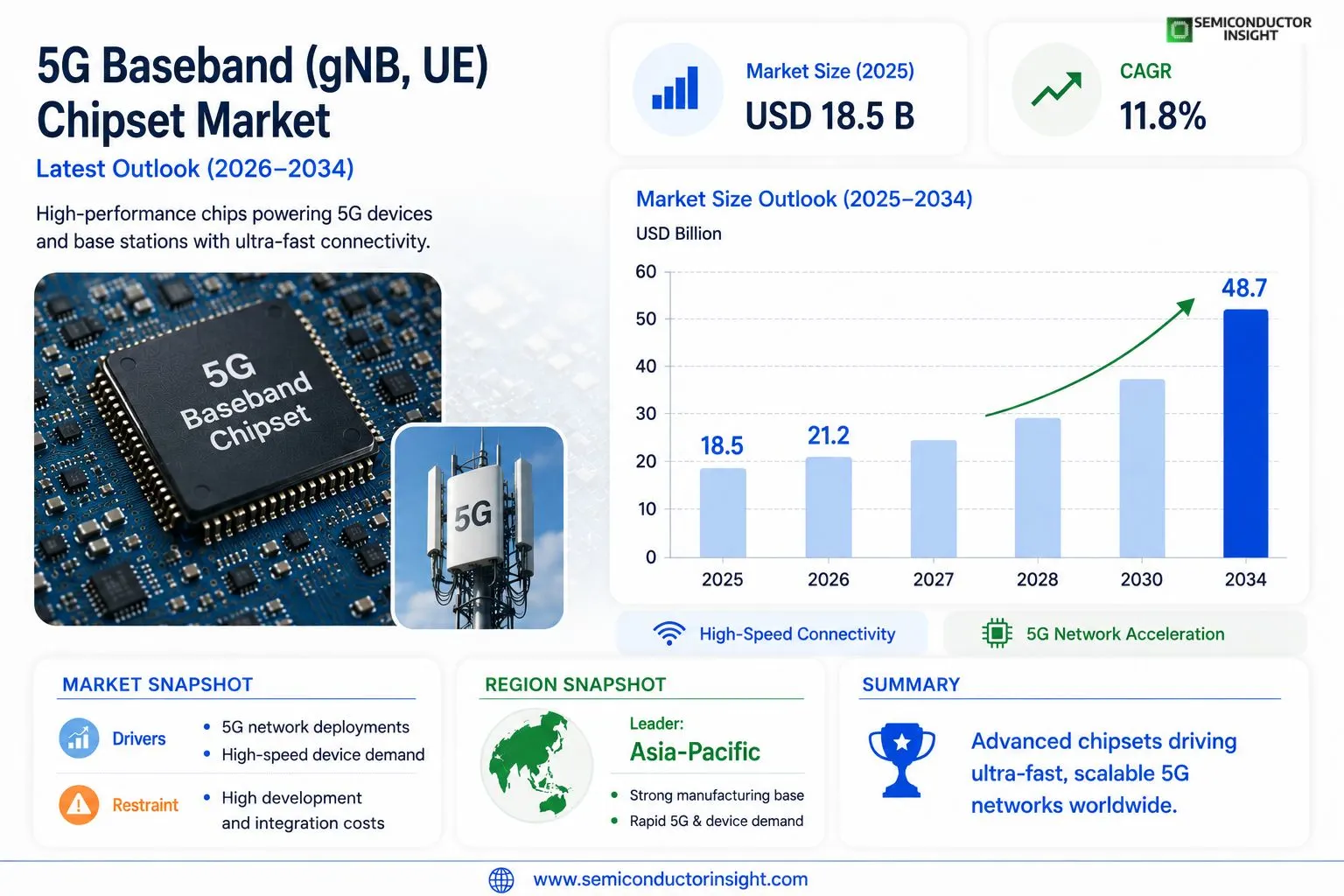
Global 5G Baseband (gNB, UE) Chipset market size was valued at USD 18.5 billion in 2025. The market is projected to grow from USD 21.2 billion in 2026 to USD 48.7 billion by 2034, exhibiting a CAGR of 11.8% during the forecast period.
5G baseband chipsets serve as the critical processing engines in modern wireless networks, powering both user equipment (UE) such as smartphones and customer premise equipment, as well as gNodeB (gNB) infrastructure for base stations. These specialized semiconductors handle complex signal processing tasks including modulation, demodulation, channel coding, beamforming, and protocol stack management to deliver ultra-high data rates, low latency, and massive connectivity essential to 5G performance.
The market is experiencing robust growth due to several factors, including accelerated 5G network deployments worldwide, rising demand for high-performance mobile devices, and expanding applications in industrial automation, autonomous vehicles, and fixed wireless access. Advancements in semiconductor technology, such as improved power efficiency and support for mmWave frequencies, further drive adoption. Initiatives by key players continue to fuel expansion. For instance, major manufacturers have introduced integrated solutions combining baseband processing with AI capabilities to optimize network performance and energy consumption. Qualcomm, MediaTek, Samsung, Huawei, and Unisoc are among the leading companies operating in the market with comprehensive portfolios spanning UE and infrastructure chipsets.
MARKET DRIVERS
Rapid Global 5G Network Deployment
5G Baseband (gNB, UE) Chipset Market is experiencing robust growth driven by the accelerated rollout of 5G infrastructure worldwide. Operators continue to expand standalone 5G networks, requiring advanced baseband processors for gNB base stations to handle higher data throughput, massive MIMO, and low-latency applications. This expansion directly fuels demand for sophisticated baseband chipsets in both infrastructure and user equipment (UE) segments.
Proliferation of 5G-Enabled Devices
Smartphone manufacturers are increasingly integrating 5G baseband solutions from leaders like Qualcomm, MediaTek, and Samsung into mid-range and premium devices. Growing consumer adoption of 5G handsets, coupled with emerging applications in fixed wireless access, automotive, and industrial IoT, is creating sustained volume demand for UE baseband chipsets capable of supporting sub-6 GHz and mmWave frequencies.
➤ Integration of AI capabilities in baseband processors is further enhancing efficiency in signal processing and power management for both gNB and UE applications.
The transition toward advanced process nodes continues to improve performance-per-watt metrics, enabling chipset vendors to meet the stringent requirements of modern 5G deployments while supporting backward compatibility with 4G networks.
MARKET CHALLENGES
Technological Complexity and Power Efficiency
Developing 5G baseband chipsets that deliver multi-gigabit speeds while maintaining acceptable power consumption remains a significant technical hurdle. gNB solutions must process complex massive MIMO and beamforming algorithms, while UE chipsets face strict thermal and battery constraints in mobile devices.
Other Challenges
Geopolitical and Supply Chain Issues
Trade restrictions and export controls continue to impact Global supply of advanced semiconductors, affecting collaboration and component sourcing for 5G baseband chipset manufacturers.
High Development Costs
Substantial R&D investments required for next-generation designs, including support for new spectrum bands and AI-enhanced features, create barriers particularly for smaller players in 5G Baseband (gNB, UE) Chipset Market.
MARKET RESTRAINTS
High Implementation and Spectrum Costs
Elevated costs associated with deploying dense 5G networks, including spectrum acquisition and infrastructure buildout, are tempering the pace of adoption in certain regions. These economic factors indirectly constrain the growth velocity of demand for corresponding baseband chipsets in both gNB and UE categories.
The scarcity of mid-band spectrum in key markets presents ongoing challenges for operators seeking optimal balance between coverage and capacity, affecting chipset specification requirements and overall market expansion.
MARKET OPPORTUNITIES
Emergence of Advanced Applications and Open RAN
5G Baseband (gNB, UE) Chipset Market stands to benefit significantly from the rise of private 5G networks, Industry 4.0 implementations, and Open RAN architectures. These trends are driving demand for customizable and disaggregated baseband solutions that offer greater flexibility for enterprise and specialized use cases.
Continued innovation in chiplet architectures and heterogeneous integration presents opportunities for improved performance and cost efficiency. Expansion into emerging markets with increasing 5G smartphone penetration further expands the addressable market for UE baseband processors.
5G Baseband (gNB, UE) Chipset Market Trends
Accelerated Global 5G Deployments Driving Chipset Innovation
5G Baseband (gNB, UE) Chipset Market continues to expand as operators worldwide accelerate the rollout of advanced 5G infrastructure. These chipsets function as the core processing units in both user equipment such as smartphones and customer premise equipment, as well as in gNodeB base stations. They manage essential tasks including signal modulation, demodulation, channel coding, beamforming, and protocol handling to enable high data rates, reduced latency, and support for massive device connectivity.
Demand for high-performance mobile devices and the growth of fixed wireless access solutions are contributing to sustained momentum in 5G Baseband (gNB, UE) Chipset Market. As network coverage expands across regions, manufacturers are focusing on delivering chipsets that balance performance with operational requirements for diverse deployment scenarios.
Other Trends
Advancements in Power Efficiency and mmWave Support
Semiconductor innovations are playing a pivotal role in 5G Baseband (gNB, UE) Chipset Market. Improved power efficiency features allow devices and infrastructure to operate with lower energy consumption while maintaining peak performance. Enhanced support for mmWave frequencies is enabling operators to deliver ultra-fast connectivity in dense urban environments and specialized industrial settings.
Expansion into Industrial Automation and Autonomous Applications
5G Baseband (gNB, UE) Chipset Market is benefiting from broader adoption across emerging use cases. Applications in industrial automation, autonomous vehicles, and smart infrastructure are increasing the need for reliable, low-latency baseband processing capabilities that can handle complex real-time data requirements.
Strategic Initiatives by Leading Manufacturers
Major industry participants including Qualcomm, MediaTek, Samsung, Huawei, and Unisoc are actively developing integrated solutions within 5G Baseband (gNB, UE) Chipset Market. These efforts include combining baseband processing with AI-driven optimizations to improve network efficiency and reduce energy usage across both UE and gNB platforms. Such developments are helping address the growing complexity of 5G networks while supporting seamless connectivity for next-generation services.
Overall, 5G Baseband (gNB, UE) Chipset Market remains positioned for continued evolution as technological refinements and application diversity drive ongoing investment in advanced semiconductor solutions. The focus on performance optimization and ecosystem integration will likely shape competitive dynamics as 5G adoption matures globally.
COMPETITIVE LANDSCAPEKey Industry Players
Intense Competition Among Semiconductor Leaders Driving 5G Baseband Innovation
Qualcomm maintains its position as the dominant force in 5G Baseband (gNB, UE) Chipset Market, leveraging its Snapdragon X-series modems to command significant share in both user equipment and infrastructure solutions. The market exhibits a moderately concentrated structure where a handful of established players control the majority of high-performance segments, while specialized and regional firms address niche applications in gNB base stations and cost-sensitive UE devices. Advancements in power efficiency, mmWave integration, and AI-optimized processing continue to differentiate leaders amid rapid global 5G deployment.
Other significant players include MediaTek with its strong mid-to-high range Dimensity portfolio, Samsung’s vertically integrated Exynos solutions, and Huawei’s HiSilicon Balong series focused primarily on domestic and select international markets. Emerging and niche participants such as Unisoc target affordable segments, while infrastructure specialists like Broadcom and Marvell address gNB-specific requirements, contributing to a dynamic ecosystem supported by ongoing technological convergence in semiconductors.
List of Key 5G Baseband (gNB, UE) Chipset Companies Profiled
- Qualcomm
- MediaTek
- Samsung Electronics
- Huawei HiSilicon
- UNISOC (Spreadtrum)
- Apple Inc.
- Intel Corporation
- Broadcom Inc.
- Marvell Technology
- Qorvo Inc.
- NXP Semiconductors
- Analog Devices
- Skyworks Solutions
- ZTE Corporation
- Ericsson
Segment Analysis:
| Segment Category | Sub-Segments | Key Insights |
| By Type |
|
UE Baseband Chipsets lead due to their critical role in enabling high-speed connectivity and advanced features in consumer devices. These chipsets excel in managing complex protocol stacks while optimizing power consumption for extended battery life. Their design prioritizes integration with application processors to deliver seamless user experiences in data-intensive applications. Manufacturers focus on enhancing beamforming capabilities and AI-driven optimizations to support dynamic network conditions effectively. |
| By Application |
|
Smartphones and Mobile Devices represent the dominant application segment. Chipsets in this category drive ultra-high data rates and low latency essential for immersive multimedia and real-time applications. They support sophisticated signal processing for superior call quality and connectivity in dense urban environments. Continuous innovation focuses on multi-RAT compatibility and energy-efficient designs to meet consumer expectations for premium performance without compromising device form factors. |
| By End User |
|
Consumer Electronics emerge as the leading end-user segment. Demand stems from the need for flagship devices offering exceptional wireless performance and future-proof connectivity features. Baseband chipsets enable enhanced user experiences through superior download speeds, reduced latency for gaming, and reliable connections in varied environments. Providers emphasize customization for different device tiers while incorporating advanced security protocols and AI enhancements for intelligent network management. |
| By Frequency Band |
|
Sub-6 GHz stands out as the primary segment due to its balanced coverage and capacity characteristics suitable for widespread deployment. Chipsets supporting this band prioritize broad compatibility and reliable performance across diverse geographic areas. They facilitate efficient spectrum utilization while delivering consistent speeds for everyday applications. Development efforts concentrate on improving penetration capabilities and coexistence with legacy networks for smooth transitions and enhanced user mobility. |
| By Deployment Mode |
|
Non-Standalone (NSA) configurations lead the market as operators leverage existing 4G infrastructure for faster 5G rollouts. These chipsets excel in delivering immediate performance gains while maintaining backward compatibility. They support rapid service launches with minimal additional investment in core networks. Ongoing advancements focus on seamless handover mechanisms and optimized resource allocation to maximize the benefits of combined network architectures during the transition phase toward full standalone deployments. |
Regional Analysis: 5G Baseband (gNB, UE) Chipset Market
Asia-Pacific
Asia-Pacific stands as the undisputed leader in 5G Baseband (gNB, UE) Chipset Market, driven by aggressive network deployments, massive manufacturing ecosystems, and strong government support for digital infrastructure. Countries like China, South Korea, Japan, and India are spearheading innovation in both gNB base station chipsets and UE device processors, fostering an environment where rapid iteration and cost-efficient production thrive. The region’s vertically integrated supply chains enable seamless collaboration between chipset designers, foundries, and telecom operators, accelerating the transition toward advanced 5G capabilities including enhanced mobile broadband and ultra-reliable low-latency communications.Business strategies in Asia-Pacific emphasize heavy R&D investment in energy-efficient baseband solutions and AI-integrated chip architectures to support dense urban deployments. Leading players focus on proprietary technologies that optimize spectrum utilization while addressing power consumption challenges critical for widespread small cell networks. The market dynamics here reflect a blend of domestic demand and export-oriented growth, with companies pursuing strategic partnerships to co-develop next-generation chipsets tailored for smart cities, industrial automation, and autonomous vehicles. As operators expand standalone 5G networks, the emphasis shifts toward modular and scalable baseband platforms that facilitate smooth upgrades and multi-vendor interoperability across the region.
Asia-Pacific benefits from concentrated semiconductor clusters and collaborative R&D hubs that speed up the development cycle for 5G baseband chipsets. This ecosystem supports rapid prototyping of gNB solutions optimized for high-throughput scenarios and UE chipsets with superior power management for extended battery life in consumer devices.
Proactive government initiatives and spectrum allocation policies create favorable conditions for chipset adoption. Strategies focus on building resilient 5G infrastructure that integrates with emerging technologies like edge computing, positioning the region as a global benchmark for large-scale commercial deployments.
Market participants leverage cost leadership combined with technological differentiation. Partnerships between local firms and global technology providers help in customizing baseband solutions while expanding presence in both premium and mid-tier UE segments across diverse Asian markets.
The region is poised to maintain dominance through continuous advancements in sub-6 GHz and mmWave chipset designs. Emphasis on sustainable manufacturing and open RAN compatibility will shape business strategies well into the next decade.
North America
North America exhibits robust growth in 5G Baseband (gNB, UE) Chipset Market, characterized by strong emphasis on enterprise applications and private networks. The region excels in developing high-performance chipsets tailored for industrial IoT, smart manufacturing, and advanced healthcare solutions. Companies prioritize security features and software-defined architectures that allow flexible network slicing. Business strategies revolve around strategic acquisitions and alliances to enhance intellectual property portfolios while addressing regulatory requirements for critical infrastructure protection. Focus remains on innovation in mmWave technologies and energy optimization to support expansive rural and suburban coverage expansions.
Europe
Europe maintains a steady trajectory in 5G Baseband (gNB, UE) Chipset Market with particular attention to regulatory compliance, sustainability, and cross-border interoperability. The region invests in green chipset designs that reduce power consumption across gNB deployments while supporting diverse use cases from connected vehicles to public safety networks. Collaborative frameworks among member states facilitate standardized approaches to spectrum management and technology adoption. Market players adopt strategies centered on open innovation platforms and joint ventures to compete globally, emphasizing reliability and data privacy in UE solutions for consumer and enterprise segments alike.
South America
South America is experiencing gradual advancement in 5G Baseband (gNB, UE) Chipset Market as countries work toward bridging digital divides through targeted infrastructure investments. The focus lies on cost-effective chipset solutions suitable for urban centers and emerging industrial applications. Business strategies involve partnerships with international technology providers to localize deployment expertise while adapting global standards to regional needs. Growth centers on enhancing mobile broadband accessibility and supporting agricultural technology initiatives that leverage reliable low-latency connectivity provided by modern baseband architectures.
Middle East & Africa
The Middle East & Africa region shows promising potential in 5G Baseband (gNB, UE) Chipset Market driven by smart city initiatives and digital transformation programs in key economies. Strategies emphasize leapfrogging legacy technologies through direct adoption of advanced gNB and UE chipsets optimized for harsh environments and large-scale coverage. Governments and operators collaborate on ecosystem development to foster local talent and attract foreign investment in semiconductor-related infrastructure. The market dynamics highlight opportunities in oil & gas automation, logistics optimization, and expanding financial technology services that rely on secure, high-speed 5G connectivity.
Report Scope
This market research report provides a comprehensive analysis of the 5G Baseband (gNB, UE) Chipset Market , covering the forecast period 2026–2034. It offers detailed insights into market dynamics, technological advancements, competitive landscape, and key trends shaping the industry.
Key focus areas of the report include:
- Market Overview: The report begins with an overview outlining its current market scenario, key growth indicators, and industry transformation drivers. It discusses macroeconomic factors, demand–supply balance, regulatory landscape, and the strategic role of semiconductors in powering advancements across industries such as automotive, telecommunications, consumer electronics, and industrial automation.
- Market Size & Forecast: Historical data and future projections for revenue, unit shipments, and market value across major regions and segments.
- Segmentation Analysis: Detailed breakdown by product type, technology, application, and end-user industry to identify high-growth segments and investment opportunities.
- Regional Insights: Insights into market performance across North America, Europe, Asia-Pacific, Latin America, and the Middle East & Africa, including country-level analysis where relevant.
- Competitive Landscape: Profiles of leading market participants, including their product offerings, R&D focus, manufacturing capacity, pricing strategies, and recent developments such as mergers, acquisitions, and partnerships.
- Technology Trends & Innovation: Assessment of emerging technologies, integration of AI/IoT, semiconductor design trends, fabrication techniques, and evolving industry standards.
- Market Drivers & Restraints: Evaluation of factors driving market growth along with challenges, supply chain constraints, regulatory issues, and market-entry barriers.
- Stakeholder Insights: Insights for component suppliers, OEMs, system integrators, investors, and policymakers regarding the evolving ecosystem and strategic opportunities.
Primary and secondary research methods are employed, including interviews with industry experts, data from verified sources, and real-time market intelligence to ensure the accuracy and reliability of the insights presented.
FREQUENTLY ASKED QUESTIONS:
What is the current market size of 5G Baseband (gNB, UE) Chipset Market?
-> 5G Baseband (gNB, UE) Chipset Market was valued at USD 18.5 billion in 2025 and is expected to reach USD 48.7 billion by 2034.
Which key companies operate in 5G Baseband (gNB, UE) Chipset Market?
-> Key players include Qualcomm, MediaTek, Samsung, Huawei, and Unisoc, among others.
What are the key growth drivers?
-> Key growth drivers include accelerated 5G network deployments worldwide, rising demand for high-performance mobile devices, and expanding applications in industrial automation, autonomous vehicles, and fixed wireless access.
Which region dominates the market?
-> Asia-Pacific is the fastest-growing region with strong momentum from network rollouts and device demand.
What are the emerging trends?
-> Emerging trends include integration of AI capabilities with baseband processing, improved power efficiency, and support for mmWave frequencies.

Get Sample Report PDF for Exclusive Insights
Report Sample Includes
- Table of Contents
- List of Tables & Figures
- Charts, Research Methodology, and more...
 Download Sample Report PDF