2.5D (Interposer-based) Packaging Market Insights
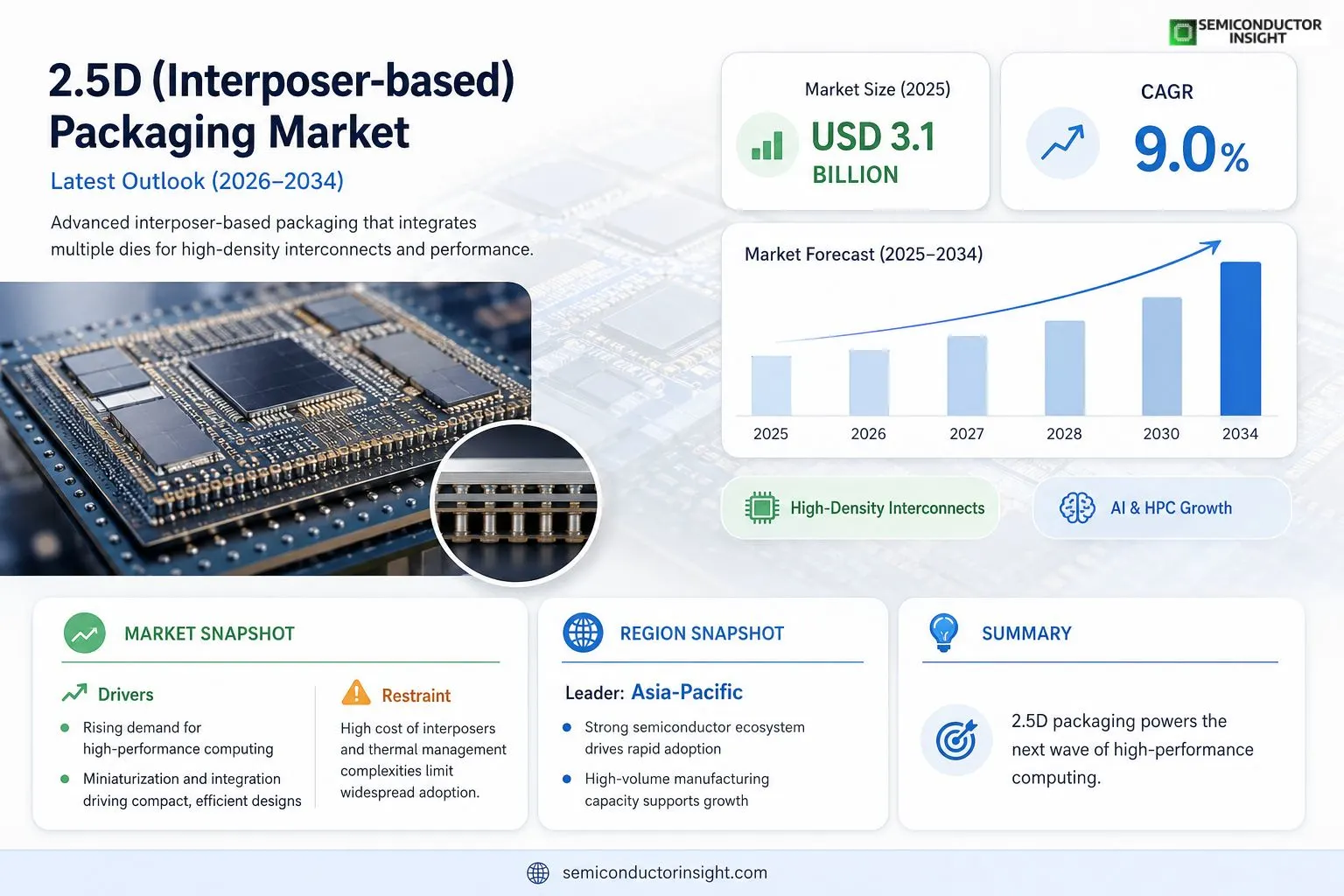
Global 2.5D (Interposer-based) Packaging Market size was valued at USD 3.1 billion in 2025.
The market is projected to grow from USD 3.4 billion in 2026 to USD 7.9 billion by 2034, exhibiting a CAGR of 9.0% during the forecast period.
2.5D interposer‑based packaging integrates multiple dies on a silicon or glass interposer, enabling high‑density interconnects and superior electrical performance compared with traditional substrate solutions.
Because it reduces signal loss and supports heterogeneous integration of logic, memory and RF components, manufacturers are adopting it for high‑performance computing, AI accelerators and mobile processors.
However, challenges such as the cost of silicon interposers and thermal management persist, prompting ongoing R&D investments.
MARKET DRIVERS
Rising Demand for High‑Performance Computing
The surge in artificial intelligence workloads and edge‑computing devices is compelling semiconductor manufacturers to adopt advanced interconnect solutions. 2.5D (Interposer-based) Packaging Market growth is fueled by the need for higher bandwidth and lower latency, enabling processors to handle complex algorithms efficiently.
Miniaturization and Integration Trends
Consumer electronics continue to shrink in size while increasing functionality. 2.5D (Interposer-based) Packaging Market offers a compact form factor that integrates multiple dies, reducing board space and power consumption, which is critical for smartphones and wearables.
➤ Industry analysts project that 2.5D solutions will capture over 30% of high‑end package shipments by 2028, driven primarily by AI accelerators and 5G base stations.
Regulatory support for advanced packaging in key regions, combined with substantial R&D investments from leading foundries, creates a stable environment for sustained adoption of interposer technologies.
MARKET CHALLENGES
Cost Sensitivity and Yield Management
Despite performance benefits, 2.5D (Interposer-based) Packaging Market faces pricing pressure as manufacturers balance high‑cost tooling with the need for competitive product pricing. Yield variability during interposer fabrication adds to the challenge, requiring sophisticated process control.
Other Challenges
Supply Chain Complexity
Limited availability of high‑quality silicon interposers and the reliance on a narrow supplier base can cause bottlenecks, especially when demand spikes for AI and 5G applications.
MARKET RESTRAINTS
Technical Barriers to Integration
Integrating multiple heterogeneous dies on a single interposer demands precise alignment and thermal management. Design complexities increase development time and require specialized CAD tools, which can deter smaller firms from adopting the technology.
The lack of standardized testing methodologies for interposer reliability further restrains market expansion, as customers seek proven performance metrics before large‑scale deployment.
Moreover, the steep learning curve associated with new materials, such as glass and organic interposers, adds to the perceived risk for OEMs evaluating alternative packaging options.
MARKET OPPORTUNITIES
Emerging Applications in Autonomous Systems
Autonomous vehicles and drones require real‑time data processing with stringent power and latency constraints. 2.5D (Interposer-based) Packaging Market is uniquely positioned to meet these requirements, opening new revenue streams for packaging providers.Growth in high‑bandwidth memory (HBM) adoption across data‑center accelerators presents a sizable opportunity. Interposer technology enables dense memory stacking, delivering performance gains that traditional packaging cannot achieve.Strategic collaborations between fabless chip designers and packaging houses are accelerating co‑development cycles, fostering innovative solutions that capitalize on emerging market niches.
2.5D (Interposer-based) Packaging Market Trends
Growth Fueled by High‑Performance Computing and AI Workloads
2.5D (Interposer-based) Packaging Market is experiencing rapid adoption as system designers prioritize bandwidth, signal integrity, and power efficiency. By mounting multiple dies on a silicon or glass interposer, manufacturers achieve fine‑pitch interconnects that meet the rigorous demands of AI accelerators, data‑center processors, and advanced mobile SoCs. This heterogeneous integration reduces trace lengths, minimizes latency, and supports higher I/O counts without a proportional increase in substrate area. Consequently, product roadmaps for next‑generation servers and edge devices increasingly specify 2.5D solutions as the preferred packaging approach, reinforcing a steady upward trajectory for the market.
Other Trends
Cost and Thermal Management Strategies
While performance advantages are clear, the cost of silicon interposers and associated thermal management remain critical considerations. Suppliers are investing in wafer‑level thinning, advanced bonding techniques, and low‑stress underfills to lower material expenses and improve yield. Parallel efforts focus on thermal interface materials and heat‑spreader designs that dissipate the higher power densities typical of densely stacked dies. These initiatives collectively aim to balance the premium price of 2.5D technology with the economic realities of large‑scale production, enabling broader adoption across mid‑range platforms.
Materials Innovation and Production Scaling
Emerging trends point toward the introduction of glass interposers and hybrid organic‑inorganic composites, which promise reduced cost and comparable electrical performance to traditional silicon bases. At the same time, foundries are scaling out dedicated 2.5D process lines, integrating inline metrology and automated inspection to boost throughput. These material and manufacturing advances are expected to widen the addressable applications of 2.5D (Interposer-based) Packaging Market, driving incremental volume growth while maintaining the high performance standards demanded by cutting‑edge computing ecosystems.
COMPETITIVE LANDSCAPEKey Industry Players
2.5D (Interposer‑Based) Packaging Market Competitive Overview
2.5D interposer‑based packaging market is dominated by integrated circuit foundries and outsourced assembly providers that combine advanced silicon interposer technology with high‑volume die stacking. TSMC leads the segment by leveraging its mature silicon‑interposer platform for high‑performance computing and AI accelerators, while Intel and Samsung Electronics follow with proprietary interposer processes that target data‑center and mobile processors. Large OSATs such as ASE Group, Amkor Technology, and JCET‑Stats ChipPAC (through its acquisition of STATS) further shape the market by offering cost‑effective assembly services and expanding capacity for heterogeneous integration.Beyond the primary tier, several niche players contribute specialized capabilities that reinforce the ecosystem. Broadcom and Nvidia partner with leading foundries to deliver custom 2.5D solutions for networking and graphics, whereas Xilinx (now part of AMD) and Qualcomm focus on FPGA and modem integration on glass interposers. Regional manufacturers such as GlobalFoundries, Powerchip Semiconductor, and Texas Instruments add depth in niche memory and analog segments, while Infineon and Micron Technology provide memory‑centric interposer offerings that support emerging AI workloads.
List of Key 2.5D (Interposer‑Based) Packaging Companies Profiled
- TSMC
- Intel Corporation
- Samsung Electronics
- ASE Group
- Amkor Technology
- JCET Group (STATS ChipPAC)
- Broadcom Inc.
- Nvidia Corporation
- AMD (Xilinx)
- Qualcomm Incorporated
- GlobalFoundries
- Powerchip Semiconductor Corp.
- Texas Instruments
- Infineon Technologies AG
- Micron Technology
Segment Analysis:
| Segment Category | Sub-Segments | Key Insights |
| By Type |
|
Silicon Interposer
|
| By Application |
|
AI Accelerators
|
| By End User |
|
Data Center
|
| By Interposer Material |
|
Organic
|
| By Integration Approach |
|
Heterogeneous Integration
|
Regional Analysis: North America
North America
The North American 2.5D packaging market is characterized by a strong emphasis on high-frequency applications and increased integration capabilities. There is a growing trend toward heterogeneous integration, combining different chiplets with specialized functionalities. The adoption of advanced materials and innovative interconnect technologies is also gaining momentum.
Major drivers include the escalating demand for high-performance computing, the proliferation of AI and machine learning applications, and the need for improved power efficiency in electronic devices. The increasing complexity of chip designs is also pushing the adoption of advanced packaging solutions like 2.5D.
The competitive landscape is marked by the presence of established semiconductor packaging companies and emerging technology providers. Key players are focused on expanding their product portfolios and strengthening their partnerships with semiconductor manufacturers. Innovation in packaging materials and interconnects are crucial for gaining a competitive edge.
The future of the North American 2.5D packaging market appears promising, with continued growth expected in the coming years. The market is poised to benefit from ongoing advancements in semiconductor technology and the increasing demand for advanced electronic devices. Focus on power efficiency and performance will be key strategic imperatives.
Europe
Europe represents a significant and growing market for 2.5D (Interposer-based) Packaging Market. Driven by strong industrial automation, automotive advancements, and a commitment to technological leadership, the region is witnessing increasing adoption of advanced packaging solutions. The European Union’s investments in research and development, particularly through initiatives like Horizon Europe, are fostering innovation in this area. Emphasis on energy efficiency and sustainable electronics further supports the demand for advanced packaging that enables better power management. Major European semiconductor manufacturers are actively exploring and implementing 2.5D packaging to enhance the performance and functionality of their chips. The automotive sector’s push towards connected and autonomous vehicles is a significant driver, requiring high-performance computing and advanced sensor integration. This is expected to fuel considerable demand for 2.5D packaging.
Asia-Pacific
Asia-Pacific is emerging as the fastest-growing market for 2.5D (Interposer-based) Packaging Market, largely fueled by the burgeoning semiconductor industry in countries like China, Taiwan, and South Korea. The region’s massive electronics manufacturing base and rapidly expanding consumer electronics market are major contributors to this growth. Significant investments in advanced packaging technologies by leading Asian semiconductor companies are driving market expansion. Government initiatives promoting domestic chip manufacturing are also creating a favorable environment for 2.5D packaging adoption. The demand for advanced packaging is particularly strong in the mobile, automotive, and industrial sectors. The concentration of contract manufacturing organizations (CMOs) in the region further facilitates the adoption of advanced packaging solutions.
United States
The United States, being the home to many of the world’s leading semiconductor companies, constitutes a pivotal market for 2.5D (Interposer-based) Packaging Market. Government initiatives, coupled with substantial private sector investments, are fostering innovation and driving adoption. The US market is particularly strong in high-performance computing, artificial intelligence, and defense applications, all of which demand advanced packaging capabilities. While North America as a whole leads, the US market benefits from a well-established ecosystem of research institutions, technology providers, and experienced engineering talent. The emphasis on national security and technological independence is further bolstering investment in advanced packaging technologies.
South America
South America presents a relatively nascent but gradually expanding market for 2.5D (Interposer-based) Packaging Market. The increasing adoption of electronics in sectors like telecommunications, automotive, and industrial automation is driving demand. The growing need for improved performance and miniaturization in electronic devices is also contributing to market growth. While the market is smaller compared to North America, Europe, and Asia-Pacific, it offers potential for future expansion as the region’s economy continues to develop. The focus on cost-effectiveness and value proposition will be crucial for market penetration.
Middle East & Africa
The Middle East & Africa region represents a smaller market for 2.5D (Interposer-based) Packaging Market, but with significant potential for future growth. Increasing investments in infrastructure development, telecommunications, and defense are driving demand for advanced electronic systems that require advanced packaging. The growing adoption of 5G technology and the increasing use of IoT devices are also contributing to market expansion. While the region faces certain economic and political challenges, the long-term outlook remains positive, supported by government initiatives to promote technological advancement and diversification.
Report Scope
This market research report provides a comprehensive analysis of the 2.5D (Interposer-based) Packaging Market , covering the forecast period 2026–2034. It offers detailed insights into market dynamics, technological advancements, competitive landscape, and key trends shaping the industry.
Key focus areas of the report include:
- Market Overview: The report begins with an overview outlining its current market scenario, key growth indicators, and industry transformation drivers. It discusses macroeconomic factors, demand–supply balance, regulatory landscape, and the strategic role of semiconductors in powering advancements across industries such as automotive, telecommunications, consumer electronics, and industrial automation.
- Market Size & Forecast: Historical data and future projections for revenue, unit shipments, and market value across major regions and segments.
- Segmentation Analysis: Detailed breakdown by product type, technology, application, and end-user industry to identify high-growth segments and investment opportunities.
- Regional Insights: Insights into market performance across North America, Europe, Asia-Pacific, Latin America, and the Middle East & Africa, including country-level analysis where relevant.
- Competitive Landscape: Profiles of leading market participants, including their product offerings, R&D focus, manufacturing capacity, pricing strategies, and recent developments such as mergers, acquisitions, and partnerships.
- Technology Trends & Innovation: Assessment of emerging technologies, integration of AI/IoT, semiconductor design trends, fabrication techniques, and evolving industry standards.
- Market Drivers & Restraints: Evaluation of factors driving market growth along with challenges, supply chain constraints, regulatory issues, and market-entry barriers.
- Stakeholder Insights: Insights for component suppliers, OEMs, system integrators, investors, and policymakers regarding the evolving ecosystem and strategic opportunities.
Primary and secondary research methods are employed, including interviews with industry experts, data from verified sources, and real-time market intelligence to ensure the accuracy and reliability of the insights presented.
FREQUENTLY ASKED QUESTIONS:
What is the current market size of 2.5D (Interposer-based) Packaging Market?
-> Global 2.5D (Interposer-based) Packaging Market was valued at USD 3.1 billion in 2025 and is expected to reach USD 7.9 billion by 2034, reflecting a CAGR of 9.0% over the forecast period.
Which key companies operate in 2.5D (Interposer-based) Packaging Market?
-> Key players include TSMC, Intel, ASE Group, Amkor Technology, Samsung Electronics, and Qualcomm, among others.
What are the key growth drivers?
-> Key growth drivers include the demand for high‑performance computing, AI accelerators, mobile processors, and the need for high‑density interconnects that reduce signal loss.
Which region dominates the market?
-> Asia‑Pacific leads the market due to its extensive semiconductor manufacturing ecosystem, while North America remains a significant contributor.
What are the emerging trends?
-> Emerging trends include heterogeneous integration of logic, memory and RF components, advancements in silicon interposer cost reduction, and ongoing R&D in thermal management solutions.

Get Sample Report PDF for Exclusive Insights
Report Sample Includes
- Table of Contents
- List of Tables & Figures
- Charts, Research Methodology, and more...
 Download Sample Report PDF