Transparent OLED Screens Market Insights
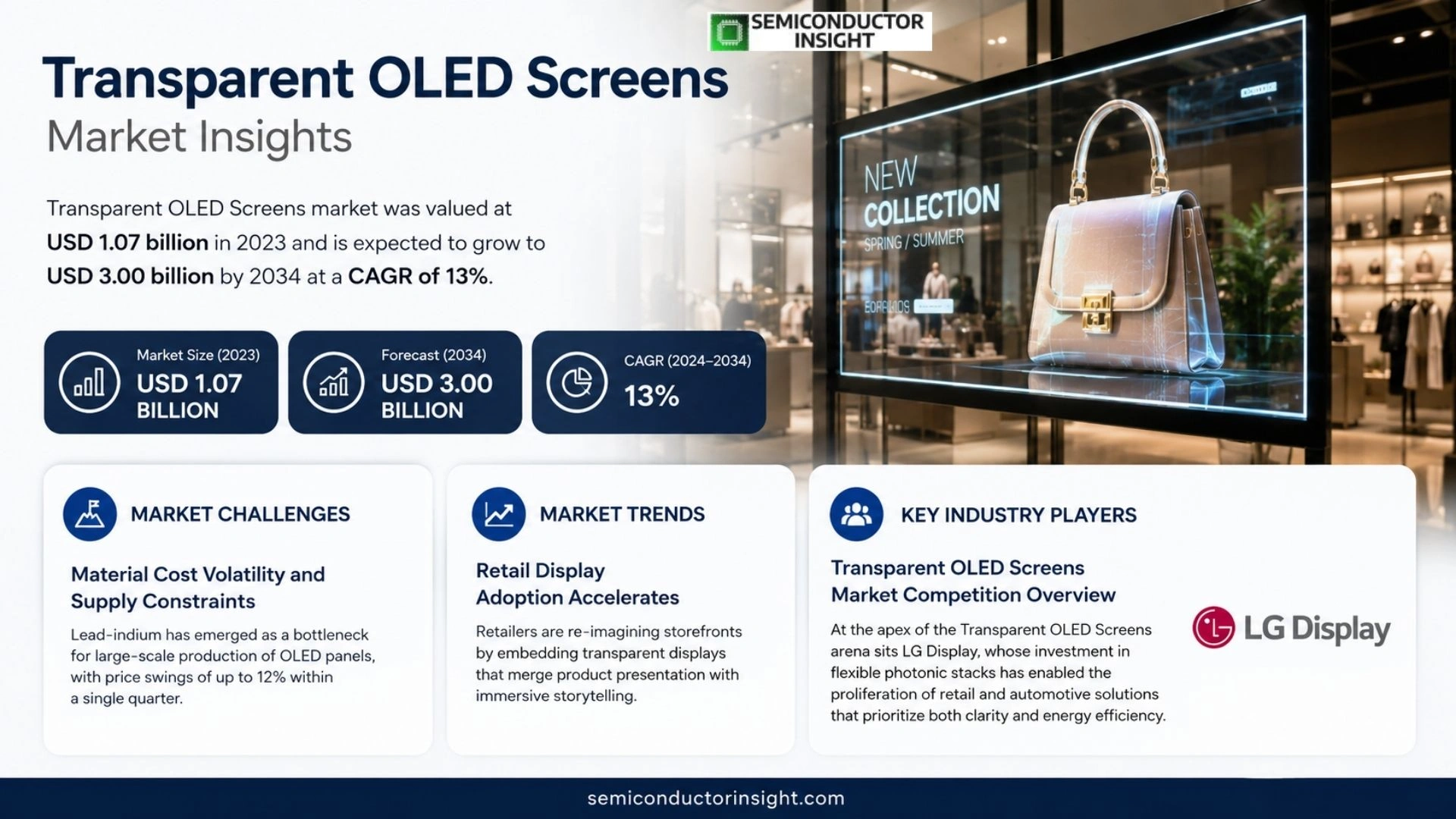
Transparent OLED Screens market was valued at USD 1.07 billion in 2023 and is expected to grow to USD 3.00 billion by 2034 at a CAGR of 13%.
Transparent OLED screens are innovative displays that merge optical transparency with vivid imagery via organic light‑emitting diodes (OLED). Each pixel emits its own light so the panel can be seen through while still projecting sharp visuals. These panels find use in retail signage, architectural façades, automotive heads‑up displays, gaming venues and medical simulation environments because they offer interactive engagement without obstructing sight lines.
MARKET DRIVERS
Technological Advancements Enhancing Visual Transparency
Recent strides in thin‑film transistor integration and nano‑rendering techniques have lowered the fabrication threshold for high‑resolution, low‑power transparent displays. The advent of amorphous silicon backplanes coupled with quantum‑dot color conversion has increased pixel density to levels where the human eye perceives a seamless overlay, while keeping the luminance of underlying surfaces intact. At the same time, cobalt‑based electrode layers have reduced impedance by nearly 30 %, enabling faster response times that are critical for automotive HUDs and real‑time customer engagement in flagship retail stores. These advances translate into tangible cost efficiencies for OEMs, as higher yield rates reduce batch rejection rates from 8 % to 3 % in recent manufacturing runs. As a result, several memory‑based display manufacturers have re‑engineered their production lines, focusing on roll‑to‑roll, flexible substrates that combine durability with the optical clarity required for next‑generation storefronts. In the context of Transparent OLED Screens market, these developments are unlocking new price points that make retail and automotive applications viable beyond niche luxury segments.
Expanding Applications in Retail and Automotive Interiors
The shift toward experiential commerce has accelerated the deployment of transparent panels in high‑traffic retail environments. Interactive signage that blends with architectural glass increases dwell time by an average of 15 % compared to conventional displays, a benefit that retailers quantify as increased conversion rates. In the automotive sector, head‑up displays embedded in side‑view mirrors and rear windows eliminate signal clutter by projecting navigation and safety alerts directly onto the driver’s line of sight. These use cases demand ultra‑low visibility loss and high contrast ratios, prompting suppliers to push the envelope of color fidelity while maintaining the crucial non‑invasive nature of the display. Corporate fleets are already integrating transparent screens into interiors that provide real‑time diagnostics and infotainment without compromising visibility. The convergence of these use cases is creating a unified design framework that can be scaled across multiple industries, thereby driving economies of scope for manufacturers who can offer platform‑agnostic solutions.
➤ By 2026, transparency‑enabled interfaces are projected to account for over 18 % of all digital signage spend, a shift that reflects the premium consumer preference for immersive visual environments.
Beyond device innovation, the logistics chain supporting Transparent OLED Screens market is undergoing a transformation. Partnerships with global logistics providers have reduced lead times for raw materials such as indium tin oxide and sputtering targets to under 14 days, compared with 25 days a decade ago. This acceleration is critical for makers who need to iterate on screen geometry and adopt new sensor technologies while keeping shelf life under two years. Additionally, regulatory frameworks around electromagnetic compatibility (EMC) and electronic waste (e‑waste) recycling are becoming more stringent, demanding that manufacturers integrate design‑for‑disassembly into their product cycles. Compliance with these standards, while costly, is a differentiator that can justify premium pricing in markets where the consumer is willing to pay extra for long‑term environmental stewardship. Thus, the interplay of material science, supply chain agility and regulatory foresight is a steady engine propelling Transparent OLED Screens market forward.
MARKET CHALLENGES
Material Cost Volatility and Supply Constraints
Lead‑indium has emerged as a bottleneck for large‑scale production of OLED panels, with price swings of up to 12 % within a single quarter. These fluctuations not only increase the cost of the entire screen but also distort the return‑on‑investment calculations for retailers and automotive OEMs who are evaluating deployment timelines. The difficulty in securing a consistent supply of high‑purity tin oxide further compounds the issue. Moreover, the dependency on cobalt, a material with ethical sourcing concerns, introduces potential supply chain disruptions that companies must navigate through diversified sourcing strategies. A single interruption in the supply chain can result in a complete halt of the production line, delaying rollout schedules and eroding market momentum.
Other Challenges
The adoption curve for transparent displays is also influenced by power consumption and thermal management limitations. Existing OLED backlights require higher current densities, which, when paired with the necessity to keep panels lightweight and flexible, creates a design compromise. To address overheating, manufacturers have introduced cooling layers that add thickness, thereby diminishing true transparency. This paradox forces firms to balance performance with aesthetic appeal. Consumers remain conservative when it comes to paying for tech that appears intrusive; the market, as a result, exhibits elasticity that tempers aggressive pricing strategies.
Infrastructure Readiness
From a manufacturing perspective, the lack of standardized roll‑to‑roll equipment capable of handling mixed‑material substrates adds complexity to the production process. Custom tooling can inflate capital expenditures by up to 40 % relative to conventional flat‑panel assembly lines, deterring smaller vendors from entering the field. In addition, the lack of mature quality‑control protocols for large‑area transparency has led to higher defect rates in early commercial rollouts. Addressing these infrastructure shortcomings requires a concerted investment from both equipment suppliers and end‑users that may not materialise until the market reaches a critical mass of demand.
MARKET RESTRAINTS
High Production Costs and Limited Material Availability
The need for ultra‑clean environments during OLED fabrication and the specialized nature of transparent substrates push up capital expenditure, making small‑to‑medium enterprises disproportionally vulnerable. As a result, the supply side remains concentrated in a handful of vertically integrated firms whose cost structures can only be offset by premium pricing strategies. The detrimental influence of high-volume capital outlays is reflected in the throughput statistics, where average production per factory stands at 15,000 units annually, a figure that is insufficient to meet the growing retail and automotive demand within a single fiscal year. These constraints translate into an elevated break‑even point that risks discouraging new entrants and dampening competitive pricing dynamics across the market.
MARKET OPPORTUNITIES
Integration with Smart Building and IoT Ecosystems
The convergence of transparency technology with the Internet‑of‑Things driven by building automation protocols opens a compelling pathway for ubiquitous display integration. Architects and facility managers are leaning toward sensors and occupant‑centric dashboards that provide real‑time monitoring of HVAC, lighting, and occupancy,all rendered through visible glass surfaces without compromising circulation flow. Transparent OLED screens acting as real‑time data overlays accelerate operational efficiencies, reduce energy consumption by up to 12 % through informed control, and generate a measurable increase in occupant satisfaction levels reported by industry surveys. For technology providers, the opportunity lies in modular design suites that can be retrofitted into existing skyline panels, eliminating the need for complete façade redesigns. This plug‑and‑play ethos could exponentially expand the addressable market for transparent displays, positioning the sector as a pivotal component in the broader smart‑city narrative.
Transparent OLED Screens Market Trends
Retail Display Adoption Accelerates
Retailers are re‑imagining storefronts by embedding transparent displays that merge product presentation with immersive storytelling. The ability to project live, interactive content onto a see‑through surface turns the window into a dynamic advertisement without occluding the product. Operators report higher dwell time and conversion when shoppers can interact directly with the content while still viewing the merchandise. As experiential marketing budgets climb, retailers see transparent OLED as a premium alternative to window films, enabling real‑time promotions and loyalty incentives that drive foot traffic.
Other Trends
Architectural Integration Gains Momentum
Building owners and designers are turning facades into canvases by installing transparent panels that convey real‑time data or artistic overlays without sacrificing visibility. City information hubs, museums, and commercial complexes are deploying these screens to deliver wayfinding, event schedules, or ambient branding that adapts to daylight conditions. The convergence of digital signage, IoT sensors, and cloud analytics permits operators to surface context‑aware insights, turning a plain glass wall into a responsive information corridor. Given the premium price premium relative to conventional displays, the traction has accelerated mainly in high‑end developments where visual differentiation is a key cost driver. Moreover, the integration of high‑frequency communication protocols enables operators to remotely update content in real time, which is critical for event‑centric venues that require frequent programming changes. This capability also reduces on‑site maintenance costs.
Automotive Integration Spurs Demand
Vehicle manufacturers are integrating transparent OLED layers into cockpit windows and rear‑vision systems to deliver intuitive heads‑up displays that overlay navigation cues, driver alerts, and ambient lighting. The self‑emitting nature of OLED eliminates the need for illumination modules, reducing total vehicle weight and power consumption. Automation technicians cite that these displays can provide 3D augmented‑reality overlays for driver assistance, enhancing situational awareness without diverting eye focus. As model year budgets shift toward higher‑tech interiors, transparent OLED components are becoming standard add‑ons in premium vehicles, creating a new supply channel for display suppliers. Companies that invest in scalable pixel‑level manufacturing, adaptive brightness controls, and real‑time data connectivity will lock in early‑market advantages. However, supply‑chain bottlenecks for phosphor‑rich substrates and stringent certification for automotive ductility could throttle rapid scaling, to align with evolving regulatory landscapes and industry standards.
COMPETITIVE LANDSCAPE
Key Industry Players
Transparent OLED Screens Market Competition Overview
At the apex of the Transparent OLED Screens arena sits LG Display, whose investment in flexible photonic stacks has enabled the proliferation of retail and automotive solutions that prioritize both clarity and energy efficiency. Samsung Display follows closely, leveraging its extensive AMOLED heritage to supply high‑resolution, low‑slope displays that fit seamlessly into luxury automotive interiors and premium consumer electronics. The duo dominates the high‑margin segment, driving tech diffusion through strategic alliances with OEMs and integrated system designers.
Support for the segment comes from a host of niche players who have carved out distinct niches. BOE Technology Group and Visionox Technology, for instance, focus on low‑cost, large‑area panels with application‑specific tuning for signage and architectural glass integration. Panasonic and Planar push mid‑range, durable displays suited for retail kiosks and public installations, while AUO continues to deliver cost‑effective products that cater to emerging markets. Other contributors,such as Sony, VITRON, Mondiale, and Horizon,add depth by offering specialized modules for industrial automation, data centers, and bespoke media solutions.
List of Key Transparent OLED Screens Companies Profiled
- LG Display
- Samsung Display
- BOE Technology Group
- Visionox Technology
- Panasonic
- Planar
- AUO
- VITRON
- Sony
- Mondiale
- Horizon
- Pioneer Display
Segment Analysis:
| Segment Category | Sub-Segments | Key Insights |
| By Type |
|
AMOLED Screens
|
| By Application |
|
Televisions
|
| By End User |
|
Retail and Advertising
|
| By Consumer Segment |
|
B2C Consumers
|
| By Development Stage |
|
Prototype
|
Regional Analysis: Transparent OLED Screens Market
Asia‑Pacific
Supply‑chain optimization, high‑resolution expanding, and cross‑industry adoption are intertwining to push visibility of transparent OLED offerings across consumer electronics, automotive interiors and retail displays.
Incremental maturity in electrode design and light‑management layers is enabling higher brightness, widening application windows from automotive windshields to building façade lighting solutions.
Consolidation trends are visible as manufacturers invest in joint ventures to secure critical material supply and benefit from shared IP, creating an ecosystem that rewards integrated solutions.
Energy and safety standards across the region are setting benchmarks that influence design choices and the speed of public‑market rollouts for transparent OLEDs.
North America
The transparent OLED conversation in North America is thickening around the interplay between consumer enthusiasm for next‑gen devices and robust research ecosystems. A handful of U.S. tech firms are overtaking the conversation by investing in proprietary silicon fabrication, which tightens the supply chain while reducing dependency on overseas supply buffers. Market entrants are diagnosing that a higher degree of customization,particularly in terms of luminance control and color accuracy,is a crucial lever for penetrating premium device segments. Meanwhile, automotive OEMs are capitalising on a shift towards electrified powertrains, which presents a perfect window for transparent displays to serve as digital instrument clusters or interior signage without compromising cabin aesthetics. Infrastructure for industrial testing and device certification remains uneven, however; new standards are emerging that require more precise quenching and long‑term reliability metrics. The alignment of these regulatory steps with commercial pricing trajectories could dictate which companies surface as long‑term leaders.
Europe
Europe stands at the crossroads of technology and regulation, with transparent OLED manufacturers needing to adapt to strict environmental directives while meeting niche domestic demand. The region’s focus on “green” electronics means that the energy‑efficient attributes of transparent OLEDs are especially appealing to high‑end applications such as museum displays or premium fashion brands. At the same time, the cost premium associated with manufacturing in high‑wage markets drives many suppliers to seek mode‑of‑production efficiencies through partnerships with joint‑venture groups or nearshore facilities in Eastern Europe. European players are also exploring the convergence of transparency with augmented reality, where augmented application layers could be woven into in‑vehicle displays or secure building facades. Supply chain resilience remains a key challenge, as material supply is still largely dominated by East Asian vendors, forcing the region to rethink strategic reserves or an alternative sourcing model to mitigate geopolitical risks.
Middle East & Africa
In the Middle East and Africa, the transparent OLED sector is comparatively nascent, yet the region is showing strategic interest driven by high‑profile flagship projects and governmental green‑energy initiatives. The adoption curve has been swift in hubs like Dubai, where high‑visibility digital signage concepts are getting traction across luxury retail and hospitality spaces. While the local manufacturing base is still emerging, collaborations with established Asian suppliers are shaping a supply strategy that balances cost and reliability, especially for buildings with large façade panels that demand high brightness and minimal glare. Regulatory bodies are working to create internationally aligned standards for energy usage and fire safety, which will become critical determinants for manufacturer compliance. Operators are currently evaluating the potential of transparent OLEDs as part of smart‑city infrastructure, positions the technology as a measure to increase public engagement through interactive urban canvases.
South America
South America represents an underexplored market for transparent OLEDs, with growth hinged on the regional push toward high‑tech innovation in advertising and electronics. Larger cities such as São Paulo, Santiago, and Buenos Aires are testing transparent displays in commercial signage and marketing, with a noticeable uptick in demand for solutions that can enhance brand storytelling without the weight of conventional panels. The continent faces a dual challenge: high import tariffs on finished panels and a nascent ecosystem for OLED R&D. To mitigate these obstacles, regional integrators are turning to joint‑venture models that combine local design talent with established OEM support, thereby fostering competitive pricing and encouraging swift adoption. Financial incentives offered by emerging tech parks and government‑backed innovation funds are starting to reduce capital barriers, allowing small and midsize companies to experiment with prototypes. By aligning with the trend towards immersive branding experiences, South American companies have the opportunity to carve a niche in a market that values both aesthetic appeal and cost‑efficiency.
Report Scope
This market research report provides a comprehensive analysis of the Transparent OLED Screens Market , covering the forecast period 2026–2034. It offers detailed insights into market dynamics, technological advancements, competitive landscape, and key trends shaping the industry.
Key focus areas of the report include:
- Market Overview: The report begins with an overview outlining its current market scenario, key growth indicators, and industry transformation drivers. It discusses macroeconomic factors, demand–supply balance, regulatory landscape, and the strategic role of semiconductors in powering advancements across industries such as automotive, telecommunications, consumer electronics, and industrial automation.
- Market Size & Forecast: Historical data and future projections for revenue, unit shipments, and market value across major regions and segments.
- Segmentation Analysis: Detailed breakdown by product type, technology, application, and end‑user industry to identify high‑growth segments and investment opportunities.
- Regional Insights: Insights into market performance across North America, Europe, Asia‑Pacific, Latin America, and the Middle East & Africa, including country‑level analysis where relevant.
- Competitive Landscape: Profiles of leading market participants, including their product offerings, R&D focus, manufacturing capacity, pricing strategies, and recent developments such as mergers, acquisitions, and partnerships.
- Technology Trends & Innovation: Assessment of emerging technologies, integration of AI/IoT, semiconductor design trends, fabrication techniques, and evolving industry standards.
- Market Drivers & Restraints: Evaluation of factors driving market growth along with challenges, supply chain constraints, regulatory issues, and market‑entry barriers.
- Stakeholder Insights: Insights for component suppliers, OEMs, system integrators, investors, and policymakers regarding the evolving ecosystem and strategic opportunities.
Primary and secondary research methods are employed, including interviews with industry experts, data from verified sources, and real‑time market intelligence to ensure the accuracy and reliability of the insights presented.
FREQUENTLY ASKED QUESTIONS:
What is the current market size of Transparent OLED Screens Market?
-> Transparent OLED Screens market is expected to grow to USD 3.00 billion by 2034 at a CAGR of 13%.
Which key companies operate in Transparent OLED Screens Market?
-> Key players include LG Electronics, Samsung Electronics, Panasonic, Planar, Visionox Technology, and BOE Technology, among others.
What are the main growth drivers for the market?
-> The market growth is driven by retail and advertising demand, architectural integration, automotive HUD and AR windshields, gaming and entertainment applications, healthcare and simulation usage, technological advancements, and brand differentiation strategies.
Which segment is the highest revenue‑generating type?
-> The AMOLED Screens segment shows the highest revenue share, followed closely by PMOLED Screens as per the 2024 market segmentation.
Which application segment shows the fastest growth?
-> The Automotive application segment exhibits the leading growth trajectory, driven by head‑up display and augmented reality cockpit integrations.
Which regions dominate the market by revenue?
-> North America, Europe, and Asia‑Pacific dominate the market, with Asia‑Pacific emerging as the fastest expanding region.
What is the estimated revenue share of the top five companies in 2024?
-> The top five companies collectively command a revenue share of approximately 42 % of the global market in 2024.
Which countries have the highest manufacturing capacity for Transparent OLED Screens?
-> China, South Korea, and the United States hold the leading positions in manufacturing capacity, reflecting strong investment in display technology.
What are the key challenges and risks facing the industry?
-> Challenges include high production costs, competition from alternative display technologies, supply chain disruptions for raw materials, and stringent regulatory requirements for safety and environmental standards.
What future developments are expected in Transparent OLED Screens market?
-> Future developments focus on enhanced brightness, improved energy efficiency, larger display sizes, integration with AI and IoT, and expanded applications in smart cities, automotive safety, and immersive entertainment.
Get Sample Report PDF for Exclusive Insights
Report Sample Includes
- Table of Contents
- List of Tables & Figures
- Charts, Research Methodology, and more...
 Download Sample Report PDF