Solid-State PIN Diode Switches Market Insights
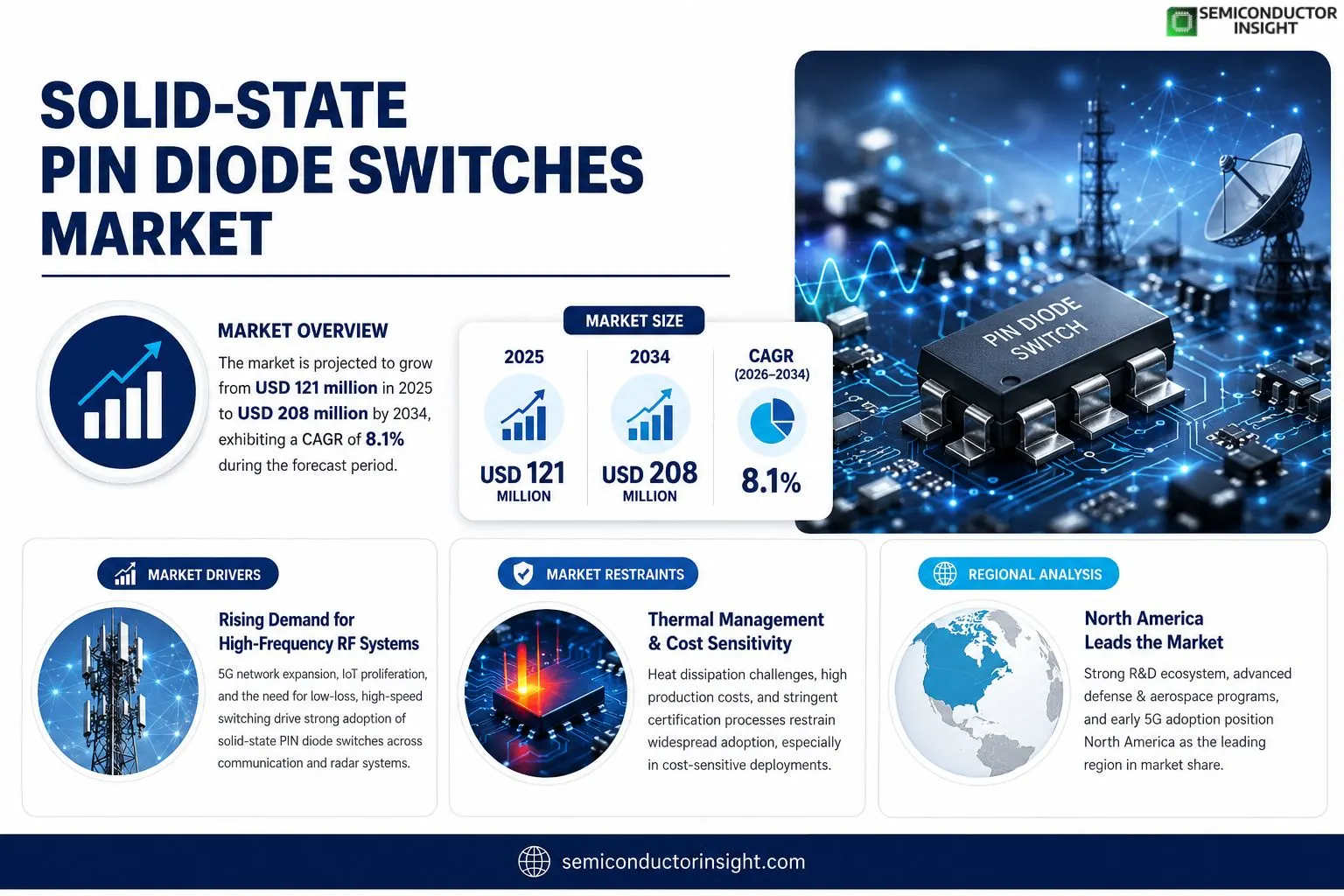
Solid-State PIN Diode Switches market was valued at USD 121 million in 2025 and will reach USD 208 million by 2034, reflecting a CAGR of 8.1% over the forecast horizon.
Solid-State PIN diode switches are semiconductor components that exploit the intrinsic properties of PIN diodes for precise current switching control. In 2025, worldwide sales amounted to 12 million units at an average selling price of USD 11 per unit, delivering fast switching speed, low power consumption and high voltage resistance across communication systems, radar, RF switches, power control and test instrumentation.The expansion is linked to the rollout of 5G networks, proliferation of Internet‑of‑Things devices and growing demand for high‑frequency, high‑power equipment. Upstream inputs such as silicon wafers, phosphine and gallium nitride feed midstream manufacturers who package the diodes, while downstream users include communication equipment makers, radar system integrators and RF module producers. Production capacity reached roughly 15 million units in 2025 with an industry gross margin near 34%, indicating healthy profitability as new application scenarios emerge.
MARKET DRIVERS
Rising Demand for High‑Frequency RF Systems
Solid-State PIN Diode Switches Market is benefitting from telecom operators that are expanding carrier‑grade microwave back‑haul. As networks migrate from legacy coaxial components to agile, low‑loss solid‑state solutions, designers are able to shrink cabinet footprints while preserving insertion loss below 1 dB. This shift translates into lower power consumption for repeaters, which is especially valuable in remote or offshore installations.
Advances in Semiconductor Materials
Recent breakthroughs in high‑electron‑mobility transistors (HEMT) and gallium nitride (GaN) epitaxy have pushed switching speeds into the sub‑nanosecond regime. When a PIN diode is fabricated on these substrates, the on‑state resistance drops dramatically, enabling broadband applications such as satellite‑direct‑to‑home links. Vendors that leverage these material gains can command premium pricing while delivering performance that legacy silicon devices cannot match.
➤ Adoption of solid‑state platforms trims maintenance overhead and shortens system upgrade cycles.
Collectively, the convergence of tighter spectrum allocations and faster data‑rate targets creates a feedback loop: operators require more reliable switches, manufacturers introduce faster, lower‑loss devices, and the market expands accordingly. Stakeholders that anticipate these interactions can position portfolios to capture incremental revenue streams.
MARKET CHALLENGES
Thermal Management Constraints
Even as switching times improve, dissipating heat from high‑power PIN arrays remains a bottleneck. In densely packed RF modules, temperature gradients can degrade forward‑bias performance, leading to drift in insertion loss and sometimes premature failure. Designers therefore have to integrate advanced heat‑spreaders or adopt active cooling, which adds bill‑of‑materials cost and complicates mechanical integration.
Other Challenges
Manufacturing Yield
The intricate doping profiles required for low‑leakage PIN structures demand tight process controls. Small deviations in ion implantation depth can inflate leakage current, forcing manufacturers to reject a significant portion of wafers. Yield pressures push fab costs upward, limiting price elasticity for cost‑sensitive telecom projects.Furthermore, the need for repeatable RF performance across temperature extremes imposes additional inspection steps, extending test cycles and slowing time‑to‑market for new product variants.
MARKET RESTRAINTS
Cost Sensitivity in Telecom Deployments
Network operators allocate capital based on return‑on‑investment calculations that heavily weight equipment cost. While solid‑state switches provide performance gains, their unit price frequently exceeds that of traditional electromechanical alternatives, especially for large‑scale roll‑outs in emerging markets. This price gap forces procurement teams to defer adoption until economies of scale materialize.Regulatory certification overhead also restrains expansion. Each new PIN diode family must pass stringent FCC and CE testing, a process that can add months and substantial lab fees. Companies that lack dedicated compliance resources face delayed launches and reduced market responsiveness.Supply‑chain volatility for GaAs and GaN substrates adds another layer of uncertainty. Geopolitical factors and limited fab capacity have occasionally resulted in lead times surpassing six months, prompting OEMs to keep larger safety stocks and consequently inflate inventory costs.
MARKET OPPORTUNITIES
Emerging 5G and Satellite‑Backhaul Applications
5G roll‑outs are driving demand for compact, high‑speed RF front ends that can operate across multiple bands without manual re‑tuning. Solid‑state PIN diode switches enable seamless band‑switching, a capability that directly supports the carrier’s objective of delivering consistent throughput in dense urban environments. Simultaneously, low‑Earth‑orbit (LEO) satellite constellations require lightweight, low‑loss switching matrices to manage uplink and downlink paths, presenting a dual market thrust.Integration with phased‑array antenna systems is another lucrative avenue. As antenna modules become more digital, the need for rapid, repeatable signal routing intensifies. PIN diode switches that can be digitally controlled via MEMS drivers provide the determinism required for beam‑steering algorithms, opening up contracts with defense and aerospace firms.Finally, the growing emphasis on electric‑vehicle (EV) telematics and V2X communication creates niche demand for rugged solid‑state switches that can survive automotive temperature cycles. Early entrants that qualify components to automotive standards can capture a segment that is still largely dominated by legacy discrete devices.
Solid-State PIN Diode Switches Market Trends
Accelerating Adoption in 5G and IoT Infrastructure
The rollout of next‑generation mobile networks and the explosion of interconnected devices have reshaped demand patterns for high‑frequency switching components. Engineers are increasingly selecting solid‑state PIN diode switches because they can tolerate the voltage swings and thermal loads that accompany dense antenna arrays and massive‑MIMO deployments. This shift is not merely a replacement of legacy mechanical relays; it reflects a broader design philosophy that prizes deterministic latency and reduced power draw. Suppliers that can deliver parts with tighter insertion‑loss tolerances are seeing their order books fill faster, while OEMs report shorter system integration cycles thanks to the predictable behavior of these semiconductor devices.
Other Trends
Supply Chain Evolution
The upstream segment, dominated by silicon wafer and gallium‑nitride producers, has begun consolidating around a few large fabs capable of running high‑volume, low‑defect processes. Midstream packaging firms are differentiating through advanced die‑attach techniques that improve thermal dissipation, a critical parameter for high‑power RF modules. Downstream, component distributors are offering value‑added services such as kitting for radar and test‑equipment manufacturers, smoothing the path from raw die to finished system. This vertical integration reduces lead times and creates pricing leverage for firms that can lock in material supplies early in the design cycle.
Advancements in Frequency and Power Handling
Technical roadmaps indicate a steady push toward operation well beyond the traditional X‑band ceiling. Recent prototypes demonstrate stable switching at frequencies approaching the low‑millimeter‑wave range, opening doors for satellite‑backhaul links and high‑resolution imaging radars. Parallel improvements in power handling arise from refined junction designs that sustain higher currents without sacrificing switching speed. For end users, these capabilities translate into fewer cascaded stages, lowered overall system loss, and a smaller footprint—attributes that are increasingly prized in aerospace and defense platforms where weight and volume are at a premium.
COMPETITIVE LANDSCAPEKey Industry Players
Solid-State PIN Diode Switches: Competitive Overview
The high‑frequency segment is still led by a handful of multinational semiconductor firms that combine deep R&D spend with volume‑driven fabs. Skyworks Solutions and Qorvo dominate the 5G and radar niches, leveraging proprietary PIN‑diode architectures that deliver sub‑nanosecond transition times while keeping insertion loss below 0.5 dB. Their ability to co‑package the switches with driver ICs creates a bundled value proposition that forces downstream equipment makers to lock in long‑term supply agreements. Analog Devices and Infineon follow closely, differentiating through silicon‑on‑insulator (SOI) processes that boost voltage tolerance and thermal robustness, attributes prized by test‑and‑measurement instrument manufacturers. Across the spectrum, Texas Instruments and NXP supply more cost‑effective variants aimed at IoT gateways, where price sensitivity outweighs the need for extreme power handling. This tiered structure—premium innovators at the top, cost‑optimized players in the middle, and regional assemblers at the base—shapes pricing dynamics and migration paths for end‑users seeking to upgrade legacy RF front‑ends.Beyond the headline names, several niche specialists are carving out meaningful market share. Murata Manufacturing and Rohm Semiconductor have introduced compact, surface‑mount PIN switches that cater to space‑constrained satellite modules, gaining traction among aerospace integrators. STMicroelectronics and Mitsubishi Electric focus on high‑power variants for phased‑array radar, where durability under repeated high‑voltage swings is critical. Taiwan‑based players such as Win Semiconductors and Taiwan Semiconductor Manufacturing Co. (TSMC) provide foundry services that enable emerging Chinese and Korean firms to launch bespoke switch families without building their own fabs. European boutique firms like AMS and Nexperia are leveraging advanced GaN heterostructures to push frequency ceilings past 100 GHz, opening doors to next‑generation mmWave communication trials. These smaller but agile companies increase competitive pressure, prompting incumbents to accelerate product‑roadmap cycles and explore strategic collaborations.
List of Key Solid-State PIN Diode Switches Companies Profiled
- Skyworks Solutions
- Qorvo
- Analog Devices
- Infineon Technologies
- Texas Instruments
- NXP Semiconductors
- Murata Manufacturing
- Rohm Semiconductor
- STMicroelectronics
- Mitsubishi Electric
- Win Semiconductors
- TSMC
- AMS
- Nexperia
- Broadcom Inc.
Segment Analysis:
| Segment Category | Sub-Segments | Key Insights |
| By Type |
|
Single Knife Single Throw dominates the market owing to its simplicity, reliability, and ease of integration. ‑ Preferred for compact RF modules where space and weight are critical. ‑ Offers the fastest switching speed with minimal insertion loss, meeting the stringent demands of high‑frequency 5G front‑ends. ‑ Provides a cost‑effective solution for large‑volume production in consumer‑grade communication devices. |
| By Application |
|
5G Communication is the leading application segment, driven by the need for ultra‑fast, low‑power RF switching in base‑station and handset architectures. ‑ Enables agile beam‑forming and carrier aggregation with rapid state changes. ‑ Supports high‑power amplifier protection, enhancing overall system reliability. ‑ Aligns with the broader shift toward dense network deployments and edge‑computing environments. |
| By End User |
|
Communication Equipment Manufacturers lead the end‑user landscape because solid‑state PIN diodes provide the high‑frequency performance required in modern transceiver designs. ‑ Their fast turn‑on/off characteristics reduce latency in signal routing. ‑ Low power consumption aligns with sustainability targets for network operators. ‑ Robust voltage handling meets the demands of high‑power transmission modules. |
| By Frequency Range |
|
High Frequency segment is gaining prominence as system architects target millimeter‑wave bands for next‑generation backhaul and satellite links. ‑ Devices exhibit lower insertion loss, preserving signal integrity at elevated frequencies. ‑ Enhanced thermal stability supports prolonged operation in power‑dense environments. ‑ The trend towards higher data rates reinforces the preference for high‑frequency solid‑state switches. |
| By Product Configuration |
|
Integrated Packages are emerging as the preferred configuration for compact, high‑performance RF subsystems. ‑ Consolidates multiple functions, reducing board space and interconnect complexity. ‑ Improves reliability by minimizing mechanical interfaces. ‑ Aligns with the industry shift toward miniaturized, modular designs for portable and aerospace platforms. |
Regional Analysis: Solid-State PIN Diode Switches
North America
R&D teams in the United States and Canada are piloting monolithic integration of PIN diodes with GaN power stages, aiming to shrink footprint while preserving high‑frequency performance. Collaborative programs with national labs accelerate proof‑of‑concept cycles, encouraging early‑stage adopters to experiment with hybrid switch topologies.
A dense network of silicon‑based substrate suppliers and precision assembly houses mitigates bottlenecks. Near‑shoring initiatives have expanded Tier‑2 capacity, allowing OEMs to buffer inventory against logistical shocks without sacrificing lead‑time.
Federal agencies have issued updated electromagnetic compatibility guidelines that favor solid‑state switching solutions, reducing reliance on mechanical relays. Certification pathways are well‑defined, encouraging smaller players to enter the market with confidence.
Aerospace integrators cite the thermal stability of PIN diode switches as a decisive factor for high‑altitude radar upgrades. Meanwhile, telecom operators prioritize the low‑latency switching capability to support emerging 6G testbeds across major metros.
Europe
European manufacturers leverage a mature automotive electronics base to embed Solid-State PIN Diode Switches in advanced driver‑assistance systems. Cross‑border collaborations between German fab clusters and French design houses have produced modules optimized for high‑temperature operation, aligning with the continent’s push toward electric‑vehicle electrification. Regulatory frameworks, particularly the EU’s RoHS extensions, have nudged suppliers toward lead‑free compositions, prompting incremental material innovations that improve switching efficiency. Meanwhile, defense contracts in the United Kingdom and the Netherlands sustain a steady demand for ruggedized switch assemblies, reinforcing the region’s reputation for high‑reliability components. As 5G rollout matures, the need for fast, low‑loss switching in base‑station back‑haul continues to expand, offering European firms an avenue to diversify beyond automotive and aerospace niches.
Asia-Pacific
The Asia‑Pacific landscape is characterized by rapid adoption in consumer‑device manufacturers seeking to miniaturize front‑end modules. Chinese and Taiwanese fabs have scaled production of PIN diode arrays, benefiting from cost‑effective wafer processing while maintaining performance metrics required for satellite communication payloads. South Korean conglomerates are integrating these switches into next‑generation radar on emerging unmanned aerial platforms, a move spurred by heightened regional security investments. Although the region grapples with fragmented standards, industry consortia are converging on common test protocols, thereby improving cross‑border component compatibility. The emerging demand from renewable‑energy inverters, where fast‑acting switches mitigate harmonic distortion, adds another growth vector, positioning the Asia‑Pacific as a versatile demand hub.
South America
In South America, niche markets such as oil‑and‑gas exploration and mining equipment benefit from the robustness of Solid-State PIN Diode Switches in harsh environments. Brazilian manufacturers are customizing switch packages to meet the strict vibration and temperature tolerances of offshore platforms, leveraging local supplier networks to reduce import dependency. The region’s telecommunications upgrades, especially the rollout of 5G in Brazil and Colombia, have sparked interest in compact switching solutions that enable dense antenna arrays. Although overall market size remains modest, strategic partnerships with North American OEMs are fostering technology transfer, gradually elevating local design expertise and paving the way for broader adoption across industrial sectors.
Middle East & Africa
The Middle East & Africa segment derives momentum from large‑scale satellite ground‑station projects and defense modernization programs. United Arab Emirates and Saudi Arabia are investing heavily in high‑frequency communication infrastructure, where the low insertion loss of PIN diode switches translates directly into signal integrity gains. African telecom operators, while still expanding basic network coverage, are beginning to trial advanced back‑haul solutions that require reliable solid‑state switching. Meanwhile, the region’s renewable‑energy installations, particularly solar farms in North Africa, are exploring switch‑based power‑conditioning modules to improve grid stability. Although supply‑chain complexity poses challenges, increasing local assembly capabilities are reducing lead‑times and fostering a nascent ecosystem for high‑performance switch components.
Report Scope
This market research report provides a comprehensive analysis of the Solid-State PIN Diode Switches Market , covering the forecast period 2026–2034. It offers detailed insights into market dynamics, technological advancements, competitive landscape, and key trends shaping the industry.
Key focus areas of the report include:
- Market Overview: The report begins with an overview outlining its current market scenario, key growth indicators, and industry transformation drivers. It discusses macroeconomic factors, demand–supply balance, regulatory landscape, and the strategic role of semiconductors in powering advancements across industries such as automotive, telecommunications, consumer electronics, and industrial automation.
- Market Size & Forecast: Historical data and future projections for revenue, unit shipments, and market value across major regions and segments.
- Segmentation Analysis: Detailed breakdown by product type, technology, application, and end-user industry to identify high-growth segments and investment opportunities.
- Regional Insights: Insights into market performance across North America, Europe, Asia-Pacific, Latin America, and the Middle East & Africa, including country-level analysis where relevant.
- Competitive Landscape: Profiles of leading market participants, including their product offerings, R&D focus, manufacturing capacity, pricing strategies, and recent developments such as mergers, acquisitions, and partnerships.
- Technology Trends & Innovation: Assessment of emerging technologies, integration of AI/IoT, semiconductor design trends, fabrication techniques, and evolving industry standards.
- Market Drivers & Restraints: Evaluation of factors driving market growth along with challenges, supply chain constraints, regulatory issues, and market-entry barriers.
- Stakeholder Insights: Insights for component suppliers, OEMs, system integrators, investors, and policymakers regarding the evolving ecosystem and strategic opportunities.
Primary and secondary research methods are employed, including interviews with industry experts, data from verified sources, and real-time market intelligence to ensure the accuracy and reliability of the insights presented.
FREQUENTLY ASKED QUESTIONS:
What is the current market size of Solid-State PIN Diode Switches Market?
-> Solid-State PIN Diode Switches Market was valued at USD 121 million in 2025 and is expected to reach USD 208 million by 2034, at a CAGR of 8.1% during the forecast period.
Which key companies operate in Solid-State PIN Diode Switches Market?
-> Key players include international semiconductor manufacturers and emerging domestic firms, which dominate the high‑end and mid‑to‑low‑end segments respectively.
What are the key growth drivers?
-> Key growth drivers include 5G communications rollout, Internet of Things expansion, radar technology advancements, and rising demand for high‑frequency, high‑power equipment.
Which region dominates the market?
-> Asia‑Pacific is the fastest‑growing region, while Europe remains a major market due to established telecommunications and defense sectors.
What are the emerging trends?
-> Emerging trends include development of higher‑frequency and higher‑speed PIN diode switches, lower insertion loss designs, and integration with AI/IoT enabled smart communication systems.
Get Sample Report PDF for Exclusive Insights
Report Sample Includes
- Table of Contents
- List of Tables & Figures
- Charts, Research Methodology, and more...