RF GaN Devices Market Insights
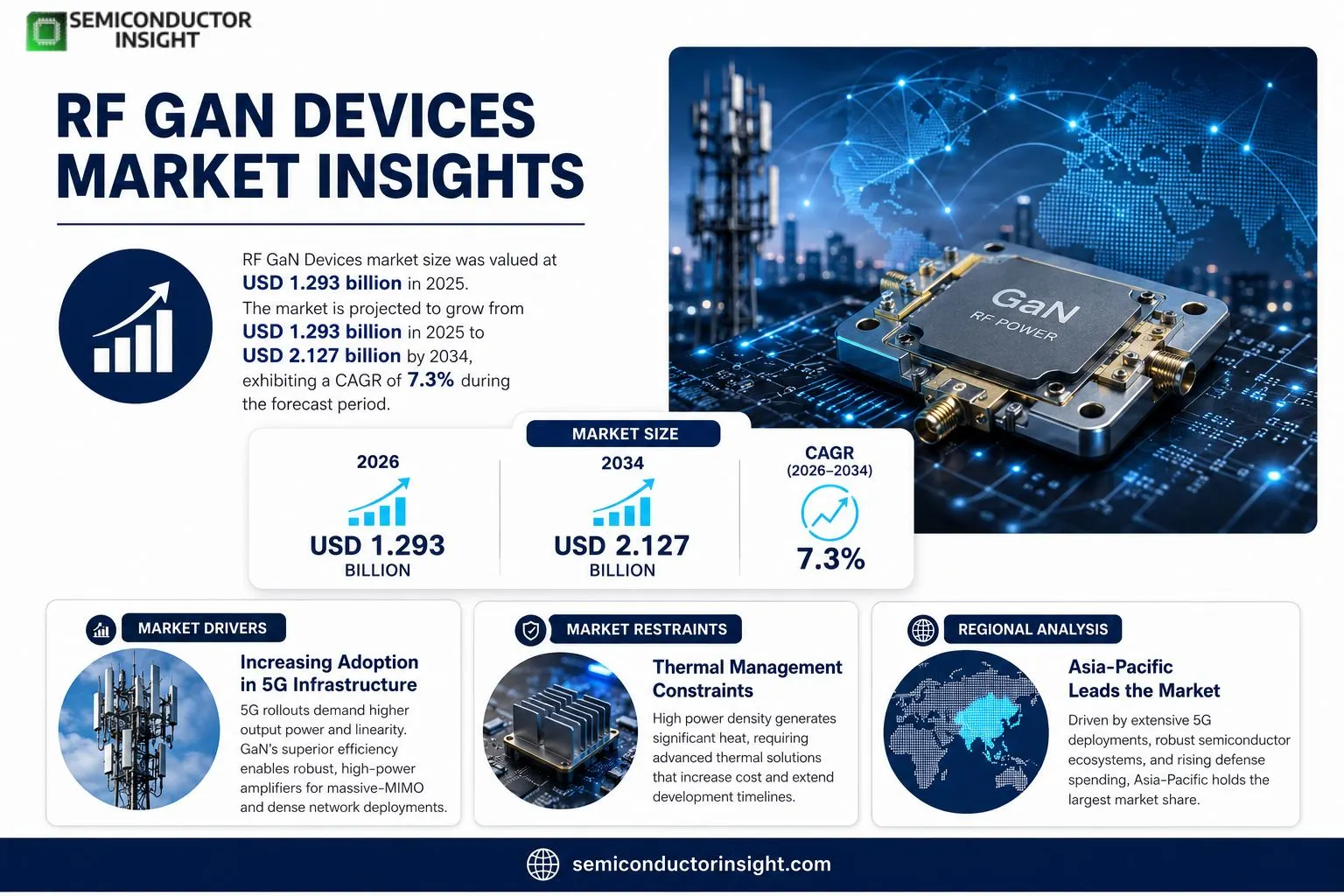
RF GaN Devices market size was valued at USD 1.293 billion in 2025. The market is projected to grow from USD 1.293 billion in 2025 to USD 2.127 billion by 2034, exhibiting a CAGR of 7.3% during the forecast period.
GaN RF devices refer to high‑power, high‑efficiency semiconductor components built on gallium‑nitride (GaN) material and employed across RF, microwave and mmWave signal chains, where power amplification drives value creation. The product scope encompasses discrete RF GaN power transistors (die or packaged), GaN MMICs that integrate PA/driver/LNA/switch functions, and system‑facing PA/driver modules or selected integrated assemblies. The dominant technology is GaN HEMT, realized primarily on two substrate platforms – GaN‑on‑SiC, prized for superior power density and thermal handling in radar, electronic warfare and satellite communications, and GaN‑on‑Si, which leverages silicon wafer scalability for cost‑effective infrastructure deployment. These devices exploit wide‑bandgap advantages such as high breakdown voltage, elevated charge density and temperature robustness, enabling higher operating voltages, greater power density and improved efficiency for long‑range or high‑power RF systems.
MARKET DRIVERS
Increasing Adoption in 5G Infrastructure
The rollout of 5G networks demands radio‑frequency front‑ends that can deliver higher output power while preserving linearity. RF GaN Devices Market participants are capitalising on gallium‑nitride’s superior electron mobility, which translates into more robust power amplifiers for massive‑MIMO antenna arrays. This technical edge is reshaping equipment specifications and prompting telecom OEMs to replace legacy silicon solutions.
Shift Toward Energy‑Efficient Power Amplifiers
Enterprise data‑centres and base‑station operators are under pressure to lower operational expenditures. Gallium‑nitride’s higher power‑added efficiency enables up to 30 % reduction in cooling‑related costs, making it an attractive choice for green‑energy initiatives. Companies that integrate RF GaN devices are therefore positioned to capture cost‑conscious customers.
➤ “The efficiency advantage of GaN is no longer a niche benefit; it is becoming a baseline requirement for next‑generation RF systems.”
Beyond telecommunications, radar and satellite payloads are benefitting from the weight and size savings that GaN technology offers. Designers can consolidate multiple stages into a single module, accelerating time‑to‑market and reducing bill‑of‑materials. This cross‑sector appeal amplifies the momentum behind RF GaN Devices Market.
MARKET CHALLENGES
Thermal Management Constraints
Despite its high efficiency, GaN still generates considerable heat at elevated power densities. Engineers must design sophisticated heat‑sink architectures, often involving exotic materials or active cooling, which inflates device cost and prolongs development cycles. The need for reliable thermal solutions therefore temper the speed of market adoption.
Other Challenges
Supply‑Chain Vulnerabilities
The semiconductor ecosystem remains sensitive to raw‑material shortages and geopolitical tensions. Gallium nitrate and high‑purity substrates are sourced from a limited number of suppliers, creating bottlenecks that can delay production ramps and affect pricing stability.
MARKET RESTRAINTS
High Capital Expenditure
Fabrication facilities for GaN wafers require advanced epitaxial reactors and stringent clean‑room environments. The upfront investment exceeds that of conventional silicon fabs, deterring smaller players from entering the space and limiting competitive pressure. This capital intensity dampens the overall pace at which RF GaN Devices Market can expand.
MARKET OPPORTUNITIES
Emerging Defense Applications
Modern defense systems, from active electronically scanned arrays to directed‑energy weapons, demand RF components that can operate across wide frequency bands with minimal latency. GaN’s resilience to radiation and ability to handle high peak powers make it a strategic fit. Government procurement programmes are therefore creating a fertile pipeline of contracts for suppliers adept at meeting rigorous defence specifications.In parallel, the automotive sector’s push toward advanced driver‑assistance systems (ADAS) and vehicle‑to‑everything (V2X) communications is opening a new frontier. RF GaN devices can support the high‑frequency bands required for low‑latency vehicle networking, positioning RF GaN Devices Market to benefit from the coming wave of connected‑car technologies.
RF GaN Devices Market Trends
Shift Toward Si Substrates for Cost‑Effective Deployments
RF GaN Devices Market is seeing a pronounced migration from the traditional GaN‑on‑SiC platform to GaN‑on‑Si solutions. Si‑based epitaxy leverages the economies of scale inherent to silicon wafer manufacturing, allowing larger diameters and lower per‑unit cost. This cost advantage is resonating with network operators that are scaling out dense 5G macro and small‑cell deployments, where the total bill of materials drives equipment selection. While SiC still dominates high‑power radar and space applications, the incremental performance gap for sub‑6 GHz base‑station power amplifiers has narrowed enough that many OEMs now consider Si as the pragmatic choice. The trend creates pressure on suppliers to optimise wafer‑level yield and to redesign thermal pathways that compensate for Si’s lower thermal conductivity.
Other Trends
Thermal Mangaement Advances
Improved thermal interface materials and novel package architectures are extending the power density envelope of GaN‑on‑Si devices. Engineers are integrating copper‑based heat spreaders directly onto the die and employing micro‑channel cooling in high‑output modules. These innovations reduce junction temperature by up to 15 °C under peak load, translating into longer mean time between failures for outdoor base‑station units. The ripple effect is a stronger value proposition for carriers seeking to minimise maintenance cycles while maintaining high‑efficiency amplification.
Broadening Adoption in 5G and Defense
Demand from both telecom infrastructure and defense sectors continues to shape RF GaN Devices Market. In the telecom arena, massive‑MIMO arrays and backhaul links are increasingly specified with GaN‑based power amplifiers because of their superior linearity and ability to handle high peak‑to‑average power ratios. Concurrently, defense programs targeting AESA radar and electronic warfare are prioritising GaN‑on‑SiC for its resilience under extreme thermal and radiation stress. The dual‑track growth forces manufacturers to maintain parallel development streams, balancing cost‑sensitive silicon products with performance‑centric SiC offerings. Companies that can seamlessly navigate this split are positioned to capture a larger share of the overall market while mitigating supply‑chain risks associated with a single substrate dependency.
COMPETITIVE LANDSCAPE
Key Industry Players
RF GaN Devices Market – Competitive Overview
The market is anchored by a handful of integrated device manufacturers that control both design and high‑volume production. Qorvo, for example, leverages its IDM platform to deliver GaN‑on‑SiC power amplifiers that dominate the sub‑6 GHz 5G base‑station segment. Its extensive R&D pipeline, combined with a global packaging network, enables rapid iteration on linearity and efficiency metrics that customers demand for massive‑MIMO deployments. The company’s ability to bundle discrete HEMTs with MMIC modules has forced downstream system integrators to align their design roadmaps around Qorvo’s reference architectures, effectively setting the tempo for pricing and technology adoption across the supply chain.Beyond the tier‑one players, a diverse cohort of specialty foundries and defense‑oriented firms enriches the competitive fabric. MACOM and SEDI operate niche RF‑focused foundry services, offering GaN‑on‑Si platforms that appeal to cost‑sensitive infrastructure projects. Defense vendors such as Raytheon and Northrop Grumman prioritize ruggedized GaN modules for radar and electronic warfare, emphasizing reliability over sheer performance. Meanwhile, firms like Mitsubishi Electric, Ampleon, and UMS RF target industrial microwave applications, delivering custom‑tuned transistors for high‑temperature environments. Emerging Chinese participantsincluding CETC 55, Youjia Technology, and Shenzhen Taigaoare scaling epitaxy capacity, positioning themselves to capture a share of the rapidly expanding Asia‑Pacific rollout. Collectively, these players generate a multilayered competitive dynamic where scale, application focus, and substrate choice dictate market positioning.
List of Key RF GaN Devices Companies Profiled
- Qorvo
- MACOM
- Sumitomo Electric Device Innovations (SEDI)
- NXP Semiconductors
- RFHIC Corporation
- Raytheon Technologies
- Dynax Semiconductor
- Mitsubishi Electric
- Ampleon
- UMS RF
- CETC 55
- Northrop Grumman
- ReliaSat (Arralis)
- WAVICE Inc
- Microchip Technology
- Youjia Technology (Suzhou) Co., Ltd
- Shenzhen Taigao Technology
- Hebei Sinopack Electronic Technology
Segment Analysis:
| Segment Category | Sub-Segments | Key Insights |
| By Type |
|
Discrete RF GaN Transistors
|
| By Application |
|
Telecom Infrastructure
|
| By End User |
|
Mobile Network Operators
|
| By Technology |
|
GaN‑on‑SiC
|
| By Process Platform |
|
Specialty RF Foundries
|
Regional Analysis: RF GaN Devices Market
North America
The Department of Defense’s recent contracts emphasize high‑power, low‑loss amplifiers for radar and electronic countermeasures. Contractors are favoring GaN because its thermal performance reduces cooling requirements, enabling more compact weapon systems. This procurement pattern reinforces a steady demand stream that buffers manufacturers from cyclical consumer market swings.
U.S. carriers are expanding mid‑band and millimeter‑wave deployments, a scenario where RF GaN power amplifiers deliver the required output with superior linearity. Network operators view GaN as a cost‑effective path to meet spectrum efficiency targets while limiting energy consumption across dense urban sites.
Collaborative projects between leading universities and industry labs focus on material defect reduction and novel substrate architectures. These initiatives accelerate technology transfer, allowing start‑ups to enter the market with differentiated device topologies that challenge incumbent offerings.
Domestic wafer manufacturers have broadened their capacity, ensuring a reliable feedstock for GaN epitaxy. This reduces lead times compared with regions reliant on imported substrates, granting North American firms a logistical edge when fulfilling urgent defense contracts.
Europe
European stakeholders are capitalizing on stringent emission standards and the continent’s commitment to sovereign technology. The EU’s strategic autonomy agenda has encouraged local chip designers to embed GaN solutions within automotive radar and satellite communications, sectors that demand high reliability under extreme conditions. Collaborative frameworks between German research institutes and French manufacturers are fostering a niche of high‑frequency GaN devices tailored for autonomous vehicle testing grounds in Scandinavia. While the market size lags behind North America, Europe’s regulatory climate and cross‑border funding mechanisms create a fertile environment for specialized applications, prompting firms to pursue joint‑venture models that spread development risk while accessing diverse customer bases across the bloc.
Asia-Pacific
The Asia‑Pacific region exhibits a dynamic blend of rapid telecom rollouts and burgeoning defense modernization programs, particularly in China, Japan, and South Korea. Mobile operators are layering dense small‑cell networks to exploit higher spectrum slices, a deployment that leans heavily on the power efficiency of GaN amplifiers. Simultaneously, governmental incentives for domestic semiconductor capability have spurred several Asian conglomerates to invest in GaN fabs, seeking to reduce reliance on imported components. However, the fragmented market landscapecharacterized by varied standards and pricing pressuresmeans that manufacturers must tailor product portfolios to address a wide spectrum of performance and cost expectations across the region’s diverse economies.
South America
In South America, RF GaN Devices Market is largely propelled by the telecommunications sector’s upgrade to 4G‑Advanced and the early phases of 5G pilots in Brazil and Chile. Operators are attracted to GaN’s ability to deliver higher output power without proportionally increasing energy consumption, a critical consideration in regions where grid reliability can be uneven. Government‑led initiatives to modernize public safety communications also present a modest but growing demand for ruggedized GaN amplifiers capable of withstanding harsh environmental conditions. The market remains nascent, yet the combination of telecom expansion and public‑sector investment hints at a trajectory that could diversify the regional vendor mix in the next few years.
Middle East & Africa
Middle East and African markets are witnessing incremental adoption of RF GaN Devices, driven by large‑scale oil‑field communications and emerging smart‑city projects in the Gulf states. The high‑temperature tolerance of GaN aligns well with the harsh climatic conditions, reducing cooling system costs for field‑deployed equipment. In addition, defense contracts in several Gulf nations prioritize stealth and high‑power radar capabilities, areas where GaN’s high efficiency offers distinct performance gains. African nations, while still early in their upgrade cycles, are beginning to explore satellite backhaul solutions that could benefit from GaN’s lightweight and power‑dense attributes, suggesting a gradual widening of the market footprint beyond traditional strongholds.
Report Scope
This market research report provides a comprehensive analysis of the RF GaN Devices Market , covering the forecast period 2026–2034. It offers detailed insights into market dynamics, technological advancements, competitive landscape, and key trends shaping the industry.
Key focus areas of the report include:
- Market Overview: The report begins with an overview outlining its current market scenario, key growth indicators, and industry transformation drivers. It discusses macroeconomic factors, demand–supply balance, regulatory landscape, and the strategic role of semiconductors in powering advancements across industries such as automotive, telecommunications, consumer electronics, and industrial automation.
- Market Size & Forecast: Historical data and future projections for revenue, unit shipments, and market value across major regions and segments.
- Segmentation Analysis: Detailed breakdown by product type, technology, application, and end-user industry to identify high-growth segments and investment opportunities.
- Regional Insights: Insights into market performance across North America, Europe, Asia-Pacific, Latin America, and the Middle East & Africa, including country-level analysis where relevant.
- Competitive Landscape: Profiles of leading market participants, including their product offerings, R&D focus, manufacturing capacity, pricing strategies, and recent developments such as mergers, acquisitions, and partnerships.
- Technology Trends & Innovation: Assessment of emerging technologies, integration of AI/IoT, semiconductor design trends, fabrication techniques, and evolving industry standards.
- Market Drivers & Restraints: Evaluation of factors driving market growth along with challenges, supply chain constraints, regulatory issues, and market-entry barriers.
- Stakeholder Insights: Insights for component suppliers, OEMs, system integrators, investors, and policymakers regarding the evolving ecosystem and strategic opportunities.
Primary and secondary research methods are employed, including interviews with industry experts, data from verified sources, and real-time market intelligence to ensure the accuracy and reliability of the insights presented.
FREQUENTLY ASKED QUESTIONS:
What is the current market size of RF GaN Devices Market?
-> RF GaN Devices Market was valued at USD 1293 million in 2025 and is expected to reach USD 2127 million by 2034, growing at a CAGR of 7.3% during the forecast period.
Which key companies operate in RF GaN Devices Market?
-> Key players include Sumitomo Electric Device Innovations (SEDI), MACOM, Qorvo, NXP, RFHIC Corporation, Raytheon, Dynax Semiconductor, Mitsubishi Electric, CETC 55, Northrop Grumman, Ampleon, UMS RF, CETC 13, ReliaSat (Arralis), WAVICE Inc, Microchip Technology, Youjia Technology (Suzhou) Co., Ltd, Shenzhen Taigao Technology, and Hebei Sinopack Electronic Technology.
What are the key growth drivers?
-> Key growth drivers include expanding wireless infrastructure for 5G/5G‑Advanced (macro, massive‑MIMO, backhaul, mmWave), increasing aerospace & defense demand for AESA radar, EW and satcom, and the rise of industrial/specialty microwave systems requiring high‑power, high‑efficiency RF solutions.
Which region dominates the market?
-> Asia holds the largest market share, driven by extensive 5G deployments, strong semiconductor manufacturing ecosystems, and growing defense spending, while North America and Europe remain significant growth contributors.
What are the emerging trends?
-> Emerging trends include device scaling for higher frequencies, improved linearity and Doherty‑friendly PA architectures, advanced thermal‑reliability engineering, and the convergence of GaN‑on‑SiC and GaN‑on‑Si technologies to balance performance with cost‑effective manufacturability.
Get Sample Report PDF for Exclusive Insights
Report Sample Includes
- Table of Contents
- List of Tables & Figures
- Charts, Research Methodology, and more...
 Download Sample Report PDF