Key Statistics
Key Takeaways
- Market trajectory: low-voltage silicon power MOSFET revenue stood near USD 4,794.0 million during 2025 and is forecast to reach USD 6,887.0 million by 2034, representing 4.1% annual growth. Demand expands through automotive low-voltage distribution, server power conversion, industrial control and charger applications rather than a single device platform.
- Device architecture: N-channel switches account for an estimated ~82% of sales because low-resistance power paths, synchronous rectification and motor stages rely heavily on enhancement-mode N-channel silicon. P-channel parts retain approximately ~18% through polarity protection and selected simple high-side switching requirements.
- Application mix: automotive auxiliary systems contribute an estimated ~30% of value; data-center power supplies ~26%; industrial automation and robotics ~18%; consumer chargers and adapters ~18%; and power-over-Ethernet equipment ~8%. Designers increasingly weigh gate charge, switching noise and thermal constraints against lowest on-state resistance.
- Regional footprint: Asia-Pacific captures an estimated ~46% because power semiconductor production and high-volume electronics assembly cluster there. North America contributes ~27% through cloud equipment and automotive engineering, Europe ~20%, Middle East and Africa ~4%, and South and Central America ~3% through industrial and power distribution demand.
- Qualification barrier: AEC-Q101 automotive parts require verified electrical endurance, thermal cycling and supplier change control. Product announcements in 2026 highlight both 40 V compact devices and 100 V motor-control families, confirming that voltage class, package thermal resistance and gate-drive behavior remain meaningful differentiators between nominally similar switches.
Low Voltage Power MOSFETs Market Overview
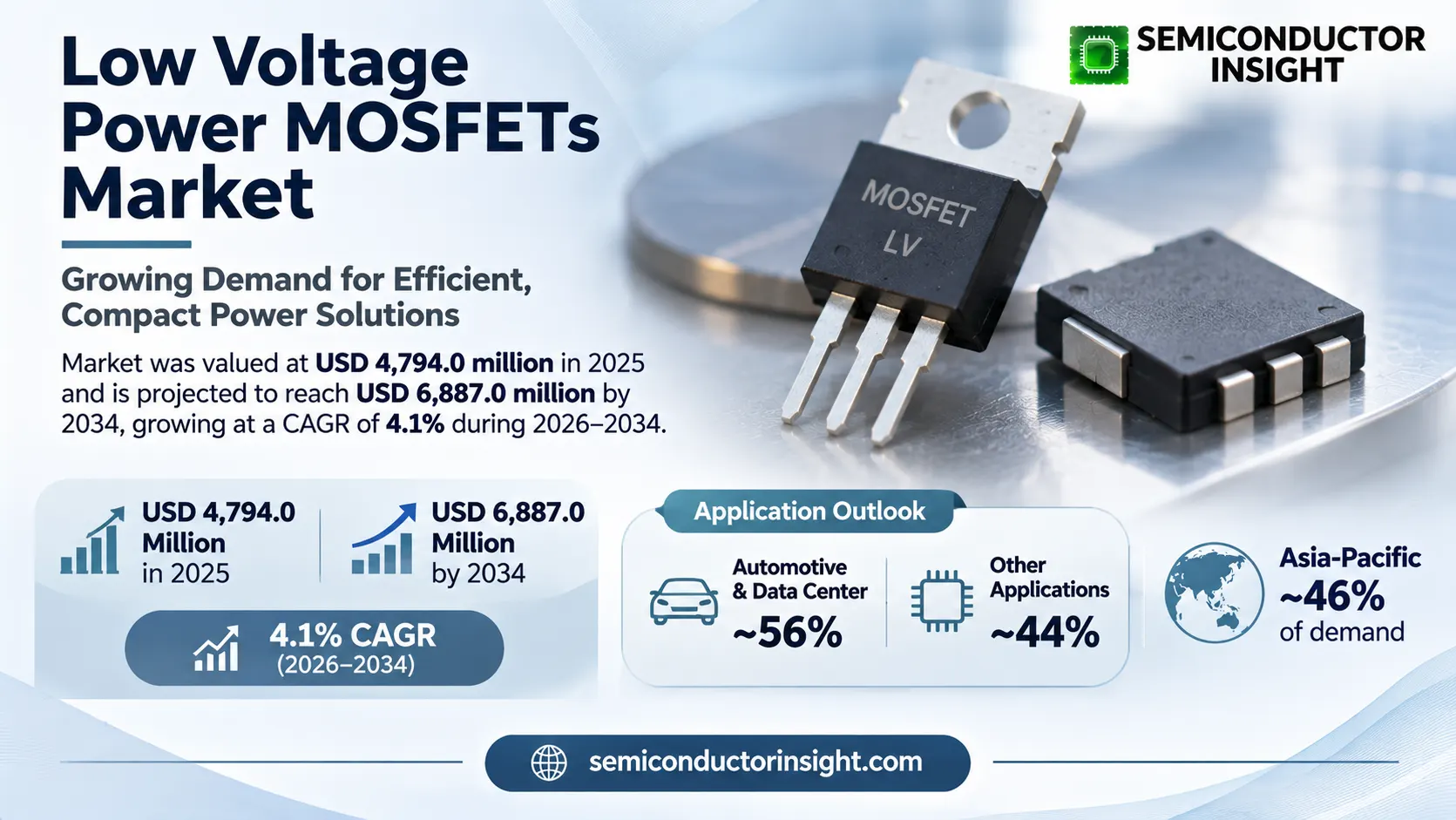
Low voltage power MOSFETs market was valued at USD 4,794.0 million in 2025 and is projected to reach USD 6,887.0 million by 2034, growing at a CAGR of 4.1% during 2026–2034. Asia-Pacific represents an estimated ~46% of demand, reflecting dense power-device supply chains, consumer electronics assembly and vehicle-electrification production.
Low-voltage power MOSFETs use an insulated gate to control current through a silicon semiconductor channel. Power-system designers typically select these devices for rails below about 100 V, although some catalogues extend their practical low-voltage category toward 150 V. Selection is governed by drain-to-source voltage, drain current, on-state resistance, total gate charge, switching energy, avalanche behavior and thermal dissipation in the installed package. A low numerical resistance alone does not guarantee the most efficient converter.
This revenue category includes discrete N-channel and P-channel silicon power MOSFETs sold into the Type, Application, End User, Package and Qualification groups, including devices supplied with compatible copper-clip and thermal-enhanced terminations. It excludes finished motor drives, electric vehicles, power-supply assemblies, gate-driver integrated circuits, radio-frequency amplifier transistor revenue and higher-voltage SiC or IGBT modules. A component purchased by a contract manufacturer is counted at semiconductor component value, not at the eventual system invoice.
Modern server and battery platforms impose significant switching and thermal requirements on relatively low-voltage devices. An Infineon November 2026 announcement introduced 40 V OptiMOS 7 products for server and telecom systems with package options around 3.3 × 3.3 mm and 5 × 6 mm. These specifications matter in dense power rails where printed-circuit-board copper, gate-drive waveforms and cooling make a measurable difference to power dissipation and reliability.
Automotive adoption adds a distinct qualification pathway. Renesas lists an AEC-Q101 40 V, 100 A N-channel device with maximum 2 mΩ resistance in an SO8-FL package; a separate 40 V, 50 A option specifies 5 mΩ maximum. The spread reflects different electrical, thermal and cost tradeoffs within one voltage class. Purchasing departments need production traceability and approved process changes, while designers must verify pulse loads and junction temperature under actual vehicle operating profiles.
The Semiconductor Industry Association reported USD 791.7 billion of total worldwide semiconductor sales for 2025, an increase of 25.6% from the prior year. That is the market context rather than low-voltage MOSFET revenue; the latter occupies a specific discrete-power semiconductor subset. Procurement volumes follow power-device content per product, qualification cycles, manufacturing geography and component price movements rather than tracking total chip-industry revenue in direct proportion.
Segment Analysis: By Type
N-channel devices comprise an estimated ~82% of commercial value because efficient conduction and synchronous switching favor their lower available resistance at a given area. P-channel power MOSFETs make up approximately ~18%, serving selective reverse-polarity, simple high-side and load-isolation circuits where less complex gate control can outweigh their generally higher resistance.
| Type | Function | Market position |
|---|---|---|
| N-Channel MOSFETs | An N-channel power transistor requires the gate to be driven above its source potential by the appropriate voltage while the power stage handles drain current and switching transitions. Modern trench designs reduce conduction loss; designers then evaluate gate charge, output capacitance, diode recovery and transient ruggedness to avoid moving loss into the driver or interconnect. High-current 40 V, 60 V and 100 V catalogues from several suppliers serve automotive, datacenter, motor and battery circuits. | An estimated ~82% of value arises from the widespread use of N-channel devices in synchronous rectifiers, low-voltage half bridges, e-fuses and industrial motor stages. Infineon positions 25 V and 40 V OptiMOS products around server conversion and power efficiency, while Nexperia offers 40 V LFPAK parts with sub-milliohm resistance. Competition therefore emphasizes a package-specific performance envelope, not one universal best electrical metric. |
| P-Channel MOSFETs | P-channel switches conduct using the complementary carrier structure and are useful where a negative gate-to-source drive enables straightforward high-side switching. Their on-state resistance is usually greater than an equivalent-size N-channel product, so large-current designs often substitute N-channel stages with a dedicated controller. Nevertheless, load disconnect, reverse-battery arrangements and some consumer switching circuits value the simplified biasing and reduced part count that a P-channel device can offer. | The estimated ~18% market position reflects smaller but persistent requirements in polarity-sensitive power routing. Vishay lists a 40 V P-channel SiSS4409DN MOSFET with specified gate-charge and switching characteristics, demonstrating an active product offering. A P-channel choice can be commercially preferable when modest current and a simple gate-drive network outweigh efficiency improvements that would otherwise justify a more elaborate N-channel circuit. |
Secondary segmentation: customers, package construction and grade
Application and end-user demand intersect with package and qualification requirements: a 40 V part may be used by an automotive supplier, packaged in an LFPAK footprint and ordered by an electronics manufacturer without becoming separate sales. Standardized electrical testing and the final circuit thermal profile are important determinants of substitution between similar parts.
| Axis | Members | Commercial role |
|---|---|---|
| End User | OEM Power-Supply Designers · Tier-1 Automotive Suppliers · Contract Manufacturing Services | OEM design teams lead with an estimated ~46% of purchasing influence, automotive Tier-1 suppliers hold ~35%, and contract manufacturers contribute ~19% through procurement and assembly. A qualified bill of materials often determines which approved producer can supply an identical power stage over its full lifecycle. |
| Package | DFN (Dual-Flat-No-Lead) · LFPAK · PowerFLAT · TOLL · Thermal-Enhanced Packages | An estimated ~25% of value is associated with DFN, ~24% with LFPAK, ~20% with PowerFLAT, ~18% with TOLL and ~13% with other thermal-enhanced packages. Electrical resistance must be judged with copper area, lead construction, solder joints and heat removal rather than from nominal footprint alone. |
| Qualification | Automotive-Grade (AEC-Q101) · Industrial-Grade (AEC-Q200) · General-Purpose / Consumer | Automotive-grade requirements represent an estimated ~36% of product value, the source-designated industrial grade ~24%, and general-purpose or consumer parts ~40%. Automotive discrete semiconductors normally use AEC-Q101; AEC-Q200 is a passive-component standard and should not be interpreted as certification for an industrial MOSFET. |
Segment Analysis: By Application
Applications differ in their voltage transients, thermal limits, switching frequency and cost of qualification. Automotive and data-center equipment generate an estimated ~56% of low-voltage power MOSFET component value together, with other sectors expanding through compact motors, USB charging and network power delivery. This category excludes the value of the complete systems in which the devices are fitted.
| Application | Demand characteristics |
|---|---|
| Automotive Auxiliary Systems | An estimated ~30% of demand comes from vehicle auxiliary circuits such as 12 V and 24 V load switching, electronic fuses, steering assistance, braking actuators and body electronics. These circuits require avalanche endurance, stable behavior under abnormal supply transients and extensive validation. Renesas 40 V automotive MOSFET catalogues demonstrate relevant current and resistance specifications, while a supplier still must prove production traceability and qualification to the exact vehicle application. |
| Data-Center Power Supplies | An estimated ~26% supports server power shelves, 48 V bus conversion, processor voltage regulation and high-efficiency rectification. Cloud facilities prize small energy losses because a fraction of a watt per component can compound across dense equipment populations. The best switch is determined by total switching energy, cooling layout and electrical noise; Infineon 40 V product releases in 2026 address these conditions without implying that all data-center power spending becomes MOSFET sales. |
| Industrial Automation & Robotics | Industrial controls and robotic actuators account for approximately ~18% of value through motors, safety disconnects, power distribution and embedded supply boards. Continuous operating duty, inductive-load transients and difficult thermal conditions make safe-operating-area performance important. Designers must evaluate reverse recovery, repetitive current pulses and parts continuity rather than substituting a lower-price 40 V MOSFET solely on the strength of its room-temperature resistance. |
| Consumer Chargers & Adapters | Consumer adapters and chargers generate an estimated ~18% of low-voltage device value, including synchronous rectification stages, power routing and battery-related switching. Product engineers emphasize small size, efficiency and scalable cost but face margin pressure across a highly competitive device population. A 25 V or 40 V compact MOSFET may be entirely suitable for a specified rail even though a higher-voltage device exists elsewhere in the portfolio. |
| Power-over-Ethernet (PoE) | Power-over-Ethernet equipment holds an estimated ~8% of component revenue through Ethernet power sourcing and powered-device circuitry, current limiting and protected input stages. Switches must tolerate cable hot-plug conditions and faults while remaining within package temperature limits. The end application can prioritize reliable line isolation over extremely low resistance, particularly when the PoE product is deployed across a large unattended network. |
Power MOSFET content per finished device depends on circuit topology and the number of parallel switches required for acceptable conduction loss. A motor drive may use multiple devices where a protected network load needs only a few, and a higher integration level can replace discrete parts with a multichip package. Consequently, unit growth and revenue growth can diverge as average selling prices and transistor silicon area change across applications.
Regional Analysis
Asia-Pacific leads the low-voltage power MOSFET market with an estimated ~46% of worldwide component revenue, supported by electronics assembly, automotive supply chains and dense device manufacturing. North America follows at an estimated ~27%, Europe at ~20%, Middle East and Africa at ~4%, and South and Central America at ~3%. Demand is attributed to where devices support manufacturing and end-use equipment; it is not a census of the places where all finished electronics are purchased.
Which regional industries buy the most low-voltage power MOSFETs?
Regional purchasing patterns depend on the location of power-board assembly, vehicle electrical engineering and qualified component supply. Asian power-conversion manufacturers buy high volumes of surface-mount switches, while American cloud infrastructure and European automotive systems support demanding specifications. Other regions contribute through industrial equipment, imported electrical assemblies and local power-distribution applications. Component value can be significant even when a country does not operate a dedicated wafer fabrication plant.
| Region | Position | Growth outlook | Demand profile | What decides supplier selection |
|---|---|---|---|---|
| Asia-Pacific | Largest (~46%) | Estimated ~4.5% CAGR | Power-board assembly, battery and motor electronics | Supply continuity and thermal design |
| North America | Second (~27%) | Estimated ~4.2% CAGR | Cloud servers, industrial controls and vehicle electronics | Performance per watt and approved suppliers |
| Europe | Third (~20%) | Estimated ~3.9% CAGR | Automotive auxiliaries, industrial drives and chargers | Qualification, endurance and compliance |
| Middle East & Africa | Emerging (~4%) | Estimated ~3.8% CAGR | Power distribution, industrial infrastructure and telecom | Import costs and environmental durability |
| South & Central America | Emerging (~3%) | Estimated ~3.7% CAGR | Motor controls, adapters and vehicle assembly | Local supply and value engineering |
Key Low Voltage Power MOSFETs Manufacturers and Competitive Landscape
The competitive field includes manufacturers with specialized N-channel and P-channel switching portfolios, extensive surface-mount packaging and automotive-grade variants. Infineon, STMicroelectronics, Nexperia, Vishay and Renesas provide direct product evidence. Price competition intensifies in widely available 40 V designs, but thermal performance, transient response, production-change controls and local engineering support enable differentiation. Manufacturing breadth is not interchangeable with a published market-share disclosure for any single supplier.
Infineon expanded its OptiMOS range in 2025 and 2026 to address server conversion, batteries and motor-control needs, including new 25 V, 40 V and 100 V offerings. For engineers the meaningful comparison is installed power loss under a defined switching waveform. A newer process generation can lower resistance and improve package efficiency, but a customer must validate gate-drive compatibility, board heating and electromagnetic behavior before replacing an existing qualified part.
STMicroelectronics lists automotive MOSFET products in several PowerFLAT footprints with low milliohm resistance and documented temperature performance. Nexperia offers LFPAK packages through a substantial automotive voltage catalogue, while Vishay supplies both trench N-channel and specialized P-channel alternatives. These portfolios differ in package parasitics, assembly tooling and support arrangements. A supply contract can be won through footprint continuity even when a rival product has a modest advantage in laboratory conduction measurements.
Renesas offers AEC-Q101 discrete N-channel products rated at 40 V with 50 A and 100 A current options, illustrating automotive-grade specification differences. Vendors active in adjacent gate drivers, integrated load switches or SiC power devices should not automatically be credited with revenue from discrete low-voltage silicon MOSFETs. Commercial rankings depend on actual device shipments and contracts, information not disclosed consistently across mixed corporate reporting segments.
Tier structure
| Tier | Companies | Basis of competition |
|---|---|---|
| Broad power-switch portfolios | Infineon Technologies; STMicroelectronics | Large-scale device portfolios compete through semiconductor technology, packaging variety and customer engineering. Infineon OptiMOS and ST PowerFLAT offerings address multiple voltage and current ratings. Their advantages include extended qualification processes and breadth of supply, while individual sockets still depend on price, thermals and the precise electrical waveform rather than manufacturer identity alone. |
| Automotive and industrial specialists | Nexperia; Renesas Electronics | Catalogues emphasize qualified 40 V to 100 V designs and practical package formats for motor, battery and power-distribution electronics. Customers examine AEC-Q101 evidence and tested avalanche or temperature conditions before accepting substitution. Supplier scale does not remove the need for board-level validation, especially where load dump, inductive pulses or high ambient operating temperatures are material. |
| Performance and complementary options | Vishay Intertechnology; selected discrete-device firms | Vishay TrenchFET portfolios cover high-current N-channel switches, while P-channel PowerPAK and specialized products support less common power-routing choices. Smaller suppliers can compete on stock, cost and niche packaging, but procurement teams require genuine specifications and stable lifecycle support. Broader power-conversion chip or driver sales are not equivalent to discrete MOSFET revenue. |
Key companies profiled
- Infineon Technologies
- STMicroelectronics
- Nexperia
- Vishay Intertechnology
- Renesas Electronics
- onsemi
- ROHM Semiconductor
- Diodes Incorporated
- Alpha and Omega Semiconductor
Low Voltage Power MOSFETs Production Capacity Analysis
Manufacturing capacity for low-voltage power MOSFETs spans silicon wafer processing, trench-cell formation, backside metallization, die singulation and package assembly. Useful supply is constrained by electrical yield, die area, heat-transfer design and customer approvals, not just by the number of front-end wafers made. Products with matching voltage ratings may still require different equipment, gate characteristics and production tests, affecting how easily a fabrication line can change its mix.
High-current silicon devices often use trench architectures that reduce channel resistance while keeping gate charge within converter limits. Wafer-level electrical testing screens leakage, breakdown and on-resistance; package assembly adds leadframe or copper-clip choices that influence final heat flow. A nominal 40 V design in DFN can behave differently from a TOLL or LFPAK alternative after mounting, even when the chip technology is similar, making assembly qualification part of meaningful commercial capacity.
SEMI projected global 300 mm fab equipment investment rising toward USD 227 billion by 2029, but that broad fabrication outlook should not be confused with available discrete power-MOSFET output. Such devices may rely on different process equipment and wafer diameters from leading-edge logic products. Capacity planning must account for specific silicon processes, packaging bottlenecks, automotive traceability and the number of validated source locations rather than treating all wafer spending as immediately usable MOSFET supply.
Long qualification cycles can keep a customer attached to an older but proven switch while a new generation is ramping. A supplier adding wafer output still needs power cycling, temperature and transient verification for the packaged device before substantial automotive shipments. Assembly partners also need consistent mold compounds, leadframe geometry and solderability. These constraints help explain why supply resilience and second-source qualification are important alongside semiconductor fabrication productivity.
Low Voltage Power MOSFETs Market Dynamics: Drivers, Restraints and Opportunities
The market advances as low-voltage DC power is switched more efficiently in vehicles, server installations and automated equipment. New transistor generations reduce some conduction and switching losses, but design engineers face tradeoffs between resistance, charge, noise, assembly area and cost. Competitive product substitution and integrated alternative components can restrain revenue even when the number of switched power rails rises across installed equipment.
MARKET DRIVERS
Drivers Impact Analysis*
| Market Drivers | Impact Rank | CAGR Contribution (%) | 2026–2028 | 2029–2031 | 2032–2034 |
|---|---|---|---|---|---|
| Automotive auxiliaries and electronic load switching | High | +2.40% | High | High | Medium |
| Server and telecom DC conversion density | Medium-High | +1.90% | High | High | Medium |
| Industrial motor and robotics power control | Medium | +1.50% | Medium | High | High |
| Battery systems and protected power routing | Medium | +1.10% | High | Medium | High |
| Package and silicon switching efficiency gains | Low-Medium | +0.80% | Medium | High | High |
| Others (network power delivery and compact adapters) | Low | +0.40% | Medium | Low | Medium |
Vehicle electrical subsystems need rugged low-voltage switches
Modern vehicle architectures include electronically protected loads, pumps and distributed control modules that depend on fast current interruption and safe thermal behavior. A single 12 V network may use multiple MOSFETs with differing current and surge duties. Suppliers offering qualified parts and repeatable assembly can serve these applications, although the pace of adoption varies by vehicle platform and does not map directly onto finished automobile sales.
Datacenter power boards favor efficient N-channel stages
Servers use conversion and distribution circuitry where switching energy and conduction loss influence rack-level thermal management. Power architects compare total gate charge, available cooling and high-frequency operation before selecting a low-voltage transistor. As processor systems require denser power delivery, additional stages can increase device opportunities; integration or design changes can also reduce part counts, so component revenue grows differently from capital spending on datacenters.
Robotic motors require controlled inductive switching
Industrial actuators and factory machinery use silicon MOSFET bridges to drive motors, protect DC rails and isolate failed loads. Inductive transients demand attention to safe operating area, body-diode recovery and gate-drive timing. Equipment vendors are willing to validate more robust designs when downtime is expensive, supporting demand for established and qualified devices rather than purely commodity switching components.
Battery electronics create recurring load-path requirements
Charging, discharge protection and energy-storage auxiliaries use back-to-back MOSFETs and controlled switching to manage unexpected currents. Device choice depends on system voltage, fault-clearing energy and available temperature headroom. Compact higher-current packages can improve power density, but the revenue object remains the purchased semiconductor component, not the cells or complete energy-storage installation.
MARKET RESTRAINTS
Restraints Impact Analysis*
| Market Restraints | Impact Rank | CAGR Contribution (%) | 2026–2028 | 2029–2031 | 2032–2034 |
|---|---|---|---|---|---|
| Commodity price competition and dual sourcing | Medium | -1.40% | High | High | High |
| Integrated switches replacing discrete devices | Medium | -1.10% | Medium | High | High |
| Thermal and qualification constraints | Low-Medium | -0.90% | High | Medium | Medium |
| Others (supply disruptions and alternative architectures) | Low | -0.60% | Medium | Medium | Low |
Mature voltage grades invite price pressure
Many suppliers offer nominally similar 25 V, 40 V and 60 V N-channel devices, enabling buyers to seek alternative quotations. Electrical and mechanical differences still limit interchangeability, but volume purchasers can use competitive sourcing to reduce semiconductor pricing. Market value may therefore increase less rapidly than device shipments, particularly in adapters and other consumer products with tight system margins.
Integrated power devices can remove standalone transistors
Protected switches, e-fuses and power-management chips combine control functions with switching elements in one package. Where these parts meet circuit constraints, an equipment maker can simplify board layout by eliminating a discrete MOSFET and its associated driver. Such integration may raise functionality per dollar while reducing demand for a specific discrete part, even if the underlying semiconductor switching function remains essential.
Qualification and heat removal slow design conversion
An automotive switch must pass specified reliability tests, and a high-current converter still requires adequate copper area, solder joints and package temperature margins. Substituting a new low-resistance component can alter gate-drive behavior or electromagnetic interference. Customer testing costs and long design lifecycles delay rapid turnover, so promising product announcements do not translate into immediate replacement of every installed MOSFET model.
Supply geography and competing power stages create uncertainty
Packaging lines, export logistics and regional component procurement can introduce availability risks that encourage customers to certify several suppliers. In selected applications, a higher-voltage architecture, multi-chip module or different switching technology may be more practical than a low-voltage discrete silicon device. These options constrain the category while leaving room for specialized products tailored to demanding loads.
MARKET OPPORTUNITIES
Qualified 48 V server conversion parts
Hardware architects need devices that balance low charge and resistance for distributed 48 V conversion. Suppliers that publish complete switching, thermal and package performance data can win design positions even when many other 40 V and 60 V transistors exist. A successful opportunity depends on validating the entire power stage at realistic operating frequency and board temperature.
Advanced copper-clip and thermally enhanced packages
A transistor die with improved silicon performance may still be limited by package resistance and thermal impedance. Efficient clip bonds and exposed thermal pads can improve usable current in compact assemblies. Package-engineering specialists can differentiate through predictable parasitic inductance, reliable soldering and repeatable heat removal, especially where board area is constrained.
Aftermarket replacement and extended product lifecycles
Industrial devices often stay in service after the original equipment platform stops being manufactured. Authorized replacement stocks and reliable data-sheet cross-references allow suppliers to support repair programs without forcing complete controller redesigns. This market rewards long-term parts management and engineering support, which can be commercially important even when an existing MOSFET generation is not the latest technology.
Automotive e-fuse and distributed safety designs
Solid-state load protection can replace some mechanical switching functions in distributed automotive electrical architectures. The opportunity is strongest where designers need rapid fault response, diagnostics and repeated switching under defined transients. Discrete MOSFET suppliers can participate through robust approved devices, although a fully integrated protection IC may win when functional integration is valued more than the discrete approach.
Low Voltage Power MOSFETs Supply Chain Analysis
The low-voltage MOSFET supply chain begins with semiconductor-grade silicon and materials for transistor cell processing, continues through front-end wafer fabrication and high-current packaging, and ends with qualified distribution to board manufacturers. Device vendors integrate electrical performance and manufacturing traceability across these stages. Power-electronics integrators purchase discrete switches for incorporation into their own products; these downstream systems are an application channel, not additional MOSFET revenue.
Materials and transistor-cell fabrication. Power silicon devices require stable channel geometry, wafer doping and oxide characteristics to maintain breakdown and predictable switching. Foundry or internal fabrication decisions influence yield and ability to supply voltage-specific designs. Materials are purchased upstream; the market here measures the resulting discrete power transistor sold into an eligible application, not separate invoices for every silicon wafer or process chemical.
Package technology and thermal qualification. After wafer test, power-device die are connected to leadframes and package structures that carry substantial current. Copper-clip construction and thermally enhanced surface-mount outlines can reduce parasitic and improve heat transfer, but assembly choices demand process control. The performance of the completed package is essential because customers qualify electrical behavior at a specified thermal environment, not simply a bare transistor die.
Authorized procurement and technical services. Power MOSFETs pass through direct supply contracts and approved distribution channels serving board manufacturers. Product change notifications, lot records and application advice help purchasing groups maintain consistent builds. For vehicle electronics, qualification documentation is particularly valuable, while industrial customers prioritize long service-life supply. Poorly sourced replacement parts can create significant equipment risk despite a low initial component price.
Use in finished products and demand boundaries. Electronic assemblies combine power MOSFETs with drivers, inductors, control ICs, protection circuits and thermal structures. A server power shelf may require numerous discrete switches but its selling value also covers expensive electronics and mechanics. Device demand should therefore be tied to the actual number, type and selling value of semiconductor switches, rather than to total rack, charger or vehicle expenditure.
Recent Developments in the Low Voltage Power MOSFETs Market
- November 2026 Infineon 40 V OptiMOS 7 release
Infineon announced 40 V OptiMOS 7 MOSFETs for server and telecommunications power systems in November 2026, discussing compact package options and improved switching characteristics. The technical relevance lies in meeting tighter low-voltage conversion space and thermal limits. This product expansion does not by itself establish revenue growth for the full semiconductor market or any individual geographic destination. Source - July 2026 Vishay TrenchFET Gen IV power release
Vishay introduced 40 V TrenchFET Gen IV MOSFET offerings in July 2026, highlighting current-handling capability for motor-control and related power designs. New semiconductor cell and package choices can reduce energy loss when matched to the correct operating circuit. Engineers still need to check gate-drive compatibility, transient behavior and thermal ratings before qualifying a proposed substitution. Source - June 2026 Infineon 100 V OptiMOS 8 announcement
Infineon described 100 V OptiMOS 8 devices for industrial and battery-related requirements in June 2026. Higher voltage headroom can be valuable where inductive switching and long wiring introduce surges above a nominal low-voltage rail. This announcement demonstrates continuing silicon-device development; it should not be read as a new forecast of the entire battery or motor-drive market. Source - March 2026 Renesas qualified 40 V device documentation
Renesas published a March 2026 data sheet for a 40 V, 50 A AEC-Q101 automotive MOSFET with a maximum on-resistance specification around 5.8 mΩ. Such documentation informs thermal and protection design, including how much electrical headroom a proposed load path has. The engineering data demonstrates product availability, not the number of units shipped into automobiles. Source - September 2025 OptiMOS 7 25 V and 40 V platform update
Infineon expanded its 25 V and 40 V low-voltage MOSFET offerings during September 2025. These classes support compact switching and synchronous power conversion, where circuit frequency can make total gate charge as important as a low resistance measurement. A board designer must verify heat flow and component footprint before changing a qualified product family. Source - February 2026 Worldwide semiconductor industry sales
The Semiconductor Industry Association reported that global semiconductor sales reached USD 791.7 billion during 2025, increasing 25.6% year over year. This is useful context for electronic manufacturing activity, but it includes many chip categories unrelated to discrete low-voltage power switches. The market for MOSFETs needs its own product scope and component-sales measure. Source
REPORT SCOPE & SEGMENTATION
| Attribute | Details |
|---|---|
| Study Period | 2020–2034 |
| Base Year | 2025 |
| Estimated Year | 2026 |
| Forecast Period | 2026–2034 |
| Historical Period | 2020–2024 |
| Market Size 2025 | USD 4,794.0 million |
| Market Size 2026 | USD 4,990.9 million |
| Market Size 2034 | USD 6,887.0 million |
| Growth Rate | CAGR of 4.1% from 2026–2034 |
| Unit | Value (USD Million) |
| Segmentation | By Type, Application, End User, Package, Qualification and Region |
| By Type | N-Channel MOSFETs · P-Channel MOSFETs |
| By Application | Automotive Auxiliary Systems · Data-Center Power Supplies · Industrial Automation & Robotics · Consumer Chargers & Adapters · Power-over-Ethernet (PoE) |
| By End User | OEM Power-Supply Designers · Tier-1 Automotive Suppliers · Contract Manufacturing Services |
| By Package | DFN · LFPAK · PowerFLAT · TOLL · Thermal-Enhanced Packages |
| By Qualification | Automotive-Grade (AEC-Q101) · Industrial-Grade (AEC-Q200) · General-Purpose / Consumer |
| By Region | Regional coverage includes Type, Application and selected country-level opportunities Asia-PacificChina, Japan, South Korea, Taiwan, India North AmericaUnited States, Canada, Mexico EuropeGermany, France, Italy, United Kingdom Middle East & AfricaSaudi Arabia, United Arab Emirates, South Africa South & Central AmericaBrazil, Argentina, Chile, Colombia |
| Key Companies Profiled | Infineon Technologies, STMicroelectronics, Nexperia, Renesas Electronics, Vishay Intertechnology and other discrete power-device vendors |
| Customization Scope | Free report customization (equivalent to up to 4 analyst working days) with purchase. Addition or alteration to country, regional and segment scope. |
Frequently Asked Questions
What size is the global low-voltage power MOSFET market?
Global sales were USD 4,794.0 million in 2025 and are forecast to reach USD 6,887.0 million in 2034, indicating approximately 4.1% compound annual growth. The figures concern discrete silicon MOSFET components designed for relatively low-voltage applications rather than complete server power systems, automobiles or battery packs. A board may include several transistors, each contributing only its semiconductor sales value to this market.
Which low-voltage MOSFET category has the largest position?
N-channel MOSFETs comprise an estimated ~82% of device revenue, reflecting their extensive use in synchronous rectification, motor stages and protected power routes. P-channel products contribute approximately ~18% because they provide simpler biasing for selected high-side or polarity-sensitive circuits. Device selection depends on overall circuit energy loss and gate-drive behavior; the two channel types are not interchangeable in every design.
Where is demand geographically concentrated?
Asia-Pacific leads with an estimated ~46% of market value through electronic board assembly and diverse manufacturing supply chains. North America represents approximately ~27% and Europe ~20%, while Middle East and Africa holds ~4% and South and Central America about ~3%. These positions describe component purchasing and associated production activity, not the geographic location of all finished electronics users.
What are the principal applications for these power transistors?
Automotive auxiliary equipment is the largest application with an estimated ~30% share, followed by data-center supplies at ~26%. Industrial automation and consumer charger functions each contribute around ~18%, and power-over-Ethernet devices represent roughly ~8%. The specific transistor content changes with voltage, current, cooling constraints and whether protection and control are implemented as separate components or integrated chips.
Why do 40 V devices serve many different systems?
A nominal 40 V drain-source rating can fit appropriate 12 V or 24 V rails with their required electrical margins, but systems differ greatly in transient behavior. Engineers must assess avalanche tolerance, operating temperature and dynamic switching effects, not simply nominal voltage. The same package family may be sold into server equipment or vehicle electronics only after the design meets the applicable qualification requirements.
How do AEC-Q101 and AEC-Q200 differ?
AEC-Q101 is a recognized qualification framework for discrete semiconductors used in automotive applications. AEC-Q200, by contrast, covers passive components, and its presence as an industrial category label does not indicate an MOSFET has passed that passive-component standard. Buyers should request device-specific qualification reports, environmental test results and change-control information before approving a transistor for a safety-critical design.
Which manufacturers supply low-voltage silicon MOSFETs?
Major device portfolios are available from Infineon, STMicroelectronics, Nexperia, Vishay and Renesas. Their catalogs include multiple voltage classes and surface-mount packages, with differing current capability, gate characteristics and thermal requirements. Comparing corporate revenue totals would be misleading because the firms also sell many other semiconductor types. The meaningful purchasing choice is a product whose qualified specifications match the actual circuit.
What electrical tradeoff matters beyond on-resistance?
Lower on-resistance generally reduces conduction loss, but transistor area and structure also affect charge and capacitance that must be moved during switching. At higher operating frequency, dynamic loss, diode recovery and board parasitics can offset an apparent efficiency advantage. An application engineer therefore evaluates measured converter efficiency and worst-case temperature, often comparing multiple package and gate-drive combinations before completing a design.
What limits rapid revenue expansion despite growing power demand?
Mature device classes face competitive pricing and alternative supply, while integrated power switches can reduce the number of separate MOSFETs required in an assembly. Automotive parts qualification takes time, and dense systems may be limited by physical heat removal rather than by availability of a newer semiconductor process. Shipment volume can rise faster than revenue when average device selling prices decline.
What time period and segmentation are included?
The analysis uses 2025 as its base year, 2026 as the estimated year and 2026–2034 as the forecast period. Categories include N-channel and P-channel Type, five Application groups, three End User groups, five Package classifications, three Qualification groups and five world regions. The coverage excludes radio-frequency amplifiers, separate gate-driver integrated circuits, full converters and higher-voltage silicon-carbide modules.
Research Sources & Evidence Base

Get Sample Report PDF for Exclusive Insights
Report Sample Includes
- Table of Contents
- List of Tables & Figures
- Charts, Research Methodology, and more...
 Download Sample Report PDF