High Speed Micro-D Connector Market Insights
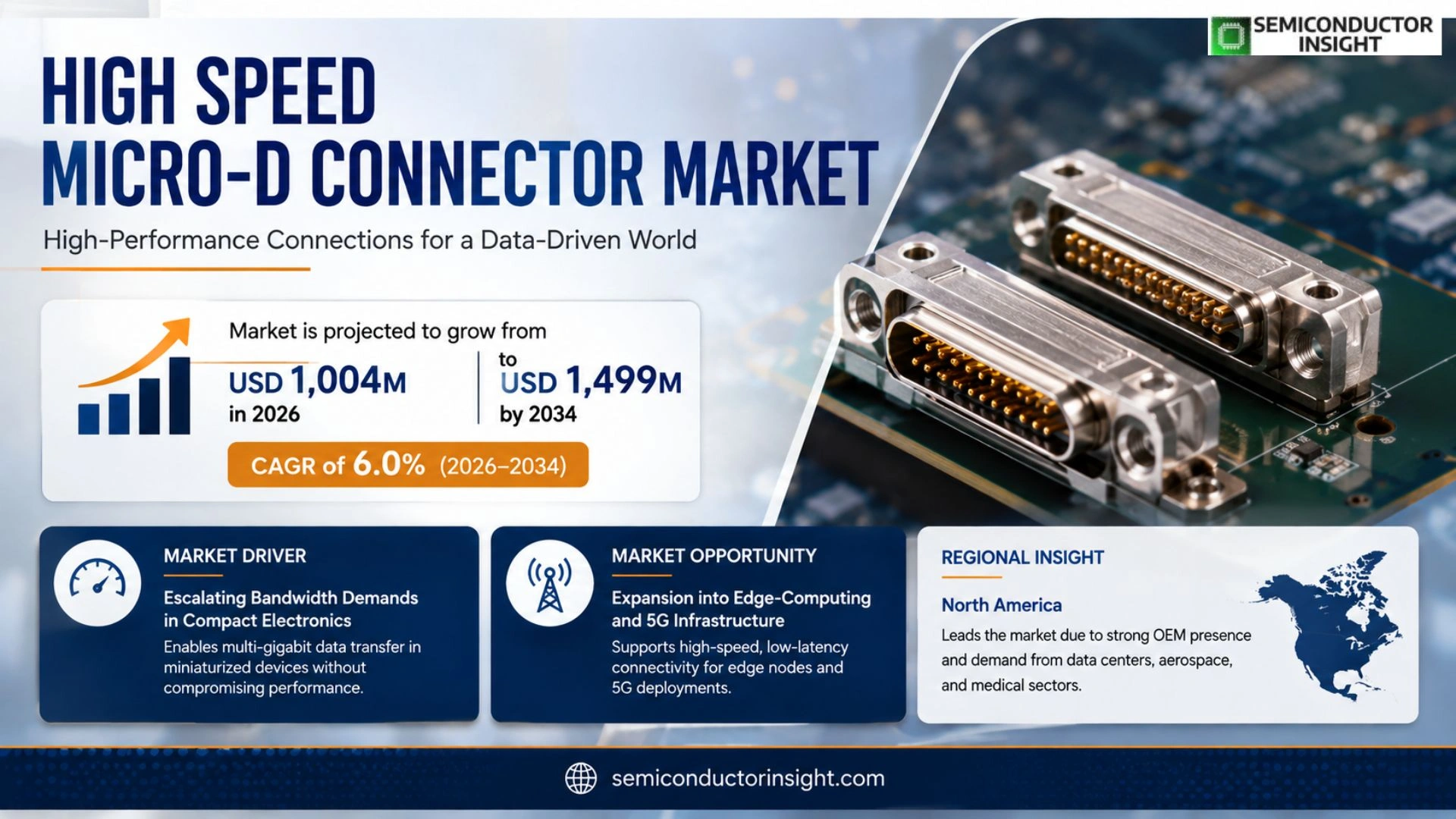
High Speed Micro-D Connector market is projected to grow from USD 1,004 million in 2026 to USD 1,499 million by 2034, exhibiting a CAGR of 6.0% during the forecast period.
High Speed Micro‑D Connectors are compact high‑density interconnect devices engineered for reliable high‑speed data transmission within constrained spaces, especially in aerospace and industrial systems. They maintain signal integrity and power delivery under vibration, temperature extremes and electromagnetic interference while offering miniaturization, lightweight construction and robust contact reliability.
The market expands as system miniaturization and higher data‑throughput requirements drive demand across avionics, satellite payloads and industrial automation. While stringent qualification standards limit rapid scaling, emerging unmanned platforms and advanced sensing solutions add incremental opportunities. Key players such as Amphenol Corporation, TE Connectivity, ITT Cannon, Glenair and Omnetics Connector continuously invest in precision micro‑contact design and shielding optimization to meet these challenges.
MARKET DRIVERS
Escalating Bandwidth Demands in Compact Electronics
Manufacturers of smartphones, wearables, and autonomous sensors are redesigning layouts to squeeze more functionality into smaller footprints. High Speed Micro-D Connector market benefits as engineers replace legacy interfaces with ultra‑compact, high‑frequency connectors that can handle multi‑gigabit data streams without compromising board real‑estate.
Advances in Materials and Signal Integrity Techniques
New dielectric formulations and precision stamping processes reduce insertion loss and crosstalk, allowing connectors to operate reliably at frequencies beyond 10 GHz. This technical progress gives OEMs confidence to adopt the connectors in mission‑critical modules such as aerospace telemetry and high‑resolution imaging.
➤ Design teams are reporting up to a 30 % reduction in board layers when substituting high‑speed micro‑D connectors for bulkier coaxial solutions
Because the connectors combine a tiny form factor with high‑frequency capability, supply‑chain planners are seeing a shift toward single‑source strategies that emphasize quality and on‑time delivery, reinforcing the market’s upward momentum.
MARKET CHALLENGES
Stringent Electromagnetic Compliance Requirements
Regulatory bodies across North America and Europe are tightening limits on radiated emissions for compact devices. Meeting these standards often requires additional shielding or redesign, which can erode the cost advantage of High Speed Micro-D Connector market and extend development cycles.
Other Challenges
Manufacturing Yield Variability
The precision tolerances required for high‑frequency performance increase the likelihood of defect generation during automated assembly, prompting manufacturers to invest in more sophisticated inspection equipment.
Furthermore, the scarcity of experienced technicians familiar with micro‑D soldering techniques adds labor overhead, especially for low‑volume specialty applications.
MARKET RESTRAINTS
Cost Sensitivity in High‑Volume Consumer Segments
While the performance merits are clear, price‑point pressure in mass‑market smartphones and tablets restrains adoption. Buyers often favor lower‑cost alternatives even if they sacrifice marginal bandwidth, keeping overall market penetration modest.
In addition, long‑term reliability data for the newest material stacks remain limited, causing some OEMs to postpone large‑scale integration until field‑tested evidence accumulates.
Finally, the need for specialized tooling to mate the tiny contacts adds upfront capital expense, which can deter smaller contract manufacturers from entering the space.
MARKET OPPORTUNITIES
Expansion into Edge‑Computing and 5G Infrastructure
Edge‑computing nodes require dense interconnects that can sustain high data rates while fitting into limited enclosures. High Speed Micro-D Connector market is well positioned to service these deployments, especially as 5G rollouts demand low‑latency, high‑throughput links.
Collaborations between connector manufacturers and semiconductor firms are spawning integrated modules where the connector and transceiver are co‑packaged, reducing signal loss and simplifying board layout. This co‑design trend opens avenues for premium pricing and differentiated solutions.
Geographically, emerging markets in Southeast Asia are witnessing a surge in IoT device production, creating a fresh customer base that values compact, high‑performance interconnects. Early entry into these regions could secure long‑term contracts and brand recognition.
High Speed Micro-D Connector Market Trends
System Miniaturization Fuels Connector Demand
The aerospace and industrial automation sectors are packing more functionality into tighter enclosures, prompting engineers to replace legacy board‑to‑board links with High Speed Micro‑D connectors. In 2025, manufacturers delivered roughly 44 million units, a volume that reflects the shift toward dense signal routing while preserving the 38 % gross margin that signals healthy pricing power. The practice of consolidating multiple high‑frequency lines into a single, ruggedized interface reduces both weight and cabling complexity, directly supporting the push for lighter airframes and more compact robotic cells. The resulting reduction in harness length also lowers electromagnetic coupling, which translates into measurable improvements in bit error rates for high‑speed data links.
Other Trends
Customization and Qualification Pressures
Customers such as Boeing and Siemens impose strict aerospace‑grade qualification protocols, which elongate design cycles and limit the ability of suppliers to scale quickly. While the need for tailored pitch configurations and shielding schemes creates a barrier to entry for new entrants, it also opens revenue opportunities for established firms that have invested in certified test labs. The 70 % capacity utilization recorded in 2025 indicates that manufacturers are operating near optimal lines, yet the requirement for product‑specific testing consumes excess capacity that could otherwise support volume growth. Consequently, manufacturers are leveraging modular design kits to streamline the qualification process, allowing OEMs to request variant configurations without incurring full redesign costs.
Emerging Unmanned and Sensing Platforms
Unmanned aerial vehicles and advanced sensing modules are introducing incremental demand for High Speed Micro‑D connectors. These platforms rely on high‑bandwidth telemetry and real‑time data fusion, prompting system designers to adopt connectors that can sustain 10‑25 Gbps rates while resisting vibration and electromagnetic interference. Although the overall market size remains anchored by aerospace and industrial users, the diversification into defense and autonomous systems adds a hedge against sector‑specific downturns and signals a modest, yet strategic, growth vector. As regulatory bodies tighten emission standards for unmanned platforms, suppliers that can certify low‑EMI performance will likely command premium pricing and secure longer‑term contracts.
COMPETITIVE LANDSCAPE
Key Industry Players
High Speed Micro‑D Connector Market – Competitive Overview
Amphenol Corporation dominates the upper tier of the market, leveraging its broad aerospace client base and deep engineering capabilities to secure multi‑year supply agreements with Boeing and Airbus. Its portfolio spans standard, latching, and high‑frequency variants, allowing it to serve both legacy platforms and next‑generation unmanned systems. TE Connectivity follows closely, differentiating through aggressive cost‑optimization across its global manufacturing network, which translates into competitive pricing for high‑volume industrial automation contracts. Both firms benefit from vertically integrated supply chains that mitigate raw‑material volatility, while their extensive test laboratories reinforce reliability credentials required for space‑qualified applications. The market structure therefore reflects a duopolistic core, where scale, certification breadth, and after‑sales support dictate the majority of revenue share.
Beyond the leading duo, a cadre of specialist players fuels product diversity. Glenair, Omnetics Connector, and Smiths Interconnect concentrate on niche segments such as miniature medical devices and high‑frequency radar modules, often collaborating directly with OEM engineers to develop custom pitch arrangements. European firms like Souriau, Nicomatic, and Axon’ Cable exploit regional aerospace clusters, offering rapid prototyping services that appeal to European aircraft manufacturers. Asian participants,including JAE Electronics, Hosiden Corporation, Jonhon Optronic Technology, Guizhou Space Appliance, and Sichuan Huafeng Technology,capitalize on cost‑effective production capacities and growing domestic demand for defense and satellite payloads, gradually expanding their footprints into Western supply chains.
List of Key High Speed Micro‑D Connector Companies Profiled
- Amphenol Corporation
- TE Connectivity
- Glenair
- Omnetics Connector
- AirBorn
- Smiths Interconnect
- Souriau
- Nicomatic
- Axon’ Cable
- JAE Electronics
- Hosiden Corporation
- Jonhon Optronic Technology
- Guizhou Space Appliance
- Sichuan Huafeng Technology
Segment Analysis:
| Segment Category | Sub-Segments | Key Insights |
| By Type |
|
Standard Micro‑D Connector
|
| By Application |
|
Aerospace
|
| By End User |
|
OEMs
|
| By Data Rate |
|
25‑56 Gbps
|
| By Contact Pitch |
|
0.8 mm pitch
|
Regional Analysis: High Speed Micro-D Connector Market
North America
The relentless push for higher data throughput in server farms and autonomous platforms fuels demand for connectors that can sustain multi‑gigabit rates within minimal footprints. North American design houses prioritize such capabilities to meet performance targets while complying with stringent thermal budgets, driving sustained adoption of high‑speed Micro‑D solutions.
Coordinated standards from bodies such as IEC and the U.S. Department of Defense create a predictable compliance framework. This clarity reduces the risk of redesign, allowing manufacturers to align product roadmaps with long‑term certification timelines and focus on performance enhancements.
Proximity to semiconductor foundries and specialized contract manufacturers shortens prototype cycles. The ability to iterate designs rapidly, coupled with robust logistics networks, translates into faster time‑to‑market for innovative connector variants.
Established players leverage extensive IP portfolios and deep customer relationships to lock in strategic accounts. Meanwhile, niche innovators exploit emerging application niches,such as quantum‑computing interfaces,by offering bespoke form factors that broaden the market’s solution space.
Europe
European manufacturers benefit from a collaborative R&D environment fostered by cross‑border initiatives like Horizon Europe, which fund high‑speed interconnect research. Aerospace and automotive sectors, particularly in Germany and France, demand compact connectors with rigorous vibration resistance, steering design preferences toward Micro‑D architectures. Although the market is fragmented across multiple standards bodies, alignment around EN and IEC norms reduces technical friction. Companies that can navigate the diverse regulatory landscape while offering modular, low‑profile solutions are poised to capture incremental share in this mature yet evolving market.
Asia‑Pacific
Asia‑Pacific’s rapid digitalization, driven by large‑scale data‑center rollouts in China, Japan, and South Korea, is reshaping demand patterns for high‑speed interconnects. Local OEMs are increasingly integrating Micro‑D connectors into consumer electronics and industrial automation, attracted by the combination of high bandwidth and minimal board space. While cost pressures remain intense, the region’s expanding manufacturing base provides a competitive advantage in scaling production volumes, enabling price‑competitive offerings without sacrificing performance thresholds.
South America
In South America, emerging telecommunications infrastructure and modest growth in aerospace maintenance, repair, and overhaul (MRO) activities generate a niche but steady appetite for high‑performance connectors. Brazil’s push to upgrade its fiber‑optic backbone creates ancillary demand for server‑grade components, while Argentina’s defense procurement programs seek reliable, compact solutions. Market players that can supply localized logistics support and navigate import‑tariff complexities will find a receptive customer base eager for next‑generation connectivity.
Middle East & Africa
The Middle East & Africa region witnesses demand driven largely by sovereign wealth‑fund‑backed data‑center projects and defense modernization efforts in the Gulf Cooperation Council states. Climatic considerations,high temperature and sand exposure,necessitate connectors with robust sealing and thermal performance, an area where Micro‑D technology’s precision engineering adds value. Africa’s nascent telecom expansions, particularly in Kenya and Nigeria, present early‑stage opportunities for vendors willing to engage in joint‑development partnerships that tailor connector specifications to local operating conditions.
Report Scope
This market research report provides a comprehensive analysis of the High Speed Micro-D Connector Market , covering the forecast period 2026–2034. It offers detailed insights into market dynamics, technological advancements, competitive landscape, and key trends shaping the industry.
Key focus areas of the report include:
- Market Overview: The report begins with an overview outlining its current market scenario, key growth indicators, and industry transformation drivers. It discusses macroeconomic factors, demand–supply balance, regulatory landscape, and the strategic role of semiconductors in powering advancements across industries such as automotive, telecommunications, consumer electronics, and industrial automation.
- Market Size & Forecast: Historical data and future projections for revenue, unit shipments, and market value across major regions and segments.
- Segmentation Analysis: Detailed breakdown by product type, technology, application, and end-user industry to identify high-growth segments and investment opportunities.
- Regional Insights: Insights into market performance across North America, Europe, Asia-Pacific, Latin America, and the Middle East & Africa, including country-level analysis where relevant.
- Competitive Landscape: Profiles of leading market participants, including their product offerings, R&D focus, manufacturing capacity, pricing strategies, and recent developments such as mergers, acquisitions, and partnerships.
- Technology Trends & Innovation: Assessment of emerging technologies, integration of AI/IoT, semiconductor design trends, fabrication techniques, and evolving industry standards.
- Market Drivers & Restraints: Evaluation of factors driving market growth along with challenges, supply chain constraints, regulatory issues, and market-entry barriers.
- Stakeholder Insights: Insights for component suppliers, OEMs, system integrators, investors, and policymakers regarding the evolving ecosystem and strategic opportunities.
Primary and secondary research methods are employed, including interviews with industry experts, data from verified sources, and real-time market intelligence to ensure the accuracy and reliability of the insights presented.
FREQUENTLY ASKED QUESTIONS:
What is the current market size of High Speed Micro-D Connector Market?
-> High Speed Micro-D Connector market is projected to grow from USD 1,004 million in 2026 to USD 1,499 million by 2034, exhibiting a CAGR of 6.0%
Which key companies operate in High Speed Micro-D Connector Market?
-> Key players include Amphenol Corporation, TE Connectivity, ITT Cannon, Glenair, Omnetics Connector, AirBorn, Smiths Interconnect, Souriau, Nicomatic, Axon’ Cable, JAE Electronics, Hosiden Corporation, Jonhon Optronic Technology, Guizhou Space Appliance, and Sichuan Huafeng Technology.
What are the key growth drivers?
-> Key growth drivers include system miniaturization, increasing data‑throughput requirements in aerospace and industrial electronics, and the need for compact high‑performance interconnect solutions that maintain signal integrity under vibration and electromagnetic interference.
Which region dominates the market?
-> Asia-Pacific holds a leading position due to strong aerospace manufacturing and industrial automation activities, while North America and Europe also represent significant markets.
What are the emerging trends?
-> Emerging trends include applications in unmanned aerial systems, advanced sensing platforms, and further integration of high‑speed data links in next‑generation aerospace and industrial equipment.

Get Sample Report PDF for Exclusive Insights
Report Sample Includes
- Table of Contents
- List of Tables & Figures
- Charts, Research Methodology, and more...
 Download Sample Report PDF