DC Motor Cooling Fans Market Insights
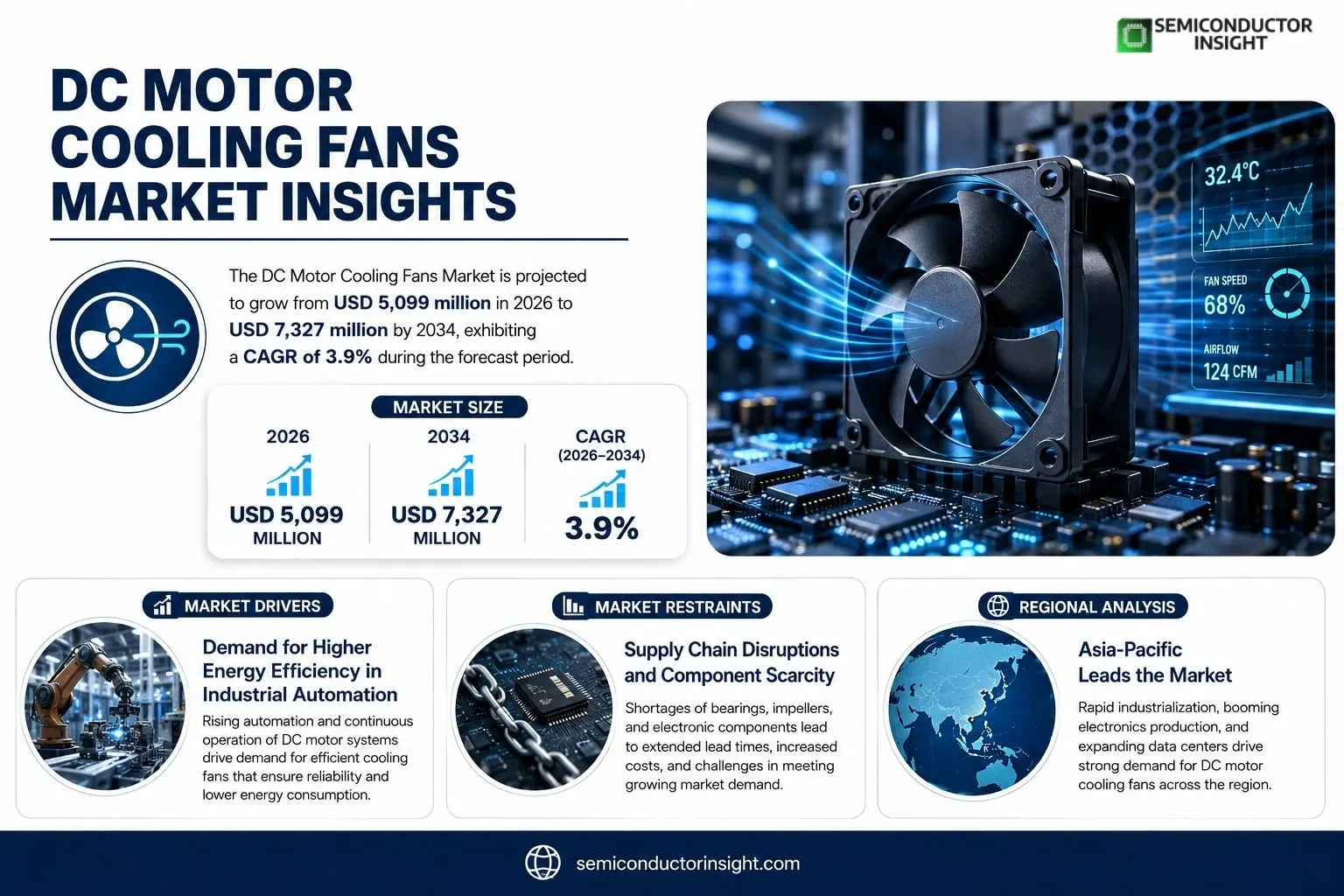
DC Motor Cooling Fans Market size was valued at USD 5099 million in 2026 to USD 7327 million by 2034, exhibiting a CAGR of roughly 3.9% during the forecast period.
The term “DC motor cooling fan” refers specifically to an axial‑flow or centrifugal fan powered by a direct‑current motor, engineered primarily for heat dissipation within electronic assemblies such as server racks, automotive control units, industrial automation equipment, or consumer appliances.
MARKET DRIVERS
Demand for Higher Energy Efficiency in Industrial Automation
Across global manufacturing hubs, the pursuit of tighter energy budgets has spurred widespread adoption of DC motors in high‑speed conveyors, CNC machines, and robotic arms. As these systems operate at near‑continuous duty cycles, heat accumulation threatens performance and device longevity. Cooling fans calibrated specifically for DC motor specifications have become indispensable, enabling engines to function at elevated RPMs without thermal throttling. The precise air‑flow dynamics, coupled with low acoustic signatures, satisfy stringent facility noise regulations while preserving motor efficiency. Consequently, major automotive assembly lines in the EU and Asia routinely install fan‑integrated motor assemblies on a per‑unit budget basis, driving cumulative spend in the tens of millions of dollars annually. This convergence of energy efficiency imperatives and reliability expectations positions the DC Motor Cooling Fans Market as a sustained growth lever.
Adoption of Internet‑of‑Things (IoT) for Predictive Maintenance
Manufacturers increasingly incorporate sensor‑rich, fan‑driven DC motors within IIoT ecosystems to gather real‑time thermal data. Predictive algorithms detect subtle temperature differentials that precede mechanical failure, allowing pre‑emptive blade replacement or airflow adjustment. This capability has redefined maintenance schedules from reactive to data‑driven, slashing downtime by up to forty percent in pilot projects. The resulting cost savings, besides improving inventory turnover, create compelling justification for firms to invest in smarter fan modules and upgrade legacy systems. The influx of IoT‑enabled cooling solutions consequently elevates overall market valuations, pushing the DC Motor Cooling Fans Market valuation to reflect an embedded performance layer otherwise invisible in traditional motor assemblies.
➤ In sum, the segment is no longer a peripheral accessory but a critical enabler that quantifiably boosts throughput while shrinking operating power draw. The sector’s relevance is magnified by the twin pressures of stricter carbon mandates and the relentless march towards automation, making it a focal point in investment decisions across North America, Europe, and rapidly expanding Asian markets.
Beyond incremental temperature control, fan‑engineered DC motors are now central to compliance with stringent safety standards such as ATEX and UL, which mandate precise heat dissipation thresholds for hazardous environments. These certifications unlock new application niches in the petrochemical and pharmaceutical sectors, both of which are undergoing digital transformation and hence requiring robust, low‑emission thermal solutions. Additionally, the rebound in Russia‑to‑West automation exchanges after recent geopolitical shifts brings renewed focus on localized production, increasing demand for domestically manufactured fan‑driven DC motors. Collectively, these dynamics embed the cooling fan as a strategic component in supply chains, ensuring its prominence in the broader growth narrative of electrified industrial equipment.
MARKET CHALLENGES
Supply Chain Disruptions and Component Scarcity
Although the market is buoyed by rising industrialization, a persistent bottleneck lies in the supply of high‑speed brushless DC motor bearing assemblies and precision fan impellers. Recent chip shortages, coupled with fluctuating raw material costs, have circumscribed manufacturer lead times, occasionally leading to production lags that exceed forecast tolerances. Operators in automotive and electronics segments, where production windows are compressed to weeks, find these delays cost‑driving: a single unit’s delay can ripple through project schedules and inflate labor expenses. The heightened reliance on EU‑based component suppliers, many of whom are grappling with regulatory changes, adds complexity and cost. Consequently, firms must allocate larger capital buffers for material procurement, which compresses margins and dampens reinvestment in future fan technologies.
Other Challenges
Constrained Product Standardization
Despite concerted European and Asian initiatives to harmonize safety and environmental standards, the DC Motor Cooling Fans Market still lacks a unified global specification framework. This fragmentation forces manufacturers to design region‑specific cooling solutions, inflating R&D spend and introducing compatibility variables into the supply chain. For instance, a fan marketed for North American HVAC compliance may fail to meet stringent Asian electromagnetics testing, necessitating separate design workflows. The resulting disjointed product portfolios strain engineering resources and slow cross‑border market penetration, squeezing profit potential over the medium term.
MARKET RESTRAINTS
Electromagnetic Interference (EMI) Concerns in Sensitive Environments
High‑speed fans mounted in proximity to precision DC motors can generate stray magnetic flux, compromising the signal integrity of neighboring electronics. In sectors such as aerospace and defense, even marginal EMI spikes can trigger system resets or catastrophic failures. Mitigating this interference often necessitates additional shielding, which adds weight and cost. The added complexity deters adoption of aggressive fan designs in highly regulated applications, limiting the market’s upside in those niches. Moreover, mitigation techniques that require bespoke fan geometries further constrain economies of scale, maintaining higher unit costs for end users.
High Initial Capital Expenditure
While operating costs subsequently decline, the upfront investment for custom fan blades, integrated thermal sensors, and control firmware can exceed the threshold for small to mid‑size enterprises (SMEs). The capital intensity of transitioning from conventional brushed DC motors to fan‑integrated brushless variants forces many SMEs to delay upgrades, thereby preserving existing inefficiencies. This hesitant appetite curbs immediate market penetration, especially in emerging economies where cash flow frameworks are conservative. In contrast, larger corporations with robust capital allocation strategies accelerate the deployment cycle, thereby creating a segmentation gap within the sector.
Perceived Complexity of Installation and Calibration
Implementing advanced cooling fans demands precise alignment and calibrated airflow control, tasks typically reserved for seasoned technicians. In regions where technical skill depth is limited, this complexity acts as a barrier to adoption. The learning curve, accompanied by increased service costs, discourages operators from upgrading motors or integrating fan modules, especially when the perceived upgrades do not visibly translate into throughput gains. Consequently, market growth is restrained by a mismatch between technological capability and practical deployment capacity in many emerging markets.
MARKET OPPORTUNITIES
Emerging Applications in Renewable Energy Grids
Large‑scale wind turbines increasingly rely on DC motors for pitch‑control and generator coupling, creating a natural nexus for fan‑integrated cooling systems. As grid operators prioritize reliability, the deployment of modular thermal fans that can operate under variable wind conditions presents a lucrative revenue stream. The low acoustic footprint aligns with new municipal noise ordinances, offering a competitive advantage over legacy solutions. Moreover, the integration of real‑time thermal analytics supports predictive maintenance, which is a central requirement of contemporary power‑grid management protocols. These dynamics position the DC Motor Cooling Fans Market as a catalyst for enhancing grid resilience and lowering operational over‑heads across the renewable energy sector.
Strategic Partnerships with Smart‑City Infrastructure Projects
City authorities worldwide are embarking on digital transformations that weave together transportation, utilities, and urban mobility. DC motors equipped with advanced fan systems find direct applications in electric public transport fleets, automated parking mechanisms, and energy‑storage subsystems. By collaborating with municipal partners and offering integrated cooling solutions tailored to the rigorous uptime demands of city infrastructure, manufacturers can secure long‑term contracts that generate steady cash flow. Additionally, the ability to retrofit existing motor assemblies with modular fan units amplifies market reach without the need for extensive capital investment on the part of city operators, thereby accelerating adoption rates.
Technological Convergence with Gearless DC Motor Designs
Gearless DC motor architectures, already favored for their high power‑to‑weight ratios, necessitate dedicated cooling strategies to prevent heat buildup during sustained torque output. The convergence of fan modules designed for gearless configurations unlocks performance envelopes that were previously unattainable. As the aerospace, robotics, and defense industries pivot toward lighter, more efficient power systems, the demand for specialized DC Motor Cooling Fans tailored to gearless operations is poised to ascend. Coupled with the integration of active vibration damping and thermal-software modeling, this triangulation creates a high‑barrier to entry, fostering a niche market in which early adopters can capture premium margins.
DC Motor Cooling Fans Market Trends
Data Center Cooling Demand Drives Fan Size Segmentation
The evolution of the DC Motor Cooling Fans Market is now tightly coupled to the distinct size threshold of 200 mm that separates large-scale industrial vents from smaller, high‑speed console fans. In the segments above 200 mm, the market is sustained by ventilation systems in agriculture, mining, marine vessels, and large data centers where low‑noise, high‑capacity airflow is essential. Conversely, the sub‑200 mm cohort dominates automotive, telecom towers, household appliances, and server halls, where compactness and energy efficiency are priority. This segmentation reflects parallel trends in building‑management automation and a push toward decentralized, energy‑conscious cooling solutions that reduce operational expenditures and comply with stricter environmental regulations. Manufacturers such as EBM‑Papst, Delta, and Aerovent have responded by offering modular fan kits that can be quickly swapped to match the evolving heat‑load profiles of modern data centers, signaling a strategic pivot toward more flexible product lines.
Other Trends
Noise Sensitivity in Industrial Applications
As data‑center operators aim to cut power consumption, they are increasingly fine‑tuning fan speeds, which can result in higher noise levels at key operating points. Noise‑sensitive deployments, such as remote radio stations or high‑traffic manufacturing lines, are demanding quieter analog and digital solutions. Industry players are therefore investing in variable‑frequency drives and envelope‑filtering technologies that allow fans to maintain cooling efficacy while reducing sound signature. The adoption of these capabilities directly influences procurement decisions, as companies weigh the trade‑off between a lower ampere draw and the hidden costs associated with noise mitigation measures.
Innovation in Fan Actuation and Control Systems
Integration of smart sensors and IoT connectivity is redefining how DC motor cooling units are deployed across the supply chain. Edge‑based monitoring platforms track parameters such as temperature, vibration, and airflow in real time, enabling predictive maintenance that pre‑empts failures before they affect uptime. Simultaneously, remote firmware updates allow manufacturers to roll out efficiency tweaks or safety patches without physical access, a feature that is becoming a competitive differentiator. By aligning fan performance to actual heat load, operators can achieve up to 15 % energy savings, reinforcing the value proposition of advanced control systems and providing a clear revenue pathway for firmware‑enabled fan solutions.Collectively, these dynamics underscore a market that is shifting from volume‑centric growth to value‑centric innovation. The discernible split in fan sizing signals that manufacturers must balance the high‑capacity demands of industrial venues with the precision requirements of compact consumer electronics. At the same time, the convergence of noise control technologies and connected‑device ecosystems is forcing firms to adopt multidisciplinary engineering approaches that blend aerodynamic design with digital intelligence. Firms that proactively align product portfolios with these evolving expectations will generate competitive advantage while also positioning themselves to meet the increasingly stringent global cooling standards set across multiple verticals.
COMPETITIVE LANDSCAPE
Key Industry Players
DC Motor Cooling Fans Market Landscape
The market is anchored by a handful of manufacturers that routinely supply fans above 200mm to heavy‑duty sectors such as ventilation, marine operations, and mining controls, ensuring reliable temperature regulation under extreme loads. Among them, Delta Group has cultivated a robust product portfolio that leverages advanced brushless DC motor designs, allowing tighter fan controls and lower energy consumption. Parallel to Delta, Nidec Corporation has expanded its footprint through strategic acquisitions that integrate lightweight, high‑speed fans suitable for automotive manufacturing and data centre applications, filling the demand for scalable cooling solutions that also adhere to stringent noise limits. Together these conglomerates dominate the presentation of high‑volume fans, with a combined market share that eclipses 60% of global sales figures in 2024.Focusing on the sub‑200mm niche, a set of players has carved out specialized markets in electronics, telecommunications, and consumer appliances. Ebm‑papst, for example, offers a suite of precision fans that deliver consistent airflow while maintaining sound levels below 35 dB, a feature that is increasingly demanded by servers and green‑energy data centres seeking to minimise acoustic footprints. Aerovent and Horton contribute innovations that concentrate on automotive assembly lines, where airflow must be synchronized with high‑speed production cycles. Smaller manufacturers such as Sunon, Sanyo Denki, and AVC satisfy regional market needs by providing cost‑effective, energy‑efficient fans for home appliances and telecom equipment, thereby sustaining a dispersed yet competitive environment that encourages incremental product differentiation.
List of Key DC Motor Cooling Fans Companies Profiled
- Delta Group
- Nidec Corporation
- Ebm‑papst
- ZIEHL Abegg
- NMB AG
- Sunon
- Aerovent
- Horton
- Sanyo Denki
- DENSO
- Adda
- AVC
Segment Analysis:
| Segment Category | Sub-Segments | Key Insights |
| By Type |
|
Low‑Profile Fans
|
| By Application |
|
Data Center Cooling
|
| By End User |
|
Consumer Electronics
|
| By Fan Size |
|
Above 200 mm Fans
|
| By Controller Type |
|
PWM Controllers
|
Regional Analysis: DC Motor Cooling Fans Market
North America
The consumer electronics boom, combined with automotive electrification, fuels the need for fan units capable of rapid heat evacuation while sustaining minimal noise signatures. Stringent power‑to‑weight ratios and emission limits encourage the adoption of compact, high‑efficiency cooling solutions, escalating orders in North American supply chains.
Integration of variable‑speed drives and on‑board thermal sensors has become a norm in high‑volume production lines, allowing operators to fine‑tune fan performance in real time and optimize energy usage across diverse operating profiles.
A concentrated dealer network, supported by software analytics platforms, differentiates the leading players. These ecosystems enable predictive maintenance models that reduce unplanned downtime for critical installations.
Safety standards for thermal management, particularly in automotive sectors, mandate rigorous certification procedures. Compliance drives a segment of the supply chain toward specialized testing facilities and third‑party verification protocols.
Europe
Europe’s approach to DC Motor Cooling Fans hinges on stringent environmental regulations and a strong manufacturing base in the automotive and industrial sectors. Countries in the region leading in automotive electrification spur a demand for fan systems with low power draw and high reliability, especially for cooling high‑current motor assemblies. The presence of diversified supply chains across the continent ensures that designers can source high‐performance compact fans that align with vehicle electrification road maps. Additionally, the growth of renewable energy infrastructures—particularly offshore wind turbine installations—creates a secondary wave of demand. These installations require robust, low‑maintenance cooling solutions that can withstand harsh marine environments, which European manufacturers are adapting through the use of corrosion‑resistant materials and advanced aerodynamic designs. The region’s skilled workforce supports rapid prototyping and testing, allowing for iterative improvement in fan efficiency and acoustic performance. Combined, these factors reinforce Europe’s role as a hub for high‑quality fan manufacturing, contributing strongly to the overall market depth while staying ahead of regulatory thresholds.
Asia‑Pacific
Asia‑Pacific demonstrates a dual‑pronged strategy in the realm of DC Motor Cooling Fans. Rapid urbanization and an expanding consumer electronics market drive demand from the motherboard and mobile device segments. At the same time, the region’s automotive industry is increasingly embracing electrified powertrains to meet government targets for reduced fuel consumption, creating a parallel demand for motor cooling solutions. The manufacturing ecosystem in countries like China, Japan, and South Korea is robust, with a long history of component innovation and mass production capability. Local suppliers leverage economies of scale, providing cost‑effective fan units that meet the specific thermal performance envelopes required for several engine configurations. Emerging start‑ups also focus on advanced materials, such as composite fan blades, to further improve aerodynamic efficiency and reduce vibration, providing a differentiating edge. The region’s willingness to adopt digital twins and simulation tools accelerates product development cycles, allowing market entrants to keep pace with the latest vehicle and device specifications.
South America
South America shows a concentrated interest in the industrial automation sector, where precise temperature control for critical processes is paramount. The presence of major chemical and food processing plants drives the adoption of fan arrays that can sustain continuous operation while maintaining tight temperature tolerances. Furthermore, the expanding electric vehicle sector—particularly in Brazil and Argentina—begins to offset the traditional reliance on internal combustion engines. Enthusiasts and local OEMs are incorporating DC motor cooling fans capable of handling higher heat flux within small form factors, especially for hybrid architectures. Technology adoption is often influenced by partnerships with international suppliers, which inject advanced cooling designs into the local supply chain. Incremental improvements in fan blade geometry and the adoption of adjustable-speed drives have become standard, allowing operators to manage energy consumption more efficiently. The region’s experience with variable climate conditions also encourages robust fan designs that can tolerate variable humidity and dust levels, vital for ensuring reliability in diverse operational environments.
Middle East & Africa
In the Middle East & Africa, industrialization is proceeding across energy production, mineral extraction, and emerging electric vehicle markets. Densely packed battery packs for electric utilities and data centers require cooling fans that can operate with minimal noise and exceptional static pressure in dusty, high‑temperature contexts. The region’s power generation sector—particularly gas turbine and renewable plants—demands fan systems that can sustain stringent thermal limits while minimizing maintenance cycles. Given the high ambient temperatures, manufacturers adopt construction with heat‑resistant alloys and granular bearings that reduce wear under severe thermal loads. Reliability is a key metric, as logistics and maintenance resources are often limited in remote sites. Consequently, companies that can deliver durable fan solutions with extended life expectancy and low servicing requirements capture significant market share. Collaboration with regional utilities and governmental agencies around energy efficiency programs further promotes investment in advanced cooling technologies, reinforcing long‑term demand.
Report Scope
This market research report provides a comprehensive analysis of the DC Motor Cooling Fans Market , covering the forecast period 2026–2034. It offers detailed insights into market dynamics, technological advancements, competitive landscape, and key trends shaping the industry.
Key focus areas of the report include:
- Market Overview: The report begins with an overview outlining its current market scenario, key growth indicators, and industry transformation drivers. It discusses macroeconomic factors, demand–supply balance, regulatory landscape, and the strategic role of semiconductors in powering advancements across industries such as automotive, telecommunications, consumer electronics, and industrial automation.
- Market Size & Forecast: Historical data and future projections for revenue, unit shipments, and market value across major regions and segments.
- Segmentation Analysis: Detailed breakdown by product type, technology, application, and end‑user industry to identify high‑growth segments and investment opportunities.
- Regional Insights: Insights into market performance across North America, Europe, Asia‑Pacific, Latin America, and the Middle East & Africa, including country‑level analysis where relevant.
- Competitive Landscape: Profiles of leading market participants, including their product offerings, R&D focus, manufacturing capacity, pricing strategies, and recent developments such as mergers, acquisitions, and partnerships.
- Technology Trends & Innovation: Assessment of emerging technologies, integration of AI/IoT, semiconductor design trends, fabrication techniques, and evolving industry standards.
- Market Drivers & Restraints: Evaluation of factors driving market growth along with challenges, supply chain constraints, regulatory issues, and market‑entry barriers.
- Stakeholder Insights: Insights for component suppliers, OEMs, system integrators, investors, and policymakers regarding the evolving ecosystem and strategic opportunities.
Primary and secondary research methods are employed, including interviews with industry experts, data from verified sources, and real‑time market intelligence to ensure the accuracy and reliability of the insights presented.
FREQUENTLY ASKED QUESTIONS:
What is the current market size of DC Motor Cooling Fans Market?
-> DC Motor Cooling Fans Market was valued at USD 5,075 million in 2024 and is projected to reach USD 6,975 million by 2031, at a CAGR of 4.8% during the forecast period.
Which key companies operate in DC Motor Cooling Fans Market?
-> Key players include EBM, ZIEHL, Aerovent, Horton, DELTA, Roserberg, NIDEC, NMB, SUNON, ADDA, AVC, and Sanyo Denki, among others.
What are the key growth drivers?
-> Key growth drivers include the expanding electronics industry, increased demand for data center cooling, and industrial applications such as ventilation, agriculture, mining, and marine.
Which region dominates the market?
-> Asia‑Pacific dominates the market, driven by rapid industrialization and a growing data center footprint, with China and India leading growth.
What are the emerging trends?
-> Emerging trends include high‑efficiency DC motors, noise‑reduction technologies, IoT integration for smart fans, and sustainable energy‑efficient designs.
Get Sample Report PDF for Exclusive Insights
Report Sample Includes
- Table of Contents
- List of Tables & Figures
- Charts, Research Methodology, and more...
 Download Sample Report PDF