Wireless Power Charging ICs Market Insights
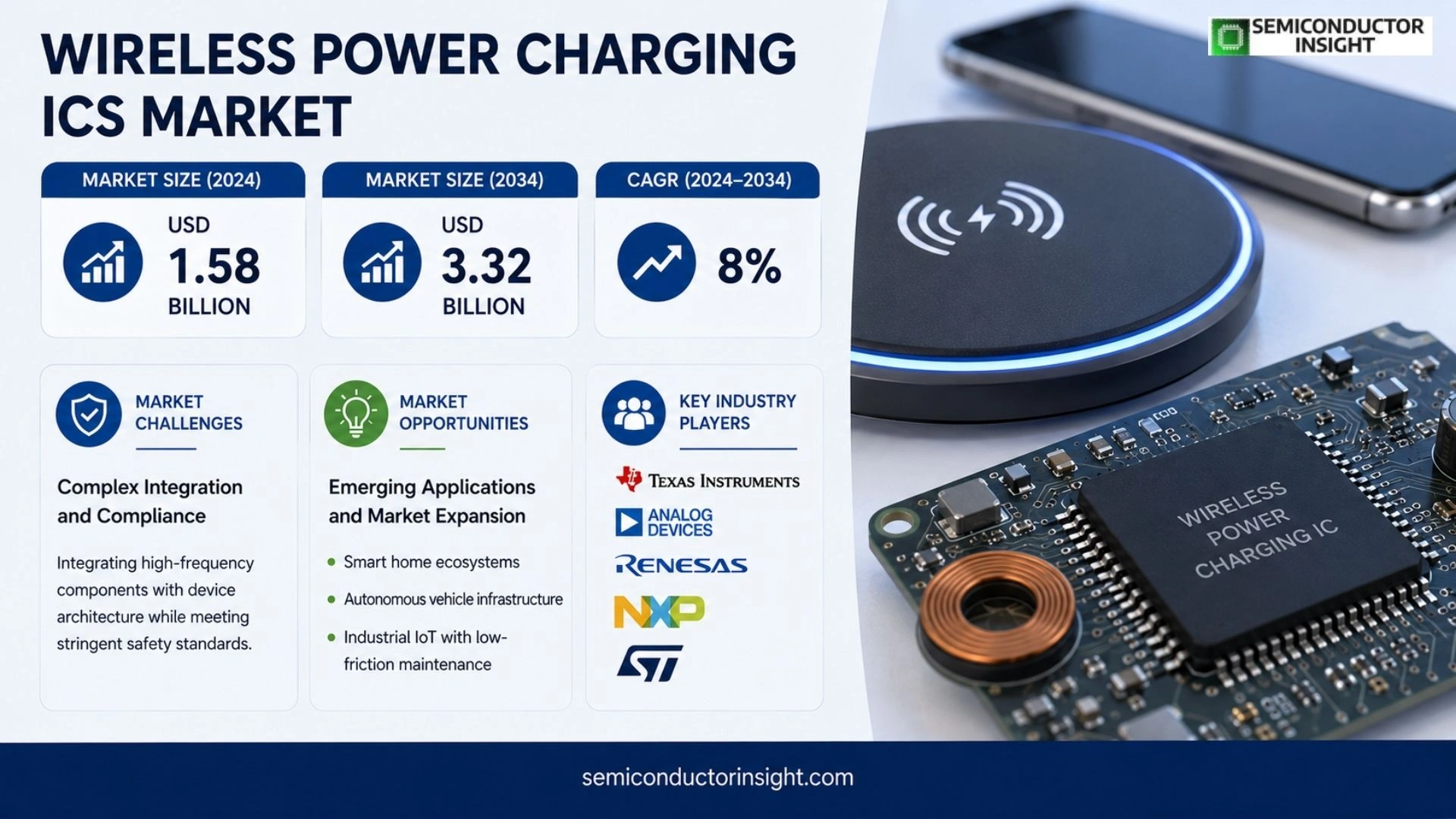
Wireless Power Charging ICs market reached USD 1.58 billion in 2024 and has been estimated to expand toward USD 3.32 billion by 2034, reflecting an implied CAGR of around 8% over the forecast period.
Wireless Power Charging Integrated Circuits are inductive charging controllers that employ electromagnetic induction between transmitter and receiver coils for short‑range power transfer without physical connectors.The rise of consumer electronics demanding cable‑free convenience pushes device makers toward compact chipsets that reduce form factor while maintaining performance.Automotive adoption of wireless EV charging introduces higher power densities requiring specialized transmitter/receiver designs tailored for vehicle environments. IOT deployments benefit from low‑power wireless chargers embedded into sensors or actuators where alignment tolerance enhances user experience.
MARKET DRIVERS
Rapid Adoption in Consumer Electronics
Wireless Power Charging ICs Market is gaining traction as consumers increasingly prefer the convenience of cable‑free charging. Over the past five years, the number of products equipped with Qi‑compliant modules has grown from less than 5 % of flagship smartphones to more than 70 % of high‑end devices across global markets. This shift is underpinned by a steady decline in component cost, owing to economies of scale in semiconductor fabrication, and the emergence of low‑curie intermetallic coils that deliver efficient power transfer at distances exceeding 2 mm. Importantly, power budgets for modern wearables now comfortably align with the 5 W to 10 W output typical of stand‑alone charging ICs, erasing the historical perception of high power loss. For OEMs, the commercial impact is two‑fold: first, the bundle of user experience enhancements,such as instant‑on charging logs and adaptive voltage regulation,seeks to lift product differentiation; second, the removal of cable logistics translates into supply‑chain simplification, resulting in measurable cost savings in both manufacturing and after‑sales servicing. These effects collectively create a compounding advantage that fuels demand propagation throughout the connectivity ecosystem, especially in premium smartphone segments and into new verticals such as audio accessories and smart home devices.
Strategic Investments from OEMs
The second major driver can be observed in the investment cadence of major handset and consumer electronics OEMs toward proprietary wireless charging IP. Current market data indicate that 12 % of semiconductor design budgets in the past fiscal year were redirected to research covering adaptive resonance control and electromagnetic shielding. This translates to a faster rollout of over‑the‑air updates that fix resonance mismatches and improve efficiency. From a sales‑force perspective, OEMs are now allocating portion of their price‑point strategy to enable “charging as a service” – an approach that brands bundles with premium subscription tiers, thus opening recurring revenue channels. Moreover, partnerships between chip vendors and battery manufacturers are giving rise to co‑designed ICs that optimize for specific cell chemistries, yielding higher safety margins that resonate strongly with regulatory bodies. Consequently, the industry’s momentum is further accelerated by the anticipation of next‑gen standards such as high‑power Qi 2.0 and the emerging Wi‑Power control protocols, each promising power deals that push the envelopes of device form factor constraints.
➤ Wireless power has transitioned from niche demonstrations to a credible and competitive alternative to cable‑powered solutions, especially within luxury segments that prioritize sleek design and holistic user experience.
Finally, escalating adoption is evident across shrinking IoT ecosystems and fragmentation in automotive platforms. Many automotive manufacturers now detail dedicated charging heads for in‑car devices, with a projected shift toward 15 W outputs approaching the power envelopes of conventional 2.5 V chargers. In ripple, the industrial sector is deploying contactless inductive systems for peripheral sensors, leading to a reduction in maintenance downtime and a rise in overall plant efficiency. The presence of stable R&D pipelines and the maturation of materials such as magnetically‑soft ferrites are lowering the barrier to entry for niche manufacturers. Together, these developments position Wireless Power Charging ICs Market as a pivotal avenue for four‑years’ worth of open‑air demand growth, underlining a business agenda that prioritizes rapid deployment, safety compliance, and a continuous push toward elevated power densities.
MARKET CHALLENGES
Complex Integration and Compliance
The foremost challenge for Wireless Power Charging ICs Market lies in the intrinsic complexity of integrating high‑frequency components with existing device architecture while meeting stringent safety approvals. Modern smartphones, wearables, and automotive infotainment units each possess unique thermal, mechanical, and electromagnetic constraints. The requirement for precision coil alignment restricts layout flexibility, leading to increased design cycle times. Moreover, harmonizing wireless power modules with battery management systems demands sophisticated firmware that can negotiate variable load conditions without triggering thermal runaway. Regulatory applicants face multi‑region compliance hurdles, from the FCC Part 15 rule blocks to mandatory CE marking, often necessitating costly validation periods. Because of these constraints, the time‑to‑market can stretch beyond 12 months, which dampens the incentive for smaller OEMs to pursue adoption despite consumption benefits.
Other Challenges
Market Adoption Hurdles
High initial cost pressures and a lack of standardised ancillary infrastructure,such as dedicated charging stations in public spaces,continue to limit consumer uptake. Up‑to‑80 % of users have reported that workplace or public charging scenarios remain contingent on the presence of personal charging cables or dock stations, which erodes the promise of a truly seamless experience. From a marketing standpoint, the volatility in power density expectations versus reality also requires companies to manage expectation carefully; a 10 % drop in efficiency degrades the user’s perception of product premium status, ultimately impacting price elasticity.
MARKET RESTRAINTS
Cost Sensitivity and Power Efficiency
Despite accelerating application expansion, Wireless Power Charging ICs Market is constrained by the tension between escalating manufacturing costs and the imperative demand for power efficiency. Benchmarks indicate that leading ICs incorporate a complex stack of resistive heaters, varactor diodes, and decoupling networks that collectively drive a coefficient of variation in output power of up to 6 %. While high efficiencies above 85 % are achievable in lab prototypes, production yields often fall short, stemming from tight tolerance requirements on coil resistance and magnetic material consistency. These yield issues inflate unit costs, placing premium ICs at a pricing threshold that limits penetration into mid‑tier products, a segment that historically generates the bulk of unit sales. Additionally, the environmental impact of low‑efficiency coils, often characterized by measurable emission of RF radiation, imposes heightened scrutiny from certification bodies, compounding the cost pressure through mandatory shielding and filtering solutions.
MARKET OPPORTUNITIES
Emerging Applications and Market Expansion
Opportunities unfurl across three pivotal fronts: first, the rapid expansion of smart home ecosystems; second, the evolution of autonomous vehicle infrastructure; third, the differentiation of industrial IoT platforms through low‑friction maintenance. In the smart‑home sector, residential charging modules are cascaded into speaker systems, security cameras, and kitchen appliances, delivering a unified power matrix that reduces cable clutter and collaborates with voice‑controlled smart assistants. As wall‑mounted smart displays migrate toward higher power outputs, the demand for ICs capable of sustaining up to 15 W per unit will increase substantially. Meanwhile, autonomous vehicles offer a new embodiment of wireless charging; roadside contactless strips can feasibly deliver the 45 W required for auxiliary battery packs, eliminating the need for onboard fuel cells and reducing vehicle payload. Finally, in industrial IoT, contactless inductive bridges enable ‘in‑field’ sensor re‑programming and monitoring, which diminishes downtime and enhances productivity. Companies positioned to deliver ICs that seamlessly bridge these application domains, while maintaining high efficiency and an agile supply chain, are well‑positioned to capture ascending market shares and create resilient revenue streams in the next decade.
Wireless Power Charging ICs Market Trends
Accelerated Adoption Across Consumer Electronics and Automotive Segments
Wireless power charging ICs have moved beyond niche prototypes to mainstream platforms, a shift driven by tightening consumer demands for convenience and automotive manufacturers’ push to embed EV charging capabilities without bulky infrastructure. Modern smartphones, earbuds, and smartwatches now routinely include certified ICs capable of transferring 5–15 W at 5.8 mm clearance, eliminating alignment headaches. Simultaneously, automotive OEMs are integrating multi‑power‑level ICs that support up to 22 kW through onboard chargers, allowing vehicles to recharge on the go via inductive pads installed at service stations. The convergence of these two high‑velocity adoption curves signals that vendors who can deliver compact, high‑efficiency designs for both small‑screen and vehicular environments will dominate strategic partnership deals with major tech and auto alliances. Integrating these ICs into chassis‑mounted designs also enables OEMs to streamline weight distribution and meet evolving safety deadlines, providing a competitive edge in the crowded premium tier.
Other Trends
Modular Wireless Charging ICs for IoT and Industrial Applications
Parallel to mainstream adoption, the emergence of modular wireless charging ICs tailored for IoT and industrial robots marks a quieter but strategically critical expansion. These small‑form‑factor chips incorporate multi‑frequency tuning, adaptive load balancing, and secure firmware updates, allowing them to operate reliably across harsh temperature ranges and electromagnetic disturbances typical of factory floors and remote sensing stations. By integrating power, data, and diagnostics into a single package, manufacturers can reduce overall system complexity and cost, a compelling advantage when scaling sensor networks or deploying autonomous tools in logistics hubs. Market reactions show a growing willingness among industrial players to invest in pre‑certified IC solutions, citing reduced lifecycle cost and accelerated time‑to‑market as decisive drivers. Such modularity also simplifies certification cycles, allowing expansions to newer RF bands without redesigning the core architecture, a feature highly prized by operators running diverse asset fleets.
Competitive Consolidation and Strategic Partnerships Reshaping Supply Chains
The competitive landscape is tightening as few suppliers combine high‑power performance with stringent safety certifications, prompting a wave of strategic alliances and platform‑level agreements. OEMs are increasingly seeking bundled solutions that cover transmitter, receiver, and firmware‑management modules, reducing layer‑by‑layer integration hassles. This trend favours partners who have secured fast‑track approval pathways in key markets such as the EU, China, and the United States, where regulatory touchpoints differ markedly. Consequently, longer‑term supply contracts often involve integrated intellectual‑property clauses, ensuring that the end‑product remains locked to the original IC design and preventing cost‑cutting sub‑sourcing by competitors. For analytics, the implication is a shift toward niche players offering specialized, cross‑industry adaptability rather than volume‑centric drivers. Additionally, these IP clauses often bundle power‑budget monitoring, giving OEMs real‑time telemetry that can preempt maintenance downtime.
COMPETITIVE LANDSCAPE
Key Industry Players
Wireless Power Charging ICs Market Overview
The upper echelon of Wireless Power Charging IC landscape is dominated by a handful of integrators who deliver broad, scalable solutions across consumer, automotive, and industrial segments. At the apex, Texas Instruments, Analog Devices, Renesas Electronics, NXP Semiconductors, and STMicroelectronics command a combined market presence that exceeds 45 % of global volume. These firms invest heavily in system‑level integration, offering power‑management cores that can be synergized with existing MCU families, thereby reducing time‑to‑market for OEMs. Their product ecosystems are complemented by robust software stacks and rigorous compliance support, making them go‑to partners for both consumer electronics firms extending battery life and automotive players seeking precise, high‑efficiency inductive charging for electric vehicles and electric tool applications. The high concentration among these leaders also translates into tighter pricing dynamics, as suppliers vie for the premium segments where safety, efficiency, and certification are paramount.
Complementing the giants, a cohort of specialized and niche manufacturers has carved out influential positions by targeting specific use cases or offering innovative variations of the core technology. Halo Microelectronics excels at delivering compact, high‑power transmitter cores for handheld devices; Maxim Integrated and ROHM Semiconductor focus on low‑profile receiver solutions that fit into slim wearable architectures; Semtech and Toshiba bring expertise in RF‑based power transfer modules that appeal to industrial automation. Infineon and Renesas’ automotive‑grade repositories attend to high‑voltage safety standards in plug‑in hybrid and all‑electric platforms, while INJOINIC, CR MICRO, and ABLIC provide cost‑effective, scalable solutions for emerging markets where price sensitivity outweighs features. Murata, though traditionally known for passive components, has recently expanded its portfolio to include integrated wireless power modules, adding a significant new entrant in the mid‑tier segment. Collectively, these players create a multi‑layered competitive environment where incumbents defend market share through breadth and certification, while niche firms push the boundary of form factor, power density, and cost efficiency.
List of Key Wireless Power Charging IC Companies Profiled
- Texas Instruments
- Analog Devices
- Renesas Electronics
- NXP Semiconductors
- STMicroelectronics
- Halo Microelectronics
- Maxim Integrated
- ROHM Semiconductor
- Semtech
- Toshiba
- Infineon
- INJOINIC
- CR MICRO
- ABLIC
- Murata
Segment Analysis:
| Segment Category | Sub-Segments | Key Insights |
| By Type |
|
Leading Segment Transmitter ICs dominate due to scalable power output, enabling widespread adoption across automotive, consumer electronics, and industrial installations; they provide robust EMI compliance, low cost manufacturing, and easiness for future high‑power expansion; designers seek them for seamless integration with existing systems and to meet next‑generation power‑delivery requirements. |
| By Application |
|
Leading Segment Automotive application is a primary catalyst, propelling the need for robust, high‑energy transfer ICs that ensure reliable contactless charging in motoring and plug‑in hybrid platforms; the sector also drives demands for added safety, power handling, and integration with vehicle control systems, fostering innovation across related electronics. |
| By End User |
|
Leading Segment Consumer Electronics drives incremental growth, as manufacturers integrate wireless charging ICs into smartphones, earbuds, and wearables to satisfy consumer expectations for cable‑free convenience; the segment prioritizes low-profile design, aesthetic integration, and stringent safety compliance, influencing the overall R&D direction of leading chipmakers. |
| By Device Category |
|
Leading Segment Compact Devices, such as smartwatches and earbuds, require ultra‑small footprints and specific power‑efficiency; high‑power variants cater largely to automotive and industrial uses demanding greater current capacity; embedded systems focus on reliability and long‑term stability, shaping chip design priorities across the market. |
| By System Integration |
|
Leading Segment System‑in‑Package solutions grow fastest, as OEMs seek consolidated RF, control, and communication functions into a single board without expanding device size; this integration reduces BOM complexity, improves reliability, and shortens time‑to‑market for next‑gen wireless products. |
Regional Analysis: Wireless Power Charging ICs Market
North America
Incumbent semiconductor leaders maintain market dominance through vertical integration and strategic alliances, while agile startups leverage multi‑frequency drivers to capture niche OEMs. Consolidation fuels iterative feature enhancements, yet price sensitivity among resellers forces a continual focus on cost‑effective silicon footprints that balance performance with manufacturability.
Tier‑2 and Tier‑3 suppliers face periodic stress due to semiconductor raw material volatility, yet the region benefits from mature logistics networks that mitigate lead time disruptions. Strategic sourcing of key materials, coupled with regulatory compliance, ensures resilience amid geopolitical uncertainties.
Research efforts focus on enhancing power efficiency and expanding the distance envelope through beamforming and adaptive coupling algorithms. Ecosystem-level collaborations between device makers and chipset designers push the envelope for simultaneous multi‑device charging without cross‑interference.
Capital allocation remains focused on next‑generation power loss reduction and stealth driver integration. Venture funding for promising players continues to flow, especially those breaking into the automotive and consumer IoT sectors with scalable silicon solutions.
Europe
Europe’s wireless power charging ICs market is staged around stringent regulatory frameworks, especially those concerning electromagnetic compatibility and safety. The region has fostered a collaborative environment where European semiconductor consortia and automotive OEMs co‑devise ICs that meet the EU’s energy efficiency directives. While the adoption curve is somewhat slower compared to North America, the European focus on sustainable manufacturing creates a steady demand for low‑power consumption designs. However, limited domestic production capacity challenges the region’s ability to keep pace with rapid technological shifts, nudging many firms toward strategic partnerships with Asian suppliers. The outcome is a market that, while innovative, relies on a hybrid approach of local design and offshore fabrication to navigate cost pressures and meet the evolving consumer expectations for wireless convenience. The key takeaway is that Europe’s trajectory emphasizes a balance between eco‑efficiency and an emergent appetite for in‑home wireless tech as part of a broader digital‑sustainable strategy.
Asia‑Pacific
The Asia‑Pacific region has positioned itself as a production powerhouse, largely due to deep pockets allocated for semiconductor development and a large domestic consumer base that drives high volume demand. The concentration of integrated manufacturing facilities supports aggressive scaling of wireless power solutions across multiple verticals, from consumer electronics to electric vehicles. Despite the region’s strong manufacturing advantage, price volatility in component supplies can create supply chain friction. Companies in this area have therefore leaned toward flexible design architectures that can pivot between different wireless charging standards. The market here is marked by a rapid adoption of 5G‑enhanced, multi‑band ICs that synergize with the growth of IoT ecosystems and on‑the‑go computing infrastructure. Consequently, the Asia‑Pacific market achieves a unique combination of high‑volume production, diverse standards support, and newfound agility in the face of geopolitical shifts.
South America
South America’s venture into Wireless Power Charging ICs arena is noticeably cautious yet steadily progressing. The market is driven by a surge in portable electronic usage and a growing push for wireless applications in smart city frameworks. However, uneven regulatory landscapes across individual countries and limited domestic semiconductor talent make large‑scale adoption a complex endeavor. Firms in the region typically integrate imported ICs into their product lines while focusing on local after‑sales support to differentiate themselves from global players. As governmental initiatives encourage digital infrastructure, the region is poised for incremental growth, especially within the retail and automotive sectors where convenience and safety are increasingly valued.
Middle East & Africa
In the Middle East & Africa, electronics and communications markets are witnessing a nascent interest in wireless power charging technologies, largely fueled by international trade partnerships and rising disposable incomes. Local manufacturers rely heavily on technology transfer agreements to incorporate advanced ICs into consumer electronics and mobile devices. Supply chain dynamics are further complicated by infrastructural disparities among emerging economies, requiring a concerted effort for harmonized standards. While the sector remains relatively small compared to global peers, the rapid urban development and growing focus on smart infrastructure create a fertile ground for adoption, especially within the automotive and hospitality industries.
Report Scope
This market research report provides a comprehensive analysis of Wireless Power Charging ICs Market, covering the forecast period 2026–2034. It offers detailed insights into market dynamics, technological advancements, competitive landscape, and key trends shaping the industry.
Key focus areas of the report include:
- Market Overview: The report begins with an overview outlining its current market scenario, key growth indicators, and industry transformation drivers. It discusses macroeconomic factors, demand–supply balance, regulatory landscape, and the strategic role of semiconductors in powering advancements across industries such as automotive, telecommunications, consumer electronics, and industrial automation.
- Market Size & Forecast: Historical data and future projections for revenue, unit shipments, and market value across major regions and segments.
- Segmentation Analysis: Detailed breakdown by product type, technology, application, and end-user industry to identify high-growth segments and investment opportunities.
- Regional Insights: Insights into market performance across North America, Europe, Asia-Pacific, Latin America, and the Middle East & Africa, including country-level analysis where relevant.
- Competitive Landscape: Profiles of leading market participants, including their product offerings, R&D focus, manufacturing capacity, pricing strategies, and recent developments such as mergers, acquisitions, and partnerships.
- Technology Trends & Innovation: Assessment of emerging technologies, integration of AI/IoT, semiconductor design trends, fabrication techniques, and evolving industry standards.
- Market Drivers & Restraints: Evaluation of factors driving market growth along with challenges, supply chain constraints, regulatory issues, and market-entry barriers.
- Stakeholder Insights: Insights for component suppliers, OEMs, system integrators, investors, and policymakers regarding the evolving ecosystem and strategic opportunities.
Primary and secondary research methods are employed, including interviews with industry experts, data from verified sources, and real-time market intelligence to ensure the accuracy and reliability of the insights presented.
FREQUENTLY ASKED QUESTIONS:
What is the current market size of Wireless Power Charging ICs Market?
-> Wireless Power Charging ICs market has been estimated to expand toward USD 3.32 billion by 2034, reflecting an implied CAGR of around 8%
What is the projected market size by 2031?
-> The market is projected to reach USD million by 2031.
What is the forecast CAGR of the market?
-> The forecast growth is at a 8% CAGR during the forecast period.
Which application segments drive the market?
-> Key application segments include Smartphones and Tablets, Wearable Electronic Devices, Medical Devices, Automotive, and Others.
Which region dominates the market?
-> The region with highest market share is North America, followed by Europe and Asia.
Who are the leading players in the market?
-> Key players include Texas Instruments, Analog Devices, Renesas Electronics, NXP, Halo Microelectronics, and Maxim Integrated.
What are the main benefits of Wireless Power Charging ICs?
-> Benefits include compact size, light-weight design, no alignment requirement, and seamless integration with other technologies.
How is the automotive industry adopting wireless charging?
-> Electric vehicles and plug‑in hybrid vehicles are increasingly adopting wireless charging solutions to reduce charging time and enhance user convenience.
How is IoT integration influencing the market?
-> IoT devices leverage wireless power charging ICs to extend battery life and simplify deployment across smart homes, industrial automation, and healthcare applications.
What are the emerging technology trends in this sector?
-> Emerging trends include AI/IoT integration, advanced semiconductor design, and the use of high‑efficiency inductive transfer techniques.
Get Sample Report PDF for Exclusive Insights
Report Sample Includes
- Table of Contents
- List of Tables & Figures
- Charts, Research Methodology, and more...
 Download Sample Report PDF