Wireless Charging Receiver IC (Qi2) Market Insights
Global Wireless Charging Receiver IC (Qi2) Market size was valued at USD 2.15 billion in 2025. The market is projected to grow from USD 2.45 billion in 2026 to USD 8.75 billion by 2034, exhibiting a CAGR of 17.2% during the forecast period.
Wireless Charging Receiver ICs compliant with the Qi2 standard are specialized semiconductor components designed to receive electromagnetic energy from compatible charging transmitters and convert it efficiently into usable electrical power for electronic devices. These integrated circuits support magnetic alignment features introduced in Qi2, enabling faster and more reliable wireless power transfer while maintaining high efficiency levels, often exceeding 85-90 percent in modern implementations.
The market is experiencing robust growth due to several factors, including widespread adoption of Qi2-enabled consumer electronics such as smartphones, wireless earbuds, smartwatches, and tablets, along with increasing integration in automotive and industrial applications. Rising consumer preference for cable-free charging solutions, coupled with advancements in power management and thermal efficiency, continues to drive demand. Furthermore, the expansion of the Qi2 ecosystem through standardization efforts by the Wireless Power Consortium has accelerated interoperability and boosted manufacturer confidence in deploying these technologies at scale. Key players in the market offer diverse portfolios featuring compact, high-performance receiver solutions tailored for various power levels and device categories.
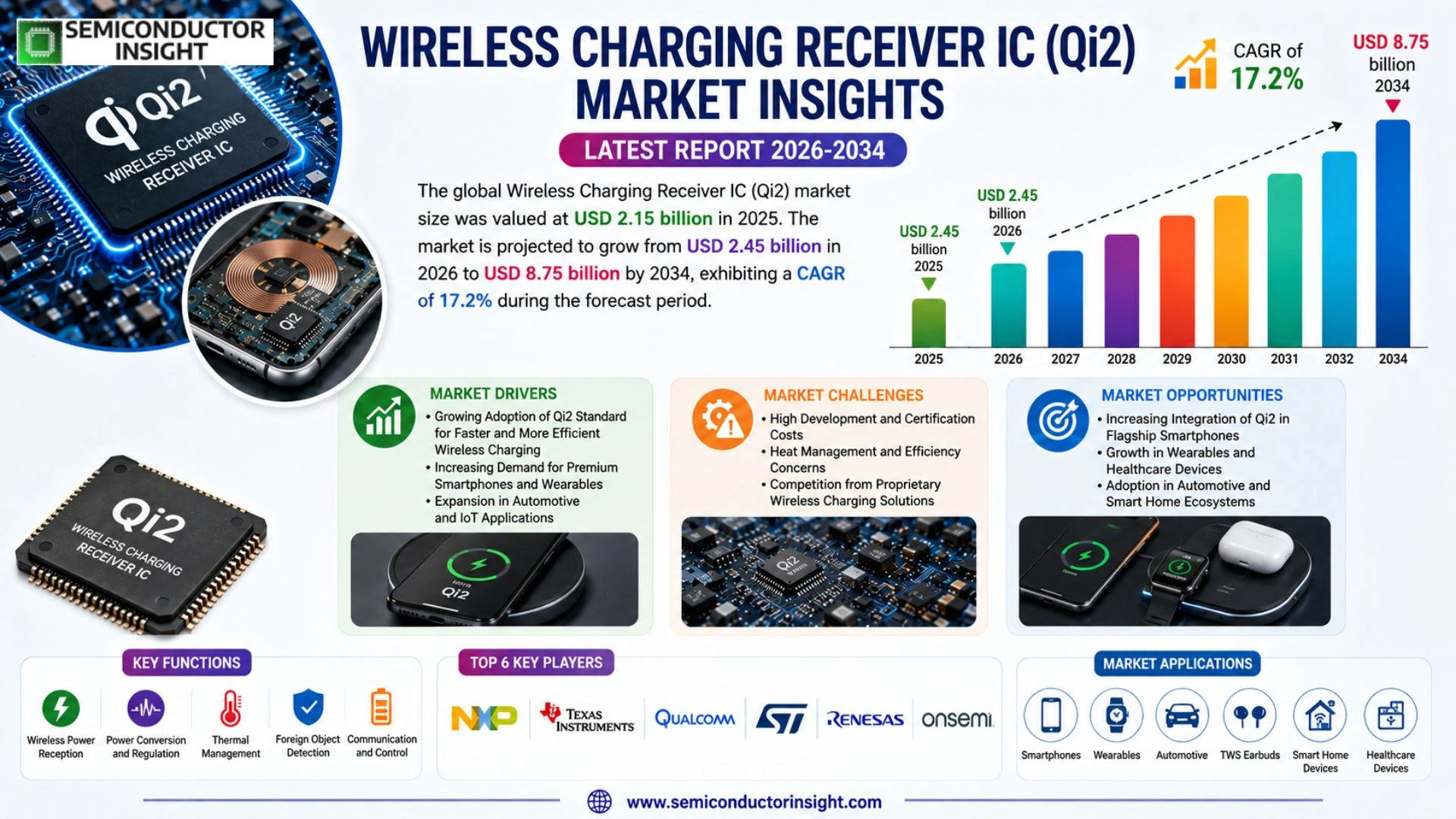
MARKET DRIVERS
Rapid Adoption of Qi2 Standard and Magnetic Alignment
Wireless Charging Receiver IC (Qi2) Market is propelled by the swift industry-wide transition to the Qi2 standard, which integrates magnetic alignment for improved efficiency and user experience. This evolution from earlier Qi specifications enables faster charging speeds up to 15W-25W, with Qi2.2 enhancements supporting higher power delivery, driving demand for advanced receiver ICs in smartphones, wearables, and accessories.
Growth in Consumer Electronics and Wearables
Explosive shipment volumes of premium devices exceeding 1.5 billion units annually have accelerated integration of compact, high-efficiency Qi2-compliant receiver ICs. Manufacturers prioritize miniaturized designs with superior thermal management and 90%+ efficiency to support longer battery life and seamless charging in smartphones, earbuds, and smartwatches.
➤ Receiver ICs continue to command significant market share due to their essential role in energy conversion within end devices, with ongoing innovations in GaN integration enhancing performance.
Automotive and infrastructure deployments further amplify growth, as Qi2-enabled solutions expand into vehicle consoles and public charging stations, creating sustained demand for robust receiver IC technologies.
MARKET CHALLENGES
Technical Complexity and Efficiency Optimization
Developing Wireless Charging Receiver IC (Qi2) solutions requires balancing high power delivery with thermal constraints and electromagnetic compatibility. Achieving consistent efficiency across varying alignment positions and device loads remains a key technical hurdle for IC designers serving diverse applications.
Other Challenges
Certification and Interoperability Issues
Obtaining Qi2 certification involves rigorous testing for magnetic alignment, foreign object detection, and safety protocols, extending development timelines and increasing costs for semiconductor vendors and device makers.
Competition from Alternative Technologies
Emerging resonant and other wireless charging approaches challenge inductive Qi2 solutions in specific use cases, pressuring receiver IC providers to innovate rapidly while maintaining cost competitiveness.
MARKET RESTRAINTS
High Development and Certification Costs
The complexity of Qi2-compliant Wireless Charging Receiver IC designs, including advanced features like precise magnetic alignment and multi-protocol support, results in elevated R&D expenditures. These costs can limit participation to well-resourced semiconductor companies and slow market entry for smaller players.
Compatibility and Standardization Fragmentation
Despite Qi2 progress, lingering compatibility variations across legacy devices and differing regional requirements create adoption barriers. This fragmentation affects receiver IC demand as manufacturers navigate multiple standards and power profiles in product development.
MARKET OPPORTUNITIES
Expansion into Automotive and Industrial Applications
Automotive integration of Qi2 receiver ICs in next-generation vehicles presents substantial growth potential, supported by rising demand for in-cabin wireless charging and alignment with EV infrastructure trends. Industrial uses in automation and IoT devices further expand the addressable market for specialized high-reliability solutions.
Innovation in Higher Power and Multi-Device Solutions
Advancements toward 25W+ Qi2.2 capabilities and multi-coil designs open opportunities for receiver IC manufacturers to differentiate through superior efficiency, compact form factors, and integrated safety features. This aligns with broader wireless charging market projections exceeding double-digit CAGRs through the early 2030s.
Wireless Charging Receiver IC (Qi2) Market Trends
Rising Integration of Qi2 Receiver ICs in Consumer Electronics
Wireless Charging Receiver IC (Qi2) Market is witnessing significant momentum driven by the accelerating adoption of Qi2-enabled devices across smartphones, wireless earbuds, smartwatches, and tablets. These specialized integrated circuits enable precise magnetic alignment features that enhance wireless power transfer reliability and speed, while delivering efficiency levels often exceeding 85-90 percent. Manufacturers are increasingly embedding these receiver solutions to meet consumer demand for seamless, cable-free charging experiences that prioritize convenience and device longevity.
Other Trends
Expansion into Automotive and Industrial Applications
Automotive manufacturers are incorporating Wireless Charging Receiver IC (Qi2) solutions for in-vehicle device charging systems, supporting the growing ecosystem of connected car technologies. Similarly, industrial sectors are exploring these ICs for specialized equipment requiring robust wireless power delivery in challenging environments. This diversification reflects the versatility of Qi2-compliant receiver designs in handling varied power levels and operational conditions.
Advancements in Power Management and Thermal Efficiency
Ongoing innovations focus on optimizing power management within Wireless Charging Receiver IC (Qi2) architectures to minimize heat generation during operation. Enhanced thermal performance allows for sustained high-power charging without compromising device safety or battery health, addressing key concerns in premium consumer electronics where compact form factors are essential.
Strengthening of the Qi2 Standardization Ecosystem
The Wireless Power Consortium’s continued efforts in standardizing Qi2 protocols have fostered greater interoperability between transmitters and receivers from multiple vendors. This collaborative framework has boosted manufacturer confidence, encouraging broader portfolio development of compact, high-performance Wireless Charging Receiver IC (Qi2) solutions tailored for different device categories. As more brands commit to the standard, the market benefits from reduced fragmentation and accelerated technology deployment at scale.
Overall, the convergence of consumer preferences for intuitive charging methods and technological refinements in magnetic alignment and energy conversion positions Wireless Charging Receiver IC (Qi2) Market for sustained expansion. Industry participants are strategically focusing on integration flexibility and efficiency gains to capture opportunities across diverse end-use segments, ensuring these receiver ICs remain central to next-generation wireless power solutions.
COMPETITIVE LANDSCAPE
Key Industry Players
Wireless Charging Receiver IC (Qi2) Market Features Strong Competition Among Semiconductor Leaders and Specialized IC Providers
Wireless Charging Receiver IC (Qi2) Market is led by established semiconductor giants such as Texas Instruments, NXP Semiconductors, Infineon Technologies, and STMicroelectronics, which command significant market share through their advanced, high-efficiency receiver solutions supporting magnetic alignment and high power transfer. These players benefit from broad portfolios, strong R&D capabilities, and extensive integration with consumer electronics, automotive, and industrial applications, creating a consolidated yet innovative market structure with high barriers to entry for new entrants.
Complementing the leaders are specialized Asian manufacturers including ConvenientPower, NuVolta Technology, Injoinic, Maxic Technology, and WPINNO that focus on cost-effective, compact Qi2-compliant receiver ICs tailored for smartphones, wearables, and accessories. These niche players drive rapid innovation in thermal management and interoperability while expanding the ecosystem through partnerships with device OEMs.
List of Key Wireless Charging Receiver IC (Qi2) Companies Profiled
- Texas Instruments
- NXP Semiconductors
- Infineon Technologies
- STMicroelectronics
- Qualcomm Technologies
- ConvenientPower
- NuVolta Technology
- Injoinic Technology
- Maxic Technology
- WPINNO
- Analog Devices
- Broadcom Inc.
- MediaTek
- ROHM Co., Ltd.
- Suncore
Segment Analysis:
| Segment Category | Sub-Segments | Key Insights |
| By Type |
|
Multi-Coil Receivers stand out for their superior flexibility in handling varied positioning tolerances enabled by Qi2 magnetic alignment. These solutions deliver consistent power delivery even with slight misalignments, enhancing user experience in dynamic environments. They also support simultaneous charging capabilities for multiple accessory devices, making them ideal for complex ecosystems. Advanced thermal management features further ensure reliable performance during extended operation. |
| By Application |
|
Smartphones and Tablets represent the dominant application area due to the seamless integration of Qi2 features that prioritize consumer convenience. Manufacturers benefit from standardized interoperability that reduces design complexity while improving charging speeds and efficiency. The segment emphasizes compact form factors that fit slim device profiles without compromising battery life or generating excess heat. Growing demand for cable-free lifestyles continues to reinforce innovation in this space. |
| By End User |
|
Consumer Electronics OEMs lead adoption by embedding Qi2 receiver ICs across flagship and mid-range portfolios. These users prioritize solutions that enhance product differentiation through reliable wireless charging while maintaining sleek aesthetics. Strong ecosystem support from the Wireless Power Consortium enables faster time-to-market and broader compatibility testing. Focus remains on power efficiency and safety certifications to meet stringent consumer expectations. |
| By Power Rating |
|
Medium Power Solutions gain prominence for balancing performance and thermal constraints in modern portable devices. These ICs provide optimal energy transfer rates suitable for rapid charging of flagship smartphones and tablets while supporting Qi2 magnetic alignment precision. They incorporate sophisticated power management algorithms that adapt dynamically to device requirements. Enhanced efficiency helps minimize energy loss during transfer, supporting sustainable design goals across product lines. |
| By Integration Level |
|
System-on-Chip Solutions excel by combining wireless power reception with comprehensive power management and protection features in a single compact package. This integration reduces board space requirements and simplifies overall device architecture for manufacturers. Advanced variants offer programmable parameters that allow customization for different device categories. Such highly integrated designs also improve signal integrity and reduce electromagnetic interference, supporting reliable operation in densely packed electronic assemblies. |
Regional Analysis: Wireless Charging Receiver IC (Qi2) Market
Asia-Pacific
Asia-Pacific stands as the dominant force Wireless Charging Receiver IC (Qi2) Market, driven by its unparalleled concentration of consumer electronics manufacturing and rapid adoption of next-generation wireless power technologies. The region benefits from established supply chains in countries like China, South Korea, Japan, and Taiwan, where major semiconductor foundries and device OEMs collaborate closely to integrate Qi2-compatible receiver ICs into smartphones, wearables, and automotive applications. Innovation ecosystems here prioritize efficiency improvements and compact designs that align with the stringent Qi2 standard requirements for enhanced power transfer and magnetic alignment.Local governments actively support technology advancement through favorable policies for green electronics and smart manufacturing initiatives. This creates an environment where Wireless Charging Receiver IC (Qi2) Market participants can accelerate product development cycles. The presence of both global giants and agile local players fosters intense competition that spurs continuous refinement of receiver IC performance, thermal management, and interoperability features. Consumer demand for seamless charging experiences in densely populated urban centers further propels market penetration across diverse product categories.
Strong ecosystem integration between device manufacturers and IC suppliers enables swift Qi2 implementation. Growing emphasis on cable-free lifestyles in tech-savvy populations boosts demand for advanced receiver solutions that deliver reliable, high-efficiency wireless power transfer.
Intense rivalry among established semiconductor firms and emerging specialists drives innovation in receiver IC architecture. Strategic partnerships with leading consumer brands help companies secure design wins and expand regional influence Wireless Charging Receiver IC (Qi2) Market.
Early and widespread integration of Qi2 features in flagship devices sets the pace for broader market diffusion. Focus on miniaturization and multi-device compatibility positions the region at the forefront of evolving wireless charging standards.
Continued investment in R&D and expanding applications in automotive and industrial sectors suggest sustained leadership. Evolving regulatory support for energy-efficient technologies will likely reinforce Asia-Pacific’s pivotal role in shaping Global Wireless Charging Receiver IC (Qi2) Market trajectories.
North America
North America exhibits robust growth Wireless Charging Receiver IC (Qi2) Market fueled by high consumer spending on premium electronics and a strong innovation culture. The region benefits from significant R&D investments by technology companies focused on enhancing user convenience through advanced wireless power solutions. Major automotive manufacturers are exploring Qi2 integration for in-vehicle charging systems, creating new avenues for receiver IC applications. Regulatory emphasis on consumer safety and electromagnetic compatibility further encourages adoption of standardized, high-quality components. Strategic collaborations between semiconductor designers and device makers help accelerate the commercialization of next-generation receiver technologies tailored to North American market preferences.
Europe
Europe demonstrates steady progress Wireless Charging Receiver IC (Qi2) Market with particular strength in automotive and industrial segments. Strict environmental regulations and sustainability goals drive demand for efficient wireless charging solutions that reduce reliance on traditional power cables. The region’s well-established engineering expertise supports sophisticated IC design improvements focused on thermal performance and reliability. Growing consumer awareness regarding convenient charging technologies complements policy initiatives promoting digital infrastructure. European firms often emphasize interoperability and safety certifications, which helps build consumer confidence in Qi2-enabled devices across various applications.
South America
South America represents an emerging territory Wireless Charging Receiver IC (Qi2) Market where expanding middle-class consumer bases are gradually adopting modern electronics. Urban centers show increasing interest in wireless convenience features as smartphone penetration rises. Local manufacturing initiatives and foreign investments in technology sectors create opportunities for gradual market development. Challenges related to infrastructure and economic variability influence the pace of adoption, yet demand for premium devices incorporating advanced receiver ICs continues to gain traction. Strategic focus on cost-effective solutions adapted to regional requirements supports long-term market expansion potential.
Middle East & Africa
The Middle East and Africa region shows promising early-stage development Wireless Charging Receiver IC (Qi2) Market, particularly in affluent urban markets with high disposable incomes. Government initiatives to diversify economies through technology and innovation hubs facilitate greater technology transfer and local capabilities. Rising adoption of smart devices and luxury consumer electronics creates demand for contemporary wireless charging solutions. While infrastructure variations exist across different countries, targeted investments in key economic centers help establish foundations for broader Qi2 integration. The market benefits from growing partnerships with global technology providers aiming to serve expanding regional consumer bases.
Report Scope
This market research report provides a comprehensive analysis of the Wireless Charging Receiver IC (Qi2) Market , covering the forecast period 2026–2034. It offers detailed insights into market dynamics, technological advancements, competitive landscape, and key trends shaping the industry.
Key focus areas of the report include:
- Market Overview: The report begins with an overview outlining its current market scenario, key growth indicators, and industry transformation drivers. It discusses macroeconomic factors, demand–supply balance, regulatory landscape, and the strategic role of semiconductors in powering advancements across industries such as automotive, telecommunications, consumer electronics, and industrial automation.
- Market Size & Forecast: Historical data and future projections for revenue, unit shipments, and market value across major regions and segments.
- Segmentation Analysis: Detailed breakdown by product type, technology, application, and end-user industry to identify high-growth segments and investment opportunities.
- Regional Insights: Insights into market performance across North America, Europe, Asia-Pacific, Latin America, and the Middle East & Africa, including country-level analysis where relevant.
- Competitive Landscape: Profiles of leading market participants, including their product offerings, R&D focus, manufacturing capacity, pricing strategies, and recent developments such as mergers, acquisitions, and partnerships.
- Technology Trends & Innovation: Assessment of emerging technologies, integration of AI/IoT, semiconductor design trends, fabrication techniques, and evolving industry standards.
- Market Drivers & Restraints: Evaluation of factors driving market growth along with challenges, supply chain constraints, regulatory issues, and market-entry barriers.
- Stakeholder Insights: Insights for component suppliers, OEMs, system integrators, investors, and policymakers regarding the evolving ecosystem and strategic opportunities.
Primary and secondary research methods are employed, including interviews with industry experts, data from verified sources, and real-time market intelligence to ensure the accuracy and reliability of the insights presented.
FREQUENTLY ASKED QUESTIONS:
What is the current market size of Wireless Charging Receiver IC (Qi2) Market?
-> Wireless Charging Receiver IC (Qi2) Market was valued at USD 2.15 billion in 2025 and is expected to reach USD 8.75 billion by 2034.
Which key companies operate Wireless Charging Receiver IC (Qi2) Market?
-> Key playerWireless Charging Receiver IC (Qi2) Markets include leading semiconductor manufacturers offering Qi2 compliant solutions, among others.
What are the key growth drivers?
-> Key growth drivers include widespread adoption of Qi2-enabled consumer electronics such as smartphones, wireless earbuds, smartwatches, and tablets, increasing integration in automotive and industrial applications, and expansion of the Qi2 ecosystem.
Which region dominates the market?
-> Asia-Pacific is the fastest-growing region, while North America remains a dominant market.
What are the emerging trends?
-> Emerging trends include magnetic alignment features, high efficiency levels exceeding 85-90 percent, and advancements in power management and thermal efficiency.

Get Sample Report PDF for Exclusive Insights
Report Sample Includes
- Table of Contents
- List of Tables & Figures
- Charts, Research Methodology, and more...