Wi-Fi 7 (802.11be) Chipset for Mobile Market Insights
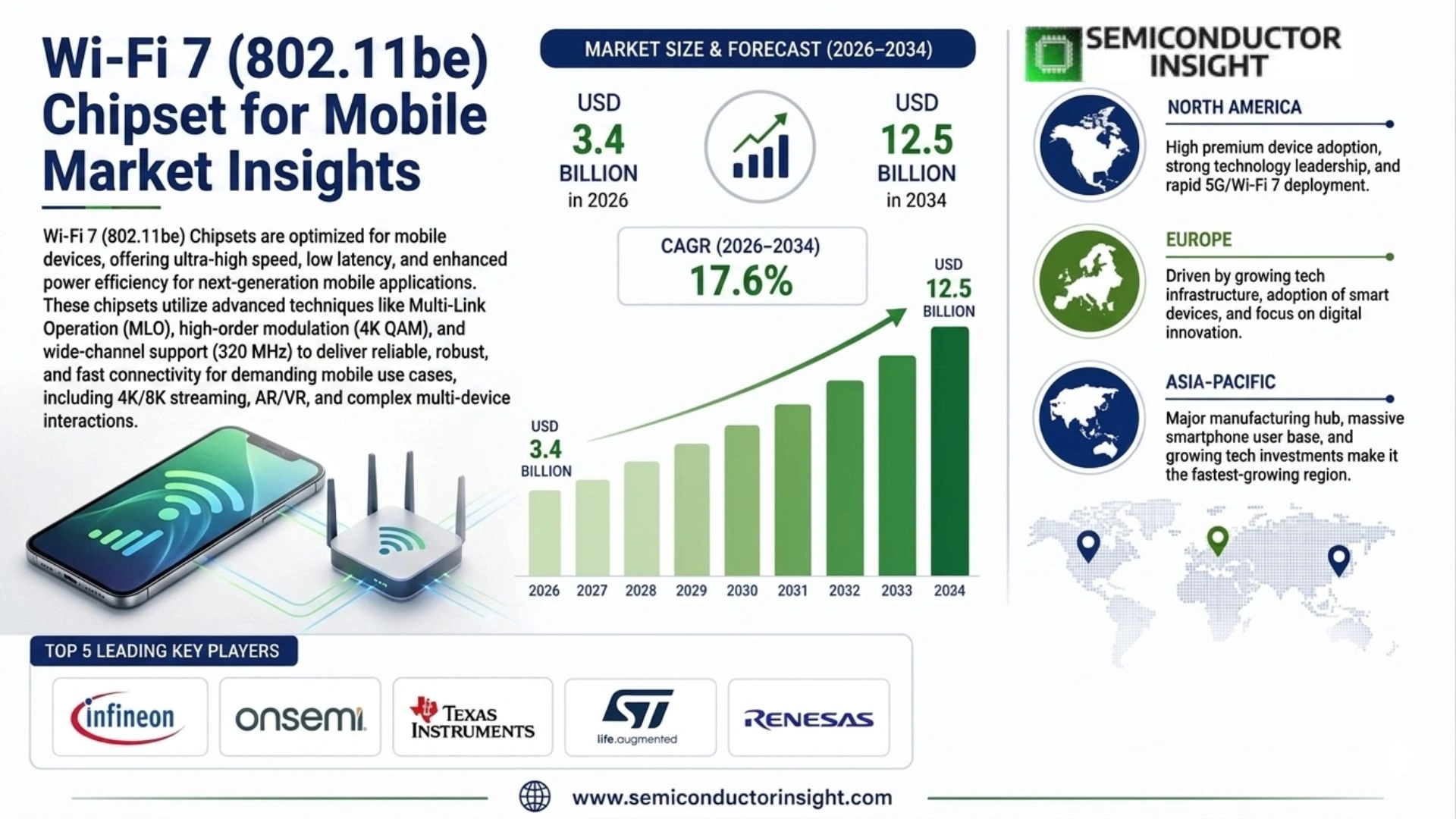
Wi-Fi 7 (802.11be) Chipset for Mobile Market size was valued at USD 2.8 billion in 2025. The market is projected to grow from USD 3.4 billion in 2026 to USD 12.5 billion by 2034, exhibiting a CAGR of 17.6% during the forecast period.
Wi-Fi 7 (802.11be) chipsets for mobile are advanced semiconductor solutions designed to deliver multi-gigabit wireless connectivity in smartphones, tablets, and other portable devices. These chipsets leverage the IEEE 802.11be standard to provide significantly higher throughput, lower latency, and improved efficiency compared to previous generations. Key features include support for 320 MHz channel bandwidth, Multi-Link Operation (MLO), 4K QAM modulation, and enhanced MU-MIMO capabilities, enabling seamless performance for data-intensive applications such as 8K video streaming, cloud gaming, augmented reality, and on-device AI processing.
The market is experiencing robust growth due to several factors, including the rapid proliferation of high-end smartphones, increasing consumer demand for ultra-fast and reliable wireless connectivity, and the integration of advanced connectivity features in next-generation mobile processors. Furthermore, the expansion of 5G networks and the need for seamless offloading to Wi-Fi in dense environments are accelerating adoption. Advancements in chipset design focused on power efficiency are also critical, as mobile devices require optimized performance without compromising battery life. Initiatives by key players continue to drive innovation in the space. Qualcomm, Broadcom, and MediaTek are some of the key players that operate in the market with a wide range of portfolios.
MARKET DRIVERS
Rising Demand for High-Speed Connectivity in Smartphones
Wi-Fi 7 (802.11be) Chipset for Mobile Market is propelled by the increasing need for multi-gigabit wireless speeds in flagship and mid-range smartphones. As mobile devices handle bandwidth-intensive tasks like 8K video streaming and cloud gaming, chipsets from leaders such as Qualcomm, Broadcom, and MediaTek deliver up to 5.8 Gbps theoretical throughput using 320 MHz channels and Multi-Link Operation (MLO).
Expansion of AR/VR and Immersive Applications
Adoption of augmented reality and virtual reality experiences on mobile platforms requires ultra-low latency and high reliability, which Wi-Fi 7 chipsets provide through advanced features like puncturing and enhanced MU-MIMO. Smartphone manufacturers are integrating these chipsets to support seamless wireless XR applications and real-time collaboration.
➤ The proliferation of IoT ecosystems and smart home integration further accelerates demand, as mobile chipsets enable efficient multi-device connectivity in high-density environments.
Integration with 5G capabilities in mobile SoCs enhances overall user experience, driving premium device upgrades and broader market penetration in 2026.
MARKET CHALLENGES
Integration Complexity and Device Compatibility
Implementing Wi-Fi 7 (802.11be) chipsets in mobile devices involves significant engineering hurdles related to antenna design, thermal management, and coexistence with cellular modems. While flagship models lead adoption, ensuring consistent performance across varying form factors remains a key issue for manufacturers.
Other Challenges
Power Consumption Management
Higher bandwidth capabilities and multi-band operation in Wi-Fi 7 chipsets can increase power draw in smartphones, posing challenges for battery life optimization during intensive use cases like gaming or streaming.
Regulatory and Spectrum Availability
Access to the 6 GHz band varies by region, affecting global rollout and consistent performance expectations for mobile Wi-Fi 7 implementations.
MARKET RESTRAINTS
High Development and Implementation Costs
The premium pricing associated with advanced Wi-Fi 7 chipsets limits initial adoption primarily to high-end mobile devices. Substantial R&D investments required for multi-link features and 320 MHz support contribute to elevated costs passed on to consumers. Supply chain dependencies on advanced semiconductor nodes (such as 4nm/5nm processes) create production constraints and potential delays in scaling for mass-market smartphones.
MARKET OPPORTUNITIES
Proliferation Across Mid-Range Devices
Recent launches of mid-range mobile platforms with Wi-Fi 7 support open significant volume opportunities beyond flagships, accelerating market growth as costs decrease and ecosystem maturity improves in 2026. Emerging applications in mobile cloud gaming, wireless AR/VR headsets paired with phones, and enhanced IoT device control present new revenue streams for chipset providers targeting the mobile segment.
Trends
Accelerated Adoption Driven by Multi-Gigabit Connectivity Demands
Wi-Fi 7 (802.11be) Chipset for Mobile Market is witnessing significant momentum as device manufacturers integrate advanced wireless solutions to meet consumer expectations for seamless high-bandwidth experiences. These chipsets enable multi-gigabit speeds through features such as 320 MHz channel bandwidth and Multi-Link Operation (MLO), allowing smartphones and tablets to handle demanding applications with greater reliability. The integration of 4K QAM modulation further enhances data throughput while maintaining efficient spectrum usage in crowded environments.
Other Trends
Power Efficiency Innovations in Mobile Chipset Design
Power management remains a critical focus area for Wi-Fi 7 (802.11be) Chipset for Mobile Market participants. Chipset developers are optimizing architectures to deliver superior performance without draining device batteries, which is essential for sustained usage in portable devices. This balance supports prolonged operation during data-intensive tasks like augmented reality applications and on-device AI processing, addressing one of the key challenges in next-generation mobile connectivity.
Expansion of Enhanced MU-MIMO and Latency Reduction Capabilities
Enhanced multi-user multiple input multiple output (MU-MIMO) capabilities in Wi-Fi 7 chipsets are transforming how mobile devices interact in dense network scenarios. These advancements reduce latency substantially compared to prior standards, facilitating smoother cloud gaming sessions and 8K video streaming on portable platforms. As 5G networks continue to expand, the complementary role of Wi-Fi 7 for intelligent traffic offloading becomes increasingly vital, enabling better overall connectivity experiences in urban and high-traffic areas.
Leading semiconductor companies including Qualcomm, Broadcom, and MediaTek are actively enhancing their portfolios with Wi-Fi 7 solutions tailored for mobile applications. Their efforts emphasize not only raw speed but also improved coexistence with cellular technologies and better support for emerging use cases in consumer electronics. The trend toward embedding these advanced connectivity features directly into next-generation mobile processors is streamlining device architectures and accelerating time-to-market for premium smartphones and tablets.
Overall, Wi-Fi 7 (802.11be) Chipset for Mobile Market reflects the broader industry shift toward ubiquitous ultra-fast wireless performance. Manufacturers are prioritizing these chipsets to differentiate their flagship devices, responding to user demands for reliable connectivity that matches the capabilities of modern content and applications. Continued innovation in this space is expected to further solidify Wi-Fi 7 as a standard feature in high-performance mobile devices moving forward.
COMPETITIVE LANDSCAPE
Key Industry Players
Leadership of Semiconductor Giants in Wi-Fi 7 Mobile Chipset Innovation
The Wi-Fi 7 (802.11be) chipset market for mobile devices is highly concentrated among a few leading semiconductor companies that dominate high-end smartphone and tablet platforms. Qualcomm stands out as the primary leader, leveraging its FastConnect 7800 and subsequent solutions integrated into Snapdragon processors to deliver multi-gigabit speeds, Multi-Link Operation (MLO), and superior power efficiency tailored for premium mobile experiences. This positions the company strongly in flagship devices from major OEMs, capitalizing on its extensive ecosystem and patented technologies in wireless connectivity.
Broadcom and MediaTek represent significant competitive forces, with Broadcom excelling in high-performance integrated solutions that balance throughput and efficiency for mobile applications, while MediaTek has rapidly gained traction through its Filogic series, enabling cost-effective Wi-Fi 7 adoption in a broader range of devices. Other notable players are carving niches through specialized offerings and partnerships, contributing to accelerated innovation in areas such as 320 MHz channels, 4K QAM, and enhanced MU-MIMO for data-intensive mobile use cases like AR/VR and 8K streaming.
List of Key Wi-Fi 7 Chipset Companies Profiled
- Qualcomm Technologies, Inc.
- Broadcom Inc.
- MediaTek Inc.
- Intel Corporation
- Realtek Semiconductor Corp.
- Infineon Technologies AG
- NXP Semiconductors
- Marvell Technology
- STMicroelectronics
- ON Semiconductor
- Texas Instruments Incorporated
- Cypress Semiconductor (Infineon)
- Samsung Electronics (Exynos connectivity)
- Huawei Technologies (HiSilicon)
- Espressif Systems
Segment Analysis:
| Segment Category | Sub-Segments | Key Insights |
| By Type |
|
Tri-Band Chipsets represent the leading segment due to their ability to simultaneously operate across multiple frequency bands for superior performance in crowded mobile environments. These solutions excel in delivering seamless connectivity for data-heavy tasks while maintaining stability. Manufacturers prioritize power-optimized designs that balance speed with thermal management essential for compact mobile devices. Enhanced spectrum utilization allows devices to dynamically switch between bands reducing interference and improving overall user experience in real-world scenarios. |
| By Application |
|
Smartphones dominate as the primary application segment owing to the critical need for ultra-fast wireless capabilities in flagship and premium devices. Integration with advanced mobile processors enables exceptional throughput for applications like high-resolution video streaming, real-time cloud gaming, and immersive augmented reality experiences. Chipsets in this category focus heavily on low-latency Multi-Link Operation that ensures reliable connections even during mobility. The emphasis remains on compact form factors with efficient heat dissipation to preserve battery longevity during intensive usage sessions. |
| By End User |
|
Premium Consumer Devices lead this segment through strong demand for next-generation connectivity features that enhance everyday digital lifestyles. End users in this category expect flawless performance for bandwidth-intensive activities including on-device AI processing and multi-device ecosystem synchronization. Chipsets tailored here incorporate sophisticated power management techniques that optimize energy consumption without sacrificing speed. This results in extended usage times alongside superior network efficiency particularly valuable in urban settings with dense wireless traffic. |
| By Integration Level |
|
Fully Integrated SoC emerges as the leading approach by combining Wi-Fi 7 capabilities directly with the main mobile processor for streamlined architecture. This integration delivers improved signal processing efficiency and reduced component footprint ideal for slim mobile designs. Benefits include better thermal characteristics and lower overall power draw supporting prolonged high-performance operation. Such solutions facilitate tighter coordination between wireless and application processing units enabling advanced features like simultaneous multi-network handling with minimal latency. |
| By Feature Set |
|
320 MHz Bandwidth Support stands out as the forefront feature set driving exceptional data rates and network capacity in mobile environments. These chipsets leverage wider channels to accommodate surging content demands while implementing intelligent interference mitigation strategies. The combination with Multi-Link Operation allows devices to maintain robust connections across diverse usage contexts from home networks to public hotspots. Focus on hardware-level optimizations ensures these high-bandwidth capabilities remain practical within the stringent power and size constraints of mobile hardware. |
Regional Analysis: Wi-Fi 7 (802.11be) Chipset for Mobile Market
Asia-Pacific
Asia-Pacific’s integrated semiconductor and mobile manufacturing ecosystem provides unmatched advantages for Wi-Fi 7 (802.11be) chipset development. Close collaboration between design teams and production facilities enables rapid prototyping and optimization for mobile-specific power and size constraints. This vertical integration supports high-volume production while maintaining the stringent quality standards required for flagship smartphones.
The region excels in developing advanced features like enhanced multi-link operation and intelligent channel management tailored for mobile environments. Research institutions and corporate R&D centers focus on addressing real-world challenges such as interference in high-density areas, driving the evolution of Wi-Fi 7 (802.11be) Chipset for Mobile Market technologies.
Tech-savvy consumers in Asia-Pacific actively seek devices with superior connectivity for data-intensive applications. This demand encourages manufacturers to prioritize Wi-Fi 7 integration in mid-to-premium segments, creating a robust market dynamic that influences global product roadmaps and accelerates technology adoption.
Collaborative ecosystems between chipset vendors, device OEMs, and network operators facilitate comprehensive testing and optimization. These partnerships ensure seamless compatibility and performance, strengthening the region’s position in shaping the future trajectory of Wi-Fi 7 (802.11be) solutions for mobile devices.
North America
North America maintains a strong position Wi-Fi 7 (802.11be) Chipset for Mobile Market through its focus on innovation and premium device segments. Leading semiconductor companies headquartered in the region drive advancements in security protocols and AI-powered network optimization specifically designed for mobile platforms. The emphasis on enterprise-grade features influences consumer product development, while robust intellectual property frameworks protect technological breakthroughs. Consumer preference for high-performance devices in both professional and entertainment contexts sustains steady demand for Wi-Fi 7 enabled smartphones and tablets. Strategic investments in research continue to enhance coexistence capabilities with other wireless technologies prevalent in the North American market landscape.
Europe
Europe exhibits measured yet strategic growth Wi-Fi 7 (802.11be) Chipset for Mobile Market, characterized by strong regulatory focus on data privacy and energy efficiency. The region’s emphasis on sustainable technology encourages chipset designs that balance high performance with lower power consumption for mobile applications. Collaborative projects between academia and industry accelerate standardization efforts, while major consumer electronics brands integrate Wi-Fi 7 capabilities to meet sophisticated user expectations across diverse markets. The focus on seamless connectivity in smart cities and IoT ecosystems indirectly benefits mobile chipset development, creating opportunities for specialized implementations tailored to European requirements.
South America
South America represents an emerging frontier for Wi-Fi 7 (802.11be) Chipset for Mobile Market, with growth propelled by expanding digital infrastructure and increasing smartphone penetration. Urban centers drive demand for advanced connectivity solutions as consumers embrace bandwidth-intensive applications. Local manufacturers and international players collaborate to adapt Wi-Fi 7 technologies to regional network conditions and usage patterns. While adoption follows global leaders, the region’s youthful demographic and improving economic conditions create fertile ground for future expansion of premium mobile devices featuring next-generation chipsets.
Middle East & Africa
The Middle East and Africa region shows promising potential Wi-Fi 7 (802.11be) Chipset for Mobile Market, supported by ambitious smart nation initiatives and digital transformation programs. High-end mobile device adoption in key Gulf markets creates initial demand for advanced Wi-Fi capabilities. Infrastructure development projects emphasize future-proof connectivity, opening pathways for Wi-Fi 7 integration in mobile ecosystems. Diverse market conditions across the region require flexible chipset solutions that perform reliably in varying network environments. Growing tech entrepreneurship and international partnerships are gradually building local expertise in implementing these sophisticated mobile connectivity technologies.
Report Scope
This market research report provides a comprehensive analysis of the Wi-Fi 7 (802.11be) Chipset for Mobile Market , covering the forecast period 2026–2034. It offers detailed insights into market dynamics, technological advancements, competitive landscape, and key trends shaping the industry.
Key focus areas of the report include:
- Market Overview: The report begins with an overview outlining its current market scenario, key growth indicators, and industry transformation drivers. It discusses macroeconomic factors, demand–supply balance, regulatory landscape, and the strategic role of semiconductors in powering advancements across industries such as automotive, telecommunications, consumer electronics, and industrial automation.
- Market Size & Forecast: Historical data and future projections for revenue, unit shipments, and market value across major regions and segments.
- Segmentation Analysis: Detailed breakdown by product type, technology, application, and end-user industry to identify high-growth segments and investment opportunities.
- Regional Insights: Insights into market performance across North America, Europe, Asia-Pacific, Latin America, and the Middle East & Africa, including country-level analysis where relevant.
- Competitive Landscape: Profiles of leading market participants, including their product offerings, R&D focus, manufacturing capacity, pricing strategies, and recent developments such as mergers, acquisitions, and partnerships.
- Technology Trends & Innovation: Assessment of emerging technologies, integration of AI/IoT, semiconductor design trends, fabrication techniques, and evolving industry standards.
- Market Drivers & Restraints: Evaluation of factors driving market growth along with challenges, supply chain constraints, regulatory issues, and market-entry barriers.
- Stakeholder Insights: Insights for component suppliers, OEMs, system integrators, investors, and policymakers regarding the evolving ecosystem and strategic opportunities.
Primary and secondary research methods are employed, including interviews with industry experts, data from verified sources, and real-time market intelligence to ensure the accuracy and reliability of the insights presented.
FREQUENTLY ASKED QUESTIONS:
What is the current market size of Wi-Fi 7 (802.11be) Chipset for Mobile Market?
-> Wi-Fi 7 (802.11be) Chipset for Mobile Market was valued at USD 2.8 billion in 2025 and is expected to reach USD 12.5 billion by 2034.
Which key companies operate Wi-Fi 7 (802.11be) Chipset for Mobile Market?
-> Key players include Qualcomm, Broadcom, and MediaTek, among others.
What are the key growth drivers?
-> Key growth drivers include rapid proliferation of high-end smartphones, increasing consumer demand for ultra-fast and reliable wireless connectivity, and integration of advanced connectivity features in next-generation mobile processors.
Which region dominates the market?
-> Asia-Pacific is the fastest-growing region, while North America remains a dominant market.
What are the emerging trends?
-> Emerging trends include Multi-Link Operation (MLO), 320 MHz channel bandwidth, 4K QAM modulation, enhanced MU-MIMO, and power-efficient designs for mobile devices.

Get Sample Report PDF for Exclusive Insights
Report Sample Includes
- Table of Contents
- List of Tables & Figures
- Charts, Research Methodology, and more...
 Download Sample Report PDF