Wearable ECG (Electrocardiogram) Analog Front End Market Insights
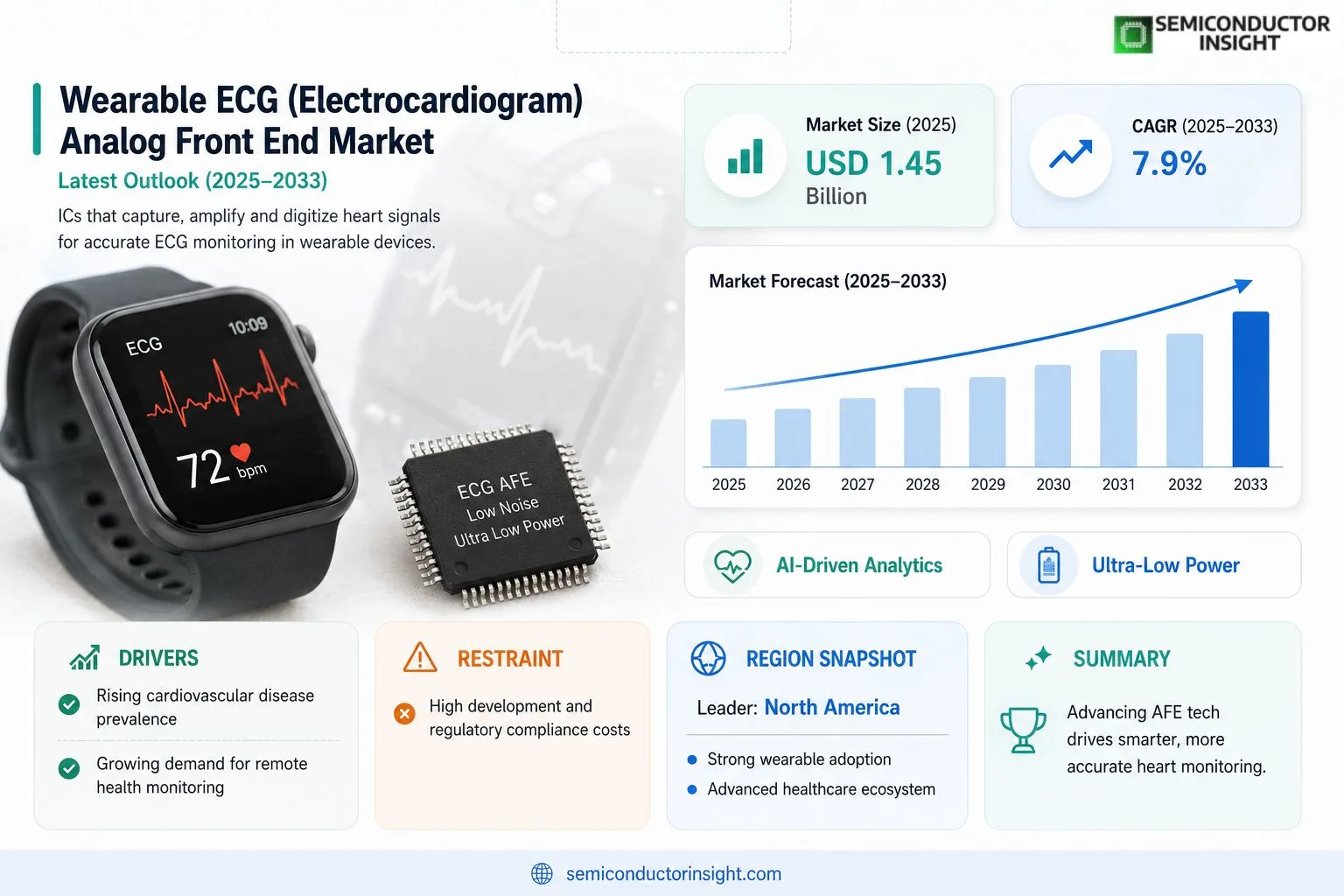
Global Wearable ECG (Electrocardiogram) Analog Front End market size was valued at USD 1.35 billion in 2024. The market is projected to grow from USD 1.45 billion in 2025 to USD 2.67 billion by 2033, exhibiting a CAGR of 7.9% during the forecast period.
Wearable ECG Analog Front End (AFE) components are specialized integrated circuits designed to acquire, amplify, filter, and digitize the weak bioelectrical signals from the heart. These compact, low-power solutions enable accurate electrocardiogram monitoring in wearable devices such as smartwatches, patches, and fitness trackers. They typically integrate low-noise amplifiers, analog-to-digital converters, and signal conditioning circuits optimized for continuous, real-time cardiac data capture in dynamic environments.
The market is experiencing steady growth due to several factors, including the rising prevalence of cardiovascular diseases, increasing consumer demand for remote health monitoring, and advancements in miniaturized electronics. Furthermore, the shift toward preventive healthcare and the integration of AI-driven analytics in wearables are accelerating adoption. Initiatives by key players continue to drive innovation, with a focus on lower power consumption and higher signal fidelity to support longer battery life and clinical-grade accuracy. Analog Devices, Texas Instruments, and Maxim Integrated are some of the key players that operate in the market with a wide range of portfolios.
MARKET DRIVERS
Rising Prevalence of Cardiovascular Diseases and Demand for Continuous Monitoring
Wearable ECG (Electrocardiogram) Analog Front End Market is propelled by the increasing global incidence of cardiovascular conditions, including arrhythmias and atrial fibrillation. As populations age and lifestyle-related heart issues rise, there is growing demand for convenient, real-time cardiac monitoring solutions integrated into wearable devices like smartwatches and patches. Analog front-end (AFE) components enable high-precision signal acquisition in compact, low-power formats essential for these applications.
Technological Advancements in Wearable Health Devices
Advancements in semiconductor technology have led to more efficient, miniaturized AFE solutions optimized for wearable ECG applications. These components support low-power operation and high signal-to-noise ratios, facilitating integration into consumer-grade devices with medical-grade capabilities. The shift toward preventive healthcare and remote patient monitoring further accelerates adoption, with wearable ECG monitors experiencing strong growth trajectories.
➤ The integration of ECG AFE into smartwatches, fitness bands, and patch-based monitors is opening new avenues for market expansion.
Consumer health awareness and the proliferation of connected wearable devices continue to drive innovation, positioning the Wearable ECG Analog Front End Market for sustained expansion through enhanced functionality and accessibility.
MARKET CHALLENGES
Signal Quality and Noise Management in Dynamic Environments
Achieving reliable ECG signal acquisition in wearable devices remains challenging due to motion artifacts, electrode-skin contact issues, and environmental interference. High contact impedance can lead to signal attenuation and increased noise, requiring sophisticated AFE designs with advanced filtering and high input impedance to maintain accuracy during daily activities.
Other Challenges
Power Consumption and Battery Life Constraints
Wearable devices demand ultra-low power AFE solutions to extend battery life while maintaining continuous monitoring capabilities. Balancing performance with energy efficiency poses ongoing engineering hurdles for designers in the Wearable ECG Analog Front End Market.
Miniaturization and Integration Complexity
Creating compact, comfortable wearables requires extreme miniaturization of AFE components without compromising signal integrity or regulatory compliance for medical applications.
MARKET RESTRAINTS
Regulatory and Data Privacy Concerns
Stringent regulatory requirements for medical-grade wearable devices, combined with growing concerns over data security and patient privacy, slow down market penetration in certain regions. Compliance with standards for accuracy and safety adds complexity and cost to AFE development and deployment in Wearable ECG (Electrocardiogram) Analog Front End Market.
The high costs associated with design, testing, and manufacturing of specialized AFE solutions can limit participation by smaller companies, while accuracy limitations in single-lead configurations may hinder full clinical adoption.
MARKET OPPORTUNITIES
Expansion in AI-Integrated and Remote Monitoring Solutions
Significant opportunities exist in integrating advanced AFE technology with AI-driven analytics for real-time arrhythmia detection and personalized health insights. The growth of telehealth, home-based cardiac care, and next-generation wearables creates demand for sophisticated analog front-end solutions that support multi-parameter monitoring and seamless connectivity.
Emerging applications in implantable and advanced wearable devices, along with expansion in emerging markets, offer pathways for innovation and market share growth in the Wearable ECG Analog Front End sector.
Wearable ECG (Electrocardiogram) Analog Front End Market Trends
Advancements in Low-Power Signal Acquisition Technologies
Wearable ECG (Electrocardiogram) Analog Front End Market continues to evolve as manufacturers develop specialized integrated circuits optimized for capturing, amplifying, filtering, and digitizing weak bioelectrical heart signals in compact wearable devices. These solutions incorporate low-noise amplifiers, analog-to-digital converters, and advanced signal conditioning circuits specifically engineered for continuous real-time cardiac monitoring in dynamic environments such as smartwatches, patches, and fitness trackers. Industry focus remains on achieving clinical-grade accuracy while maintaining the ultra-low power profiles essential for extended device operation.
Other Trends
Rising Demand for Remote and Preventive Cardiac Monitoring
Healthcare shifts toward preventive approaches have accelerated adoption of wearable ECG solutions. The increasing prevalence of cardiovascular conditions combined with consumer interest in proactive health management drives integration of these analog front end components into everyday wearable devices. Enhanced signal fidelity enables more reliable data collection during daily activities, supporting remote patient monitoring programs and reducing the need for traditional clinical visits.
Innovation in Miniaturization and AI Integration
Progress in miniaturized electronics allows for more sophisticated analog front end designs that deliver higher performance in smaller form factors. Leading developers prioritize improvements in power efficiency and signal quality to extend battery life without compromising monitoring capabilities. Integration with AI-driven analytics further enhances the value of wearable ECG systems by enabling real-time insights and personalized health feedback. Established players including Analog Devices, Texas Instruments, and Maxim Integrated maintain strong market positions through diverse portfolios focused on these critical performance attributes, fostering continued innovation across Wearable ECG (Electrocardiogram) Analog Front End Market.
COMPETITIVE LANDSCAPE
Key Industry Players
Wearable ECG Analog Front End Competitive Analysis
The Wearable ECG Analog Front End market is led by semiconductor giants Analog Devices, Inc. and Texas Instruments Incorporated, which command significant market share through their advanced, low-power AFE solutions optimized for continuous cardiac monitoring in smartwatches, patches, and fitness trackers. These leaders offer highly integrated chips featuring low-noise amplifiers, high-resolution ADCs, and sophisticated signal conditioning that deliver clinical-grade accuracy while minimizing power consumption for extended battery life in dynamic wearable environments. The market structure is characterized by high barriers to entry due to stringent regulatory requirements, complex analog design expertise, and the need for seamless integration with digital health platforms.
Other significant players include STMicroelectronics, Infineon Technologies, NXP Semiconductors, ON Semiconductor, and Microchip Technology, which focus on niche applications such as ultra-compact designs, IoT connectivity, and cost-effective solutions for emerging markets. Maxim Integrated (now part of Analog Devices) continues to influence the wearable segment with its heritage in ultra-low power biopotential AFEs. These companies drive innovation through strategic partnerships with device OEMs and emphasis on AI-ready signal processing to support remote patient monitoring and preventive healthcare initiatives.
List of Key Wearable ECG Analog Front End Companies Profiled
- Analog Devices, Inc.
- Analog Devices, Inc.
- Texas Instruments Incorporated
- STMicroelectronics N.V.
- Infineon Technologies AG
- NXP Semiconductors N.V.
- ON Semiconductor Corporation
- Microchip Technology Inc.
- Renesas Electronics Corporation
- Maxim Integrated (Analog Devices)
- ROHM Semiconductor
- Silicon Laboratories Inc.
- Cirrus Logic Inc.
- Asahi Kasei Microdevices
Segment Analysis:
| Segment Category | Sub-Segments | Key Insights |
| By Type |
|
Multi-Channel AFE stands out for delivering comprehensive cardiac rhythm assessment in compact wearable formats. These solutions excel in capturing detailed heart activity from multiple vectors, supporting superior signal fidelity even during user movement. Their design prioritizes seamless integration with various sensor arrays while maintaining minimal power draw for extended wear. Enhanced noise rejection capabilities make them particularly effective in real-world ambulatory conditions where motion artifacts are common. |
| By Application |
|
Continuous Cardiac Monitoring represents the dominant application area due to its critical role in proactive health management. This segment benefits from AFEs optimized for uninterrupted data streams that feed into sophisticated algorithms for rhythm analysis. Devices in this category emphasize long-term comfort and reliability, enabling users to maintain daily activities without interruption. The integration of real-time processing helps identify subtle pattern changes that might indicate emerging concerns, fostering better user engagement with personal health metrics. |
| By End User |
|
Individual Consumers drive significant momentum through widespread adoption of lifestyle-integrated monitoring devices. This group values intuitive interfaces and stylish designs that blend ECG capabilities into everyday accessories like smartwatches and patches. Consumer-focused AFEs prioritize ease of use, battery efficiency, and data privacy features that build user trust. The segment thrives on growing awareness of preventive health, encouraging regular monitoring without clinical oversight while still offering pathways to professional review when needed. |
| By Form Factor |
|
Wrist-Worn Devices lead due to their unmatched convenience and user acceptance in daily routines. AFEs tailored for this format master the challenges of motion artifact compensation on the wrist while preserving signal quality. They support versatile wear patterns across different user demographics and lifestyles. This form factor facilitates frequent, passive data collection without requiring dedicated placement routines, resulting in richer longitudinal datasets for personalized insights. |
| By Technology Integration |
|
AI-Enhanced Processing emerges as the forward-looking leader by embedding intelligent algorithms directly at the hardware edge. These AFEs deliver refined data streams that reduce downstream computational loads on companion devices. They excel at distinguishing meaningful cardiac events from environmental noise in real time. This technology supports more accurate anomaly flagging and personalized feedback, strengthening the overall value proposition of wearable ECG solutions across both consumer and clinical contexts. |
Regional Analysis: Wearable ECG (Electrocardiogram) Analog Front End Market
North America
North America stands as the undisputed leader in Wearable ECG (Electrocardiogram) Analog Front End Market, driven by its robust ecosystem of technological innovation, advanced healthcare infrastructure, and strong emphasis on preventive cardiology. The region benefits from a dense concentration of semiconductor designers, medical device manufacturers, and digital health startups that continuously push the boundaries of low-power, high-precision analog front-end solutions tailored for wearable ECG applications. Consumer awareness regarding continuous cardiac monitoring is exceptionally high, fueled by an aging population and rising lifestyle-related heart conditions, creating sustained demand for seamless integration of ECG AFE chips into smartwatches, patches, and fitness bands.Strategic collaborations between technology giants and healthcare providers accelerate product validation and market entry, while favorable reimbursement policies for remote patient monitoring further embed these devices into clinical workflows. The region’s focus on miniaturization, signal accuracy in motion, and power efficiency positions its innovations as global benchmarks. North American companies excel at addressing complex design challenges such as noise reduction, artifact filtering, and multi-lead simulation within compact form factors, ensuring superior performance in real-world ambulatory settings.
North America hosts world-class R&D centers and university-industry partnerships that drive breakthroughs in analog front-end integration for wearable ECG devices. Emphasis on AI-enhanced signal processing and ultra-low power consumption enables longer battery life and higher diagnostic accuracy, maintaining the region’s technological edge in this competitive market.
Supportive regulatory frameworks and streamlined approval processes for digital health technologies encourage rapid commercialization of advanced ECG analog front-end solutions. High clinician confidence and patient adoption rates reflect the region’s mature ecosystem for integrating wearable ECG devices into telehealth and chronic disease management programs.
Intense competition among established semiconductor firms and agile startups fosters continuous improvement in wearable ECG (Electrocardiogram) Analog Front End performance metrics. Focus on proprietary architectures and strategic acquisitions strengthens supply chain resilience and accelerates feature development for next-generation wearables.
Expanding applications beyond clinical use into wellness, sports performance, and occupational health monitoring create diverse avenues for market expansion. Investment in cross-border talent and venture funding sustains innovation momentum, ensuring North America remains at the forefront of wearable ECG technology evolution through 2034.
Europe
Europe demonstrates strong momentum in Wearable ECG (Electrocardiogram) Analog Front End Market, supported by comprehensive healthcare systems and stringent data protection standards that build consumer trust. Countries across the region prioritize integrated care models where wearable ECG solutions play a vital role in remote monitoring and early intervention. Collaborative research initiatives between academic institutions and industry drive advancements in biocompatible materials and energy-efficient designs. While adoption varies by country, unified efforts toward digital health transformation enhance market penetration. European manufacturers emphasize precision engineering and regulatory compliance, positioning their analog front-end technologies as reliable choices for both consumer and clinical applications.
Asia-Pacific
The Asia-Pacific region is emerging as a dynamic player in Wearable ECG (Electrocardiogram) Analog Front End Market, propelled by large population bases, rising disposable incomes, and growing awareness of cardiovascular health. Rapid urbanization and increasing prevalence of lifestyle diseases accelerate demand for affordable, high-quality wearable monitoring solutions. Governments are investing in healthcare modernization, creating opportunities for deployment of ECG-enabled wearables in public health programs. Local semiconductor and electronics manufacturing capabilities support cost-effective production, while partnerships with global technology leaders facilitate technology transfer and customization for regional needs. The market benefits from youthful demographics eager to adopt smart health devices.
South America
South America shows promising yet developing potential within Wearable ECG (Electrocardiogram) Analog Front End Market. Improving economic conditions and expanding private healthcare sectors gradually increase accessibility to advanced wearable technologies. Focus remains on addressing prevalent cardiovascular challenges through preventive monitoring tools. Local distributors and regional manufacturers are working to adapt international solutions to local infrastructure realities, including connectivity limitations in remote areas. Awareness campaigns and physician training programs are helping build acceptance of continuous ECG monitoring. While challenges persist, growing digital infrastructure supports future expansion of analog front-end applications in wearable formats.
Middle East & Africa
The Middle East and Africa region presents an evolving landscape for Wearable ECG (Electrocardiogram) Analog Front End Market, characterized by targeted investments in healthcare diversification and medical tourism. Gulf countries are leading adoption through smart city initiatives and premium healthcare services that incorporate wearable monitoring. Rising focus on chronic disease management creates demand for reliable ECG analog front-end solutions suited to diverse climatic conditions and active lifestyles. International partnerships help bridge technology gaps, while local innovation hubs explore context-specific applications. Market growth is supported by increasing health consciousness among urban populations and government-backed digital health strategies aimed at improving cardiac care outcomes.
Report Scope
This market research report provides a comprehensive analysis of the Wearable ECG (Electrocardiogram) Analog Front End Market , covering the forecast period 2026–2034. It offers detailed insights into market dynamics, technological advancements, competitive landscape, and key trends shaping the industry.
Key focus areas of the report include:
- Market Overview: The report begins with an overview outlining its current market scenario, key growth indicators, and industry transformation drivers. It discusses macroeconomic factors, demand–supply balance, regulatory landscape, and the strategic role of semiconductors in powering advancements across industries such as automotive, telecommunications, consumer electronics, and industrial automation.
- Market Size & Forecast: Historical data and future projections for revenue, unit shipments, and market value across major regions and segments.
- Segmentation Analysis: Detailed breakdown by product type, technology, application, and end-user industry to identify high-growth segments and investment opportunities.
- Regional Insights: Insights into market performance across North America, Europe, Asia-Pacific, Latin America, and the Middle East & Africa, including country-level analysis where relevant.
- Competitive Landscape: Profiles of leading market participants, including their product offerings, R&D focus, manufacturing capacity, pricing strategies, and recent developments such as mergers, acquisitions, and partnerships.
- Technology Trends & Innovation: Assessment of emerging technologies, integration of AI/IoT, semiconductor design trends, fabrication techniques, and evolving industry standards.
- Market Drivers & Restraints: Evaluation of factors driving market growth along with challenges, supply chain constraints, regulatory issues, and market-entry barriers.
- Stakeholder Insights: Insights for component suppliers, OEMs, system integrators, investors, and policymakers regarding the evolving ecosystem and strategic opportunities.
Primary and secondary research methods are employed, including interviews with industry experts, data from verified sources, and real-time market intelligence to ensure the accuracy and reliability of the insights presented.
FREQUENTLY ASKED QUESTIONS:
What is the current market size of Wearable ECG (Electrocardiogram) Analog Front End Market?
-> Wearable ECG (Electrocardiogram) Analog Front End Market was valued at USD 1.45 billion in 2025 and is expected to reach USD 2.67 billion by 2033.
Which key companies operate in Wearable ECG (Electrocardiogram) Analog Front End Market?
-> Key players include Analog Devices, Texas Instruments, and Maxim Integrated, among others.
What are the key growth drivers?
-> Key growth drivers include rising prevalence of cardiovascular diseases, increasing consumer demand for remote health monitoring, and advancements in miniaturized electronics.
Which region dominates the market?
-> North America remains a dominant market with strong adoption in consumer wearables.
What are the emerging trends?
-> Emerging trends include AI-driven analytics, lower power consumption designs, and higher signal fidelity for clinical-grade accuracy.

Get Sample Report PDF for Exclusive Insights
Report Sample Includes
- Table of Contents
- List of Tables & Figures
- Charts, Research Methodology, and more...
 Download Sample Report PDF