Key Statistics
Key Takeaways
- Market size: The market is valued at USD 1.59 billion in 2025 and is projected to reach USD 2.79 billion by 2034, representing a 6.5% CAGR during 2026–2034.
- Atmospheric transport systems remain the largest type, covering EFEMs, sorters, aligners and clean robots used around most semiconductor process tools.
- 300mm wafer applications dominate value growth as advanced logic, memory and power fabs continue investing in larger-wafer automation.
- Asia Pacific leads demand, supported by the highest concentration of semiconductor fabs in Taiwan, South Korea, China and Japan.
- Automation intensity is increasing, with fabs prioritizing lower particle generation, higher transfer throughput, predictive maintenance and tighter OHT integration.
Wafer Handling System Market Overview
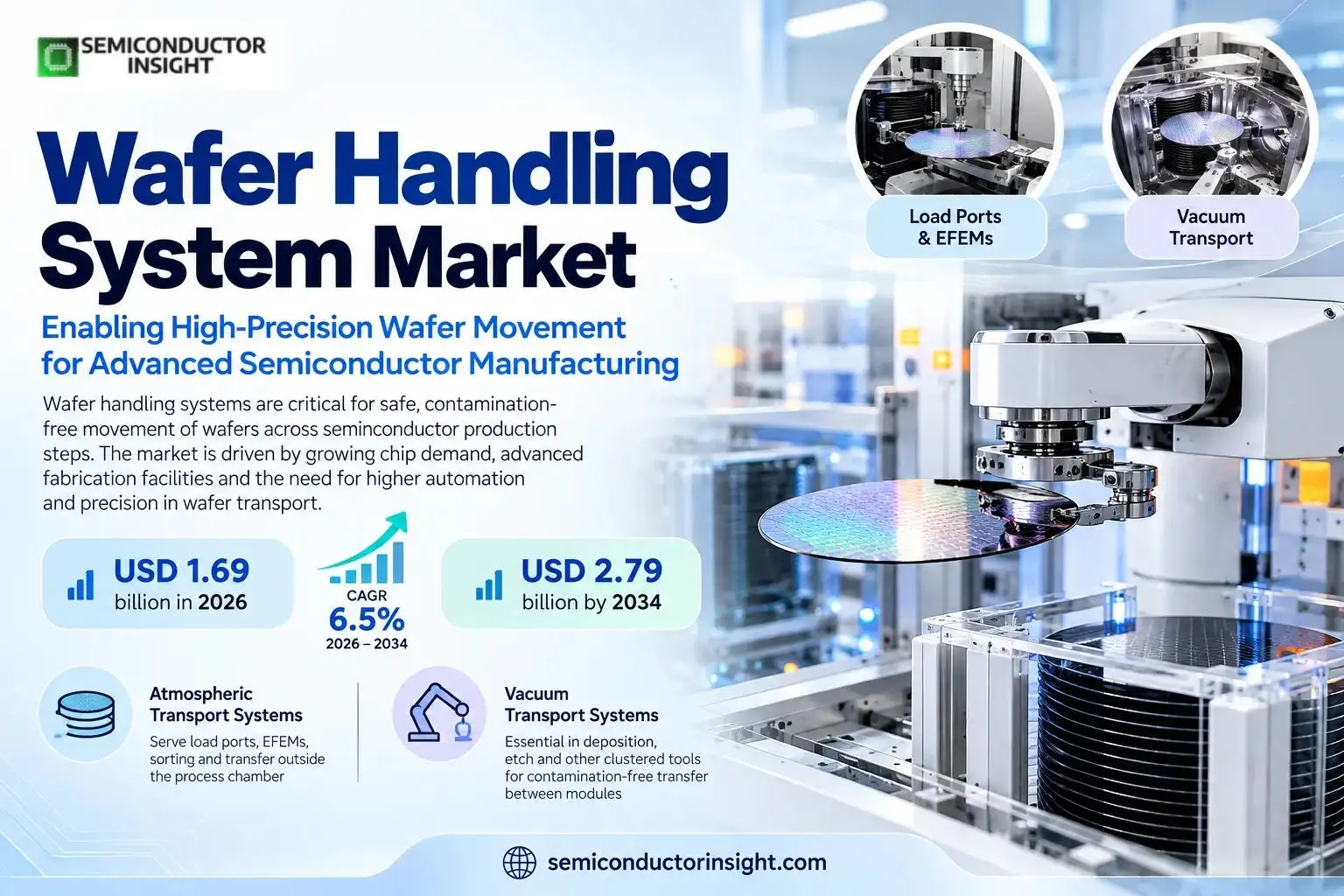
Wafer handling system market is valued at USD 1.59 billion in 2025 and is projected to reach USD 2.79 billion by 2034, expanding at a 6.5% CAGR during 2026–2034. The 2026 market level is USD 1.69 billion. Asia Pacific leads because it contains the world’s largest concentration of 300mm fabs and front-end equipment investment. Demand rises with new logic, memory and power capacity and with the need for contamination-controlled automation around every process step.
Wafer handling systems automate the transfer, alignment, buffering and sorting of semiconductor wafers between carriers and process chambers. Atmospheric systems include EFEMs, load ports, aligners and clean robots, while vacuum transport systems move wafers between chambers without breaking controlled process conditions. Accuracy, particle generation, throughput, wafer edge protection and software integration directly affect fab yield and tool productivity.
RORZE’s current portfolio illustrates the breadth of modern wafer automation, spanning atmospheric robots, vacuum robots, aligners, load ports, EFEMs, sorters and stockers. Its 300mm atmospheric robots specify ISO Class 1 cleanliness and ±0.1mm transfer accuracy, showing how commercial systems combine precision motion with ultra-clean operation. Commercial decisions in the Wafer Handling System market also depend on qualification history, integration effort, operating reliability, lifecycle support and measurable system-level value.
Wafer handling is purchased as part of semiconductor process tools and factory automation rather than as an isolated robot market. Tool OEMs and fabs evaluate reliability, mean time between failure, carrier compatibility, wafer-map integration, SEMI standards and service response. Because a handling failure can stop a high-value process chamber, proven field reliability is a major competitive barrier.
Segment Analysis: By Type
By type, the market is segmented into atmospheric and vacuum transport systems. Atmospheric systems serve load ports, EFEMs, sorting and transfer outside the process chamber and therefore represent the larger installed base. Vacuum systems are more specialized but essential in deposition, etch and other clustered tools where wafers must move between modules without exposure to ambient contamination.
| Type | Commercial role |
|---|---|
| Atmospheric Transport Systems | EFEMs, aligners, sorters and clean robots operating around process tools. |
| Vacuum Transport Systems | Vacuum robots and platforms transferring wafers between process chambers. |
Additional Segmentation: By Equipment Module
Equipment modules include atmospheric robots, vacuum robots, aligners, load ports and EFEM/sorter systems. Fabs increasingly prefer integrated modules that simplify tool qualification and factory automation. Double-arm robots improve throughput, aligners reduce placement error, and load ports connect FOUPs with process equipment and overhead transport systems. Commercial decisions in the Wafer Handling System market also depend on qualification history, integration effort, operating reliability, lifecycle support and measurable system-level value.
| Equipment Module | Demand characteristics |
|---|---|
| Atmospheric Robot | Clean-room transfer around EFEMs and front-end process tools. |
| Vacuum Robot | Wafer transfer inside cluster tools and vacuum platforms. |
| Aligner | Orientation and centering before downstream processing. |
| Load Port | FOUP/FOSB interface between factory logistics and equipment. |
| EFEM / Sorter | Integrated front-end handling, mapping and sorting. |
Segment Analysis: By Application
By application, 300mm wafer handling is the largest value segment because advanced logic, DRAM, NAND and many power fabs operate on 300mm substrates. 200mm remains important for analog, MEMS, RF and mature-node power devices, while other wafer sizes serve specialty compound semiconductor, research and legacy production. Commercial decisions in the Wafer Handling System market also depend on qualification history, integration effort, operating reliability, lifecycle support and measurable system-level value.
| Application | Demand characteristics |
|---|---|
| 200mm Wafer Size | Analog, MEMS, RF, specialty and mature-node semiconductor production. |
| 300mm Wafer Size | Advanced logic, foundry, DRAM, NAND, image sensors and growing power applications. |
| Others | 150mm and specialty wafer formats including compound semiconductor lines. |
Additional Segmentation: By End User
End-user demand is concentrated in foundries, memory fabs, logic/IDM operations and power or analog facilities. Foundry and memory customers drive the largest 300mm spending cycles, while power and analog manufacturers increasingly automate mature-node lines. Different end users prioritize throughput, particle control, flexibility and wafer-size support differently. Commercial decisions in the Wafer Handling System market also depend on qualification history, integration effort, operating reliability, lifecycle support and measurable system-level value.
| End User | Commercial relevance |
|---|---|
| Foundry | High-volume logic and specialty manufacturing with extensive tool automation. |
| Memory | DRAM and 3D NAND fabs with high wafer movement and large 300mm capacity. |
| Logic / IDM | Microprocessor, MCU and mixed-signal manufacturing. |
| Power & Analog | Mature-node and expanding 300mm power semiconductor production. |
Regional Analysis
Asia Pacific is the dominant region because Taiwan, South Korea, China and Japan contain the majority of global 300mm capacity. North America and Europe are increasing fab investment through regionalization programs, while other regions remain smaller but benefit from new semiconductor projects. Commercial decisions in the Wafer Handling System market also depend on qualification history, integration effort, operating reliability, lifecycle support and measurable system-level value.
Why does regional demand differ across the Wafer Handling System market?
Regional demand follows new fab construction and equipment spending rather than end-electronics consumption. SEMI’s Q3 2026 outlook projects record global 300mm front-end spending of USD 149 billion in 2026. Asia remains the largest equipment market, while U.S. and European investments are improving geographic diversification. Commercial decisions in the Wafer Handling System market also depend on qualification history, integration effort, operating reliability, lifecycle support and measurable system-level value.
| Region | Position | Demand profile | Supplier-selection factor |
|---|---|---|---|
| Asia Pacific | Largest / fastest | Foundry, memory, logic | Fab concentration and equipment spending |
| North America | High-growth | Logic, foundry, analog | Regionalization and new fabs |
| Europe | Strategic | Power, automotive, specialty | Industrial policy and electrification |
| South America | Emerging | Limited semiconductor production | Small local fab base |
| Middle East & Africa | Emerging | New semiconductor initiatives | Greenfield opportunities |
Competitive Landscape
RORZE, Brooks Automation, DAIHEN, Hirata, Sinfonia Technology, Nidec/Genmark, JEL and other automation specialists compete through transfer speed, particle performance, installed-base reliability and integration with process-tool OEMs. The underlying market evidence indicates the top ten suppliers hold more than 80% share. Commercial decisions in the Wafer Handling System market also depend on qualification history, integration effort, operating reliability, lifecycle support and measurable system-level value.
RORZE differentiates through a broad modular portfolio and clean-room precision. Its RR759 atmospheric robot supports 300mm wafers, double arms and ISO Class 1 cleanliness, while its ACE Sorter integrates robots, aligners, tracks and load ports for higher throughput. Commercial decisions in the Wafer Handling System market also depend on qualification history, integration effort, operating reliability, lifecycle support and measurable system-level value.
Competitive advantage is strengthened by service infrastructure. Semiconductor fabs cannot tolerate long automation downtime, so global spare-parts availability, field engineering and compatibility with factory automation protocols are as important as robot specifications. Commercial decisions in the Wafer Handling System market also depend on qualification history, integration effort, operating reliability, lifecycle support and measurable system-level value.
| Competitive tier | Representative companies | Primary differentiation |
|---|---|---|
| Global automation leaders | RORZE, Brooks Automation, DAIHEN | Broad wafer-handling platforms and global tool-OEM relationships. |
| Japanese equipment specialists | Hirata, Sinfonia, JEL | Precision robotics, aligners and front-end modules. |
| Regional / specialty suppliers | Nidec Genmark, Cymechs, RND and Asian vendors | Application-specific robots and competitive regional support. |
Key companies profiled
RORZE, Brooks Automation, DAIHEN, Hirata, Sinfonia Technology, Nidec/Genmark, JEL, Cymechs, Robots and Design, RAONTEC and other wafer automation suppliers are included in the competitive scope. Supplier positions vary by atmospheric versus vacuum handling, wafer size and OEM qualification. Commercial decisions in the Wafer Handling System market also depend on qualification history, integration effort, operating reliability, lifecycle support and measurable system-level value.
Production Capacity Analysis
Capacity depends on precision motion components, clean-room assembly, robot calibration, controller electronics and factory acceptance testing. Unlike commodity robotics, semiconductor wafer handlers must meet contamination and repeatability specifications that require dedicated clean manufacturing and metrology. Commercial decisions in the Wafer Handling System market also depend on qualification history, integration effort, operating reliability, lifecycle support and measurable system-level value.
Global 300mm fab spending is the main leading indicator for demand. SEMI’s Q3 2026 outlook projects USD 149 billion of front-end 300mm equipment spending in 2026, up 31% year over year, providing a strong equipment-cycle backdrop for handling-system suppliers. Commercial decisions in the Wafer Handling System market also depend on qualification history, integration effort, operating reliability, lifecycle support and measurable system-level value.
Market Dynamics
The market is driven by semiconductor fab expansion, 300mm adoption, automation and contamination control. Growth is restrained by fab-cycle volatility, high qualification requirements and customer concentration. Smarter predictive maintenance, integrated EFEMs and advanced handling for thin or warped wafers offer the strongest opportunities. Commercial decisions in the Wafer Handling System market also depend on qualification history, integration effort, operating reliability, lifecycle support and measurable system-level value.
Market Drivers
| Driver | Impact | Commercial mechanism |
|---|---|---|
| 300mm fab expansion | High | More fab tools require more load ports, robots and EFEMs. |
| Advanced-node automation | High | Smaller geometries demand lower particle exposure and tighter positioning. |
| Memory investment | Medium-High | DRAM and NAND fabs move very high wafer volumes. |
| Thin and advanced wafers | Medium | New packaging and power processes create harder handling challenges. |
300mm fab expansion
Each new process tool includes front-end and internal wafer transfer. Rising 300mm equipment spending therefore creates direct demand for handling systems. Commercial decisions in the Wafer Handling System market also depend on qualification history, integration effort, operating reliability, lifecycle support and measurable system-level value. Buyers therefore evaluate technical performance together with manufacturability, supply continuity and the cost of maintaining the solution across its intended service life.
Advanced-node automation
As device dimensions shrink, wafer handling must minimize particles, edge contact and vibration because small defects can destroy high-value die. Commercial decisions in the Wafer Handling System market also depend on qualification history, integration effort, operating reliability, lifecycle support and measurable system-level value. Buyers therefore evaluate technical performance together with manufacturability, supply continuity and the cost of maintaining the solution across its intended service life.
Memory investment
Memory lines require large fleets of automated equipment and often run at high utilization, making transfer speed and uptime commercially important. Commercial decisions in the Wafer Handling System market also depend on qualification history, integration effort, operating reliability, lifecycle support and measurable system-level value. Buyers therefore evaluate technical performance together with manufacturability, supply continuity and the cost of maintaining the solution across its intended service life.
Thin and advanced wafers
Thinner, warped or specialty wafers require adaptive gripping, mapping and motion control, creating premium automation opportunities. Commercial decisions in the Wafer Handling System market also depend on qualification history, integration effort, operating reliability, lifecycle support and measurable system-level value. Buyers therefore evaluate technical performance together with manufacturability, supply continuity and the cost of maintaining the solution across its intended service life.
Market Restraints
| Restraint | Impact | Commercial consequence |
|---|---|---|
| Fab-cycle volatility | High | Equipment demand rises and falls with semiconductor capital spending. |
| Qualification barriers | Medium-High | Process-tool OEMs require long reliability validation. |
| Customer concentration | Medium | A limited number of tool OEMs and fabs control large order volumes. |
| Service complexity | Medium | Installed systems require rapid global support. |
Fab-cycle volatility
Handling-system orders can change quickly when fabs delay construction or process-tool purchases, creating utilization swings for suppliers. Commercial decisions in the Wafer Handling System market also depend on qualification history, integration effort, operating reliability, lifecycle support and measurable system-level value. Buyers therefore evaluate technical performance together with manufacturability, supply continuity and the cost of maintaining the solution across its intended service life.
Qualification barriers
A new robot or load port must prove particle, accuracy and uptime performance before broad deployment, slowing supplier entry. Commercial decisions in the Wafer Handling System market also depend on qualification history, integration effort, operating reliability, lifecycle support and measurable system-level value. Buyers therefore evaluate technical performance together with manufacturability, supply continuity and the cost of maintaining the solution across its intended service life.
Customer concentration
Losing one major platform qualification can materially affect revenue for a specialist supplier. Commercial decisions in the Wafer Handling System market also depend on qualification history, integration effort, operating reliability, lifecycle support and measurable system-level value. Buyers therefore evaluate technical performance together with manufacturability, supply continuity and the cost of maintaining the solution across its intended service life.
Service complexity
Downtime can idle expensive process equipment, so suppliers need local engineering and spare-parts coverage near major fabs. Commercial decisions in the Wafer Handling System market also depend on qualification history, integration effort, operating reliability, lifecycle support and measurable system-level value. Buyers therefore evaluate technical performance together with manufacturability, supply continuity and the cost of maintaining the solution across its intended service life.
Market Opportunities
Predictive maintenance
Sensor and motion data can identify wear before failure, reducing unplanned downtime and improving fab utilization. Commercial decisions in the Wafer Handling System market also depend on qualification history, integration effort, operating reliability, lifecycle support and measurable system-level value. Buyers therefore evaluate technical performance together with manufacturability, supply continuity and the cost of maintaining the solution across its intended service life.
Integrated EFEM platforms
Combining load ports, robots, aligners and controls can simplify tool design and qualification. Commercial decisions in the Wafer Handling System market also depend on qualification history, integration effort, operating reliability, lifecycle support and measurable system-level value. Buyers therefore evaluate technical performance together with manufacturability, supply continuity and the cost of maintaining the solution across its intended service life.
Advanced packaging handling
Thin wafers, glass carriers and bonded stacks create new motion and end-effector requirements. Commercial decisions in the Wafer Handling System market also depend on qualification history, integration effort, operating reliability, lifecycle support and measurable system-level value. Buyers therefore evaluate technical performance together with manufacturability, supply continuity and the cost of maintaining the solution across its intended service life.
Regional fab construction
New U.S. and European fabs create opportunities for local service, integration and supplier diversification. Commercial decisions in the Wafer Handling System market also depend on qualification history, integration effort, operating reliability, lifecycle support and measurable system-level value. Buyers therefore evaluate technical performance together with manufacturability, supply continuity and the cost of maintaining the solution across its intended service life.
Supply Chain Analysis
Components. Servo or stepper motors, encoders, bearings, end effectors, sensors and controllers form the motion platform. Materials must minimize particles and outgassing. Commercial decisions in the Wafer Handling System market also depend on qualification history, integration effort, operating reliability, lifecycle support and measurable system-level value. Buyers therefore evaluate technical performance together with manufacturability, supply continuity and the cost of maintaining the solution across its intended service life.
Assembly. Robots and modules are assembled and calibrated in clean environments. Transfer accuracy, vibration and cleanliness are verified before shipment. Commercial decisions in the Wafer Handling System market also depend on qualification history, integration effort, operating reliability, lifecycle support and measurable system-level value. Buyers therefore evaluate technical performance together with manufacturability, supply continuity and the cost of maintaining the solution across its intended service life.
Integration. Process-tool OEMs combine handlers with chambers, load ports and software. SEMI-standard communications and safety interlocks are validated during qualification. Commercial decisions in the Wafer Handling System market also depend on qualification history, integration effort, operating reliability, lifecycle support and measurable system-level value. Buyers therefore evaluate technical performance together with manufacturability, supply continuity and the cost of maintaining the solution across its intended service life.
Deployment. Fabs integrate equipment with FOUP logistics and overhead transport. Maintenance data and spare-parts support are essential to protect tool uptime. Commercial decisions in the Wafer Handling System market also depend on qualification history, integration effort, operating reliability, lifecycle support and measurable system-level value. Buyers therefore evaluate technical performance together with manufacturability, supply continuity and the cost of maintaining the solution across its intended service life.
Recent Developments in the Wafer Handling System Market
Developments tracked through September 2026 and limited to events that materially affect technology, capacity, adoption or competition.
- Q3 2026
SEMI’s current 300mm Fab Outlook projects global front-end fab equipment spending of USD 149 billion in 2026, up 31% year over year, driven by AI, logic and memory investment. Source - 2026 Current Portfolio
RORZE continues offering wafer handling systems spanning atmospheric and vacuum robots, aligners, load ports, EFEM/sorters and stockers for semiconductor automation. Source - 2026 Product Specification
RORZE’s RR759 300mm atmospheric robot combines double-arm transfer, ±0.1mm accuracy and ISO Class 1 cleanliness for high-throughput wafer movement. Source
Report Scope & Segmentation
| Attribute | Scope |
|---|---|
| Base year | 2025 |
| Estimated year | 2026 |
| Forecast period | 2026–2034 |
| 2025 market size | USD 1.59 billion |
| 2026 estimated size | USD 1.69 billion |
| 2034 projected size | USD 2.79 billion |
| CAGR (2026–2034) | 6.5% |
| Largest market in 2025 | Asia Pacific |
| By Type | Atmospheric Transport Systems; Vacuum Transport Systems |
| By Application | 200mm Wafer Size; 300mm Wafer Size; Others |
| By Equipment Module | Atmospheric Robot; Vacuum Robot; Aligner; Load Port; EFEM/Sorter |
| By End User | Foundry; Memory; Logic/IDM; Power & Analog |
| Companies profiled | RORZE; Brooks Automation; DAIHEN; Hirata; Sinfonia Technology; Nidec/Genmark; JEL and others |
Frequently Asked Questions
What is the wafer handling system market size in 2025?
The global market is valued at USD 1.59 billion in 2025.
What is the market forecast for 2034?
The market is projected to reach USD 2.79 billion by 2034, representing a 6.5% CAGR during 2026–2034. The 2026 market level is USD 1.69 billion.
Which region leads the market?
Asia Pacific leads because it contains the largest concentration of semiconductor fabs and equipment investment.
Which type is largest?
Atmospheric transport systems are the largest type because EFEMs, sorters and clean robots are used around most process tools.
Which wafer size drives demand?
300mm wafer applications drive the highest value growth across foundry, logic and memory fabs.
Who are the major suppliers?
RORZE, Brooks Automation, DAIHEN, Hirata, Sinfonia, Nidec/Genmark and JEL are important suppliers.
Why is cleanliness important?
Particles introduced during wafer transfer can reduce semiconductor yield, especially at advanced process nodes.
What limits market growth?
Fab-cycle volatility, long qualification cycles, customer concentration and service complexity are the main restraints.
How does AI affect demand?
AI chip and memory investment increases 300mm fab construction and equipment purchases, indirectly raising handling-system demand.
What will drive growth through 2034?
300mm fabs, advanced packaging, predictive maintenance and regional semiconductor capacity expansion will support growth.
Research Sources & Evidence Base
View research sources used in this market overview
- SEMI — 300mm Fab Outlook Q3 2026. Current 300mm spending and capacity outlook.
- RORZE — Wafer Handling System Portfolio. Current atmospheric, vacuum, alignment, load-port and EFEM product categories.

Get Sample Report PDF for Exclusive Insights
Report Sample Includes
- Table of Contents
- List of Tables & Figures
- Charts, Research Methodology, and more...
 Download Sample Report PDF