
Key Statistics
Key Takeaways
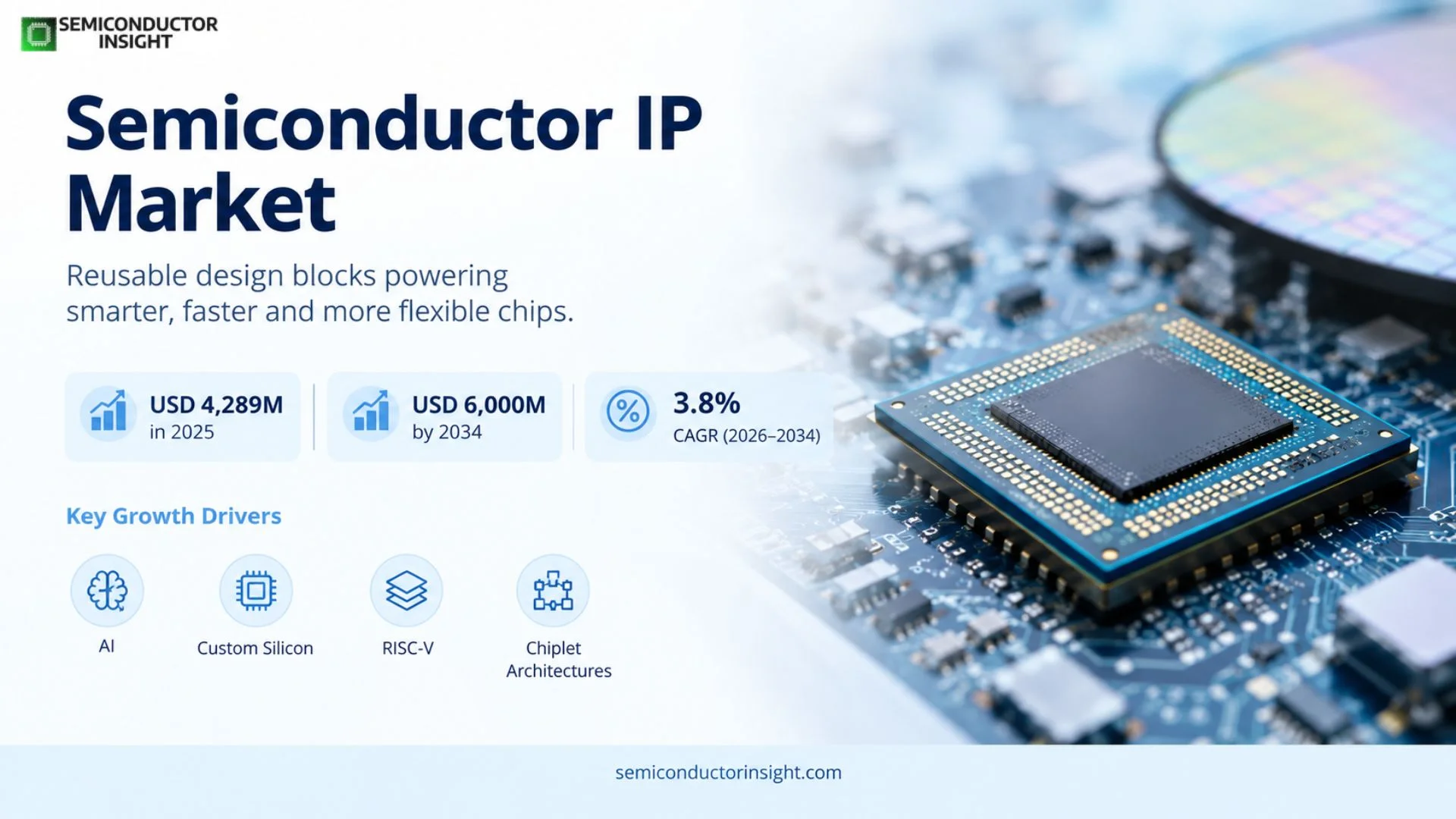
- Market size: The market stands at USD 4,289 million in 2025 and is projected to reach USD 6,000 million by 2034, representing a 3.8% CAGR across 2026–2034.
- Processor IP is the strategic center of the market, while interface and memory IP become more valuable as SoCs integrate chiplets, high-speed links, AI accelerators and increasingly complex memory hierarchies.
- North America holds the leading quantified regional position, supported by Arm, Synopsys, Cadence, Rambus and a dense ecosystem of fabless semiconductor and cloud-computing customers.
- RISC-V is widening architectural choice as automotive, AI and embedded developers adopt open-standard processor architectures alongside established proprietary IP ecosystems.
- Chiplet and subsystem approaches are changing the unit of sale, shifting customer value from isolated reusable blocks toward pre-integrated compute, interconnect and system IP.
Semiconductor IP Market Overview
Semiconductor IP Market is valued at USD 4,289 million in 2025 and is projected to reach USD 6,000 million by 2034, expanding at a 3.8% CAGR during 2026–2034. The 2026 market level is USD 4,452 million. North America holds the strongest quantified regional position, while Asia Pacific is the fastest ecosystem expansion area because chip design, electronics manufacturing and automotive semiconductor programs are scaling rapidly. AI, custom silicon, chiplets and RISC-V are increasing both the number of reusable blocks per design and the value of verified subsystem-level IP.
Semiconductor intellectual property consists of reusable, licensable design blocks used to build SoCs, ASICs, ASSPs and other integrated circuits. Processor cores, interface controllers, memory compilers, security engines and interconnect blocks allow design teams to avoid recreating proven functions from first principles. Commercial value comes from verified RTL or physical implementations, documentation, software enablement, process-node portability and support that shorten design cycles while reducing technical risk.
The technology model is moving beyond standalone IP cores. Complex chips increasingly combine CPUs, accelerators, coherent fabrics, high-speed interfaces and memory controllers that must be verified together. Arm Compute Subsystems illustrate this shift by packaging CPU, interconnect, system IP and firmware into pre-integrated platforms, while chiplet architectures increase demand for reusable die-to-die interfaces and physical IP. RISC-V adds another competitive dimension by enabling processor customization around an open instruction-set standard.
The commercial model mixes upfront license fees, per-unit royalties, maintenance, support and engineering services. The economics differ sharply by IP class: a widely deployed processor architecture can generate long royalty tails, while interface or physical IP may be licensed for a specific process node and tape-out. Customer willingness to pay depends on verification maturity, ecosystem support, PPA results, functional-safety or security evidence and the cost of schedule delay if an internal design fails.
Segment Analysis: By Type
By type, the market is segmented into Processor IP, Interface IP, Memory IP and Other IP. Processor IP anchors system architecture and software compatibility, while Interface IP is gaining strategic value as chips use PCIe, CXL, Ethernet, UCIe and other high-speed standards. Memory IP supports embedded SRAM, controllers and memory subsystems, and the Other IP category includes security, interconnect, analog and specialized accelerator blocks.
| Type | Technical / commercial role | Market position |
|---|---|---|
| Processor IP | CPU, DSP, NPU and microcontroller architectures licensed for integration into SoCs. | Strategic segment supported by Arm and expanding RISC-V adoption across embedded, automotive and AI designs. |
| Interface IP | Controllers and PHYs for PCIe, CXL, Ethernet, USB, DDR, UCIe and other standards. | High-growth value area as chiplets and high-bandwidth system connectivity become more complex. |
| Memory IP | Memory compilers, controllers and embedded-memory interfaces. | Essential for dense SoCs where area, speed, yield and process-node tuning matter. |
| Other IP | Security, interconnect, analog, verification and specialized functional blocks. | Fragmented but commercially important where certified or differentiated functionality reduces design risk. |
Additional Segmentation: By Licensing Model
Licensing models divide revenue into upfront license arrangements, royalty-based agreements and subscription or support structures. Large processor platforms often combine initial access with production royalties, while physical and interface IP may be licensed by node, project or implementation. Subscription and long-term support become more important when customers need continuous updates, security maintenance, software enablement and migration across process generations.
| Licensing Model | Demand characteristics |
|---|---|
| Upfront License | Project or portfolio access paid before implementation; common where a customer needs defined IP rights for a tape-out. |
| Royalty-Based | Per-device or per-unit fees align supplier economics with customer production volume and can create long revenue tails. |
| Subscription & Support | Recurring access, updates, maintenance, software and engineering support for multi-project or platform use. |
Segment Analysis: By Application
By application, consumer electronics and telecom remain large installed markets, while automotive and AI-oriented infrastructure are increasing specification intensity. Aerospace and healthcare place greater emphasis on reliability, security and lifecycle support. Agriculture and other embedded markets use reusable processor, connectivity and control IP to shorten time to market without carrying the cost of developing proprietary cores.
| Application | Demand characteristics |
|---|---|
| Consumer Electronics | Mobile, PC, wearables and smart-device SoCs use processor, GPU, interface and memory IP at high design volumes. |
| Telecom | Networking, baseband, edge and infrastructure silicon requires high-speed interfaces, processor subsystems and security IP. |
| Automotive | Zonal controllers, ADAS and central compute increase demand for safety-capable processors, interfaces and secure subsystem IP. |
| Aerospace | Long-life and mission-critical designs prioritize verification, reliability and controlled configuration. |
| Healthcare | Imaging, diagnostics and wearable devices use low-power compute, signal processing and security functions. |
| Agriculture & Others | Industrial and edge systems benefit from reusable connectivity, control and embedded processor blocks. |
Additional Segmentation: By Integration Model
IP is also differentiated by how closely the licensed block is tied to implementation. Soft IP is delivered in synthesizable RTL and offers maximum portability, firm IP adds implementation guidance or partially optimized netlists, and hard IP is delivered as a process-specific physical block. The trade-off is flexibility versus predictability: hard IP can reduce timing and analog risk, while soft IP gives designers more freedom to optimize for a chosen foundry flow.
| Integration Model | Commercial relevance |
|---|---|
| Soft IP | Synthesizable RTL with broad portability and customer-controlled implementation. |
| Firm IP | Partially constrained or optimized implementation that balances portability with predictable results. |
| Hard IP | Process-specific physical layout or macro with tightly characterized performance and area. |
Regional Analysis
North America has the strongest quantified regional base because major IP vendors and fabless customers are concentrated in the United States. Asia Pacific is expanding through mobile, automotive, consumer and AI chip design in China, Taiwan, South Korea, Japan and India. Europe has strong automotive, industrial and processor-design activity, while South America and the Middle East & Africa remain smaller design markets with selective sovereign and embedded-computing initiatives.
Why does regional demand differ across the Semiconductor IP market?
Regional demand depends on where chips are designed and licensed rather than where wafers are physically fabricated. A U.S. cloud company can license processor and interface IP for a design manufactured in Taiwan, while a European automotive supplier may license a safety processor for production in Asia. North America therefore benefits from design concentration, Asia Pacific from a growing fabless and electronics ecosystem, and Europe from automotive and industrial specialization.
| Region | Position | Growth outlook | Demand profile | Supplier selection |
|---|---|---|---|---|
| Asia Pacific | Major | High | Manufacturing, design and end-market demand | Qualification, local support and scale |
| North America | Largest | High | Technology development and premium demand | Engineering support and platform access |
| Europe | Strategic | Steady-high | Automotive, industrial and specialty applications | Reliability, lifecycle and compliance |
| South America | Emerging | Moderate | Imported technology and project-led demand | Price, availability and distributor support |
| Middle East & Africa | Emerging | Selective | Infrastructure, research and premium applications | Project access and technical support |
Competitive Landscape
Arm, Synopsys and Cadence occupy broad positions across processor, interface, physical and system IP, while Imagination, CEVA, VeriSilicon, eMemory and Rambus specialize in graphics, DSP, platform, memory and high-speed interface technologies. Competitive advantage is built on silicon-proven implementations, ecosystem support and the number of foundry nodes for which an IP block has already been validated.
Open-standard RISC-V changes competition without eliminating commercial IP economics. Vendors can license verified RISC-V cores, subsystems, safety packages and software even though the ISA itself is open. This expands architectural choice for customers and pushes proprietary vendors to compete more aggressively on software, subsystem integration, verification, roadmap continuity and time to market.
Competition also depends on design-in durability. Once a IP core is qualified inside a customer platform or manufacturing flow, substitution can require engineering work, validation and supply-chain changes. That gives incumbents recurring revenue but also creates opportunity for suppliers that solve a new performance, integration or cost problem. The market therefore rewards sustained R&D, customer support and clear product roadmaps rather than one-time specification advantages.
| Competitive tier | Representative companies | Primary differentiation |
|---|---|---|
| Broad platform and processor IP | Arm, Synopsys, Cadence | Processor/subsystem, interface, physical and system IP with broad foundry support. |
| Specialized compute and multimedia IP | Imagination Technologies, CEVA, VeriSilicon | GPU, DSP, NPU, multimedia and platform IP optimized for specific workloads. |
| Memory, interface and security specialists | Rambus, eMemory Technology, Lattice/Silicon Image, Sonics | High-speed interface, embedded memory, interconnect and specialized reusable blocks. |
Key companies profiled
ARM, Synopsys, Imagination Technologies, Cadence, CEVA, VeriSilicon, eMemory Technology, Rambus, Lattice/Silicon Image and Sonics are included in the competitive scope. Their product responsibilities differ materially, so comparisons should be made by processor architecture, interface standard, process-node support, implementation model and software ecosystem rather than by a single company-wide revenue measure.
Production Capacity Analysis
Semiconductor IP has no factory capacity in the conventional sense, but supplier capacity is constrained by engineering resources, verification infrastructure, software teams and the number of process nodes or foundry platforms supported simultaneously. A new interface or processor block requires architecture, RTL, verification, physical implementation and customer support before it becomes reusable. The scarce resource is therefore validated engineering throughput rather than wafer starts.
Implementation capacity expands when vendors package proven cores into subsystems and reusable platforms. Arm Compute Subsystems demonstrate this shift by delivering pre-integrated compute elements that can reduce customer integration work. Chiplet standards and reusable physical IP can produce a similar effect: more functions arrive verified together, allowing design teams to focus scarce engineers on differentiated accelerators, software and system architecture.
Market Dynamics
The Semiconductor IP market is expanding as AI, custom silicon, RISC-V and chiplet architectures increase the number and strategic value of reusable design blocks. Commercial growth is not determined by unit demand alone: specification complexity, qualification depth, lifecycle support and the value of system-level performance all influence revenue per design. The main counterweight is integration complexity, high license costs, verification risk and long customer qualification cycles can delay adoption. Suppliers that combine technical performance with documented reliability, scalable supply and responsive engineering support are best positioned to convert technology transitions into recurring commercial demand.
Market Drivers
| Driver | Impact | Commercial mechanism |
|---|---|---|
| Custom AI silicon | High | Hyperscalers and semiconductor companies increasingly design workload-specific processors, raising demand for reusable CPU, interface and memory IP. |
| RISC-V ecosystem expansion | High | Open-standard processor adoption creates new commercial opportunities for cores, tools and safety packages. |
| Chiplet and subsystem design | Medium-High | Pre-integrated subsystems reduce verification burden and accelerate complex SoC and multi-die development. |
| Automotive compute | Medium | Software-defined vehicles need reusable safety, security and connectivity IP across long platform lifecycles. |
Custom AI silicon
Custom AI silicon requires high-performance processors, coherent fabrics, memory controllers and high-speed interfaces, but few customers want to design every block internally. Reusable, silicon-proven IP shortens schedules and lets engineering teams concentrate on accelerators and system differentiation. Chiplet architectures further multiply interface and subsystem requirements, expanding the addressable set of licensed blocks per platform.
RISC-V ecosystem expansion
RISC-V lowers architectural barriers while creating a commercial ecosystem around verified cores, software, security, functional safety and implementation support. RISC-V International reported strong 2025 momentum across automotive, data center, HPC and AI. The result is not a zero-price IP market; instead, value shifts toward tested implementations and ecosystem support built around an open instruction set.
Chiplet and subsystem design
As monolithic SoCs become harder to scale economically, designers can reuse validated compute chiplets, die-to-die links and subsystem IP. Arm’s CSS strategy shows how vendors can sell a broader verified platform rather than isolated cores. This increases average value per customer engagement and rewards suppliers with strong integration and physical-design expertise.
Automotive compute
Automotive electronics is moving toward zonal and central compute, increasing demand for processors, interconnect, security and interface IP. Long vehicle lifecycles make software portability and functional-safety evidence especially important. RISC-V’s automotive momentum adds competitive choice, while established Arm and proprietary architectures continue to benefit from mature tools and software. For commercial buyers, the practical decision therefore depends on qualification evidence, system-level performance, lifecycle support and supply continuity rather than a single headline specification.
Market Restraints
| Restraint | Impact | Commercial consequence |
|---|---|---|
| Integration and verification complexity | High | Combining many third-party blocks can create timing, power, interface and functional problems. |
| License and royalty cost | Medium-High | High-value processor and interface IP can be expensive for small design teams or low-volume programs. |
| Process-node dependence | Medium-High | Hard and physical IP must be re-characterized for each foundry process and option set. |
| IP protection and compliance | Medium | Licensing disputes, export controls and security concerns can limit cross-border use. |
Integration and verification complexity
An IP block that works independently can still fail at system level if assumptions about clocks, reset, coherency, memory ordering or physical implementation are incompatible. Verification therefore consumes significant customer engineering resources. Vendors must provide reference designs, validation suites and implementation support to prevent integration risk from offsetting the time savings that motivated licensing.
License and royalty cost
Upfront license fees, royalties and maintenance costs can be difficult for startups and low-volume projects to absorb. Open-source alternatives reduce some entry barriers, but commercial customers still pay for verification, safety evidence, support and implementation quality. Vendors must align pricing with the economic value of avoided engineering effort and faster market entry.
Process-node dependence
Analog, memory and high-speed PHY IP is tightly coupled to device models, metal stacks and foundry design rules. Moving a design to another node can require new characterization or a different macro. This limits portability and creates a continuous R&D burden as customers adopt new process technologies or diversify foundry supply.
IP protection and compliance
Semiconductor IP is transferred digitally and can embed strategically sensitive functionality. Vendors therefore need strong contract controls, encryption, auditing and compliance processes. Geopolitical restrictions can also limit availability of advanced processor or interface technology in some jurisdictions, complicating global customer support and product planning. For commercial buyers, the practical decision therefore depends on qualification evidence, system-level performance, lifecycle support and supply continuity rather than a single headline specification.
Market Opportunities
Pre-integrated compute subsystems
Customers increasingly value verified combinations of CPU, interconnect, memory and system IP. Suppliers can increase revenue per design while reducing customer integration effort by delivering configurable subsystem platforms with software, physical implementation guidance and reference validation. For commercial buyers, the practical decision therefore depends on qualification evidence, system-level performance, lifecycle support and supply continuity rather than a single headline specification.
UCIe and chiplet connectivity
Multi-die systems need standardized die-to-die interfaces, controller IP, PHYs and management logic. Vendors with silicon-proven UCIe, CXL and coherent interconnect portfolios can participate in AI accelerators, networking and custom compute platforms without owning the full processor architecture. For commercial buyers, the practical decision therefore depends on qualification evidence, system-level performance, lifecycle support and supply continuity rather than a single headline specification.
Automotive RISC-V safety IP
RISC-V adoption in automotive creates demand for certifiable processor cores, lockstep features, security, virtualization, software and verification. Suppliers that package these capabilities with long lifecycle support can address zonal controllers and central compute while preserving the openness of the ISA. For commercial buyers, the practical decision therefore depends on qualification evidence, system-level performance, lifecycle support and supply continuity rather than a single headline specification.
AI-enabled design automation around IP
IP vendors can combine reusable blocks with automated configuration, verification and implementation assistance. This reduces customer engineering time, improves design consistency and makes larger IP portfolios easier to adopt across many derivative SoCs. For commercial buyers, the practical decision therefore depends on qualification evidence, system-level performance, lifecycle support and supply continuity rather than a single headline specification.
Supply Chain Analysis
Architecture. Vendors define processor, interface, memory or subsystem functionality around standards, customer roadmaps and target workloads. Decisions at this stage determine software compatibility, performance targets and the degree of configurability available to licensees. Standards bodies and ecosystem partners influence interfaces that must remain interoperable across multiple generations. For commercial buyers, the practical decision therefore depends on qualification evidence, system-level performance, lifecycle support and supply continuity rather than a single headline specification.
Design and verification. RTL, analog design, physical implementation and verification convert the architecture into licensable IP. Extensive regression testing, formal methods and silicon correlation are required because one defect can propagate into many customer chips. Documentation and software are part of the product, not secondary deliverables. For commercial buyers, the practical decision therefore depends on qualification evidence, system-level performance, lifecycle support and supply continuity rather than a single headline specification.
Platform validation. Physical and hard IP must be characterized on specific foundry nodes, while processor and interface IP is often optimized for target processes. Silicon test chips, foundry certification and PPA benchmarking reduce customer risk and make a block easier to select during architecture planning. For commercial buyers, the practical decision therefore depends on qualification evidence, system-level performance, lifecycle support and supply continuity rather than a single headline specification.
Customer integration. Licensees combine multiple blocks into SoCs or chiplets, then add software, verification and physical implementation. Vendor field engineers remain involved through tape-out and bring-up. Successful production creates royalties, support revenue and a reference design that can strengthen future licensing. For commercial buyers, the practical decision therefore depends on qualification evidence, system-level performance, lifecycle support and supply continuity rather than a single headline specification.
Recent Developments in the Semiconductor IP Market
Developments tracked through September 2026. Entries are limited to events that materially affect product capability, manufacturing capacity, customer adoption, channel access or the competitive structure of the market.
- 18 November 2025
Arm highlighted its Lumex Compute Subsystems platform across its 2025 ecosystem events, combining CPU, GPU and system technologies for AI-oriented client designs. The subsystem model reinforces a broader shift from isolated cores toward pre-integrated reusable compute platforms. Source - 6 October 2025
Arm described chiplet-based Compute Subsystems and Chiplet System Architecture as a route for a wider group of companies to develop custom AI silicon. The approach increases commercial demand for reusable compute, interconnect and physical IP that can be integrated across multi-die systems. Source - 2025 Annual Report
RISC-V International reported new members and broader adoption across AI, automotive, data center, HPC, embedded and space markets. The expanding open-standard ecosystem increases competition and creates demand for commercial cores, verification, safety and software around RISC-V implementations. Source
Report Scope & Segmentation
| Attribute | Scope |
|---|---|
| Base year | 2025 |
| Estimated year | 2026 |
| Forecast period | 2026–2034 |
| 2025 market size | USD 4,289 million |
| 2026 estimated size | USD 4,452 million |
| 2034 projected size | USD 6,000 million |
| CAGR (2026–2034) | 3.8% |
| Largest market in 2025 | North America |
| By Type | Processor IP; Interface IP; Memory IP; Other IP |
| By Application | Consumer Electronics; Telecom; Automotive; Aerospace; Healthcare; Agriculture; Others |
| By Licensing Model | Upfront License; Royalty-Based; Subscription & Support |
| By Integration Model | Soft IP; Firm IP; Hard IP |
| Companies profiled | ARM; Synopsys; Imagination Technologies; Cadence; CEVA; VeriSilicon; eMemory Technology; Rambus; Lattice/Silicon Image; Sonics |
Frequently Asked Questions
What is the semiconductor IP market size in 2025?
The global semiconductor IP market is valued at USD 4,289 million in 2025. The market covers reusable processor, interface, memory and other design IP licensed for SoCs, ASICs and related integrated circuits. For commercial buyers, the practical decision therefore depends on qualification evidence, system-level performance, lifecycle support and supply continuity rather than a single headline specification.
What is the semiconductor IP market forecast for 2034?
The market is projected to reach USD 6,000 million by 2034, representing a 3.8% CAGR during 2026–2034. The corresponding 2026 market level is USD 4,452 million. For commercial buyers, the practical decision therefore depends on qualification evidence, system-level performance, lifecycle support and supply continuity rather than a single headline specification.
Which region leads the semiconductor IP market?
North America holds the strongest quantified regional position, supported by major IP vendors and a dense base of fabless semiconductor, cloud, networking and custom-silicon customers. For commercial buyers, the practical decision therefore depends on qualification evidence, system-level performance, lifecycle support and supply continuity rather than a single headline specification. The commercial implication is that buyers evaluate the complete operating and supply context, including validation history, integration effort, reliability, roadmap continuity, technical support and the cost of disruption over the full product lifecycle.
What is semiconductor IP?
Semiconductor IP is reusable design content such as processor cores, interface controllers, memory macros and security blocks that chip designers license instead of developing every function internally. For commercial buyers, the practical decision therefore depends on qualification evidence, system-level performance, lifecycle support and supply continuity rather than a single headline specification.
Which IP type is most strategically important?
Processor IP remains strategically central because it defines software architecture and system behavior, while interface and memory IP are becoming more valuable as chiplets, AI systems and high-speed memory increase integration complexity. For commercial buyers, the practical decision therefore depends on qualification evidence, system-level performance, lifecycle support and supply continuity rather than a single headline specification.
How does RISC-V affect the IP market?
RISC-V expands architectural choice by providing an open instruction set. Commercial vendors can still monetize verified cores, safety features, software, physical implementation and support built around the standard. For commercial buyers, the practical decision therefore depends on qualification evidence, system-level performance, lifecycle support and supply continuity rather than a single headline specification.
Why are chiplets important to semiconductor IP?
Chiplets increase the need for reusable die-to-die interfaces, coherent interconnect, memory controllers and subsystem IP. They also encourage pre-integrated platforms that reduce customer verification and physical-design effort. For commercial buyers, the practical decision therefore depends on qualification evidence, system-level performance, lifecycle support and supply continuity rather than a single headline specification.
What are the main licensing models?
Commercial models include upfront licenses, production royalties and recurring support or subscription arrangements. The mix depends on IP type, project scope, customer volume and the depth of vendor support. For commercial buyers, the practical decision therefore depends on qualification evidence, system-level performance, lifecycle support and supply continuity rather than a single headline specification.
Which companies are included in the competitive scope?
The competitive scope includes Arm, Synopsys, Cadence, Imagination Technologies, CEVA, VeriSilicon, eMemory Technology, Rambus, Lattice/Silicon Image and Sonics. For commercial buyers, the practical decision therefore depends on qualification evidence, system-level performance, lifecycle support and supply continuity rather than a single headline specification. The commercial implication is that buyers evaluate the complete operating and supply context, including validation history, integration effort, reliability, roadmap continuity, technical support and the cost of disruption over the full product lifecycle.
What will drive growth through 2034?
Growth will be driven by custom AI silicon, chiplets, RISC-V, automotive compute and increasingly complex SoCs that require more verified reusable building blocks. Integration cost and process-node support remain key constraints. For commercial buyers, the practical decision therefore depends on qualification evidence, system-level performance, lifecycle support and supply continuity rather than a single headline specification.
Research Sources & Evidence Base
View research sources used in this market overview
- Arm – Arm Compute Subsystems. Subsystem, chiplet and time-to-market evidence.
- Arm Newsroom – Inside the Chiplet Revolution. 2025 chiplet and CSS strategy evidence.
- RISC-V International – RISC-V Annual Report 2025. 2025 ecosystem and adoption milestones.
- RISC-V International – Automotive RISC-V microcontroller family. Automotive processor-IP adoption evidence, March 2025.
Get Sample Report PDF for Exclusive Insights
Report Sample Includes
- Table of Contents
- List of Tables & Figures
- Charts, Research Methodology, and more...
 Download Sample Report PDF


