Thermocompression Bonding (TCB) Market Insights
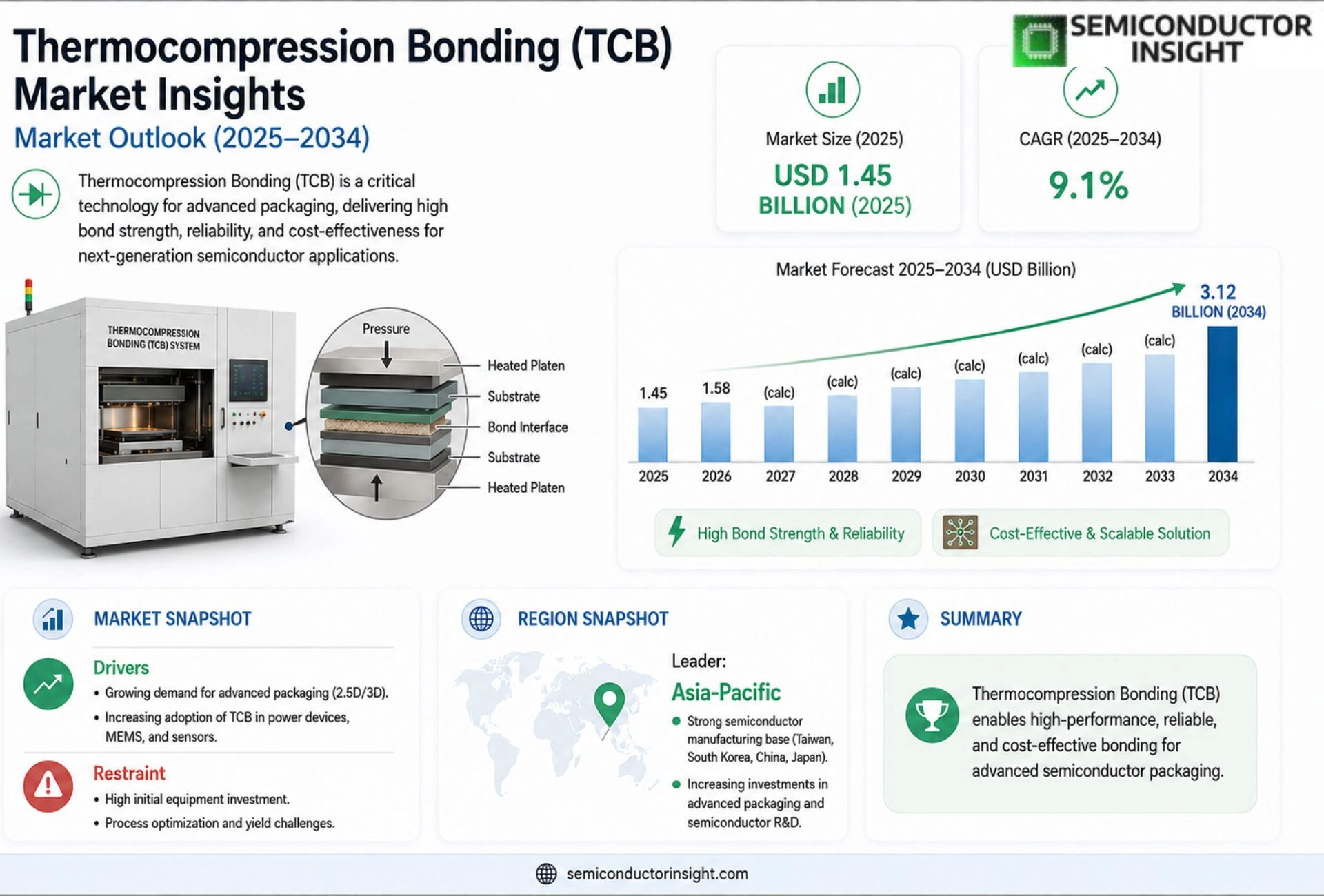
Global Thermocompression Bonding (TCB) market size was valued at USD 1.45 billion in 2025. The market is projected to grow from USD 1.58 billion in 2026 to USD 3.12 billion by 2034, exhibiting a CAGR of 9.1% during the forecast period.
Thermocompression bonding (TCB) is an advanced semiconductor packaging technique that utilizes heat and pressure to form reliable electrical interconnections between chips and substrates without solder. This process is particularly critical for fine-pitch applications, such as flip-chip bonding, 3D IC stacking, and fan-out wafer-level packaging (FOWLP), where traditional solder-based methods face limitations due to shrinking pad sizes and increasing I/O densities. TCB ensures precise alignment, minimal thermal stress, and superior bond strength, making it indispensable in high-performance computing, automotive electronics, and consumer devices requiring miniaturization.
The rapid adoption of heterogeneous integration and the rising demand for high-bandwidth memory (HBM) modules are key drivers propelling the growth of Thermocompression Bonding (TCB) Market. Furthermore, advancements in AI-driven chip designs and the proliferation of 5G infrastructure are accelerating the need for robust interconnect solutions like TCB. Leading industry players, including ASM Pacific Technology, Besi, Kulicke & Soffa Industries, and Toray Engineering, continue to innovate with automated TCB systems that enhance throughput while reducing production costs. As semiconductor nodes advance beyond 3nm, TCB’s role in enabling next-generation packaging solutions will remain pivotal.
MARKET DRIVERS
Increasing Adoption of Advanced Packaging
Thermocompression Bonding (TCB) Market is primarily driven by the rapid evolution of advanced semiconductor packaging technologies. As demand for smaller, faster, and more efficient electronics grows, manufacturers are increasingly turning to TCB as a critical method for interconnecting semiconductor chips. The technology supports flip-chip and wafer-level packaging, which are essential for reducing signal delay and improving overall device performance. This adoption trend is evident across major technology sectors, including consumer electronics and wireless communications.
Rising Electronics Manufacturing in Asia
Geographically, the Asia-Pacific region remains the dominant force in the expansion of Thermocompression Bonding (TCB) Market. Countries such as Taiwan, South Korea, and China host some of the world’s largest foundries and electronic assembly firms. The robust manufacturing ecosystem in these regions, coupled with heavy investment in Research and Development, ensures that TCB technology continues to be integrated into high-volume production lines, further propelling market growth.
➤ The shift towards heterogeneous integration is significantly boosting the need for precise bonding techniques like TCB.
Technological Advancements in Chip Design
Continuous innovation in semiconductor chip design demands better interconnection solutions. The transition to 3D integrated circuits (3D IC) has created a necessity for tools that can handle the complexity of aligning layers with high accuracy. TCB offers the mechanical strength and thermal stability required for these sophisticated structures, making it a preferred choice for next-generation chip fabrication.
Global spending on electronic manufacturing services is projected to reach double-digit growth rates, driven by these continuous technological advancements.
MARKET CHALLENGES
Processing Speed Limitations
One of the primary challenges facing Thermocompression Bonding (TCB) Market is the relatively slow processing speed associated with thermal operations. Unlike ultrasonic bonding, which is generally faster, TCB relies on heat and pressure over longer durations. This limitation can impact throughput in high-volume manufacturing environments, making it difficult for the technology to scale up to meet the rapidly increasing demands of mass production without significant process optimization.
Other Challenges
Maintenance and Downtime
High-temperature bonding equipment often requires frequent calibration and maintenance to maintain precision. Downtime for these maintenance tasks can reduce overall factory efficiency and increase operational costs. Furthermore, ensuring consistent quality control requires rigorous testing, which adds another layer of complexity to the production workflow.
Environmental and Safety Regulations
As strict environmental regulations regarding chemical usage and thermal emissions come into play, companies must adapt their bonding processes. Navigating these regulations often requires retrofitting existing equipment, which can be an expensive and time-consuming process for established manufacturers.
MARKET RESTRAINTS
High Initial Capital Expenditure
Thermocompression Bonding (TCB) Market faces significant restraints from the high cost of capital equipment. Acquiring advanced TCB tools, which feature precision manipulators and advanced thermal systems, requires substantial upfront investment. This high barrier to entry can deter smaller semiconductor companies or startups from entering the market, effectively limiting competition and innovation in niche segments of the bonding process.
Additionally, the high power consumption of thermal bonding systems contributes significantly to operational costs, especially in regions where electricity is expensive, posing a challenge for budget-sensitive manufacturers.
Temperature Sensitivity
The bond quality in TCB is highly sensitive to temperature variations. Maintaining a consistent thermal profile throughout the bonding process is critical; any fluctuation can lead to defects such as intermetallic compound formation or even chip damage. This sensitivity necessitates expensive climate-controlled facility environments and sophisticated monitoring systems, which adds to the overall cost and complexity of deployment.
MARKET OPPORTUNITIES
Growth of 5G Infrastructure
The widespread deployment of 5G networks presents a substantial opportunity for Thermocompression Bonding (TCB) Market. 5G infrastructure requires high-frequency components that demand advanced packaging to minimize signal loss and achieve optimal performance. TCB technology is ideally suited for manufacturing the high-density interconnects required for 5G base stations and high-end routers, creating a clear growth trajectory for the industry. With global connectivity demands escalating, the need for reliable microelectronics continues to surge, pushing vendors to innovate TCB solutions specifically for 5G applications.
Healthcare and Medical Device Innovations
The healthcare sector is undergoing a digital transformation, with increasing integration of sensors and IoT devices in medical equipment. Thermocompression Bonding (TCB) Market analysts identify this vertical as a promising frontier. The ability of TCB to create durable and biocompatible connections makes it essential for advanced medical implants and portable diagnostic devices. As the population ages and healthcare becomes more technology-driven, the demand for reliable, miniature bonding solutions will likely increase.
Miniaturization in Wearables
Wearable technology continues to push the envelope of miniaturization. Thermocompression Bonding (TCB) Market stands to benefit enormously from the trend of shrinking form factors. TCB allows for the reliable interconnection of components within tight spaces, which is crucial for smartwatches and hearing aids. Manufacturers that can optimize TCB processes for ultra-small form factors will gain a competitive edge in the consumer electronics niche.
Trends
Thermocompression Bonding (TCB) is emerging as a crucial semiconductor packaging technique, gaining significant traction in the electronics industry. This method employs heat and pressure to establish robust electrical connections between integrated circuits and substrates, circumventing the reliance on solder. The market is experiencing substantial growth, driven by the increasing demands for advanced packaging solutions.
The Rise of Heterogeneous Integration
The increasing trend towards heterogeneous integration is a primary catalyst for Thermocompression Bonding (TCB) Market. This involves combining different types of semiconductor devices and materials into a single package to enhance performance and functionality. TCB’s ability to reliably bond dissimilar materials makes it ideally suited for this application.
Demand for High-Bandwidth Memory (HBM)
The growing demand for high-bandwidth memory (HBM) modules is significantly influencing Thermocompression Bonding (TCB) Market. HBM’s superior data transfer rates are essential for applications such as artificial intelligence, machine learning, and high-performance computing, fueling the need for efficient and reliable bonding technologies like TCB.
Other Trends
Advancements in AI-Driven Chip Designs
The proliferation of AI-driven chip designs necessitates advanced packaging techniques. TCB’s precise bonding capabilities cater to the complex interconnect requirements of these sophisticated semiconductors, contributing to market expansion.
Proliferation of 5G Infrastructure
The rollout of 5G infrastructure is driving demand for high-performance electronic devices, which in turn necessitates advanced semiconductor packaging solutions. Thermocompression Bonding (TCB) plays a vital role in enabling the miniaturization and enhanced performance of components used in 5G systems.
Next-Generation Packaging Solutions
As semiconductor technology progresses beyond 3nm, Thermocompression Bonding (TCB) is positioned to remain a pivotal technology for enabling the next generation of packaging solutions. Its ability to maintain reliable connections in increasingly complex and miniaturized devices ensures its continued relevance in the market.
COMPETITIVE LANDSCAPE
Key Industry Players
Thermocompression Bonding (TCB) Market is characterized by a mix of established equipment manufacturers and specialized technology providers. Key players are actively investing in research and development to enhance TCB system capabilities, expand application scope, and address the evolving needs of the semiconductor packaging industry. This includes advancements in automation, process control, and the ability to handle increasingly complex chip designs. The market is witnessing a significant focus on heterogeneous integration and high-performance packaging solutions, driving innovation among the leading companies.
Competitive strategies revolve around technological leadership, offering comprehensive TCB solutions, and establishing strong partnerships within the semiconductor ecosystem. Companies are also adapting to the growing demand for miniaturization and higher interconnect density by developing advanced bonding techniques and equipment. The competitive landscape is further shaped by the increasing adoption of TCB in applications such as 3D ICs, FOWLP, and advanced memory modules, creating opportunities for expansion and market share gains.
List of Key Thermocompression Bonding Companies Profiled
- ASM Pacific Technology
- Besi
- Kulicke & Soffa Industries
- Toray Engineering
- Epel GmbH
- Raycus Technology
- IBS Electronic Technology
- Daheng Electronics
- Jinkang Electronics
- J & S Electronics
- UNISYS
- RAG Technology
- Sunwin Electronic Technology
- Shenzhen JXJ Electronic Technology Co., Ltd.
- AWC – Advanced Wafer Connector
Segment Analysis:
| Segment Category | Sub-Segments | Key Insights |
| By Type |
|
Leading Segment focused on direct chip attachment to the substrate for improved thermal performance and miniaturization. This approach is gaining traction in high-performance computing applications. |
| By Application |
|
Leading Segment in high-performance computing leverages TCB for advanced processor and memory module integration, enabling higher speeds and reduced power consumption. |
| By End User |
|
Leading Segment consists of semiconductor companies adopting TCB for advanced packaging of their integrated circuits. This trend is fueled by the demand for smaller, more powerful devices. |
| By Packaging Technology |
|
Leading Segment focusing on advanced 3D integration techniques, enabling higher performance and integration density for complex systems. |
| By Material |
|
Leading Segment utilizing copper as the primary bonding material for its superior electrical conductivity and reliability in high-frequency applications. |
Regional Analysis:
United States
The automotive sector is a primary consumer of Thermocompression Bonding (TCB) solutions, utilizing them extensively in bonding structural components for weight reduction and improved vehicle performance. The increasing adoption of electric vehicles (EVs) further necessitates lightweighting, thereby driving demand for advanced bonding technologies.
The aerospace and defense industries represent a significant application area for TCB, leveraging its strength and reliability in bonding critical aircraft components. The demand for lighter, more durable, and corrosion-resistant materials fuels the adoption of Thermocompression Bonding (TCB) in this sector.
Various industrial applications benefit from the precise and durable bonding offered by TCB. This includes the manufacturing of wind turbine blades, composite panels for buildings, and other high-performance structures.
In the electronics industry, Thermocompression Bonding (TCB) is utilized for assembling electronic components and creating durable, lightweight housings. The demand for miniaturization and high-performance electronics drives the need for advanced bonding solutions.
Europe
The European Thermocompression Bonding (TCB) Market is characterized by a strong emphasis on sustainability and technological innovation. The automotive sector in Europe is actively adopting TCB to meet stringent emissions standards and enhance fuel efficiency. The aerospace industry also presents a significant opportunity for growth, with increasing demand for lightweight composite materials in aircraft manufacturing. Government regulations promoting the use of lightweight materials and reducing carbon emissions further drive the adoption of TCB. Research and development efforts are focused on developing environmentally friendly bonding solutions and improving the performance of TCB in challenging operating conditions. The market is also witnessing a growing interest in TCB for applications in wind energy and renewable energy systems.The focus on circular economy principles is influencing the development of TCB solutions that facilitate the recyclability of composite materials. The strong regulatory framework in Europe, including REACH and RoHS directives, ensures the safe and responsible use of chemicals in TCB formulations.
Asia-Pacific
The Asia-Pacific region is emerging as a key growth market for Thermocompression Bonding (TCB) Market, driven by rapid industrialization and increasing demand from various end-use industries. China, in particular, is witnessing significant growth in the automotive, aerospace, and electronics sectors, fueling the demand for TCB. The region’s manufacturing prowess and cost competitiveness make it an attractive destination for TCB manufacturers. Government initiatives promoting domestic manufacturing and technological advancement are further contributing to market growth. The increasing adoption of composite materials in infrastructure projects also presents a significant opportunity for TCB.
The Asia-Pacific market is also characterized by a growing focus on localized production and supply chains. Several companies are establishing manufacturing facilities in the region to cater to the increasing demand.
South America
Thermocompression Bonding (TCB) Market in South America is relatively nascent but poised for growth, driven by the expanding automotive and aerospace industries. Brazil and Argentina are the key markets in the region, with increasing investments in infrastructure development and manufacturing. The demand for lightweight materials in the automotive sector is increasing due to rising fuel prices and stricter emission regulations. The aerospace industry is also witnessing growth, particularly in the production of commercial aircraft components.
The market is characterized by a limited number of domestic TCB manufacturers, leading to a reliance on imports. However, there is a growing interest in establishing local manufacturing capabilities to cater to the increasing demand in the region.
Middle East & Africa
The Middle East and Africa represent a promising growth market for Thermocompression Bonding (TCB) Market, driven by increasing investments in infrastructure development, particularly in the aerospace and construction sectors. The region’s focus on diversification away from oil dependence is fueling growth in manufacturing industries, creating opportunities for TCB. The aerospace sector in the Middle East is witnessing significant expansion, with investments in aircraft maintenance and manufacturing facilities. The construction industry is also witnessing growth, with increasing demand for lightweight and durable building materials.
The market is characterized by a reliance on imports, and there is potential for growth in local manufacturing capabilities as the region’s industries continue to develop.
Report Scope
This market research report provides a comprehensive analysis of the Thermocompression Bonding (TCB) Market , covering the forecast period 2026–2034. It offers detailed insights into market dynamics, technological advancements, competitive landscape, and key trends shaping the industry.
Key focus areas of the report include:
- Market Overview: The report begins with an overview outlining its current market scenario, key growth indicators, and industry transformation drivers. It discusses macroeconomic factors, demand–supply balance, regulatory landscape, and the strategic role of semiconductors in powering advancements across industries such as automotive, telecommunications, consumer electronics, and industrial automation.
- Market Size & Forecast: Historical data and future projections for revenue, unit shipments, and market value across major regions and segments.
- Segmentation Analysis: Detailed breakdown by product type, technology, application, and end-user industry to identify high-growth segments and investment opportunities.
- Regional Insights: Insights into market performance across North America, Europe, Asia-Pacific, Latin America, and the Middle East & Africa, including country-level analysis where relevant.
- Competitive Landscape: Profiles of leading market participants, including their product offerings, R&D focus, manufacturing capacity, pricing strategies, and recent developments such as mergers, acquisitions, and partnerships.
- Technology Trends & Innovation: Assessment of emerging technologies, integration of AI/IoT, semiconductor design trends, fabrication techniques, and evolving industry standards.
- Market Drivers & Restraints: Evaluation of factors driving market growth along with challenges, supply chain constraints, regulatory issues, and market-entry barriers.
- Stakeholder Insights: Insights for component suppliers, OEMs, system integrators, investors, and policymakers regarding the evolving ecosystem and strategic opportunities.
Primary and secondary research methods are employed, including interviews with industry experts, data from verified sources, and real-time market intelligence to ensure the accuracy and reliability of the insights presented.
FREQUENTLY ASKED QUESTIONS:
What is the current market size of Thermocompression Bonding (TCB) Market?
-> Thermocompression Bonding (TCB) market size was valued at USD 1.45 billion in 2025. The market is projected to grow from USD 1.58 billion in 2026 to USD 3.12 billion by 2034, exhibiting a CAGR of 9.1% during the forecast period.
Which key companies operate Thermocompression Bonding (TCB) Market?
-> Key players include ASM Pacific Technology, Besi, Kulicke & Soffa Industries, and Toray Engineering, among others.
What are the key growth drivers?
-> Key growth drivers include heterogeneous integration, rising demand for high‑bandwidth memory (HBM) modules, AI‑driven chip designs, and the expansion of 5G infrastructure.
Which region dominates the market?
-> The provided reference does not specify a single dominant region for Thermocompression Bonding (TCB) Market.
What are the emerging trends?
-> Emerging trends include advancements in AI‑driven semiconductor designs, increased adoption of 5G networks driving interconnect needs, and broader implementation of heterogeneous integration techniques.

Get Sample Report PDF for Exclusive Insights
Report Sample Includes
- Table of Contents
- List of Tables & Figures
- Charts, Research Methodology, and more...
 Download Sample Report PDF