Strain Gage Market Insights
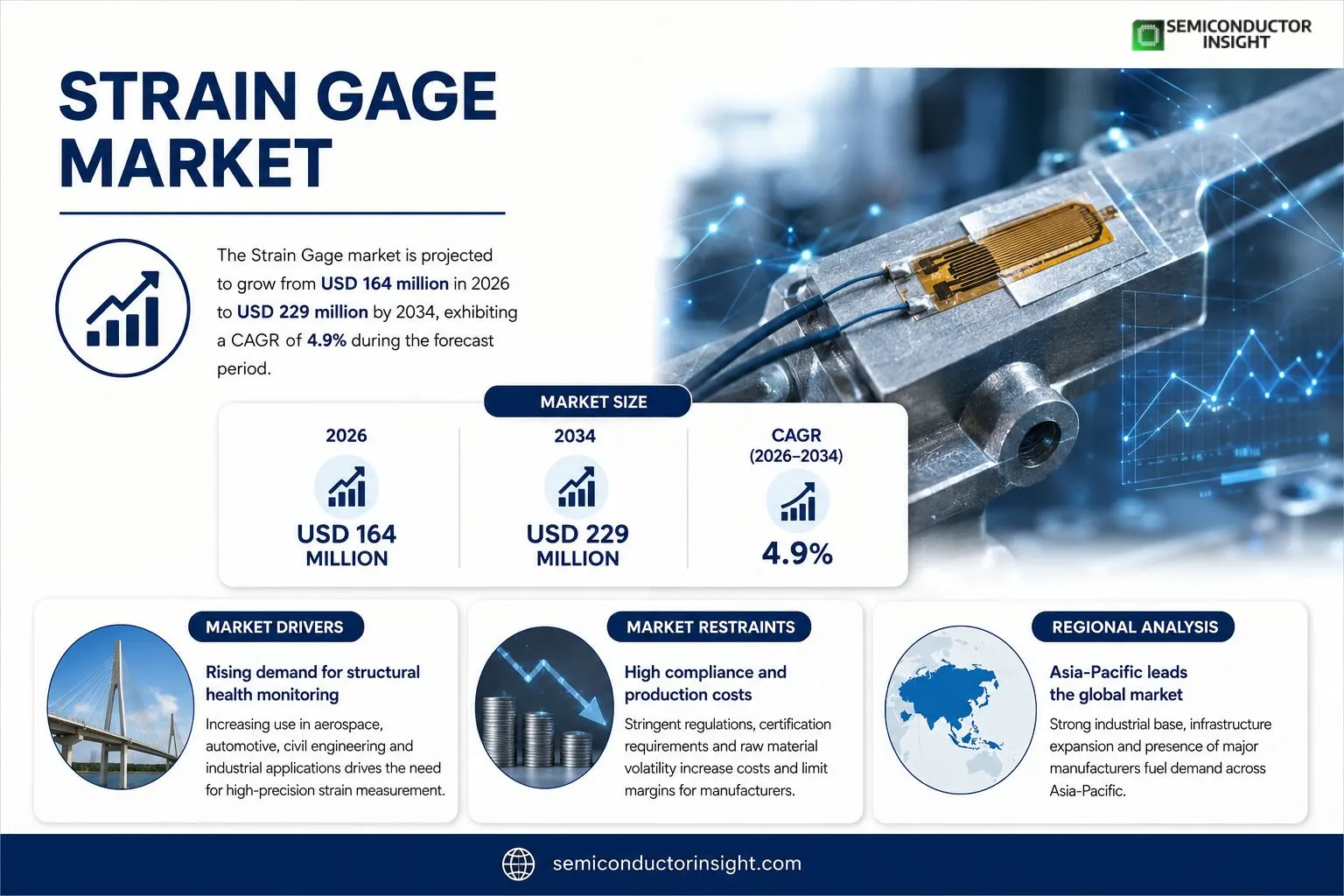
Strain Gage market size was valued at USD 164 million in 2025. The market is forecasted to rise from USD 164 million in 2025 to USD 229 million by 2032, reflecting a CAGR of 4.9% over the period.
A strain gauge is a sensor that measures deformation (strain) in a material or structure. It consists of a sensitive elementtypically metal foil, conductive carbon fabric, or thin filmbonded to the test surface. When external force induces minute deformation, the element’s geometry and electrical resistance change slightly; measuring this resistance shift together with the gauge factor yields the strain value, enabling inference of stress distribution or structural health.Demand for high‑precision deformation measurement in structural health monitoring, aerospace, automotive and civil engineering sustains market expansion. Advances such as multi‑channel data acquisition, wireless sensing, temperature compensation and self‑powered thin‑film substrates are shifting adoption toward flexible‑substrate and intelligent sensing solutions. The typical unit price stands at USD 669 per thousand pieces, with shipments of approximately 267.65 million pieces and an industry gross profit margin near 30%. Upstream inputs include nickel‑chromium wire, constantan foil and polyimide; downstream users span general stress testing laboratories and construction projects.
MARKET DRIVERS
Advancements in Sensor Materials
Strain Gage Market is benefiting from the introduction of high‑performance alloys and conductive polymers that deliver superior gauge factors while tolerating harsher environments. These material upgrades translate into longer device lifespans, reducing replacement cycles for OEMs and encouraging adoption across aerospace and heavy‑industry sectors.
Integration with Smart Systems
Embedding strain gages into IoT‑enabled platforms allows real‑time health monitoring of critical infrastructure. This convergence is prompting original equipment manufacturers to bundle sensor data with predictive‑maintenance services, creating a recurring‑revenue stream that reshapes traditional sales models in Strain Gage Market.
➤ Manufacturers who adopt AI‑enabled calibration see faster time‑to‑market and higher customer confidence.
Beyond technology, the rising demand for lightweight yet robust structures in automotive and renewable‑energy applications is compelling engineering teams to specify strain gages earlier in the design phase. The resulting design‑for‑monitoring approach shortens development timelines and strengthens the overall value proposition of Strain Gage Market.
MARKET CHALLENGES
Cost Pressures in High‑Volume Production
While economies of scale can lower unit costs, the need for tighter tolerances and extensive qualification testing inflates overhead for mass producers. Small‑to‑mid‑size players often struggle to match the pricing leverage of larger competitors, limiting their ability to compete in price‑sensitive segments of Strain Gage Market.
Other Challenges
Raw Material Scarcity
Fluctuations in the supply of specialty alloys and nano‑coatings have introduced lead times that can extend project schedules. When critical inputs become scarce, manufacturers may be forced to redesign gauge constructions, incurring additional R&D expenses and eroding profit margins.
MARKET RESTRAINTS
Regulatory Compliance Burdens
Stringent certification requirements for safety‑critical deploymentsparticularly in aerospace, automotive, and medical devicesnecessitate extensive documentation and testing. The associated compliance costs and prolonged approval cycles can deter new entrants and slow product rollouts within Strain Gage Market.
MARKET OPPORTUNITIES
Emerging Applications in Renewable Energy
Wind‑turbine blade monitoring and solar‑panel structural health assessment are creating fresh demand vectors for strain gage technology. As developers seek to maximize uptime and certify longer service lives, Strain Gage Market stands to capture a sizable share of the sustainability‑driven engineering spend, especially where remote diagnostics are a prerequisite.
Strain Gage Market Trends
Shift Toward Smart Thin‑Film Sensors
The traditional metal‑foil gauge is gradually being eclipsed by thin‑film devices that embed flexible substrates and integrated circuitry. Manufacturers are embedding temperature‑compensation layers and wireless telemetry directly onto the sensing element, reducing installation time and improving long‑term drift performance. This evolution is driven by the need for continuous structural health monitoring on bridges, wind‑turbine blades, and aerospace components, where downtime for manual inspection is costly. The resulting solutions deliver higher signal‑to‑noise ratios while preserving the $669 per‑thousand‑piece price point, which keeps the overall cost of ownership attractive for large‑scale projects. For suppliers, the transition opens a pathway to differentiate through software services rather than pure hardware, reshaping revenue models within Strain Gage Market.
Other Trends
Supply‑Chain Pressures on Raw Materials
Nickel‑chromium wire, constantan foil, and polyimide film remain the backbone of sensor fabrication, yet geopolitical frictions and raw‑material scarcity have tightened lead times. Prices for nickel‑chromium have risen modestly, prompting manufacturers to explore alloy alternatives that retain gauge factor stability while lowering cost. The 30 % gross‑profit margin reported across the sector offers limited cushion, so firms are investing in vertical integrationsecuring their own foil production lines to mitigate external volatility. This strategic shift is evident in several OEMs expanding upstream capabilities, a move that strengthens bargaining power with downstream users in construction and automotive testing.
Growth in Infrastructure and Energy Applications
Renewable‑energy installations, high‑rise construction, and offshore platforms have amplified demand for precise deformation monitoring. Engineers increasingly specify full‑bridge configurations that provide redundancy and higher accuracy for concrete‑curing surveys and turbine blade strain mapping. In parallel, the adoption of embedded gauges within composite layups allows real‑time feedback during manufacturing, reducing scrap rates. These application trends translate into higher volume orders sales of roughly 267 million pieceswhile reinforcing the relevance of Strain Gage Market as a critical enabler of safety‑critical infrastructure projects.
COMPETITIVE LANDSCAPEKey Industry Players
Competitive dynamics and concentration in the strain gage sector
The strain gage arena is dominated by a handful of large‑scale manufacturers that combine deep legacy in precision instrumentation with aggressive portfolio diversification. HBK (formerly HBM) leverages its extensive experience in high‑accuracy sensors to command a sizable share across aerospace, civil‑engineering and automotive testing, while Vishay’s Micro‑Measurements division supplies a broad spectrum of foil and thin‑film gauges that appeal to both OEMs and research labs. MinebeaMitsumi’s acquisition of several niche sensor firms has broadened its reach into wireless and thin‑film solutions, allowing it to serve emerging applications such as smart infrastructure monitoring. These three entities together shape price benchmarks, drive standard‑setting activities, and influence the upstream supply of constantan and polyimide substrates through long‑term contracts.Beyond the top tier, a diverse set of specialists enriches the competitive fabric. Japanese company KYOWA remains a strong contender in high‑temperature gauges, whereas Omega Engineering focuses on rugged, field‑ready kits for construction and energy sectors. TML and BCM cater to mid‑range markets with cost‑effective adhesive‑bonded products that meet basic reliability criteria. ZEMIC, HUA LAN HAI, and the Guangzhou Electrical Measuring Instruments Factory provide regionally tailored solutions, often integrating local supply chains for nickel‑chromium wire. Additional players such as LCT, ZHEJIANG HUANGYAN TESTING INSTRUMENT FACTORY, and several emerging Chinese innovators target flexible‑film and embedded gauge niches, positioning themselves to capture demand from smart‑city and additive‑manufacturing projects. The coexistence of powerhouses and agile domestic firms creates a landscape where technology diffusion is rapid, yet differentiation hinges on application‑specific performance, service depth, and the ability to streamline integration with data‑acquisition platforms.
List of Key Strain Gage Companies Profiled
- HBK (formerly HBM)
- Vishay Micro‑Measurements
- MinebeaMitsumi
- KYOWA
- Omega Engineering
- TML
- BCM
- ZEMIC
- HUA LAN HAI
- Guangzhou Electrical Measuring Instruments Factory
- LCT
- ZHEJIANG HUANGYAN TESTING INSTRUMENT FACTORY
- Smart Sensor Solutions
- Newhaven Electronics
- TE Connectivity
Segment Analysis:
| Segment Category | Sub-Segments | Key Insights |
| By Type |
|
Foil Type is favored for its high gauge factor and proven reliability. – Engineers value its ease of integration into traditional testing rigs. – Continuous improvements in adhesive technology enhance long‑term stability on diverse substrates. – Market participants focus on optimizing foil thickness to balance sensitivity with durability. |
| By Application |
|
General Stress Measurement remains the core use case across industries. – Provides a straightforward method for calibrating structural load paths. – Supports real‑time monitoring when coupled with modern data acquisition platforms. – Drives demand for robust packaging that tolerates harsh field conditions. |
| By End User |
|
Aerospace sector pushes the frontier of strain‑gage performance. – Emphasizes ultra‑light, thin‑film sensors for wing and fuselage monitoring. – Requires stringent temperature compensation to meet flight‑cycle reliability. – Encourages integration with wireless telemetry for remote health assessment. |
| By Installation Method |
|
Adhesive Attachment dominates because of its simplicity and adaptability. – Innovation in high‑temperature adhesives expands applicability in power‑generation environments. – Users appreciate the reversible nature for prototype testing. – Emerging bio‑based adhesives are gaining attention for sustainability goals. |
| By Technology Trend |
|
Smart Integrated Sensing is reshaping how data is captured. – Combines strain measurement with temperature and vibration monitoring in a single package. – Facilitates predictive maintenance through AI‑driven analytics. – Accelerates adoption in infrastructure projects seeking long‑term asset health visibility. |
Regional Analysis: Strain Gage Market
Vehicle manufacturers are leveraging strain gages to validate new lightweight frames, ensuring crashworthiness while meeting fuel‑efficiency targets. The shift toward electric drivetrains adds complexity, as battery packs require precise stress monitoring during thermal cycling, prompting suppliers to develop high‑temperature polymer substrates.
Flight‑critical components such as wing spars and fuselage sections undergo rigorous strain testing. Defense contracts now favor gage families that can be pre‑qualified for stealth coatings, limiting electromagnetic interference while preserving measurement accuracy.
Factories adopting Industry 4.0 link strain gage outputs to IoT gateways, creating real‑time dashboards for load prediction. This integration reduces manual inspection cycles and supports continuous improvement initiatives across assembly lines.
Researchers are experimenting with fiber‑optic and wireless strain sensors that complement traditional foil gages. Early field trials in smart‑grid installations suggest a future where hybrid sensor arrays deliver richer data without extensive wiring.
Europe
European manufacturers are focusing on regulatory harmonization, which drives consistent adoption of calibrated strain gage kits across automotive and rail sectors. The continent’s push for carbon‑neutral transportation fuels increased the need for load‑monitoring during lightweight material testing, especially in high‑speed train projects. German and French OEMs favor suppliers that can guarantee long‑term traceability, fostering a niche market for premium‑grade calibration services. Collaborative research programs funded by the EU encourage cross‑border material innovations, offering a pipeline of new substrate technologies that could reshape sensor performance standards.
Asia‑Pacific
Rapid industrialization in China, India, and Southeast Asia is expanding the pool of downstream users, from shipbuilding yards to wind‑turbine farms. Manufacturers in the region are increasingly adopting digital twins, where strain gage data feeds real‑time simulations to optimize design cycles. Cost sensitivity remains high, prompting a rise in locally sourced foil manufacturers who compete on price while gradually improving quality controls. The growing prevalence of renewable‑energy infrastructure, particularly offshore wind, creates demand for corrosion‑resistant gage packages capable of withstanding marine environments.
South America
Brazil’s expanding petrochemical complex and Argentina’s renewed focus on agribusiness equipment have generated modest but steady demand for strain measurement solutions. Local OEMs prioritize durability, as equipment often operates in high‑humidity and temperature‑fluctuating conditions. Trade agreements with North America have eased component imports, yet many firms are exploring in‑house assembly to reduce lead times. Market participants are beginning to offer bundled servicessensor installation, data logging, and periodic recalibrationto differentiate themselves in a price‑competitive landscape.
Middle East & Africa
Infrastructure projects across the Gulf Cooperation Council and emerging markets in Africa rely on strain gages for bridge and skyscraper load testing, driven by ambitious urbanization agendas. harsh desert climates necessitate gages with enhanced thermal stability, prompting vendors to introduce ceramic‑based backing layers. While the overall market size remains smaller than other regions, the high‑value nature of oil‑field and aerospace contracts offers attractive margins for specialized suppliers willing to provide on‑site technical support.
Report Scope
This market research report provides a comprehensive analysis of Strain Gage Market , covering the forecast period 2026–2034. It offers detailed insights into market dynamics, technological advancements, competitive landscape, and key trends shaping the industry.
Key focus areas of the report include:
- Market Overview: The report begins with an overview outlining its current market scenario, key growth indicators, and industry transformation drivers. It discusses macroeconomic factors, demand–supply balance, regulatory landscape, and the strategic role of semiconductors in powering advancements across industries such as automotive, telecommunications, consumer electronics, and industrial automation.
- Market Size & Forecast: Historical data and future projections for revenue, unit shipments, and market value across major regions and segments.
- Segmentation Analysis: Detailed breakdown by product type, technology, application, and end-user industry to identify high-growth segments and investment opportunities.
- Regional Insights: Insights into market performance across North America, Europe, Asia-Pacific, Latin America, and the Middle East & Africa, including country-level analysis where relevant.
- Competitive Landscape: Profiles of leading market participants, including their product offerings, R&D focus, manufacturing capacity, pricing strategies, and recent developments such as mergers, acquisitions, and partnerships.
- Technology Trends & Innovation: Assessment of emerging technologies, integration of AI/IoT, semiconductor design trends, fabrication techniques, and evolving industry standards.
- Market Drivers & Restraints: Evaluation of factors driving market growth along with challenges, supply chain constraints, regulatory issues, and market-entry barriers.
- Stakeholder Insights: Insights for component suppliers, OEMs, system integrators, investors, and policymakers regarding the evolving ecosystem and strategic opportunities.
Primary and secondary research methods are employed, including interviews with industry experts, data from verified sources, and real-time market intelligence to ensure the accuracy and reliability of the insights presented.
FREQUENTLY ASKED QUESTIONS:
What is the current market size of Strain Gage Market?
-> Strain Gage Market was valued at USD 164 million in 2025 and is expected to reach USD 229 million by 2032, growing at a CAGR of 4.9% during the forecast period.
Which key companies operate in Strain Gage Market?
-> Key players include HBK (formerly HBM), Vishay (Micro-Measurements), MinebeaMitsumi, KYOWA, Omega, TML, BCM, ZEMIC, HUA LAN HAI, Guangzhou Electrical Measuring Instruments Factory, LCT, ZHEJIANG HUANGYAN TESTING INSTRUMENT FACTORY, among others.
What are the key growth drivers?
-> Key growth drivers include increasing demand for high‑precision deformation measurement in structural health monitoring, aerospace, automotive and civil engineering, coupled with technological advances such as multi‑channel data acquisition, wireless sensing, temperature compensation, and thin‑film flexible sensors.
Which region dominates the market?
-> Asia leads the market due to a strong industrial base, extensive infrastructure projects, and a concentration of major manufacturers, while North America and Europe also hold significant shares.
What are the emerging trends?
-> Emerging trends include thin‑film and flexible substrate strain gauges, integrated full‑bridge/half‑bridge intelligent sensing solutions, self‑powered sensors, and the integration of IoT for real‑time monitoring.

Get Sample Report PDF for Exclusive Insights
Report Sample Includes
- Table of Contents
- List of Tables & Figures
- Charts, Research Methodology, and more...
 Download Sample Report PDF