Key Statistics
Key Takeaways
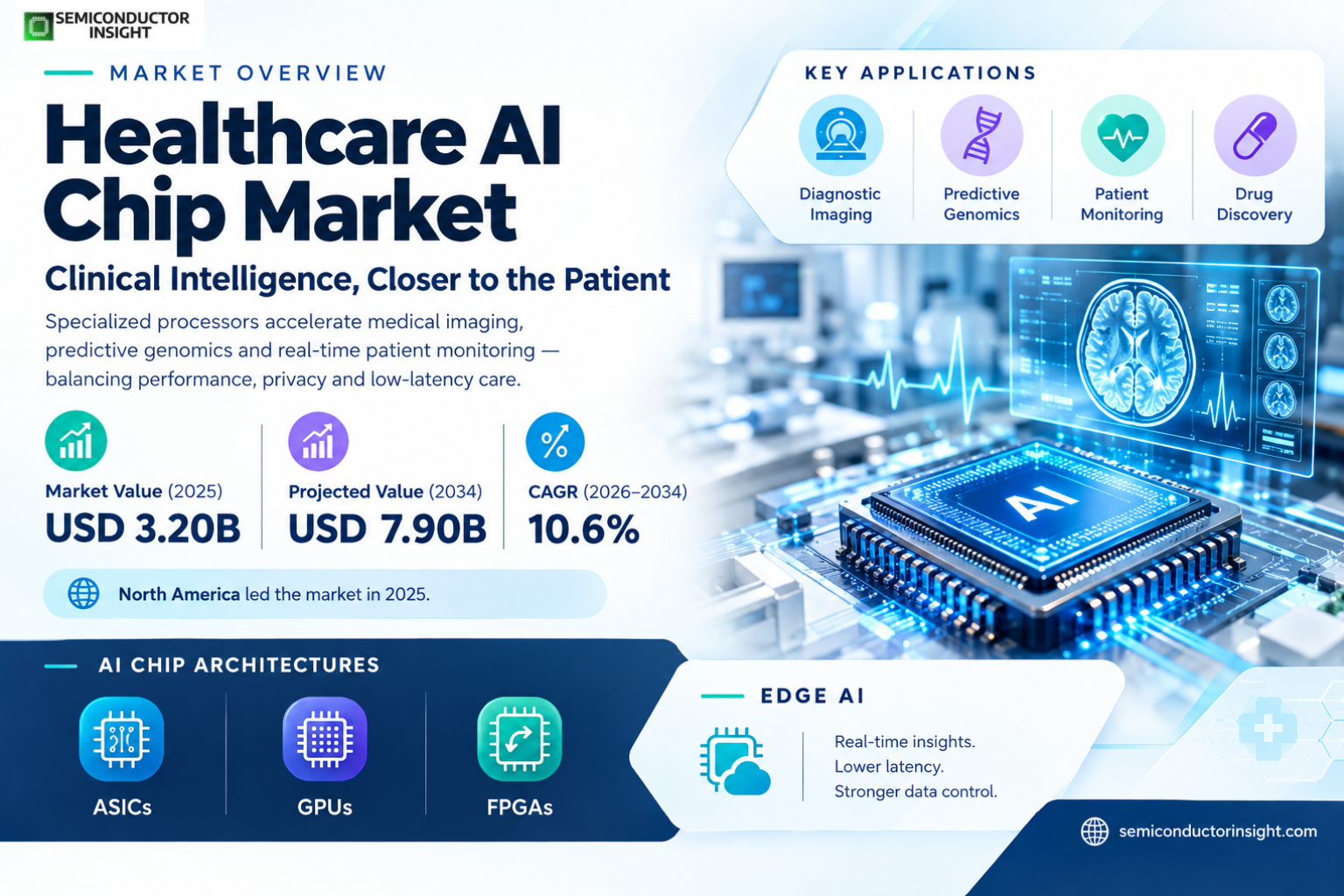
- Market size: the Healthcare AI Chip market was valued at USD 3.20 billion in 2025 and is projected to reach USD 7.90 billion by 2034, representing a 10.6% CAGR over 2026–2034.
- ASICs (Application-Specific Integrated Circuits) holds the strongest position within the type segmentation because it aligns with the broadest installed application base and current purchasing requirements.
- Diagnostic Imaging is the most commercially important application, with demand shaped by measurable performance, reliability and integration needs rather than feature novelty alone.
- North America is the largest market in 2025, while growth opportunities vary by region according to installed infrastructure, manufacturing concentration, regulation and customer investment cycles.
- Competitive differentiation is shifting toward integration, software, service quality and lifecycle support as buyers seek lower deployment risk and stronger total-cost-of-ownership outcomes.
Healthcare AI Chip Market Overview
Healthcare AI Chip market was valued at USD 3.20 billion in 2025 and is estimated at USD 3.54 billion in 2026. It is projected to reach USD 7.90 billion by 2034, registering a 10.6% CAGR over 2026–2034. North America held the largest market position in 2025.
Healthcare AI chips are processors and accelerators optimized for training or inference on medical imaging, physiological signals, clinical data and biomedical workloads. The market includes GPUs, application-specific accelerators, FPGAs and integrated SoCs used in hospital servers, cloud platforms, imaging systems and point-of-care devices. Demand is shaped by model complexity, latency, privacy, power consumption and regulatory requirements, with edge processing becoming more important when clinical workflows cannot tolerate network delay or unrestricted movement of patient data.
The commercial boundary of this market includes the hardware, software-enabled functionality and specialist services directly associated with healthcare ai chip deployments. Demand is ultimately created by customer investment in the downstream systems that use these products or services. Procurement decisions therefore depend on performance, reliability, qualification effort, interoperability and supplier support as much as on headline unit price. The market is becoming more technically segmented as customers optimize architectures for specific workloads, regulatory regimes and operating environments.
The 2026–2034 outlook is shaped by a combination of replacement demand and new capacity. Existing users are upgrading platforms to gain better efficiency, automation and analytics, while new deployments expand the installed base. Suppliers with defensible intellectual property, strong application engineering and established customer qualification records can capture a disproportionate share of incremental value because switching costs rise once a solution is embedded in a production or clinical workflow.
Segment Analysis: By Type
By type, the market is segmented into ASICs (Application-Specific Integrated Circuits), GPUs (Graphics Processing Units), FPGAs (Field-Programmable Gate Arrays). ASICs (Application-Specific Integrated Circuits) currently has the strongest market position, while growth within the remaining categories depends on application-specific performance requirements, lifecycle economics and the pace at which customers migrate from installed legacy platforms.
| Type | Function / role | Market position |
|---|---|---|
| ASICs (Application-Specific Integrated Circuits) | ASICs (Application-Specific Integrated Circuits) addresses a distinct technical or service requirement within the healthcare ai chip ecosystem. | High-growth category where fixed or semi-programmable architectures can deliver strong inference performance per watt for imaging, monitoring and embedded medical devices. |
| GPUs (Graphics Processing Units) | GPUs (Graphics Processing Units) addresses a distinct technical or service requirement within the healthcare ai chip ecosystem. | Largest broad compute platform because GPUs support training and inference across imaging, genomics and large multimodal models using mature software ecosystems. |
| FPGAs (Field-Programmable Gate Arrays) | FPGAs (Field-Programmable Gate Arrays) addresses a distinct technical or service requirement within the healthcare ai chip ecosystem. | Valued where deterministic latency, custom interfaces and reconfigurability matter, including imaging pipelines and specialized medical instrumentation. |
Commercial implications by type
Pricing and margin structures differ materially by type because customer value is tied to performance, qualification effort and integration depth. Mature high-volume categories face more price competition, while specialized solutions can sustain premiums when they reduce failure risk, simplify integration or improve operating efficiency. Suppliers increasingly use platform architectures to reuse core technology across several variants, lowering development cost while allowing customers to select the configuration suited to a specific application.
Segment Analysis: By Application
By application, the market is segmented into Diagnostic Imaging, Predictive Genomics, Patient Monitoring, Others. Diagnostic Imaging represents the largest or most strategically important application because it combines a substantial installed base with clear performance requirements and recurring upgrade cycles.
| Application | Demand characteristics |
|---|---|
| Diagnostic Imaging | Largest application because CT, MRI, ultrasound, X-ray and pathology workflows use deep learning for reconstruction, segmentation, detection and triage. High data volumes favor accelerators with strong tensor and memory performance. |
| Predictive Genomics | Compute-intensive sequence analysis and model training create demand for data-center accelerators and specialized architectures, particularly in research and precision-medicine workflows. |
| Patient Monitoring | Edge AI enables real-time analysis of ECG, vital signs and wearable data close to the patient, reducing latency and network dependence. |
| Others | Includes drug discovery, robotic surgery, clinical decision support and biomedical research applications with diverse compute profiles. |
By End User
| End User | Market role | Commercial relevance |
|---|---|---|
| Hospitals & Clinics | Leading / high priority | Hospitals & Clinics represents a distinct purchasing profile within the healthcare ai chip value chain, with adoption influenced by technical fit, integration requirements, cost and the maturity of the downstream use case. |
| Research Institutions | Established | Research Institutions represents a distinct purchasing profile within the healthcare ai chip value chain, with adoption influenced by technical fit, integration requirements, cost and the maturity of the downstream use case. |
| Medical Device Manufacturers | Selective / emerging | Medical Device Manufacturers represents a distinct purchasing profile within the healthcare ai chip value chain, with adoption influenced by technical fit, integration requirements, cost and the maturity of the downstream use case. |
By Deployment Model
| Deployment Model | Market role | Commercial relevance |
|---|---|---|
| Edge Devices | Leading / high priority | Edge Devices represents a distinct purchasing profile within the healthcare ai chip value chain, with adoption influenced by technical fit, integration requirements, cost and the maturity of the downstream use case. |
| Cloud Platforms | Established | Cloud Platforms represents a distinct purchasing profile within the healthcare ai chip value chain, with adoption influenced by technical fit, integration requirements, cost and the maturity of the downstream use case. |
| Hybrid Solutions | Selective / emerging | Hybrid Solutions represents a distinct purchasing profile within the healthcare ai chip value chain, with adoption influenced by technical fit, integration requirements, cost and the maturity of the downstream use case. |
 Regional Analysis
North America leads the Healthcare AI Chip market in 2025. Regional demand differs according to manufacturing or deployment concentration, customer investment cycles, regulation, infrastructure maturity and local supplier ecosystems. These structural differences influence both market size and the route to market.
How does regional demand differ across the Healthcare AI Chip market?
Regional demand cannot be explained by a single growth factor. Mature regions buy more replacement, premium and compliance-intensive solutions, while faster-growing regions often add new capacity or infrastructure. The most attractive supplier strategy therefore varies by geography: direct technical selling is important for complex accounts, distributor and partner coverage matters in fragmented markets, and local service capability becomes a deciding factor where downtime, qualification or regulatory requirements are costly.
| Region | Position | Growth outlook | Demand profile | What decides supplier selection |
|---|---|---|---|---|
| North America | Largest market | High | Clinical AI and cloud ecosystem led | Technical fit, local support, qualification and total cost |
| Asia Pacific | Fast-growing | High | Electronics manufacturing and healthcare digitization led | Technical fit, local support, qualification and total cost |
| Europe | Established | Moderate | Regulation and medical-device integration led | Technical fit, local support, qualification and total cost |
| South America | Developing | Moderate | Imaging and cloud-service led | Technical fit, local support, qualification and total cost |
| Middle East & Africa | Emerging | Moderate | Digital-health investment led | Technical fit, local support, qualification and total cost |
Competitive Landscape
Competition in the Healthcare AI Chip market is shaped by technology depth, application expertise, customer qualification and the ability to support deployments over a long lifecycle. Leading suppliers combine differentiated core technology with software, services or ecosystem partnerships that make replacement less attractive once customers have standardized on a platform.
Large vendors benefit from broader R&D budgets, global sales coverage and established account relationships. They can spread development costs across multiple products and regions while supporting demanding qualification programs. Smaller specialists can still win where they solve a narrow technical problem, respond faster to customization requests or offer a cost structure suited to regional and mid-tier customers.
Competitive intensity is highest where core specifications have become standardized. In those segments, vendors increasingly differentiate through reliability, analytics, integration tools, reference designs, customer support and supply assurance. In high-complexity applications, qualification cycles and workflow integration protect incumbent positions because customers are reluctant to introduce new technical risk without a measurable performance or cost advantage.
| Competitive tier | Representative participants | Strategic position |
|---|---|---|
| Global / platform leaders | NVIDIA Corporation, Intel Corporation (Habana Labs), Google Cloud (Tensor Processing Unit), Qualcomm Technologies Inc., AMD Inc. | Broad portfolios, major R&D investment, global account access and deep integration with customer workflows. |
| Established specialists | Arm Holdings, Samsung Electronics Co., Ltd., Micron Technology Inc., Graphcore Ltd., Cerebras Systems Inc. | Application-focused portfolios, regional strengths and targeted technical differentiation. |
| Emerging / niche participants | Mythic AI, BrainChip Holdings Ltd., Siemens Healthineers AG, IBM Corporation, Huawei Technologies Co., Ltd. | Compete through specialization, cost, new architectures or local customer access. |
Companies Profiled
- NVIDIA Corporation
- Intel Corporation (Habana Labs)
- Google Cloud (Tensor Processing Unit)
- Qualcomm Technologies Inc.
- AMD Inc.
- Arm Holdings
- Samsung Electronics Co., Ltd.
- Micron Technology Inc.
- Graphcore Ltd.
- Cerebras Systems Inc.
- Mythic AI
- BrainChip Holdings Ltd.
- Siemens Healthineers AG
- IBM Corporation
- Huawei Technologies Co., Ltd.
Production Capacity Analysis
Capacity in the Healthcare AI Chip market is best understood as the combination of physical production capability, engineering throughput, software capacity and qualified supplier availability required to serve customer demand. Capacity does not expand instantly because new lines, design teams, tooling or regulated workflows require investment and qualification. The most important bottleneck varies by market segment, but specialized talent, high-performance components, process know-how and customer acceptance commonly limit how quickly suppliers can convert capital expenditure into revenue.
Regional concentration also creates supply risk. When production, engineering expertise or critical upstream inputs are clustered in a small number of countries or suppliers, disruptions can lengthen lead times and increase customer inventory requirements. Vendors are responding through dual sourcing, modular platform design, regional service teams and selective localization. Buyers increasingly evaluate continuity plans during qualification, especially when the component or service sits on a critical path for manufacturing, clinical operation or network availability.
Market Dynamics
The Healthcare AI Chip market is expanding because downstream systems require greater performance, automation and intelligence, but adoption remains constrained by qualification cost, technical integration and the need for reliable lifecycle support. Growth is therefore strongest where the new solution produces a measurable operational or economic benefit rather than simply adding specifications.
Demand is moving from isolated product purchases toward platform decisions. Customers increasingly assess compatibility with software, infrastructure, standards and service ecosystems before committing to a vendor. This raises switching costs for incumbents but also creates entry points for challengers that can solve integration pain points or reduce total ownership cost. The balance between innovation and risk management is especially important in semiconductor, healthcare and communications markets where a failed deployment can interrupt production or essential services.
Market Drivers
Drivers Impact Analysis
| Driver | Impact | Time horizon |
|---|---|---|
| Expansion of AI-enabled medical devices | High | 2026–2034 |
| Medical imaging workloads | High | 2026–2034 |
| Edge inference and data privacy | Medium-High | 2026–2034 |
| Generative and multimodal clinical AI | Medium-High | 2026–2034 |
Expansion of AI-enabled medical devices
The FDA’s expanding list of authorized AI-enabled devices demonstrates growing commercialization across radiology, cardiovascular and other specialties. More approved algorithms increase demand for compute platforms capable of running them reliably.
Medical imaging workloads
Imaging reconstruction, segmentation and detection use large neural networks and high-dimensional data, favoring GPUs and specialized accelerators with high memory bandwidth and mature software libraries.
Edge inference and data privacy
Hospitals and device makers increasingly process data locally to reduce latency, limit data movement and maintain functionality when cloud connectivity is constrained.
Generative and multimodal clinical AI
Large vision-language and multimodal models increase compute requirements for radiology, pathology and clinical documentation, expanding accelerator demand in data centers and high-end edge systems.
Market Restraints
Restraints Impact Analysis
| Restraint | Impact | Commercial effect |
|---|---|---|
| Regulatory and validation requirements | Medium-High | Can delay adoption, increase qualification cost or compress supplier margins. |
| Integration with legacy hospital systems | Medium-High | Can delay adoption, increase qualification cost or compress supplier margins. |
| High compute and energy cost | Medium | Can delay adoption, increase qualification cost or compress supplier margins. |
| Data access and privacy constraints | Medium | Can delay adoption, increase qualification cost or compress supplier margins. |
Regulatory and validation requirements
Medical AI systems require evidence, documentation and lifecycle controls. Hardware changes can affect performance, cybersecurity and validation, slowing platform transitions compared with consumer AI markets.
Integration with legacy hospital systems
Hospitals operate heterogeneous imaging, PACS, EHR and network environments. Deploying accelerators may require software integration, cybersecurity review and workflow redesign.
High compute and energy cost
Training and running advanced models can require expensive accelerators and cooling, challenging smaller healthcare organizations and research centers.
Data access and privacy constraints
Clinical AI depends on representative data, yet patient privacy, cross-border data rules and institutional governance can limit model development and cloud deployment.
Market Opportunities
AI inside medical imaging equipment
Integrating accelerators directly into CT, MRI, ultrasound and pathology systems creates lower-latency inference and more predictable performance.
Portable and point-of-care AI
Low-power SoCs can bring advanced analysis to handheld ultrasound, bedside monitoring and remote diagnostics.
Genomics and drug discovery acceleration
Large-scale sequence analysis and molecular modeling create demand for high-throughput accelerators in research and biopharma environments.
Lifecycle-managed AI platforms
Chip and system vendors can differentiate with secure update paths, monitoring tools and validated software stacks aligned with medical-device lifecycle requirements.
Supply Chain Analysis
1. Upstream inputs
2. Component / platform creation
3. OEM / integrator channel
4. End-use deployment
Upstream value is concentrated in differentiated technology and scarce technical inputs, while downstream value is captured through integration, qualification and customer support. For the Healthcare AI Chip market, suppliers that own key IP or process know-how have greater pricing power than commodity component providers. At the same time, system integrators and service partners can capture meaningful value by reducing deployment risk and providing a single accountable interface to the customer.
The principal bottleneck is not always raw material availability. In many cases, engineering validation, software compatibility, qualified manufacturing capacity or customer acceptance limits shipment growth. This makes supply-chain resilience a combination of sourcing strategy and technical execution. Multi-sourcing is useful only when alternate suppliers can meet the same performance and qualification requirements without forcing customers to repeat lengthy validation programs.
Recent Developments
Report Scope & Segmentation
| Attribute | Coverage |
|---|---|
| Market | Healthcare AI Chip |
| Base Year | 2025 |
| Estimated Year | 2026 |
| Forecast Period | 2026–2034 |
| 2025 Market Size | USD 3.20 billion |
| 2034 Projected Market Size | USD 7.90 billion |
| CAGR (2026–2034) | 10.6% |
| Largest Market in 2025 | North America |
| By Type | ASICs (Application-Specific Integrated Circuits), GPUs (Graphics Processing Units), FPGAs (Field-Programmable Gate Arrays) |
| By Application | Diagnostic Imaging, Predictive Genomics, Patient Monitoring, Others |
| By End User | Hospitals & Clinics, Research Institutions, Medical Device Manufacturers |
| By Deployment Model | Edge Devices, Cloud Platforms, Hybrid Solutions |
| By Integration Level | Standalone Chips, Integrated SoCs, System-in-Package (SiP) |
| Regions | North America, Europe, Asia Pacific, South America, Middle East & Africa |
| Companies Profiled | NVIDIA Corporation, Intel Corporation (Habana Labs), Google Cloud (Tensor Processing Unit), Qualcomm Technologies Inc., AMD Inc., Arm Holdings, Samsung Electronics Co., Ltd., Micron Technology Inc., Graphcore Ltd., Cerebras Systems Inc., Mythic AI, BrainChip Holdings Ltd., Siemens Healthineers AG, IBM Corporation, Huawei Technologies Co., Ltd. |
Frequently Asked Questions
What is the Healthcare AI Chip market size in 2025?
What is the projected Healthcare AI Chip market size by 2034?
What is the CAGR of the Healthcare AI Chip market from 2026 to 2034?
Which region leads the Healthcare AI Chip market?
What are the main product or service types?
What are the key applications?
What is a major growth driver?
What is a major restraint?
Where are the strongest opportunities?
Which companies are active in the market?
Research Sources & Evidence Base
View primary and official evidence sources
- U.S. Food and Drug Administration: Current list of AI-enabled medical devices authorized in the United States.
- U.S. Food and Drug Administration: Final 2025 guidance on predetermined change control plans for AI-enabled device software functions.
- NVIDIA: Medical imaging AI workflows and MONAI ecosystem.
- NVIDIA: Healthcare and life-sciences accelerated computing platform context.

Get Sample Report PDF for Exclusive Insights
Report Sample Includes
- Table of Contents
- List of Tables & Figures
- Charts, Research Methodology, and more...
 Download Sample Report PDF