Thin Film NTC Temperature Sensor Market Insights
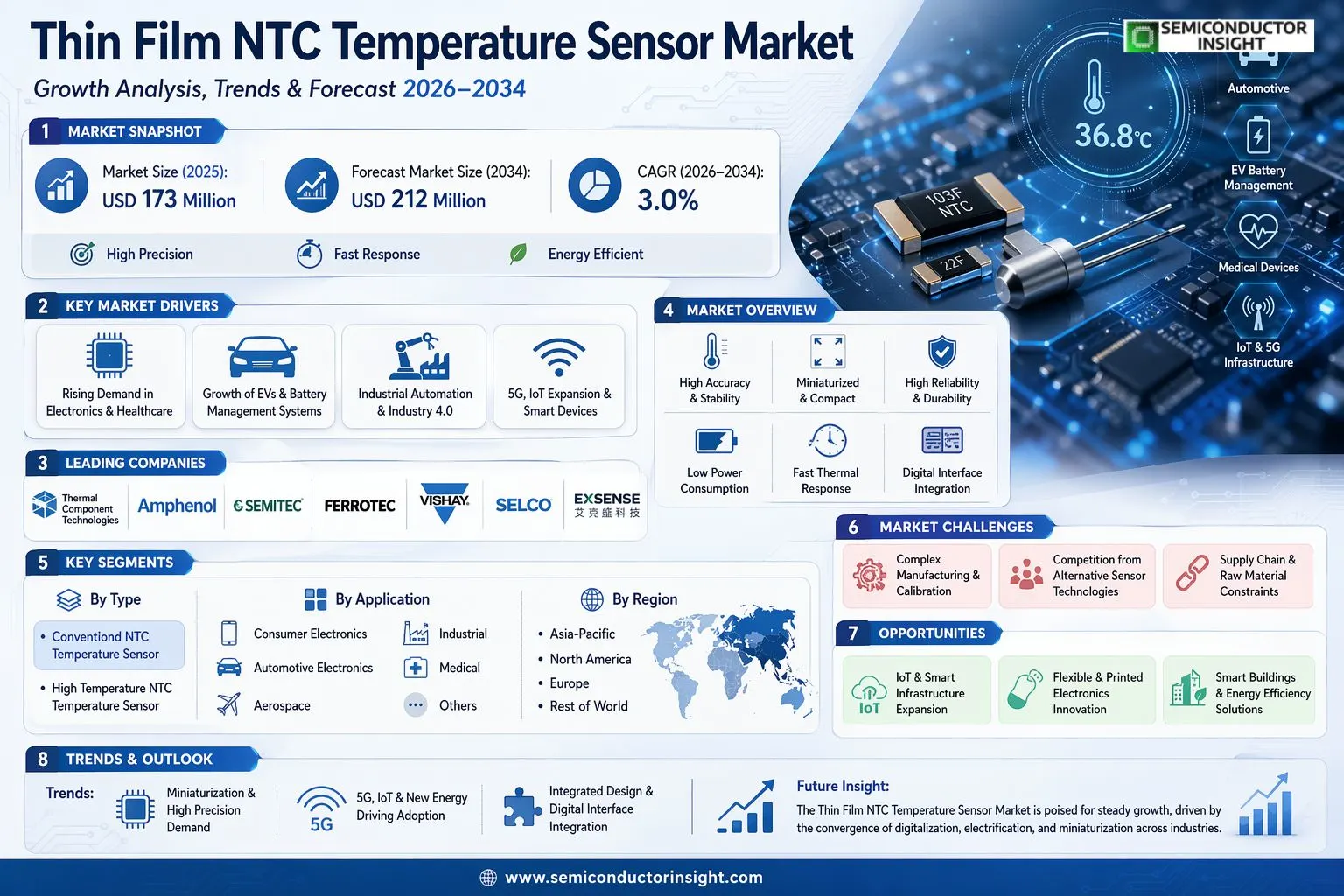
Global Thin Film NTC Temperature Sensor market size was valued at USD 173 million in 2025. The market is projected to grow from USD 178 million in 2026 to USD 212 million by 2034, exhibiting a CAGR of 3.0% during the forecast period.
A thin film NTC temperature sensor is a precision temperature measurement device grounded in the principle of the negative temperature coefficient (NTC) thermistor. Its defining characteristic lies in the application of thin film deposition technology to prepare thermally sensitive materials in an ultra-thin film form, enabling high-precision, fast thermal response, and miniaturized temperature measurement across demanding environments. The sensor types encompass Conventional NTC Temperature Sensors and High Temperature NTC Temperature Sensors, serving applications ranging from consumer electronics and automotive electronics to medical devices, industrial systems, and aerospace.
The market has demonstrated a steady growth trajectory in recent years, primarily driven by sustained demand for miniaturized and high-accuracy temperature sensing solutions across consumer electronics, automotive electronics, and medical equipment sectors. Furthermore, the accelerating deployment of 5G infrastructure, the Internet of Things (IoT), and the new energy vehicle industry has considerably elevated the industry’s focus on thin film NTC products offering rapid responsiveness, low power consumption, and enhanced heat resistance. Manufacturers are actively refining production processes to improve cost efficiency while strengthening product competitiveness through integrated designs, including the incorporation of digital interfaces. Thermal Component Technologies, Amphenol, Semitec, Ferrotec, and Vishay are among the key players operating in the market with diversified product portfolios.
MARKET DRIVERS
Rising Demand for Precision Temperature Monitoring Across End-Use Industries
Thin Film NTC Temperature Sensor Market is experiencing robust growth driven by the accelerating need for high-precision, miniaturized temperature sensing solutions across industries such as consumer electronics, automotive, medical devices, and industrial automation. Thin film NTC (Negative Temperature Coefficient) thermistors offer superior sensitivity, fast response times, and compact form factors that make them highly suitable for embedded and space-constrained applications. As electronics continue to miniaturize and performance benchmarks tighten, the demand for accurate thermal management components has intensified considerably.
Expansion of Electric Vehicles and Battery Thermal Management Systems
One of the most significant drivers propelling Thin Film NTC Temperature Sensor Market is the rapid global adoption of electric vehicles (EVs). Battery thermal management is critical for EV performance, longevity, and safety, and thin film NTC temperature sensors are increasingly deployed within battery management systems (BMS) to monitor cell-level temperatures with high accuracy. As EV production scales globally, automakers and Tier-1 suppliers are sourcing advanced temperature sensing components that can withstand harsh automotive environments while delivering reliable real-time data across a wide thermal range.
➤ Thin film NTC temperature sensors are uniquely positioned to serve the growing EV market, offering stable resistance-temperature characteristics, compact packaging, and fast thermal response , all critical requirements for next-generation battery management and powertrain thermal control systems.
The proliferation of Internet of Things (IoT) devices and smart home applications further amplifies market momentum. Connected thermostats, HVAC systems, wearable health monitors, and industrial sensors all rely on precise, low-power temperature sensing. Thin film NTC sensors, owing to their thin-profile construction and compatibility with automated surface mount technology (SMT) assembly processes, are well-aligned with the manufacturing requirements of high-volume IoT product lines, reinforcing their adoption across both consumer and industrial segments.
MARKET CHALLENGES
Technical Complexity in Thin Film Deposition and Calibration Processes
Despite their advantages, manufacturers operating in Thin Film NTC Temperature Sensor Market face considerable technical challenges related to the precision required in thin film deposition processes. Achieving consistent resistivity, uniformity, and adhesion across substrates demands advanced sputtering or chemical vapor deposition (CVD) techniques, specialized equipment, and stringent process controls. Even minor deviations during fabrication can result in calibration drift, impacting the sensor’s accuracy over its operational lifespan , a particularly critical concern in medical and automotive applications where measurement tolerances are extremely tight.
Other Challenges
Sensitivity to Environmental Stress
Thin film NTC temperature sensors, while compact and highly responsive, can be susceptible to mechanical stress, humidity ingress, and chemical exposure if not adequately encapsulated. In harsh industrial or outdoor environments, long-term reliability can be compromised, requiring additional protective packaging that can offset the miniaturization advantages these sensors inherently provide. Balancing protection with form factor remains an ongoing engineering challenge for sensor designers and OEMs alike.
Supply Chain Constraints and Raw Material Availability
The production of thin film NTC sensors relies on specialty metal oxides and thin film deposition materials, the supply of which can be subject to geopolitical disruptions and raw material price volatility. Global supply chain fragilities, as demonstrated during recent semiconductor shortages, have underscored vulnerabilities in sourcing high-purity materials essential for consistent thin film sensor production, creating lead time and cost pressures for manufacturers serving just-in-time production environments.
MARKET RESTRAINTS
High Manufacturing Costs and Capital-Intensive Production Infrastructure
A primary restraint facing Thin Film NTC Temperature Sensor Market is the relatively high capital investment required for thin film fabrication facilities. Unlike conventional wire-wound or bulk ceramic NTC thermistors, thin film variants require cleanroom environments, precision deposition equipment, and advanced photolithographic patterning processes. These infrastructure requirements translate into elevated manufacturing costs that can restrict market entry for smaller players and compress margins for established producers competing on price in cost-sensitive end markets.
Competition from Alternative Temperature Sensing Technologies
Thin Film NTC Temperature Sensor Market also faces competitive pressure from alternative sensing technologies including resistance temperature detectors (RTDs), thermocouples, digital temperature ICs, and MEMS-based thermal sensors. In certain high-temperature or wide-range measurement applications, RTDs and thermocouples may be preferred for their broader operating ranges. Meanwhile, integrated digital temperature sensors from semiconductor vendors are gaining traction in IoT and consumer electronics applications due to their ease of digital interfacing, potentially limiting the addressable market for analog thin film NTC solutions in some segments.
Regulatory compliance requirements across medical and automotive verticals introduce additional complexity. Sensors used in implantable devices or safety-critical automotive systems must meet stringent certifications such as ISO 13485, AEC-Q200, and IEC standards, which require extensive qualification testing, documentation, and ongoing quality assurance investment. These compliance burdens can slow time-to-market and increase operational costs, particularly for companies seeking to enter regulated verticals without pre-existing certification frameworks.
MARKET OPPORTUNITIES
Growth in Medical Wearables and Point-of-Care Diagnostic Devices
The expanding medical wearables sector presents a compelling growth opportunity for Thin Film NTC Temperature Sensor Market. Continuous body temperature monitoring has gained clinical and consumer interest, particularly following Global focus on remote health monitoring. Thin film NTC sensors, with their miniaturized profiles, low power consumption, and biocompatible packaging options, are well-suited for integration into wearable patches, smart thermometers, and non-invasive diagnostic devices. As healthcare systems globally prioritize preventive and remote care models, demand for such precision sensing components is expected to grow steadily.
Industrial Automation and Smart Manufacturing Adoption
Global transition toward Industry 4.0 and smart manufacturing environments offers significant upside for Thin Film NTC Temperature Sensor Market. Automated production lines, robotic systems, and condition monitoring applications increasingly rely on distributed, high-accuracy temperature sensing to optimize process efficiency and prevent equipment failures. Thin film NTC sensors, capable of being deployed in dense sensor arrays with consistent performance characteristics, align strongly with the requirements of predictive maintenance and real-time process control systems being adopted across manufacturing, energy, and semiconductor fabrication industries.
Emerging applications in renewable energy systems, including solar inverter thermal management and battery energy storage systems (BESS), are opening new demand channels. As global investments in clean energy infrastructure accelerate, the need for reliable, high-cycle thermal monitoring components within power conversion and storage equipment is growing. Thin film NTC temperature sensors, with their proven performance in demanding thermal environments and compatibility with compact power electronics packaging, are strategically positioned to capture share in this expanding application domain within the broader Thin Film NTC Temperature Sensor Market.
Trends
Rising Demand for Miniaturized, High-Precision Temperature Sensing Solutions
Thin Film NTC Temperature Sensor Market has demonstrated a consistent and steady growth trajectory in recent years, driven primarily by the expanding need for compact, high-accuracy temperature measurement across multiple industries. Thin film NTC temperature sensors leverage the negative temperature coefficient thermistor principle, with sensitive materials deposited in thin film form to deliver fast response times, high precision, and a reduced physical footprint. These attributes have positioned thin film NTC technology as a preferred solution in consumer electronics, automotive electronics, and medical equipment , sectors that collectively account for a significant share of global sensor demand. The sustained proliferation of connected devices and the integration of temperature monitoring functions into increasingly miniaturized hardware have reinforced the market’s upward momentum, distinguishing thin film variants from conventional thick film alternatives in high-end application environments.
Other Trends
Acceleration of 5G, IoT, and New Energy Applications
The rapid expansion of 5G infrastructure, Internet of Things ecosystems, and new energy vehicle platforms has materially broadened the addressable market for thin film NTC temperature sensors. These emerging technology segments demand sensing components that combine low power consumption, thermal resilience, and rapid response , characteristics that align closely with the performance profile of thin film NTC products. Automotive electronics, in particular, has emerged as a high-growth application segment, as battery thermal management systems in electric vehicles require precise, reliable, and compact temperature sensors to ensure safety and efficiency. Industrial and aerospace applications are also contributing to incremental demand, further diversifying the end-use base of Thin Film NTC Temperature Sensor Market.
Integration of Digital Interfaces and Process Optimization
Manufacturers operating in Thin Film NTC Temperature Sensor Market are actively investing in integrated design approaches, combining analog sensor outputs with digital communication interfaces to enhance product competitiveness. This trend toward sensor integration reduces system complexity for downstream equipment designers and supports broader adoption in smart device architectures. Concurrently, producers are optimizing thin film deposition and manufacturing processes to lower unit costs, addressing the persistent price competition presented by traditional thick film NTC sensors. Companies such as Amphenol, Vishay, Semitec, and Ferrotec, among other key players, have been refining their product portfolios to reflect these dual imperatives of performance enhancement and cost efficiency.
Emerging Opportunities in Smart Wearables and AR/VR Devices
Looking ahead, Thin Film NTC Temperature Sensor Market is expected to benefit from the growth of smart wearable technology and augmented and virtual reality devices, both of which impose stringent requirements on sensor size, power draw, and measurement accuracy. These emerging consumer application categories are anticipated to expand the market’s penetration beyond traditional segments. However, the industry continues to navigate challenges related to technological maturity, consistent raw material supply, and supply chain stability , factors that will influence how effectively manufacturers can scale production to meet diversifying global demand across North America, Europe, Asia, and other key regions.
COMPETITIVE LANDSCAPE
Key Industry Players
Thin Film NTC Temperature Sensor Market , Competitive Dynamics and Leading Manufacturer Profiles
Global Thin Film NTC Temperature Sensor market is moderately consolidated, with a mix of established multinational corporations and specialized regional manufacturers competing across product performance, miniaturization capability, and cost efficiency. As of 2025, the market is valued at approximately US$ 173 million and is projected to reach US$ 212 million by 2034, growing at a CAGR of 3.0%. Leading players such as Amphenol, Vishay, and Semitec hold significant revenue shares owing to their advanced thin film deposition technologies, robust global distribution networks, and diversified product portfolios catering to high-demand segments including automotive electronics, medical devices, and consumer electronics. These companies continue to invest in R&D to develop sensors with faster thermal response times, lower power consumption, and enhanced heat resistance , attributes increasingly critical in 5G infrastructure and new energy vehicle (NEV) applications. Ferrotec and Thermal Component Technologies also maintain strong competitive positions by focusing on high-temperature NTC variants and precision-grade sensing solutions for industrial and aerospace end-users.
Beyond Global leaders, a growing cluster of Asia-Pacific manufacturers , particularly from China and Taiwan , are rapidly gaining market traction by offering competitively priced thin film NTC sensors without sacrificing core performance benchmarks. Companies such as Guangdong Exsense Electronics Technology, Shenzhen TOPOS Sensor Technology, Taiwan Thinking Electronic, and Nanjing SinoChip Electronics have emerged as significant niche players, leveraging localized supply chains and government-backed manufacturing incentives to scale production. Taiwanese firms including TAYAO Technology and SEN TECH have distinguished themselves through integration of digital interface compatibility and SMD-optimized form factors, aligning with the miniaturization demands of smart wearables and AR/VR devices. While price competition from traditional thick film NTC thermistors remains a persistent challenge, the technical irreplaceability of thin film technology in high-precision, high-reliability scenarios continues to drive its penetration across premium application verticals, reinforcing the long-term competitive viability of both established and emerging market participants.
List of Key Thin Film NTC Temperature Sensor Companies Profiled
- Amphenol
- Vishay
- Semitec
- Ferrotec
- Thermal Component Technologies
- Selco
- El Sensor
- Shenzhen Mcnic
- Dongguan Sensicom Electronics Technology
- Nanjing Shiheng Electronics
- Dongguan Starwin Technology
- Guangdong JPET Technology
- Nanjing SinoChip Electronics
- Shenzhen Kepengda Electronics
- Shenzhen NTC-WORLD
- Taiwan TAYAO Technology
- Taiwan Thinking Electronic
- Taiwan SEN TECH
- Guangdong Exsense Electronics Technology
- Shenzhen TOPOS Sensor Technology
Segment Analysis:
| Segment Category | Sub-Segments | Key Insights |
| By Type |
|
Conventional NTC Temperature Sensor holds the leading position in the thin film NTC market, driven by its broad applicability across mainstream industries and its well-established manufacturing ecosystem.
High Temperature NTC Temperature Sensor represents a rapidly emerging sub-segment, gaining traction in demanding environments such as automotive powertrains, aerospace systems, and industrial furnaces where elevated thermal resilience is non-negotiable.
|
| By Application |
|
Consumer Electronics stands as the dominant application segment for thin film NTC temperature sensors, underpinned by the explosive global proliferation of smart devices, wearables, and portable technology platforms.
Automotive Electronics is the fastest-growing application, propelled by Global transition toward electric vehicles and the increasing complexity of automotive thermal management systems requiring precise and durable sensing solutions across multiple vehicle subsystems.
|
| By End User |
|
OEMs (Original Equipment Manufacturers) represent the leading end-user category in Thin Film NTC Temperature Sensor Market, as the integration of these sensors occurs primarily at the design and manufacturing stage of finished goods across electronics, automotive, and medical device industries.
|
| By Technology Integration |
|
Integrated/Hybrid Sensor Modules are emerging as the leading sub-segment within this category, reflecting the broader industry shift toward combining thin film NTC sensing elements with digital signal conditioning, communication interfaces, and embedded processing capabilities within a single compact unit.
|
| By Form Factor |
|
Chip/SMD (Surface Mount Device) Type dominates the thin film NTC market by form factor, as Global electronics manufacturing industry’s overwhelming preference for surface mount assembly processes drives sustained and growing demand for chip-format temperature sensing components.
|
Regional Analysis: Thin Film NTC Temperature Sensor Market
Asia-Pacific hosts the world’s most concentrated cluster of thin film NTC temperature sensor manufacturers, particularly in China’s Guangdong and Jiangsu provinces. These hubs benefit from vertically integrated supply chains, enabling rapid prototyping, cost-efficient mass production, and agile response to shifting market demand , a critical advantage in an increasingly competitive global landscape.
The accelerating shift toward electric vehicles across China, Japan, and South Korea is generating significant demand for reliable thermal sensing solutions. Thin film NTC temperature sensors are critical in battery management systems and motor thermal protection, placing Asia-Pacific automotive manufacturers at the forefront of next-generation sensor adoption and integration strategies.
Rapid deployment of industrial IoT frameworks across Japan, South Korea, and emerging ASEAN economies is amplifying the need for precise, miniaturized temperature sensing technologies. Thin film NTC sensors are being embedded in smart grids, automated factory systems, and intelligent HVAC infrastructure, supporting the region’s broader digital transformation agenda across multiple industry verticals.
Leading regional universities and government-backed research institutions in China, Japan, and India are channeling significant resources into advanced sensor technologies. This sustained innovation pipeline is producing next-generation thin film NTC temperature sensor designs with improved accuracy, wider operating ranges, and enhanced durability, ensuring Asia-Pacific’s long-term technological competitiveness in Global market.
North America
North America represents one of the most technologically mature and innovation-driven regions in Thin Film NTC Temperature Sensor Market. The United States leads regional demand, propelled by a well-established aerospace, defense, medical device, and advanced automotive manufacturing base that demands high-precision thermal sensing components. The growing adoption of electric and hybrid vehicles by major domestic automakers is reshaping thermal management requirements, directly benefiting thin film NTC temperature sensor suppliers. Additionally, the region’s expanding data center infrastructure, driven by cloud computing and AI workload growth, is creating new application avenues where temperature monitoring is critical to operational integrity. Canada contributes through its burgeoning cleantech and energy storage sectors. Strong intellectual property frameworks, favorable regulatory environments for electronic component innovation, and significant private-sector R&D expenditure collectively underpin North America’s position as a premium-demand market within Global Thin Film NTC Temperature Sensor Market landscape through 2034.
Europe
Europe maintains a strategically important position in Global Thin Film NTC Temperature Sensor Market, anchored by its stringent regulatory standards, advanced industrial automation sector, and accelerating energy transition initiatives. Germany, France, and the Netherlands are key contributors, housing world-class automotive OEMs and Tier-1 suppliers that increasingly integrate thin film NTC temperature sensors in electric powertrains, battery thermal systems, and onboard diagnostics. The European Union’s aggressive carbon neutrality targets are accelerating investments in renewable energy infrastructure, where precise temperature monitoring in solar inverters, wind turbines, and energy storage systems is essential. The region’s medical device industry, particularly in Germany and Switzerland, also sustains steady demand for highly accurate and miniaturized thermal sensing components. Europe’s emphasis on quality certification, traceability, and sustainability in electronics manufacturing further elevates the performance expectations placed upon thin film NTC temperature sensor suppliers operating in this competitive regional marketplace.
South America
South America represents an emerging but increasingly relevant market for thin film NTC temperature sensors, with Brazil and Argentina leading regional development. Industrial modernization across sectors including food and beverage processing, agricultural technology, and automotive assembly is gradually elevating the adoption of precision temperature sensing solutions. Brazil’s growing manufacturing sector, supported by government-backed industrial competitiveness programs, is creating a foundational demand base for sensor technologies as local producers seek quality upgrades to compete in international export markets. The region’s expanding renewable energy sector, particularly in solar and hydroelectric projects, is also beginning to generate incremental demand for reliable thermal monitoring components. While infrastructure limitations and currency volatility present challenges, the long-term trajectory of Thin Film NTC Temperature Sensor Market in South America remains positive, contingent on continued industrial investment and regional supply chain development through the forecast period ending in 2034.
Middle East & Africa
The Middle East and Africa region occupies an early-stage but strategically promising position in Global Thin Film NTC Temperature Sensor Market. Gulf Cooperation Council nations, particularly the United Arab Emirates and Saudi Arabia, are driving demand through large-scale smart city initiatives, energy infrastructure modernization, and healthcare sector expansion , all of which rely on dependable temperature sensing technologies. Saudi Arabia’s Vision 2030 initiative and the UAE’s industrial diversification agenda are channeling investments into advanced manufacturing and automation, creating a gradual but measurable pull for high-quality thin film NTC temperature sensors. Sub-Saharan Africa remains at an earlier adoption stage, though expanding telecommunications infrastructure, cold chain logistics development, and off-grid energy solutions present nascent but growing application opportunities. As regional awareness of sensor technology benefits increases and local distribution networks mature, the Middle East and Africa are expected to emerge as a progressively important contributor to Global Thin Film NTC Temperature Sensor Market by 2034.
Report Scope
This market research report provides a comprehensive analysis of Thin Film NTC Temperature Sensor Market, covering the forecast period 2026–2034. It offers detailed insights into market dynamics, technological advancements, competitive landscape, and key trends shaping the industry.
Key focus areas of the report include:
- Market Overview: The report begins with an overview outlining its current market scenario, key growth indicators, and industry transformation drivers. It discusses macroeconomic factors, demand–supply balance, regulatory landscape, and the strategic role of thin film NTC temperature sensors in powering advancements across industries such as automotive electronics, consumer electronics, medical equipment, and industrial automation.
- Market Size & Forecast: Historical data and future projections for revenue, unit shipments, and market value across major regions and segments.
- Segmentation Analysis: Detailed breakdown by product type, technology, application, and end-user industry to identify high-growth segments and investment opportunities.
- Regional Insights: Insights into market performance across North America, Europe, Asia-Pacific, Latin America, and the Middle East & Africa, including country-level analysis where relevant.
- Competitive Landscape: Profiles of leading market participants, including their product offerings, R&D focus, manufacturing capacity, pricing strategies, and recent developments such as mergers, acquisitions, and partnerships.
- Technology Trends & Innovation: Assessment of emerging technologies, integration of AI/IoT, thin film fabrication techniques, digital interface integration, and evolving industry standards.
- Market Drivers & Restraints: Evaluation of factors driving market growth along with challenges, supply chain constraints, regulatory issues, and market-entry barriers.
- Stakeholder Insights: Insights for component suppliers, OEMs, system integrators, investors, and policymakers regarding the evolving ecosystem and strategic opportunities.
Primary and secondary research methods are employed, including interviews with industry experts, data from verified sources, and real-time market intelligence to ensure the accuracy and reliability of the insights presented.
FREQUENTLY ASKED QUESTIONS:
What is the current market size of Thin Film NTC Temperature Sensor Market?
-> Global Thin Film NTC Temperature Sensor Market was valued at USD 173 million in 2025 and is expected to reach USD 212 million by 2034, growing at a CAGR of 3.0% during the forecast period.
Which key companies operate in Thin Film NTC Temperature Sensor Market?
-> Key players include Thermal Component Technologies, Amphenol, Semitec, Ferrotec, Selco, El Sensor, Vishay, Shenzhen Mcnic, Dongguan Sensicom Electronics Technology, Nanjing Shiheng Electronics, Dongguan Starwin Technology, Guangdong JPET Technology, Nanjing SinoChip Electronics, Shenzhen Kepengda Electronics, Shenzhen NTC-WORLD, Taiwan TAYAO Technology, Taiwan Thinking Electronic, Taiwan SEN TECH, Guangdong Exsense Electronics Technology, and Shenzhen TOPOS Sensor Technology, among others.
What are the key growth drivers?
-> Key growth drivers include sustained demand for high-precision and miniaturized temperature sensing solutions in consumer electronics, automotive electronics, and medical equipment, as well as the rapid development of 5G, the Internet of Things (IoT), and the new energy industry, which have significantly increased demand for thin film NTC products that are responsive, low-power, and heat-resistant.
Which region dominates the market?
-> Asia is a dominant and fast-growing region in Global Thin Film NTC Temperature Sensor Market, driven by major manufacturing hubs in China, Japan, South Korea, and Southeast Asia, while North America and Europe also hold significant shares due to strong demand from automotive and medical sectors.
What are the emerging trends?
-> Emerging trends include smart wearables, AR/VR applications, integrated digital interface designs, low-power thin film NTC solutions, and the adoption of thin film NTC temperature sensors in new energy vehicles and IoT-connected devices, alongside manufacturers actively optimizing production processes to reduce costs and improve competitiveness.

Get Sample Report PDF for Exclusive Insights
Report Sample Includes
- Table of Contents
- List of Tables & Figures
- Charts, Research Methodology, and more...