SEMICONDUCTOR INSIGHT
MARKET RESEARCH REPORT

Electric Power Steering (EPS) Sensor Market

2026 to 2034
MARKET INTELLIGENCE
ACROSS KEY REGIONS
2026 EDITION
SENSORS Semiconductor Market Research

Electric Power Steering (EPS) Sensor Market

Global Outlook and Forecast 2026–2036

◷
UPDATED 19 October 2026
▤
REPORT LENGTH Detailed Report
▣
REPORT CODE 74cfc230219f
▯
FORMATS PDF

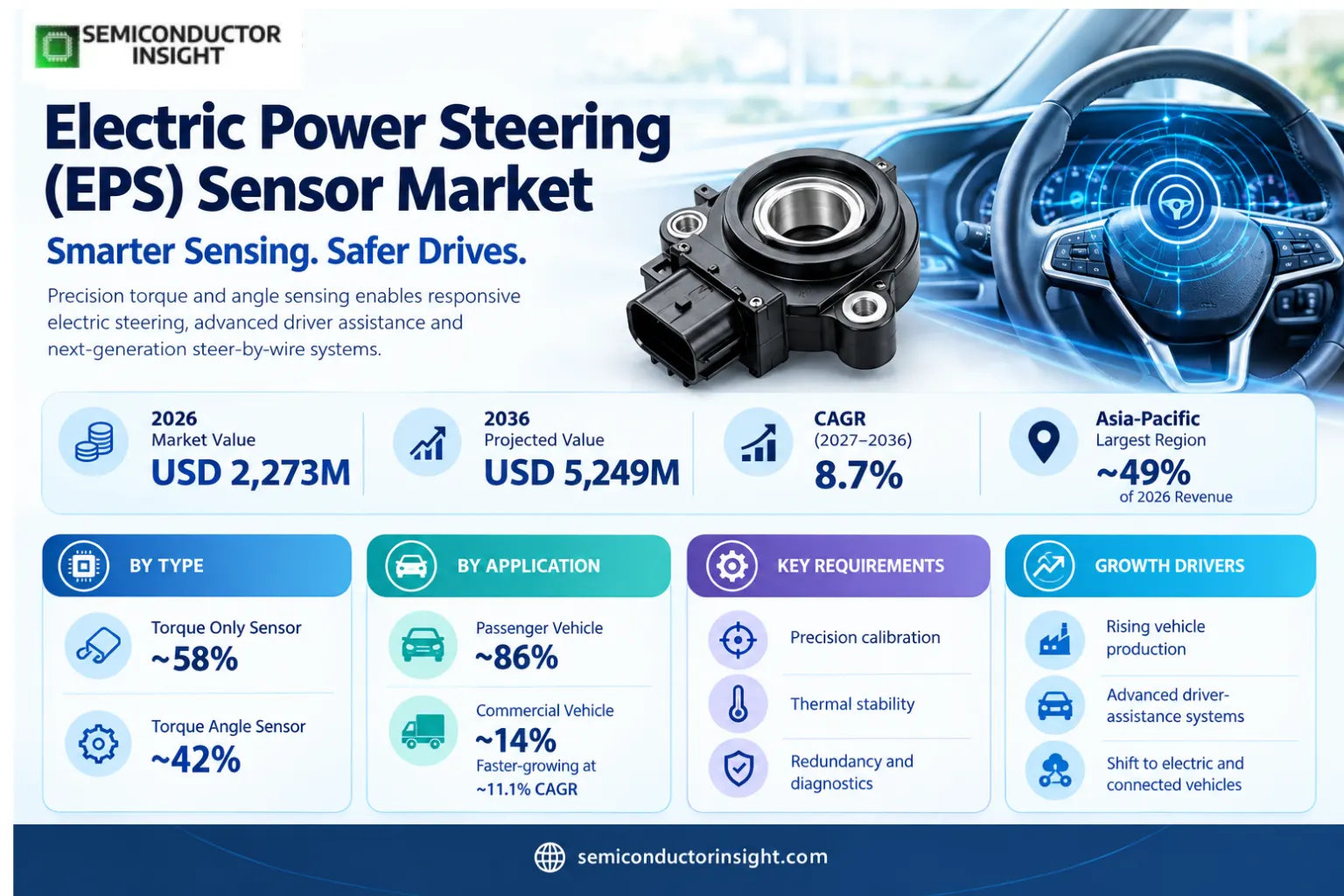
The electric power steering (EPS) sensor market was valued at USD 2,273 million in 2026 and is projected to reach USD 5,249 million by 2036, expanding at a CAGR of 8.7% during 2027–2036. Asia-Pacific holds the largest 2026 revenue position at an estimated ~49%, with China, Japan, South Korea and India anchoring both vehicle production and qualified steering-component supply.

Get the sample PDF with study scope, segmentation and methodology details.

Key Statistics

2026 Market Size
USD 2,273 million
2036 Projected Size
USD 5,249 million
CAGR (2027–2036)
8.7%
Largest Market in 2026
Asia-Pacific (~49%)

Key Takeaways

  • Market value: The electric power steering (EPS) sensor market is valued at USD 2,273 million in 2026 and is projected to reach USD 5,249 million by 2036 at 8.7% CAGR, reflecting higher electronic steering penetration and more sensors per safety-critical system.
  • Torque-only sensors retain an estimated ~58% of 2026 component revenue, reflecting their installed base in column and pinion electric steering, while combined torque-angle units represent ~42% and grow faster at ~10.6% CAGR.
  • Passenger vehicles represent an estimated ~86% of sensor demand by revenue, while commercial vehicles account for ~14% and grow at ~11.1% CAGR as electric steering reaches larger trucks and delivery fleets.
  • Asia-Pacific leads with an estimated ~49% of 2026 revenue and grows at ~9.6% CAGR; the region produces over 61% of world vehicles, although its EPS sensor revenue share is lower because of differing electronic content and component pricing.
  • Functional safety is reshaping procurement: redundant TMR, GMR and Hall channels, ASIL-oriented diagnostics and high-temperature operation are increasingly important as steer-by-wire programs enter series production in China and Europe.

Electric Power Steering (EPS) Sensor Market Overview

The electric power steering (EPS) sensor market was valued at USD 2,273 million in 2026 and is projected to reach USD 5,249 million by 2036, expanding at a CAGR of 8.7% during 2027–2036. Asia-Pacific holds the largest 2026 revenue position at an estimated ~49%, with China, Japan, South Korea and India anchoring both vehicle production and qualified steering-component supply.

Base year: 2026 · Estimated year: 2027 · Forecast period: 2027–2036 · Historical data: 2021–2025 · Values in USD million

Electric power steering sensors convert steering-wheel torque, shaft rotation or motor rotor position into signals that allow an electronic control unit to command electric assistance. A conventional EPS unit commonly senses deformation across a torsion bar; magnetic fields from a pole wheel are read by Hall, giant magnetoresistive or tunnel magnetoresistive elements. Bosch specifies a torque measuring range of plus or minus 10 newton-metres and 0.015 newton-metre resolution for its Servolectric sensor, which operates from minus 40 to plus 125 degrees Celsius. Those tolerances illustrate why sensor calibration and magnetic design are automotive safety functions rather than commodity electronics.

The monetary boundary covers torque-only sensing assemblies, combined torque-angle sensing modules and their automotive-qualified electronics when sold into electric power steering, including OEM replacement and aftermarket units. It does not include the complete steering rack, assist motor, steering ECU, hydraulic pump or general-purpose wheel-position sensors sold into unrelated chassis applications. When an integrated steering unit is sold as one system, only the attributable sensor value belongs to this component market; otherwise a supplier that makes a complete rack would distort the apparent sensor opportunity.

Electronic steering adoption has followed the migration away from hydraulic assistance and the spread of driver-assistance functions. Bosch describes column systems delivering up to 100 newton-metres of assist torque for small and midsize vehicles, while Nexteer offers single- and dual-pinion and rack-assist architectures for heavier loads. Each configuration changes the sensing location, cable routing and redundancy strategy. Column systems prioritize compact low-cost integration, whereas rack and pinion systems expose sensors to greater vibration, temperature swings and demanding sealing conditions.

The demand backdrop is geographically concentrated. OICA reported roughly 59.2 million vehicles produced in Asia-Pacific in 2025, more than 61% of global production, with China reaching 34.53 million and India 6.49 million units. Those counts do not equal sensor revenue: the mix of passenger and commercial vehicles, supplier sourcing, integrated-system pricing and regional import flows must also be considered. Europe contributes premium steering engineering and safety-critical semiconductor supply, while North America has substantial pickup, SUV and light-commercial steering demand.

Steer-by-wire introduces an additional content opportunity without replacing every EPS torque sensor overnight. ZF began supplying the NIO ET9 with redundant electronic steering actuators in February 2025, and Nexteer reported its first series-production steer-by-wire program in April 2026. Redundant driver-input and actuator-position measurement becomes more important when the mechanical connection is removed. However, hydraulic commercial-vehicle platforms and cost-sensitive legacy vehicles remain addressable markets, so growth is uneven by architecture rather than a uniform conversion of the global vehicle fleet.

Segment Analysis: By Type

By type, the EPS sensor market comprises Torque Only Sensor and Torque Angle Sensor. Torque-only designs account for an estimated ~58% of 2026 revenue because they are embedded in high-volume assist systems; integrated torque-angle devices contribute ~42% and are expected to expand at ~10.6% CAGR as automated steering functions require more information and more diagnostics from the steering column.

Type Function Market position
Torque Only Sensor A torsion bar twists under steering input, and a Hall, GMR or magnetoresistive sensing bridge converts that displacement into a torque signal. The ECU uses the signal with vehicle speed and other control inputs to determine assist current. Bosch lists a plus-or-minus 10 newton-metre range and minus 40 to plus 125 degree operating envelope, showing the calibration, sealing and temperature requirements that distinguish production steering sensors from general industrial transducers. Largest type (~58% of 2026 revenue; ~7.2% CAGR). Existing column- and pinion-assist EPS platforms dominate installed production programs and sustain replacement volumes. Competitive pricing is particularly intense on single-channel designs, but redundant outputs, traceability and long-term qualification preserve value in safety-critical OEM contracts. Growth is slower than for combined modules because conventional platforms already have broad penetration and face design migration toward richer angle feedback.
Torque Angle Sensor Combines measurement of steering effort with steering-wheel or shaft angle, sometimes using separate redundant elements and a multi-turn index. The additional signal supports lane-centering, return-to-center control, hands-on detection and electronic handwheel actuators. Nexteer describes custom-developed torque and rotation-angle sensors in its modular column EPS platform; Allegro offers a 360-degree dual-channel TMR angle IC with diagnostic functions for EPS and steer-by-wire. Fastest-growing type (~42% share; ~10.6% CAGR). OEMs pay a premium for integrated measurement when it reduces wiring, calibration work and the number of separately qualified components. Adoption accelerates in premium passenger cars, high-availability rack steering and by-wire platforms. The higher electronic content also increases exposure to magnetic-interference testing, functional-safety documentation and system-level failure-mode analysis before a design can enter series production.

Torque sensing principles and price differentiation

Hall-effect sensing remains relevant for cost-sensitive steering units because it supports established manufacturing flows and robust non-contact measurement. GMR and TMR technologies provide alternative sensitivity and angular accuracy, but device choice depends on magnet geometry, air gap, temperature drift and diagnostics rather than sensor physics alone. JTEKT documented a waterproof Hall IC torque sensor designed to improve cost, reliability and temperature compensation; Bosch uses a magnetoresistive element in Servolectric. Both approaches can meet production needs when mechanical tolerances and ECU calibration are properly matched.

Integrated torque-angle modules and redundancy

Combined sensing increases design value because angle and effort signals must remain mutually consistent during driver input and automated interventions. The Allegro A33110 has a primary TMR channel with 14-bit noise-free resolution and a secondary channel with 10-bit resolution; the A33115 adds a turns counter. These are sensing IC specifications, not complete steering module selling prices, but they illustrate the shift toward redundant electronics. Supplier differentiation increasingly depends on proof of fault detection, signal integrity under stray fields and stable output after repeated temperature cycles.

Segment Analysis: By Application

By application, Passenger Vehicle platforms account for an estimated ~86% of 2026 EPS sensor revenue, reflecting their far larger production base and the rapid rollout of column and pinion electric assistance. Commercial Vehicle systems represent ~14%, but growth of ~11.1% CAGR is faster as 24-volt truck architectures, electric delivery fleets and redundant automated-driving systems open new sensing positions.

Application Demand characteristics
Passenger Vehicle Largest application (~86% share; ~8.3% CAGR). Compact cars favor low-cost column EPS, while SUVs and premium sedans increasingly use pinion or rack assistance with richer sensing and diagnostic requirements. OICA reported China produced 34.53 million vehicles in 2025 and Japan 8.41 million, underpinning Asia-Pacific sensor volumes. European electric vehicles and software-defined platforms add demand for high-integrity angle sensing, but replacement cycles and model mix mean revenue grows more slowly than the number of features promoted in vehicle marketing.
Commercial Vehicle Faster-growing application (~14% share; ~11.1% CAGR). Electric delivery vans, medium trucks and selected heavy vehicles are moving toward fully electric steering and redundant control, creating demand for sensors that survive higher mechanical loads and extended duty cycles. Bosch ServoE uses dual steering control units and an electric motor architecture for commercial vehicles; the sensor interface supplies the steering demand. Adoption is constrained by packaging, 24-volt electronics and rigorous reliability requirements, so unit volumes remain below passenger-car levels even as sensor value per vehicle rises.

The vehicle-platform mix matters more than the total number of steering racks sold. A conventional passenger-car column system typically needs a torque measurement channel and motor commutation feedback, whereas a steer-by-wire vehicle can add independent handwheel position, roadwheel actuator position and diagnostic channels. These are different revenue opportunities within the same vehicle, but general motor-current sensing and the full actuator should not be counted as EPS torque-angle sensor revenue. Sales through OEM production programs remain dominant, while the aftermarket is limited by safety qualification and calibration complexity.
Electric Power Steering (EPS) Sensor Market, Global Outlook and Forecast 2026–2036

Regional Analysis

Asia-Pacific leads with an estimated ~49% of global EPS sensor revenue in 2026 and is projected to grow at ~9.6% CAGR, ahead of North America (~22%) and Europe (~20%). The regional estimates are anchored to vehicle production, OEM sourcing and technology mix rather than presented as directly reported sensor sales. South America (~6%) and Middle East & Africa (~3%) are smaller markets with greater dependence on imported steering components and global platform specifications.

Where are EPS sensor volumes concentrated and which regions have the strongest upgrade cycle?

Regional market structure reflects three overlapping factors: where vehicles are assembled, where steering components are qualified and manufactured, and which models carry high-value redundant sensing. Asia-Pacific dominates vehicle output, while Germany, Japan and the United States are important for premium safety architecture and semiconductor design. A production-share proxy alone would overstate Asian revenue because high-value steering electronics are also shipped to North American and European plants. The estimated regional growth rates therefore differentiate platform electrification, steer-by-wire introduction and the slower replacement cycle in mature vehicle fleets.

Region Position Growth outlook Demand profile What decides supplier selection
Asia-Pacific Largest (~49%) Highest (~9.6% CAGR) China, Japan, India and Korea vehicle output Local OEM qualification, price and production traceability
North America Second (~22%) Moderate (~8.2% CAGR) SUV, pickup and light-commercial platforms Automotive safety qualification and Tier-1 sourcing
Europe Third (~20%) Mature (~7.5% CAGR) Premium passenger and advanced steering ASIL documentation, software integration and lifecycle
South America Fourth (~6%) Selective (~7.6% CAGR) Brazilian production and imported platforms Landed cost, service network and component availability
Middle East & Africa Fifth (~3%) Emerging (~7.7% CAGR) Assembly programs and imported vehicle fleets Distribution, environmental qualification and support

Asia-Pacific LARGEST · ~49% SHARE · FASTEST-GROWING

Why does Asia-Pacific lead EPS sensor demand?

Asia-Pacific accounts for an estimated ~49% of 2026 EPS sensor revenue and has the fastest modeled growth at ~9.6% CAGR. OICA records more than 61% of global vehicle production in the region, led by China at 34.53 million units and Japan at 8.41 million in 2025. Domestic and multinational steering suppliers qualify sensors for large passenger-car programs, while Chinese new-energy platforms are advancing steer-by-wire. The regional revenue share is lower than vehicle-production share because higher-priced steering architectures and imported sensors contribute significant value elsewhere.

Market positionLargest (~49%)
Growth outlook~9.6% CAGR
Demand profileHigh-volume vehicle assembly and EV platforms
Market access gateOEM validation and cost-down discipline
Country Position in region What drives demand
China Largest production base China produced 34.53 million vehicles in 2025, including 16.626 million new-energy vehicles according to OICA, making it the principal volume driver for steering sensor programs. ZF began supplying redundant steer-by-wire actuators for the NIO ET9 in February 2025, and Nexteer started its first series-production by-wire program with a Chinese manufacturer in April 2026. These projects raise demand for reliable angle feedback, but their initial volumes are much smaller than conventional EPS in mass-market models.
Japan Mature supplier hub Japan produced 8.41 million vehicles in 2025, sustaining a broad base of steering system engineering and precision sensor production. JTEKT describes Hall IC torque sensing and column or rack EPS designs, while its electronics affiliate states that it develops and manufactures EPS torque sensors. The region is important for qualification and exports as well as domestic vehicle assembly, with long supplier relationships favoring consistent calibration, reliability and documentation rather than rapid vendor substitution.
India Expanding platform base India produced 6.49 million vehicles in 2025 and is a major source of compact passenger cars and light commercial vehicles. Lower-cost column EPS is commercially attractive where packaging space and price sensitivity dominate, but hybrid and battery-electric programs increasingly require integrated steering electronics. Local assembly and imported ICs coexist, so a sensor supplier needs application engineering, thermal validation and dependable logistics before its product can be nominated into high-volume models.
South Korea Technology-intensive producer South Korean automakers participate in global SUV and electrified vehicle platforms, creating demand for safety-oriented torque and angle sensing even when components are sourced internationally. Steering electronics programs are tied to launch schedules and shared architectures rather than to local aftermarket demand. High-output electric assistance and automated lane-keeping functions favor redundant signal paths, while supplier approval requires evidence of stable accuracy after thermal cycling, vibration and electromagnetic interference testing.

Market instances

  • China is the global production center. OICA recorded 34.53 million Chinese vehicles produced in 2025 and 16.626 million new-energy vehicles, a 29% rise in that category. High-volume electric and hybrid platforms increase the number of qualified EPS programs and provide a strong commercial foundation for sensor suppliers. However, new-energy vehicle output is a vehicle-production statistic rather than an observed share of EPS sensor revenue, so the regional allocation remains an estimated ~49% rather than a direct conversion of output counts.
  • Nexteer entered series production of steer-by-wire. On 28 April 2026 Nexteer reported its first series-production steer-by-wire program for a Chinese new-energy vehicle. The system achieved ASIL D functional-safety approval in late 2025, demonstrating a move beyond prototype validation. That milestone is commercially relevant to EPS sensors because removing the mechanical steering link increases the need for independent handwheel and roadwheel position signals, reliable diagnostics and fail-operational electronic control.
  • Japan combines mature systems with sensor engineering. JTEKT has documented Hall IC torque sensor development and an electric power steering architecture in which the torque signal is sent to the ECU before motor current is commanded. These primary engineering disclosures connect sensor design directly to the steering function. Japanese demand is therefore not only domestic vehicle production; it also includes export-oriented qualification, manufacturing and technical support for programs assembled in China, North America and Europe.
In the full report: country-level steering sensor revenue and component demand for China, Japan, South Korea, India and Southeast Asia, with segmentation by sensor type, vehicle platform and OEM versus aftermarket supply.

North America SECOND LARGEST · ~22% SHARE

What sustains North American steering sensor revenue?

North America holds an estimated ~22% of 2026 EPS sensor revenue and expands at ~8.2% CAGR. Its mix of SUVs, pickups and light commercial vehicles creates demand for higher steering-assist capacity, while premium driver-assistance packages support angle and diagnostic content. OICA recorded 16.68 million vehicle sales in the United States during 2025, but sales should not be mistaken for local sensor production. Most electronic steering components enter through global Tier-1 contracts, and North American buyers emphasize lifecycle support, safety evidence and qualified supply continuity.

Market positionSecond (~22%)
Growth outlook~8.2% CAGR
Demand profilePickup, SUV and commercial programs
Market access gateProgram-level safety validation
Country Position in region What drives demand
United States Largest regional demand OICA reported 16,675,488 motor vehicles sold in the United States in 2025, supporting a broad installed base of passenger and commercial steering systems. Pickup and SUV programs can require more assist force than compact cars, and automated lane-centering raises demand for reliable steering-angle feedback. Sensor revenue is primarily attached to OEM vehicle platforms rather than to independent replacement channels, since safety-critical steering calibration makes many repairs assembly-level operations.
Mexico Manufacturing integration hub Mexico is a major North American automotive assembly location with steering modules and electronic parts moving through cross-border supply chains. Vehicle platforms built for the United States and Canada use the same functional-safety specifications, but purchasing and qualification often occur at a global Tier-1 supplier. Local demand for EPS sensors therefore depends on model allocations and component localization, not merely on the number of vehicles registered in Mexico in a given year.
Canada Established assembly and fleet base Canada supports North American steering demand through vehicle assembly, engineering and an extensive installed fleet. OEMs often share steering architectures across US and Canadian variants, which reduces the need for separate sensor designs but increases the importance of consistent validation under cold-weather conditions. Replacement activity is concentrated in qualified service parts and full steering assemblies, while new sensor nominations follow North American model-year cycles and Tier-1 platform awards.

Market instances

  • US sales support high-value vehicle mix. OICA lists 16.68 million US motor-vehicle sales in 2025, including a substantial commercial-vehicle component. Higher assist loads and premium safety functions can raise the value of sensing electronics per steering unit, even where the number of vehicles assembled locally is lower than the number sold. The resulting North American revenue share is modeled at ~22%, with the vehicle-sales figure serving as demand context rather than a direct sensor-revenue observation.
  • Bosch supports passenger and commercial EPS architectures. Bosch describes passenger-car EPS systems that use torque sensor signals to calculate assistance and its ServoE commercial steering platform with two steering control units. The latter can support automated driving functions up to SAE Level 4. These technical capabilities matter to North American pickup and truck applications because the sensing chain must work with higher mechanical loads and a greater range of power and control architectures.
  • Safety qualification limits easy supplier switching. A steering torque sensor is usually validated with its magnet, torsion bar, ECU and actuator rather than purchased as a generic interchangeable chip. Once a model enters production, changes can trigger new environmental, functional-safety and software testing. North American purchasing therefore rewards long product availability, traceable manufacturing and field-failure performance, helping explain why aftermarket sensor sales remain a small fraction of the ~22% modeled regional revenue.
In the full report: country-level EPS sensor demand for the United States, Mexico and Canada, including light-truck versus passenger platforms, OEM nominations, replacement channels and qualification criteria.

Europe THIRD LARGEST · ~20% SHARE

How do European safety requirements affect sensor selection?

Europe accounts for an estimated ~20% of 2026 EPS sensor revenue and grows at ~7.5% CAGR. Premium passenger-car programs, advanced driver assistance and a strong automotive semiconductor base support higher-value sensing even as vehicle production expands more slowly than in Asia. ACEA reported battery-electric cars reached 17.4% of EU new registrations in 2025, with hybrids at 34.5%. The region is also a center for automotive functional-safety engineering, so redundant channels, diagnostics and long-term supply support are important purchasing factors.

Market positionThird (~20%)
Growth outlook~7.5% CAGR
Demand profilePremium and electrified vehicle mix
Market access gateASIL compliance and traceability
Country Position in region What drives demand
Germany Engineering and OEM anchor Germany is a center for premium vehicle engineering and steering system development, and OICA recorded 3.21 million vehicle sales there in 2025. Bosch designs complete EPS systems and magnetoresistive torque sensors, while Infineon supplies the TLE5012B angle sensor with a listed EPS application. Vehicle programs demand traceable safety documentation and long service lives, which supports premium sensor architectures despite more modest local volume growth than in Asia-Pacific.
France Supplier and vehicle base France registered 1.63 million passenger cars in 2025 according to OICA and participates in pan-European vehicle platforms that share steering hardware. Purchasing decisions emphasize compatibility with electronic control architectures, durability and compliance across several model variants. Sensor producers serving French OEMs may ship through Tier-1 suppliers located in Germany, Central Europe or elsewhere, so national registrations are not a direct measure of where the sensors are manufactured.
United Kingdom Engineering-led market The United Kingdom recorded about 2.40 million total motor-vehicle sales in 2025 according to OICA, and its automotive engineering base contributes to steering software, testing and high-performance vehicle applications. Sensor suppliers compete on precise angular response, electromagnetic immunity and traceable calibration, particularly for assisted-driving functions. Production volumes are smaller than in Germany or Asia, so the country is more important for engineering requirements and premium programs than for mass sensor fabrication.
Italy and Central Europe Integrated production network Italy, Czechia, Slovakia, Poland and neighboring countries participate in a tightly linked European vehicle and component supply chain. A steering sensor may be designed in Germany, packaged elsewhere and assembled into a rack or column in another country before final vehicle production. This fragmentation makes supply-chain resilience and cross-plant calibration consistency important. OEMs seek compatible variants across combustion, hybrid and battery-electric models while balancing price against the cost of requalification.

Market instances

  • EU battery-electric penetration continued to rise. ACEA reported 1,880,370 battery-electric passenger-car registrations in the EU in 2025, representing 17.4% of new registrations, compared with 13.6% in 2024. Hybrid-electric vehicles represented 34.5%. Electrification does not automatically add a second EPS torque sensor, but it often accompanies new electronic architectures and driver-assistance features that can increase the value of steering position and diagnostic sensing in premium programs.
  • ZF put steer-by-wire into the NIO ET9. On 17 February 2025 ZF announced production supply of its steer-by-wire system for the NIO ET9, including a handwheel actuator, redundant steering gear actuator and software. Although the vehicle is Chinese, the project illustrates European engineering influence on by-wire sensing architectures. It also shows why a component-market boundary must isolate torque and position sensor value from the much larger price of the complete steering system.
  • TDK advanced redundant TMR sensing. TDK announced its TAS8240 angle sensor on 20 June 2024, describing four separate sine/cosine outputs, plus-or-minus 1.0 degree accuracy over minus 40 to plus 150 degrees Celsius and applicability to power steering motors. Such devices help European OEMs pursue higher system safety levels and fail-operational control. These specifications are supplier capabilities, not evidence that any one chip family holds a stated percentage of the European EPS sensor market.
In the full report: country-level analysis for Germany, France, the United Kingdom, Italy, the Nordics and Central Europe, with OEM platform sourcing, steering technology and automotive safety requirements.

South America FOURTH · ~6% SHARE

What drives the South American EPS sensor opportunity?

South America represents an estimated ~6% of 2026 EPS sensor revenue, growing at ~7.6% CAGR. Brazil anchors both assembly and demand, with OICA recording 2.69 million motor-vehicle sales in 2025, while Argentina contributes smaller passenger and commercial vehicle programs. Many steering components arrive through global Tier-1 systems and imports, so local supplier opportunities depend on model localization, exchange rates and aftermarket service availability. Cost-sensitive platforms favor proven torque-only designs over expensive redundant sensing unless the vehicle specification requires additional functions.

Market positionFourth (~6%)
Growth outlook~7.6% CAGR
Demand profileBrazil-led vehicle assembly
Market access gateCurrency exposure and import costs
Country Position in region What drives demand
Brazil Largest regional market Brazil recorded 2,689,634 motor-vehicle sales in 2025, including about 1,997,264 passenger cars according to OICA. The country hosts multinational vehicle assembly and component supply, creating demand for EPS sensors installed into locally built platforms. Lower-priced compact vehicles often use established torque-only designs, while higher-content SUVs and hybrids provide opportunities for combined torque-angle modules. Import duties, local content rules and currency fluctuations affect component sourcing and final selling prices.
Argentina Smaller production market Argentina contributes vehicle assembly and an established aftermarket but has more volatile purchasing conditions than Brazil. EPS sensor orders follow global model allocations and the ability of suppliers to deliver qualified components through local Tier-1 channels. Standalone replacement sensors face practical limitations because steering systems may require recalibration after repair. Import financing and currency movements can alter purchasing timing even when the number of vehicles requiring steering assistance changes little.
Chile and Colombia Import-led demand Chile and Colombia rely heavily on imported passenger vehicles and light trucks, so their EPS sensor demand is embedded in finished vehicles rather than driven by local component manufacturing. Service demand is mainly channeled through authorized repair networks and qualified replacement assemblies. As vehicle electronics become more complex, diagnostic equipment and software access are increasingly important for repairs, but the independent market for loose sensors remains small relative to OEM installed value.

Market instances

  • Brazil is the main regional demand center. OICA reported about 2.69 million motor vehicles sold in Brazil in 2025, a substantially larger market than any single neighboring country. That installed-base and production context supports the estimated ~6% South American share of EPS sensor revenue, although it cannot be translated directly into sensor sales. Suppliers must consider the mix of compact vehicles, imported steering racks and local assembly when assessing which portion of regional vehicle spending reaches the sensor level.
  • Low-cost column EPS supports mass-market models. JTEKT explains that column-assist EPS places the motor and ECU inside the cabin, reducing waterproofing requirements and helping compact vehicle packaging. This architecture is commercially relevant to South American mass-market vehicles, where purchase price and repair cost can outweigh premium automated-steering features. It creates steady demand for reliable torque sensing but limits the average selling price achievable by suppliers of high-end redundant angle devices.
  • Import dependence increases qualification importance. Global automotive manufacturers frequently reuse steering systems across multiple markets, allowing Brazilian and Argentine programs to benefit from existing validated designs. The same strategy means a local sensor substitution is difficult without fresh calibration and safety evidence. Distributors can serve maintenance and prototype demand, but production supply is typically secured through Tier-1 nominations, so commercial access depends more on program awards than on broad catalog availability.
In the full report: country-level EPS sensor value and demand for Brazil, Argentina and the wider region, including localized assembly, imported steering modules and OEM versus service replacement.

Middle East & Africa FIFTH · ~3% SHARE

How is EPS sensor demand developing in the Middle East and Africa?

Middle East and Africa accounts for an estimated ~3% of 2026 EPS sensor revenue, with modeled growth of ~7.7% CAGR. The region is predominantly a destination for imported vehicles and qualified replacement assemblies, although South Africa and Morocco have meaningful vehicle assembly activity. Passenger-car electrification and higher driver-assistance content can raise sensing value over time, but the addressable component market is constrained by relatively limited local sensor manufacturing. Supplier access therefore depends on global platform approvals, distributor coverage and the ability to support harsh-temperature service conditions.

Market positionFifth (~3%)
Growth outlook~7.7% CAGR
Demand profileImported vehicles and selected assembly hubs
Market access gateDistribution and environmental support
Country Position in region What drives demand
South Africa Regional manufacturing base South Africa has established passenger and commercial vehicle assembly operations serving domestic and export markets. EPS sensor demand is mainly attached to global OEM steering platforms, with a smaller replacement channel through service networks. Component suppliers must address long transport distances, inventory availability and heat exposure, while avoiding assumptions that all locally assembled vehicles use domestically manufactured sensors. Engineering requirements are set by the original steering system design and functional-safety documentation.
Morocco Export-oriented assembly hub Morocco has become an automotive manufacturing and export location connected to European vehicle supply chains. Sensors may be imported as part of complete steering columns or racks and installed into vehicles destined for Europe, which makes factory demand more important than domestic registration figures. Supplier opportunities depend on integration into approved Tier-1 bills of materials and predictable delivery to assembly plants; local value addition at the sensor-chip level is comparatively limited.
Saudi Arabia and UAE High-value import markets Saudi Arabia and the United Arab Emirates purchase a broad mix of imported passenger cars, SUVs and commercial vehicles. Sensor value is largely captured when vehicles are manufactured abroad, while regional demand for replacement units follows authorized service channels. High ambient temperatures and dust exposure raise the importance of environmental qualification, but these requirements are usually specified by the global vehicle manufacturer rather than by a separate local steering-sensor standard.

Market instances

  • Assembly and sales have different geographic meanings. South Africa and Morocco host vehicle assembly that may consume imported steering systems, while Gulf markets purchase many finished vehicles with EPS already installed. This difference matters when assigning the estimated ~3% regional revenue share: local vehicle sales do not automatically translate into local sensor manufacturing. A consistent revenue model must count the component once at the point of its qualified sale, rather than counting both imported modules and finished vehicle purchases.
  • Thermal durability matters in service. Bosch specifies a minus 40 to plus 125 degree Celsius operating range for its Servolectric torque sensor, illustrating the environmental demands placed on steering electronics. In hot climates, temperature stability, sealed connectors and diagnostic fault handling influence long-term reliability. Such requirements can support premium pricing for qualified parts, but do not imply that local buyers will independently select a different sensor from the original vehicle system.
  • Aftermarket activity is constrained by calibration. Steering torque and angle sensors are integrated with control-unit software and often require recalibration after replacement. In markets with long vehicle service lives, that favors authorized workshops and complete assemblies over generic sensor substitutions. Suppliers with technical support and access to diagnostic procedures may capture service demand, but the aftermarket remains only a small portion of the modeled global EPS sensor market, with OEM programs accounting for about ~94%.
In the full report: country-level market value and steering component channels for South Africa, Morocco, Saudi Arabia, the UAE and the wider region, including import dependence and service replacement.

Key Electric Power Steering (EPS) Sensor Manufacturers and Competitive Landscape

Competition in EPS sensing spans complete steering-system integrators and specialist magnetic sensor suppliers. Bosch, JTEKT and Nexteer engineer torque-sensing assemblies as part of qualified steering systems; Allegro, Infineon, TDK and Melexis supply sensing ICs or rotor-position components that may be designed into such assemblies. These are different tiers of the value chain, so the market should not treat a complete rack supplier and a bare sensor-chip supplier as interchangeable competitors for the same invoiced component revenue.

Bosch publishes an EPS torque sensor data sheet specifying magnetoresistive measurement, a plus-or-minus 10 newton-metre range and a minus 40 to plus 125 degree Celsius temperature envelope. JTEKT describes a Hall IC torque sensor with waterproof construction, while its electronics affiliate identifies EPS torque sensor manufacturing among its automotive products. These disclosures support direct participation in steering sensing rather than relying on a general automotive component catalog. Supplier qualification is linked to the steering unit, its magnetic geometry and ECU software, making customer switching costly once vehicle production starts.

Nexteer competes primarily as a steering system integrator rather than a merchant supplier of stand-alone torque sensor chips. Its 2021 modular column EPS announcement specifically references custom-developed torque and rotation-angle sensors, and its 2023 modular rack EPS design describes high-performance torque and position sensing. ZF also integrates steering electronics and actuators, including a production steer-by-wire system for the NIO ET9. Their presence establishes demand for sensing technology but does not make full-system revenue comparable with semiconductor supplier sales.

At the component level, Allegro offers the A33110 and A33115 TMR angle devices with dual sensing channels and diagnostic functions; Infineon lists its TLE5012B iGMR angle sensor for EPS; TDK markets redundant TMR angle sensors for power steering motors; and Melexis specifies its MLX90517 inductive resolver for electric power steering. These suppliers compete on accuracy, safety integration, stray-field immunity and operating temperature. Their public product specifications do not disclose EPS-specific market revenue, so company-level automotive sales must not be substituted for the sensor market.

Price pressure is greatest for mature torque-only assemblies, where OEMs expect cost reductions across multi-year programs. Differentiation is stronger for redundant angle sensing, high-availability rack EPS and steer-by-wire applications, where diagnostic coverage and system architecture create switching barriers. The competitive field also includes local magnetic-component specialists and packaging providers, but these should be described as upstream suppliers unless a directly qualified EPS sensor product is verified. Product roadmaps and program nominations matter more than broad claims about global market share.

Tier structure

Tier Companies Basis of competition
System integrators Bosch, JTEKT, Nexteer, ZF Design complete EPS or steer-by-wire systems and integrate torque or position sensing into qualified vehicle platforms.
Sensing semiconductor specialists Allegro MicroSystems, Infineon Technologies, TDK, Melexis Supply Hall, GMR, TMR or inductive position ICs and safety features for integration by steering system suppliers.
Automotive electronics specialists JTEKT Electronics and qualified regional module assemblers Manufacture sensor modules, signal conditioning or calibrated electronics subject to customer-specific approvals.

Key companies profiled

  • Bosch
  • JTEKT
  • JTEKT Electronics
  • Nexteer Automotive
  • ZF
  • Allegro MicroSystems
  • Infineon Technologies
  • TDK
  • Melexis

Electric Power Steering (EPS) Sensor Production Capacity Analysis

EPS sensor capacity is governed less by nominal chip wafer starts than by the ability to ship calibrated, traceable and automotive-qualified assemblies. A semiconductor die, magnet carrier, torsion element and electronic interface must be validated together before the complete steering module can enter series production. Capacity can therefore be constrained by calibration stations, end-of-line functional testing or supplier qualification even when generic magnetic sensor chips are available in large volumes.

At the semiconductor stage, Hall, GMR, TMR and inductive sensing devices require stable wafer processing, automotive-grade packaging and controlled temperature drift. Allegro integrates dual-channel diagnostics into its A33110 and A33115 products, while TDK offers four redundant sine/cosine outputs on the TAS8240. Those architectures can increase testing requirements and the number of signals verified per unit. Production capacity should be assessed as qualified yield and test throughput rather than multiplying nominal wafer capacity by an assumed steering application share.

Module assembly adds mechanical operations that are not present in a catalog semiconductor sale. A steering torque sensor must align magnets, torsion bars and sensing elements within tolerances, then be calibrated against a known applied torque and checked across environmental conditions. Bosch publishes 0.015 newton-metre resolution for Servolectric and JTEKT documents waterproof Hall IC packaging. Such performance creates barriers to relocating production without a validated process transfer, and it makes field-failure records and traceability important parts of supplier capacity planning.

Global vehicle programs favor production close to major assembly regions but frequently centralize semiconductor fabrication. OICA reports Asia-Pacific made more than 61% of vehicles in 2025, which explains the concentration of steering-module assembly in China, Japan, Korea and India. European suppliers contribute specialized devices and engineering, while North American plants support pickup and SUV platforms. New capacity is most attractive when backed by multi-year OEM nominations; building unqualified sensor capacity ahead of design wins can leave equipment underutilized.

Electric Power Steering (EPS) Sensor Market Dynamics: Drivers, Restraints and Opportunities

The EPS sensor market grows through greater electric steering penetration, vehicle electrification and the movement from single-function torque feedback toward redundant torque-angle measurement. At the same time, strict functional-safety requirements, price negotiations and difficult calibration processes limit supplier entry. Opportunities concentrate in steer-by-wire handwheel and roadwheel actuators, higher-load commercial steering and magnetic sensing architectures that preserve accuracy despite stray fields and thermal cycling.

MARKET DRIVERS

Drivers Impact Analysis*

Driver (~) % impact on CAGR forecast Geographic relevance Impact timeline
Vehicle production and EPS penetration +1.8% Asia-Pacific and global platforms 2026–2031
Torque-angle and safety-content upgrades +1.3% Premium vehicles in Europe, China and North America 2027–2036
Commercial vehicle electrification +0.8% China, Europe and North America 2028–2036

Electronic assistance displaces hydraulic systems

Electric power steering eliminates the continuous hydraulic pump load of conventional steering and allows electronic control of assistance according to speed and driver input. JTEKT states that electric steering can improve fuel consumption by 3 to 5 percent relative to hydraulic designs, although the benefit varies by vehicle. Each new EPS platform requires reliable torque feedback and usually motor position information, creating a broad installed base of sensor demand. OICA records 2025 production of 34.53 million vehicles in China and 6.49 million in India, supporting the volume opportunity.

ADAS raises steering signal requirements

Lane centering, automated parking and stability functions require steering commands that remain predictable when driver torque, wheel angle and vehicle motion interact. Bosch describes EPS control interfaces for highly automated driving up to SAE Level 4, while Nexteer markets modular steering with high-performance torque and position sensors. This raises the value of diagnostic coverage and multi-channel measurement rather than simply increasing the number of basic torque sensors. Premium sensor architectures gain share as OEMs migrate to higher automated-driving levels and require documented failure handling.

Electrified and commercial vehicles expand addressable platforms

Battery-electric and hybrid vehicles favor electronically controlled steering because power-on-demand assistance integrates with their electrical architectures. ACEA reports 1.88 million EU battery-electric passenger-car registrations in 2025, and Bosch ServoE demonstrates fully electric steering for medium and heavy commercial vehicles. The commercial segment is smaller today but can use more robust sensing and redundant controls, especially where vehicles operate for long hours or support automated functions. Demand therefore shifts toward qualified higher-value modules even without proportional growth in vehicle unit production.

MARKET RESTRAINTS

Restraints Impact Analysis*

Restraint (~) % impact on CAGR forecast Geographic relevance Impact timeline
Safety validation and calibration cost −0.9% Global automotive supply chains Throughout forecast
OEM price pressure and platform reuse −0.6% High-volume Asian and European programs 2026–2036
Magnetic interference and temperature drift −0.4% EV and harsh-environment platforms 2027–2034

Functional-safety qualification delays design changes

Steering is safety-critical, so an EPS sensor must be validated with the ECU, actuator and mechanical interface, not merely shown to meet a chip data-sheet specification. Redundant output channels require fault-detection logic, diagnostic thresholds and failure-mode testing, often aligned with ISO 26262. Nexteer reported ASIL D approval for its first production steer-by-wire system in late 2025, demonstrating the depth of verification involved. New entrants may offer lower-cost components but still face long qualification cycles and customer reluctance to reopen approved steering architectures.

Mature torque sensors face aggressive pricing

Torque-only sensing is embedded in many existing column and pinion steering platforms, making it a large but cost-sensitive category. OEMs negotiate price reductions across long vehicle production cycles and often standardize one sensing design across several models. A supplier with an established qualification history can retain volume but may struggle to expand margins without better calibration yields or integration. The market therefore shifts value toward combined torque-angle modules and diagnostic functions even as the simpler type retains an estimated ~58% of revenue in 2026.

Environmental and electromagnetic requirements constrain suppliers

Electric motors, high-voltage traction equipment and compact steering packaging create magnetic interference and temperature-management challenges. Allegro emphasizes stray-field diagnostics in TMR angle devices, while TDK publishes accuracy across minus 40 to plus 150 degrees Celsius for TAS8240. The sensor must remain stable through vibration, humidity and long service life, so low-cost designs can fail qualification if calibration drifts or signal paths become inconsistent. These constraints increase engineering expense and slow the transfer of manufacturing between plants.

MARKET OPPORTUNITIES

Steer-by-wire creates multiple high-integrity sensing positions

Removing the mechanical connection between handwheel and roadwheels changes the role of steering feedback from assist calculation to direct electronic control. ZF announced NIO ET9 series production in February 2025, and Nexteer reported a production Chinese by-wire program in April 2026. Handwheel and roadwheel actuators need independent position and torque information with fault tolerance, creating opportunities for redundant TMR, GMR and inductive devices. However, complete actuator sales must be excluded from the sensor revenue boundary to avoid exaggerating the market.

Commercial EPS brings higher loads and duty cycles

Bosch ServoE uses two steering control units for commercial vehicles and supports automated functions up to SAE Level 4. Heavy vehicles operate under larger steering loads and more demanding duty cycles than compact passenger cars, increasing the value of robust sensor packaging and redundant feedback. Suppliers that can document calibration stability, thermal endurance and failure behavior can target truck and electric delivery-vehicle platforms, although development costs and lower production volumes mean commercial wins typically depend on a small number of OEM programs.

Inductive and TMR designs improve fault tolerance

TDK has released redundant TMR sensors for power steering motors, Allegro combines TMR and vertical Hall technologies in the A33110 family, and Melexis offers the MLX90517 inductive resolver with specified magnetic stray-field immunity. These approaches let designers trade accuracy, air-gap tolerance, packaging and safety diagnostics against cost. The commercial opportunity is strongest when a sensing device reduces system-level qualification effort or enables a compact fail-operational architecture rather than merely claiming better standalone resolution on a laboratory bench.

Electric Power Steering (EPS) Sensor Supply Chain Analysis

The EPS sensor supply chain connects magnetic materials, semiconductor devices and calibrated electromechanical modules to steering system integrators and vehicle OEMs. Value is created by precision, traceability and system-level qualification, not simply by the quantity of silicon shipped. A single steering assembly may contain multiple sensing channels, but market accounting should attribute the value of each sensor function only once and exclude the complete rack, motor and control-unit price.

UpstreamMagnets, torsion bars, Hall/GMR/TMR or inductive sensing dies, signal-conditioning ASICs and automotive packaging materials
ManufacturingWafer fabrication, sensor assembly, magnet alignment, calibration, thermal cycling and end-of-line functional tests
ChannelDirect Tier-1 and OEM program nominations; controlled automotive distribution for development and service parts
DownstreamPassenger cars, SUVs, pickups, vans, trucks and emerging steer-by-wire vehicle platforms

Upstream. Magnetic sensing starts with materials and device processes that determine temperature stability, noise and sensitivity. Hall elements remain common, while TMR and GMR devices enable alternative resolution and redundant-channel designs. Infineon specifies its TLE5012B iGMR angle sensor for EPS, and TDK markets redundant TMR devices for steering motors. Automotive qualification extends beyond the die to packaging, electromagnetic compatibility and long-term supply. Material substitutions can change sensor behavior, so upstream sourcing decisions are closely tied to the calibration process.

Manufacturing. Sensor modules combine electronics with a precisely controlled mechanical or magnetic geometry. Bosch Servolectric measures steering torque from torsion-bar deflection, and JTEKT describes a waterproof Hall IC assembly for steering applications. Manufacturing includes magnet placement, assembly alignment, calibration and verification of output signals across temperature and applied torque. A plant may have adequate semiconductor capacity but insufficient calibrated module throughput, making end-of-line testing and traceable quality data critical to reliable deliveries.

Distribution. Most EPS sensors reach vehicle production through direct steering-system Tier-1 contracts rather than open catalog purchases. Once a sensor is approved for a vehicle program, the supplier must maintain consistent electrical and mechanical characteristics for years, often across several factories and model derivatives. Semiconductor distributors are important for prototypes and engineering samples, while authorized service channels handle qualified replacement assemblies. Standalone aftermarket substitution is limited because many steering units require software pairing or recalibration.

Downstream. Vehicle manufacturers specify steering feel, automated-driving capability, packaging and safety performance, then work with Tier-1 integrators to choose the sensor architecture. OICA production figures show the scale of Asian passenger-vehicle manufacturing, while European premium platforms and North American pickups support differentiated sensor value. Steer-by-wire adds a new downstream application in which driver intention and roadwheel position must be measured electronically, but its initial adoption is concentrated in selected high-end models rather than the entire fleet.

Recent Developments in the Electric Power Steering (EPS) Sensor Market

  • 28 April 2026 Production
    Nexteer Automotive announced the start of series production for its first steer-by-wire program with a Chinese new-energy vehicle manufacturer. The system had achieved ASIL D functional-safety approval in late 2025, and its commercial launch confirms that redundant electronic steering has moved beyond laboratory demonstration. Sensor suppliers gain an addressable opportunity in independent handwheel and roadwheel measurement, although the complete by-wire actuator must not be counted as sensor revenue. Source
  • 27 January 2026 Published
    ACEA reported 1,880,370 battery-electric EU passenger-car registrations in 2025, equal to 17.4% of new registrations, alongside 34.5% hybrid-electric share. The mix shows how vehicle electrification is changing steering control architectures and qualification requirements. Battery-electric vehicles do not necessarily use more torque sensors than comparable combustion cars, but they create design refresh cycles in which advanced angle and diagnostic sensing can be specified. Source
  • 6 January 2026 Standards
    Nexteer reported participation in China’s chassis-by-wire standards group following release of GB 17675-2025 on 2 December 2025. National technical requirements are relevant to steer-by-wire because they influence safety, performance and testing of electronic steering functions. The commercial effect is to strengthen the case for traceable, redundant sensor architectures and to increase the documentation burden on suppliers seeking nominations in Chinese production programs. Source
  • 6 October 2025 Announced
    Nexteer introduced its Direct Drive Hand Wheel Actuator for steer-by-wire, compatible with 12-volt and 48-volt vehicle electrical architectures. The actuator targets software-defined vehicle integration and customized steering feel. From a sensing perspective, the announcement indicates demand for high-precision handwheel position and torque feedback that can be validated together with the control software, rather than for generic unqualified position chips. Source
  • 10 July 2025 Contract
    ZF announced that it would supply Mercedes-Benz with steer-by-wire technology beginning in 2026, following work on fully electronic steering architectures. The shift replaces a fixed mechanical steering connection with software-controlled actuation and changes the safety case for driver-input and roadwheel-position sensors. For the EPS sensor supply chain, it signals a potential rise in high-integrity sensing content per premium vehicle even as conventional column EPS remains the volume leader. Source
  • 17 February 2025 Production
    ZF announced series production of its steer-by-wire system for the NIO ET9, supplying both the handwheel and redundant steering gear actuators with associated software. This is a concrete automotive deployment rather than a conceptual technology roadmap. It highlights the role of sensor redundancy and signal validation in electronic steering, while the component revenue boundary excludes the much larger value of the complete actuator system. Source
  • 20 June 2024 Product
    TDK launched the TAS8240 redundant TMR angle sensor, specifying four independent sine/cosine outputs and angle accuracy of plus or minus 1.0 degree over minus 40 to plus 150 degrees Celsius. The company identifies electric power steering motors among the target applications. These capabilities support fault-tolerant motor-position measurement and illustrate how sensor suppliers compete on redundancy, environmental performance and automotive manufacturing qualification. Source
  • 17 April 2023 Product
    Nexteer announced a modular rack-assist electric power steering system for heavier vehicles, including electric vehicles and light commercial models. The design uses custom-developed high-performance torque and position sensors and supports SAE automated-driving Levels 3 through 5. This development connects sensor content to the expansion of electric steering into higher-load vehicle segments, where qualification and reliability requirements can justify more expensive sensing assemblies. Source

REPORT SCOPE & SEGMENTATION

Attribute Details
Study Period 2021–2036
Base Year 2026
Estimated Year 2027
Forecast Period 2027–2036
Historical Period 2021–2025
Market Size 2026 USD 2,273 million
Market Size 2036 USD 5,249 million
Growth Rate CAGR of 8.7% from 2027 to 2036
Unit Value (USD million)
Segmentation By Type, By Application, By Vehicle Type, By Sales Channel, and By Region
By Type Torque Only Sensor · Torque Angle Sensor
By Application Passenger Vehicle · Commercial Vehicle
By Vehicle Type ICE Vehicle · Hybrid Electric Vehicle · Battery Electric Vehicle
By Sales Channel OEM · Aftermarket
By Region Regional sensor revenue includes qualified OEM and service components, not complete steering racks or finished vehicles.
North AmericaUnited States, Canada, Mexico
EuropeGermany, France, United Kingdom, Italy, Nordics and Central Europe
Asia-PacificChina, Japan, South Korea, India and Southeast Asia
South AmericaBrazil, Argentina and Rest of South America
Middle East & AfricaSouth Africa, Morocco, Saudi Arabia, UAE and Rest of MEA
Key Companies Profiled Bosch · JTEKT · JTEKT Electronics · Nexteer Automotive · ZF · Allegro MicroSystems · Infineon Technologies · TDK · Melexis
Customization Scope Country-level vehicle-platform allocation, torque-only versus combined torque-angle revenue, OEM qualification, redundant sensing architectures and supplier product comparisons.

Frequently Asked Questions

What is the global electric power steering (EPS) sensor market size?

The market is valued at USD 2,273 million in 2026 and is projected to reach USD 5,249 million by 2036, growing at 8.7% CAGR over 2027–2036. The value covers steering torque and combined torque-angle sensor assemblies and attributable automotive-qualified sensing electronics, rather than complete steering racks, electric assist motors or vehicle sales. Growth reflects higher electronic steering penetration and increasing safety-related sensor content.

Which EPS sensor type has the largest share?

Torque Only Sensor holds an estimated ~58% of 2026 revenue, reflecting the installed base of column and pinion electric steering systems. Torque Angle Sensor contributes ~42% and is expected to grow faster at ~10.6% CAGR as automated driving, redundant diagnostics and integrated steering feedback become more common. These are modeled revenue shares, not publicly disclosed supplier shipment percentages.

Which EPS sensor application is growing fastest?

Commercial Vehicle is the faster-growing application at an estimated ~11.1% CAGR, although Passenger Vehicle remains much larger at ~86% of 2026 revenue. Heavy trucks, delivery vehicles and higher-load electric steering architectures need robust sensing and can support higher value per vehicle. Bosch ServoE demonstrates a redundant electric steering architecture for commercial vehicles, while passenger-car production provides the market’s main unit volume.

Which region leads EPS sensor revenue?

Asia-Pacific leads with an estimated ~49% of 2026 market revenue and grows at ~9.6% CAGR, supported by China, Japan, South Korea and India. OICA reports the region produced more than 61% of vehicles worldwide in 2025, but production share is not identical to component revenue share. North America follows at ~22% and Europe at ~20%, reflecting vehicle mix, supplier sourcing and high-value electronic content.

How do torque-only and torque-angle sensors differ?

Torque-only sensors measure steering effort, often from torsion-bar deflection, to help the ECU command electric motor assistance. Torque-angle modules also capture steering-wheel or shaft rotation, supporting functions such as return-to-center control, lane centering and by-wire feedback. Combined devices are generally more complex to calibrate and qualify, but they can reduce the number of separately integrated components in advanced steering architectures.

What role does steer-by-wire play in sensor demand?

Steer-by-wire removes the continuous mechanical connection between handwheel and roadwheels, making reliable electronic measurement and diagnostics central to the steering function. ZF supplied a production system for the NIO ET9 in 2025 and Nexteer reported its first production program in April 2026. The opportunity lies in redundant torque and position sensing at multiple actuators, not in treating the full steering-system price as sensor revenue.

What technologies are used in EPS magnetic sensing?

Hall-effect, giant magnetoresistance, tunnel magnetoresistance and inductive sensing all appear in steering-related designs. Bosch uses a magnetoresistive torque sensor; JTEKT has documented Hall IC torque sensing; Allegro and TDK offer redundant TMR angle devices; and Melexis lists an inductive resolver for EPS motor position. Technology choice depends on temperature stability, stray-field immunity, calibration, cost and the required automotive safety architecture.

How important is the OEM channel compared with aftermarket sales?

OEM supply accounts for an estimated ~94% of 2026 EPS sensor revenue, while aftermarket and service components represent ~6%. Steering sensors are commonly calibrated and validated as part of a complete rack or column, limiting the use of unqualified replacements. Production nominations typically run through Tier-1 steering integrators; aftermarket demand is concentrated in authorized service channels and qualified replacement assemblies.

Which vehicle powertrains generate the most EPS sensor revenue?

Internal-combustion vehicles retain an estimated ~55% of 2026 revenue because of their large installed production base, followed by hybrid-electric vehicles at ~29% and battery-electric vehicles at ~16%. Battery-electric platforms are modeled to grow fastest at ~12.9% CAGR, while hybrids expand at ~10.1%. These shares reflect vehicle mix and electronic content assumptions rather than direct sensor-revenue disclosures from automakers.

What limits the growth of the EPS sensor market?

The principal constraints are automotive functional-safety qualification, calibration complexity, long program nomination cycles and price pressure on mature torque-only assemblies. Sensors must withstand temperature variation, vibration and electromagnetic interference while preserving predictable steering signals. Suppliers also need traceable manufacturing and long-term product support. Higher-content by-wire systems offer attractive opportunities, but they introduce additional diagnostics and failure-mode testing that can slow commercialization.

Research Sources & Evidence Base

View research sources used for this overview
  1. Bosch Mobility. Servolectric torque sensor technical data sheet, magnetoresistive sensing principle, range, resolution and operating temperature
  2. Bosch Mobility. Electric power steering systems, torque feedback and ECU assist-control architecture
  3. Bosch Mobility. Electric power steering column, up to 100 newton-metres assist and integrated sensor placement
  4. Bosch Mobility. ServoE commercial electric steering, redundant steering control for trucks and automated functions
  5. Nexteer Automotive. Modular rack-assist EPS announcement, 17 April 2023 system launch and torque-position sensing
  6. Nexteer Automotive. Modular column EPS announcement, 22 October 2021 sensor integration and scalable architecture
  7. Nexteer Automotive. Steer-by-wire enters series production, 28 April 2026 production program and safety approval
  8. Nexteer Automotive. Direct Drive Hand Wheel Actuator, 6 October 2025 12-volt and 48-volt steer-by-wire development
  9. JTEKT. Electric steering system product overview, torque sensor signal path and steering architectures
  10. JTEKT. Waterproof Hall IC torque sensor engineering report, Hall IC design and environmental protection
  11. JTEKT Electronics. Automotive electronic device portfolio, direct EPS torque sensor manufacturing participation
  12. Infineon Technologies. TLE5012B-E9000 angle sensor, iGMR sensing and electric power steering application
  13. Allegro MicroSystems. A33110 precision TMR angle sensor, dual-channel angle sensing and diagnostics
  14. Allegro MicroSystems. A33115 TMR sensor with turns counter, automotive angle and multi-turn sensing capability
  15. Allegro MicroSystems. Electric power steering application guide, EPS angle sensing product portfolio
  16. TDK. TAS8240 redundant angle sensor launch, 20 June 2024 four-channel TMR and power steering motor applications
  17. TDK. TAS4240 angle sensor launch, 14 July 2022 redundant TMR for safety-critical steering
  18. Melexis. MLX90517 inductive resolver, EPS motor-position sensing and magnetic stray-field immunity
  19. ZF. NIO ET9 steer-by-wire series production, 17 February 2025 by-wire vehicle integration
  20. ZF. Steer-by-wire for Mercedes-Benz, 10 July 2025 supply announcement and software-controlled steering
  21. OICA. 2025 automotive production regional review, Asia-Pacific, China, India and Japan production counts
  22. OICA. 2025 motor-vehicle sales statistics, country sales for United States, Germany and Brazil
  23. ACEA. EU 2025 new car registration results, battery-electric and hybrid-electric vehicle registration mix
  24. Nexteer Automotive. China steer-by-wire standards research group, January 2026 discussion of GB 17675-2025 safety standard
Electric Power Steering (EPS) Sensor Market, Global Outlook and Forecast 2026–2036

Get Sample Report PDF for Exclusive Insights

Report Sample Includes

  • Table of Contents
  • List of Tables & Figures
  • Charts, Research Methodology, and more...

PDF Icon Download Sample Report PDF
SKU: 74cfc230219f
Category:

Download Sample Report

Table of Content

Table of Contents
1 Research Methodology and Statistical Scope
1.1 Market Definition and Statistical Scope of Electric Power Steering (EPS) Sensor
1.2 Key Market Segments
1.2.1 Electric Power Steering (EPS) Sensor Segment by Type
1.2.2 Electric Power Steering (EPS) Sensor Segment by Application
1.3 Methodology & Sources of Information
1.3.1 Research Methodology
1.3.2 Research Process
1.3.3 Market Breakdown and Data Triangulation
1.3.4 Base Year
1.3.5 Report Assumptions & Caveats
2 Electric Power Steering (EPS) Sensor Market Overview
2.1 Global Market Overview
2.1.1 Global Electric Power Steering (EPS) Sensor Market Size (M USD) Estimates and Forecasts (2026-2034)
2.1.2 Global Electric Power Steering (EPS) Sensor Sales Estimates and Forecasts (2026-2034)
2.2 Market Segment Executive Summary
2.3 Global Market Size by Region
3 Electric Power Steering (EPS) Sensor Market Competitive Landscape
3.1 Global Electric Power Steering (EPS) Sensor Sales by Manufacturers (2019-2025)
3.2 Global Electric Power Steering (EPS) Sensor Revenue Market Share by Manufacturers (2019-2025)
3.3 Electric Power Steering (EPS) Sensor Market Share by Company Type (Tier 1, Tier 2, and Tier 3)
3.4 Global Electric Power Steering (EPS) Sensor Average Price by Manufacturers (2019-2025)
3.5 Manufacturers Electric Power Steering (EPS) Sensor Sales Sites, Area Served, Product Type
3.6 Electric Power Steering (EPS) Sensor Market Competitive Situation and Trends
3.6.1 Electric Power Steering (EPS) Sensor Market Concentration Rate
3.6.2 Global 5 and 10 Largest Electric Power Steering (EPS) Sensor Players Market Share by Revenue
3.6.3 Mergers & Acquisitions, Expansion
4 Electric Power Steering (EPS) Sensor Industry Chain Analysis
4.1 Electric Power Steering (EPS) Sensor Industry Chain Analysis
4.2 Market Overview of Key Raw Materials
4.3 Midstream Market Analysis
4.4 Downstream Customer Analysis
5 The Development and Dynamics of Electric Power Steering (EPS) Sensor Market
5.1 Key Development Trends
5.2 Driving Factors
5.3 Market Challenges
5.4 Market Restraints
5.5 Industry News
5.5.1 New Product Developments
5.5.2 Mergers & Acquisitions
5.5.3 Expansions
5.5.4 Collaboration/Supply Contracts
5.6 Industry Policies
6 Electric Power Steering (EPS) Sensor Market Segmentation by Type
6.1 Evaluation Matrix of Segment Market Development Potential (Type)
6.2 Global Electric Power Steering (EPS) Sensor Sales Market Share by Type (2019-2025)
6.3 Global Electric Power Steering (EPS) Sensor Market Size Market Share by Type (2019-2025)
6.4 Global Electric Power Steering (EPS) Sensor Price by Type (2019-2025)
7 Electric Power Steering (EPS) Sensor Market Segmentation by Application
7.1 Evaluation Matrix of Segment Market Development Potential (Application)
7.2 Global Electric Power Steering (EPS) Sensor Market Sales by Application (2019-2025)
7.3 Global Electric Power Steering (EPS) Sensor Market Size (M USD) by Application (2019-2025)
7.4 Global Electric Power Steering (EPS) Sensor Sales Growth Rate by Application (2019-2025)
8 Electric Power Steering (EPS) Sensor Market Segmentation by Region
8.1 Global Electric Power Steering (EPS) Sensor Sales by Region
8.1.1 Global Electric Power Steering (EPS) Sensor Sales by Region
8.1.2 Global Electric Power Steering (EPS) Sensor Sales Market Share by Region
8.2 North America
8.2.1 North America Electric Power Steering (EPS) Sensor Sales by Country
8.2.2 U.S.
8.2.3 Canada
8.2.4 Mexico
8.3 Europe
8.3.1 Europe Electric Power Steering (EPS) Sensor Sales by Country
8.3.2 Germany
8.3.3 France
8.3.4 U.K.
8.3.5 Italy
8.3.6 Russia
8.4 Asia Pacific
8.4.1 Asia Pacific Electric Power Steering (EPS) Sensor Sales by Region
8.4.2 China
8.4.3 Japan
8.4.4 South Korea
8.4.5 India
8.4.6 Southeast Asia
8.5 South America
8.5.1 South America Electric Power Steering (EPS) Sensor Sales by Country
8.5.2 Brazil
8.5.3 Argentina
8.5.4 Columbia
8.6 Middle East and Africa
8.6.1 Middle East and Africa Electric Power Steering (EPS) Sensor Sales by Region
8.6.2 Saudi Arabia
8.6.3 UAE
8.6.4 Egypt
8.6.5 Nigeria
8.6.6 South Africa
9 Key Companies Profile
9.1 Robert Bosch
9.1.1 Robert Bosch Electric Power Steering (EPS) Sensor Basic Information
9.1.2 Robert Bosch Electric Power Steering (EPS) Sensor Product Overview
9.1.3 Robert Bosch Electric Power Steering (EPS) Sensor Product Market Performance
9.1.4 Robert Bosch Business Overview
9.1.5 Robert Bosch Electric Power Steering (EPS) Sensor SWOT Analysis
9.1.6 Robert Bosch Recent Developments
9.2 HELLA
9.2.1 HELLA Electric Power Steering (EPS) Sensor Basic Information
9.2.2 HELLA Electric Power Steering (EPS) Sensor Product Overview
9.2.3 HELLA Electric Power Steering (EPS) Sensor Product Market Performance
9.2.4 HELLA Business Overview
9.2.5 HELLA Electric Power Steering (EPS) Sensor SWOT Analysis
9.2.6 HELLA Recent Developments
9.3 LG
9.3.1 LG Electric Power Steering (EPS) Sensor Basic Information
9.3.2 LG Electric Power Steering (EPS) Sensor Product Overview
9.3.3 LG Electric Power Steering (EPS) Sensor Product Market Performance
9.3.4 LG Electric Power Steering (EPS) Sensor SWOT Analysis
9.3.5 LG Business Overview
9.3.6 LG Recent Developments
9.4 Valeo
9.4.1 Valeo Electric Power Steering (EPS) Sensor Basic Information
9.4.2 Valeo Electric Power Steering (EPS) Sensor Product Overview
9.4.3 Valeo Electric Power Steering (EPS) Sensor Product Market Performance
9.4.4 Valeo Business Overview
9.4.5 Valeo Recent Developments
9.5 Methode Electronics
9.5.1 Methode Electronics Electric Power Steering (EPS) Sensor Basic Information
9.5.2 Methode Electronics Electric Power Steering (EPS) Sensor Product Overview
9.5.3 Methode Electronics Electric Power Steering (EPS) Sensor Product Market Performance
9.5.4 Methode Electronics Business Overview
9.5.5 Methode Electronics Recent Developments
10 Electric Power Steering (EPS) Sensor Market Forecast by Region
10.1 Global Electric Power Steering (EPS) Sensor Market Size Forecast
10.2 Global Electric Power Steering (EPS) Sensor Market Forecast by Region
10.2.1 North America Market Size Forecast by Country
10.2.2 Europe Electric Power Steering (EPS) Sensor Market Size Forecast by Country
10.2.3 Asia Pacific Electric Power Steering (EPS) Sensor Market Size Forecast by Region
10.2.4 South America Electric Power Steering (EPS) Sensor Market Size Forecast by Country
10.2.5 Middle East and Africa Forecasted Consumption of Electric Power Steering (EPS) Sensor by Country
11 Forecast Market by Type and by Application (2025-2032)
11.1 Global Electric Power Steering (EPS) Sensor Market Forecast by Type (2025-2032)
11.1.1 Global Forecasted Sales of Electric Power Steering (EPS) Sensor by Type (2025-2032)
11.1.2 Global Electric Power Steering (EPS) Sensor Market Size Forecast by Type (2025-2032)
11.1.3 Global Forecasted Price of Electric Power Steering (EPS) Sensor by Type (2025-2032)
11.2 Global Electric Power Steering (EPS) Sensor Market Forecast by Application (2025-2032)
11.2.1 Global Electric Power Steering (EPS) Sensor Sales (K Units) Forecast by Application
11.2.2 Global Electric Power Steering (EPS) Sensor Market Size (M USD) Forecast by Application (2025-2032)
12 Conclusion and Key FindingsList of Tables
Table 1. Introduction of the Type
Table 2. Introduction of the Application
Table 3. Market Size (M USD) Segment Executive Summary
Table 4. Electric Power Steering (EPS) Sensor Market Size Comparison by Region (M USD)
Table 5. Global Electric Power Steering (EPS) Sensor Sales (K Units) by Manufacturers (2019-2025)
Table 6. Global Electric Power Steering (EPS) Sensor Sales Market Share by Manufacturers (2019-2025)
Table 7. Global Electric Power Steering (EPS) Sensor Revenue (M USD) by Manufacturers (2019-2025)
Table 8. Global Electric Power Steering (EPS) Sensor Revenue Share by Manufacturers (2019-2025)
Table 9. Company Type (Tier 1, Tier 2, and Tier 3) & (based on the Revenue in Electric Power Steering (EPS) Sensor as of 2022)
Table 10. Global Market Electric Power Steering (EPS) Sensor Average Price (USD/Unit) of Key Manufacturers (2019-2025)
Table 11. Manufacturers Electric Power Steering (EPS) Sensor Sales Sites and Area Served
Table 12. Manufacturers Electric Power Steering (EPS) Sensor Product Type
Table 13. Global Electric Power Steering (EPS) Sensor Manufacturers Market Concentration Ratio (CR5 and HHI)
Table 14. Mergers & Acquisitions, Expansion Plans
Table 15. Industry Chain Map of Electric Power Steering (EPS) Sensor
Table 16. Market Overview of Key Raw Materials
Table 17. Midstream Market Analysis
Table 18. Downstream Customer Analysis
Table 19. Key Development Trends
Table 20. Driving Factors
Table 21. Electric Power Steering (EPS) Sensor Market Challenges
Table 22. Global Electric Power Steering (EPS) Sensor Sales by Type (K Units)
Table 23. Global Electric Power Steering (EPS) Sensor Market Size by Type (M USD)
Table 24. Global Electric Power Steering (EPS) Sensor Sales (K Units) by Type (2019-2025)
Table 25. Global Electric Power Steering (EPS) Sensor Sales Market Share by Type (2019-2025)
Table 26. Global Electric Power Steering (EPS) Sensor Market Size (M USD) by Type (2019-2025)
Table 27. Global Electric Power Steering (EPS) Sensor Market Size Share by Type (2019-2025)
Table 28. Global Electric Power Steering (EPS) Sensor Price (USD/Unit) by Type (2019-2025)
Table 29. Global Electric Power Steering (EPS) Sensor Sales (K Units) by Application
Table 30. Global Electric Power Steering (EPS) Sensor Market Size by Application
Table 31. Global Electric Power Steering (EPS) Sensor Sales by Application (2019-2025) & (K Units)
Table 32. Global Electric Power Steering (EPS) Sensor Sales Market Share by Application (2019-2025)
Table 33. Global Electric Power Steering (EPS) Sensor Sales by Application (2019-2025) & (M USD)
Table 34. Global Electric Power Steering (EPS) Sensor Market Share by Application (2019-2025)
Table 35. Global Electric Power Steering (EPS) Sensor Sales Growth Rate by Application (2019-2025)
Table 36. Global Electric Power Steering (EPS) Sensor Sales by Region (2019-2025) & (K Units)
Table 37. Global Electric Power Steering (EPS) Sensor Sales Market Share by Region (2019-2025)
Table 38. North America Electric Power Steering (EPS) Sensor Sales by Country (2019-2025) & (K Units)
Table 39. Europe Electric Power Steering (EPS) Sensor Sales by Country (2019-2025) & (K Units)
Table 40. Asia Pacific Electric Power Steering (EPS) Sensor Sales by Region (2019-2025) & (K Units)
Table 41. South America Electric Power Steering (EPS) Sensor Sales by Country (2019-2025) & (K Units)
Table 42. Middle East and Africa Electric Power Steering (EPS) Sensor Sales by Region (2019-2025) & (K Units)
Table 43. Robert Bosch Electric Power Steering (EPS) Sensor Basic Information
Table 44. Robert Bosch Electric Power Steering (EPS) Sensor Product Overview
Table 45. Robert Bosch Electric Power Steering (EPS) Sensor Sales (K Units), Revenue (M USD), Price (USD/Unit) and Gross Margin (2019-2025)
Table 46. Robert Bosch Business Overview
Table 47. Robert Bosch Electric Power Steering (EPS) Sensor SWOT Analysis
Table 48. Robert Bosch Recent Developments
Table 49. HELLA Electric Power Steering (EPS) Sensor Basic Information
Table 50. HELLA Electric Power Steering (EPS) Sensor Product Overview
Table 51. HELLA Electric Power Steering (EPS) Sensor Sales (K Units), Revenue (M USD), Price (USD/Unit) and Gross Margin (2019-2025)
Table 52. HELLA Business Overview
Table 53. HELLA Electric Power Steering (EPS) Sensor SWOT Analysis
Table 54. HELLA Recent Developments
Table 55. LG Electric Power Steering (EPS) Sensor Basic Information
Table 56. LG Electric Power Steering (EPS) Sensor Product Overview
Table 57. LG Electric Power Steering (EPS) Sensor Sales (K Units), Revenue (M USD), Price (USD/Unit) and Gross Margin (2019-2025)
Table 58. LG Electric Power Steering (EPS) Sensor SWOT Analysis
Table 59. LG Business Overview
Table 60. LG Recent Developments
Table 61. Valeo Electric Power Steering (EPS) Sensor Basic Information
Table 62. Valeo Electric Power Steering (EPS) Sensor Product Overview
Table 63. Valeo Electric Power Steering (EPS) Sensor Sales (K Units), Revenue (M USD), Price (USD/Unit) and Gross Margin (2019-2025)
Table 64. Valeo Business Overview
Table 65. Valeo Recent Developments
Table 66. Methode Electronics Electric Power Steering (EPS) Sensor Basic Information
Table 67. Methode Electronics Electric Power Steering (EPS) Sensor Product Overview
Table 68. Methode Electronics Electric Power Steering (EPS) Sensor Sales (K Units), Revenue (M USD), Price (USD/Unit) and Gross Margin (2019-2025)
Table 69. Methode Electronics Business Overview
Table 70. Methode Electronics Recent Developments
Table 71. Global Electric Power Steering (EPS) Sensor Sales Forecast by Region (2025-2032) & (K Units)
Table 72. Global Electric Power Steering (EPS) Sensor Market Size Forecast by Region (2025-2032) & (M USD)
Table 73. North America Electric Power Steering (EPS) Sensor Sales Forecast by Country (2025-2032) & (K Units)
Table 74. North America Electric Power Steering (EPS) Sensor Market Size Forecast by Country (2025-2032) & (M USD)
Table 75. Europe Electric Power Steering (EPS) Sensor Sales Forecast by Country (2025-2032) & (K Units)
Table 76. Europe Electric Power Steering (EPS) Sensor Market Size Forecast by Country (2025-2032) & (M USD)
Table 77. Asia Pacific Electric Power Steering (EPS) Sensor Sales Forecast by Region (2025-2032) & (K Units)
Table 78. Asia Pacific Electric Power Steering (EPS) Sensor Market Size Forecast by Region (2025-2032) & (M USD)
Table 79. South America Electric Power Steering (EPS) Sensor Sales Forecast by Country (2025-2032) & (K Units)
Table 80. South America Electric Power Steering (EPS) Sensor Market Size Forecast by Country (2025-2032) & (M USD)
Table 81. Middle East and Africa Electric Power Steering (EPS) Sensor Consumption Forecast by Country (2025-2032) & (Units)
Table 82. Middle East and Africa Electric Power Steering (EPS) Sensor Market Size Forecast by Country (2025-2032) & (M USD)
Table 83. Global Electric Power Steering (EPS) Sensor Sales Forecast by Type (2025-2032) & (K Units)
Table 84. Global Electric Power Steering (EPS) Sensor Market Size Forecast by Type (2025-2032) & (M USD)
Table 85. Global Electric Power Steering (EPS) Sensor Price Forecast by Type (2025-2032) & (USD/Unit)
Table 86. Global Electric Power Steering (EPS) Sensor Sales (K Units) Forecast by Application (2025-2032)
Table 87. Global Electric Power Steering (EPS) Sensor Market Size Forecast by Application (2025-2032) & (M USD)
List of Figures
Figure 1. Product Picture of Electric Power Steering (EPS) Sensor
Figure 2. Data Triangulation
Figure 3. Key Caveats
Figure 4. Global Electric Power Steering (EPS) Sensor Market Size (M USD), 2026-2034
Figure 5. Global Electric Power Steering (EPS) Sensor Market Size (M USD) (2026-2034)
Figure 6. Global Electric Power Steering (EPS) Sensor Sales (K Units) & (2026-2034)
Figure 7. Evaluation Matrix of Segment Market Development Potential (Type)
Figure 8. Evaluation Matrix of Segment Market Development Potential (Application)
Figure 9. Evaluation Matrix of Regional Market Development Potential
Figure 10. Electric Power Steering (EPS) Sensor Market Size by Country (M USD)
Figure 11. Electric Power Steering (EPS) Sensor Sales Share by Manufacturers in 2023
Figure 12. Global Electric Power Steering (EPS) Sensor Revenue Share by Manufacturers in 2023
Figure 13. Electric Power Steering (EPS) Sensor Market Share by Company Type (Tier 1, Tier 2 and Tier 3): 2023
Figure 14. Global Market Electric Power Steering (EPS) Sensor Average Price (USD/Unit) of Key Manufacturers in 2023
Figure 15. The Global 5 and 10 Largest Players: Market Share by Electric Power Steering (EPS) Sensor Revenue in 2023
Figure 16. Evaluation Matrix of Segment Market Development Potential (Type)
Figure 17. Global Electric Power Steering (EPS) Sensor Market Share by Type
Figure 18. Sales Market Share of Electric Power Steering (EPS) Sensor by Type (2019-2025)
Figure 19. Sales Market Share of Electric Power Steering (EPS) Sensor by Type in 2023
Figure 20. Market Size Share of Electric Power Steering (EPS) Sensor by Type (2019-2025)
Figure 21. Market Size Market Share of Electric Power Steering (EPS) Sensor by Type in 2023
Figure 22. Evaluation Matrix of Segment Market Development Potential (Application)
Figure 23. Global Electric Power Steering (EPS) Sensor Market Share by Application
Figure 24. Global Electric Power Steering (EPS) Sensor Sales Market Share by Application (2019-2025)
Figure 25. Global Electric Power Steering (EPS) Sensor Sales Market Share by Application in 2023
Figure 26. Global Electric Power Steering (EPS) Sensor Market Share by Application (2019-2025)
Figure 27. Global Electric Power Steering (EPS) Sensor Market Share by Application in 2023
Figure 28. Global Electric Power Steering (EPS) Sensor Sales Growth Rate by Application (2019-2025)
Figure 29. Global Electric Power Steering (EPS) Sensor Sales Market Share by Region (2019-2025)
Figure 30. North America Electric Power Steering (EPS) Sensor Sales and Growth Rate (2019-2025) & (K Units)
Figure 31. North America Electric Power Steering (EPS) Sensor Sales Market Share by Country in 2023
Figure 32. U.S. Electric Power Steering (EPS) Sensor Sales and Growth Rate (2019-2025) & (K Units)
Figure 33. Canada Electric Power Steering (EPS) Sensor Sales (K Units) and Growth Rate (2019-2025)
Figure 34. Mexico Electric Power Steering (EPS) Sensor Sales (Units) and Growth Rate (2019-2025)
Figure 35. Europe Electric Power Steering (EPS) Sensor Sales and Growth Rate (2019-2025) & (K Units)
Figure 36. Europe Electric Power Steering (EPS) Sensor Sales Market Share by Country in 2023
Figure 37. Germany Electric Power Steering (EPS) Sensor Sales and Growth Rate (2019-2025) & (K Units)
Figure 38. France Electric Power Steering (EPS) Sensor Sales and Growth Rate (2019-2025) & (K Units)
Figure 39. U.K. Electric Power Steering (EPS) Sensor Sales and Growth Rate (2019-2025) & (K Units)
Figure 40. Italy Electric Power Steering (EPS) Sensor Sales and Growth Rate (2019-2025) & (K Units)
Figure 41. Russia Electric Power Steering (EPS) Sensor Sales and Growth Rate (2019-2025) & (K Units)
Figure 42. Asia Pacific Electric Power Steering (EPS) Sensor Sales and Growth Rate (K Units)
Figure 43. Asia Pacific Electric Power Steering (EPS) Sensor Sales Market Share by Region in 2023
Figure 44. China Electric Power Steering (EPS) Sensor Sales and Growth Rate (2019-2025) & (K Units)
Figure 45. Japan Electric Power Steering (EPS) Sensor Sales and Growth Rate (2019-2025) & (K Units)
Figure 46. South Korea Electric Power Steering (EPS) Sensor Sales and Growth Rate (2019-2025) & (K Units)
Figure 47. India Electric Power Steering (EPS) Sensor Sales and Growth Rate (2019-2025) & (K Units)
Figure 48. Southeast Asia Electric Power Steering (EPS) Sensor Sales and Growth Rate (2019-2025) & (K Units)
Figure 49. South America Electric Power Steering (EPS) Sensor Sales and Growth Rate (K Units)
Figure 50. South America Electric Power Steering (EPS) Sensor Sales Market Share by Country in 2023
Figure 51. Brazil Electric Power Steering (EPS) Sensor Sales and Growth Rate (2019-2025) & (K Units)
Figure 52. Argentina Electric Power Steering (EPS) Sensor Sales and Growth Rate (2019-2025) & (K Units)
Figure 53. Columbia Electric Power Steering (EPS) Sensor Sales and Growth Rate (2019-2025) & (K Units)
Figure 54. Middle East and Africa Electric Power Steering (EPS) Sensor Sales and Growth Rate (K Units)
Figure 55. Middle East and Africa Electric Power Steering (EPS) Sensor Sales Market Share by Region in 2023
Figure 56. Saudi Arabia Electric Power Steering (EPS) Sensor Sales and Growth Rate (2019-2025) & (K Units)
Figure 57. UAE Electric Power Steering (EPS) Sensor Sales and Growth Rate (2019-2025) & (K Units)
Figure 58. Egypt Electric Power Steering (EPS) Sensor Sales and Growth Rate (2019-2025) & (K Units)
Figure 59. Nigeria Electric Power Steering (EPS) Sensor Sales and Growth Rate (2019-2025) & (K Units)
Figure 60. South Africa Electric Power Steering (EPS) Sensor Sales and Growth Rate (2019-2025) & (K Units)
Figure 61. Global Electric Power Steering (EPS) Sensor Sales Forecast by Volume (2026-2034) & (K Units)
Figure 62. Global Electric Power Steering (EPS) Sensor Market Size Forecast by Value (2026-2034) & (M USD)
Figure 63. Global Electric Power Steering (EPS) Sensor Sales Market Share Forecast by Type (2025-2032)
Figure 64. Global Electric Power Steering (EPS) Sensor Market Share Forecast by Type (2025-2032)
Figure 65. Global Electric Power Steering (EPS) Sensor Sales Forecast by Application (2025-2032)
Figure 66. Global Electric Power Steering (EPS) Sensor Market Share Forecast by Application (2025-2032)