Static Dissipative Heat Activated Cover Tape Market Insights
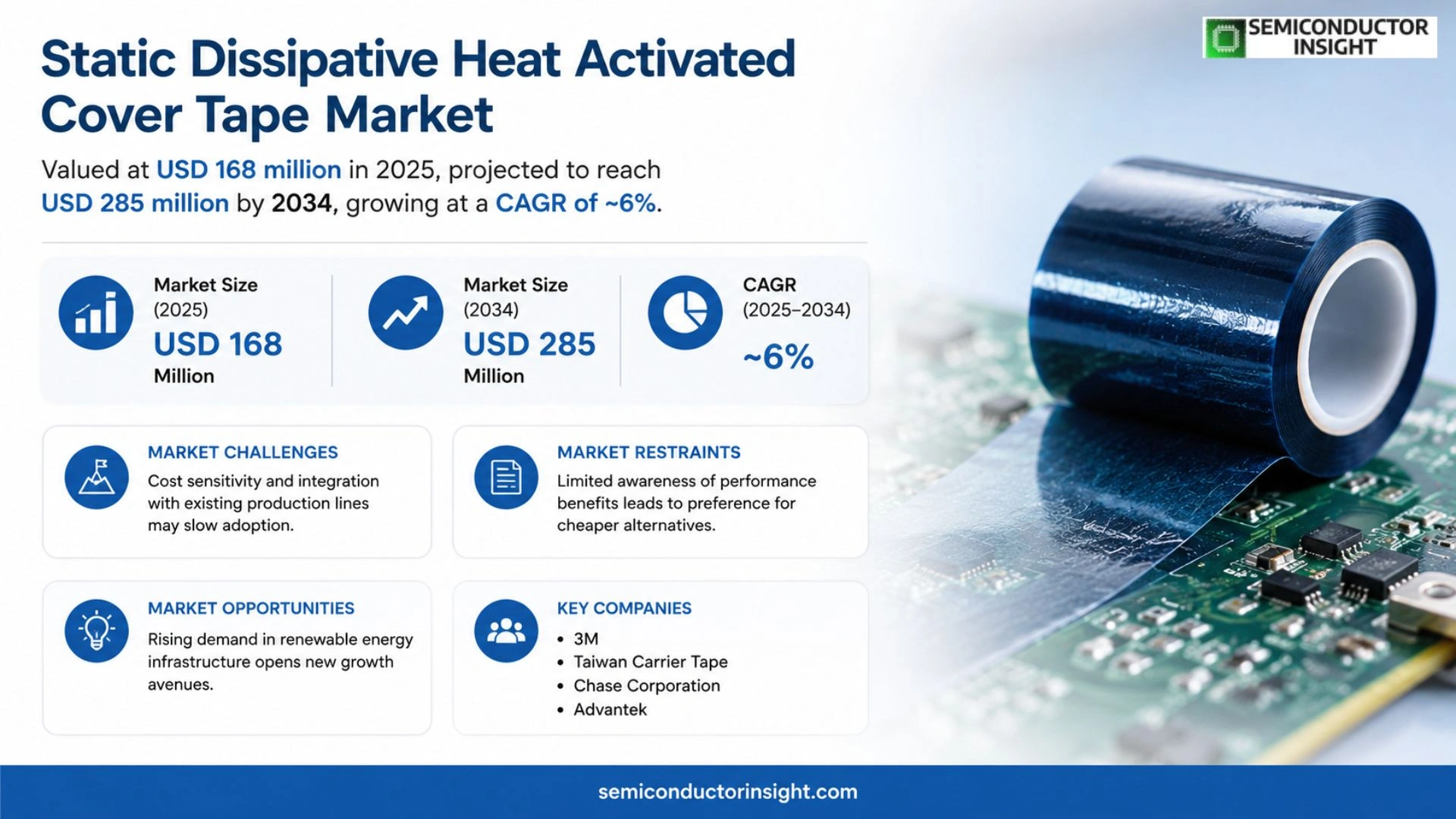
Static Dissipative Heat Activated Cover Tape market was valued at USD 168 million in 2025 and reached USD 285 million by 2034, reflecting a CAGR of about 6 % during the period.
Static Dissipative Heat Activated Cover Tape is a static‑dissipative, heat‑activated cover tape designed for sealing polycarbonate conductive carriers; its loaded conductive material provides permanent protection for electrostatic‑sensitive devices.
The tape is widely used in electronic packaging to shield components such as integrated circuits from electrostatic discharge during assembly, and expanding adoption of smartphones, computers and IoT products increases its demand.
MARKET DRIVERS
Rising Demand for EMI Protection in High‑Performance Electronics
Manufacturers of aerospace, automotive and telecom equipment are increasingly specifying static dissipative heat activated cover tape to mitigate electromagnetic interference (EMI). The tape’s ability to maintain a controlled surface resistance while sealing components reduces the need for additional shielding layers, which in turn trims assembly time and material costs.
Stringent Compliance Standards Across Sectors
Regulations such as IEC 61340‑5‑1 and MIL‑STD‑810 impose strict limits on electrostatic discharge (ESD) and static buildup. Companies that adopt static dissipative heat activated cover tape can demonstrate compliance more easily, avoiding costly redesigns or retrofits. Compliance‑driven procurement therefore fuels market uptake.
➤ Survey data indicates that 68 % of Tier‑1 automotive suppliers plan to increase their quarterly spend on static dissipative sealing solutions.
When the tape is activated by heat, it conforms tightly to irregular geometries, eliminating air gaps that could otherwise become charge accumulation points. This performance advantage is prompting original equipment manufacturers (OEMs) to replace traditional adhesive tapes with the heat‑activated variant, expanding the addressable market size.
MARKET CHALLENGES
Cost Sensitivity in Low‑Margin Manufacturing
While the functional benefits are clear, the material cost of static dissipative heat activated cover tape remains higher than that of generic PVC or polyester tapes. Small‑batch producers, especially in emerging markets, often face budgeting constraints that deter adoption, even when long‑term savings are projected.
Other Challenges
Integration with Existing Production Lines
Heat‑activation requires precise temperature control and dwell time, which may necessitate equipment upgrades. Facilities lacking automated baking ovens must invest in new hardware, creating a temporary barrier to rapid rollout.
MARKET RESTRAINTS
Limited Awareness of Performance Benefits
Many design engineers are unfamiliar with the distinction between static dissipative and merely insulative tapes. This knowledge gap leads to default selection of cheaper, less suitable alternatives, slowing market penetration despite the clear technical advantages of the heat‑activated product.
MARKET OPPORTUNITIES
Expansion into Renewable Energy Infrastructure
Solar farms and wind turbine assemblies increasingly incorporate sensitive power electronics that must be protected from static discharge. Integrating static dissipative heat activated cover tape into module housings offers a lightweight, reliable sealing method. Targeted outreach to EPC contractors could unlock a sizable new revenue stream for tape manufacturers.
Static Dissipative Heat Activated Cover Tape Market Trends
Escalating Demand for Electrostatic Safeguarding in Miniaturized Devices
The proliferation of compact, high‑performance electronics has intensified the need for reliable electrostatic protection during assembly. As component geometries shrink, surface charge accumulation becomes more volatile, prompting manufacturers to integrate static dissipative, heat‑activated cover tapes directly into packaging lines. This shift reflects a strategic move to embed protection rather than rely on separate handling procedures, thereby reducing rework rates and enhancing overall yield. The trend is evident across smartphone enclosures, advanced computing modules, and emerging IoT sensors, where a single tape layer now performs both sealing and charge‑dissipation functions. For Static Dissipative Heat Activated Cover Tape Market, the implication is a steady reallocation of procurement budgets toward higher‑specification tapes that can tolerate tighter thermal cycles while maintaining conductivity.
Other Trends
Material Optimization for Thermal Activation
Suppliers are refining polymer matrices and conductive fillers to achieve faster activation at lower temperatures, addressing the thermal constraints of increasingly delicate substrates. Recent formulations incorporate nano‑scaled carbon pathways that enable a consistent surface resistivity without compromising mechanical strength. Simultaneously, width variations below 20 mm are gaining traction for tight‑fit applications, while wider formats remain essential for bulk sealing tasks. These material advances are driven by the dual pressure of cost efficiency and performance reliability, encouraging vendors to differentiate their portfolios through proprietary carrier technologies rather than price alone.
Regional Shifts Toward Asia‑Pacific Manufacturing Hubs
Production capacity in China, South Korea, and Southeast Asian nations has expanded considerably, propelled by the concentration of contract electronics manufacturers in those locales. Localized sourcing of conductive carriers shortens lead times and aligns with the just‑in‑time inventory models favored by OEMs. This geographic rebalancing also introduces competitive pricing dynamics, compelling traditional North American and European firms to pursue joint ventures or licensing agreements to maintain market relevance. For participants in Static Dissipative Heat Activated Cover Tape Market, the emerging regional landscape underscores the necessity of agile supply‑chain strategies and the potential upside of aligning with regional engineering hubs.
COMPETITIVE LANDSCAPE
Key Industry Players
Static Dissipative Heat Activated Cover Tape market: competitive hierarchy and strategic positioning
Within the global arena, 3M remains the most influential supplier, leveraging a vast portfolio that pairs conductive carrier technology with proprietary adhesive formulations. Its extensive distribution channels across North America, Europe and Asia enable rapid rollout of new tape widths, while sustained R&D investment translates into incremental performance gains that set industry benchmarks. Taiwan Carrier Tape follows closely, capitalizing on a manufacturing footprint in the Greater China region to serve high‑volume electronics assemblers. The duo’s scale creates a de‑facto duopoly, shaping price elasticity and compelling smaller firms to adopt niche or value‑added strategies to retain market relevance.
Beyond the two titans, a constellation of specialized firms contributes depth to the competitive field. Chase Corporation distinguishes itself with low‑temperature activation solutions tailored to sensitive semiconductor packages, whereas Advantek focuses on ultra‑narrow tape (below 20 mm) for IoT devices. Keaco and Eurostat emphasize eco‑friendly conductive fillers, attracting customers with strict environmental mandates. Shin‑Etsu’s chemistry expertise fuels high‑frequency component protection, while Force‑One Applied Materials pursues advanced polymer blends for miniaturized modules. Acupaq, DuraTape, Nitto Denko, Polytron, and CETC round out the roster, each carving out regional strongholds or product‑specific niches that collectively prevent market concentration from becoming absolute.
List of Key Static Dissipative Heat Activated Cover Tape Companies Profiled
- 3M
- Taiwan Carrier Tape
- Chase Corporation
- Advantek
- Keaco
- Eurostat
- Shin‑Etsu
- Force‑One Applied Materials
- Acupaq
- DuraTape
- Nitto Denko
- Polytron
- CETC
- GSI Technology
Segment Analysis:
| Segment Category | Sub-Segments | Key Insights |
| By Type |
|
Narrow Width Formats
|
| By Application |
|
Active Component Protection
|
| By End User |
|
Electronic Device Manufacturers
|
| By Conductivity Level |
|
High Conductivity Variants
|
| By Product Form |
|
Film Based Solutions
|
Regional Analysis: Static Dissipative Heat Activated Cover Tape Market
Data‑center builders prioritize static‑dissipative tape for server rack assembly, while automotive OEMs rely on it to protect sensitive electronics during heat‑intensive paint processes. The convergence of these demands strengthens the market’s resilience across cycles.
OSHA and IEC standards compel manufacturers to certify electro‑static safety, nudging suppliers toward formulations that meet both conductive and fire‑retardant criteria without sacrificing activation speed.
Proximity to polymer resin producers in the Great Lakes corridor shortens lead times, while logistics hubs along the West Coast support rapid distribution to Pacific‑linked aerospace projects.
Emerging research into nano‑fillers aims to lift conductivity thresholds, allowing thinner tapes to meet the same static‑control specifications, a development closely watched by cost‑sensitive manufacturers.
Europe
European manufacturers exhibit a pragmatic approach, integrating static‑dissipative tape into high‑precision medical device assembly lines where regulatory scrutiny is intense. The region’s emphasis on sustainability drives a gradual tilt toward recyclable backings, prompting suppliers to experiment with closed‑loop material cycles. Moreover, the EU’s focus on circular economy policies encourages collaborative R&D consortia that share test data, accelerating the diffusion of best practices across borders. For end users, the consequence is a market where compliance and environmental stewardship are interwoven, shaping procurement criteria beyond simple performance metrics.
Asia‑Pacific
In Asia‑Pacific, rapid scaling of consumer electronics fabrication fuels demand for heat‑activated cover tape that can keep pace with high‑volume production lines. Nations such as China, South Korea, and Taiwan leverage extensive manufacturing bases to iterate tape formulations that tolerate aggressive thermal profiles common in automated soldering stations. While cost considerations remain paramount, the region also witnesses a surge in specialty applications, notably in aerospace component assembly where static discharge poses a critical risk. This duality forces suppliers to balance price competitiveness with quality assurance mechanisms tailored to tier‑1 aerospace suppliers.
South America
South American markets are gradually emerging as niche adopters, primarily within the automotive sector where the rollout of electric‑vehicle factories necessitates reliable static‑control measures. Local distributors prioritize partnerships with North American firms to import proven tape technologies, while also encouraging technology transfer to bolster domestic manufacturing capabilities. The strategic implication for suppliers is the opportunity to establish early‑stage footholds that could mature as regional automotive production expands, especially in Brazil and Argentina.
Middle East & Africa
The Middle East & Africa region presents a mixed landscape; oil‑field equipment manufacturers require static‑dissipative solutions for electronic monitoring tools used in hazardous environments, whereas African telecommunications roll‑outs demand tape that can survive high ambient temperatures. Limited local production means that most demand is met through imports, yet emerging free‑trade zones are attracting niche tape producers seeking cost‑effective entry points. For suppliers, the key takeaway is the potential to tailor product packs that address both extreme temperature resilience and compliance with regional safety directives.
Report Scope
This market research report provides a comprehensive analysis of the Static Dissipative Heat Activated Cover Tape Market , covering the forecast period 2026–2034. It offers detailed insights into market dynamics, technological advancements, competitive landscape, and key trends shaping the industry.
Key focus areas of the report include:
- Market Overview: The report begins with an overview outlining its current market scenario, key growth indicators, and industry transformation drivers. It discusses macroeconomic factors, demand–supply balance, regulatory landscape, and the strategic role of semiconductors in powering advancements across industries such as automotive, telecommunications, consumer electronics, and industrial automation.
- Market Size & Forecast: Historical data and future projections for revenue, unit shipments, and market value across major regions and segments.
- Segmentation Analysis: Detailed breakdown by product type, technology, application, and end-user industry to identify high-growth segments and investment opportunities.
- Regional Insights: Insights into market performance across North America, Europe, Asia-Pacific, Latin America, and the Middle East & Africa, including country-level analysis where relevant.
- Competitive Landscape: Profiles of leading market participants, including their product offerings, R&D focus, manufacturing capacity, pricing strategies, and recent developments such as mergers, acquisitions, and partnerships.
- Technology Trends & Innovation: Assessment of emerging technologies, integration of AI/IoT, semiconductor design trends, fabrication techniques, and evolving industry standards.
- Market Drivers & Restraints: Evaluation of factors driving market growth along with challenges, supply chain constraints, regulatory issues, and market-entry barriers.
- Stakeholder Insights: Insights for component suppliers, OEMs, system integrators, investors, and policymakers regarding the evolving ecosystem and strategic opportunities.
Primary and secondary research methods are employed, including interviews with industry experts, data from verified sources, and real-time market intelligence to ensure the accuracy and reliability of the insights presented.
FREQUENTLY ASKED QUESTIONS:
What is the current market size of Static Dissipative Heat Activated Cover Tape Market?
-> Static Dissipative Heat Activated Cover Tape market was valued at USD 285 million by 2034, reflecting a CAGR of about 6 %, growing at a CAGR of 6.1% during the forecast period.
Which key companies operate in Static Dissipative Heat Activated Cover Tape Market?
-> Key players include 3M, Taiwan Carrier Tape, Chase Corporation, Advantek, Keaco, Eurostat, Shin‑Etsu, Force‑One Applied Materials, Acupaq, among others.
What are the key growth drivers?
-> Key growth drivers include the expanding electronic packaging sector, rising demand for smartphones, computers and IoT devices, and the need for reliable static protection for increasingly miniaturized components.
Which region dominates the market?
-> Asia holds the largest market share, driven by extensive electronics manufacturing hubs, while Europe remains a strong secondary market.
What are the emerging trends?
-> Emerging trends include material optimization for higher‑performance and smaller‑sized electronic products, integration of advanced conductive polymers, and sustainability initiatives toward greener static‑dissipative solutions.
Get Sample Report PDF for Exclusive Insights
Report Sample Includes
- Table of Contents
- List of Tables & Figures
- Charts, Research Methodology, and more...
 Download Sample Report PDF