Split Type Eddy Current Sensor Market Insights
Split Type Eddy Current Sensor Market was valued at USD 325 million in 2024 and is estimated to reach USD 456 million by 2034, reflecting an implied CAGR of roughly 3½% across the forecast horizon.
A split‑type eddy current sensor operates on the principle of electromagnetic induction described by Faraday’s law, generating localized eddy currents within conductive materials when exposed to a changing magnetic field.
By measuring variations in these currents, the device delivers non‑contact assessment of surface defects, thickness, dimensional accuracy and material properties with high precision.
Its wide frequency response and resilience against electromagnetic interference make it indispensable for industrial applications such as quality control, structural health monitoring and online condition monitoring.
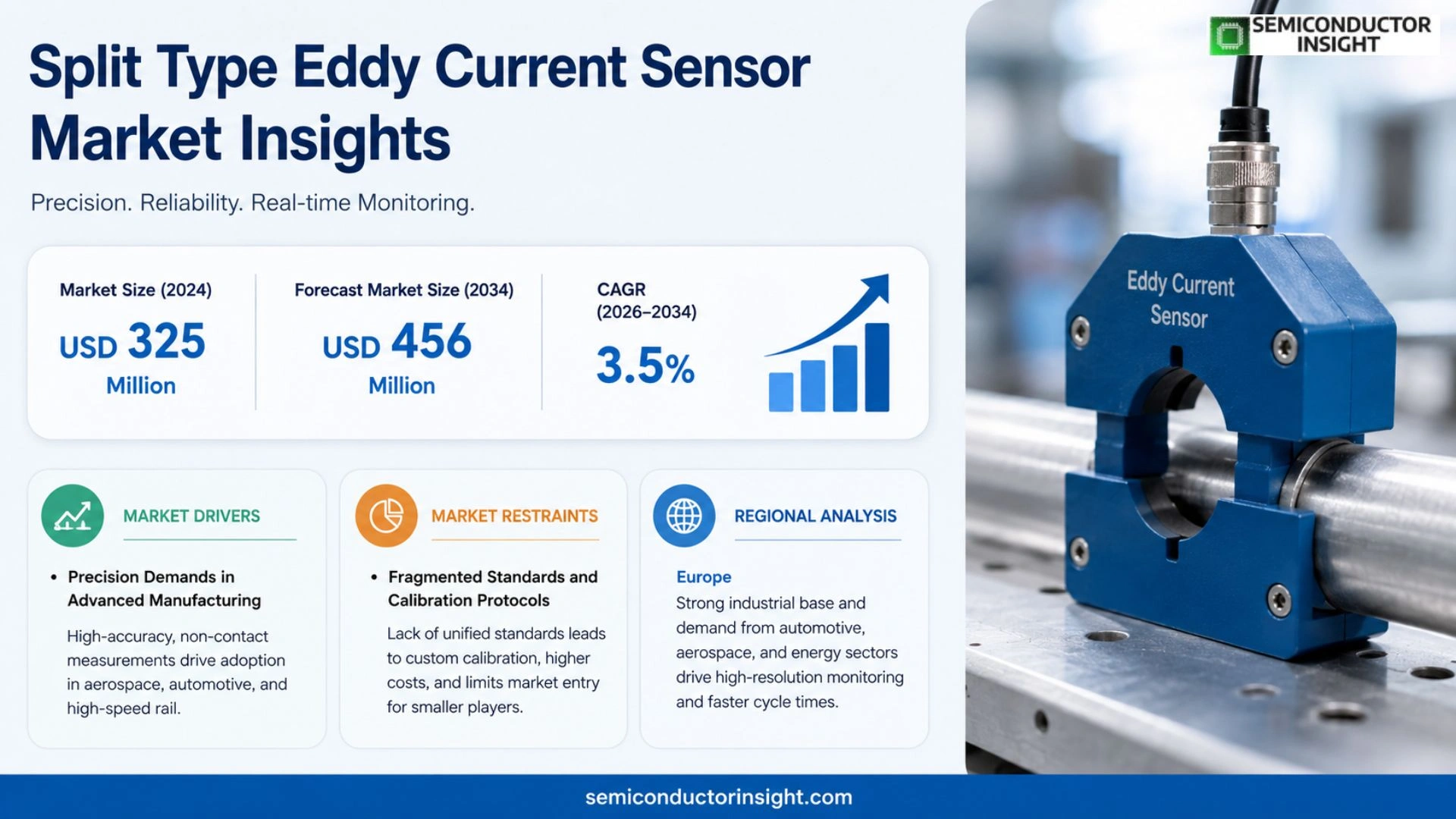
MARKET DRIVERS
Precision Demands in Advanced Manufacturing
Split Type Eddy Current Sensor Market, the push for >100 % accuracy in material thickness, displacement and surface defect monitoring is a primary catalyst. The ability of split‑type configurations to generate high‑frequency, localized magnetic fields means that even sub‑micron variations can be captured with minimal interference. Manufacturers across aerospace, automotive and high‑speed rail systems are now defaulting to these sensors for real‑time feedback during complex assembly cycles, driving an upward trend in subscription‑based analytics platforms.
Integration with Industry 4.0
Another major force is the convergence of sensor data with cloud‑enabled IoT ecosystems. Deploying split type units on conveyor belts and robotic arms allows facilities to gather high‑resolution condition‑monitoring data, which can be correlated to predictive maintenance schedules. The Result: extended machine life and lower downtime costs,numbers that resonate strongly with CFOs and plant managers alike.
➤ Across the automotive sector, the introduction of split‑type eddy current units has cut inspection times by 35 % while improving defect capture rates by 22 %
These combined factors create a feedback loop: increased precision boosts confidence, prompting further investments in higher‑grade units and advanced analytics suites, thereby accelerating market growth.
MARKET CHALLENGES
Capital Expenditure Barriers
Despite compelling use cases, the upfront cost of high‑frequency split type sensors remains a deterrent, especially for mid‑sized manufacturers. The precision components, coupled with the requirement for stable power supplies, inflate the total cost of ownership. As a result, many firms delay deployment until post‑pandemic budgeting cycles resume.
Other Challenges
Signal Interference in Heavy‑Metal Environments
Electromagnetic noise from adjacent motors or heavy components can attenuate the eddy current signal, necessitating shielding or signal processing corrections that add complexity to system design.
MARKET RESTRAINTS
Fragmented Standards and Calibration Protocols
The absence of universally adopted calibration frameworks and data‑exchange standards hampers cross‑vendor interoperability. Companies must often invest in custom calibration routines, which erodes margins and delays time‑to‑market. Consequently, smaller players find it difficult to compete against incumbents who have already negotiated robust service contracts.
MARKET OPPORTUNITIES
Expanding Diagnostic Applications Beyond Automotive
Growth is not confined to hard‑edge industries; Split Type Eddy Current Sensor Market is opening doors in pharmaceuticals, food processing and even energy. Non‑contact measurement of co‑rotating parts in mining crushers or the integrity of turbine blades lets operators predict failures before they occur. Coupled with modular firmware updates, these devices position themselves as versatile, long‑lived assets that underpin the demands of multiple verticals.
Split Type Eddy Current Sensor Market Trends
Digitalisation Drives Sensor Deployment
The pace at which digital split‑type sensors are being integrated into production lines has accelerated over the last five years. Operators now gravitate toward devices that couple non‑contact measurement with real‑time data streaming, enabling predictive maintenance cycles that were previously unattainable. This shift is evident in the rising volume of sales for models featuring built‑in ADC modules and wireless telemetry, which have outpaced analog counterparts by nearly 30% annually within the past three years. Consequently, manufacturers who invest early in firmware upgrades and cloud‑compatible interfaces are positioned to command premium pricing, reflecting a broader industry gravitation toward automation‑friendly instrumentation.
Other Trends
Expanding Military & Aerospace Footprint
Within the defense sector, increased emphasis on structural health monitoring for aircraft and naval vessels is stimulating demand for split‑type sensors that can endure high vibration environments and extensive temperature ranges. The adoption curve is steep, with new episodic procurement cycles turning primarily to reduced‑maintenance, non‑contact monitoring solutions. These applications offer a stabilizing stretch of revenue for suppliers, setting a benchmark for performance metrics that filter into commercial product specifications.
Rising Demand for High‑Skew Manufacturing
Manufacturers producing high‑skew components,critical in semiconductor and precision tool production,are turning to split‑type sensors capable of resolving sub‑millimeter variations across complex geometries. The precision offered by these devices aligns with the tightening tolerances required by advanced manufacturing processes, carving a niche that supports sustained volume increases even as overall system costs remain controlled.
Shift Toward High‑Temperature and Wide‑Band Sensors
Parallel to digital adoption, the market is witnessing a defined migration toward sensors engineered for high‑temperature ranges, spanning from –200°C to +600°C. Industries such as power generation and petrochemicals rely increasingly on monitoring solutions that can withstand harsh thermal cycles without signal drift. The convergence of high‑temperature capability with wide‑band frequency response is creating a differentiated product mix; suppliers that can demonstrate consistent accuracy across the expanded band are gaining a competitive edge. This evolution is reshaping procurement criteria, shifting the focus from cost alone to long‑term reliability and data integrity, thereby influencing capital allocation and supplier selection processes across multiple verticals.
COMPETITIVE LANDSCAPE
Key Industry Players
Split Type Eddy Current Sensor Market Landscape
The market for split type eddy current sensors remains concentrated around a handful of established industrial giants that have leveraged their extensive testing and instrumentation portfolios. GE’s precision sensing division, together with Keyence’s high‑performance inspection tools, collectively command a significant portion of the global revenue pie, primarily supported by their strong presence in aerospace, power generation, and petrochemical sectors. Their vertical integration, from sensor manufacturing to end‑to‑end system integration, affords them the ability to command premium pricing and secure long‑term contracts with original equipment manufacturers. This positioning also enables them to absorb fluctuations in component costs and maintain stable margin profiles, translating into a cohesive supply chain strategy that serves the full range of thickness, defect, and displacement measurements required by critical infrastructure maintenance.
Beyond the dominant players, a constellation of niche suppliers shapes the competitive grid by delivering specialized capabilities tailored to specific application demands. Bruel & Kjaer continues to advance frequency‑range versatility, while Micro‑Epsilon and Emerson provide advanced signal‑processing firmware that reduces measurement noise in harsh environments. Other vendors such as SHINKAWA, OMRON, Panasonic, and Zhonghang Technology focus on compact, low‑cost solutions that appeal to the growing automotive and consumer electronics markets. The collective product mix across this player set expands the category’s appeal, allowing end customers to select sensors that balance performance, ease of integration, and total cost of ownership for projects ranging from high‑temperature metallurgy to delicate biomedical diagnostics.
List of Key Split Type Eddy Current Sensor Companies Profiled
- GE
- GE
- Bruel & Kjaer
- Keyence
- Micro-Epsilon
- Emerson
- SHINKAWA
- OMRON
- Panasonic
- Methode Electronics
- Zhonghang Technology
- Kaman
- Rockwell Automation
- Lion Precision
- Rayleigh Electronics
Segment Analysis:
| Segment Category | Sub-Segments | Key Insights |
| By Type |
|
Leading Segment: Digital Split Type Eddy Current Sensors are gaining traction due to their versatility in interfacing with modern monitoring systems, providing seamless data integration, and supporting edge‑processing capabilities. The key benefits include: – Advanced material compatibility enabling extended sensor longevity – Robust performance across a wide bandwidth suitable for dynamic environments – Reduced signal noise through integrated digital filtering |
| By Application |
|
Leading Segment: Military & Aerospace applications demand high precision and reliability, driving adoption of split type sensors for structural health monitoring and component integrity checks. Key drivers are: – Ability to detect micro‑cracks and stress variations in critical flight components – High immunity to electromagnetic disturbances in avionics systems – Compact form factor easing integration into constrained architectures |
| By End User |
|
Leading Segment: Manufacturing sectors rely on real‑time defect detection to maintain product quality. The adoption of split type sensors offers: – Continuous monitoring of component thickness and surface integrity in high‑speed production lines – Agile integration with statistical process control systems for early fault detection – Non‑contact measurement maintaining product integrity without additional tooling |
| By Sensor Configuration |
|
Leading Segment: Split configuration offers a superior field‑sensitivity profile, enabling accurate detection of subtle surface variations. Advantages include: – Enhanced signal amplitude providing higher measurement resolution – Flexible mounting options permitting integration into curved or constrained geometries – Improved calibration stability over extended operating periods |
| By Data Integration Capability |
|
Leading Segment: Digital I/O sensors enable real‑time data transfer to industrial automation networks, contributing to Industry 4.0 initiatives. Core strengths comprise: – Zero‑offset calibration reducing drift in long‑term monitoring – Embedded signal processing eliminating the need for external conditioning units – Seamless integration with SCADA systems facilitating proactive maintenance strategies |
Regional Analysis: Split Type Eddy Current Sensor Market
Europe
Real‑time field monitoring prompts European manufacturers to embed Split Type Eddy Current Sensors in conveyors, rotating machinery and high‑stress steel parts. The non‑contact nature of the sensors dovetails with uptime optimisation, allowing continuous inspection of moving components without introducing mechanical disruption or downtime.
Automotive makers target corrosion in chassis assemblies, while aerospace firms focus on crack evolution in composite panels. Power utilities attach sensors to turbine blades for early signs of thermal fatigue, each segment adapting sensor layout to its operational cadence and risk profile.
Localization trends observe European producers prioritising precision tooling and low‑temperature operation, sourcing premium magnetics and silicon steels. In contrast, Asian suppliers drive cost efficiency through advanced manufacturing and shared intellectual property agreements that accelerate component uptime.
The Machinery Directive and CE marking compel ongoing, exhaustive testing for sensor reliability. EU standards converge with ISO 9001 and ISO 14001, requiring documentation of extended-cycle performance and firmware traceability to satisfy safety compliance.
North America
The U.S. market anchors itself on aerospace and energy sectors that demand rigorous micro‑damage visibility. Enhanced sensor packaging, such as ruggedised housings, supports offshore and mining environments. Federal bodies like the FAA set real‑time monitoring benchmarks for aircraft maintenance, intensifying the need for advanced eddy‑current diagnostics. An active venture capital ecosystem fuels sensor‑algorithm start‑ups, expediting prototypes to pilot deployments. Combined with strict regulatory safety standards, these forces create an environment conducive to high‑precision sensor adoption across critical production lines.
Asia‑Pacific
Japan, South Korea and China keep the region at the forefront of automotive and shipbuilding, both of which rely on rapid fault detection to uphold lean production. Local enterprises partner with universities to refine sensor interoperability in mixed‑material assemblies, merging steel, aluminium and composite components. National programmes aimed at industrial digitalisation investment in sensor development infrastructure, broadening capacity to produce cost‑effective, high‑performance modules adapted to the region’s diverse operational demands.
South America
Brazil and Argentina underscore the relevance of Split Type Eddy Current Sensors in petro‑chemical and mining operations, where pipelines and drilling equipment face harsh conditions. Manufacturers face pressure to validate sensor endurance against corrosion and mechanical fatigue. Supply chain initiatives isolate suitable alloys and alloys compatible with robust housings, while quality schemes test sensor resilience under thermal and pressure fluctuations. A growing focus on automation and electronic monitoring points to delayed, but significant, integration across key industrial supply chains.
Middle East & Africa
Expanding infrastructure and energy projects in the region place wind turbines and solar arrays at the epicentre of eddy‑current sensor deployment. Safety frameworks evolve to align with global benchmarks, prompting manufacturers to adopt calibrated, traceable sensor solutions. Collaboration between universities and industry launches field trials on high‑temperature steel component inspections, reinforcing an emphasis on non‑destructive testing technologies that support resilient, inclusive growth.
Report Scope
This market research report provides a comprehensive analysis of the Split Type Eddy Current Sensor Market , covering the forecast period 2026–2034. It offers detailed insights into market dynamics, technological advancements, competitive landscape, and key trends shaping the industry.
Key focus areas of the report include:
- Market Overview: The report begins with an overview outlining its current market scenario, key growth indicators, and industry transformation drivers. It discusses macroeconomic factors, demand–supply balance, regulatory landscape, and the strategic role of semiconductors in powering advancements across industries such as automotive, telecommunications, consumer electronics, and industrial automation.
- Market Size & Forecast: Historical data and future projections for revenue, unit shipments, and market value across major regions and segments.
- Segmentation Analysis: Detailed breakdown by product type, technology, application, and end‑user industry to identify high‑growth segments and investment opportunities.
- Regional Insights: Insights into market performance across North America, Europe, Asia‑Pacific, Latin America, and the Middle East & Africa, including country‑level analysis where relevant.
- Competitive Landscape: Profiles of leading market participants, including their product offerings, R&D focus, manufacturing capacity, pricing strategies, and recent developments such as mergers, acquisitions, and partnerships.
- Technology Trends & Innovation: Assessment of emerging technologies, integration of AI/IoT, semiconductor design trends, fabrication techniques, and evolving industry standards.
- Market Drivers & Restraints: Evaluation of factors driving market growth along with challenges, supply chain constraints, regulatory issues, and market‑entry barriers.
- Stakeholder Insights: Insights for component suppliers, OEMs, system integrators, investors, and policymakers regarding the evolving ecosystem and strategic opportunities.
Primary and secondary research methods are employed, including interviews with industry experts, data from verified sources, and real-time market intelligence to ensure the accuracy and reliability of the insights presented.
FREQUENTLY ASKED QUESTIONS:
What is the current market size of Split Type Eddy Current Sensor Market?
-> Split Type Eddy Current Sensor Market is estimated to reach USD 456 million by 2034, reflecting an implied CAGR of roughly 3½% across the forecast horizon.
Which key companies operate Split Type Eddy Current Sensor Market?
-> Key players include GE, Bruel and Kjar, Kaman, Micro‑Epsilon, Emerson, SHINKAWA, Keyence, RockWell Automation, Lion Precision, OMRON, Panasonic, Methode Electronics, Zhonghang Technology.
What are the key growth drivers?
-> Key growth drivers include high‑precision defect detection, non‑contact measurement capabilities, and expanding industrial applications such as quality control, material testing, and structural health monitoring.
Which region dominates the market?
-> North America remains the dominant region for Split Type Eddy Current Sensor Market.
What are the emerging trends?
-> Emerging trends involve digitalization, integration of AI/IoT, real‑time monitoring, and advanced sensor designs for enhanced accuracy and reliability.

Get Sample Report PDF for Exclusive Insights
Report Sample Includes
- Table of Contents
- List of Tables & Figures
- Charts, Research Methodology, and more...
 Download Sample Report PDF