Smartwatch Application Processor (Low Power) Market Insights
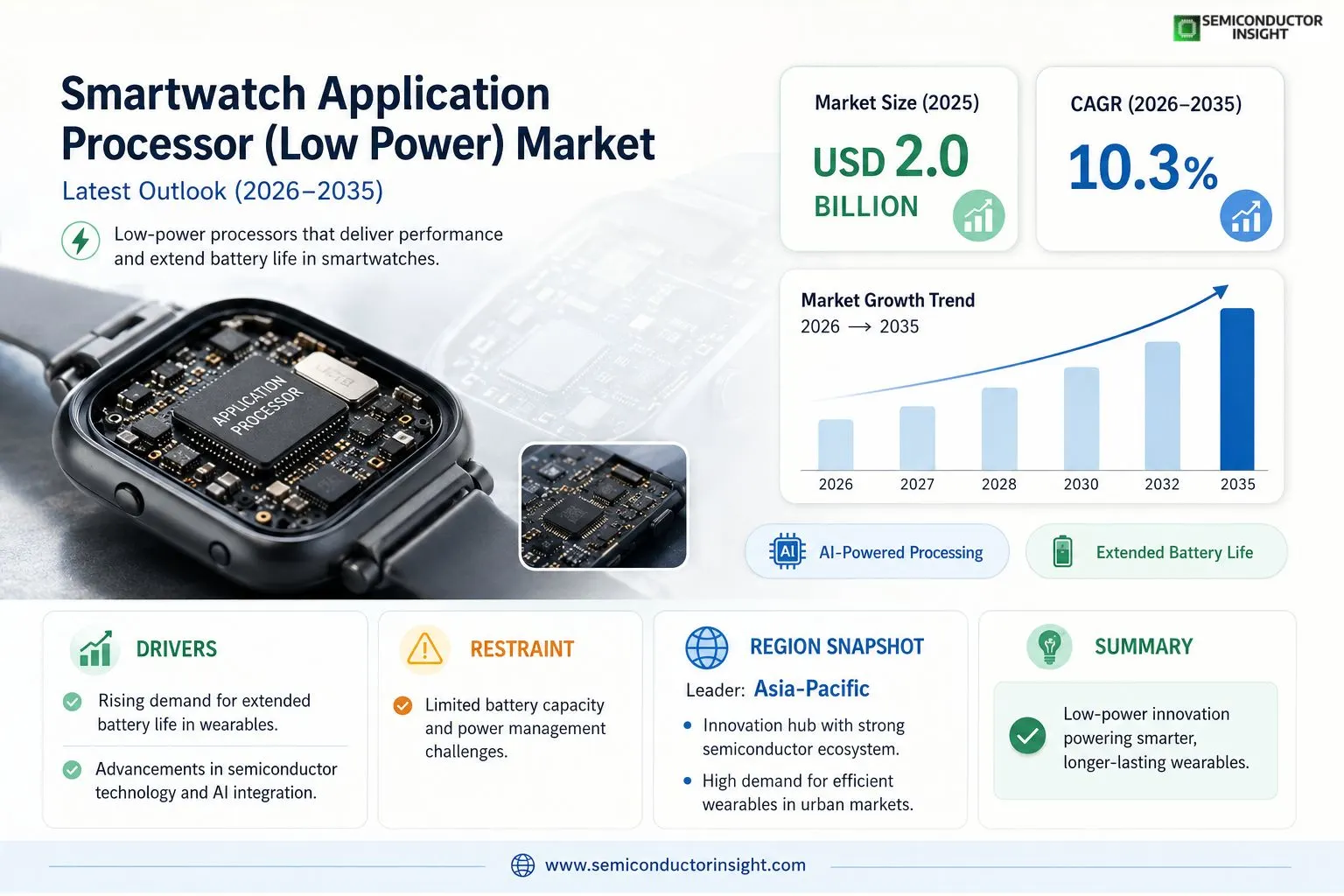
Global Smartwatch Application Processor (Low Power) Market size was valued at USD 2.0 billion in 2025. The market is projected to grow from USD 2.2 billion in 2026 to USD 5.3 billion by 2035, exhibiting a CAGR of 10.3% during the forecast period.
Smartwatch Application Processor (Low Power) refers to specialized system-on-chip (SoC) solutions designed for wearable devices, prioritizing energy efficiency while delivering sufficient computational performance for health monitoring, notifications, and connectivity features. These processors integrate CPU, GPU, memory controllers, and sensor interfaces in compact, low-power architectures, often based on ARM cores optimized for extended battery life in wrist-worn devices.
The market is experiencing robust growth due to several factors, including surging consumer demand for advanced wearable technology, rising health and fitness awareness, and continuous advancements in semiconductor manufacturing processes that enable better power efficiency. Furthermore, the integration of AI capabilities for on-device processing of biometric data and the expansion of IoT ecosystems are contributing to market expansion. Initiatives by key players in the market are also expected to fuel the market growth. For instance, leading semiconductor companies continue to innovate with next-generation low-power platforms featuring enhanced sensor fusion and connectivity options. Qualcomm, Apple, Samsung, and MediaTek are some of the key players that operate in the market with a wide range of portfolios.
MARKET DRIVERS
Rising Demand for Extended Battery Life in Wearables
Smartwatch Application Processor (Low Power) Market is propelled by consumer expectations for multi-day battery performance amid expanding feature sets including continuous health monitoring and on-device AI processing. Manufacturers are prioritizing energy-efficient application processors that balance performance with ultra-low power consumption, enabling always-on functionalities without frequent charging.
Advancements in Semiconductor Technology and AI Integration
Technological progress in chip design, such as advanced process nodes and specialized low-power architectures, supports sophisticated applications like real-time biometric analysis and edge AI computations. These processors deliver enhanced processing capabilities while maintaining minimal energy draw, driving adoption across premium and mid-range smartwatch segments.
➤ Integration of low-power application processors with advanced connectivity options and sensor fusion capabilities is enabling standalone smartwatch functionality and improved user experiences.
Health and fitness tracking trends continue to fuel market expansion, with low-power processors facilitating accurate, continuous monitoring of metrics such as heart rate, SpO2, and sleep patterns without compromising device longevity.
MARKET CHALLENGES
Balancing Performance with Power Efficiency
Developing application processors that deliver high computational performance for complex tasks while adhering to strict power budgets remains a significant technical hurdle in Smartwatch Application Processor (Low Power) Market. Device designers must optimize for thermal management and battery constraints within compact form factors.
Other Challenges
Integration Complexity
Combining low-power application processors with multiple sensors, wireless modules, and security features increases design complexity and validation requirements.
Manufacturing Cost Pressures
Advanced semiconductor processes needed for efficient low-power operation contribute to higher production costs, challenging affordability in mass-market segments.
MARKET RESTRAINTS
Limited Battery Capacity and Power Management Issues
Despite improvements in processor efficiency, overall smartwatch battery life continues to constrain market potential. Low-power application processors must contend with power demands from displays, sensors, and connectivity features, often resulting in daily charging requirements that deter some consumers.
MARKET OPPORTUNITIES
Expansion of AI-Enabled Health and Wellness Features
The proliferation of on-device AI capabilities presents substantial growth potential for low-power application processors. Opportunities exist in developing specialized processors optimized for machine learning inference, enabling personalized health insights and predictive analytics while preserving extended battery life.The emergence of standalone smartwatches with cellular connectivity and advanced applications creates demand for more capable yet energy-efficient processors. Growth in emerging markets and increasing adoption among older demographics focused on health monitoring further expand the addressable market for optimized low-power solutions.
Smartwatch Application Processor (Low Power) Market Trends
Advancements in Energy-Efficient Semiconductor Designs
Smartwatch Application Processor (Low Power) Market continues to evolve through significant innovations in low-power system-on-chip (SoC) architectures. Manufacturers are prioritizing energy efficiency while maintaining the computational capabilities required for health monitoring, notifications, and seamless connectivity. These specialized processors integrate CPU, GPU, memory controllers, and sensor interfaces within compact designs, frequently leveraging optimized ARM cores that extend battery life in wearable devices.
Other Trends
Rising Integration of AI for On-Device Processing
Integration of AI capabilities stands out as a key development in Smartwatch Application Processor (Low Power) Market, enabling efficient on-device processing of biometric data. This trend supports advanced features such as real-time health analytics and personalized insights without excessive power consumption. Semiconductor advancements further enhance power efficiency, allowing smartwatches to handle complex tasks while preserving extended operational duration between charges.
Expansion of IoT Ecosystems and Connectivity Features
The broader expansion of IoT ecosystems drives demand for smartwatch processors with improved connectivity options and sensor fusion technologies. Leading companies are focusing on platforms that deliver robust performance for wearable applications while addressing the critical need for low power consumption in always-on scenarios.
Growing Demand Driven by Health and Fitness Awareness
Surging consumer interest in advanced wearable technology, coupled with increased health and fitness awareness, propels Smartwatch Application Processor (Low Power) Market forward. Key players including Qualcomm, Apple, Samsung, and MediaTek actively develop next-generation low-power solutions featuring enhanced sensor integration and efficient processing capabilities. These innovations support continuous monitoring features and seamless device interoperability, addressing the evolving requirements of modern consumers seeking reliable, long-lasting smartwatch performance. The market benefits from ongoing semiconductor manufacturing improvements that balance power optimization with functional richness, ensuring processors meet the demands of sophisticated wearable applications.
COMPETITIVE LANDSCAPEKey Industry Players
Smartwatch Application Processor (Low Power) Market Competitive Landscape
Smartwatch Application Processor (Low Power) Market is characterized by intense competition among semiconductor giants and specialized chip designers, with Apple and Qualcomm emerging as dominant leaders. Apple maintains a significant edge through its vertically integrated custom SiP (System in Package) processors like the S-series, optimized for exceptional power efficiency, seamless ecosystem integration, and advanced on-device AI capabilities in its Apple Watch lineup. Qualcomm follows closely with its Snapdragon Wear platform, capturing a substantial share of the Android-based smartwatch segment through energy-efficient SoCs that balance performance with extended battery life for health monitoring and connectivity features.
Other significant players include MediaTek, Samsung, and niche innovators like Ambiq Micro, who focus on ultra-low power architectures tailored for wearable constraints. These companies are advancing ARM-based cores, sensor fusion technologies, and AI accelerators to meet rising demands for biometric processing while minimizing energy consumption. The market structure features high barriers to entry due to complex semiconductor design requirements and established partnerships with device OEMs, resulting in a consolidated yet innovative competitive environment.
List of Key Smartwatch Application Processor Companies Profiled
- Apple Inc.
- Qualcomm Technologies, Inc.
- Samsung Electronics
- MediaTek Inc.
- STMicroelectronics
- Ambiq Micro
- Broadcom Inc.
- Nordic Semiconductor
- Texas Instruments
- NXP Semiconductors
- Huawei Technologies (HiSilicon)
- Ingenic Semiconductor
- Dialog Semiconductor
- Renesas Electronics
- Bestechnic
Segment Analysis:
| Segment Category | Sub-Segments | Key Insights |
| By Type |
|
Integrated AI Accelerators lead this category by enabling efficient on-device processing of biometric data and machine learning tasks directly on the smartwatch. These processors excel in balancing computational demands with minimal energy consumption, supporting real-time health insights without draining the battery. Their architecture allows seamless handling of continuous monitoring features while maintaining smooth user interface responsiveness. Manufacturers prioritize these solutions for premium devices where intelligence and efficiency are paramount. |
| By Application |
|
Health & Fitness Monitoring dominates as the primary application driving processor requirements. These processors must handle multiple sensor inputs simultaneously with exceptional power efficiency to support continuous heart rate tracking, sleep analysis, and activity recognition. The need for accurate real-time data processing while preserving battery life makes specialized low-power architectures essential. Integration of sensor fusion capabilities allows for more sophisticated wellness insights, enhancing user engagement with personalized health recommendations. |
| By End User |
|
Individual Consumers represent the largest end-user group, seeking versatile smartwatches that combine style, functionality, and long battery endurance. Low-power application processors are critical for delivering all-day performance without frequent charging, supporting everyday tasks from notifications to health tracking. This segment values processors that enable intuitive interfaces and reliable connectivity while maintaining comfort for continuous wear. Demand for seamless integration with smartphones further emphasizes the importance of efficient processing capabilities. |
| By Processor Architecture |
|
ARM Cortex Series stands out for its proven energy-efficient designs tailored to wearable constraints. These architectures deliver robust performance for complex tasks while optimizing power usage through advanced power gating and dynamic voltage scaling. Their widespread adoption facilitates easier software development and ecosystem compatibility across various smartwatch platforms. The scalability of these cores allows manufacturers to address different performance tiers without compromising on battery longevity. |
| By Connectivity Features |
|
Bluetooth & BLE Enabled processors lead due to their critical role in maintaining persistent yet power-efficient connections with smartphones and other devices. These solutions optimize wireless communication stacks to minimize energy draw during data synchronization and notifications. Enhanced protocol efficiency supports reliable sensor data transmission while extending overall device runtime. This connectivity focus enables richer user experiences through seamless ecosystem integration without sacrificing the core low-power objectives of smartwatch design. |
Regional Analysis: Smartwatch Application Processor (Low Power) Market
Asia-Pacific
Asia-Pacific dominates Smartwatch Application Processor (Low Power) Market as the primary innovation and production hub. The region benefits from a robust ecosystem of semiconductor manufacturers, device assemblers, and technology developers who prioritize energy-efficient designs tailored for continuous health monitoring and extended battery life in smartwatches. Countries like China, South Korea, Taiwan, and Japan drive advancements through close collaboration between chip designers and major wearable brands, fostering rapid iteration cycles that address consumer demand for sleek, long-lasting devices. Low power architecture innovations thrive here due to specialized talent pools and supply chain efficiencies that enable cost-effective scaling of advanced nodes optimized for minimal energy consumption.The market dynamics reflect strong emphasis on integration of AI capabilities within power-constrained environments, allowing smartwatches to perform complex tasks like real-time activity tracking and adaptive power management without draining batteries quickly. Regional policies supporting electronics manufacturing and R&D investments further accelerate adoption of next-generation low power processors. Consumer preferences in densely populated urban centers fuel demand for feature-rich yet efficient devices, pushing developers to refine processor architectures for better thermal management and seamless connectivity. This environment positions Asia-Pacific as the trendsetter, where new low power solutions are conceptualized, tested, and refined before global rollout.
Asia-Pacific’s dense network of foundries and design houses creates an unparalleled environment for developing Smartwatch Application Processor (Low Power) solutions. Collaborative efforts focus on optimizing instruction sets and memory hierarchies specifically for wearable constraints, resulting in processors that deliver sustained performance while preserving battery longevity. This ecosystem encourages experimentation with novel materials and fabrication techniques that enhance power efficiency.
Integrated manufacturing capabilities allow seamless transition from processor design to smartwatch assembly, minimizing delays and costs. Regional expertise in miniaturization supports compact, low power processors that fit evolving form factors while maintaining high reliability. Strong supplier relationships ensure consistent access to cutting-edge components essential for energy-efficient applications.
Urban consumers in Asia-Pacific seek smartwatches with advanced features yet exceptional battery performance for daily use. This preference drives processor innovations focused on intelligent power allocation across sensors, displays, and wireless modules. Market responsiveness to local usage patterns shapes development priorities toward balanced, low power operation.
The region is poised to maintain leadership through ongoing investments in specialized low power technologies and emerging applications like health analytics. Strategic partnerships and talent development will sustain momentum in creating processors that set global benchmarks for efficiency and integration in Smartwatch Application Processor (Low Power) Market.
North America
North America exhibits significant strength in Smartwatch Application Processor (Low Power) Market through its focus on software-hardware co-design and premium device segments. Tech hubs in the United States emphasize architectural innovations that deliver sophisticated AI features within strict power budgets, appealing to health-conscious professionals and fitness enthusiasts. Companies prioritize seamless ecosystem integration, ensuring processors support advanced operating systems and secure data handling while maintaining extended operational times. The region’s regulatory emphasis on data privacy influences processor designs to incorporate efficient security modules without compromising energy profiles. Consumer preference for high-end smartwatches drives development of processors capable of supporting rich user interfaces and multiple concurrent applications in a power-sensitive manner. Strategic investments in research foster breakthroughs in dynamic voltage scaling and adaptive computing techniques tailored for wearable environments. This market segment values quality and performance optimization over sheer volume, positioning North America as a key influencer in setting performance standards for low power processors globally.
Europe
Europe plays a vital role in Smartwatch Application Processor (Low Power) Market with its strong emphasis on sustainability and precision engineering. Countries across the region invest in developing energy-efficient processors that align with environmental goals and strict electronic waste regulations. The market benefits from collaborative research initiatives between academic institutions and industry players, focusing on low power architectures that reduce overall device energy consumption. European consumers appreciate smartwatches with reliable long battery life and accurate health metrics, pushing demand for processors optimized for continuous monitoring applications. Design philosophies here highlight thermal efficiency and longevity, resulting in robust solutions suitable for diverse climates and active lifestyles. Regulatory frameworks encourage innovation in power management features that minimize resource usage. The region also contributes through specialized expertise in sensor fusion and edge processing capabilities within constrained power envelopes, enhancing the overall value proposition of smartwatches in health and wellness sectors.
South America
South America represents an emerging force in Smartwatch Application Processor (Low Power) Market characterized by growing adoption and localization efforts. Increasing consumer awareness of health tracking benefits stimulates demand for affordable yet efficient smartwatches, encouraging adaptation of low power processors to regional requirements. Local manufacturers and distributors focus on solutions that perform reliably in varied climatic conditions while offering essential features like activity monitoring and notification management. The market dynamics reflect emphasis on cost-effective implementations that maintain competitive battery performance without advanced premium capabilities. Infrastructure development and rising disposable incomes support gradual expansion of the ecosystem around low power application processors. Regional players explore partnerships to customize processor functionalities for local user behaviors, such as enhanced sports modes popular in active communities. This growing market contributes to global diversity in application scenarios and drives manufacturers to consider broader accessibility in their low power design strategies.
Middle East & Africa
The Middle East and Africa region shows promising development in Smartwatch Application Processor (Low Power) Market driven by expanding digital health initiatives and lifestyle modernization. Urban centers with tech-savvy populations increasingly adopt smartwatches for fitness and connectivity, creating demand for processors that balance performance with extended battery operation crucial in regions with variable power availability. Market growth centers on practical, durable solutions suitable for challenging environments while supporting core health monitoring functions. Governments and private sectors invest in technology infrastructure that indirectly supports wider wearable adoption. Local innovation focuses on optimizing low power processors for specific use cases like outdoor activity tracking and basic medical alerts. The region benefits from technology transfer and distribution networks that introduce efficient processor designs tailored to cost-sensitive markets. As awareness grows, Smartwatch Application Processor (Low Power) Market gains traction through emphasis on reliability, ease of use, and energy conservation features that resonate with regional consumer needs and usage patterns.
Report Scope
This market research report provides a comprehensive analysis of the Smartwatch Application Processor (Low Power) Market , covering the forecast period 2026–2034. It offers detailed insights into market dynamics, technological advancements, competitive landscape, and key trends shaping the industry.
Key focus areas of the report include:
- Market Overview: The report begins with an overview outlining its current market scenario, key growth indicators, and industry transformation drivers. It discusses macroeconomic factors, demand–supply balance, regulatory landscape, and the strategic role of semiconductors in powering advancements across industries such as automotive, telecommunications, consumer electronics, and industrial automation.
- Market Size & Forecast: Historical data and future projections for revenue, unit shipments, and market value across major regions and segments.
- Segmentation Analysis: Detailed breakdown by product type, technology, application, and end-user industry to identify high-growth segments and investment opportunities.
- Regional Insights: Insights into market performance across North America, Europe, Asia-Pacific, Latin America, and the Middle East & Africa, including country-level analysis where relevant.
- Competitive Landscape: Profiles of leading market participants, including their product offerings, R&D focus, manufacturing capacity, pricing strategies, and recent developments such as mergers, acquisitions, and partnerships.
- Technology Trends & Innovation: Assessment of emerging technologies, integration of AI/IoT, semiconductor design trends, fabrication techniques, and evolving industry standards.
- Market Drivers & Restraints: Evaluation of factors driving market growth along with challenges, supply chain constraints, regulatory issues, and market-entry barriers.
- Stakeholder Insights: Insights for component suppliers, OEMs, system integrators, investors, and policymakers regarding the evolving ecosystem and strategic opportunities.
Primary and secondary research methods are employed, including interviews with industry experts, data from verified sources, and real-time market intelligence to ensure the accuracy and reliability of the insights presented.
FREQUENTLY ASKED QUESTIONS:
What is the current market size of Smartwatch Application Processor (Low Power) Market?
-> Smartwatch Application Processor (Low Power) Market was valued at USD 2.0 billion in 2025 and is expected to reach USD 5.3 billion by 2034.
Which key companies operate in Smartwatch Application Processor (Low Power) Market?
-> Key players include Qualcomm, Apple, Samsung, and MediaTek, among others.
What are the key growth drivers?
-> Key growth drivers include surging consumer demand for advanced wearable technology, rising health and fitness awareness, and continuous advancements in semiconductor manufacturing processes that enable better power efficiency.
Which region dominates the market?
-> Asia-Pacific is the fastest-growing region, while North America remains a dominant market.
What are the emerging trends?
-> Emerging trends include integration of AI capabilities for on-device processing, enhanced sensor fusion, next-generation low-power platforms, and expansion of IoT ecosystems.

Get Sample Report PDF for Exclusive Insights
Report Sample Includes
- Table of Contents
- List of Tables & Figures
- Charts, Research Methodology, and more...
 Download Sample Report PDF