Key Statistics
Key Takeaways
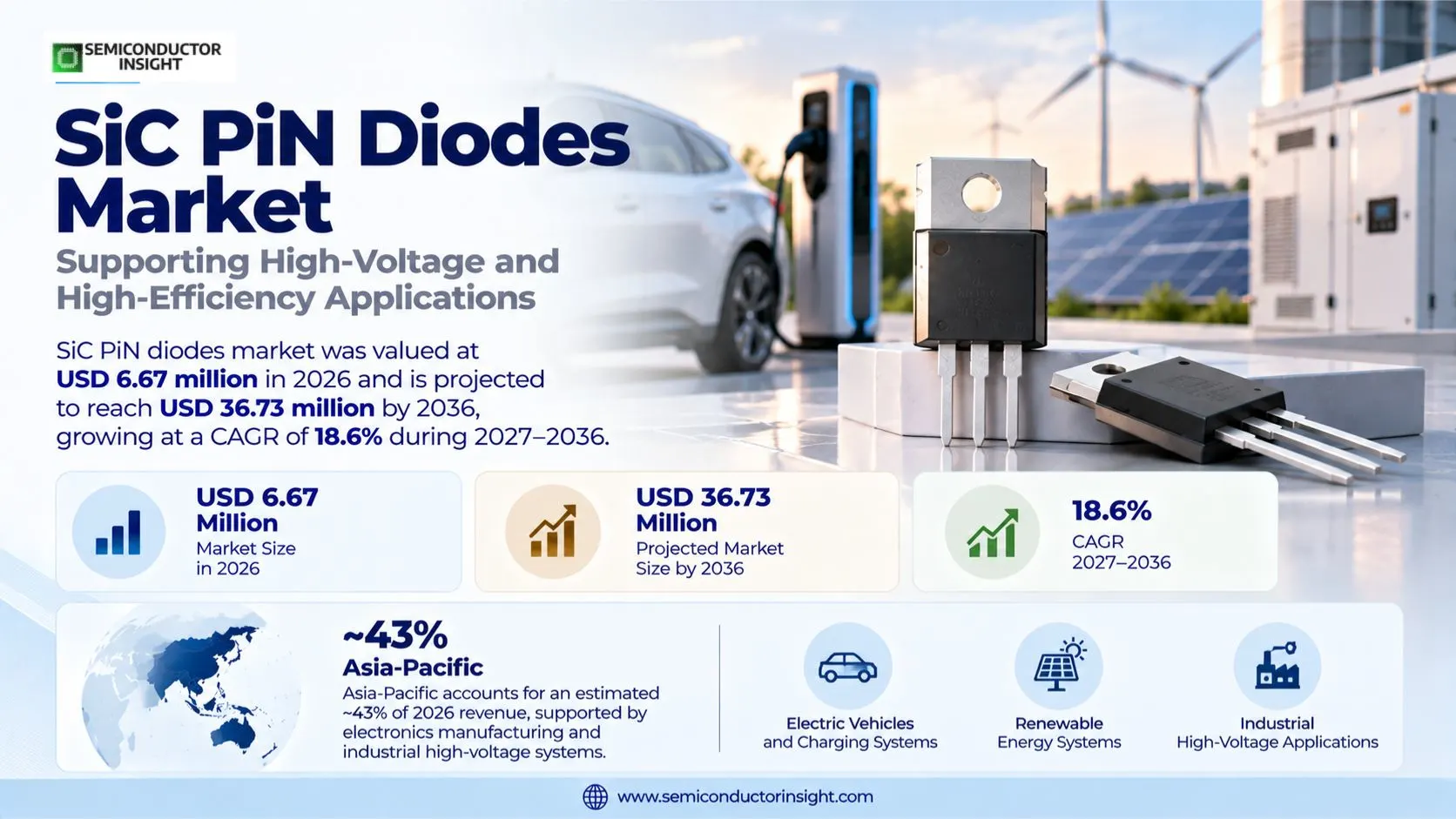
- Market outlook: The global SiC PiN diodes market was valued at USD 6.67 million in 2026 and is projected to reach USD 36.73 million by 2036, expanding at a CAGR of 18.6% through 2027–2036. Specialized high-voltage rectification and trigger systems underpin the revenue opportunity.
- 15 kV rating: The 15 kV type leads with an estimated ~58% of 2026 sales value; its high blocking capability allows designers to avoid series stacking in selected voltage multipliers and high-energy trigger circuits.
- Industrial demand: Industrial applications lead with an estimated ~42% share, followed by aerospace and defense at ~38% and consumer-oriented equipment at ~20%; these are value allocations, not verified unit shipment counts.
- Asia-Pacific: Asia-Pacific represents an estimated ~43% of the 2026 market, with ~19.3% modeled annual growth, while North America retains an important ~26% share through specialist component engineering and qualification.
- Qualification economics: The strongest opportunity comes from very-high-voltage design wins; the main barriers are device yield, limited supplier choice and rigorous high-temperature reliability testing before procurement approval.
SiC PiN Diodes Market Overview
SiC PiN diodes market was valued at USD 6.67 million in 2026 and is projected to reach USD 36.73 million by 2036, growing at a CAGR of 18.6% during 2027–2036. Asia-Pacific accounts for an estimated ~43% of 2026 revenue, supported by electronics manufacturing and industrial high-voltage systems.
Silicon-carbide positive-intrinsic-negative diodes are minority-carrier rectifiers designed for high blocking voltage, high-temperature operation and controlled reverse recovery. They are distinct from mainstream SiC Schottky barrier diodes and from RF PIN attenuators. GeneSiC specifies 8 kV and 15 kV discrete rectifier products, with continuous forward-current ratings of 2 A and 1 A respectively. These technical limits illustrate why the market is a specialist component niche rather than the full market for SiC power diodes or electric-vehicle traction inverters.
The revenue boundary includes finished SiC PiN diode chips and packaged rectifiers sold for high-voltage industrial, aerospace, defense and specialist consumer equipment, consistent with the published type and application axes. It excludes conventional silicon PiN diodes, SiC Schottky rectifiers, MOSFETs, complete converters, wafers and separate engineering services. The distinction is essential because wider SiC semiconductor growth can influence research spending without creating a proportionate increase in 8 kV or 15 kV PiN rectifier orders.
High blocking voltage can reduce the number of discrete rectifiers needed in a series-connected circuit. A GeneSiC 15 kV part is specified for 175°C operation and 1 A continuous forward current, while the 8 kV family supports 2 A. The designer must still evaluate forward-voltage drop, reverse leakage, recovery charge and package insulation against actual waveforms. A high voltage rating alone does not establish superior system efficiency in every topology or qualify the device for safety-critical equipment.
Applications extend beyond renewable-energy power conversion. Product documentation identifies voltage multipliers, ignition and trigger circuits, lighting, downhole electronics and defense-related uses. These examples suggest demand in low-volume, high-specification equipment where the cost of component qualification can outweigh the cost of the diode itself. Procurement is typically driven by an engineering bill of materials and long product-life requirements rather than consumer retail volume or short-term electric-vehicle production changes.
Expansion through 2036 depends on higher-voltage grid interfaces, compact pulsed-power assemblies and improved semiconductor fabrication yields. Public research by the US Department of Energy and the National Renewable Energy Laboratory supports the relevance of SiC in medium-voltage systems, but these programs span many device architectures. The addressable PiN portion remains narrower and requires a specific circuit-level reason to choose a bipolar rectifier over Schottky, MOSFET or thyristor alternatives.
Segment Analysis: By Type
The type segmentation comprises 15 kV and 8 kV SiC PiN rectifiers. The 15 kV category leads at an estimated ~58% of 2026 revenue and ~19.2% modeled annual growth, reflecting higher unit value and demanding insulation requirements. The 8 kV segment accounts for ~42% and is modeled at ~17.7% growth, serving lower-voltage multipliers and triggering assemblies where a 15 kV component would add cost without an engineering benefit.
| Type | Technical role | Market position |
|---|---|---|
| 15 kV | GeneSiC documents 15 kV repetitive peak reverse blocking, 1 A continuous forward current and 175°C junction capability in DO-201 and related packages. The rating can simplify high-voltage multiplier stacks and specialized trigger circuits. Package creepage, forward loss and reverse-recovery behavior still determine suitability, particularly where the circuit cycles frequently or encounters large transient energy. | Largest type (~58% share in 2026; ~19.2% CAGR). Higher-rated rectifiers have a value premium linked to wafer defect control, insulation, testing and small production batches. Sales growth depends on industrial and defense design qualification rather than broad power-electronics unit shipments. The forecast assumes greater adoption in engineered equipment but does not treat a manufacturer catalog listing as evidence of an announced production expansion. |
| 8 kV | The 8 kV class provides a lower blocking-voltage option with 2 A forward-current capability in the GeneSiC GA01PNS80-220 technical documentation. It is relevant to high-voltage pulses and power-supply stages that do not need 15 kV margin. Engineers must compare repetitive voltage stress and junction temperature with the application duty cycle rather than selecting a part solely by its nominal voltage class. | Second-largest type (~42% share; ~17.7% CAGR). The class can compete where higher current and lower insulation burden matter more than maximum blocking voltage. Its revenue outlook is constrained by availability of lower-cost rectification alternatives at less demanding voltage levels. Industrial designers may nevertheless value continuity of supply, documented reverse-recovery curves and familiar package footprints for maintenance equipment. |
15 kV high-voltage PiN rectifiers
A 15 kV rating is relevant where a design would otherwise need multiple lower-voltage components in series. Fewer devices can reduce interconnection count and simplify voltage-balancing work, although each diode still needs an appropriate protection network. GeneSiC publishes forward-voltage and switching characteristics for its GA01PNS150-201 and GA01PNS150-220 families. The segment is modeled to represent ~58% of 2026 revenue and to grow at ~19.2% annually through 2036.
Package choice affects thermal resistance, board clearance and serviceability. A DO-201-style part may suit one installation while a different mounting configuration better fits a custom multiplier assembly. High-voltage validation requires attention to surge events, humidity, insulation spacing and transient recovery. Buyers therefore assess lifetime circuit performance, not just the 15 kV data-sheet headline, before approving the same rectifier across multiple industrial platforms.
8 kV specialist PiN rectifiers
An 8 kV PiN device serves high-voltage equipment whose blocking requirement falls below the highest-rated products. The GA01PNS80-220 lists 2 A continuous forward current and 175°C operating capability, allowing trade-offs between voltage margin and conduction capacity. The category contributes an estimated ~42% of 2026 revenue, with ~17.7% modeled growth as pulse and multiplier designs spread into more industrial systems.
A lower voltage rating does not necessarily mean a less demanding qualification process. Repeated pulse energy, elevated ambient temperature and service access can require extensive validation, especially in downhole and remote installations. Component makers that publish consistent lot-level electrical data and support long-lived designs are positioned to compete on engineering assurance rather than only purchase price.
Segment Analysis: By Application
Applications comprise Consumer, Industrial and Aerospace & Defense. Industrial equipment leads with an estimated ~42% of 2026 revenue, aerospace and defense represent ~38%, and specialist consumer applications account for ~20%. These are modeled revenue shares aligned with the published segmentation; they should not be confused with the broader deployment of SiC Schottky diodes in automotive or solar inverters.
| Application | Demand characteristics |
|---|---|
| Industrial | Largest application (~42% share; ~19.0% CAGR). High-voltage multipliers, trigger supplies, instrumentation and downhole electronics require predictable reverse blocking and recovery characteristics. Equipment builders qualify specific 8 kV or 15 kV devices to reduce replacement and service risk. Orders depend on custom industrial project schedules, high-voltage engineering budgets and availability of parts over extended product lifecycles. |
| Aerospace & Defense | Second-largest application (~38% share; ~18.9% CAGR). Specialized pulse-generation and power-management systems value compact high-voltage rectification and high-temperature capability. A manufacturer data sheet does not itself establish flight or weapons qualification; safety and mission-critical use requires additional certification. The market allocation reflects specialized development and equipment supply, with procurement timing sensitive to lengthy approval cycles. |
| Consumer | Smaller application (~20% share; ~16.9% CAGR). Specialist lighting, ignition and high-voltage equipment represent a narrower consumer-facing demand channel. Standard household electronics seldom require 8 kV or 15 kV PiN rectifiers, so the segment should not be scaled directly from consumer-device shipments. Suppliers compete where reliability and electrical performance justify a premium over conventional silicon or alternative SiC rectifiers. |
Industrial procurement often follows a design-in cycle spanning prototype testing, stress qualification and maintenance planning. Once a particular diode is accepted for a 2026 or 2027 production platform, engineering teams may retain it for many years to avoid repeating high-voltage safety tests. This supports recurring niche revenue but can also make new product adoption slower than general semiconductor market growth.
Aerospace and defense opportunities involve stringent documentation, screening and application-specific assurance. GeneSiC product literature identifies defense-related circuit uses while explicitly limiting certain safety-critical applications absent additional authorization. Consequently, technical relevance must not be presented as proof that a given commercial component has been qualified for a particular aircraft or weapons program.
Regional Analysis
Asia-Pacific leads with an estimated ~43% of global 2026 SiC PiN diode revenue, followed by North America (~26%), Europe (~21%), Middle East & Africa (~6%) and South America (~4%). The regional model reflects concentrations of high-voltage engineering, industrial equipment manufacturing and specialist component sourcing. Asia-Pacific is modeled at ~19.3% annual growth and Middle East & Africa at ~19.8%, with the latter growing from a much smaller base.
Which regions generate demand for high-voltage SiC PiN rectifiers?
Regional demand is linked to specific circuit engineering activity rather than all SiC semiconductor shipments. A 15 kV rectifier in a voltage multiplier may be procured by an equipment integrator in one country and installed elsewhere. Consequently, regional estimates should be read as modeled purchasing activity, not a verified location-by-location register of diode fabrication output.
The 2026–2036 outlook favors markets with research capability, industrial high-voltage projects and reliable component distribution. Differences in qualification lead times can be more important than differences in GDP growth. The largest region is not automatically the fastest in every year, and a high forecast rate in a small geography does not imply leadership in total value.
| Region | Position | Growth outlook | Demand profile | What decides supplier selection |
|---|---|---|---|---|
| Asia-Pacific | Largest (~43% share) | ~19.3% CAGR | Specialist 8 kV and 15 kV rectifier applications; industrial design activity during 2026–2036. | Engineering acceptance in Asia-Pacific depends on blocking voltage, package insulation and access to long-life qualified parts. Customers compare 8 kV and 15 kV designs with alternative rectifier stacks, taking account of 175°C thermal requirements and the expected maintenance interval. |
| North America | Second largest (~26% share) | ~17.6% CAGR | Specialist 8 kV and 15 kV rectifier applications; industrial design activity during 2026–2036. | Engineering acceptance in North America depends on blocking voltage, package insulation and access to long-life qualified parts. Customers compare 8 kV and 15 kV designs with alternative rectifier stacks, taking account of 175°C thermal requirements and the expected maintenance interval. |
| Europe | Third largest (~21% share) | ~18.0% CAGR | Specialist 8 kV and 15 kV rectifier applications; industrial design activity during 2026–2036. | Engineering acceptance in Europe depends on blocking voltage, package insulation and access to long-life qualified parts. Customers compare 8 kV and 15 kV designs with alternative rectifier stacks, taking account of 175°C thermal requirements and the expected maintenance interval. |
| Middle East & Africa | Fourth largest (~6% share) | ~19.8% CAGR | Specialist 8 kV and 15 kV rectifier applications; industrial design activity during 2026–2036. | Engineering acceptance in Middle East & Africa depends on blocking voltage, package insulation and access to long-life qualified parts. Customers compare 8 kV and 15 kV designs with alternative rectifier stacks, taking account of 175°C thermal requirements and the expected maintenance interval. |
| South America | Fifth largest (~4% share) | ~17.7% CAGR | Specialist 8 kV and 15 kV rectifier applications; industrial design activity during 2026–2036. | Engineering acceptance in South America depends on blocking voltage, package insulation and access to long-life qualified parts. Customers compare 8 kV and 15 kV designs with alternative rectifier stacks, taking account of 175°C thermal requirements and the expected maintenance interval. |
Competitive Landscape
Competition is concentrated in specialist high-voltage rectifier portfolios rather than the entire SiC semiconductor supplier universe. GeneSiC Semiconductor, now associated with Navitas Semiconductor, publishes 8 kV and 15 kV PiN device data sheets. Shenzhen BASiC Semiconductor is also profiled in the published landscape, although an independently verified matching 15 kV catalog offering was not established. Supplier rankings should therefore reflect product-specific technical evidence rather than broad corporate SiC sales.
GeneSiC’s GA01PNS80-220, GA01PNS150-201 and GA01PNS150-220 show how a narrow catalog can address multiple package and voltage requirements. Its technical literature provides forward-voltage, reverse leakage, recovery and thermal information that engineering buyers need for screening. This documentation is a stronger indicator of participation than an unrelated supplier’s total power-semiconductor revenue. It also lets equipment manufacturers compare insulation requirements, 175°C limits and product continuity before accepting a replacement.
A high-voltage PiN diode can be differentiated by defect density, leakage at temperature, recovery characteristics and the availability of a package compatible with electrical-clearance rules. Buyers may also demand lot traceability and long-term supply commitments. These factors favor vendors that can support engineering qualification over a generic distributor with a wide but unrelated rectifier catalog.
Navitas markets a broader GeneSiC portfolio including MOSFETs and power modules. Those products support the parent company’s commercial scale but are not automatically counted as PiN diode revenue. A market participant may also supply adjacent Schottky diodes without producing an 8 kV or 15 kV bipolar PiN part, so category boundaries remain important when comparing vendors.
The limited direct product field increases customer concentration and supplier dependence. A design-in can generate recurring orders over several years, but an engineering change may require a new round of electrical and environmental testing. Price competition is therefore balanced by qualification cost, supply continuity and the technical risk of switching a component in an approved high-voltage assembly.
Tier structure
| Tier | Companies | Basis of competition |
|---|---|---|
| Tier 1 | GeneSiC Semiconductor / Navitas Semiconductor | Direct published data sheets cover both 8 kV and 15 kV PiN rectifiers, including 1 A and 2 A rated products. Tier placement describes visible specialist product coverage rather than independently verified market share. Customers can evaluate package and electrical characteristics against the intended application and must complete their own acceptance testing. |
| Tier 2 | Specialist high-voltage rectifier developers | Engineering-focused developers may compete through custom die design, wafer process capability and tailored qualification. A supplier should enter this tier only after a specific SiC PiN product and its operating limits are documented. Research programs and general SiC MOSFET manufacturing do not by themselves establish commercial PiN sales. |
| Tier 3 | Shenzhen BASiC Semiconductor Ltd | The company is included in the published competitive landscape, but a current directly matching 8 kV or 15 kV PiN catalog was not independently identified. Its placement is a reference to the broader supplier landscape, not a verified ranking or claim that it currently ships the same high-voltage bipolar rectifier designs. |
Key companies profiled
- GeneSiC Semiconductor
- Navitas Semiconductor
- Shenzhen BASiC Semiconductor Ltd
Production Capacity Analysis
SiC PiN diode capacity is constrained by high-quality epitaxial growth, bipolar junction processing, wafer defect control and high-voltage testing. Unlike commodity rectifiers, 8 kV and 15 kV parts require thick, controlled drift regions and reliable edge termination. Production cannot be inferred directly from a fab’s total 150mm or 200mm SiC wafer output because most wafer starts may be allocated to MOSFETs, Schottky diodes or other devices.
Manufacturing begins with suitable SiC substrates and epitaxial structures, followed by doping, contact formation, passivation and electrical testing. At 15 kV, defects that would be tolerable in a lower-voltage component can cause unacceptable leakage or premature breakdown. Yield therefore determines effective output as much as nominal wafer throughput, and a producer may prioritize lower-voltage products when the specialist PiN order book is thin.
Packaging is an additional bottleneck because the semiconductor die rating must be matched by creepage, clearance and insulation design. GeneSiC’s published DO-201 and DO-220 product families show that package geometry varies even within a common 15 kV class. The thermal path and surge environment can determine which configuration qualifies, making interchangeable volume less straightforward than for a standard low-voltage diode.
North American high-voltage device research and Asian manufacturing capability provide complementary supply-chain strengths. Yet publicly announced SiC fab expansions cannot be assigned to PiN rectifiers without device-specific evidence. Manufacturers must allocate scarce engineering resources to low-volume qualification, and purchasers may secure inventory against long service lives to reduce exposure to changes in product availability.
Market Dynamics: Drivers, Restraints and Opportunities
The principal growth forces are demand for high-voltage pulse and multiplier circuits, increased research into medium-voltage SiC conversion and gradual improvements in bipolar device yield. These forces face constraints from high-voltage testing cost, competition from other rectifier technologies and lengthy engineering approvals. The impact allocations describe estimated percentage-point contributions across the 2027–2036 outlook rather than observed annual company revenue changes.
MARKET DRIVERS
Drivers Impact Analysis*
| Market Drivers | Impact Rank | CAGR Contribution (%) | 2027–2029 | 2030–2032 | 2033–2036 |
|---|---|---|---|---|---|
| High-voltage industrial multiplier adoption | High | +7.00% | High | High | Medium |
| Specialized aerospace and defense circuit requirements | High | +5.20% | Medium | High | High |
| Medium-voltage grid research and equipment designs | Medium-High | +4.10% | Medium | High | High |
| High-temperature and harsh-environment electronics | Medium | +3.20% | High | Medium | High |
| Improved high-voltage SiC fabrication yield | Low-Medium | +2.10% | Low | Medium | High |
| Others (pulsed lighting, scientific instruments and downhole electronics) | Low | +1.50% | Medium | Medium | Low |
High-voltage multiplier design-ins
Voltage multipliers and ignition systems can use 8 kV or 15 kV rectifiers to reduce the number of series devices in selected architectures. GeneSiC’s product documentation explicitly lists these applications and provides relevant recovery characteristics. The economic benefit is not universal: system engineers must balance diode conduction loss and package clearance against the cost of additional components. New design wins therefore matter more than broad semiconductor shipment growth.
Specialized defense and aerospace electronics
Certain pulsed-power and high-voltage control assemblies need components with reliable blocking capability under demanding conditions. GeneSiC identifies defense-related uses, but its standard datasheet also contains restrictions for safety-critical equipment. Commercial opportunities depend on application-specific approvals, traceability and environmental testing, and should not be interpreted as evidence of an existing contract with any particular aerospace or defense program.
Medium-voltage grid conversion research
US Department of Energy and NREL projects investigate SiC devices for higher-voltage conversion, grid interfaces and industrial drives. These programs show that compact, thermally capable semiconductors can improve some converter architectures. However, most publicly described projects do not specify PiN rectifier purchases; their relevance is as a technology and design-development indicator that may create future demand for qualified high-blocking-voltage diodes.
Harsh-environment operating capability
Industrial and downhole electronics may face high ambient temperatures and limited maintenance access. A PiN diode rated for 175°C junction operation can offer useful design flexibility where conventional devices approach their thermal limits. The complete assembly must still survive insulation stress, moisture and thermal cycling, so component-level ratings are only one input to equipment reliability and lifecycle purchasing decisions.
MARKET RESTRAINTS
Restraints Impact Analysis*
| Market Restraints | Impact Rank | CAGR Contribution (%) | 2027–2029 | 2030–2032 | 2033–2036 |
|---|---|---|---|---|---|
| Cost of low-defect high-voltage SiC fabrication | High | -2.00% | High | High | Medium |
| Long electrical and environmental qualification | Medium-High | -1.30% | High | Medium | Medium |
| Alternative silicon and SiC rectifier topologies | Medium | -0.80% | High | Medium | Medium |
| Others (specialty supply concentration and replacement timing) | Low | -0.40% | Medium | Medium | Low |
Expensive high-voltage fabrication and screening
Producing a reliable 15 kV bipolar rectifier requires stringent control of epitaxial thickness, material defects and edge termination. High-voltage wafer probing and packaged-device screening add time and cost, especially in low-volume production. A supplier may achieve adequate yield for 650 V or 1200 V products without being able to economically supply the same number of 15 kV PiN rectifiers, limiting immediate market expansion.
Slow engineering qualification
Customers generally validate leakage, surge response, thermal behavior and insulation under the exact circuit conditions before approving a high-voltage part. A substitute diode with a similar nominal voltage can have different forward loss or reverse recovery, potentially changing system protection requirements. This extends design cycles and makes new supplier entry difficult, even when the proposed component has attractive catalog specifications.
Competition from other rectifier technologies
Silicon diode stacks, SiC Schottky rectifiers and alternative switching devices remain suitable for many voltage-conversion topologies. A PiN rectifier may be selected for blocking capability but rejected if forward drop, recovery charge or cost outweigh its advantages. The addressable market is therefore restricted to circuits where its combination of voltage, current and thermal behavior is valuable, not all SiC power electronics.
Narrow supplier availability
Directly documented commercial high-voltage PiN catalogs are relatively limited, increasing dependence on specialist vendors. If a product family changes package, specification or production status, customers may need to redesign an approved circuit. Engineering teams can mitigate this by holding spares and qualifying alternatives early, but both measures add working-capital cost and reduce the speed of market conversion.
MARKET OPPORTUNITIES
Compact 15 kV multiplier assemblies
A higher blocking-voltage device can replace a stack of lower-rated rectifiers in some voltage multiplier designs. This can reduce assembly complexity and potential interconnection failures, particularly where space is limited. Suppliers can capture value by providing repeatable leakage and recovery performance plus design support for insulation and transient protection. Each commercial opportunity still depends on proving that the circuit benefits from the specific 15 kV PiN architecture.
Specialty pulsed-power research
Scientific instruments, ignition equipment and high-voltage pulse generators offer design opportunities that are not tightly correlated with vehicle or solar production. Engineers may value rapid switching, small size and operation at elevated temperatures. The market can benefit from laboratory-to-product transfer when a prototype moves into repeat manufacturing, although the transition may require extensive electrical stress testing and careful documentation of device lifetime.
Harsh-environment industrial electronics
Oil and gas instrumentation, remote power supplies and industrial measurement systems can justify premium components when service access is difficult. A qualified 8 kV or 15 kV diode may lower maintenance exposure in a suitable circuit, but its packaging must tolerate humidity and thermal cycling. Vendors offering stable specifications and accessible replacement inventory can win repeat orders beyond the initial design-in phase.
High-voltage qualification partnerships
Specialist device makers can work with industrial integrators and laboratories to validate recovery, leakage and thermal behavior in representative converter assemblies. This approach helps customers avoid assuming that a datasheet rating guarantees system reliability. Joint engineering can also identify which applications truly benefit from a PiN rectifier, supporting more durable revenue than promotional claims based on the overall wide-bandgap market.
Supply Chain Analysis
The SiC PiN diode supply chain links high-quality SiC substrates, epitaxial processing, bipolar junction fabrication, packaging, high-voltage screening and specialist distribution. The commercial challenge is maintaining electrical performance across small production lots, not simply sourcing a semiconductor wafer. Buyers generally purchase a qualified part number for a specific industrial or high-voltage assembly and may retain the same device for a long service period.
Upstream materials. The 15 kV voltage class places demanding requirements on crystal defects and epitaxial uniformity. Manufacturers must secure suitable substrate and process capacity even when their total PiN sales volume is small. Broader investments in 150mm and 200mm SiC wafers can improve material availability, but they do not establish how much of that capacity is assigned to bipolar PiN rectifiers.
Fabrication and yield. Junction design and edge termination determine whether a nominal high-voltage device can withstand its rated stress repeatedly. Leakage and recovery behavior must remain consistent across wafers and production lots. Rejects at high-voltage test can materially affect the economics of a niche device, which is why an apparently simple two-terminal component may carry a premium compared with lower-rated alternatives.
Packaging and channel. GeneSiC lists both DO-201 and DO-220 versions in its 15 kV family, showing that mechanical configuration matters alongside electrical specification. Distributors and equipment makers must manage lead time, lot traceability and replacement planning. A catalog listing demonstrates product availability at a point in time but does not guarantee a long-term supply contract or acceptance for a particular safety-critical system.
Downstream qualification. Industrial, aerospace and defense purchasers usually evaluate the full circuit, including protection networks, thermal conditions and insulation distances. A diode can satisfy the datasheet yet still fail a system-level requirement. Successful suppliers provide technical data that helps customers compare 8 kV and 15 kV choices and retain approved components over the service life of high-voltage equipment.
Recent Developments and Technical Milestones
- 17 Apr 2025 Announced
Navitas introduced updated SiCPAK power modules based on its broader GeneSiC SiC device platform. The release highlights continuing high-temperature packaging and reliability investment in the parent portfolio, but it is not a new 8 kV or 15 kV PiN diode launch. For specialist rectifier buyers, the relevance is supplier capability and technical continuity rather than a directly reported increase in PiN diode production. Source - 26 Feb 2024 Launched
The US Department of Energy announced a USD 2.25 million SiC packaging competition to support high-voltage power-semiconductor prototypes. The program addresses thermal and packaging barriers that can affect many wide-bandgap devices. It is adjacent evidence for high-voltage system development, not a disclosed purchase order or commercialization date for GeneSiC PiN rectifiers. Source - 10 Nov 2016 Published
GeneSiC issued the initial GA01PNS150-201 specification, documenting a 15 kV, 1 A SiC PiN rectifier with a 175°C junction rating and DO-201 package. The dated datasheet is direct technical evidence of a commercial product family. Its issue date is a documentation milestone and should not be presented as a verified first shipment or a newly announced 2026 product launch. Source - 30 Apr 2015 Revised
GeneSiC revised electrical specifications for its GA01PNS150-220 15 kV PiN diode. The document includes forward characteristics, recovery behavior and package dimensions relevant to voltage multiplier and trigger circuit design. The dated revision supports product-history chronology; it does not establish current annual sales, factory capacity or customer qualification in a particular defense application. Source - 30 Apr 2015 Revised
GeneSiC updated the GA01PNS80-220 datasheet for an 8 kV, 2 A SiC PiN diode with high-temperature switching specifications. The document provides a technical comparison point with the 15 kV family, helping engineers assess blocking-voltage and forward-current trade-offs. It is a verified revision date rather than evidence of a new product introduction during the current forecast period. Source - 19 Jun 2020 Documented
The Department of Energy recorded a proposed megawatt-class high-voltage SiC converter research project involving Eaton. Such initiatives help develop expertise in high-voltage power conversion, thermal control and device integration. The document concerns a broader converter program; it does not identify SiC PiN diode unit sales or prove that this device category was selected for the final architecture. Source - 2018 Reported
The Department of Energy described PowerAmerica efforts to lower the cost of wide-bandgap device fabrication, including SiC foundry development at X-FAB. This historical manufacturing initiative supports the wider supply-chain context for specialist SiC rectifiers. The activity should not be interpreted as a dated launch of an 8 kV or 15 kV PiN diode or as verified production dedicated to this market. Source
REPORT SCOPE & SEGMENTATION
| Attribute | Details |
|---|---|
| Study Period | 2021–2036 |
| Base Year | 2026 |
| Base-Year Market Size | USD 6.67 million |
| Estimated Year | 2027 |
| Estimated Market Size | USD 7.91 million |
| Forecast Year | 2036 |
| Forecast Market Size | USD 36.73 million |
| Forecast CAGR | 18.6% |
| Market Definition | Finished 8 kV and 15 kV silicon-carbide bipolar PiN rectifier devices, including packaged and chip formats used in specialist high-voltage equipment. |
| Revenue Unit | USD million; global SiC PiN rectifier device sales |
| By Type | 15 kV · 8 kV |
| By Application | Consumer · Industrial · Aerospace & Defense |
| By Region | Modeled 2026 shares and regional growth rates are shown in the analysis. Asia-PacificChina · Japan · India North AmericaUnited States · Canada · Mexico EuropeGermany · France · United Kingdom Middle East & AfricaSaudi Arabia · United Arab Emirates · South Africa South AmericaBrazil · Argentina · Chile |
| Key Companies Profiled | GeneSiC Semiconductor · Navitas Semiconductor · Shenzhen BASiC Semiconductor Ltd |
| Customization Scope | Voltage-class demand, high-temperature qualification, 2026–2036 regional outlook, industrial and defense application mapping, competitor product evidence and customer-specific device selection. |
Frequently Asked Questions
What is the size and forecast of the SiC PiN diodes market?
The global SiC PiN diodes market was valued at USD 6.67 million in 2026 and is forecast to reach USD 36.73 million by 2036, reflecting a CAGR of 18.6% during 2027–2036. The market covers specialist high-voltage bipolar rectifiers rather than the entire SiC power-device industry. Demand is concentrated in multiplier, trigger, industrial and selected aerospace or defense circuits that require blocking voltages of 8 kV or 15 kV.
Which voltage type holds the largest share?
The 15 kV category leads with an estimated ~58% of 2026 revenue and modeled ~19.2% annual growth. Its high blocking rating can reduce the need for series-connected rectifiers in selected circuits. The 8 kV category represents ~42% and is modeled at ~17.7% growth, offering a different balance of voltage and forward-current capability for specialized industrial applications.
Which application generates the most demand?
Industrial equipment accounts for an estimated ~42% of 2026 market value, followed by aerospace and defense at ~38% and specialist consumer systems at ~20%. Voltage multipliers, ignition circuits and high-voltage instrumentation are relevant use cases. These shares are modeled value allocations, not directly reported manufacturer sales, and mainstream automotive Schottky rectifier shipments are excluded.
Which region leads the market?
Asia-Pacific leads with an estimated ~43% of 2026 sales value, reflecting industrial electronics manufacturing and specialist power-device engineering. North America follows at ~26%, Europe at ~21%, Middle East and Africa at ~6%, and South America at ~4%. The regional figures are modeled estimates; a country’s overall SiC wafer capacity does not establish its share of very-high-voltage PiN rectifier sales.
What is the difference between a SiC PiN diode and a Schottky diode?
A SiC PiN diode uses a bipolar junction structure with an intrinsic drift region and can be designed for very high blocking voltage. A SiC Schottky diode uses a different rectification mechanism and is often preferred where low reverse recovery and efficiency dominate. Engineers compare forward loss, recovery, voltage, thermal limits and cost before selecting either technology for a given circuit.
Who supplies 8 kV and 15 kV SiC PiN rectifiers?
GeneSiC Semiconductor publishes direct product specifications for 8 kV and 15 kV SiC PiN rectifiers; the GeneSiC business is associated with Navitas Semiconductor. Shenzhen BASiC Semiconductor also appears in the profiled landscape, but a matching current high-voltage PiN catalog was not independently established. Buyers should confirm part status, available packages, environmental ratings and supply commitments before qualification.
What limits growth in high-voltage SiC PiN devices?
Low-defect SiC material, thick epitaxial structures, edge termination and high-voltage testing make these rectifiers costly to fabricate. Qualification can be lengthy because designers must verify leakage, surge performance, thermal cycling and package insulation. Conventional silicon stacks and alternative SiC rectifiers remain competitive, so the PiN design must deliver a measurable system benefit to justify adoption.
Are SiC PiN diodes commonly used in electric-vehicle traction inverters?
Most published automotive SiC power-device deployments emphasize MOSFETs and Schottky rectifiers, not 8 kV or 15 kV PiN diodes. Vehicle electrification is therefore an adjacent technology driver rather than a direct proxy for this market. A specialized vehicle or charging design could use a high-voltage PiN rectifier, but such use should be demonstrated at circuit level rather than inferred from EV sales.
What temperature and current ratings are available?
GeneSiC’s GA01PNS150-201 and GA01PNS150-220 specifications describe 15 kV blocking with 1 A continuous forward current and 175°C operation. The GA01PNS80-220 lists 8 kV blocking and 2 A continuous forward current at the same temperature limit. These are product-specific technical ratings; a finished assembly must also satisfy insulation, cooling and application safety requirements.
How should buyers qualify a high-voltage SiC PiN rectifier?
Engineers should evaluate the repetitive voltage waveform, surge energy, forward current, reverse leakage, recovery charge, thermal limits and package clearance in the intended equipment. Qualification may include accelerated aging and lot traceability, especially for long-life industrial systems. A published 15 kV rating is necessary but not sufficient for a particular application, and manufacturer literature should not be treated as blanket approval for safety-critical use.
Research Sources & Evidence Base
Get Sample Report PDF for Exclusive Insights
Report Sample Includes
- Table of Contents
- List of Tables & Figures
- Charts, Research Methodology, and more...
 Download Sample Report PDF