Key Statistics
Key Takeaways
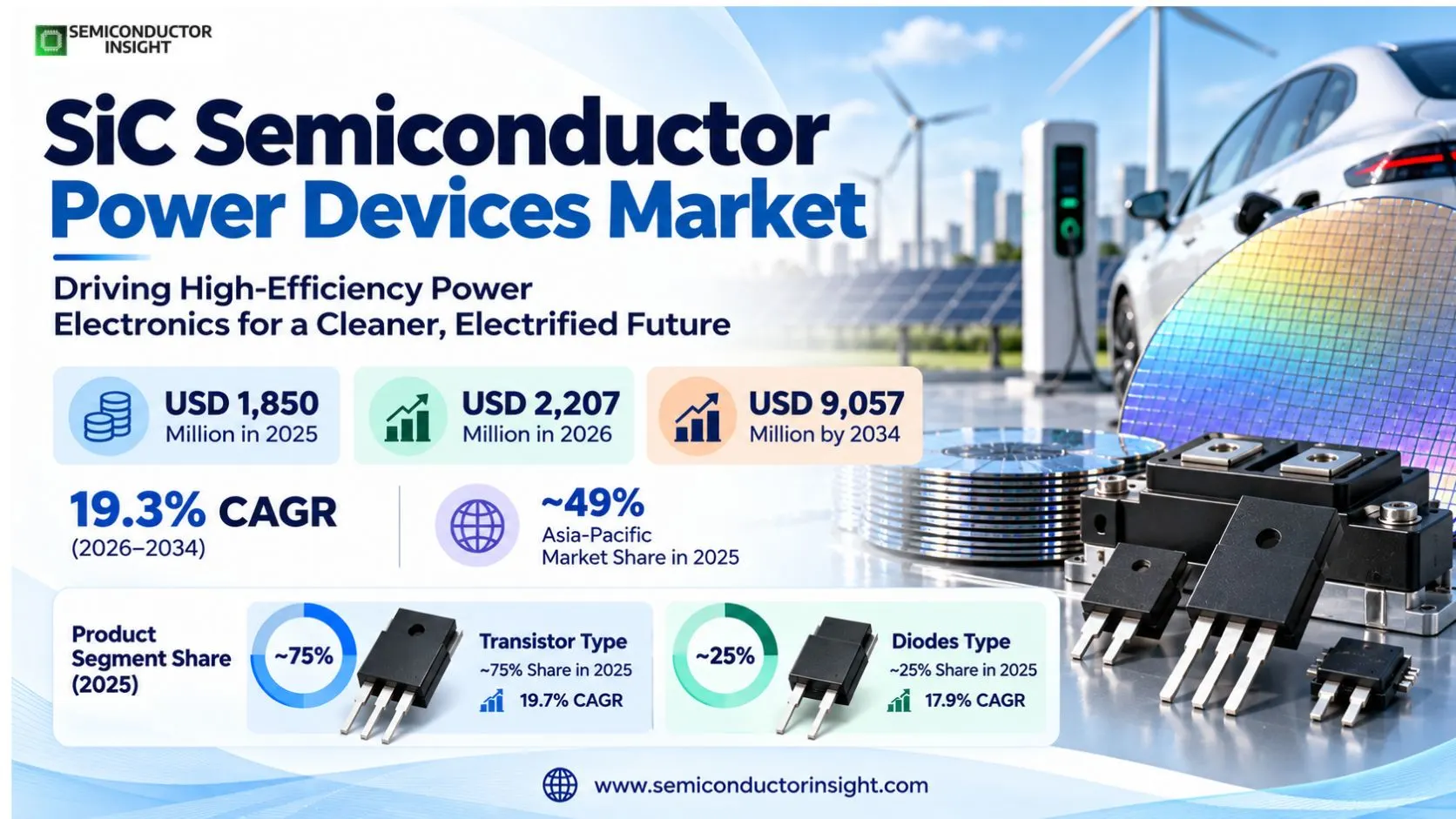
- 2025 baseline: The worldwide market for silicon-carbide semiconductor power devices reached USD 1,850 million, reflecting diode and transistor products rather than the value of finished inverters or electrical vehicles.
- Long-range expansion: The value outlook reaches USD 9,057 million by 2034, with a 19.3% CAGR across the 2026–2034 period as more converters replace silicon switches.
- Dominant device class: Transistor Type represents an estimated ~75% of 2025 revenue; Diodes Type retains ~25%, with different circuit functions and switching economics.
- End-use concentration: Automotive accounts for an estimated ~48% of device revenue, followed by Industrial at ~27%; Railways contributes ~9%, Consumer Electronics ~7%, Others ~5% and Medical ~4%.
- Geographic centre: Asia-Pacific leads at an estimated ~49% of global value, ahead of North America (~24%), Europe (~20%), South America (~4%) and Middle East & Africa (~3%).
SiC Semiconductor Power Devices Market Overview
SiC semiconductor power devices market was valued at USD 1,850 million in 2025, is estimated at USD 2,207 million in 2026 and is projected to reach USD 9,057 million by 2034, advancing at a 19.3% CAGR during 2026–2034. Asia-Pacific commands an estimated ~49% share, supported by traction electronics, industrial drives and power-conversion manufacturing.
Silicon carbide combines a wide bandgap with high breakdown-field strength and thermal endurance, permitting power switches to operate at voltages and frequencies that impose larger losses on many silicon alternatives. In 2025, the device market includes discrete rectifiers, MOSFETs and related power semiconductor packages, while the economic boundary stops before complete chargers, vehicles or grid-conversion cabinets. A 2026 engineering decision typically begins with converter efficiency, voltage margin, switching frequency and lifetime reliability rather than wafer chemistry alone.
Vehicle electrification is the principal volume engine because traction inverters, onboard chargers and high-voltage auxiliary converters can each employ different SiC components. The International Energy Agency projected more than 20 million electric-car sales in 2025 and higher sales in 2026, establishing a downstream installation backdrop rather than a direct semiconductor-revenue estimate. At an estimated ~48% of device revenue, automotive purchasing ties supplier growth to platform qualification cycles, battery-voltage architecture and the number of power stages installed per vehicle.
The technology contest is no longer limited to replacing one silicon switch with a more efficient SiC equivalent. Device makers differentiate 750 V, 1200 V, 2300 V and 3300 V offerings through on-resistance, gate charge, short-circuit behaviour, packaging parasitics and thermal design. A 2026 purchaser may pay more for a die that enables a smaller cooling system, but will still compare total converter cost over a 7–12 year service period. This makes reliability documentation and reference designs as important as catalogue voltage ratings.
Industrial converters provide a distinct demand pattern from passenger cars: equipment owners seek lower electricity losses and reduced maintenance across factory drives, storage interfaces, data-centre power and railway infrastructure. The renewable-power buildout creates additional opportunities for efficient switching, although gigawatts of solar capacity cannot be treated as device sales. Regional revenue is distributed across Asia-Pacific (~49%), North America (~24%), Europe (~20%), South America (~4%) and Middle East & Africa (~3%), with supply-chain depth and application certification shaping each market differently.
Competitive positioning depends on the ability to turn wafer process improvements into qualified power products at predictable cost. Moving from 150 mm to 200 mm substrates can improve theoretical die output per wafer, but usable yield, crystal defects, packaging throughput and qualification determine realized economics. Manufacturers therefore balance aggressive 2026–2034 expansion against price competition, investment intensity and the possibility that silicon IGBTs or gallium-nitride transistors remain more attractive in selected operating ranges. The result is a differentiated market rather than a uniform substitution of all silicon power electronics.
Segment Analysis: By Type
The product mix is divided into two publisher-defined categories, Transistor Type and Diodes Type. Transistor devices lead with an estimated ~75% of 2025 sales and a modeled ~19.7% annual growth trajectory, reflecting controlled switching in traction and industrial systems. Diodes account for ~25% and a modeled ~17.9% growth rate, supplying rectification and freewheel functions where reverse recovery, conduction losses and surge robustness govern the design choice.
| Type | Function | Market position |
|---|---|---|
| Transistor Type | A transistor is a controllable switching element used in inverter legs, DC/DC stages and high-frequency supplies. SiC MOSFET designs commonly address 750 V and 1200 V systems, while specialized products extend toward 2300 V and 3300 V. Designers evaluate gate-driver requirements, parasitic inductance, thermal impedance and short-circuit withstand alongside nominal current ratings. These characteristics influence the complete converter bill of materials, not just the die purchase price. | Largest category at an estimated ~75% of 2025 device revenue, with modeled ~19.7% growth as electric vehicles and high-voltage industrial conversion adopt higher-performing switches. Automotive platforms can require multi-year qualification, creating stickier supply relationships after design win. The commercial opportunity is strongest where reduced switching losses allow smaller magnetics or cooling hardware and where suppliers provide repeatable reliability data at 175°C or higher operating conditions. |
| Diodes Type | SiC Schottky rectifiers are valued for rapid recovery behaviour and low switching-loss penalties in power-factor correction, boost stages and auxiliary circuits. Device choice varies with blocking voltage, forward current, reverse leakage, temperature and package format. A 650 V diode can serve a different cost envelope from a 1200 V component, and a higher-rated rectifier is not automatically preferable when conduction losses dominate the duty cycle. | Diodes Type represents an estimated ~25% share in 2025 and grows at a modeled ~17.9% rate, slower than transistor devices but still above many mature silicon rectifier niches. Suppliers compete on predictable leakage at temperature, surge-current survival, board assembly compatibility and availability in common footprints. Growth is supported by fast chargers and industrial supplies, although silicon fast-recovery diodes retain positions where initial component cost is decisive. |
Transistor Type: traction and industrial switching
The economics of a transistor selection depend on how frequently it commutates and the load profile of the converter. A 1200 V MOSFET can reduce losses in an 800 V-class traction architecture, while a 750 V part can fit a lower-voltage charging stage. As 2026 programmes raise switching frequency, suppliers that balance gate charge with conduction resistance can win more sockets without requiring a proportional increase in converter size. Thermal interface and gate-driver integration remain essential to realize those advantages.
Power-device manufacturers increasingly supply matched switching packages and evaluation hardware rather than selling bare electrical specifications alone. Qualification records at 150°C–200°C junction conditions, cycling durability and failure-mode documentation can determine whether a component enters a production automotive bill of materials. The resulting customer relationship may last several vehicle model years, but price renegotiations and second-source qualification can compress revenue per unit as volumes scale.
Diodes Type: rectification and auxiliary power stages
Rectifier opportunities are more fragmented than traction inverter demand because devices are distributed across power-factor correction, protection, snubber and high-frequency conversion circuits. In 2025, the ~25% diode allocation reflects a wide base of small and medium-volume sockets rather than one dominant vehicle platform. Customers compare forward voltage at operating current, switching behaviour and package thermal resistance, with board-level replacement often easier than redesigning a main inverter bridge.
The diode growth path depends on rising power density in supplies and charging equipment as well as replacement of legacy silicon fast-recovery products. Manufacturers can protect margins through automotive-grade qualification, specialized current ratings and dependable multi-year supply, but commodity rectifier packages face direct price pressure. Device vendors offering both diode and MOSFET families can address more stages of a 2026 converter without implying that all those sales belong to the same product category.
Segment Analysis: By Application
Application demand is concentrated in Automotive (~48%) and Industrial (~27%), together representing an estimated ~75% of 2025 device value. Railways (~9%) emphasizes high-voltage robustness, Consumer Electronics (~7%) is cost-sensitive, Others (~5%) includes infrastructure power, and Medical (~4%) prioritizes validation. Growth varies from a modeled ~21.3% in automotive to ~14.2% in medical electronics, reflecting different replacement cycles and certification burdens.
| Application | Demand characteristics |
|---|---|
| Automotive | An estimated ~48% of 2025 revenue arises from traction inverters, onboard chargers and DC/DC conversion in electric vehicles. Battery systems at 400 V and 800 V impose different voltage and thermal requirements, while 750 V and 1200 V SiC transistors support multiple architectures. Vehicle programmes place high weight on defect screening, traceability and long-term supply. The modeled ~21.3% annual growth rate reflects rising SiC content per qualified platform, not a claim that every electric car uses SiC in every power stage. |
| Consumer Electronics | The ~7% modeled share covers premium adapters, efficient power supplies and higher-density consumer conversion circuits where thermal constraints are tight. Designs at 65 W, 140 W or several hundred watts can favour different semiconductor technologies, and gallium nitride remains a strong rival at selected lower-voltage operating points. A ~15.1% modeled growth rate is constrained by bill-of-material targets and rapid redesign cycles. Suppliers must offer easy-to-use packages and gate-drive guidance to justify SiC premiums in mass-market products. |
| Industrial | Industrial conversion accounts for an estimated ~27% of global device revenue in 2025, including variable-speed motor drives, uninterruptible supplies, energy-storage interfaces and factory power systems. Equipment life often exceeds 10 years, making serviceability and predictable high-temperature performance more valuable than minimum component cost. The modeled ~18.2% growth path benefits from efficiency retrofits and new high-frequency architectures. Adoption nevertheless depends on integrators proving total ownership savings in equipment with complex cooling and electromagnetic compatibility requirements. |
| Medical | Medical power equipment contributes an estimated ~4% of 2025 device revenue and follows a modeled ~14.2% growth trajectory. Imaging, laboratory instruments and backup systems value low heat, quiet operation and reliable power, but certification procedures lengthen component replacement cycles. A design with a 5–10 year maintenance horizon may retain a qualified silicon solution until a complete electronics refresh. SiC suppliers can win where reduced heat improves enclosure design, provided documentation supports safety and electromagnetic performance requirements. |
| Railways | Railways represent an estimated ~9% of 2025 revenue and a modeled ~17.5% growth rate, with demand tied to traction converters, onboard auxiliaries and wayside infrastructure. Voltage classes reaching 3300 V and demanding thermal cycles make packaging durability and surge-current performance central purchasing criteria. Rail operators generally prioritize availability and service life over short-term efficiency headlines. SiC gains traction when equipment manufacturers can demonstrate lower energy losses and smaller cooling systems under long-duration vibration and temperature exposure. |
| Others | The residual ~5% of 2025 demand spans telecommunications power, grid-edge equipment, specialist transport and emerging conversion architectures that do not fit the five named sectors. These customers may purchase 650 V, 1200 V or higher-voltage devices in modest production runs, giving distributors and application engineers an outsized role. The modeled ~14.9% growth rate reflects uneven adoption and project-specific qualification. Procurement is frequently driven by availability and design support rather than by a large recurring platform commitment. |
Automotive customers increasingly negotiate power-device supply alongside inverter and charger architecture decisions, while industrial buyers often start from energy savings and maintenance requirements. These different purchasing routes explain why an estimated ~48% automotive share need not translate into the same product mix as the ~27% industrial allocation. A 2026 design win in an 800 V traction inverter can generate long-run transistor orders; a factory retrofit may combine diodes and MOSFETs in smaller lots across several equipment types.
Medical and railway programmes share strict reliability expectations but diverge sharply in voltage and duty cycle. A railway traction stage may require 3300 V devices and substantial surge resilience, whereas a compact medical supply can prioritize low acoustic noise and electromagnetic emissions at far lower power. The modeled 2026–2034 application growth rates consequently reflect distinct engineering constraints rather than an assumed uniform replacement rate for silicon across all end markets.
Regional Analysis
Asia-Pacific is the largest geographic market at an estimated ~49% of 2025 value and a modeled ~20.8% growth rate through 2034. North America follows at ~24% with ~17.7% growth, and Europe accounts for ~20% with ~18.5% growth. South America (~4%, ~17.4%) and Middle East & Africa (~3%, ~16.6%) offer narrower opportunities driven by import channels and individual power-infrastructure projects.
Why do regional SiC power-device markets follow different commercial paths?
Asia-Pacific combines semiconductor fabrication capacity with high-volume vehicle electronics, making local device qualification and module assembly major purchasing advantages. North American demand emphasizes domestic capacity, automotive programmes and grid hardware, whereas European manufacturers connect SiC procurement to premium vehicle engineering and industrial electrification. In 2026 the five regional markets therefore differ in procurement structure even when their customers specify comparable 750 V or 1200 V devices. The estimated shares reflect sales destinations rather than where the raw crystal was grown.
The contrast is especially visible between the ~49% Asia-Pacific market and the ~4% South American market. In China, Japan and South Korea, engineering teams can collaborate directly with wafer, packaging and automotive suppliers, accelerating qualification. In Brazil and neighbouring economies, converters often arrive through imported equipment or distributor-led replacement channels. Meanwhile Gulf utility and industrial programmes can generate sizable individual orders without a broad local power-semiconductor manufacturing base, leaving Middle East & Africa at an estimated ~3% share.
| Region | Position | Growth outlook | Demand profile | What decides supplier selection |
|---|---|---|---|---|
| Asia-Pacific | Largest (~49%) | Highest (~20.8% CAGR) | Vehicle electronics and domestic manufacturing | Automotive qualification, package yield and supply-chain integration |
| North America | Second (~24%) | Moderate (~17.7% CAGR) | Fab capacity and premium industrial demand | Domestic traceability, design-in support and reliability records |
| Europe | Third (~20%) | Steady (~18.5% CAGR) | Automotive platforms and industrial efficiency | Long-term sourcing, functional safety and qualified supply |
| South America | Fourth (~4%) | Developing (~17.4% CAGR) | Import-led conversion equipment adoption | Distributor availability, landed cost and local service |
| Middle East & Africa | Fifth (~3%) | Project-driven (~16.6% CAGR) | Utility, transport and industrial power projects | Project warranties, thermal resilience and integrator backing |
Competitive Landscape of SiC Semiconductor Power Devices
Competition in the SiC power-device market is shaped by manufacturing integration, automotive qualification and the breadth of 650 V to 3300 V product families. Infineon, STMicroelectronics, onsemi, Wolfspeed, ROHM, Mitsubishi Electric, Toshiba and Navitas compete in overlapping but not identical voltage and application categories. Supplier comparisons must distinguish currently operating businesses from legacy company names and upstream material suppliers that do not independently sell finished power transistors.
The leading integrated manufacturers combine semiconductor design, wafer processing, packaging and application engineering, allowing customers to evaluate device behaviour under realistic converter loads. Wolfspeed emphasizes its 200 mm platform and low-resistance technology generations, while Infineon markets trench MOSFET architectures across automotive and industrial use cases. STMicroelectronics invests in a vertically connected SiC supply chain, and onsemi pursues vehicle-platform adoption. Their relative commercial strength varies with voltage rating, production qualification and customer programme timing rather than one universal share figure.
Specialist suppliers challenge larger groups through particular product attributes. Navitas uses its GeneSiC portfolio for automotive-qualified discrete devices and high-voltage components, while Mitsubishi Electric and Toshiba maintain engineering strengths in demanding industrial modules. ROHM supplies device and module families for power conversion, with product selection often influenced by thermal packaging and customer support. A 3300 V railway product competes in a different procurement setting from a 650 V power-factor-correction diode, limiting the usefulness of a single undifferentiated supplier ranking.
Legacy naming is a material source of competitive confusion. Cree adopted the Wolfspeed name in 2021, Fairchild became part of onsemi in 2016, GeneSiC joined Navitas in 2022 and Norstel became part of STMicroelectronics in 2019. These transactions mean that listing all eight labels as separate contemporary manufacturers would duplicate businesses. Texas Instruments, NXP and GE participate in broader electronics and industrial ecosystems, but their inclusion in historical directories does not establish current leadership in merchant SiC transistor sales.
Purchasing negotiations often combine die performance with operational risk. An automotive buyer may require second-source planning, defect traceability and 10-year supply assurance; an industrial converter vendor may prioritize a replaceable package and field-service documentation. Wafer diameter, defect density and final-test yield determine the manufacturer’s ability to price competitively over 2026–2034. The most resilient vendors can offer electrical differentiation without exposing customers to abrupt product discontinuation or unproven production transitions.
Tier structure
| Tier | Companies | Basis of competition |
|---|---|---|
| Integrated leaders | Infineon Technologies, STMicroelectronics, onsemi, Wolfspeed | These companies combine substantial power-semiconductor engineering with qualified customer channels and manufacturing investment. Their advantage lies in controlling multiple steps from wafer technology to package testing, particularly for 750 V and 1200 V automotive designs. Buyers still assess each product family separately because an integrated manufacturing footprint does not guarantee equal yield, thermal behaviour or field reliability across all voltage classes and package formats. |
| Specialist device groups | ROHM, Mitsubishi Electric, Toshiba, Navitas Semiconductor / GeneSiC | The specialist tier competes through targeted voltage ratings, device geometry, package robustness and design assistance for industrial or automotive programmes. Product families may extend from 650 V rectification through 3300 V traction and grid interfaces. Their sales opportunities are shaped by qualification and channel access rather than a single market-wide scale ranking, and ownership relationships must be reflected accurately when historical company names appear in sourcing records. |
| Adjacent ecosystem participants | Texas Instruments, NXP Semiconductors, GE-related industrial channels | These organizations influence control electronics, power-system architecture or downstream equipment procurement, but participation in the wider ecosystem should not be mistaken for proven leadership in merchant SiC MOSFET revenue. A gate driver or industrial inverter can incorporate SiC devices made by another company. Commercial comparisons therefore separate semiconductor component suppliers from customers, integrators and upstream material businesses to avoid double counting within the 2025 device market. |
Key companies profiled
- Infineon Technologies
- STMicroelectronics
- onsemi
- Wolfspeed
- ROHM Semiconductor
- Mitsubishi Electric
- Toshiba Electronic Devices & Storage
- Navitas Semiconductor (GeneSiC)
- Power Integrations
- Texas Instruments
- NXP Semiconductors
Production Economics and Device Technology Roadmap
SiC power-device manufacturing begins with crystal and wafer quality but creates commercial value only after die fabrication, electrical screening, packaging and customer qualification. Larger 200 mm substrates promise more potential die per wafer than 150 mm material, yet defect density and process yield determine the usable output. Device vendors must also manage 650 V, 750 V, 1200 V, 2300 V and 3300 V technology requirements without allowing specialized variants to fragment manufacturing economics.
A lower specific on-resistance allows designers to reduce active die area for a given electrical target, but the advantage must be assessed with gate charge, reverse recovery, thermal cycling and short-circuit capability. The same transistor can perform differently when mounted in a compact top-side-cooled package versus a larger industrial module. In 2026, product engineers increasingly seek a balanced performance envelope rather than optimizing one laboratory parameter, because converter losses and reliability arise from interacting semiconductor and package properties.
Scaling a SiC fabrication line is a yield-management problem as much as a capital-spending problem. Crystal micropipes, basal-plane dislocations, epitaxial defects and contact variability can reduce the fraction of dies meeting demanding automotive specifications. Transitioning to 200 mm equipment may improve manufacturing leverage after process stabilization, but qualification delays can temporarily offset those gains. Vendors therefore coordinate wafer supply, device design and final testing, particularly where a single defect can compromise a high-voltage switching element.
Packaging innovations extend the technology roadmap beyond silicon-carbide material improvements. Low-inductance current paths, silver-sintered die attach and enhanced heat spreading can reduce switching overshoot and thermal stress in 1200 V or 3300 V applications. The commercial consequence is that a module manufacturer may differentiate through assembly expertise even when competitors use similar bare-die ratings. System integrators must still verify electromagnetic compatibility, insulation coordination and repeated-load cycling before production acceptance.
Market Dynamics, Growth Drivers and Constraints
The growth outlook reflects several interacting demand and supply forces rather than a single electric-vehicle assumption. Automotive traction contributes the largest modeled positive effect, followed by renewable-power conversion, industrial high-voltage equipment and improvements in 200 mm manufacturing yield. Production costs, qualification delays and competing semiconductor technologies partially offset these drivers. The impact rankings describe expected relative strength across 2026–2028, 2029–2031 and 2032–2034.
MARKET DRIVERS
Drivers Impact Analysis*
| Market Drivers | Impact Rank | CAGR Contribution (%) | 2026–2028 | 2029–2031 | 2032–2034 |
|---|---|---|---|---|---|
| EV traction and onboard power-electronics adoption | High | +7.20% | High | High | Medium |
| Renewable-power and storage converter expansion | High | +5.40% | Medium | High | High |
| High-voltage industrial and railway efficiency | Medium-High | +4.40% | Medium | High | High |
| 200 mm fabrication yield and die-cost improvement | Medium | +3.50% | Low | High | High |
| Others (charging networks, solid-state switching and auxiliary power) | Low | +3.10% | Medium | Medium | High |
Automotive platform adoption increases device content
Vehicle manufacturers can deploy SiC across a 750 V or 1200 V traction inverter, an onboard charger and a high-voltage DC/DC stage, expanding the addressable semiconductor content beyond one switching bridge. The modeled +7.20 percentage-point contribution is strongest during the earlier forecast windows as qualified platforms enter production. Customer adoption still varies by vehicle segment, battery voltage and supplier economics, so unit-sales growth is not automatically proportional to SiC device revenue.
Renewable conversion supports efficient switching
Solar, wind and storage installations require repeated DC/AC and DC/DC power conversion, creating opportunities for high-efficiency switches that reduce heat and improve equipment density. The modeled +5.40 percentage-point contribution reflects the broadening of converter designs rather than counting installed gigawatts as semiconductor sales. SiC adoption is particularly relevant where switching frequency, enclosure cooling or high-voltage operation creates measurable savings over a silicon alternative.
Industrial voltage classes expand the addressable range
Factory drives, railway traction, solid-state transformers and uninterruptible power systems impose different voltage and surge requirements from passenger vehicles. The modeled +4.40 percentage-point contribution is linked to adoption of 1200 V, 2300 V and 3300 V technologies in long-lived equipment. Suppliers can command value where devices improve system efficiency and serviceability, but integration requires careful qualification of insulation, thermal cycling and abnormal-current behaviour.
Manufacturing learning improves usable die economics
The shift toward 200 mm wafers can create more potential device area per manufacturing run, while process learning can reduce defects and improve wafer-level screening. A modeled +3.50 percentage-point effect is weighted toward the middle and later forecast windows because new equipment must reach stable yields before cost benefits become dependable. Device vendors that combine process control with robust packaging can lower unit cost without sacrificing automotive-grade reliability.
Adjacent power architectures create new sockets
Fast charging, data-centre distribution, high-efficiency auxiliary supplies and solid-state protection each add possible uses for SiC switches beyond traditional traction and industrial equipment. The modeled +3.10 percentage-point residual contribution is dispersed across projects with different voltage and package requirements. Some remain early-stage in 2026, and commercial timing depends on converter standards, system cost and the availability of qualified application engineering.
MARKET RESTRAINTS
Restraints Impact Analysis*
| Market Restraints | Impact Rank | CAGR Contribution (%) | 2026–2028 | 2029–2031 | 2032–2034 |
|---|---|---|---|---|---|
| Wafer defects, packaging cost and manufacturing intensity | High | -1.70% | High | High | Medium |
| Lengthy automotive and industrial qualification cycles | Medium-High | -1.20% | High | Medium | Medium |
| Silicon IGBT and gallium-nitride substitution | Medium | -0.90% | Medium | Medium | High |
| Others (customer inventory swings, price erosion and supply concentration) | Low | -0.50% | Medium | Medium | Low |
Manufacturing cost remains the main adoption barrier
SiC crystal growth, epitaxy, device fabrication and package testing are capital-intensive, and high-voltage dies can suffer significant yield loss when defects intersect the active region. The modeled −1.70 percentage-point restraint is most visible while 200 mm processes ramp and supplier pricing remains above established silicon alternatives. Buyers evaluate whether reduced cooling and energy costs offset the semiconductor premium over a 5–15 year equipment life.
Qualification can delay revenue recognition
Automotive and railway customers may require extensive electrical stress, thermal cycling, traceability and failure-analysis evidence before a new device is accepted for serial production. The modeled −1.20 percentage-point effect is concentrated in the first two forecast windows, when new 750 V, 1200 V and 3300 V product families move from samples into qualified designs. A technically superior part can therefore face delayed shipments if system validation is incomplete.
Competing technologies retain defensible positions
Silicon IGBTs remain attractive in some high-power, cost-sensitive converters, while gallium nitride offers strong switching characteristics in selected compact supplies. The modeled −0.90 percentage-point impact reflects the fact that SiC does not displace every established device class. Engineers choose based on voltage, switching frequency, thermal budget, electromagnetic performance and total system cost, and a 650 V application may favour a different semiconductor than a 3300 V traction system.
Inventory cycles complicate capacity planning
Device makers may expand wafer starts for forecast vehicle and industrial programmes before customers finalize orders, creating exposure to inventory corrections and price renegotiations. The modeled −0.50 percentage-point residual restraint also captures supply concentration and temporary package bottlenecks. Vendors can reduce volatility through diversified applications and qualified production lines, but 2026–2034 revenue growth will remain sensitive to programme schedules and capital-expenditure discipline.
MARKET OPPORTUNITIES
Bidirectional conversion and solid-state power protection
New bidirectional switch structures can simplify power-flow management in chargers, energy-storage interfaces and protective switching systems. A 750 V dual-die design may reduce external circuit complexity, but the resulting commercial opportunity depends on switching robustness, thermal performance and design-tool availability. Suppliers that support early converter prototyping can establish preferred positions before higher-volume applications mature during the later forecast years.
High-voltage devices for grid and rail equipment
Applications operating at 1500 V DC links or requiring 3300 V device ratings create opportunities beyond the most common vehicle voltage classes. Larger power stages reward efficient thermal management and reliable surge performance, potentially increasing value per qualified component. These projects are fewer in number than passenger-car programmes, but a successful device qualification can support extended supply relationships and aftermarket demand across long equipment service lives.
Supply Chain, Distribution and End-Customer Structure
The SiC power-device value chain links crystal growth, substrate processing, epitaxial deposition, transistor or diode fabrication, package assembly and converter integration. Commercial risk is concentrated where defects or qualification delays interrupt a multi-step flow, while distributors and design-service teams influence adoption among smaller industrial buyers. Revenue in this market is recognized at the power-device level, not by adding upstream wafer sales to downstream inverter sales.
Materials and epitaxy. SiC substrate suppliers influence the electrical yield of later power devices through crystal quality, diameter control and epitaxial uniformity. A 200 mm substrate can increase the available die area compared with 150 mm material, but crystal defects and handling losses can erode the expected cost advantage. Long-term sourcing agreements therefore matter to semiconductor manufacturers seeking consistent output across 750 V and 1200 V product lines.
Semiconductor fabrication. Device fabrication creates the switching characteristics that customers ultimately purchase, including on-resistance, breakdown strength, gate-charge behaviour and leakage at temperature. A 3300 V industrial part requires different drift-region and qualification choices from a 650 V rectifier, affecting yield and production economics. Integrated manufacturers can coordinate design and process adjustments more closely, while outsourced arrangements must manage specifications across separate production partners.
Packaging and distribution. Final assembly determines much of the field reliability experienced by converter manufacturers, particularly under repeated high-current switching and temperature cycling. Discrete packages support standard board assembly, while industrial modules may use advanced die attach and low-inductance layouts. Distributors help smaller customers choose among 650 V, 750 V and 1200 V options, but automotive volume contracts generally require direct engineering and commercial coordination.
End-user qualification. Vehicle makers, factory-equipment companies and energy-system integrators select power devices according to converter-level performance and service obligations. An 800 V automotive platform may require long validation and supply traceability, whereas a replacement industrial supply can be evaluated on energy savings and field repairability. The final equipment selling price is not part of semiconductor revenue, even when SiC enables a smaller or more efficient system.
Recent Developments in SiC Semiconductor Power Devices
- 24 September 2026 Launched
Toshiba introduced a 3300 V, 800 A dual SiC MOSFET module for railway, industrial and power-conversion systems, with a specified surge-current performance parameter. The high-voltage rating extends the practical device choice for equipment that faces abnormal-current events and long service intervals. This is a direct semiconductor-product development; its commercial effect depends on equipment qualification and shipments rather than the installed value of complete traction systems. Source - 9 June 2026 Introduced
Wolfspeed announced its Gen 5 silicon-carbide MOSFET technology for 750 V and 1200 V designs, using a qualified 200 mm manufacturing platform. The company described improvements in resistance per unit die area, which can reduce conduction losses and support more compact power stages. The significance for the device market is a new performance and production benchmark, although actual market share will depend on customer design wins and yield stability. Source - 4 June 2026 Announced
Mitsubishi Electric disclosed a new generation of SiC MOSFET bare-die samples for power-electronics customers. Offering die-level products gives module developers freedom to configure thermal interfaces and electrical interconnections for specific industrial requirements. The announcement expands the design options available to converter makers, but sampling is not equivalent to a completed high-volume supply agreement and should not be treated as immediate market revenue. Source - 2 June 2026 Introduced
Infineon unveiled 750 V bidirectional CoolSiC G2 switches integrating two power elements in a common-drain arrangement. Such a device can simplify certain power-flow and protection circuits by replacing more complex discrete arrangements, with particular relevance to charging and energy systems. The launch demonstrates product diversification beyond conventional one-directional MOSFET configurations, while practical adoption depends on converter validation and cost comparisons. Source - 11 May 2026 Expanded
Infineon announced 2300 V CoolSiC power modules aimed at high-voltage systems using 1500 V DC links. The portfolio addresses energy and industrial architectures that require greater blocking-voltage margin than common passenger-car devices. Its significance lies in opening specialized design opportunities for efficient conversion at higher system voltages, rather than implying that all grid projects will use SiC or that module sales equal complete equipment value. Source - 28 April 2026 Collaborated
onsemi and Geely expanded their semiconductor collaboration, with EliteSiC technology associated with a 900 V vehicle architecture. Higher-voltage traction platforms can change inverter switching requirements and create opportunities for advanced device packages. The announcement provides a direct example of automotive design engagement, although a collaboration statement alone does not establish the value of future semiconductor shipments or the final device mix in every vehicle. Source - 9 February 2026 Selected
Infineon disclosed the selection of its CoolSiC MOSFETs for the Toyota bZ4X onboard charger and DC/DC converter. The deployment illustrates how SiC can improve efficiency in auxiliary vehicle power stages without being limited to the main traction inverter. Automotive selection carries commercial significance because qualification can support production over multiple model years, while final demand still follows vehicle output and component content per system. Source - 14 January 2026 Sampled
Mitsubishi Electric announced four trench SiC MOSFET bare-die products for evaluation, emphasizing device-level flexibility for power module designers. Bare-die sampling allows customers to test electrical and thermal integration before committing to a final package architecture. The development adds another route for specialized power-device adoption in Japan and abroad, but production revenue will emerge only after customers complete qualification and place repeat orders. Source
REPORT SCOPE & SEGMENTATION
| Attribute | Details |
|---|---|
| Study Period | 2020–2034 |
| Base Year | 2025 |
| Estimated Year | 2026 |
| Forecast Period | 2026–2034 |
| Historical Period | 2020–2024 |
| Market Size 2025 | USD 1,850 million |
| Market Size 2026 | USD 2,207 million |
| Market Size 2034 | USD 9,057 million |
| Growth Rate | CAGR of 19.3% from 2026–2034 |
| Unit | Value (USD Million); device revenue |
| Segmentation | By Type, By Application, and By Region |
| By Type | Diodes Type · Transistor Type |
| By Application | Automotive · Consumer Electronics · Industrial · Medical · Railways · Others |
| By Region | Each region assessed by product type, application and country-level demand drivers North AmericaUnited States, Canada, Mexico EuropeGermany, Italy, France, United Kingdom, Rest of Europe Asia-PacificChina, Japan, South Korea, India, Southeast Asia, Rest of Asia-Pacific South AmericaBrazil, Argentina, Chile, Rest of South America Middle East & AfricaSaudi Arabia, United Arab Emirates, South Africa, Rest of Middle East & Africa |
| Key Companies Profiled | Infineon Technologies, STMicroelectronics, onsemi, Wolfspeed, ROHM Semiconductor, Mitsubishi Electric, Toshiba Electronic Devices & Storage, Navitas Semiconductor / GeneSiC, Power Integrations, Texas Instruments, NXP Semiconductors |
| Customization Scope | Custom research can expand voltage-class analysis, application cross-splits, supplier capacity assessment and country-level pricing, subject to a mutually agreed project scope and deliverable schedule. |
Frequently Asked Questions
What is the size and growth outlook for the global SiC semiconductor power devices market?
The global market stood at USD 1,850 million in 2025 and is projected to reach USD 9,057 million in 2034, with a 19.3% CAGR across 2026–2034. The forecast includes silicon-carbide diode and transistor products used in power conversion, not the full selling value of cars, inverters or grid systems. Demand depends on qualification of efficient switching technologies and on manufacturers converting wafer investments into saleable finished devices.
Which companies supply SiC semiconductor power devices?
The competitive field includes Infineon, STMicroelectronics, onsemi, Wolfspeed, ROHM, Mitsubishi Electric, Toshiba and Navitas through its GeneSiC portfolio. Suppliers differ in their 650 V, 750 V, 1200 V and 3300 V product strengths and in whether they emphasize discrete packages, bare die or modules. Cree is the former name of Wolfspeed, and Fairchild belongs to onsemi, so historical lists should not be interpreted as a count of separate current manufacturers.
Why are transistor devices the largest product category?
Transistor Type holds an estimated ~75% of 2025 revenue because controllable switching devices occupy critical positions in traction inverters, charging circuits and industrial converters. SiC MOSFETs can reduce conduction and switching losses when the voltage and operating frequency justify their premium. Diodes Type accounts for the remaining ~25% and supports rectification, power-factor correction and related functions where fast recovery and temperature behaviour matter more than gate-controlled switching.
How are automotive and industrial applications different?
Automotive contributes an estimated ~48% of device value, with qualification linked to battery-voltage architecture, safety and high-volume production contracts. Industrial accounts for ~27% and spans factory drives, storage converters and long-life equipment that may be bought in smaller programmes. A vehicle maker often qualifies 750 V or 1200 V devices for a defined platform, while an industrial buyer may select a 3300 V module for equipment operating under different surge and maintenance conditions.
Which geographic region leads demand for SiC power devices?
Asia-Pacific is the largest region at an estimated ~49% of 2025 sales and has a modeled ~20.8% annual growth outlook, supported by vehicle-electronics production and regional device manufacturing. North America follows at ~24%, Europe at ~20%, South America at ~4% and Middle East & Africa at ~3%. The distribution represents where devices are sold into applications, not the location of every wafer-processing step in the global supply chain.
How do 200 mm wafers affect SiC device costs?
Moving from 150 mm to 200 mm substrates creates more theoretical die area per wafer and can improve fabrication economics when defect density and yield are controlled. The transition also requires stable epitaxy, handling, test processes and customer qualification, so cost reductions may arrive later than new equipment installations. Buyers should compare usable device output and packaged-component reliability rather than assuming wafer diameter alone determines the selling price of a 1200 V MOSFET.
What role does renewable energy play in semiconductor demand?
Solar and storage equipment require efficient power conversion, and SiC switches can reduce thermal losses in selected DC/AC and DC/DC architectures. The application opportunity extends to industrial voltage classes beyond common passenger-car devices, but installed renewable capacity is not a direct measure of semiconductor revenue. The commercial result depends on converter manufacturers specifying SiC parts, qualifying their lifetime behaviour and maintaining competitive system costs against silicon-based alternatives.
What restrains adoption of SiC power devices?
The main barriers are crystal and wafer defects, expensive processing, demanding package reliability and long qualification periods for automotive or railway systems. Silicon IGBTs remain cost-effective in some power ranges, while gallium nitride competes in certain compact conversion applications. Manufacturers also face price erosion as supply expands, meaning growth in physical device shipments need not produce identical percentage growth in revenue. Better yields and validated thermal designs can moderate these pressures.
Are SiC diodes and MOSFETs interchangeable in converters?
A diode conducts primarily in one direction without a gate-controlled switching command, while a MOSFET actively controls current flow and timing. Both can appear in the same charger or industrial converter but occupy different circuit positions. A 650 V Schottky rectifier is not a direct substitute for a 1200 V traction transistor, and a designer must evaluate current rating, leakage, recovery behaviour, gate drive and heat dissipation before selecting a device.
What does the market segmentation include and exclude?
Coverage separates Diodes Type and Transistor Type, then analyzes Automotive, Consumer Electronics, Industrial, Medical, Railways and Others across five geographic regions. The value boundary includes relevant semiconductor dies and packaged power devices, including module products within the broad device framing. Standalone substrates, unrelated silicon or GaN components, finished inverters and completed electric vehicles are excluded to prevent counting the same conversion system at multiple stages of its supply chain.
Research Sources & Evidence Base
Get Sample Report PDF for Exclusive Insights
Report Sample Includes
- Table of Contents
- List of Tables & Figures
- Charts, Research Methodology, and more...
 Download Sample Report PDF