MARKET INSIGHTS
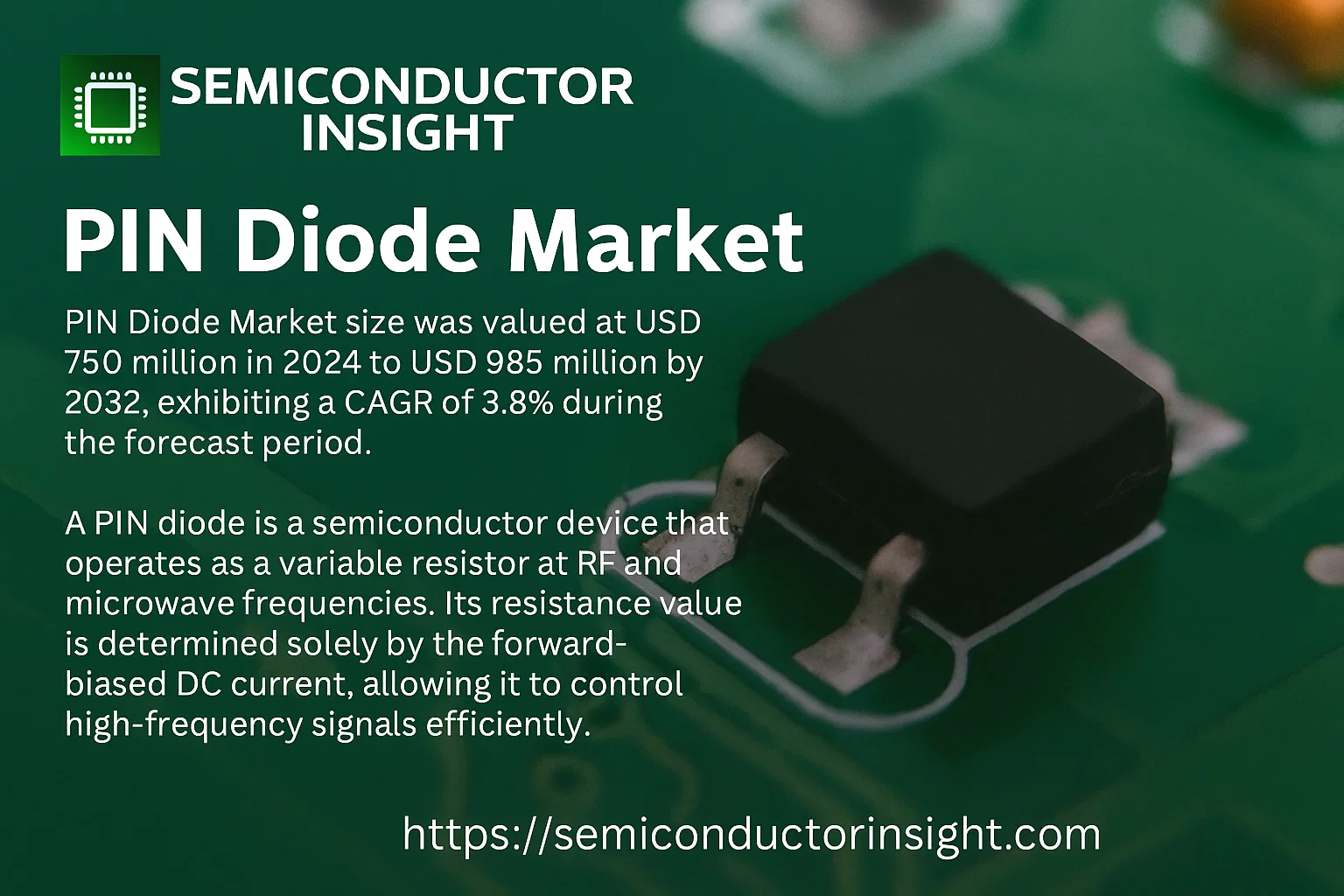
Global PIN Diode Market size was valued at USD 750 million in 2024 to USD 985 million by 2032, exhibiting a CAGR of 3.8% during the forecast period.
A PIN diode is a semiconductor device that operates as a variable resistor at RF and microwave frequencies. Its resistance value is determined solely by the forward-biased DC current, allowing it to control high-frequency signals efficiently. In applications like switches and attenuators, the PIN diode is designed to manage RF signal levels without introducing distortion that could alter the signal’s shape. A key feature is its ability to handle large RF signals while being controlled by much smaller DC excitation levels.
The market growth is primarily driven by the expansion of wireless communication infrastructure, particularly with the global rollout of 5G technology and research into future 6G systems, which demand high-performance RF components. Furthermore, increasing adoption in defense and aerospace for radar and electronic warfare systems, alongside advancements in automotive electronics for radar and communication modules, are significant contributors. The competitive landscape features key players such as Skyworks Solutions Inc., MACOM Technology Solutions, and Infineon Technologies AG, who hold a significant market position through continuous innovation and product development.
MARKET DRIVERS
Proliferation of High-Frequency Communication Networks
Global expansion of 5G infrastructure and the ongoing deployment of fiber-optic networks are primary drivers for the PIN Diode Market. PIN diodes are essential components in RF switches and attenuators for base stations and network equipment, where their fast switching speeds and ability to handle high power are critical. The increasing demand for high-speed data transmission is directly fueling market growth.
Advancements in Automotive Electronics
The automotive industry’s shift toward advanced driver-assistance systems (ADAS) and vehicle-to-everything (V2X) communication is creating significant demand. PIN diodes are used in automotive radar systems, particularly in the 24 GHz and 77-81 GHz bands, for functions like adaptive cruise control and collision avoidance. This sector’s robust growth is a major contributor to market expansion.
Furthermore, the defense and aerospace sector remains a steady driver. PIN diodes are indispensable in electronic warfare systems, radar jammers, and phased-array antennas for military applications, where reliability under extreme conditions is non-negotiable. Continuous modernization of defense systems worldwide ensures a consistent market pull.
MARKET CHALLENGES
Intense Competition from Alternative Technologies
PIN Diode Market faces stiff competition from other semiconductor technologies like GaAs pHEMTs and CMOS-based RF switches, which can offer superior integration and performance in certain applications. For instance, in consumer electronics where size and power consumption are paramount, these alternatives are often preferred, pressuring the market share of discrete PIN diodes.
Other Challenges
Performance Limitations at Higher Frequencies
While excellent for many RF applications, standard silicon PIN diodes encounter performance degradation at millimeter-wave frequencies (above 30 GHz). This limits their effectiveness in next-generation communication systems that are pushing into these higher bands, requiring more expensive semiconductor materials or complex design adaptations.
Supply Chain and Cost Pressures
Fluctuations in the prices of raw materials, particularly high-purity silicon wafers, and geopolitical factors affecting the semiconductor supply chain pose significant challenges. Manufacturers must navigate these instabilities while trying to maintain competitive pricing, especially for high-volume, cost-sensitive markets.
MARKET RESTRAINTS
High Development Costs for Advanced Variants
The research, development, and fabrication costs associated with creating PIN diodes that operate efficiently at very high frequencies or in extreme environments are substantial. This high barrier to entry can restrain innovation and limit the number of players capable of competing in the high-performance segment of the market.
Design Complexity in Integrated Systems
As electronic systems become more integrated, the design-in process for discrete components like PIN diodes becomes more complex. System designers often favor monolithic microwave integrated circuits (MMICs) that incorporate switching functionality, which can reduce the need for standalone PIN diodes and act as a restraint on market growth.
MARKET OPPORTUNITIES
Expansion into Emerging IoT and Smart City Applications
The rapid growth of the Internet of Things (IoT) and the development of smart city infrastructure present substantial opportunities. PIN diodes are used in RFID systems, smart meters, and various wireless sensor nodes. The proliferation of connected devices is expected to create new, high-volume application areas for cost-effective PIN diodes.
Development of GaN and SiC-based PIN Diodes
Research and development into PIN diodes fabricated from wide-bandgap semiconductors like Gallium Nitride (GaN) and Silicon Carbide (SiC) open new frontiers. These materials offer the potential for higher power handling, better thermal stability, and operation at higher frequencies than traditional silicon, creating opportunities in premium segments like aerospace and high-power RF energy.
PIN Diode Market Trends
Steady Market Expansion and Regional Dynamics
Global PIN Diode market is on a trajectory of consistent growth, with its value projected to increase from 750 million in 2024 to USD 985 million by 2032, representing a compound annual growth rate (CAGR) of 3.8%. This growth is underpinned by the device’s critical function as a variable resistor at RF and microwave frequencies, where it controls signal levels without introducing distortion. The market’s geographical distribution is currently led by North America, which held a 35% share in 2023, followed by Asia-Pacific at 32% and Europe at 28%. A key trend is the significant development potential identified in the Asia-Pacific region, particularly in China, where market size and global share are expected to see substantial increases.
Other Trends
Technological Innovation and Performance Enhancement
A dominant trend within the PIN Diode Market is the continuous push for technological innovation driven by major players like Skyworks, Infineon, and NXP. Manufacturers are intensely focused on improving key performance metrics, including power handling capabilities, reduction of insertion losses, and increasing switching speeds. These advancements are crucial as the demands from high-frequency applications, especially with the rollout of 5G infrastructure and the ongoing development of 6G, become more stringent. The inherent ability of PIN diodes to handle large RF signals with minimal DC excitation makes them a focal point for R&D investment.
Diversification and Expansion into New Applications
Beyond traditional communications, a significant market trend is the rapid expansion of PIN diode applications into emerging sectors. The diversification of market demand is a primary driver, pushing the technology into the Internet of Things (IoT), smart home devices, and medical equipment. This trend is complemented by sustained growth in established sectors such as defense and aerospace, where the need for high-reliability components is perennial, and the automotive industry, where PIN diodes are increasingly used in radar and communication modules for advanced driver-assistance systems (ADAS) and vehicle connectivity.
COMPETITIVE LANDSCAPE
Key Industry Players
A Market Characterized by Strong Incumbents and Niche Specialists
Global PIN Diode market exhibits a competitive structure dominated by a few established semiconductor giants that hold significant market share. Skyworks, MACOM Technology Solutions, and Infineon Technologies have emerged as the clear leaders, collectively accounting for nearly 30% of the global market revenue as of 2023. These companies leverage their extensive R&D capabilities, broad product portfolios, and strong global supply chains to serve a wide array of applications, from 5G infrastructure and automotive radar to defense systems. Their dominance is reinforced by long-standing relationships with major OEMs across key industries. The market concentration is further solidified by the high technical barriers to entry, including the need for specialized manufacturing processes for RF and microwave components. NXP Semiconductors and Microchip Technology also hold substantial positions, competing aggressively in specific high-performance segments. This top tier of players primarily competes on technological innovation, product reliability, and the ability to provide integrated solutions.
Beyond these major players, the market includes a diverse array of significant companies that have carved out strong positions in niche applications or regional markets. Companies like Broadcom, onsemi, and Vishay offer robust PIN diode product lines that compete effectively in the communications, industrial, and automotive sectors. Specialized manufacturers such as Albis Optoelectronics, Laser Components, and LITEC focus on high-performance and custom solutions for the defense, aerospace, and medical industries, where specific performance parameters are critical. Regional players, particularly in Asia, are gaining traction; ROHM and Toshiba in Japan, along with Comchip Technology, are important contributors. Furthermore, specialists like GeneSiC Semiconductor focus on high-power and high-temperature applications. This secondary tier of competitors often competes based on specialized technical expertise, customer service, and cost-effectiveness for specific applications, ensuring a dynamic and multi-faceted competitive environment.
List of Key PIN Diode Companies Profiled
- Skyworks Solutions, Inc.
- MACOM Technology Solutions
- Infineon Technologies AG
- Microchip Technology Inc.
- NXP Semiconductors N.V.
- Broadcom Inc.
- ROHM Semiconductor
- onsemi
- Vishay Intertechnology, Inc.
- Albis Optoelectronics AG
- Cobham Advanced Electronic Solutions
- Laser Components GmbH
- LITEC GmbH
- GeneSiC Semiconductor
- California Eastern Laboratories (CEL)
- Comchip Technology
- Micro Commercial Components (MCC)
- Toshiba Electronic Devices & Storage Corporation
Segment Analysis:
| Segment Category | Sub-Segments | Key Insights |
| By Type |
|
Surface Mount PIN Diodes are the leading segment due to their compatibility with modern automated PCB assembly processes, which significantly reduces manufacturing costs and enhances production speed for high-volume electronic devices. The trend towards miniaturization across consumer electronics and communication equipment fuels the demand for these compact components, as they offer superior performance in space-constrained applications. |
| By Application |
|
Communications represents the dominant application segment, driven by the ongoing global rollout of 5G infrastructure and the research into future 6G technologies, which require high-performance RF components for signal switching and attenuation. The critical role of PIN diodes in cellular base stations, microwave radio links, and satellite communication systems ensures sustained and robust demand. The Military and Aerospace segment is also a significant consumer, valued for its stringent reliability requirements. |
| By End User |
|
Telecommunication Service Providers and Equipment Manufacturers constitute the key end-user segment, as they are the primary integrators of PIN diodes into network infrastructure essential for global connectivity. The relentless demand for higher data speeds and network capacity directly translates into procurement of advanced RF components. Automotive OEMs are an increasingly important end-user group, incorporating PIN diodes into advanced driver-assistance systems and vehicle communication modules. |
| By Power Handling Capacity |
|
Medium Power diodes are the leading segment, offering an optimal balance between performance, cost, and thermal management that suits the vast majority of commercial applications in communications and automotive radar. This segment benefits from widespread adoption in 5G infrastructure and industrial equipment. High-power variants are crucial for specialized defense and aerospace applications where exceptional reliability under strenuous conditions is non-negotiable, though they represent a more niche market. |
| By Frequency Range |
|
Microwave Frequency is the leading segment, as PIN diodes excel in these ranges for critical functions like switching and phase shifting in radar systems, satellite communications, and point-to-point radio links. The expansion of applications in this frequency band is a major growth driver for the market. The millimeter wave segment is experiencing the most rapid growth potential, driven by its essential role in enabling the high-bandwidth, short-range communications required for advanced 5G networks and automotive radar sensing. |
Regional Analysis: PIN Diode Market
The region’s unparalleled electronics manufacturing base provides a powerful, integrated supply chain. This allows for efficient production of PIN diodes at scale, from wafer fabrication to final assembly, giving local suppliers a significant cost and lead-time advantage over competitors in other parts of the world. The concentration of component manufacturers and end-users in close proximity fosters strong collaborative relationships.
The massive, ongoing rollout of 5G infrastructure across major economies like China, Japan, and South Korea is a primary growth driver. PIN diodes are critical components in base stations and network equipment for signal switching and controlling power levels, creating a sustained and high-value market segment that is expected to grow for years to come.
National policies aimed at achieving technological self-sufficiency and dominating key industries like semiconductors provide a favorable environment. Substantial state-backed funding for R&D and subsidies for domestic production incentivize innovation and help local PIN diode manufacturers compete aggressively on the global stage, securing their leadership position.
Beyond telecommunications, demand is bolstered by a wide array of applications, including automotive radar systems for advanced driver-assistance, medical imaging equipment, and industrial sensors. The region’s leadership in these high-growth end-user industries ensures a diversified and resilient demand base for PIN diode technology.
North America
North America remains a highly sophisticated and technologically advanced market for PIN diodes, characterized by strong demand from the defense and aerospace sectors. The presence of major defense contractors and stringent requirements for high-reliability components for radar, electronic warfare, and communication systems creates a steady, high-value market. Furthermore, the region is a hub for innovation in telecommunications, with ongoing investments in 5G infrastructure and satellite communication networks. Leading semiconductor companies in the United States and Canada drive developments in high-frequency and high-power PIN diodes, catering to both commercial and specialized military applications, ensuring the region’s status as a key innovation center.
Europe
The European market for PIN diodes is driven by a strong industrial base and significant investment in automotive and industrial automation technologies. Leading automotive manufacturers in Germany, France, and Italy incorporate PIN diodes in advanced systems like collision avoidance radar and vehicle-to-everything communication. The region also has a well-established telecommunications infrastructure, with continuous upgrades supporting market demand. Strict regulatory standards for product quality and reliability ensure a market preference for high-performance components. Collaborative research initiatives between academia and industry foster innovation, particularly in developing PIN diodes for emerging applications in renewable energy systems and medical technology.
South America
The PIN Diode Market in South America is emerging, with growth primarily fueled by the gradual modernization of telecommunications infrastructure in key economies like Brazil and Argentina. Investments in expanding mobile network coverage and capacity are creating new opportunities. The market is also supported by the industrial sector, particularly in oil and gas and mining, where PIN diodes are used in sensing and control equipment. However, the market’s growth pace is generally more moderate compared to other regions, influenced by economic fluctuations and varying levels of industrial investment across different countries within the continent.
Middle East & Africa
This region presents a market with significant growth potential, driven by large-scale investments in telecommunications and infrastructure development, particularly in Gulf Cooperation Council countries. Ambitious national visions and smart city projects are leading to the deployment of advanced communication networks, boosting demand for RF components like PIN diodes. The defense sector is another key consumer, with several nations modernizing their military electronics. While the market is growing from a smaller base, the focus on technological advancement and economic diversification suggests a positive long-term outlook for PIN diode adoption across various applications.
Report Scope
This market research report provides a comprehensive analysis of the PIN Diode Market , covering the forecast period 2025–2032. It offers detailed insights into market dynamics, technological advancements, competitive landscape, and key trends shaping the industry.
Key focus areas of the report include:
- Market Overview: The report begins with an overview outlining its current market scenario, key growth indicators, and industry transformation drivers. It discusses macroeconomic factors, demand–supply balance, regulatory landscape, and the strategic role of semiconductors in powering advancements across industries such as automotive, telecommunications, consumer electronics, and industrial automation.
- Market Size & Forecast: Historical data and future projections for revenue, unit shipments, and market value across major regions and segments.
- Segmentation Analysis: Detailed breakdown by product type, technology, application, and end-user industry to identify high-growth segments and investment opportunities.
- Regional Insights: Insights into market performance across North America, Europe, Asia-Pacific, Latin America, and the Middle East & Africa, including country-level analysis where relevant.
- Competitive Landscape: Profiles of leading market participants, including their product offerings, R&D focus, manufacturing capacity, pricing strategies, and recent developments such as mergers, acquisitions, and partnerships.
- Technology Trends & Innovation: Assessment of emerging technologies, integration of AI/IoT, semiconductor design trends, fabrication techniques, and evolving industry standards.
- Market Drivers & Restraints: Evaluation of factors driving market growth along with challenges, supply chain constraints, regulatory issues, and market-entry barriers.
- Stakeholder Insights: Insights for component suppliers, OEMs, system integrators, investors, and policymakers regarding the evolving ecosystem and strategic opportunities.
Primary and secondary research methods are employed, including interviews with industry experts, data from verified sources, and real-time market intelligence to ensure the accuracy and reliability of the insights presented.
FREQUENTLY ASKED QUESTIONS:
What is the current market size of PIN Diode Market?
-> PIN Diode Market size was valued at USD 750 million in 2024 to USD 985 million by 2032, exhibiting a CAGR of 3.8% during the forecast period.
Which key companies operate in PIN Diode Market?
-> Key players include Skyworks, MACOM Technology Solutions, Infineon, Microchip and NXP, among others. The top three companies accounted for nearly 30% of the global market share in 2023.
What are the key growth drivers?
-> Key growth drivers include technological progress in semiconductor technology, growing application areas (especially in 5G/6G wireless communication, defense and aerospace, and the automotive industry), diversification of market demand, and policy support.
Which region dominates the market?
-> The Asia-Pacific market is considered to have the most development potential and is a key growth region, while North America held the largest market share (35%) in 2023.
What are the emerging trends?
-> Emerging trends include technological innovation to improve power handling and switching speeds, expansion of application areas into IoT and medical devices, and changes in the competitive landscape through mergers and acquisitions.

Get Sample Report PDF for Exclusive Insights
Report Sample Includes
- Table of Contents
- List of Tables & Figures
- Charts, Research Methodology, and more...
 Download Sample Report PDF